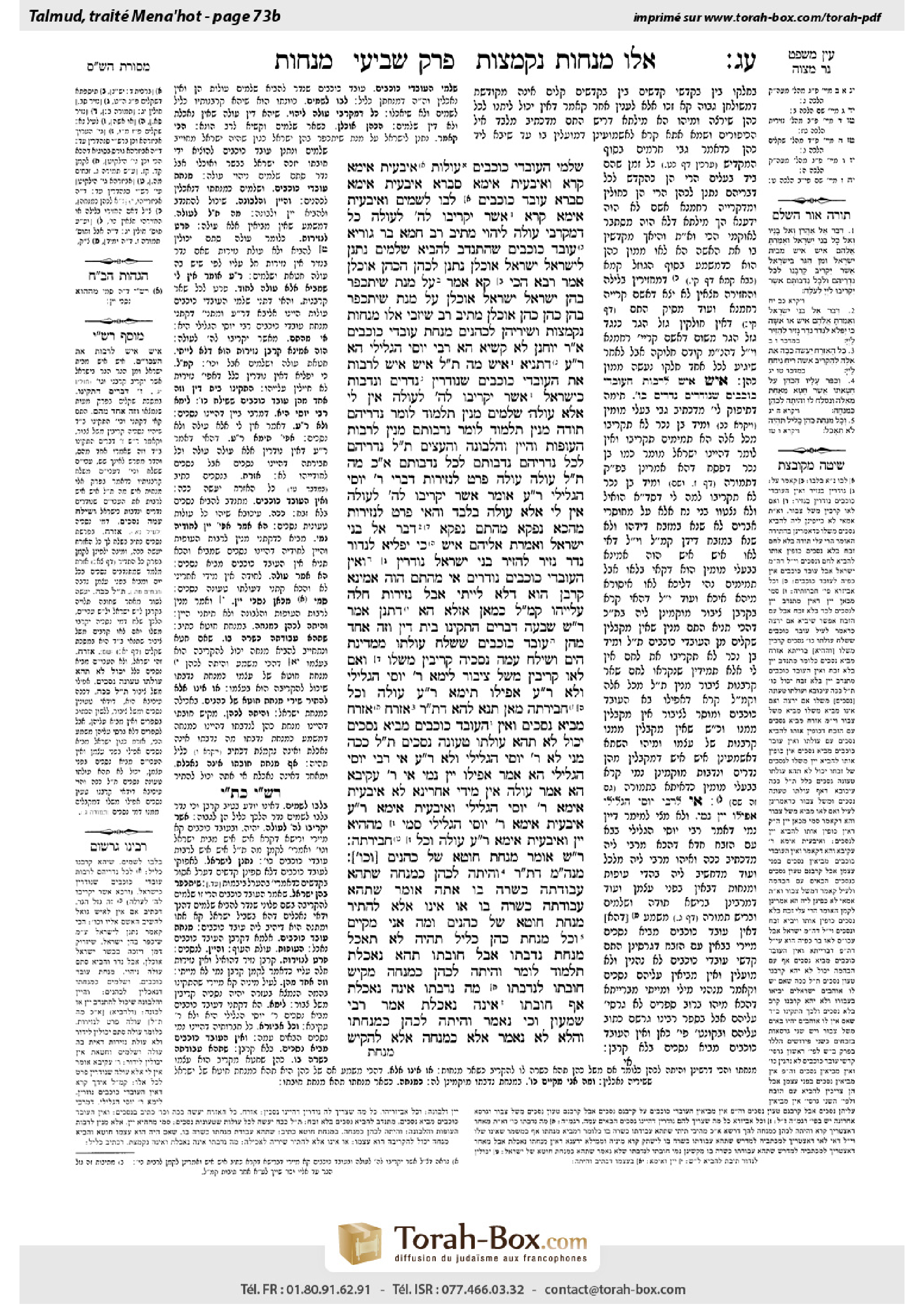
Menachot 73b: Talmud study for Daf Yomi
Daf Yomi is the daily study of one Talmud folio. Explore 37 tractates with scans, Hebrew text, Sefaria English and AI-generated French translations where annotated.
Passage selection and English or AI-generated French translation are available where the scan has annotations. Daf Study is independent of Torah-Box and Sefaria.
Browse Menachot · מנחות · All tractatesMenachot 73b text and translations
This page of Menachot includes the Aramaic text, an English translation and an AI-generated French translation, alongside the scan above.
מנחות ע״ג ב · Aramaic and Hebrew text
שַׁלְמֵי הַגּוֹי – עוֹלוֹת, אִיבָּעֵית אֵימָא קְרָא, וְאִיבָּעֵית אֵימָא סְבָרָא. אִיבָּעֵית אֵימָא סְבָרָא – גּוֹי לִבּוֹ לַשָּׁמַיִם.
וְאִיבָּעֵית אֵימָא קְרָא, ״אֲשֶׁר יַקְרִיבוּ לַה׳ לְעֹלָה״ – כֹּל דִּמְקָרְבִי עוֹלָה לֶיהֱוֵי.
מֵתִיב רַב חָמָא בַּר גּוּרְיָא: גּוֹי שֶׁהִתְנַדֵּב לְהָבִיא שְׁלָמִים, נְתָנָן לְיִשְׂרָאֵל – יִשְׂרָאֵל אוֹכְלָן, נְתָנָן לְכֹהֵן – הַכֹּהֵן אוֹכְלָן.
אָמַר רָבָא: הָכִי קָא אָמַר, עַל מְנָת שֶׁיִּתְכַּפֵּר בָּהֶן יִשְׂרָאֵל – יִשְׂרָאֵל אוֹכְלָן, עַל מְנָת שֶׁיִּתְכַּפֵּר בָּהֶן כֹּהֵן – כֹּהֵן אוֹכְלָן.
מֵתִיב רַב שֵׁיזְבִי: אֵלּוּ מְנָחוֹת נִקְמָצוֹת וּשְׁיָרֵיהֶן לַכֹּהֲנִים – מִנְחַת גּוֹיִם. אָמַר רַבִּי יוֹחָנָן: לָא קַשְׁיָא, הָא רַבִּי יוֹסֵי הַגְּלִילִי, הָא רַבִּי עֲקִיבָא.
דְּתַנְיָא: ״אִישׁ״, מָה תַּלְמוּד לוֹמַר ״אִישׁ אִישׁ״? לְרַבּוֹת אֶת הַגּוֹיִם שֶׁנּוֹדְרִין נְדָרִים וּנְדָבוֹת כְּיִשְׂרָאֵל.
״אֲשֶׁר יַקְרִיבוּ לַה׳ לְעוֹלָה״ – אֵין לִי אֶלָּא עוֹלָה, שְׁלָמִים מִנַּיִן? תַּלְמוּד לוֹמַר ״נִדְרֵיהֶם״. תּוֹדָה מִנַּיִן? תַּלְמוּד לוֹמַר ״נִדְבוֹתָם״.
מִנַּיִן לְרַבּוֹת הָעוֹפוֹת, וְהַיַּיִן, וְהַלְּבוֹנָה, וְהָעֵצִים? תַּלְמוּד לוֹמַר ״נִדְרֵיהֶם״, ״לְכׇל נִדְרֵיהֶם״, ״נִדְבוֹתָם״, ״לְכׇל נִדְבוֹתָם״.
אִם כֵּן מָה תַּלְמוּד לוֹמַר ״עוֹלָה״, ״עוֹלָה״ – פְּרָט לִנְזִירוּת, דִּבְרֵי רַבִּי יוֹסֵי הַגְּלִילִי. רַבִּי עֲקִיבָא אוֹמֵר: ״אֲשֶׁר יַקְרִיבוּ לַה׳ לְעֹלָה״ – אֵין לִי אֶלָּא עוֹלָה בִּלְבָד.
וְהַאי פְּרָט לִנְזִירוּת, מֵהָכָא נָפְקָא? מֵהָתָם נָפְקָא, ״דַּבֵּר אֶל בְּנֵי יִשְׂרָאֵל וְאָמַרְתָּ אֲלֵהֶם אִישׁ כִּי יַפְלִא לִנְדֹּר נֶדֶר נָזִיר לְהַזִּיר״ – בְּנֵי יִשְׂרָאֵל נוֹדְרִין, וְאֵין הַגּוֹיִם נוֹדְרִים.
אִי מֵהָתָם – הֲוָה אָמֵינָא: קׇרְבָּן הוּא דְּלָא לַיְיתֵי, אֲבָל נְזִירוּת חָלָה עֲלַיְיהוּ, קָא מַשְׁמַע לַן.
כְּמַאן אָזְלָא הָא דִּתְנַן, אָמַר רַבִּי שִׁמְעוֹן: שִׁבְעָה דְּבָרִים הִתְקִינוּ בֵּית דִּין, וְזֶה אֶחָד מֵהֶן: גּוֹי שֶׁשִּׁלַּח עוֹלָתוֹ מִמְּדִינַת הַיָּם וְשִׁילַּח עִמָּהּ נְסָכֶיהָ – קְרֵיבִין מִשֶּׁלּוֹ, וְאִם לָאו – קְרֵיבִין מִשֶּׁל צִיבּוּר.
לֵימָא רַבִּי יוֹסֵי הַגְּלִילִי, וְלָא רַבִּי עֲקִיבָא! אֲפִילּוּ תֵּימָא רַבִּי עֲקִיבָא, עוֹלָה וְכׇל (חַבְירָתַהּ) [אַבְזָרַהָא].
מַאן תְּנָא לְהָא דְּתָנוּ רַבָּנַן: ״אֶזְרָח״ – אֶזְרָח מֵבִיא נְסָכִים, וְאֵין הַגּוֹי מֵבִיא נְסָכִים. יָכוֹל לֹא תְּהֵא עוֹלָתוֹ טְעוּנָה נְסָכִים? תַּלְמוּד לוֹמַר ״כָּכָה״. מַנִּי? לָא רַבִּי יוֹסֵי הַגְּלִילִי וְלָא רַבִּי עֲקִיבָא.
אִי רַבִּי יוֹסֵי הַגְּלִילִי – הָא אָמַר אֲפִילּוּ יַיִן נָמֵי! אִי רַבִּי עֲקִיבָא – הָא אָמַר: עוֹלָה – אִין, מִידֵּי אַחֲרִינָא – לָא.
אִיבָּעֵית אֵימָא: רַבִּי יוֹסֵי הַגְּלִילִי, וְאִיבָּעֵית אֵימָא: רַבִּי עֲקִיבָא. אִיבָּעֵית אֵימָא: רַבִּי יוֹסֵי הַגְּלִילִי – סְמִי מֵהַהִיא ״יַיִן״, וְאִיבָּעֵית אֵימָא: רַבִּי עֲקִיבָא – עוֹלָה וְכׇל (חַבְירָתַהּ) [אַבְזָרַהָא].
רַבִּי שִׁמְעוֹן אוֹמֵר: מִנְחַת חוֹטֵא שֶׁל כֹּהֲנִים [וְכוּ׳]. מְנָא הָנֵי מִילֵּי?
דְּתָנוּ רַבָּנַן: ״וְהָיְתָה לַכֹּהֵן כַּמִּנְחָה״, שֶׁתְּהֵא עֲבוֹדָתָהּ כְּשֵׁרָה בּוֹ.
אַתָּה אוֹמֵר שֶׁתְּהֵא עֲבוֹדָתָהּ כְּשֵׁרָה בּוֹ, אוֹ אֵינוֹ אֶלָּא לְהַתִּיר מִנְחַת חוֹטֵא שֶׁל כֹּהֲנִים, וּמָה אֲנִי מְקַיֵּים ״וְכׇל מִנְחַת כֹּהֵן כָּלִיל תִּהְיֶה לֹא תֵאָכֵל״? מִנְחַת נִדְבָתוֹ, אֲבָל חוֹבָתוֹ תְּהֵא נֶאֱכֶלֶת.
תַּלְמוּד לוֹמַר ״וְהָיְתָה לַכֹּהֵן כַּמִּנְחָה״, מַקִּישׁ חוֹבָתוֹ לְנִדְבָתוֹ: מָה נִדְבָתוֹ אֵינָהּ נֶאֱכֶלֶת – אַף חוֹבָתוֹ אֵינָהּ נֶאֱכֶלֶת. אָמַר רַבִּי שִׁמְעוֹן: וְכִי נֶאֱמַר ״וְהָיְתָה לַכֹּהֵן כְּמִנְחָתוֹ״? וַהֲלֹא לֹא נֶאֱמַר אֶלָּא ״כַּמִּנְחָה״! אֶלָּא לְהַקִּישׁ
Menachot 73b · English translation
Peace offerings volunteered by gentiles are sacrificed as burnt offerings, which are burned completely upon the altar. With regard to the source for this halakha, if you wish, cite a verse; and if you wish, propose a logical argument. If you wish, propose a logical argument: Concerning a gentile who volunteers an offering, the intent of his heart is that the offering should be entirely sacred to Heaven, and he does not intend for any of it to be eaten.
And if you wish, cite a verse: “Any man [ish ish] who is of the house of Israel, or of the strangers in Israel, that brings his offering, whether it be any of their vows, or any of their gift offerings, which they will offer to the Lord as a burnt offering” (Leviticus 22:18). The doubled term ish ish teaches that the offerings of a gentile are accepted, and the verse thereby teaches that any offering that gentiles volunteer to be sacrificed should be a burnt offering.
Rav Ḥama bar Gurya raises an objection from a baraita: With regard to a gentile who volunteered to bring a peace offering, if he gave it to an Israelite, the Israelite eats it; if he gave it to a priest, the priest eats it. Evidently, the gentile’s peace offering is eaten, like the peace offering of a Jew.
To answer the challenge to Rav Huna’s statement, Rava said: This is what the baraita is saying: If a gentile volunteered a peace offering in order to achieve atonement on behalf of an Israelite who is already obligated to bring a peace offering, then the Israelite eats of the offering. If the gentile volunteered it in order to achieve atonement on behalf of a priest who is already obligated to bring a peace offering, then the priest eats of the offering. By contrast, Rav Huna’s statement teaches that when a gentile volunteers his own peace offering, it is treated as a burnt offering.
Rav Sheizevi raises an objection from the mishna: These are the meal offerings from which a handful is removed and their remainder is eaten by the priests…the meal offering of gentiles. If the priests may eat the remainder of the meal offerings of gentiles, it is logical that the peace offerings of gentiles should also be given to the priests to eat, as the right of the priests to eat from meal offerings and peace offerings is identical. To resolve this objection, Rabbi Yoḥanan said: This is not difficult. This statement in the mishna that the priests eat the meal offerings of gentiles is the opinion of Rabbi Yosei HaGelili, and that ruling of Rav Huna that the peace offerings of gentiles are not eaten is the opinion of Rabbi Akiva.
As it is taught in a baraita: The verse cited previously states: “Any man [ish ish] who is of the house of Israel, or of the strangers in Israel, that brings his offering, whether it be any of their vows, or any of their gift offerings, which they will offer to the Lord as a burnt offering.” The verse is now analyzed: The verse could have stated: A man [ish]. Why does the verse state the double expression “ish ish”? This serves to include the gentiles, demonstrating that they can vow to bring vow offerings and gift offerings like a Jew can.
When the verse states: “Which they will offer to the Lord as a burnt offering,” I have derived only that a gentile can vow to bring a burnt offering. From where is it derived that a gentile can vow to bring a peace offering? The verse states: “Their vows.” From where is it derived that he can bring a thanks offering? The verse states the seemingly superfluous clause: “Their gift offerings.”
The baraita continues: From where is it derived that the verse means to include that a gentile can bring birds as burnt offerings, and wine libations, and the frankincense, and the wood for the arrangement upon the altar? The verse states not only: “Their vows,” but also the more comprehensive term: “Any of their vows”; and the verse states not only: “Their gift offerings,” but also the more comprehensive term: “Any of their gift offerings.”
The baraita asks: If so, what is the meaning when the verse states: “They will offer to the Lord as a burnt offering”? The baraita answers: This teaches that a gentile can bring a standard burnt offering, to the exclusion of a burnt offering of naziriteship. Since a gentile is unable to assume the status of a nazirite, he is also unable to bring the offerings of a nazirite. This is the statement of Rabbi Yosei HaGelili. Rabbi Akiva says: When the verse states: “Which they will offer to the Lord as a burnt offering,” it indicates that nothing other than a burnt offering alone may be brought by a gentile.
With regard to the analysis of Rabbi Yosei HaGelili, the Gemara asks: And this exclusion of a burnt offering of naziriteship, is it derived from here, in the verse cited? Is it not derived from there: “Speak to the children of Israel, and say to them: When a man…shall clearly utter a vow, the vow of a nazirite” (Numbers 6:2); this is interpreted to mean that the children of Israel can vow to become nazirites, but the gentiles cannot vow to become nazirites? Therefore, the exclusion of gentiles from bringing the burnt offering of a nazirite is not learned from the term “a burnt offering.”
The Gemara answers: If the exclusion was derived from there, i.e., the verse in Leviticus, which is referring to offerings, I would say: It is the offering of nazirites that the gentiles cannot bring, but naziriteship takes effect upon them if they vow to become a nazirite. Therefore, the exclusion of naziriteship by the verse in Numbers teaches us that a gentile cannot become a nazirite at all.
§ The Gemara discusses a related matter. In accordance with whose opinion is that which we learned in a mishna (Shekalim 7:6): Rabbi Shimon said: The court instituted seven ordinances with regard to the financial aspects of offerings and consecrations. And this ordinance, namely, that the cost of the libations accompanying the sacrifice of a found sacrificial animal is borne by the public, is one of them. These are the other ordinances: If a gentile sent his burnt offering from a country overseas, and he sent with it money for the purchase of the libations that must accompany it, the libations are offered at his expense. And if the gentile did not cover the cost of the libations, it is a condition of the court that the libations are sacrificed at the public’s expense, with funds taken from the Temple treasury. Evidently, a gentile can offer libations as well as burnt offerings.
The Gemara suggests: Let us say that this mishna rules in accordance with the opinion of Rabbi Yosei HaGelili and not in accordance with the opinion of Rabbi Akiva. The Gemara rejects this assumption: You may even say that this mishna is in accordance with the opinion of Rabbi Akiva, and he holds that a gentile can bring a burnt offering and all its accessories, including the libations.
The Gemara asks: Who is the tanna who taught that which the Sages taught in a baraita: The verse states with regard to libations: “All who are home born shall do these things after this manner” (Numbers 15:13), which teaches that those who are home born, i.e., Jews, can bring libations as a separate offering, but a gentile cannot bring such libations. One might have thought that a gentile’s burnt offering should not require the standard accompanying libations. Therefore, the verse states: “So it shall be done for one bull” (Numbers 15:11), which indicates that every offering requires libations. Whose opinion is this? It is not that of Rabbi Yosei HaGelili and not that of Rabbi Akiva.
The Gemara explains the question: If it is in accordance with the opinion of Rabbi Yosei HaGelili, doesn’t he say that a gentile may even bring wine by itself, and not only as a libation? If it is in accordance with the opinion of Rabbi Akiva, doesn’t he say that with regard to a burnt offering, yes, a gentile may bring it, but with regard to something else other than the offering itself, no, a gentile may not bring it?
The Gemara answers: If you wish, say it is in accordance with the opinion of Rabbi Yosei HaGelili; and if you wish, say that it is in accordance with the opinion of Rabbi Akiva. If you wish, say it is in accordance with the opinion of Rabbi Yosei HaGelili, and omit from that baraita that the tanna allows gentiles to bring wine, as he holds that gentiles cannot bring wine by itself. And if you wish, say that it is in accordance with the opinion of Rabbi Akiva, and interpret his opinion to be that a gentile may bring a burnt offering and all its accessories.
§ The mishna teaches: Rabbi Shimon says: With regard to the meal offering of a sinner brought by one of the priests, a handful is removed, and the entire offering is sacrificed upon the altar. The Gemara asks: From where is this matter derived?
The Gemara answers: It is derived as the Sages taught in a baraita. The verse states with regard to the meal offering of a sinner: “And he shall bring it to the priest, and the priest shall take his handful of it as the memorial of it, and burn it on the altar…it is a sin offering. And the priest shall make atonement for him for his sin that he has sinned in any of these matters, and he shall be forgiven; and the remainder shall be the priest’s, as the meal offering” (Leviticus 5:12–13). Since the phrase “And the remainder shall be the priest’s, as the meal offering” is seemingly unnecessary, as these verses are discussing a meal offering, it therefore teaches that its sacrificial rite would be valid even when performed by a priest who has brought the offering for his own sin.
The baraita discusses the matter: Do you say that this verse teaches that the rite of the meal offering of a sinner would be valid when performed by him? Or is it only necessary to permit the eating of the remainder of the meal offering of a sinner brought by one of the priests? And if so, how do I realize the meaning of the verse that states: “And every meal offering of the priest shall be offered in its entirety; it shall not be eaten” (Leviticus 6:16)? Perhaps that is referring to his voluntary meal offering, but his obligatory meal offering may be eaten.
Therefore, the verse states: “And it shall be the priest’s as the meal offering.” In this way, the verse compares the priest’s obligatory offering to his voluntary offering: Just as his voluntary offering is not eaten, so too, his obligatory offering is not eaten. In disagreeing with the previous interpretation, Rabbi Shimon said: Is it stated: And it shall be the priest’s, as his meal offering? But it states only: “As the meal offering,” referring to the meal offering of a non-priest. Rather, this verse serves to compare and render the halakha of
Menachot 73b · Traduction française (IA)
Les offrandes de paix que les non-Juifs apportent spontanément sont sacrifiées comme des holocaustes, entièrement consumées sur l’autel. Quant à la source de cette halakha, si tu le souhaites, cite un verset ; si tu le souhaites, propose un raisonnement logique. Voici un raisonnement logique : lorsqu’un non-Juif apporte spontanément une offrande, son intention est de la consacrer entièrement à Dieu, sans qu’aucune partie en soit consommée.
Et si tu le souhaites, cite un verset : « Tout homme [ish ish] de la maison d’Israël ou parmi les étrangers qui résident en Israël, qui apporte son offrande, qu’il s’agisse de l’un de leurs vœux ou de l’une de leurs offrandes volontaires, qu’ils présenteront au Seigneur en holocauste » (Lévitique 22:18). Le terme répété ish ish enseigne que les offrandes des non-Juifs sont acceptées ; le verset enseigne ainsi que toute offrande qu’un non-Juif apporte spontanément pour être sacrifiée doit être un holocauste.
Rav Ḥama bar Gurya soulève une objection à partir d’une baraïta : un non-Juif qui s’est engagé à apporter une offrande de paix et la donne à un Israélite, celui-ci la consomme ; s’il la donne à un prêtre, le prêtre la consomme. Il apparaît donc que l’offrande de paix du non-Juif est consommée, comme celle d’un Juif.
Pour répondre à l’objection contre l’affirmation de Rav Huna, Rava dit : voici ce que signifie la baraïta. Si un non-Juif apporte spontanément une offrande de paix afin d’obtenir l’expiation pour un Israélite déjà tenu d’apporter une offrande de paix, l’Israélite en consomme une part. Si le non-Juif l’apporte spontanément afin d’obtenir l’expiation pour un prêtre déjà tenu d’apporter une offrande de paix, le prêtre en consomme une part. En revanche, l’affirmation de Rav Huna enseigne que, lorsqu’un non-Juif apporte spontanément sa propre offrande de paix, celle-ci est traitée comme un holocauste.
Rav Sheizevi soulève une objection à partir de la Michna : « Voici les offrandes végétales dont on prélève une poignée et dont le reste est consommé par les prêtres […] l’offrande végétale des non-Juifs. » Si les prêtres peuvent consommer le reste des offrandes végétales des non-Juifs, il est logique que les offrandes de paix des non-Juifs leur soient également données à consommer, puisque les droits des prêtres sur les offrandes végétales et les offrandes de paix sont identiques. Pour résoudre cette objection, Rabbi Yoḥanan dit : il n’y a pas de difficulté. La déclaration de la Michna selon laquelle les prêtres consomment les offrandes végétales des non-Juifs correspond à l’opinion de Rabbi Yosei HaGelili, tandis que la décision de Rav Huna selon laquelle les offrandes de paix des non-Juifs ne sont pas consommées correspond à l’opinion de Rabbi Akiva.
Comme il est enseigné dans une baraïta : le verset cité précédemment dit : « Tout homme [ish ish] de la maison d’Israël ou parmi les étrangers qui résident en Israël, qui apporte son offrande, qu’il s’agisse de l’un de leurs vœux ou de l’une de leurs offrandes volontaires, qu’ils présenteront au Seigneur en holocauste. » Le verset est maintenant analysé : il aurait pu dire « un homme [ish] ». Pourquoi emploie-t-il l’expression répétée « ish ish » ? Cela sert à inclure les non-Juifs, indiquant qu’ils peuvent faire vœu d’apporter des offrandes votives et des offrandes volontaires, comme un Juif.
Lorsque le verset dit : « qu’ils présenteront au Seigneur en holocauste », j’ai seulement déduit qu’un non-Juif peut faire vœu d’apporter un holocauste. D’où déduit-on qu’un non-Juif peut faire vœu d’apporter une offrande de paix ? Le verset dit : « leurs vœux ». D’où déduit-on qu’il peut apporter un sacrifice d’action de grâce ? Le verset dit cette expression apparemment superflue : « leurs offrandes volontaires ».
La baraïta poursuit : d’où déduit-on que le verset inclut le fait qu’un non-Juif peut apporter des oiseaux en holocauste, des libations de vin, de l’encens et du bois pour l’arrangement sur l’autel ? Le verset ne dit pas seulement « leurs vœux », mais aussi le terme plus général « l’un de leurs vœux » ; et il ne dit pas seulement « leurs offrandes volontaires », mais aussi le terme plus général « l’une de leurs offrandes volontaires ».
La baraïta demande : si tel est le cas, que signifie l’expression du verset : « ils présenteront au Seigneur en holocauste » ? La baraïta répond : cela enseigne qu’un non-Juif peut apporter un holocauste ordinaire, mais non un holocauste de naziréat. Puisqu’un non-Juif ne peut pas prendre le statut de nazir, il ne peut pas non plus apporter les offrandes d’un nazir. Telle est l’opinion de Rabbi Yosei HaGelili. Rabbi Akiva dit : lorsque le verset dit « qu’ils présenteront au Seigneur en holocauste », cela indique qu’un non-Juif ne peut apporter qu’un holocauste.
À propos de l’analyse de Rabbi Yosei HaGelili, la Guemara demande : cette exclusion de l’holocauste de naziréat est-elle déduite d’ici, du verset cité ? N’est-elle pas déduite de là : « Parle aux enfants d’Israël et dis-leur : Lorsqu’un homme […] prononcera clairement un vœu, le vœu d’un nazir » (Nombres 6:2) ? Ce passage est interprété ainsi : les enfants d’Israël peuvent faire vœu de devenir nazir, mais les non-Juifs ne le peuvent pas. Par conséquent, l’exclusion des non-Juifs de la possibilité d’apporter l’holocauste d’un nazir ne se déduit pas du terme « holocauste ».
La Guemara répond : si l’exclusion était déduite de là, c’est-à-dire du verset du Lévitique, qui traite des offrandes, je dirais que les non-Juifs ne peuvent pas apporter l’offrande d’un nazir, mais que le naziréat prend effet pour eux s’ils font vœu de devenir nazir. L’exclusion du naziréat par le verset des Nombres enseigne donc qu’un non-Juif ne peut en aucun cas devenir nazir.
§ La Guemara aborde une question connexe. Selon l’opinion de qui est enseignée la Michna que nous avons apprise (Shekalim 7:6) ? Rabbi Shimon a dit : le tribunal a institué sept règles concernant les aspects financiers des offrandes et des consécrations. Cette règle — à savoir que le coût des libations accompagnant le sacrifice d’un animal sacrificiel trouvé est à la charge du public — en fait partie. Voici les autres règles : si un non-Juif envoie son holocauste depuis un pays d’outre-mer et joint à l’envoi une somme destinée à l’achat des libations qui doivent l’accompagner, les libations sont offertes à ses frais. Si le non-Juif ne prend pas en charge le coût des libations, le tribunal a stipulé qu’elles seraient offertes aux frais du public, au moyen des fonds prélevés sur le trésor du Temple. Il apparaît donc qu’un non-Juif peut offrir des libations aussi bien que des holocaustes.
La Guemara propose : disons que cette Michna suit l’opinion de Rabbi Yosei HaGelili, et non celle de Rabbi Akiva. La Guemara rejette cette hypothèse : on peut même dire que cette Michna suit l’opinion de Rabbi Akiva, qui considère qu’un non-Juif peut apporter un holocauste et tous les éléments qui l’accompagnent, y compris les libations.
La Guemara demande : qui est le tanna qui a enseigné ce que les Sages ont enseigné dans une baraïta ? Le verset dit au sujet des libations : « Tous ceux qui sont nés au pays feront ces choses de cette manière » (Nombres 15:13). Cela enseigne que ceux qui sont nés au pays, c’est-à-dire les Juifs, peuvent apporter des libations comme offrande distincte, mais qu’un non-Juif ne peut pas apporter de telles libations. On aurait pu penser qu’un holocauste apporté par un non-Juif ne nécessite pas les libations habituelles qui l’accompagnent. Le verset dit donc : « Il en sera ainsi pour un taureau » (Nombres 15:11), ce qui indique que toute offrande requiert des libations. De quelle opinion s’agit-il ? Ni de celle de Rabbi Yosei HaGelili ni de celle de Rabbi Akiva.
La Guemara explique la question : si cela correspond à l’opinion de Rabbi Yosei HaGelili, ne dit-il pas qu’un non-Juif peut même apporter du vin à lui seul, et pas seulement comme libation ? Si cela correspond à l’opinion de Rabbi Akiva, ne dit-il pas qu’en ce qui concerne un holocauste, oui, un non-Juif peut l’apporter, mais qu’en ce qui concerne tout autre élément que l’offrande elle-même, non, un non-Juif ne peut pas l’apporter ?
La Guemara répond : si tu le souhaites, dis que cela correspond à l’opinion de Rabbi Yosei HaGelili ; si tu le souhaites, dis que cela correspond à celle de Rabbi Akiva. Si tu le souhaites, dis que cela correspond à l’opinion de Rabbi Yosei HaGelili, et retranche de cette baraïta l’enseignement selon lequel le tanna autorise les non-Juifs à apporter du vin, car il considère qu’ils ne peuvent pas apporter du vin à lui seul. Si tu le souhaites, dis que cela correspond à l’opinion de Rabbi Akiva, et interprète son opinion ainsi : un non-Juif peut apporter un holocauste et tous les éléments qui l’accompagnent.
§ La Michna enseigne : Rabbi Shimon dit : à propos de l’offrande végétale expiatoire apportée par l’un des prêtres, on prélève une poignée, et toute l’offrande est sacrifiée sur l’autel. La Guemara demande : d’où déduit-on cette règle ?
La Guemara répond : cela se déduit de ce que les Sages ont enseigné dans une baraïta. Le verset dit au sujet de l’offrande végétale expiatoire : « Il l’apportera au prêtre, et le prêtre en prélèvera une poignée comme mémorial et la fera brûler sur l’autel […] c’est un sacrifice expiatoire. Le prêtre fera expiation pour lui pour le péché qu’il a commis dans l’un de ces cas, et il lui sera pardonné ; et le reste appartiendra au prêtre, comme l’offrande végétale » (Lévitique 5:12–13). Puisque l’expression « et le reste appartiendra au prêtre, comme l’offrande végétale » semble superflue, étant donné que ces versets traitent d’une offrande végétale, elle enseigne que le rite sacrificiel de cette offrande est valide même lorsqu’il est accompli par un prêtre qui l’a apportée pour son propre péché.
La baraïta examine la question : faut-il dire que ce verset enseigne que le rite de l’offrande végétale expiatoire est valide lorsqu’il est accompli par le prêtre lui-même ? Ou bien est-il seulement nécessaire pour permettre de consommer le reste de l’offrande végétale expiatoire apportée par l’un des prêtres ? Et, dans ce cas, comment comprendre le verset qui dit : « Toute offrande végétale d’un prêtre sera offerte intégralement ; elle ne sera pas consommée » (Lévitique 6:16) ? Peut-être cela concerne-t-il son offrande végétale volontaire, tandis que son offrande végétale obligatoire peut être consommée.
Le verset dit donc : « Elle appartiendra au prêtre, comme l’offrande végétale. » Ainsi, le verset compare l’offrande obligatoire du prêtre à son offrande volontaire : de même que son offrande volontaire n’est pas consommée, de même son offrande obligatoire n’est pas consommée. Contestant l’interprétation précédente, Rabbi Shimon dit : est-il écrit : « Elle appartiendra au prêtre, comme son offrande végétale » ? Le verset dit seulement : « comme l’offrande végétale », en référence à l’offrande végétale d’un non-prêtre. Cette expression sert plutôt à comparer et à établir la halakha de
Traduction française générée par IA à partir de l’édition anglaise de Sefaria. Vérifie toujours un passage avec le texte source.
Text from Sefaria: William Davidson Edition - Vocalized Aramaic (unknown); William Davidson Edition - English (CC BY NC).