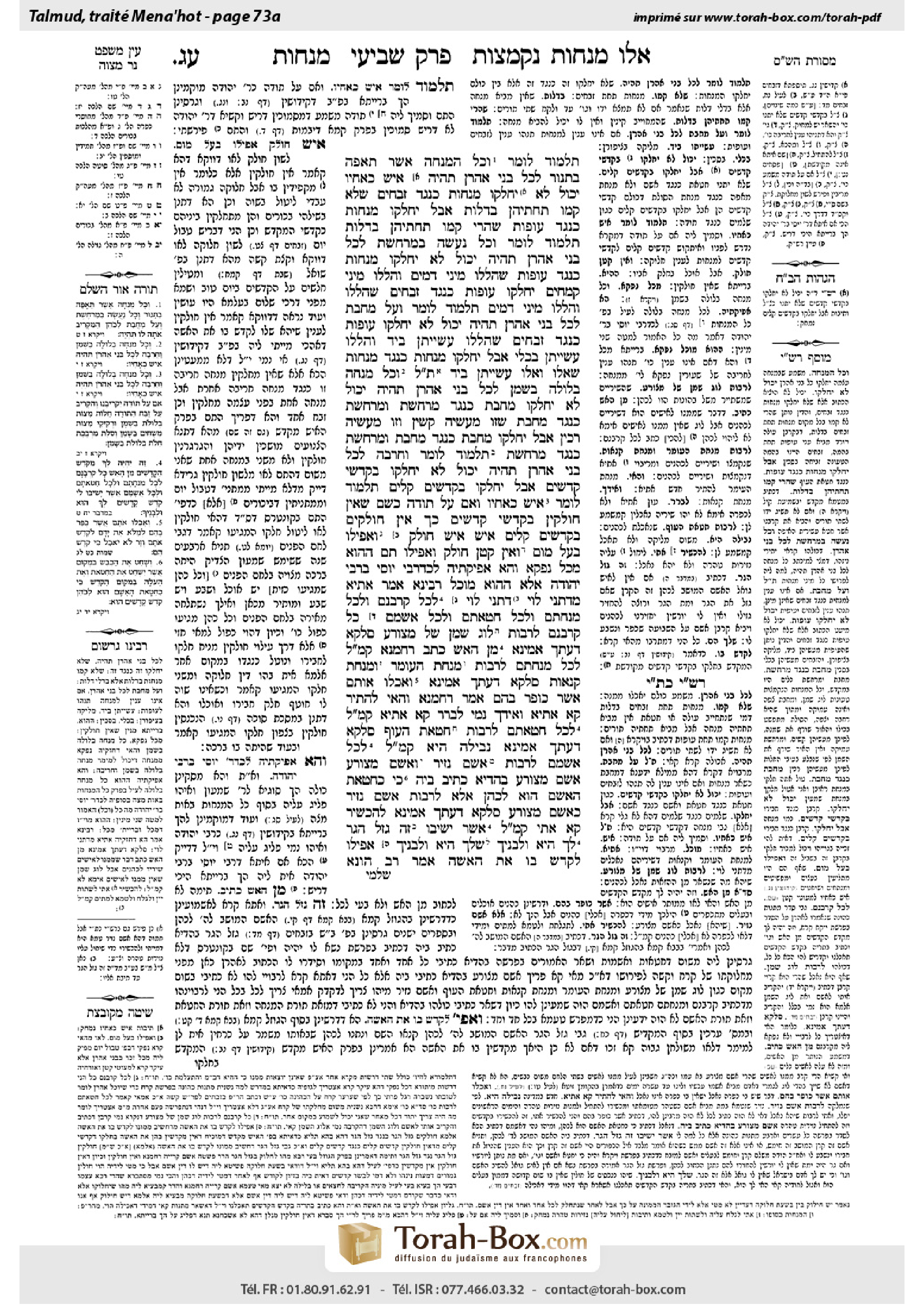
Menachot 73a: Talmud study for Daf Yomi
Daf Yomi is the daily study of one Talmud folio. Explore 37 tractates with scans, Hebrew text, Sefaria English and AI-generated French translations where annotated.
Passage selection and English or AI-generated French translation are available where the scan has annotations. Daf Study is independent of Torah-Box and Sefaria.
Browse Menachot · מנחות · All tractatesMenachot 73a text and translations
This page of Menachot includes the Aramaic text, an English translation and an AI-generated French translation, alongside the scan above.
מנחות ע״ג א · Aramaic and Hebrew text
תַּלְמוּד לוֹמַר: ״וְכׇל הַמִּנְחָה אֲשֶׁר תֵּאָפֶה בַּתַּנּוּר לְכׇל בְּנֵי אַהֲרֹן תִּהְיֶה אִישׁ כְּאָחִיו״.
יָכוֹל לֹא יַחְלְקוּ מְנָחוֹת כְּנֶגֶד זְבָחִים, שֶׁלֹּא קָמוּ תַּחְתֵּיהֶן בְּדַלּוּת, אֲבָל יַחְלְקוּ מְנָחוֹת כְּנֶגֶד עוֹפוֹת, שֶׁהֲרֵי קָמוּ תַּחְתֵּיהֶן בְּדַלּוּת – תַּלְמוּד לוֹמַר: ״וְכׇל נַעֲשָׂה בַּמַּרְחֶשֶׁת לְכׇל בְּנֵי אַהֲרֹן תִּהְיֶה״.
יָכוֹל לֹא יַחְלְקוּ מְנָחוֹת כְּנֶגֶד עוֹפוֹת, שֶׁהַלָּלוּ מִינֵי דָמִים וְהַלָּלוּ מִינֵי קְמָחִים, יַחְלְקוּ עוֹפוֹת כְּנֶגֶד זְבָחִים, שֶׁהַלָּלוּ וְהַלָּלוּ מִינֵי דָמִים – תַּלְמוּד לוֹמַר: ״וְעַל מַחֲבַת לְכׇל בְּנֵי אַהֲרֹן תִּהְיֶה״.
יָכוֹל לֹא יַחְלְקוּ עוֹפוֹת כְּנֶגֶד זְבָחִים, שֶׁהַלָּלוּ עֲשִׂיָּיתָן בַּיָּד, וְהַלָּלוּ עֲשִׂיָּיתָן בִּכְלִי, אֲבָל יַחְלְקוּ מְנָחוֹת כְּנֶגֶד מְנָחוֹת, שֶׁאֵלּוּ וָאֵלּוּ עֲשִׂיָּיתָן בַּיָּד – תַּלְמוּד לוֹמַר: ״וְכׇל מִנְחָה בְלוּלָה בַשֶּׁמֶן ... לְכׇל בְּנֵי אַהֲרֹן תִּהְיֶה״.
יָכוֹל לֹא יַחְלְקוּ מַחֲבַת כְּנֶגֶד מַרְחֶשֶׁת, וּמַרְחֶשֶׁת כְּנֶגֶד מַחֲבַת, שֶׁזּוֹ מַעֲשֶׂיהָ קָשִׁין וְזוֹ מַעֲשֶׂיהָ רַכִּין, אֲבָל יַחְלְקוּ מַחֲבַת כְּנֶגֶד מַחֲבַת וּמַרְחֶשֶׁת כְּנֶגֶד מַרְחֶשֶׁת – תַּלְמוּד לוֹמַר: ״וַחֲרֵבָה לְכׇל בְּנֵי אַהֲרֹן תִּהְיֶה״.
יָכוֹל לֹא יַחְלְקוּ בְּקׇדְשֵׁי קָדָשִׁים, אֲבָל יַחְלְקוּ בְּקָדָשִׁים קַלִּים – תַּלְמוּד לוֹמַר: ״אִישׁ כְּאָחִיו״, ״וְאִם עַל תּוֹדָה״ – כְּשֵׁם שֶׁאֵין חוֹלְקִין בְּקׇדְשֵׁי קָדָשִׁים, כָּךְ אֵין חוֹלְקִים בְּקָדָשִׁים קַלִּים.
״אִישׁ״ – אִישׁ חוֹלֵק, וַאֲפִילּוּ בַּעַל מוּם, וְאֵין קָטָן חוֹלֵק, וַאֲפִילּוּ תָּם.
הָהוּא מִ״כׇּל״ נָפְקָא, וְהָא אַפֵּיקְתֵּיהּ לְכִדְרַבִּי יוֹסֵי בְּרַבִּי יְהוּדָה? אֶלָּא, הָהוּא מִ״וְכׇל״.
רָבִינָא אָמַר: אָתְיָא מִדְּתָנֵי לֵוִי, דְּתָנֵי לֵוִי: ״לְכׇל קׇרְבָּנָם וּלְכׇל מִנְחָתָם וּלְכׇל חַטָּאתָם וּלְכׇל אֲשָׁמָם״.
״כׇּל קׇרְבָּנָם״ – לְרַבּוֹת לוֹג שֶׁמֶן שֶׁל מְצוֹרָע, סָלְקָא דַּעְתָּךְ אָמֵינָא: ״מִן הָאֵשׁ״ כְּתַב רַחֲמָנָא, קָא מַשְׁמַע לַן.
״לְכׇל מִנְחָתָם״ – לְרַבּוֹת מִנְחַת הָעוֹמֶר וּמִנְחַת קְנָאוֹת, סָלְקָא דַּעְתָּךְ אָמֵינָא: ״וְאָכְלוּ אֹתָם אֲשֶׁר כֻּפַּר בָּהֶם״ אָמַר רַחֲמָנָא, וְהַאי לְהַתִּיר קָא אָתְיָא, וְאִידַּךְ נָמֵי לְבָרֵר קָא אָתְיָא – קָא מַשְׁמַע לַן.
״לְכׇל חַטֹּאתָם״ – לְרַבּוֹת חַטַּאת הָעוֹף, סָלְקָא דַּעְתָּךְ אָמֵינָא: נְבֵילָה הִיא, קָא מַשְׁמַע לַן.
״לְכׇל אֲשָׁמָם״ – לְרַבּוֹת אֲשַׁם נָזִיר וַאֲשַׁם מְצוֹרָע. אֲשַׁם מְצוֹרָע – בְּהֶדְיָא כְּתִיב בֵּיהּ: ״כִּי כַּחַטָּאת הָאָשָׁם הוּא לַכֹּהֵן״!
אֶלָּא, לְרַבּוֹת אֲשַׁם נָזִיר כַּאֲשַׁם מְצוֹרָע. סָלְקָא דַּעְתָּךְ אָמֵינָא: לְהַכְשִׁיר קָא אָתֵי, קָא מַשְׁמַע לַן.
״אֲשֶׁר יָשִׁיבוּ״ – זֶה גֶּזֶל הַגֵּר, ״לְךָ הִיא וּלְבָנֶיךָ״ – שֶׁלְּךָ הִיא וּלְבָנֶיךָ, אֲפִילּוּ לְקַדֵּשׁ בּוֹ אֶת הָאִשָּׁה.
אָמַר רַב הוּנָא:
Menachot 73a · English translation
The verse states: “And every meal offering that is baked in the oven…shall all the sons of Aaron have, each man like the other” (Leviticus 7:9–10). This verse emphasizes that the sons of Aaron must divide the meal offering equally among themselves, without exchanging it for a portion of any other offering.
The baraita continues: One might have thought that they may not receive a share of meal offerings in exchange for portions of animal offerings since they do not substitute for them in the case of poverty. One who is too poor to afford to bring an animal offering, e.g., in the case of a sin offering determined on a sliding scale, does not bring a meal offering in its stead. Since meal offerings are not brought in place of animal offerings, there is clearly no connection between them. But perhaps they may receive a share of meal offerings in exchange for portions of bird offerings, since they do substitute for them in the case of poverty. If one is so destitute that he cannot afford to bring a bird offering he brings a meal offering. Therefore, the same verse states: “And all that is prepared in the deep pan…shall all the sons of Aaron have,” again emphasizing that all must have an equal share in that meal offering.
The baraita continues: One might have thought that they may not receive a share of meal offerings in exchange for portions of bird offerings since these, i.e., bird offerings, are types of offerings that involve blood sprinkled on the altar, and those, i.e., meal offerings, are types of offerings made of flour. But perhaps they may receive a share of portions of bird offerings in exchange for portions of animal offerings, since both categories are types of offerings that involve blood sprinkled on the altar. Therefore, the same verse states: “And on a pan…shall all the sons of Aaron have,” a seemingly superfluous phrase, which teaches that one may not receive a share even of bird offerings in exchange for portions of animal offerings.
The baraita continues: One might have thought that they may not receive a share of bird offerings in exchange for portions of animal offerings because with regard to these, i.e., the birds, their processing, i.e., killing, is executed by hand, by pinching the nape of the neck, and with regard to those, i.e., the animals, their processing, i.e., killing, is executed with a utensil, by slaughtering with a knife. But perhaps they may receive a share of meal offerings in exchange for portions of other meal offerings, since the processing of both these and those are carried out by hand. Therefore, the next verse states: “And every meal offering mixed with oil…shall all the sons of Aaron have” (Leviticus 7:10).
The baraita continues: One might have thought that they may not receive a share of a meal offering prepared on a pan in exchange for portions of a meal offering prepared in a deep pan, or portions of a meal offering prepared in a deep pan in exchange for portions of a meal offering prepared on a pan, since the actions with this pan result in a hard product, and the actions with that deep pan result in a soft product. But perhaps they may receive a share of a meal offering prepared on a pan in exchange for the portions of a different meal offering prepared on a pan, or a share of a meal offering prepared in a deep pan in exchange for portions of a different meal offering prepared in a deep pan. Therefore, the same verse states: “Or dry, shall all the sons of Aaron have” (Leviticus 7:10).
The baraita continues: One might have thought that they may not receive a share of offerings of the most sacred order, e.g., meal offerings, in exchange for a portion of another similar offering, but they may receive a share of offerings of lesser sanctity in exchange for a portion of another similar offering. Therefore, the same verse states with regard to meal offerings: “Shall all the sons of Aaron have, one as well as another” (Leviticus 7:10), and near it appears the verse: “If he offers it for a thanks offering” (Leviticus 7:12), from which is derived: Just as one may not receive a share of one offering in exchange for a portion of another similar offering in the case of offerings of the most sacred order, so too, one may not receive a share of one offering in exchange for a portion of another similar offering in the case of offerings of lesser sanctity, e.g., a thanks offering.
The baraita further expounds this verse: It states: “One as well as another [ish ke’aḥiv],” which teaches that with regard to priests, a man [ish] who is an adult receives a share even if he is blemished, but a priest who is a minor may not receive a share even if he is unblemished. This baraita evidently interprets the verse: “And every meal offering, mixed with oil, or dry, shall all the sons of Aaron have, one as well as another” (Leviticus 7:10), as referring to the prohibition against priests exchanging shares of offerings. If so, how does Ḥizkiyya state that this verse is referring to the priests’ eating of the remainder of the omer offering and the meal offering of a sota?
The Gemara answers: With regard to the prohibition against exchanging priestly shares, that is derived from the term: “Every meal offering.” By contrast, Ḥizkiyya derives his principle with regard to these two meal offerings from the rest of the verse. The Gemara asks: But haven’t you already derived from the word “every” that which Rabbi Yosei, son of Rabbi Yehuda, states, that when one vows to offer a meal offering baked in an oven, all the baked items must be of a uniform type, either loaves or wafers (see 63b)? The Gemara answers: Rather, that halakha concerning the exchange of shares of offerings is derived from the addition of the word “and,” in the term: “And every [vekhol] meal offering.”
§ Ravina said: According to the opinion of Rabbi Shimon, the source for the halakha that the omer offering and the meal offering of a sota are eaten comes from the baraita that Levi teaches, as Levi teaches: The verse states with regard to the priestly gifts: “This shall be yours of the most sacred items, reserved from the fire: Every offering of theirs, and every meal offering of theirs, and every sin offering of theirs, and every guilt offering of theirs, which they may restore to Me, shall be most holy for you and for your sons” (Numbers 18:9). The word “every” in each clause includes a number of additional offerings that are eaten by the priests.
The Torah states: “Every offering of theirs,” to include the log of oil that accompanies the guilt offering of a recovered leper, teaching that it is also eaten by the priests. As, it might enter your mind to say that since the Merciful One writes in this verse: “From the fire,” this would exclude this oil, which is not brought onto the altar. Therefore, the verse teaches us: “Every offering,” to include the leper’s oil.
The baraita continues expounding the verse: “And every meal offering of theirs,” serving to include the omer meal offering, and the meal offering of jealousy brought by a sota, teaching that they are also eaten by the priests. As, it might enter your mind to say that since the Merciful One states: “And they shall eat those wherewith atonement was made” (Exodus 29:33), the verse thereby indicates that the priests may eat only those offerings that help the owner achieve atonement. And this omer comes to permit eating from the new grain (see Leviticus 23:9–14), not to achieve atonement; and concerning the other offering, i.e., the meal offering of a sota, as well, it comes to clarify whether or not the accused woman is guilty of adultery, but not to achieve atonement. Therefore, the verse teaches us: “Every meal offering,” to teach that these two meal offerings are included.
The baraita continues to expound the verse. The verse states: “And every sin offering of theirs,” to include a bird sin offering, teaching that it is also eaten by the priests. As, it might enter your mind to say: The priests may not eat it because it is an unslaughtered animal carcass, as it is killed by pinching the nape of the neck (see Leviticus 5:8), not by conventional slaughter. Therefore, the verse teaches us: “Every sin offering,” teaching that bird sin offerings are included.
The baraita continues to expound the verse. The Torah states: “And every guilt offering of theirs,” to include the guilt offering of the nazirite who has become ritually impure (see Numbers 6:12) and the guilt offering of the leper, teaching that they are also eaten by the priests. The Gemara objects: With regard to the guilt offering of the leper, it is explicitly written with regard to it: “For as the sin offering is the priest’s, so is the guilt offering” (Leviticus 14:13), which already teaches that it is eaten by the priests.
The Gemara answers: Rather, the verse serves to include the guilt offering of the nazirite, stating that its status is like the guilt offering of the leper. As, it might enter your mind to say: The guilt offering of the nazirite is not sacrificed for atonement, but rather it comes to prepare the nazirite to begin his period of naziriteship anew, and therefore its meat would not be eaten by the priests. Therefore, the verse teaches us: “Every guilt offering,” teaching that the guilt offering of the nazirite is included.
The baraita concludes: “This shall be yours of the most sacred items…which they may restore”; this is referring to an item stolen from a convert who has no heirs and subsequently dies. In this case, the stolen item is given to the priests together with an additional one-fifth of its worth. The phrase “for you and for your sons” means that it is yours and your sons’ personal property, and it may be used even to betroth a woman with it, and it does not belong to the Temple treasury.
§ Rav Huna said:
Menachot 73a · Traduction française (IA)
Le verset dit : « Et toute oblation cuite au four… appartiendra à tous les fils d’Aaron, à chacun comme à l’autre » (Lévitique 7:9-10). Ce verset souligne que les fils d’Aaron doivent se partager l’oblation à parts égales, sans l’échanger contre une part d’une autre offrande.
La baraïta poursuit : On aurait pu penser qu’ils ne peuvent pas recevoir une part d’oblation en échange d’une part d’offrande animale, puisque les oblations ne remplacent pas les offrandes animales dans les cas de pauvreté. Celui qui est trop pauvre pour apporter une offrande animale, par exemple un sacrifice expiatoire à valeur graduée, n’apporte pas d’oblation à sa place. Puisque les oblations ne sont pas apportées à la place des offrandes animales, il n’y a manifestement aucun lien entre elles. Mais peut-être peuvent-ils recevoir une part d’oblation en échange d’une part d’offrande d’oiseau, puisque les oblations remplacent les offrandes d’oiseaux dans les cas de pauvreté. Si quelqu’un est si démuni qu’il ne peut pas apporter d’offrande d’oiseau, il apporte une oblation. Le même verset dit donc : « Et tout ce qui est préparé dans la poêle profonde… appartiendra à tous les fils d’Aaron », soulignant de nouveau que tous doivent recevoir une part égale de cette oblation.
La baraïta poursuit : On aurait pu penser qu’ils ne peuvent pas recevoir une part d’oblation en échange d’une part d’offrande d’oiseau, car celles-ci, c’est-à-dire les offrandes d’oiseaux, sont des offrandes dont le sang est aspergé sur l’autel, tandis que celles-là, c’est-à-dire les oblations, sont des offrandes à base de farine. Mais peut-être peuvent-ils recevoir une part d’offrande d’oiseau en échange d’une part d’offrande animale, puisque ces deux catégories sont des offrandes dont le sang est aspergé sur l’autel. Le même verset dit donc : « Et sur une poêle… appartiendra à tous les fils d’Aaron », expression apparemment superflue qui enseigne qu’on ne peut pas recevoir une part, même d’offrande d’oiseau, en échange d’une part d’offrande animale.
La baraïta poursuit : On aurait pu penser qu’ils ne peuvent pas recevoir une part d’offrande d’oiseau en échange d’une part d’offrande animale, car, pour les premières, c’est-à-dire les oiseaux, leur mise à mort s’effectue à la main, par pincement de la nuque, tandis que, pour les secondes, c’est-à-dire les animaux, elle s’effectue à l’aide d’un ustensile, par égorgement au couteau. Mais peut-être peuvent-ils recevoir une part d’oblation en échange d’une part d’une autre oblation, puisque la préparation de ces unes comme de ces autres s’effectue à la main. Le verset suivant dit donc : « Et toute oblation pétrie à l’huile… appartiendra à tous les fils d’Aaron » (Lévitique 7:10).
La baraïta poursuit : On aurait pu penser qu’ils ne peuvent pas recevoir une part d’oblation préparée sur une poêle en échange d’une part d’oblation préparée dans une poêle profonde, ni une part d’oblation préparée dans une poêle profonde en échange d’une part d’oblation préparée sur une poêle, car la préparation sur cette poêle donne un produit dur, tandis que la préparation dans cette poêle profonde donne un produit mou. Mais peut-être peuvent-ils recevoir une part d’oblation préparée sur une poêle en échange d’une part d’une autre oblation préparée sur une poêle, ou une part d’oblation préparée dans une poêle profonde en échange d’une part d’une autre oblation préparée dans une poêle profonde. Le même verset dit donc : « Ou sèche, appartiendra à tous les fils d’Aaron » (Lévitique 7:10).
La baraïta poursuit : On aurait pu penser qu’ils ne peuvent pas recevoir une part d’offrande de sainteté suprême, par exemple une oblation, en échange d’une part d’une autre offrande similaire, mais qu’ils peuvent recevoir une part d’offrande de moindre sainteté en échange d’une part d’une autre offrande similaire. Le même verset dit donc à propos des oblations : « Appartiendra à tous les fils d’Aaron, l’un comme l’autre » (Lévitique 7:10), et le verset « S’il l’offre en sacrifice de reconnaissance » (Lévitique 7:12) se trouve à proximité. On en déduit que, de même qu’on ne peut pas recevoir une part d’une offrande en échange d’une part d’une autre offrande similaire dans le cas des offrandes de sainteté suprême, de même on ne peut pas le faire dans le cas des offrandes de moindre sainteté, par exemple un sacrifice de reconnaissance.
La baraïta interprète encore ce verset : Il est écrit : « L’un comme l’autre [ish ke’aḥiv] », ce qui enseigne que, parmi les prêtres, un homme [ish] adulte reçoit une part même s’il est atteint d’une infirmité, tandis qu’un prêtre mineur ne peut pas recevoir de part, même s’il est sans infirmité. Cette baraïta interprète manifestement le verset « Et toute oblation pétrie à l’huile, ou sèche, appartiendra à tous les fils d’Aaron, l’un comme l’autre » (Lévitique 7:10) comme se rapportant à l’interdiction faite aux prêtres d’échanger leurs parts d’offrandes. Dans ce cas, comment Ḥizkiyya peut-il affirmer que ce verset se rapporte à la consommation par les prêtres du reste de l’oblation de l’omer et de l’oblation de la sota ?
La Guemara répond : L’interdiction d’échanger les parts des prêtres est déduite du terme « toute oblation ». En revanche, Ḥizkiyya déduit son principe concernant ces deux oblations du reste du verset. La Guemara demande : Mais n’avez-vous pas déjà déduit du mot « toute » ce que dit Rabbi Yosei, fils de Rabbi Yehouda, à savoir que lorsqu’on fait vœu d’apporter une oblation cuite au four, tous les éléments cuits doivent être du même type, soit des pains, soit des galettes (voir 63b) ? La Guemara répond : Cette halakha concernant l’échange des parts d’offrandes est plutôt déduite de l’ajout du mot « et », dans l’expression « Et toute [vekhol] oblation ».
§ Ravina dit : Selon l’opinion de Rabbi Shimon, la source de la halakha selon laquelle l’oblation de l’omer et l’oblation de la sota sont consommées se trouve dans la baraïta enseignée par Lévi. Car Lévi enseigne : À propos des dons sacerdotaux, le verset dit : « Cela t’appartiendra parmi les choses très saintes, prélevées sur le feu : toute leur offrande, toute leur oblation, tout leur sacrifice expiatoire et tout leur sacrifice de culpabilité qu’ils pourront me restituer seront très saints pour toi et pour tes fils » (Nombres 18:9). Le mot « toute », dans chacune de ces expressions, inclut plusieurs offrandes supplémentaires consommées par les prêtres.
La Torah dit : « Toute leur offrande », pour inclure le log d’huile qui accompagne le sacrifice de culpabilité du lépreux guéri et enseigner qu’il est également consommé par les prêtres. En effet, on aurait pu penser que, puisque le Miséricordieux écrit dans ce verset « prélevées sur le feu », cela exclut cette huile, qui n’est pas apportée sur l’autel. Le verset nous enseigne donc, par les mots « toute offrande », qu’il faut inclure l’huile du lépreux.
La baraïta poursuit son interprétation du verset : « Et toute leur oblation » sert à inclure l’oblation de l’omer et l’oblation de jalousie apportée par une sota, et enseigne qu’elles sont également consommées par les prêtres. En effet, on aurait pu penser que, puisque le Miséricordieux dit : « Ils mangeront ces choses par lesquelles l’expiation a été faite » (Exode 29:33), le verset indique que les prêtres ne peuvent manger que les offrandes qui permettent à leur propriétaire d’obtenir l’expiation. Or, l’omer sert à permettre la consommation du nouveau grain (voir Lévitique 23:9-14), et non à obtenir l’expiation ; l’autre offrande, c’est-à-dire l’oblation de la sota, sert également à déterminer si la femme accusée est coupable d’adultère, et non à obtenir l’expiation. Le verset nous enseigne donc, par les mots « toute oblation », que ces deux oblations sont incluses.
La baraïta poursuit son interprétation du verset. Le verset dit : « Et tout leur sacrifice expiatoire », pour inclure un sacrifice expiatoire d’oiseau et enseigner qu’il est également consommé par les prêtres. En effet, on aurait pu penser que les prêtres ne peuvent pas le manger parce qu’il s’agit d’une carcasse animale non égorgée, puisqu’il est mis à mort par pincement de la nuque (voir Lévitique 5:8), et non par égorgement rituel. Le verset nous enseigne donc, par les mots « tout sacrifice expiatoire », que les sacrifices expiatoires d’oiseaux sont inclus.
La baraïta poursuit son interprétation du verset. La Torah dit : « Et tout leur sacrifice de culpabilité », pour inclure le sacrifice de culpabilité du nazir devenu rituellement impur (voir Nombres 6:12) et celui du lépreux, et enseigner qu’ils sont également consommés par les prêtres. La Guemara objecte : Concernant le sacrifice de culpabilité du lépreux, il est explicitement écrit à son sujet : « Car, comme le sacrifice expiatoire, le sacrifice de culpabilité appartient au prêtre » (Lévitique 14:13), ce qui enseigne déjà qu’il est consommé par les prêtres.
La Guemara répond : Le verset sert plutôt à inclure le sacrifice de culpabilité du nazir, en indiquant que son statut est semblable à celui du sacrifice de culpabilité du lépreux. En effet, on aurait pu penser que le sacrifice de culpabilité du nazir n’est pas offert pour l’expiation, mais qu’il sert plutôt à lui permettre de recommencer sa période de naziréat ; sa viande ne serait donc pas consommée par les prêtres. Le verset nous enseigne donc, par les mots « tout sacrifice de culpabilité », que le sacrifice de culpabilité du nazir est inclus.
La baraïta conclut : « Cela t’appartiendra parmi les choses très saintes… qu’ils pourront me restituer » désigne un objet volé à un converti décédé sans héritiers. Dans ce cas, l’objet volé est remis aux prêtres avec un cinquième supplémentaire de sa valeur. L’expression « pour toi et pour tes fils » signifie qu’il s’agit de ton bien personnel et de celui de tes fils ; cet objet peut même servir à fiancer une femme, et il n’appartient pas au trésor du Temple.
§ Rav Houna dit :
Traduction française générée par IA à partir de l’édition anglaise de Sefaria. Vérifie toujours un passage avec le texte source.
Text from Sefaria: William Davidson Edition - Vocalized Aramaic (unknown); William Davidson Edition - English (CC BY NC).