Menachot 72b: Talmud study for Daf Yomi
Daf Yomi is the daily study of one Talmud folio. Explore 37 tractates with scans, Hebrew text, Sefaria English and AI-generated French translations where annotated.
Passage selection and English or AI-generated French translation are available where the scan has annotations. Daf Study is independent of Torah-Box and Sefaria.
Browse Menachot · מנחות · All tractatesMenachot 72b text and translations
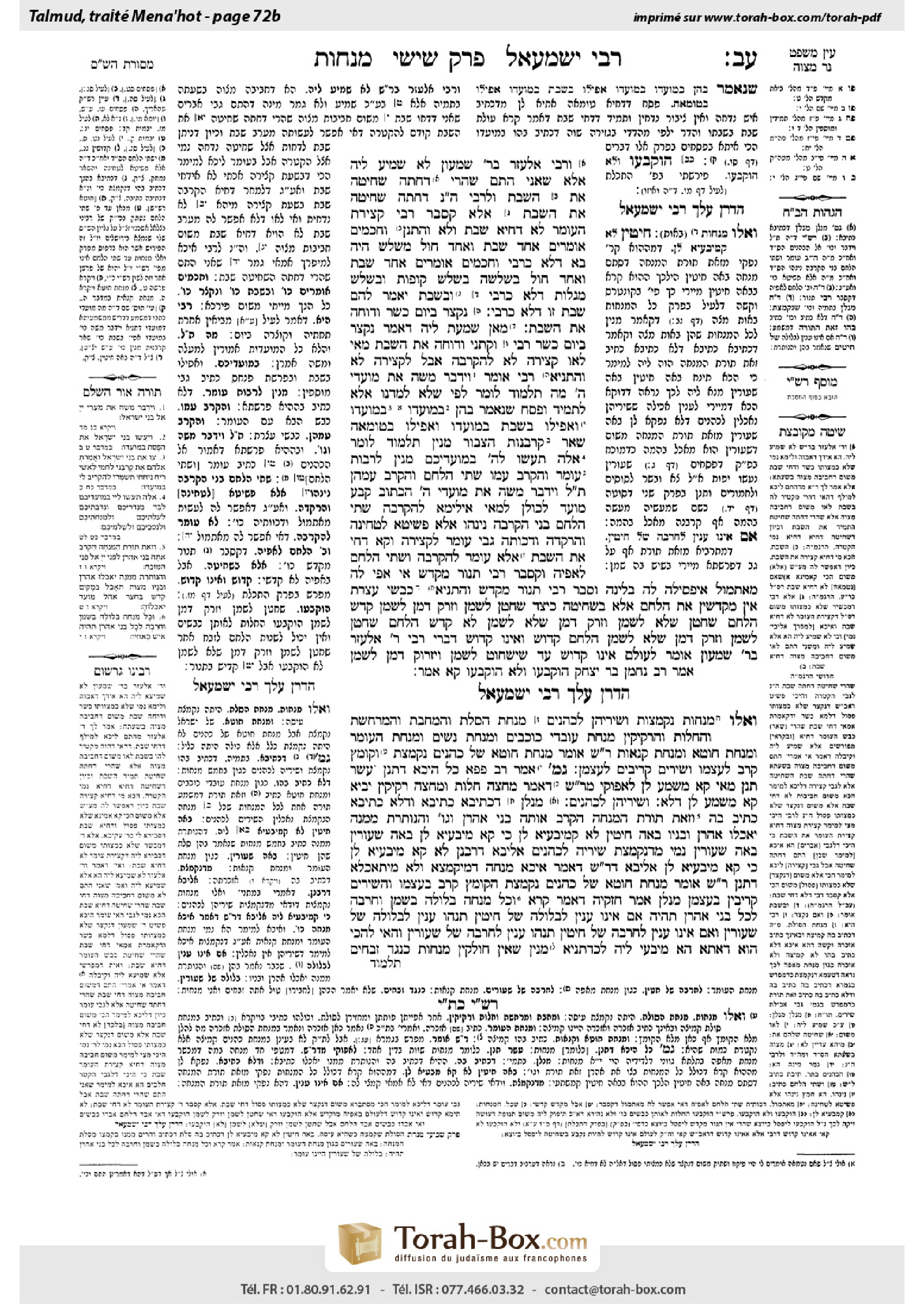
This page of Menachot includes the Aramaic text, an English translation and an AI-generated French translation, alongside the scan above.
מנחות ע״ב ב · Aramaic and Hebrew text
וְרַבִּי אֶלְעָזָר בְּרַבִּי שִׁמְעוֹן לָא שְׁמִיעַ לֵיהּ?!
אֶלָּא שָׁאנֵי הָתָם, שֶׁהֲרֵי דָּחֲתָה שְׁחִיטָה אֶת הַשַּׁבָּת.
וּלְרַבִּי, הָכִי נָמֵי דָּחֲתָה שְׁחִיטָה אֶת הַשַּׁבָּת! אֶלָּא קָסָבַר רַבִּי: קְצִירַת הָעוֹמֶר לָא דָּחֲיָא שַׁבָּת.
וְלָא? וְהָתְנַן: וַחֲכָמִים אוֹמְרִים, אֶחָד שַׁבָּת וְאֶחָד חוֹל – מִשָּׁלֹשׁ הָיָה בָּא. דְּלָא כְּרַבִּי.
וַחֲכָמִים אוֹמְרִים: אֶחָד שַׁבָּת וְאֶחָד חוֹל – בִּשְׁלֹשָׁה, בְּשָׁלֹשׁ קוּפּוֹת וּבְשָׁלֹשׁ מַגָּלוֹת – דְּלָא כְּרַבִּי.
וּבְשַׁבָּת יֹאמַר לָהֶם ״שַׁבָּת זוֹ?״ – דְּלָא כְּרַבִּי!
נִקְצַר בַּיּוֹם כָּשֵׁר, וְדוֹחֶה אֶת הַשַּׁבָּת. מַאן שָׁמְעַתְּ לֵיהּ דְּאָמַר: נִקְצַר בַּיּוֹם כָּשֵׁר? רַבִּי, וְקָתָנֵי: וְדוֹחֶה אֶת הַשַּׁבָּת. מַאי לָאו קְצִירָה? לֹא, לְהַקְרָבָה.
אֲבָל לִקְצִירָה לָא? וְהָתַנְיָא: רַבִּי אוֹמֵר: ״וַיְדַבֵּר מֹשֶׁה אֶת מֹעֲדֵי ה׳״ – מָה תַּלְמוּד לוֹמַר? לְפִי שֶׁלֹּא לָמַדְנוּ אֶלָּא לְתָמִיד וּפֶסַח, שֶׁנֶּאֱמַר בָּהֶן ״בְּמוֹעֲדוֹ״, ״בְּמוֹעֲדוֹ״ – וַאֲפִילּוּ בְּשַׁבָּת, ״בְּמוֹעֲדוֹ״ – וַאֲפִילּוּ בְּטוּמְאָה.
שְׁאָר קׇרְבְּנוֹת הַצִּבּוּר מִנַּיִן? תַּלְמוּד לוֹמַר: ״אֵלֶּה תַּעֲשׂוּ לַה׳ בְּמוֹעֲדֵיכֶם״.
מִנַּיִן לְרַבּוֹת עוֹמֶר, וְהַקָּרֵב עִמּוֹ? שְׁתֵּי הַלֶּחֶם, וְהַקָּרֵב עִמָּהֶן? תַּלְמוּד לוֹמַר: ״וַיְדַבֵּר מֹשֶׁה אֶת מֹעֲדֵי ה׳״ – הַכָּתוּב קָבַע מוֹעֵד לְכוּלָּן.
לְמַאי? אִילֵימָא לְהַקְרָבָה – שְׁתֵּי הַלֶּחֶם בְּנֵי הַקְרָבָה נִינְהוּ?
אֶלָּא פְּשִׁיטָא לִטְחִינָה וְהַרְקָדָה, וְדִכְוָתַהּ גַּבֵּי עוֹמֶר לִקְצִירָה, וְקָא דָחֵי אֶת הַשַּׁבָּת.
אֶלָּא, עוֹמֶר לְהַקְרָבָה, וּשְׁתֵּי הַלֶּחֶם לַאֲפִיָּה, וְקָסָבַר רַבִּי תַּנּוּר מְקַדֵּשׁ, אִי אָפֵי לַהּ מֵאֶתְמוֹל – אִיפְּסִילָה לַהּ בְּלִינָה.
וְסָבַר רַבִּי תַּנּוּר מְקַדֵּשׁ? וְהָתַנְיָא: כִּבְשֵׂי עֲצֶרֶת אֵין מְקַדְּשִׁין אֶת הַלֶּחֶם אֶלָּא בִּשְׁחִיטָה. כֵּיצַד? שְׁחָטָן לִשְׁמָן, וְזָרַק דָּמָן לִשְׁמָן – קָדַשׁ הַלֶּחֶם.
שְׁחָטָן שֶׁלֹּא לִשְׁמָן, וְזָרַק דָּמָן שֶׁלֹּא לִשְׁמָן – לֹא קָדַשׁ הַלֶּחֶם. שְׁחָטָן לִשְׁמָן, וְזָרַק דָּמָן שֶׁלֹּא לִשְׁמָן – הַלֶּחֶם קָדוֹשׁ וְאֵינוֹ קָדוֹשׁ, דִּבְרֵי רַבִּי.
רַבִּי אֶלְעָזָר בְּרַבִּי שִׁמְעוֹן אוֹמֵר: לְעוֹלָם אֵינוֹ קָדוֹשׁ, עַד שֶׁיִּשְׁחוֹט לִשְׁמָן וְיִזְרוֹק דָּמָן לִשְׁמָן.
אָמַר רַב נַחְמָן בַּר יִצְחָק: הוּקְבְּעוּ וְלֹא הוּקְבְּעוּ קָא אָמַר.
הֲדַרַן עֲלָךְ רַבִּי יִשְׁמָעֵאל.
מַתְנִי׳ וְאֵלּוּ מְנָחוֹת נִקְמָצוֹת, וּשְׁיָרֵיהֶן לַכֹּהֲנִים: מִנְחַת הַסֹּלֶת, וְהַמַּחֲבַת, וְהַמַּרְחֶשֶׁת, וְהַחַלּוֹת, וְהָרְקִיקִין, מִנְחַת גּוֹיִם, וּמִנְחַת נָשִׁים, וּמִנְחַת הָעוֹמֶר, וּמִנְחַת חוֹטֵא, וּמִנְחַת קְנָאוֹת.
רַבִּי שִׁמְעוֹן אוֹמֵר: מִנְחַת חוֹטֵא שֶׁל כֹּהֲנִים נִקְמֶצֶת, וְקוֹמֵץ קָרֵב לְעַצְמוֹ, וְשִׁירַיִם קְרֵיבִים לְעַצְמָן.
גְּמָ׳ אָמַר רַב פָּפָּא: כֹּל הֵיכָא דִּתְנַן – עֶשֶׂר תְּנַן, מַאי קָא מַשְׁמַע לַן?
לְאַפּוֹקֵי מֵרַבִּי שִׁמְעוֹן, דְּאָמַר: מֶחֱצָה חַלּוֹת וּמֶחֱצָה רְקִיקִין יָבִיא, קָא מַשְׁמַע לַן דְּלָא.
וּשְׁיָרֵיהֶן לַכֹּהֲנִים, מְנָלַן? דִּכְתִיבָא – כְּתִיבָא, וּדְלָא כְּתִיבָא – כְּתִיב בַּהּ: ״וְזֹאת תּוֹרַת הַמִּנְחָה הַקְרֵב אוֹתָהּ בְּנֵי אַהֲרֹן וְגוֹ׳ וְהַנּוֹתֶרֶת מִמֶּנָּה יֹאכְלוּ אַהֲרֹן וּבָנָיו״.
בָּאָה חִיטִּין – לָא קָמִיבַּעְיָא לַן, כִּי קָא מִיבַּעְיָא לַן – בָּאָה שְׂעוֹרִין. בָּאָה שְׂעוֹרִין נָמֵי, מִדְּנִקְמֶצֶת – שְׁיָרֶיהָ לַכֹּהֲנִים.
אַלִּיבָּא דְּרַבָּנַן, לָא קָא מִיבַּעְיָא לַן; כִּי קָא מִיבַּעְיָא לַן – אַלִּיבָּא דְּרַבִּי שִׁמְעוֹן, דְּאָמַר: אִיכָּא מִנְחָה דְּמִיקַּמְצָא וְלָא מִיתְאַכְלָא.
דִּתְנַן: רַבִּי שִׁמְעוֹן אוֹמֵר: מִנְחַת חוֹטֵא שֶׁל כֹּהֲנִים נִקְמֶצֶת, הַקּוֹמֶץ קָרֵב בְּעַצְמוֹ, וְהַשִּׁירַיִם קְרֵיבִין בְּעַצְמָן. מְנָלַן?
אָמַר חִזְקִיָּה: דְּאָמַר קְרָא ״וְכׇל מִנְחָה בְלוּלָה בַשֶּׁמֶן וַחֲרֵבָה לְכׇל בְּנֵי אַהֲרֹן תִּהְיֶה״. אִם אֵינוֹ עִנְיָן לִבְלוּלָה שֶׁל חִיטִּין – תְּנֵהוּ עִנְיָן לִבְלוּלָה שֶׁל שְׂעוֹרִין, וְאִם אֵינוֹ עִנְיָן לַחֲרֵבָה שֶׁל חִיטִּין – תְּנֵהוּ עִנְיָן לַחֲרֵבָה שֶׁל שְׂעוֹרִין.
וְהַאי לְהָכִי הוּא דַּאֲתָא? הָא מִיבְּעֵי לֵיהּ לְכִדְתַנְיָא: מִנַּיִן שֶׁאֵין חוֹלְקִין מְנָחוֹת כְּנֶגֶד זְבָחִים –
Menachot 72b · English translation
The Gemara asks: And did Rabbi Elazar, son of Rabbi Shimon, not know of this? He must have known of his father’s statement that a mitzva performed at its proper time overrides Shabbat. If so, his ruling that reaping at an improper time is unfit cannot be proven from the fact that reaping the omer overrides Shabbat, as claimed earlier.
Rather, it must be that Rabbi Elazar, son of Rabbi Shimon, was aware of that principle, and nevertheless he maintains that the requirement to perform a mitzva at its optimal time does not apply to the case of the reaping of the omer. This is because there, in the case of the burning of the fats and limbs, it is different, as the slaughter of the animal already overrode Shabbat. Therefore, it is dear to perform the burning of its fats and limbs at the proper time, even on Shabbat. One cannot apply this reasoning to the reaping of the omer, as there is no prior labor performed on Shabbat before the reaping. Consequently, the reason it may be performed on Shabbat must be that it would be unfit if reaped any other time.
The Gemara asks: But if so, according to Rabbi Yehuda HaNasi, he should agree that the case of the burning of the sacrifice’s fats and limbs is different from the omer, since also there, the slaughter of the animal already overrode Shabbat. Therefore, the Gemara gives a new explanation: Rather, Rabbi Yehuda HaNasi holds that in fact the reaping of the omer crop does not override Shabbat, in contrast to the opinion of Rabbi Yishmael. For this reason Rabbi Yehuda HaNasi’s ruling that the omer is fit if reaped at an improper time does not conflict with the principle of his teacher, Rabbi Akiva, that any prohibited labor that can be performed on Shabbat eve does not override Shabbat.
The Gemara asks: And does Rabbi Yehuda HaNasi not maintain that the reaping of the omer overrides Shabbat? But didn’t we learn in a mishna (63b) in response to Rabbi Yishmael’s opinion that when the sixteenth of Nisan occurred during the week, five se’a of barley were reaped, and when it occurred on Shabbat only three se’a were reaped: And the Rabbis say: Both on Shabbat and during the week, the omer offering would come from three se’a? In any case, according to both opinions, the omer was reaped on Shabbat. The Gemara answers: That mishna is not in accordance with the opinion of Rabbi Yehuda HaNasi.
The Gemara raises a difficulty from the latter clause of that mishna. Rabbi Ḥanina, the deputy High Priest, says: On Shabbat the barley was reaped by an individual, with one sickle and one basket into which the barley was placed, whereas during the week it was reaped by three people, with three baskets and three sickles. And the Rabbis say: Both on Shabbat and during the week it is reaped by three people, with three baskets and three sickles. According to both opinions the omer was reaped on Shabbat. The Gemara again responds: That clause of the mishna is also not in accordance with the opinion of Rabbi Yehuda HaNasi.
The Gemara raises another difficulty from a mishna (65a) that describes the series of questions posed by the court emissary who reaps the grain to those assembled to witness the process: And if the sixteenth of Nisan occurs on Shabbat, the court emissary says to those assembled: Shall I cut the sheaves on this Shabbat? The assembly says in response: Yes. The Gemara answers: That clause of mishna is also not in accordance with the opinion of Rabbi Yehuda HaNasi.
The Gemara raises a difficulty from the mishna (71a): If the omer was reaped during the day, it is fit, and it overrides Shabbat. Now, whom did you hear who said: If the omer was reaped during the day, it is fit? It is Rabbi Yehuda HaNasi. And yet it is taught in the mishna: And it overrides Shabbat. What, is it not referring to reaping? The Gemara answers: No, it is referring to the sacrifice of the omer offering.
The Gemara asks: But with regard to reaping, does it not override Shabbat, according to Rabbi Yehuda HaNasi? As, isn’t it taught in a baraita that Rabbi Yehuda HaNasi said the following halakha based upon the verse: “And Moses declared the appointed times of the Lord to the children of Israel” (Leviticus 23:44): What is the meaning when the verse states this phrase? This phrase is necessary because we had learned only that the daily offering and the Paschal offering override Shabbat and ritual impurity, as it is stated concerning them: “In its appointed time” (see Numbers 9:2, 28:2), from which it is derived that each of them must be sacrificed in its appointed time and even on Shabbat; in its appointed time and even in ritual impurity.
The baraita continues: With regard to the rest of the communal offerings, from where is it derived that they likewise override Shabbat and ritual impurity? The verse states with regard to additional offerings that are brought on the Festivals: “These you shall sacrifice to the Lord in your appointed times” (Numbers 29:39).
The baraita continues: From where is it derived to include in this halakha the omer and the lambs that are sacrificed with it, the two loaves sacrificed on Shavuot, and the communal peace offerings that are sacrificed with them? The verse states: “And Moses declared the appointed times of the Lord to the children of Israel,” after it lists Shabbat and the Festivals. This indicates that the verse established one time for all of them. All of these days are considered appointed times, and their offerings are not deferred.
The Gemara analyzes the baraita: With regard to what ritual does the baraita state that these offerings override Shabbat? If we say for actual sacrifice, this cannot be correct, as are the two loaves fit for sacrifice? The two loaves are not sacrificed on the altar at all. Rather, they are waved and later eaten by priests.
The Gemara concludes its interpretation of the baraita, which leads to the question about the opinion of Rabbi Yehuda HaNasi: Rather, it is obvious that the two loaves override Shabbat with regard to grinding and sifting. And if so, similarly, with regard to the omer offering, it overrides Shabbat with regard to the process of reaping the grains. And as the baraita is the opinion of Rabbi Yehuda HaNasi, evidently he maintains that the reaping of the omer overrides Shabbat.
The Gemara answers: Rather, one must say that the baraita is not referring to comparable cases. As far as the omer is concerned, it overrides Shabbat only with regard to its actual sacrifice, but when it comes to the two loaves, it overrides Shabbat with regard to its baking. And the reason why the two loaves must be baked on Shabbat is because Rabbi Yehuda HaNasi holds that the oven consecrates that which is baked inside it. Therefore, if one were to bake from the previous day, on the eve of Shavuot, he would effectively be disqualifying it from being brought on Shavuot day, as it would be disqualified by being left overnight.
The Gemara asks: And does Rabbi Yehuda HaNasi really hold that the oven consecrates that which is baked inside it? But isn’t it taught in a baraita: The communal peace offering of two lambs that accompanies the two loaves sacrificed on the festival of Shavuot consecrate the loaves that accompany them only by means of their slaughter. How so? If one slaughtered the lambs for their own sake, i.e., as lambs for Shavuot in the appropriate manner, and the priest sprinkled their blood for their own sake, the loaves are consecrated.
The baraita continues: But if one slaughtered them not for their own sake, and the priest sprinkled their blood not for their own sake, the loaves are not consecrated, as the factors indispensable in rendering the offering fit were not properly performed. If one slaughtered them for their own sake and he sprinkled their blood not for their own sake, the fact that the lambs were properly slaughtered renders the loaves partially consecrated. Therefore, the loaves are consecrated to the extent that they cannot be redeemed, but they are not consecrated to the extent that they may be eaten. This is the statement of Rabbi Yehuda HaNasi.
Rabbi Elazar, son of Rabbi Shimon, says: Actually, the loaves are consecrated only when one slaughters the offerings for their own sake and sprinkles their blood for their own sake, i.e., only if both factors indispensable in rendering the offering fit were properly performed. Apparently, Rabbi Yehuda HaNasi holds that it is the slaughter of the lambs that consecrates the loaves, not baking the loaves in the oven.
Rav Naḥman bar Yitzḥak says: Actually, Rabbi Yehuda HaNasi does hold that the oven consecrates the loaves. What the baraita is saying when it uses the categories of consecrated and not consecrated with regard to the slaughter of the lambs is that either the two loaves are fixed as Shavuot meal offerings and cannot be used for any other offering, or they are not fixed as Shavuot meal offerings. In other words, if the lambs were slaughtered and the blood sprinkled in the proper manner, one cannot change the designation of the loaves, whereas if they were not slaughtered and their blood was not sprinkled properly, one can change their designation. If the lambs were slaughtered properly but their blood was sprinkled improperly, the status of the loaves is subject to a dispute. This has nothing to do with when the loaves are consecrated.
MISHNA: And these are the meal offerings from which a handful is removed and the remainder of the offering is eaten by the priests: The meal offering of fine flour; and the meal offering prepared in a pan; and the meal offering prepared in a deep pan; and the meal offering baked in an oven that is brought entirely of loaves; and the meal offering baked in an oven that is brought entirely of wafers; the meal offering of gentiles; and the meal offering of women; and the omer meal offering, i.e., the measure of barley brought as a communal offering on the sixteenth of Nisan; and the meal offering of a sinner; and the meal offering of jealousy, brought by a sota.
Rabbi Shimon says: Although its remainder is not eaten by priests, as meal offerings of priests are burned in their entirety, as it is written: “And every meal offering of the priest shall be offered in its entirety; it shall not be eaten” (Leviticus 6:16), nevertheless, with regard to the meal offering of a sinner brought by one of the priests, a handful is removed. And the handful is sacrificed on the altar by itself, and the remainder is sacrificed on the altar by itself.
GEMARA: Rav Pappa stated a principle with regard to all the mishnayot in tractate Menaḥot: Anywhere that we learned in a mishna that one brings a meal offering, we learned that one must bring ten items of the same type, either loaves or wafers. The Gemara asks: What is Rav Pappa teaching us, as this is already stated by Rabbi Yehuda in the mishna (76a)?
The Gemara answers: This statement of Rav Pappa serves to exclude the opinion of Rabbi Shimon, who said: One who takes a vow to bring a meal offering baked in an oven must bring ten items. If he wishes, he may bring ten loaves or ten wafers, and if he wishes he may bring half of them as loaves and the other half as wafers. Rav Pappa teaches us that the tanna of the mishna maintains that one may not do so; all ten must be of the same type.
§ The mishna teaches: And their remainder is eaten by the priests. The Gemara asks: From where do we derive this halakha? The Gemara challenges the question: That which is written explicitly, is written. In the case of several meal offerings, including the gift meal offering brought by an individual, the Torah clearly states that the priests eat the remainder. And with regard to that which is not written explicitly, it is written of it: “And this is the law of the meal offering: The sons of Aaron shall offer it before the Lord…And he shall take up from it his handful…and shall make the memorial part of it smoke upon the altar….And the remainder of it shall Aaron and his sons eat” (Leviticus 6:7–9). These verses establish the principle that the priests eat the remainders of meal offerings, even where the Torah does not state this explicitly. Therefore, it is unnecessary to ask for a source.
The Gemara explains the original question: With regard to a meal offering that comes from wheat, we did not ask, as that is included in the cited verse. When we asked it was with regard to a meal offering that comes from barley, i.e., the omer meal offering and the meal offering brought by a sota: From where is it derived that the remainders of those offerings are given to the priests? The Gemara responds: With regard to one that comes from barley also, since a handful of it is removed, as the Torah states with regard to all meal offerings (see Leviticus 6:8), clearly its remainder is given to the priests, as why else would a handful be removed and offered?
The Gemara clarifies: According to the opinion of the Rabbis, who hold that the priests eat the remainder of all meal offerings from which a handful is removed, we did not ask about the source. When we asked it was according to the opinion of Rabbi Shimon, who said: There is a type of meal offering of which a handful is removed but its remainder is not eaten.
As we learned in the mishna: Rabbi Shimon says: From the meal offering of a sinner brought by a priest, a handful is removed. Subsequently, the handful is sacrificed on the altar by itself, and the remainder is sacrificed on the altar by itself. Therefore, the question is: According to Rabbi Shimon, who says that the priests do not always eat the remainder when a handful is removed, from where do we derive that the priests eat the remainder of barley-based meal offerings?
The Gemara answers. Ḥizkiyya said: The source is from a verse, as the verse states: “And every meal offering, mixed with oil, or dry, shall all the sons of Aaron have” (Leviticus 7:10). The verse is analyzed: If it is not necessary for the matter of a mixed meal offering of wheat, which is derived from the verse cited earlier, apply it to the matter of a mixed meal offering of barley, i.e., the meal offering of the omer. And if the verse is not necessary for the matter of a dry meal offering of wheat, which is derived from the verse cited earlier, apply it to the matter of a dry meal offering of barley, i.e., the meal offering of a sota.
The Gemara asks: And this verse, does it come to teach this halakha? Isn’t the verse necessary for that which is taught in a baraita: From where is it derived that priests may not receive a share of meal offerings in exchange for a share of animal offerings, i.e., one may not exchange his share of a meal offering for the equivalent value of meat from an animal offering of which he did not receive a share?
Menachot 72b · Traduction française (IA)
La Guemara demande : Rabbi Elazar, fils de Rabbi Shimon, ignorait-il donc cela ? Il devait connaître la déclaration de son père selon laquelle une mitsva accomplie en son temps repousse Chabbat. Dès lors, on ne peut pas déduire, comme on l’a affirmé plus tôt, que sa décision selon laquelle une moisson effectuée à un moment inapproprié est invalide, du fait que la moisson de l’omer repousse Chabbat.
Il faut plutôt dire que Rabbi Elazar, fils de Rabbi Shimon, connaissait ce principe, mais qu’il soutient néanmoins que l’obligation d’accomplir une mitsva au moment optimal ne s’applique pas à la moisson de l’omer. Car, dans le cas de la combustion des graisses et des membres, la situation est différente : l’abattage de l’animal a déjà repoussé Chabbat. Il est donc préférable de brûler ses graisses et ses membres au moment prévu, même si cela tombe Chabbat. On ne peut pas appliquer ce raisonnement à la moisson de l’omer, car aucun travail préalable n’est effectué Chabbat avant la moisson. Par conséquent, si celle-ci peut être effectuée Chabbat, c’est nécessairement parce qu’elle serait invalide si elle était faite à un autre moment.
La Guemara demande : Mais dans ce cas, selon Rabbi Yehouda HaNassi, ne devrait-il pas admettre que la combustion des graisses et des membres du sacrifice diffère du cas de l’omer, puisque là aussi, l’abattage de l’animal a déjà repoussé Chabbat ? La Guemara donne donc une nouvelle explication : Rabbi Yehouda HaNassi soutient plutôt qu’en réalité, la moisson de l’omer ne repousse pas Chabbat, contrairement à l’opinion de Rabbi Yichmaël. C’est pourquoi la décision de Rabbi Yehouda HaNassi selon laquelle l’omer est valide s’il a été moissonné à un moment inapproprié ne contredit pas le principe de son maître, Rabbi Akiva, selon lequel aucun travail interdit qui peut être effectué la veille de Chabbat ne repousse Chabbat.
La Guemara demande : Rabbi Yehouda HaNassi ne soutient-il donc pas que la moisson de l’omer repousse Chabbat ? N’a-t-on pas appris dans une Michna (63b), en réponse à l’opinion de Rabbi Yichmaël selon laquelle, lorsque le 16 nissan tombait un jour de semaine, on moissonnait cinq séa d’orge, et lorsqu’il tombait Chabbat, on n’en moissonnait que trois séa : « Les Sages disent : aussi bien Chabbat que les jours de semaine, l’offrande de l’omer provenait de trois séa » ? Quoi qu’il en soit, selon les deux opinions, l’omer était moissonné Chabbat. La Guemara répond : Cette Michna ne suit pas l’opinion de Rabbi Yehouda HaNassi.
La Guemara soulève une difficulté à partir de la dernière partie de cette Michna. Rabbi Ḥanina, le suppléant du grand prêtre, dit : Chabbat, l’orge était moissonnée par une seule personne, avec une seule faucille et un seul panier dans lequel on la déposait ; en semaine, elle était moissonnée par trois personnes, avec trois paniers et trois faucilles. Les Sages disent : aussi bien Chabbat qu’en semaine, elle est moissonnée par trois personnes, avec trois paniers et trois faucilles. Selon les deux opinions, l’omer était moissonné Chabbat. La Guemara répond de nouveau : Cette partie de la Michna ne suit pas non plus l’opinion de Rabbi Yehouda HaNassi.
La Guemara soulève une autre difficulté à partir d’une Michna (65a), qui décrit la série de questions posées par l’émissaire du tribunal chargé de moissonner la récolte aux personnes rassemblées pour assister à l’opération : si le 16 nissan tombe Chabbat, l’émissaire du tribunal demande à l’assemblée : « Dois-je couper les gerbes ce Chabbat ? » L’assemblée répond : « Oui. » La Guemara répond : Cette partie de la Michna ne suit pas non plus l’opinion de Rabbi Yehouda HaNassi.
La Guemara soulève une difficulté à partir de la Michna (71a) : si l’omer a été moissonné pendant le jour, il est valide et repousse Chabbat. Or, qui a-t-on entendu dire que si l’omer a été moissonné pendant le jour, il est valide ? Rabbi Yehouda HaNassi. Pourtant, la Michna enseigne : « Et il repousse Chabbat. » Ne s’agit-il pas de la moisson ? La Guemara répond : Non, il s’agit du sacrifice de l’offrande de l’omer.
La Guemara demande : Mais selon Rabbi Yehouda HaNassi, la moisson ne repousse-t-elle pas Chabbat ? N’enseigne-t-on pas dans une baraïta que Rabbi Yehouda HaNassi a énoncé la halakha suivante à partir du verset : « Moïse déclara aux enfants d’Israël les fêtes fixées par le Seigneur » (Lévitique 23,44) : que signifie cette phrase du verset ? Elle est nécessaire, car nous savions seulement que l’offrande quotidienne et le sacrifice pascal repoussent Chabbat et l’impureté rituelle, puisqu’il est dit à leur sujet : « En son temps fixé » (voir Nombres 9,2 ; 28,2), d’où l’on déduit que chacun doit être offert au moment qui lui est fixé, même Chabbat, et au moment qui lui est fixé, même en état d’impureté rituelle.
La baraïta poursuit : D’où déduit-on que les autres offrandes communautaires repoussent elles aussi Chabbat et l’impureté rituelle ? Le verset dit, au sujet des offrandes supplémentaires apportées lors des fêtes : « Vous les offrirez au Seigneur aux temps qui leur sont fixés » (Nombres 29,39).
La baraïta poursuit : D’où déduit-on que cette halakha inclut l’omer et les agneaux qui sont sacrifiés avec lui, les deux pains offerts à Chavouot et les sacrifices de paix communautaires qui sont offerts avec eux ? Le verset dit : « Moïse déclara aux enfants d’Israël les fêtes fixées par le Seigneur », après avoir énuméré Chabbat et les fêtes. Cela indique que le verset a établi un temps fixé commun à tous. Tous ces jours sont considérés comme des temps fixés, et leurs offrandes ne sont pas reportées.
La Guemara examine la baraïta : Pour quel rite la baraïta dit-elle que ces offrandes repoussent Chabbat ? Si l’on répond qu’il s’agit du sacrifice proprement dit, cela ne peut être exact : les deux pains sont-ils aptes à être sacrifiés ? Les deux pains ne sont pas du tout offerts sur l’autel ; on les balance plutôt, puis les prêtres les mangent.
La Guemara achève son interprétation de la baraïta, ce qui soulève la question de l’opinion de Rabbi Yehouda HaNassi : il est évident que les deux pains repoussent Chabbat pour ce qui est de leur mouture et de leur tamisage. Dans ce cas, de même, l’offrande de l’omer repousse Chabbat pour ce qui est de la moisson des grains. Et puisque la baraïta exprime l’opinion de Rabbi Yehouda HaNassi, il apparaît qu’il soutient que la moisson de l’omer repousse Chabbat.
La Guemara répond : Il faut plutôt dire que la baraïta ne parle pas de cas comparables. Pour l’omer, elle ne repousse Chabbat que pour le sacrifice proprement dit ; quant aux deux pains, ils repoussent Chabbat pour leur cuisson. La raison pour laquelle les deux pains doivent être cuits Chabbat est que Rabbi Yehouda HaNassi soutient que le four consacre ce qui y est cuit. Par conséquent, si on les cuisait la veille, à la veille de Chavouot, ils deviendraient inaptes à être offerts le jour de Chavouot, car ils seraient invalidés s’ils restaient toute la nuit.
La Guemara demande : Rabbi Yehouda HaNassi soutient-il vraiment que le four consacre ce qui y est cuit ? N’enseigne-t-on pas dans une baraïta que les deux agneaux du sacrifice de paix communautaire qui accompagne les deux pains offerts à la fête de Chavouot ne consacrent les pains qui les accompagnent que par leur abattage ? Comment cela ? Si l’on a abattu les agneaux pour leur propre compte, c’est-à-dire comme agneaux de Chavouot et de la manière appropriée, et que le prêtre a aspergé leur sang pour leur propre compte, les pains sont consacrés.
La baraïta poursuit : Mais si l’on a abattu les agneaux sans les destiner à leur propre compte et que le prêtre a aspergé leur sang sans le destiner à leur propre compte, les pains ne sont pas consacrés, car les éléments indispensables à la validité de l’offrande n’ont pas été accomplis correctement. Si l’on a abattu les agneaux pour leur propre compte, mais que le prêtre a aspergé leur sang sans le destiner à leur propre compte, le fait que les agneaux aient été abattus correctement rend les pains partiellement consacrés. Les pains sont donc consacrés au point qu’ils ne peuvent pas être rachetés, mais pas au point qu’ils puissent être mangés. Telle est la déclaration de Rabbi Yehouda HaNassi.
Rabbi Elazar, fils de Rabbi Shimon, dit : en réalité, les pains ne sont consacrés que si l’on a abattu les offrandes pour leur propre compte et aspergé leur sang pour leur propre compte, c’est-à-dire seulement si les deux éléments indispensables à la validité de l’offrande ont été accomplis correctement. Il apparaît donc que, selon Rabbi Yehouda HaNassi, c’est l’abattage des agneaux qui consacre les pains, et non leur cuisson au four.
Rav Naḥman bar Yitzḥak dit : en réalité, Rabbi Yehouda HaNassi soutient bien que le four consacre les pains. Lorsque la baraïta emploie les catégories « consacrés » et « non consacrés » au sujet de l’abattage des agneaux, elle veut dire que les deux pains sont soit désignés comme offrandes de Chavouot et ne peuvent servir à aucune autre offrande, soit qu’ils ne sont pas ainsi désignés. Autrement dit, si les agneaux ont été abattus et que leur sang a été aspergé de la manière appropriée, on ne peut pas modifier la désignation des pains ; si, en revanche, ils n’ont pas été abattus et que leur sang n’a pas été aspergé correctement, on peut modifier leur désignation. Si les agneaux ont été abattus correctement, mais que leur sang a été aspergé de manière incorrecte, le statut des pains fait l’objet d’un désaccord. Cela n’a rien à voir avec le moment où les pains sont consacrés.
MICHNA : Voici les offrandes de farine dont on prélève une poignée et dont le reste est mangé par les prêtres : l’offrande de farine fine ; l’offrande préparée à la poêle ; l’offrande préparée dans une poêle profonde ; l’offrande cuite au four et apportée entièrement sous forme de pains ; l’offrande cuite au four et apportée entièrement sous forme de galettes ; l’offrande de farine des non-Juifs ; l’offrande de farine des femmes ; l’offrande de farine de l’omer, c’est-à-dire la mesure d’orge apportée comme offrande communautaire le 16 nissan ; l’offrande de farine d’un pécheur ; et l’offrande de farine de jalousie, apportée par une sota.
Rabbi Shimon dit : bien que le reste ne soit pas mangé par les prêtres, puisque les offrandes de farine des prêtres sont brûlées dans leur totalité, comme il est écrit : « Toute offrande de farine du prêtre sera offerte dans sa totalité ; elle ne sera pas mangée » (Lévitique 6,16), néanmoins, dans le cas de l’offrande de farine d’un pécheur apportée par l’un des prêtres, on en prélève une poignée. La poignée est offerte sur l’autel à part, et le reste est offert sur l’autel à part.
GUEMARA : Rav Pappa a énoncé un principe concernant toutes les michnayot du traité Menaḥot : partout où une Michna enseigne qu’on apporte une offrande de farine, on apprend qu’il faut en apporter dix pièces du même type, soit des pains, soit des galettes. La Guemara demande : Que nous apprend Rav Pappa, puisque Rabbi Yehouda l’a déjà enseigné dans la Michna (76a) ?
La Guemara répond : Cette déclaration de Rav Pappa sert à exclure l’opinion de Rabbi Shimon, qui disait : celui qui fait le vœu d’apporter une offrande de farine cuite au four doit apporter dix pièces. Il peut, s’il le souhaite, apporter dix pains ou dix galettes ; il peut aussi en apporter cinq sous forme de pains et les cinq autres sous forme de galettes. Rav Pappa nous apprend que le tanna de la Michna soutient qu’on ne peut pas agir ainsi : les dix pièces doivent toutes être du même type.
§ La Michna enseigne : « Et le reste est mangé par les prêtres. » La Guemara demande : D’où déduisons-nous cette halakha ? La Guemara soulève une objection : Ce qui est écrit explicitement l’est. Dans le cas de plusieurs offrandes de farine, notamment l’offrande volontaire apportée par un particulier, la Torah dit clairement que les prêtres mangent le reste. Quant à ce qui n’est pas écrit explicitement, il est écrit : « Voici la loi de l’offrande de farine : les fils d’Aaron la présenteront devant le Seigneur… Il en prélèvera une poignée… et en fera fumer la partie commémorative sur l’autel… Aaron et ses fils mangeront le reste » (Lévitique 6,7–9). Ces versets établissent le principe selon lequel les prêtres mangent le reste des offrandes de farine, même lorsque la Torah ne le dit pas explicitement. Il n’est donc pas nécessaire d’en demander la source.
La Guemara explique la question initiale : nous ne demandions pas la source pour une offrande de farine faite de blé, car elle est incluse dans le verset cité. La question portait sur une offrande de farine faite d’orge, c’est-à-dire l’offrande de farine de l’omer et celle apportée par une sota : d’où déduit-on que le reste de ces offrandes est donné aux prêtres ? La Guemara répond : même pour une offrande faite d’orge, puisqu’on en prélève une poignée, comme la Torah le dit au sujet de toutes les offrandes de farine (voir Lévitique 6,8), il est clair que le reste est donné aux prêtres ; sinon, pourquoi en prélèverait-on une poignée pour l’offrir ?
La Guemara précise : selon l’opinion des Sages, qui soutiennent que les prêtres mangent le reste de toutes les offrandes de farine dont on prélève une poignée, nous ne demandions pas la source. La question portait sur l’opinion de Rabbi Shimon, qui disait qu’il existe un type d’offrande de farine dont on prélève une poignée, mais dont le reste n’est pas mangé.
Comme nous l’avons appris dans la Michna : Rabbi Shimon dit que, dans l’offrande de farine d’un pécheur apportée par un prêtre, on prélève une poignée. Ensuite, la poignée est offerte sur l’autel à part, et le reste est offert sur l’autel à part. La question est donc la suivante : selon Rabbi Shimon, qui dit que les prêtres ne mangent pas toujours le reste lorsqu’on prélève une poignée, d’où déduit-on que les prêtres mangent le reste des offrandes de farine faites d’orge ?
La Guemara répond. Ḥizkiyya dit : la source se trouve dans un verset qui dit : « Toute offrande de farine pétrie à l’huile, ou sèche, appartiendra à tous les fils d’Aaron » (Lévitique 7,10). Le verset est interprété ainsi : si cette précision n’est pas nécessaire pour le cas d’une offrande de farine de blé pétrie, déjà déduit du verset cité précédemment, applique-la au cas d’une offrande de farine d’orge pétrie, c’est-à-dire l’offrande de farine de l’omer. Et si le verset n’est pas nécessaire pour le cas d’une offrande de farine de blé sèche, déjà déduit du verset cité précédemment, applique-la au cas d’une offrande de farine d’orge sèche, c’est-à-dire l’offrande de farine d’une sota.
La Guemara demande : Ce verset vient-il enseigner cette halakha ? Le verset n’est-il pas nécessaire pour ce qui est enseigné dans une baraïta : d’où déduit-on que les prêtres ne peuvent pas recevoir une part des offrandes de farine en échange d’une part des offrandes animales, c’est-à-dire qu’on ne peut pas échanger sa part d’une offrande de farine contre la valeur équivalente en viande d’une offrande animale dont on n’a pas reçu de part ?
Traduction française générée par IA à partir de l’édition anglaise de Sefaria. Vérifie toujours un passage avec le texte source.
Text from Sefaria: William Davidson Edition - Vocalized Aramaic (unknown); William Davidson Edition - English (CC BY NC).