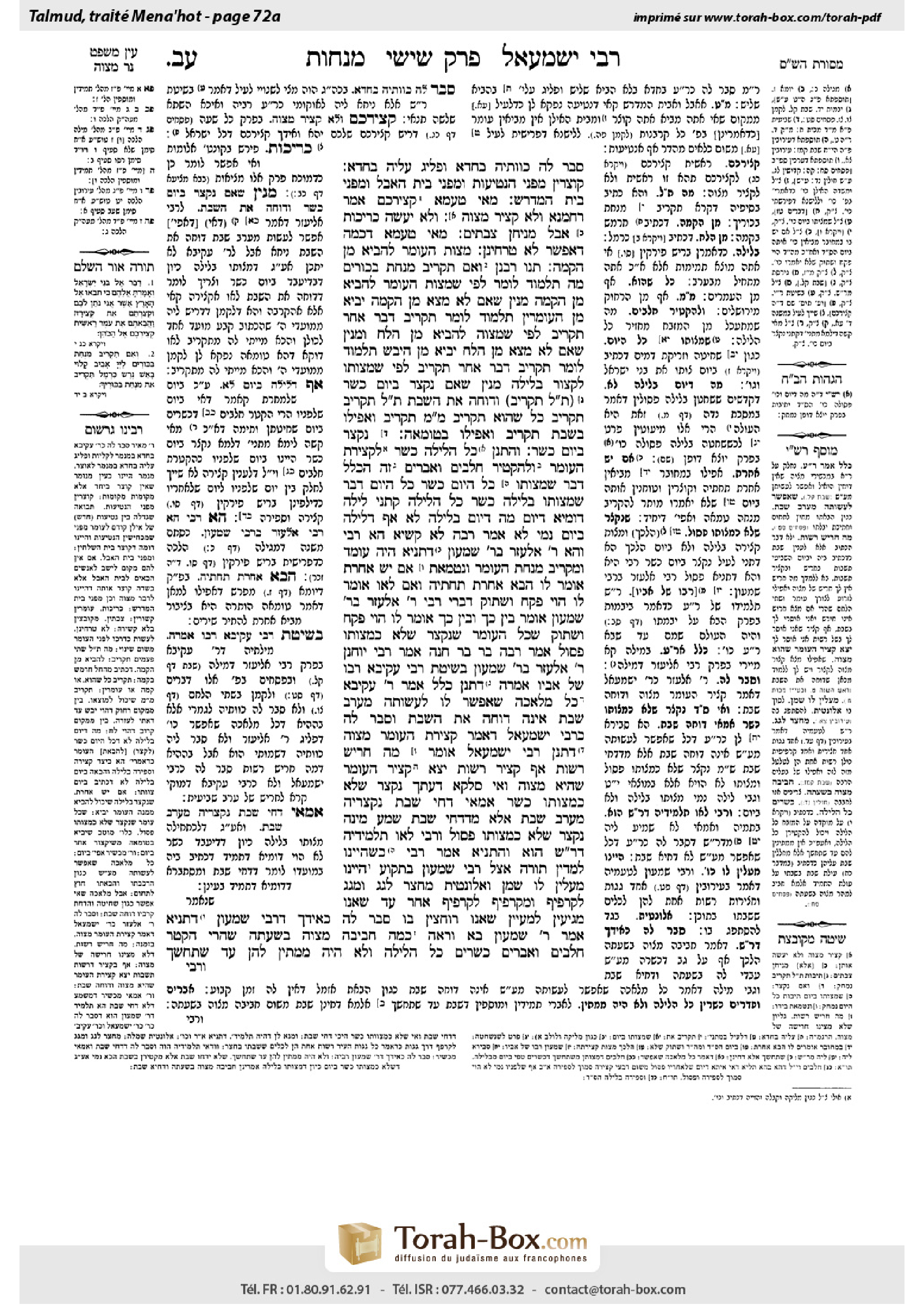
Menachot 72a: Talmud study for Daf Yomi
Daf Yomi is the daily study of one Talmud folio. Explore 37 tractates with scans, Hebrew text, Sefaria English and AI-generated French translations where annotated.
Passage selection and English or AI-generated French translation are available where the scan has annotations. Daf Study is independent of Torah-Box and Sefaria.
Browse Menachot · מנחות · All tractatesMenachot 72a text and translations
This page of Menachot includes the Aramaic text, an English translation and an AI-generated French translation, alongside the scan above.
מנחות ע״ב א · Aramaic and Hebrew text
סָבַר לַהּ כְּוָותֵיהּ בַּחֲדָא, וּפְלִיג עֲלֵיהּ בַּחֲדָא.
קוֹצְרִין מִפְּנֵי הַנְּטִיעוֹת, וּמִפְּנֵי בֵּית הָאֵבֶל, וּמִפְּנֵי בֵּית הַמִּדְרָשׁ. מַאי טַעְמָא? ״קְצִירְכֶם״ אָמַר רַחֲמָנָא, וְלֹא קְצִיר מִצְוָה.
וְלֹא יַעֲשֶׂה כְּרִיכוֹת, אֲבָל מַנִּיחָן צְבָתִים. מַאי טַעְמָא? דְּכַמָּה דְּאֶפְשָׁר לָא טָרְחִינַן.
מִצְוַת הָעוֹמֶר לְהָבִיא מִן הַקָּמָה. תָּנוּ רַבָּנַן: ״וְאִם תַּקְרִיב מִנְחַת בִּכּוּרִים״, מָה תַּלְמוּד לוֹמַר? לְפִי שֶׁמִּצְוַת הָעוֹמֶר לְהָבִיא מִן הַקָּמָה, מִנַּיִן שֶׁאִם לֹא מָצָא מִן הַקָּמָה יָבִיא מִן הָעֳמָרִין? תַּלְמוּד לוֹמַר ״תַּקְרִיב״.
דָּבָר אַחֵר: ״תַּקְרִיב״ – לְפִי שֶׁמִּצְוָה לְהָבִיא מִן הַלַּח, וּמִנַּיִן שֶׁאִם לֹא מָצָא מִן הַלַּח יָבִיא מִן הַיָּבֵשׁ? תַּלְמוּד לוֹמַר ״תַּקְרִיב״. דָּבָר אַחֵר: ״תַּקְרִיב״ – לְפִי שֶׁמִּצְוָתוֹ לִקְצוֹר בַּלַּיְלָה, מִנַּיִן שֶׁאִם נִקְצַר בַּיּוֹם כָּשֵׁר? תַּלְמוּד לוֹמַר ״תַּקְרִיב״.
וְדוֹחָה אֶת הַשַּׁבָּת, תַּלְמוּד לוֹמַר ״תַּקְרִיב״, ״תַּקְרִיב״ – כׇּל שֶׁהוּא, ״תַּקְרִיב״ – מִכׇּל מָקוֹם, ״תַּקְרִיב״ – וַאֲפִילּוּ בְּשַׁבָּת, ״תַּקְרִיב״ – וַאֲפִילּוּ בְּטוּמְאָה.
נִקְצַר בַּיּוֹם – כָּשֵׁר. וְהָתְנַן: כׇּל הַלַּיְלָה כָּשֵׁר לִקְצִירַת הָעוֹמֶר, וּלְהַקְטִיר חֲלָבִים וְאֵבָרִים. זֶה הַכְּלָל: דָּבָר שֶׁמִּצְוָתוֹ כׇּל הַיּוֹם – כָּשֵׁר כׇּל הַיּוֹם, דָּבָר שֶׁמִּצְוָתוֹ בְּלַיְלָה – כָּשֵׁר כׇּל הַלַּיְלָה.
קָתָנֵי לַיְלָה דּוּמְיָא דְּיוֹם, מָה דְּיוֹם – בַּלַּיְלָה לָא, אַף דְּלַיְלָה – בַּיּוֹם נָמֵי לָא.
אָמַר רַבָּה: לָא קַשְׁיָא, הָא רַבִּי, וְהָא רַבִּי אֶלְעָזָר בְּרַבִּי שִׁמְעוֹן. דְּתַנְיָא: הָיָה עוֹמֵד וּמַקְרִיב מִנְחַת הָעוֹמֶר וְנִטְמֵאת, אִם יֵשׁ אַחֶרֶת – אוֹמֵר לוֹ: ״הָבֵא אַחֶרֶת תַּחְתֶּיהָ״, וְאִם לָאו – אוֹמֵר לוֹ: ״הֱוֵי פִּקֵּחַ וּשְׁתוֹק״, דִּבְרֵי רַבִּי.
רַבִּי אֶלְעָזָר בְּרַבִּי שִׁמְעוֹן אוֹמֵר: בֵּין כָּךְ וּבֵין כָּךְ, אוֹמַר לוֹ: ״הֱוֵי פִּקֵּחַ וּשְׁתוֹק״, שֶׁכׇּל הָעוֹמֶר שֶׁנִּקְצַר שֶׁלֹּא כְּמִצְוָתוֹ – פָּסוּל.
אָמַר רַבָּה בַּר בַּר חָנָה אָמַר רַבִּי יוֹחָנָן: רַבִּי אֶלְעָזָר בְּרַבִּי שִׁמְעוֹן בְּשִׁיטַת רַבִּי עֲקִיבָא רַבּוֹ שֶׁל אָבִיו אֲמָרָהּ, דִּתְנַן: כְּלָל אָמַר רַבִּי עֲקִיבָא: כׇּל מְלָאכָה שֶׁאֶפְשָׁר לוֹ לַעֲשׂוֹתָהּ מֵעֶרֶב שַׁבָּת אֵינָהּ דּוֹחָה אֶת הַשַּׁבָּת.
וְסָבַר לַהּ כְּרַבִּי יִשְׁמָעֵאל, דְּאָמַר קְצִירַת הָעוֹמֶר מִצְוָה, דִּתְנַן: רַבִּי יִשְׁמָעֵאל אוֹמֵר: מָה חָרִישׁ רְשׁוּת, אַף קָצִיר רְשׁוּת, יָצָא קְצִיר הָעוֹמֶר שֶׁהִיא מִצְוָה.
וְאִי סָלְקָא דַעְתָּךְ נִקְצַר שֶׁלֹּא כְּמִצְוָתוֹ כָּשֵׁר, אַמַּאי דָּחֵי שַׁבָּת? נִקְצְרֵיהּ מֵעֶרֶב שַׁבָּת! אֶלָּא מִדְּדָחֵי שַׁבָּת, שְׁמַע מִינַּהּ: נִקְצַר שֶׁלֹּא כְּמִצְוָתוֹ – פָּסוּל.
וְרַבִּי, לָאו תַּלְמִידֵיהּ דְּרַבִּי שִׁמְעוֹן הוּא?
וְהָתַנְיָא, אָמַר רַבִּי: כְּשֶׁהָיִינוּ לְמֵדִין תּוֹרָה אֵצֶל רַבִּי שִׁמְעוֹן בִּתְקוֹעַ, הָיִינוּ מַעֲלִין לוֹ שֶׁמֶן וַאֲלוּנְטִית מֵחָצֵר לְגַג, וּמִגַּג לְקַרְפֵּיף, וּמִקַּרְפֵּיף לְקַרְפֵּיף אַחֵר, עַד שֶׁאָנוּ מַגִּיעִין לְמַעְיָין שֶׁאָנוּ רוֹחֲצִין בּוֹ.
סָבַר לַהּ כְּאִידַּךְ דְּרַבִּי שִׁמְעוֹן, דְּתַנְיָא: אָמַר רַבִּי שִׁמְעוֹן: בֹּא וּרְאֵה כַּמָּה חֲבִיבָה מִצְוָה בִּשְׁעָתָהּ, שֶׁהֲרֵי הֶקְטֵר חֲלָבִים וְאֵבָרִים כְּשֵׁרִים כׇּל הַלַּיְלָה, וְלֹא הָיָה מַמְתִּין לָהֶן עַד שֶׁתֶּחְשַׁךְ.
Menachot 72a · English translation
The Gemara answers: He holds in accordance with his opinion with regard to one issue, and disagrees with him with regard to one issue. In other words, Rabbi Meir holds in accordance with Rabbi Akiva’s opinion that the harvesting of fodder that has not yet reached one-third of its growth is not considered the start of the reaping of the entire crop, and he disagrees with Rabbi Akiva’s opinion that the harvesting of fodder that has reached one-third of its growth is also not considered the start of the reaping process, as Rabbi Meir maintains that this is considered the start of the reaping process even when it is performed for animals, and therefore it does not divide the field with regard to pe’a.
§ The mishna teaches: And one may reap crops prior to the omer due to potential damage to saplings growing alongside the crops; and due to the place of mourning, to create room for those consoling the mourners, who would bless them upon their return from the cemetery; and due to the need to create room for students to study, as failure to do so would lead to dereliction of Torah study in the study hall. The Gemara asks: What is the reason one is permitted to reap prior to the omer offering in these instances? The Gemara answers that the Merciful One states: “You shall bring the sheaf of the first fruits of your harvest to the priest” (Leviticus 23:10). The use of the term “your harvest” indicates that the omer offering’s reaping must precede any personal harvest, but it does not need to precede reaping for the purpose of a mitzva.
§ The mishna teaches: After reaping the crops for any of these reasons, one may not fashion them into sheaves, but he leaves them unbound. The Gemara asks: What is the reason? The Gemara answers: Although reaping is technically permitted, one should limit his involvement with the new grain. Therefore, as much as possible to avoid exerting effort in involvement with the grain, we do not exert effort.
§ The mishna teaches that the mitzva of the omer is to bring the barley from the standing grain. The Sages taught in a baraita: What is the meaning when the verse states: “And if you bring a meal offering of first fruits to the Lord, you shall bring for the meal offering of your first fruits grain in the ear parched with fire, even groats of the fresh ear” (Leviticus 2:14)? The baraita explains: Since the mitzva of the omer is to bring the barley from the standing grain, from where is it derived that if one does not find barley from the standing grain, he should bring it from the harvested and gathered sheaves? The verse states: “You shall bring,” to include this scenario.
Alternatively, the baraita suggests another reason why the verse states: “You shall bring.” Since it is a mitzva to bring the omer from the moist grain, one can ask: From where is it derived that if one does not find barley from the moist grain, he should bring it from the dry grain? The verse states: “You shall bring,” to include this case. Alternatively, the term “you shall bring” teaches the following: Since the mitzva of the omer is for it to be reaped at night, from where is it derived that if it was reaped during the daytime, it is fit? The verse states: “You shall bring.”
The baraita adds more halakhot that are derived from this same verse. From where is it derived that the omer offering overrides Shabbat? The verse states: “You shall bring.” Also, this term: “You shall bring,” teaches that the omer is brought in any manner that it is found, even from gathered sheaves. Furthermore, the term “you shall bring,” teaches that the omer crop may be brought from anywhere in Eretz Yisrael, if none is found near Jerusalem. Additionally, “you shall bring” teaches that it may be brought even on Shabbat. Lastly, “you shall bring” teaches that it may be brought even in a state of ritual impurity.
§ The mishna teaches: If it was reaped during the day, it is fit. The Gemara asks: But didn’t we learn in a mishna (Megilla 20b): All mitzvot that must be performed at night may be performed anytime during that night. Therefore, the entire night is valid for reaping the omer on the night following the first day of Passover, for burning the fats of offerings that had been brought during the preceding day, and for burning the limbs of burnt offerings. This is the principle: A matter that it is a mitzva to perform during the entire day is valid if performed anytime during the entire day, and likewise a matter that it is a mitzva to perform at night is valid if performed anytime during the entire night.
The Gemara analyzes this mishna: The mishna teaches the principle of mitzvot performed at night as being similar to the principle of those performed during the day. From this one can infer that just as in the case of a mitzva whose prescribed time is by day, if it is performed at night it is not valid, so too with regard to a mitzva whose prescribed time is at night, if it is performed by day it is also not valid. If so, why does the mishna here teach that if the omer was reaped during the day it is fit?
Rabba said: It is not difficult. This mishna, which teaches that the omer reaped during the day is valid, is in accordance with the opinion of Rabbi Yehuda HaNasi, and that mishna in Megilla, which states that any nighttime mitzva performed during the day is not valid, is in accordance with the opinion of Rabbi Elazar, son of Rabbi Shimon. As it is taught in a baraita (Tosefta 3:9): In a case where a priest was standing and sacrificing the omer meal offering and it became ritually impure in his hand, if there is another measure of barley grain that is ready to be reaped, then one says to the priest: Reap the barley and bring another meal offering in its stead. And if there is no alternative meal offering available, one says to him: Be shrewd and keep silent; i.e., do not tell anyone that it is impure. This is the statement of Rabbi Yehuda HaNasi.
Rabbi Elazar, son of Rabbi Shimon, says: In either case, one says to him: Be shrewd and keep silent, as any omer offering that is harvested not in accordance with the procedure dictated by its mitzva is unfit. Likewise, one may not reap the barley during the daytime, as its prescribed time is at night.
With regard to the opinion of Rabbi Elazar, son of Rabbi Shimon, that barley for the omer offering that is reaped by day is unfit, Rabba bar bar Ḥana says that Rabbi Yoḥanan says: Rabbi Elazar, son of Rabbi Shimon, said his statement in accordance with the opinion of Rabbi Akiva, the teacher of his father. As we learned in a mishna (Shabbat 130a): Rabbi Akiva stated a principle: Any prohibited labor that can be performed on Shabbat eve, i.e., before Shabbat begins, does not override Shabbat.
And furthermore, Rabbi Elazar, son of Rabbi Shimon, holds in accordance with the opinion of Rabbi Yishmael, who said that the reaping of barley for the omer offering is a mitzva. As we learned in a mishna (Shevi’it 1:4) that Rabbi Yishmael says: The verse: “In plowing time and in harvest you shall rest” (Exodus 34:21), is not referring to the prohibition against farming the land during the Sabbatical Year, as one might have thought. Rather, it is referring to the prohibition against performing labor on Shabbat. And the reason that the verse mentions these two particular forms of labor is to teach that just as the plowing that is prohibited on Shabbat is an otherwise voluntary act, as plowing is never required by the Torah, so too, the harvesting that is prohibited on Shabbat is voluntary. Therefore, the harvesting of the omer is excluded from the prohibition, as it is a mitzva. Consequently, the barley for the omer is harvested on the sixteenth of Nisan, even if it occurs on Shabbat.
Rabbi Yoḥanan explains why Rabbi Elazar, son of Rabbi Shimon, holds in accordance with the opinion of Rabbi Yishmael: And Rabbi Elazar, son of Rabbi Shimon, reached his opinion by the following reasoning: If it enters your mind to say that barley for the omer offering that is reaped not in accordance with the procedure dictated by its mitzva is nevertheless fit, why would it override Shabbat? Let one reap it on Shabbat eve. Rather, from the fact that the reaping overrides Shabbat, learn from here that if it was reaped not in accordance with its mitzva, it is unfit.
The Gemara comments: Isn’t Rabbi Yehuda HaNasi also a student of Rabbi Shimon, who was a student of Rabbi Akiva? Since Rabbi Yehuda HaNasi was a student of Rabbi Shimon, and by extension of Rabbi Akiva, he should accept Rabbi Akiva’s principle that any prohibited labor that can be performed on Shabbat eve does not override Shabbat. If so, as Rabbi Yehuda HaNasi holds that if the omer was not performed at night it should be done by day, why does its harvest override Shabbat? Let it be harvested on Shabbat eve.
The Gemara cites a proof for its claim that Rabbi Yehuda HaNasi was a student of Rabbi Shimon. But isn’t it taught in a baraita that Rabbi Yehuda HaNasi said: When we would study Torah with Rabbi Shimon in Tekoa, we would carry to him oil and a towel [aluntit] from the courtyard to the roof and from the roof into an enclosure similar to a courtyard, and from one enclosure to another enclosure, until we reached the spring in which we would bathe, without passing through a public domain.
The Gemara answers: Rabbi Yehuda HaNasi concedes that reaping barley for the omer offering overrides Shabbat, in accordance with Rabbi Akiva. But this is not because it is unfit if reaped at an improper time. Rather, Rabbi Yehuda HaNasi holds in accordance with the other opinion of Rabbi Shimon, as it is taught in a baraita that Rabbi Shimon said: Come and see how dear is a mitzva performed in its proper time. As burning the fats and limbs is valid all night, and therefore it is possible to wait until the conclusion of Shabbat and burn them at night, but nevertheless one would not wait with them until nightfall; rather, one burns them immediately, even on Shabbat. Likewise, when it comes to the reaping of the omer, although it is fit if reaped during the previous day, reaping at night still overrides Shabbat because a mitzva is dear when performed in its proper time.
Menachot 72a · Traduction française (IA)
La Guemara répond : Il partage son avis sur un point et s’en écarte sur un autre. Autrement dit, Rabbi Meïr partage l’avis de Rabbi Akiva selon lequel la récolte du fourrage qui n’a pas encore atteint le tiers de sa croissance n’est pas considérée comme le début de la moisson de toute la récolte. Mais il s’écarte de l’avis de Rabbi Akiva selon lequel la récolte du fourrage qui a atteint le tiers de sa croissance n’est pas non plus considérée comme le début de la moisson : Rabbi Meïr estime que, même lorsqu’elle est effectuée pour les animaux, elle est considérée comme le début de la moisson et ne divise donc pas le champ en ce qui concerne la péa.
§ La Michna enseigne : On peut moissonner les récoltes avant l’offrande du omer afin d’éviter que les jeunes arbres poussant à côté des cultures ne soient endommagés ; à cause du lieu de deuil, pour faire de la place à ceux qui réconfortent les endeuillés et les bénissent à leur retour du cimetière ; et afin de faire de la place aux élèves pour étudier, car autrement l’étude de la Torah serait négligée dans la maison d’étude. La Guemara demande : Pour quelle raison est-il permis de moissonner avant l’offrande du omer dans ces cas ? La Guemara répond que le Miséricordieux dit : « Vous apporterez au prêtre la gerbe des prémices de votre moisson » (Lévitique 23:10). L’expression « votre moisson » indique que la moisson destinée à l’offrande du omer doit précéder toute moisson personnelle, mais qu’elle n’a pas à précéder une moisson effectuée dans le but d’accomplir une mitsva.
§ La Michna enseigne : Après avoir moissonné les récoltes pour l’une de ces raisons, on ne doit pas les lier en gerbes, mais les laisser sans les attacher. La Guemara demande : Pour quelle raison ? La Guemara répond : Bien que la moisson soit techniquement permise, il faut limiter les manipulations du grain nouveau. Par conséquent, dans la mesure du possible, on évite de se donner la peine de manipuler le grain.
§ La Michna enseigne que la mitsva du omer consiste à apporter l’orge prise dans la récolte sur pied. Les Sages ont enseigné dans une baraïta : Que signifie le verset : « Si tu apportes à l’Éternel une offrande de prémices, tu apporteras pour l’offrande de tes prémices du grain en épis, grillé au feu, des gruaux de grain frais » (Lévitique 2:14) ? La baraïta explique : Puisque la mitsva du omer consiste à apporter l’orge prise dans la récolte sur pied, d’où déduit-on que si l’on ne trouve pas d’orge sur pied, on doit en apporter des gerbes déjà moissonnées et rassemblées ? Le verset dit : « Tu apporteras », pour inclure ce cas.
La baraïta propose une autre explication de la raison pour laquelle le verset dit : « Tu apporteras ». Puisqu’il est une mitsva d’apporter le omer à partir de grain humide, on peut demander : D’où déduit-on que si l’on ne trouve pas de grain humide, on doit en apporter à partir de grain sec ? Le verset dit : « Tu apporteras », pour inclure ce cas. Autre possibilité : l’expression « tu apporteras » enseigne ce qui suit : Puisque la mitsva du omer consiste à le moissonner la nuit, d’où déduit-on que s’il a été moissonné pendant la journée, il est apte ? Le verset dit : « Tu apporteras ».
La baraïta ajoute d’autres halakhot déduites de ce même verset. D’où déduit-on que l’offrande du omer repousse Chabbat ? Le verset dit : « Tu apporteras ». De plus, cette expression, « tu apporteras », enseigne que le omer est apporté sous la forme où on le trouve, même à partir de gerbes rassemblées. En outre, l’expression « tu apporteras » enseigne que la récolte destinée au omer peut provenir de n’importe quel endroit d’Eretz Israël, si l’on n’en trouve pas près de Jérusalem. De plus, « tu apporteras » enseigne qu’on peut l’apporter même le Chabbat. Enfin, « tu apporteras » enseigne qu’on peut l’apporter même en état d’impureté rituelle.
§ La Michna enseigne : S’il a été moissonné pendant la journée, il est apte. La Guemara demande : Mais n’avons-nous pas appris dans une Michna (Meguila 20b) : Toutes les mitsvot qui doivent être accomplies la nuit peuvent l’être à n’importe quel moment de cette nuit. La nuit entière convient donc pour moissonner le omer dans la nuit qui suit le premier jour de Pessa’h, pour brûler les graisses des sacrifices offerts la veille et pour brûler les membres des holocaustes. Voici le principe : une action qu’il est une mitsva d’accomplir pendant toute la journée est valide si elle est accomplie à n’importe quel moment de la journée entière ; de même, une action qu’il est une mitsva d’accomplir la nuit est valide si elle est accomplie à n’importe quel moment de la nuit entière.
La Guemara analyse cette Michna : La Michna énonce le principe concernant les mitsvot accomplies la nuit en le rapprochant de celui concernant les mitsvot accomplies le jour. On peut en déduire que, de même qu’une mitsva dont le moment prescrit est le jour n’est pas valide si elle est accomplie la nuit, une mitsva dont le moment prescrit est la nuit n’est pas non plus valide si elle est accomplie le jour. Si tel est le cas, pourquoi la Michna enseigne-t-elle ici que si le omer a été moissonné pendant la journée, il est apte ?
Rabba dit : Il n’y a pas de difficulté. Cette Michna, qui enseigne que le omer moissonné pendant la journée est valide, suit l’opinion de Rabbi Yehouda HaNassi ; tandis que la Michna de Meguila, qui affirme que toute mitsva nocturne accomplie le jour n’est pas valide, suit l’opinion de Rabbi Elazar, fils de Rabbi Shimon. En effet, il est enseigné dans une baraïta (Tossefta 3:9) : Dans le cas où un prêtre était en train d’offrir l’offrande de farine du omer et que celle-ci devint rituellement impure dans sa main, s’il y a une autre mesure d’orge prête à être moissonnée, on dit au prêtre : « Moissonne l’orge et apporte une autre offrande de farine à sa place. » Et si aucune autre offrande de farine n’est disponible, on lui dit : « Sois avisé et garde le silence », c’est-à-dire : ne dis à personne qu’elle est impure. Telle est la déclaration de Rabbi Yehouda HaNassi.
Rabbi Elazar, fils de Rabbi Shimon, dit : Dans les deux cas, on lui dit : « Sois avisé et garde le silence », car toute offrande du omer récoltée autrement que selon la procédure prescrite par sa mitsva est inapte. De même, on ne peut pas moissonner l’orge pendant la journée, puisque le moment prescrit est la nuit.
Au sujet de l’avis de Rabbi Elazar, fils de Rabbi Shimon, selon lequel l’orge destinée à l’offrande du omer, moissonnée le jour, est inapte, Rabba bar bar Ḥana dit au nom de Rabbi Yoḥanan : Rabbi Elazar, fils de Rabbi Shimon, a énoncé son propos conformément à l’avis de Rabbi Akiva, le maître de son père. En effet, nous avons appris dans une Michna (Chabbat 130a) : Rabbi Akiva a énoncé un principe : tout travail interdit qui peut être effectué la veille de Chabbat, c’est-à-dire avant le début de Chabbat, ne repousse pas Chabbat.
De plus, Rabbi Elazar, fils de Rabbi Shimon, partage l’avis de Rabbi Yishmaël, qui a dit que la moisson de l’orge destinée à l’offrande du omer est une mitsva. En effet, nous avons appris dans une Michna (Shevi’it 1:4) que Rabbi Yishmaël dit : Le verset « Au temps du labour et de la moisson, tu te reposeras » (Exode 34:21) ne se rapporte pas à l’interdiction de travailler la terre pendant l’année sabbatique, contrairement à ce qu’on pourrait penser. Il se rapporte plutôt à l’interdiction d’effectuer un travail le Chabbat. Si le verset mentionne précisément ces deux formes de travail, c’est pour enseigner que, de même que le labour interdit le Chabbat est une activité facultative, puisque la Torah ne prescrit jamais de labourer, la moisson interdite le Chabbat est elle aussi une activité facultative. Par conséquent, la moisson du omer est exclue de cette interdiction, car elle constitue une mitsva. L’orge destinée au omer est donc moissonnée le seize Nisan, même si ce jour tombe Chabbat.
Rabbi Yoḥanan explique pourquoi Rabbi Elazar, fils de Rabbi Shimon, partage l’avis de Rabbi Yishmaël : Rabbi Elazar, fils de Rabbi Shimon, est parvenu à son opinion par le raisonnement suivant : Si l’on envisage de dire que l’orge destinée à l’offrande du omer, lorsqu’elle est moissonnée autrement que selon la procédure prescrite par sa mitsva, reste néanmoins apte, pourquoi la moisson repousserait-elle Chabbat ? Qu’on la moissonne la veille de Chabbat. Au contraire, déduis de ce fait que la moisson repousse Chabbat qu’une récolte effectuée autrement que conformément à sa mitsva est inapte.
La Guemara fait remarquer : Rabbi Yehouda HaNassi n’est-il pas lui aussi un élève de Rabbi Shimon, qui était lui-même un élève de Rabbi Akiva ? Puisque Rabbi Yehouda HaNassi était l’élève de Rabbi Shimon et, par extension, de Rabbi Akiva, il devrait accepter le principe de Rabbi Akiva selon lequel tout travail interdit qui peut être effectué la veille de Chabbat ne repousse pas Chabbat. Dans ce cas, puisque Rabbi Yehouda HaNassi estime que si le omer n’a pas été accompli la nuit, il faut l’accomplir le jour, pourquoi sa moisson repousse-t-elle Chabbat ? Qu’on le moissonne la veille de Chabbat.
La Guemara cite une preuve à l’appui de son affirmation selon laquelle Rabbi Yehouda HaNassi était un élève de Rabbi Shimon. N’est-il pas enseigné dans une baraïta que Rabbi Yehouda HaNassi a dit : Lorsque nous étudiions la Torah auprès de Rabbi Shimon à Tekoa, nous lui apportions de l’huile et une serviette [aluntit] de la cour au toit, puis du toit à une enceinte semblable à une cour, et d’une enceinte à une autre, jusqu’à la source où nous nous baignions, sans passer par un domaine public.
La Guemara répond : Rabbi Yehouda HaNassi reconnaît que la moisson de l’orge destinée à l’offrande du omer repousse Chabbat, conformément à Rabbi Akiva. Mais ce n’est pas parce qu’elle serait inapte si elle était moissonnée au mauvais moment. Rabbi Yehouda HaNassi partage plutôt l’autre avis de Rabbi Shimon, comme il est enseigné dans une baraïta : Rabbi Shimon a dit : « Viens et vois combien est précieuse une mitsva accomplie au moment qui lui convient. » En effet, les graisses et les membres peuvent être brûlés pendant toute la nuit ; il est donc possible d’attendre la fin de Chabbat pour les brûler la nuit. Pourtant, on ne les garde pas jusqu’à la tombée de la nuit ; on les brûle immédiatement, même le Chabbat. De même, pour la moisson du omer, bien qu’il soit valide de le moissonner la veille, la moisson effectuée la nuit repousse néanmoins Chabbat, car une mitsva est précieuse lorsqu’elle est accomplie au moment qui lui convient.
Traduction française générée par IA à partir de l’édition anglaise de Sefaria. Vérifie toujours un passage avec le texte source.
Text from Sefaria: William Davidson Edition - Vocalized Aramaic (unknown); William Davidson Edition - English (CC BY NC).