Menachot 71b: Talmud study for Daf Yomi
Daf Yomi is the daily study of one Talmud folio. Explore 37 tractates with scans, Hebrew text, Sefaria English and AI-generated French translations where annotated.
Passage selection and English or AI-generated French translation are available where the scan has annotations. Daf Study is independent of Torah-Box and Sefaria.
Browse Menachot · מנחות · All tractatesMenachot 71b text and translations
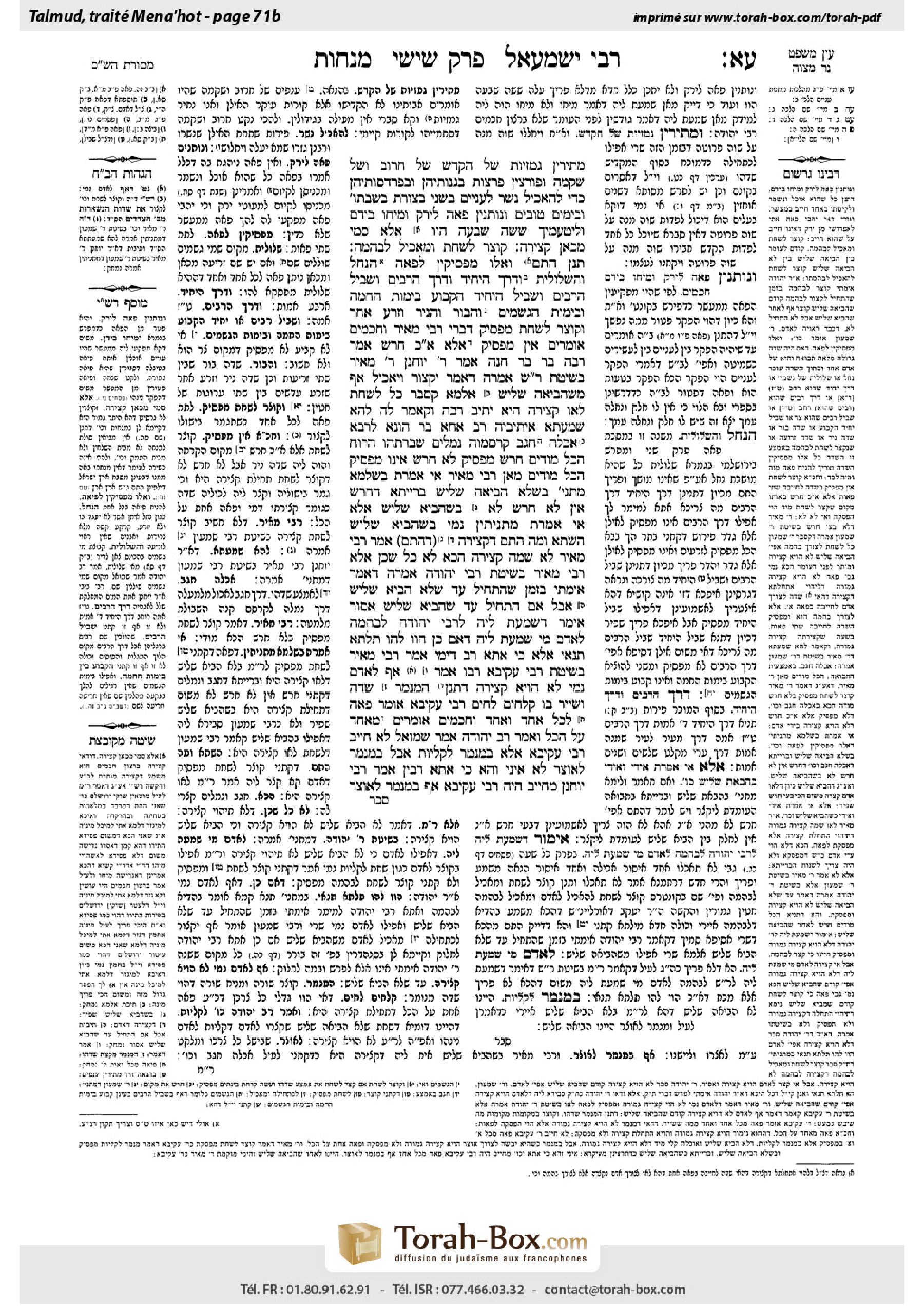
This page of Menachot includes the Aramaic text, an English translation and an AI-generated French translation, alongside the scan above.
מנחות ע״א ב · Aramaic and Hebrew text
מַתִּירִין גַּמְזִיּוֹת שֶׁל הֶקְדֵּשׁ שֶׁל חָרוּב וְשֶׁל שִׁקְמָה, וּפוֹרְצִין פְּרָצוֹת בְּגַנּוֹתֵיהֶן וּבְפַרְדְּסוֹתֵיהֶן כְּדֵי לְהַאֲכִיל נֶשֶׁר לַעֲנִיִּים בִּשְׁנֵי בַצּוֹרֶת בְּשַׁבָּתוֹת וּבְיָמִים טוֹבִים, וְנוֹתְנִין פֵּאָה לַיָּרָק, וּמִיחוּ בְּיָדָם.
וְלִיטַעְמָיךְ, שִׁשָּׁה? שִׁבְעָה הָווּ! אֶלָּא סְמִי מִכָּאן קְצִירָה.
קוֹצֵר לְשַׁחַת וּמַאֲכִיל לַבְּהֵמָה. תְּנַן הָתָם: וְאֵלּוּ מַפְסִיקִין לַפֵּאָה – הַנַּחַל, וְהַשְּׁלוּלִית, וְדֶרֶךְ הַיָּחִיד, וְדֶרֶךְ הָרַבִּים, וּשְׁבִיל הָרַבִּים, וּשְׁבִיל הַיָּחִיד הַקָּבוּעַ בִּימוֹת הַחַמָּה וּבִימוֹת הַגְּשָׁמִים, וְהַבּוֹר, וְהַנִּיר, וְזֶרַע אַחֵר.
וְקוֹצֵר לְשַׁחַת מַפְסִיק, דִּבְרֵי רַבִּי מֵאִיר, וַחֲכָמִים אוֹמְרִים: אֵין מַפְסִיק אֶלָּא אִם כֵּן חָרַשׁ.
אָמַר רַבָּה בַּר בַּר חָנָה, אָמַר רַבִּי יוֹחָנָן: רַבִּי מֵאִיר בְּשִׁיטַת רַבִּי שִׁמְעוֹן אֲמָרָהּ, דְּאָמַר: יִקְצוֹר וְיַאֲכִיל אַף מִשֶּׁהֵבִיאָה שְׁלִישׁ, אַלְמָא קָסָבַר כֹּל לְשַׁחַת לָאו קְצִירָה הִיא.
יָתֵיב רַבָּה וְקָאָמַר לַהּ לְהָא שְׁמַעְתָּא, אֵיתִיבֵיהּ רַב אַחָא בַּר הוּנָא לְרָבָא: אֲכָלָהּ חָגָב, קַרְסְמוּהָ נְמָלִים, שִׁבְּרַתָּהוֹ הָרוּחַ – הַכֹּל מוֹדִים חָרַשׁ מַפְסִיק, לֹא חָרַשׁ אֵינוֹ מַפְסִיק. ״הַכֹּל מוֹדִים״ – מַאן? רַבִּי מֵאִיר.
אִי אָמְרַתְּ בִּשְׁלָמָא מַתְנִיתִין בְּשֶׁלֹּא הֵבִיאָה שְׁלִישׁ, בָּרַיְיתָא דְּחָרַשׁ – אִין, לֹא חָרַשׁ – לֹא, בְּשֶׁהֵבִיא שְׁלִישׁ.
אֶלָּא אִי אָמְרַתְּ מַתְנִיתִין נָמֵי בְּשֶׁהֵבִיא שְׁלִישׁ, הַשְׁתָּא וּמָה הָתָם דִּקְצִירָה דְּהָתָם אָמַר רַבִּי מֵאִיר: לֹא שְׁמָהּ קְצִירָה, הָכָא – לֹא כׇּל שֶׁכֵּן?
אֶלָּא, רַבִּי מֵאִיר בְּשִׁיטַת רַבִּי יְהוּדָה אֲמָרָהּ, דְּאָמַר: אֵימָתַי? בִּזְמַן שֶׁהִתְחִיל עַד שֶׁלֹּא הֵבִיא שְׁלִישׁ, אֲבָל אִם הִתְחִיל עַד שֶׁהֵבִיא שְׁלִישׁ – אָסוּר.
אֵימַר דְּשָׁמְעַתְּ לֵיהּ לְרַבִּי יְהוּדָה לִבְהֵמָה, לְאָדָם מִי שָׁמְעַתְּ לֵיהּ? דְּאִם כֵּן, הָווּ לְהוּ תְּלָתָא תַּנָּאֵי.
אֶלָּא, כִּי אֲתָא רַב דִּימִי אָמַר: רַבִּי מֵאִיר בְּשִׁיטַת רַבִּי עֲקִיבָא רַבּוֹ אָמַר, אַף לְאָדָם נָמֵי לָא הָוְיָא קְצִירָה. דִּתְנַן: הַמְנַמֵּר שָׂדֶה וְשִׁיֵּיר בּוֹ קְלָחִים לַחִים, רַבִּי עֲקִיבָא אוֹמֵר: פֵּאָה לְכׇל אֶחָד וְאֶחָד.
וַחֲכָמִים אוֹמְרִים: מֵאֶחָד עַל הַכֹּל, וְאָמַר רַב יְהוּדָה אָמַר שְׁמוּאֵל: לֹא חִיֵּיב רַבִּי עֲקִיבָא אֶלָּא בִּמְנַמֵּר לִקְלָיוֹת, אֲבָל בִּמְנַמֵּר לָאוֹצָר – לֹא.
אִינִי? וְהָא כִּי אֲתָא רָבִין אָמַר רַבִּי יוֹחָנָן: מְחַיֵּיב הָיָה רַבִּי עֲקִיבָא אַף בִּמְנַמֵּר לָאוֹצָר.
Menachot 71b · English translation
They would permit the use of consecrated branches of carob and of sycamore trees; they would make breaches in the walls of their gardens and orchards, in order to feed fallen fruit to the poor during drought years on Shabbatot and Festivals; and they would designate for the poor the produce in the corner [pe’a] in a field of vegetables. And the Sages reprimanded them for those actions. It is clear from the baraita that according to Rabbi Yehuda the reaping of the grain before the omer offering was performed without the approval of the Sages. So why does the mishna, which represents Rabbi Yehuda’s opinion, teach that it was with the approval of the Sages?
The Gemara responds: And according to your reasoning, why did the baraita say that the residents of Jericho performed six actions without the approval of the Sages? Counting the cases listed in the baraita, there were in fact seven actions, as reaping and piling count as two actions. Evidently, the text of the baraita is problematic. The Gemara concludes: Rather, omit from here the case of the reaping of the grain before the omer offering was brought. If so, then in the baraita Rabbi Yehuda never commented about the reaping of the grain before the omer, and therefore it does not contradict the mishna’s statement that it was performed with the approval of the Sages.
§ The mishna teaches: One may reap crops in any field for fodder and feed it to an animal even before the omer offering. The Gemara notes that we learned in a mishna there (Pe’a 2:1): And these divide a field for the purpose of pe’a, i.e., the presence of any of these separates a field so that each section constitutes a distinct field from which pe’a must be allocated independently: A stream that passes through the field, and a canal [vehashelulit], and a private road that is four cubits wide, and a public road that is at least sixteen cubits wide, and a permanent public trail or a private trail that is used whether in the summer or in the rainy season, i.e., winter, and an uncultivated field, and a plowed field, and a seed of a different kind of plant, e.g., a section of barley seed in a field full of wheat.
In all of the aforementioned instances a field is considered divided into two distinct fields. Another type of separation is subject to dispute: And in the case of one who reaps crops in a field for fodder, this action also divides a field in two. This is the statement of Rabbi Meir. And the Rabbis say: It does not divide a field unless one also plowed the area that he reaped. Only then is the field divided, as it is a plowed field.
With regard to the opinion of Rabbi Meir, Rabba bar bar Ḥana says that Rabbi Yoḥanan says: Rabbi Meir said his statement in accordance with the opinion of Rabbi Shimon, who says in the mishna: One may reap and feed the crops to animals even after they reached one-third of their potential growth. Apparently, Rabbi Shimon holds that any reaping performed for fodder is not considered reaping. Likewise, Rabbi Meir maintains that reaping for fodder, even after the crop has reached one-third of its potential growth, is not considered the start of the reaping of the entire field, and therefore it divides the field.
Rabba sat and stated this halakha. Rav Aḥa bar Huna raised an objection to Rava from a baraita: If a section of crops in a field was consumed by grasshoppers, or ants nibbled away at those crops [kirsemuha], or the wind broke it down, all concede that if that section was subsequently plowed, it divides the field, and if it was not plowed, it does not divide the field. When the baraita states: All concede, to whom is it referring? It must be referring to Rabbi Meir, who maintains that usually, reaping for fodder divides a field without subsequent plowing, yet in this case he admits that it divides the field only if it is subsequently plowed.
Rav Aḥa bar Huna explains his objection to the opinion that Rabbi Meir holds in accordance with Rabbi Shimon: Granted, Rabbi Meir’s opinion can be explained if you say that the mishna, where Rabbi Meir maintains that reaping fodder is not considered reaping, is referring to a case where the fodder had not yet reached one-third of its potential growth, and the baraita, where he maintains that only if it was plowed, yes, it divides the field, but if was not plowed, no, it does not divide the field, is referring to a case where the fodder had already reached one-third of its growth. If so, the difference between the rulings of Rabbi Meir is clear, as it all depends on the growth of the produce.
But if you say that Rabbi Meir holds in accordance with Rabbi Shimon, and the mishna is also referring to a case where the fodder had reached one-third of its growth, how can his ruling in the baraita be explained? Now, if with regard to reaping there, in a case where it involves human intervention, Rabbi Meir said: It is not called reaping; here in the baraita, where the reaping is performed by grasshoppers or ants, is it not clear all the more so that Rabbi Meir would not consider it reaping? And yet the baraita indicates that all agree that it is considered reaping, as it does not divide the field without plowing.
Rather, Rabbi Meir stated his opinion in accordance with the opinion of Rabbi Yehuda, who says, with regard to the statement of the first tanna in the mishna that one may reap fodder and feed it to an animal: When [eimatai] may one do so? At a time when he began reaping before the crop reaches one-third of its potential growth. But if he began after the crop reached one-third, it is prohibited. If so, the discrepancy between Rabbi Meir’s opinion in the mishna and in the baraita can be resolved, as the mishna is referring to a case where the crops had not yet reached one-third of their growth, whereas the baraita is speaking of crops that had already reached one-third of their growth and therefore their harvesting is considered the start of the reaping of the field, which divides it only if he subsequently plows.
The Gemara asks: You can say that you heard Rabbi Yehuda express his opinion with regard to fodder that is reaped for the purposes of feeding an animal, but did you hear him say so with regard to a case where the reaping is performed for human consumption? That cannot be his opinion, since if it were so, then there would be three disputing opinions among the tanna’im: The opinion of the first tanna, who holds that reaping fodder for animal consumption is permitted; the opinion of Rabbi Yehuda, who maintains that it may be reaped even for human consumption provided that it has not grown one-third; and the opinion of Rabbi Shimon, who holds that it is permitted for human consumption even in a case where it had grown one-third. This is problematic, as the Gemara in tractate Sanhedrin (25a) states a principle that whenever Rabbi Yehuda says in a mishna: When [eimatai], he is clarifying, rather than disagreeing with, the opinion of the previous tanna.
Rather, when Rav Dimi came from Eretz Yisrael he said: Rabbi Meir stated his opinion in accordance with the opinion of Rabbi Akiva, his teacher. Rabbi Akiva holds that even harvesting for human consumption is not considered reaping with regard to the halakhot of pe’a, as we learned in a mishna (Pe’a 3:2): With regard to one who reaps alternate rows of his field, and he leaves in it moist stems that are not yet fully grown, Rabbi Akiva says: One must separate pe’a in each and every row, as each one is considered a separate field.
And the Rabbis say: One separates pe’a from one row for the whole field, as they are all considered a single field. And Rav Yehuda says that Shmuel says: Rabbi Akiva maintained that one is obligated to separate pe’a from each row only when he reaps alternate rows and the grain is unripe kernels used for making roasted grains. But when one reaps alternate rows and the grain is fully grown produce for his storehouse, there is no obligation to separate pe’a from each row, as all the rows are considered part of one field. Rav Dimi is suggesting that Rabbi Meir holds in accordance with the opinion of Rabbi Akiva, and therefore the discrepancy between the mishna and the baraita can be resolved: The mishna is discussing unripe grains that have not yet grown one-third, similar to unripe kernels used for roasted grains, whereas the baraita is discussing fully grown, ripened grains.
The Gemara asks: Is that so? But when Ravin came from Eretz Yisrael to Babylonia he reported that Rabbi Yoḥanan said: Rabbi Akiva deems one obligated in the separation of pe’a from each row even where he reaped fully grown fodder in alternative sections of his field for the purposes of storing in a storehouse. According to Ravin, Rabbi Akiva holds that reaping even fully grown fodder is not considered the start of the entire field’s reaping process, but only of the individual row. Therefore, one must separate pe’a from each row. This is inconsistent with Rabbi Meir’s opinion that the harvesting of fodder that has grown one-third is considered reaping.
Menachot 71b · Traduction française (IA)
Ils autorisaient l’utilisation de branches consacrées de caroubier et de sycomore ; ils ouvraient des brèches dans les murs de leurs jardins et de leurs vergers afin de donner aux pauvres les fruits tombés pendant les années de sécheresse, les Chabbat et les jours de fête ; et ils désignaient pour les pauvres la récolte de la parcelle d’angle [pe’a] dans un champ de légumes. Les Sages leur reprochèrent ces actes. Il ressort clairement de la baraïta que, selon Rabbi Yehouda, la moisson du grain avant l’offrande du omer était effectuée sans l’approbation des Sages. Pourquoi donc la Michna, qui présente l’opinion de Rabbi Yehouda, enseigne-t-elle qu’elle était effectuée avec l’approbation des Sages ?
La Guemara répond : selon votre raisonnement, pourquoi la baraïta dit-elle que les habitants de Jéricho accomplissaient six actes sans l’approbation des Sages ? En comptant les cas énumérés dans la baraïta, il y avait en réalité sept actes, car moissonner et mettre en meules comptent pour deux actes. Le texte de la baraïta pose donc manifestement problème. La Guemara conclut : il faut plutôt retrancher ici le cas de la moisson du grain avant l’offrande du omer. Ainsi, dans la baraïta, Rabbi Yehouda ne s’est pas prononcé sur la moisson du grain avant le omer ; il n’y a donc pas de contradiction avec l’affirmation de la Michna selon laquelle elle était effectuée avec l’approbation des Sages.
§ La Michna enseigne : on peut moissonner des récoltes dans n’importe quel champ pour en faire du fourrage et les donner à manger à un animal, même avant l’offrande du omer. La Guemara relève que nous avons appris dans une Michna, là-bas (Pe’a 2:1) : voici les éléments qui divisent un champ aux fins de la pe’a, c’est-à-dire dont la présence sépare un champ en sections, chacune constituant un champ distinct pour lequel la pe’a doit être prélevée séparément : un cours d’eau qui traverse le champ, un canal [vehashelulit], une route privée de quatre coudées de large, une voie publique d’au moins seize coudées de large, un chemin public permanent ou un chemin privé emprunté aussi bien en été que pendant la saison des pluies, c’est-à-dire en hiver, un champ laissé en friche, un champ labouré et une culture d’une autre espèce végétale, par exemple une bande d’orge dans un champ entièrement semé de blé.
Dans tous les cas susmentionnés, le champ est considéré comme divisé en deux champs distincts. Un autre type de séparation fait l’objet d’une controverse : celui qui moissonne des récoltes dans un champ pour en faire du fourrage divise également le champ en deux. Telle est l’opinion de Rabbi Meïr. Les Sages disent : le champ n’est divisé que si l’on a également labouré la zone moissonnée. Ce n’est qu’alors que le champ est divisé, puisqu’il s’agit d’un champ labouré.
Au sujet de l’opinion de Rabbi Meïr, Rabba bar bar Ḥana dit au nom de Rabbi Yoḥanan : Rabbi Meïr a exprimé son opinion conformément à celle de Rabbi Shimon, qui dit dans la Michna : on peut moissonner et donner les récoltes à manger aux animaux même après qu’elles ont atteint le tiers de leur croissance potentielle. Il semble que Rabbi Shimon considère que toute moisson destinée au fourrage n’est pas considérée comme une moisson. De même, Rabbi Meïr soutient que moissonner pour en faire du fourrage, même après que la récolte a atteint le tiers de sa croissance potentielle, ne constitue pas le début de la moisson de tout le champ ; l’opération divise donc le champ.
Rabba était assis et énonçait cette halakha. Rav Aḥa bar Huna souleva une objection contre Rava à partir d’une baraïta : si une partie des récoltes d’un champ a été dévorée par des sauterelles, si des fourmis les ont grignotées [kirsemuha], ou si le vent les a abattues, tous reconnaissent que, si cette partie a ensuite été labourée, elle divise le champ, et que, si elle n’a pas été labourée, elle ne le divise pas. À qui la baraïta fait-elle référence lorsqu’elle dit : « tous reconnaissent » ? Nécessairement à Rabbi Meïr, qui soutient qu’en général, moissonner pour faire du fourrage divise un champ sans labour ultérieur, mais qui, dans ce cas, admet que la zone ne divise le champ que si elle est ensuite labourée.
Rav Aḥa bar Huna explique son objection à l’opinion selon laquelle Rabbi Meïr suit Rabbi Shimon : certes, on peut expliquer l’opinion de Rabbi Meïr en disant que la Michna, où Rabbi Meïr soutient que moissonner du fourrage n’est pas considéré comme une moisson, parle d’un cas où le fourrage n’avait pas encore atteint le tiers de sa croissance potentielle, tandis que la baraïta, où il soutient que la zone divise le champ si elle a été labourée, mais ne le divise pas si elle ne l’a pas été, parle d’un cas où le fourrage avait déjà atteint le tiers de sa croissance. Dans ce cas, la différence entre les décisions de Rabbi Meïr est évidente, car tout dépend de la croissance des produits.
Mais si vous dites que Rabbi Meïr suit Rabbi Shimon et que la Michna parle également d’un cas où le fourrage avait atteint le tiers de sa croissance, comment expliquer sa décision dans la baraïta ? Si, à propos de la moisson, dans le cas où elle résulte d’une intervention humaine, Rabbi Meïr a dit : « Cela ne s’appelle pas moissonner », alors ici, dans la baraïta, où les sauterelles ou les fourmis ont effectué la moisson, n’est-il pas d’autant plus évident que Rabbi Meïr ne considérerait pas cela comme une moisson ? Pourtant, la baraïta indique que tous reconnaissent que cela est considéré comme une moisson, puisqu’en l’absence de labour, la zone ne divise pas le champ.
Il faut plutôt dire que Rabbi Meïr a exprimé son opinion conformément à celle de Rabbi Yehouda, qui dit à propos de la déclaration du premier tanna dans la Michna selon laquelle on peut moissonner du fourrage et le donner à manger à un animal : « Quand [eimatai] peut-on le faire ? Lorsqu’on a commencé à moissonner avant que la récolte n’atteigne le tiers de sa croissance potentielle. Mais si l’on a commencé après qu’elle a atteint le tiers, cela est interdit. » On peut ainsi résoudre l’écart entre l’opinion de Rabbi Meïr dans la Michna et dans la baraïta : la Michna parle d’un cas où les récoltes n’avaient pas encore atteint le tiers de leur croissance, tandis que la baraïta parle de récoltes qui avaient déjà atteint ce seuil ; leur moisson est donc considérée comme le début de la moisson du champ et ne le divise que si l’on laboure ensuite.
La Guemara demande : vous pouvez dire que vous avez entendu Rabbi Yehouda exprimer son opinion au sujet du fourrage moissonné pour nourrir un animal, mais l’avez-vous entendu le faire à propos d’un cas où la moisson est destinée à la consommation humaine ? Cela ne peut pas être son opinion, car, si tel était le cas, il y aurait trois opinions divergentes parmi les tannaïm : celle du premier tanna, qui soutient qu’il est permis de moissonner du fourrage destiné aux animaux ; celle de Rabbi Yehouda, qui estime qu’on peut moissonner pour la consommation humaine à condition que la récolte n’ait pas atteint le tiers de sa croissance ; et celle de Rabbi Shimon, qui soutient que cela est permis pour la consommation humaine même si la récolte a atteint le tiers de sa croissance. Cela pose problème, car la Guemara, dans le traité Sanhédrin (25a), énonce le principe selon lequel, chaque fois que Rabbi Yehouda dit dans une Michna : « Quand [eimatai] », il précise l’opinion du tanna précédent au lieu de la contester.
Il faut plutôt dire que lorsque Rav Dimi vint d’Eretz Israël, il rapporta que Rabbi Meïr avait exprimé son opinion conformément à celle de Rabbi Akiva, son maître. Rabbi Akiva soutient que même la moisson destinée à la consommation humaine n’est pas considérée comme une moisson aux fins des lois de la pe’a, comme nous l’avons appris dans une Michna (Pe’a 3:2) : à propos de celui qui moissonne des rangées alternées de son champ tout en y laissant des tiges encore vertes et qui n’ont pas achevé leur croissance, Rabbi Akiva dit : on doit prélever la pe’a de chaque rangée, car chacune est considérée comme un champ distinct.
Les Sages disent : on prélève la pe’a d’une seule rangée pour tout le champ, car toutes les rangées sont considérées comme un seul champ. Rav Yehouda dit au nom de Shmuel : Rabbi Akiva soutenait qu’on n’est tenu de prélever la pe’a de chaque rangée que lorsqu’on moissonne des rangées alternées dont le grain est encore immature et destiné à être grillé. Mais lorsqu’on moissonne des rangées alternées de grain arrivé à maturité, destiné à être entreposé dans un grenier, on n’est pas tenu de prélever la pe’a de chaque rangée, car toutes les rangées sont considérées comme faisant partie d’un seul champ. Rav Dimi suggère que Rabbi Meïr suit l’opinion de Rabbi Akiva ; l’écart entre la Michna et la baraïta peut donc être résolu ainsi : la Michna traite de grains immatures qui n’ont pas encore atteint le tiers de leur croissance, semblables aux grains immatures destinés à être grillés, tandis que la baraïta traite de grains mûrs.
La Guemara demande : est-ce vraiment le cas ? Pourtant, lorsque Ravin vint d’Eretz Israël en Babylonie, il rapporta que Rabbi Yoḥanan avait dit : Rabbi Akiva considère qu’on est tenu de prélever la pe’a de chaque rangée même lorsqu’on a moissonné du fourrage arrivé à maturité dans des sections alternées du champ afin de le stocker dans un grenier. Selon Ravin, Rabbi Akiva soutient que moissonner du fourrage, même arrivé à maturité, n’est pas considéré comme le début du processus de moisson de tout le champ, mais seulement de la rangée concernée. Il faut donc prélever la pe’a de chaque rangée. Cela contredit l’opinion de Rabbi Meïr, selon laquelle la récolte du fourrage qui a atteint le tiers de sa croissance est considérée comme une moisson.
Traduction française générée par IA à partir de l’édition anglaise de Sefaria. Vérifie toujours un passage avec le texte source.
Text from Sefaria: William Davidson Edition - Vocalized Aramaic (unknown); William Davidson Edition - English (CC BY NC).