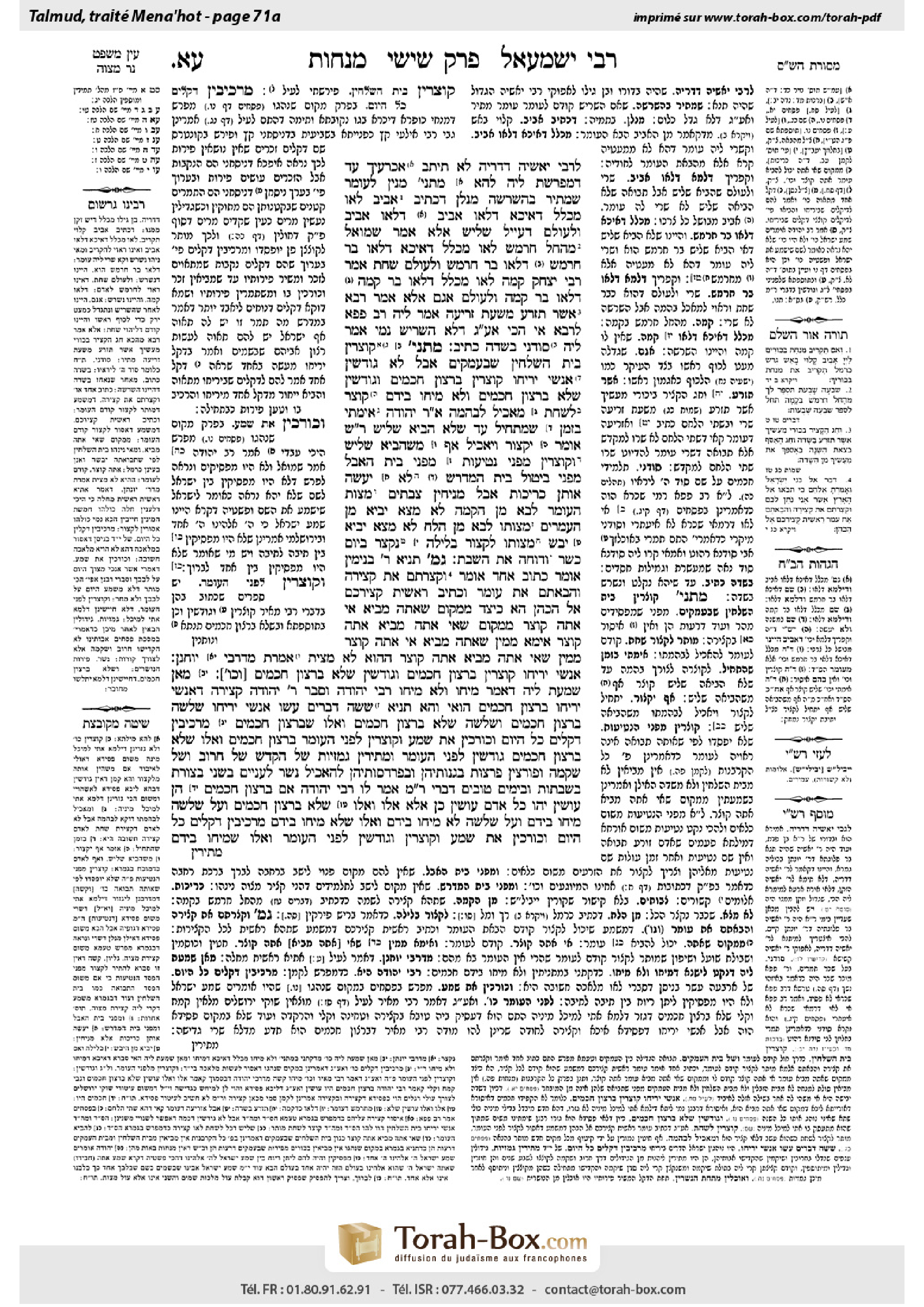
Menachot 71a: Talmud study for Daf Yomi
Daf Yomi is the daily study of one Talmud folio. Explore 37 tractates with scans, Hebrew text, Sefaria English and AI-generated French translations where annotated.
Passage selection and English or AI-generated French translation are available where the scan has annotations. Daf Study is independent of Torah-Box and Sefaria.
Browse Menachot · מנחות · All tractatesMenachot 71a text and translations
This page of Menachot includes the Aramaic text, an English translation and an AI-generated French translation, alongside the scan above.
מנחות ע״א א · Aramaic and Hebrew text
לְרַבִּי יֹאשִׁיָּה דְּדָרֵיהּ: לָא תֵּיתֵב אַכַּרְעָיךָ עַד דִּמְפָרְשַׁתְּ לֵיהּ לְהָא מַתְנִיתִין, מִנַּיִן לָעוֹמֶר שֶׁמַּתִּיר בְּהַשְׁרָשָׁה?
מְנָלַן? דִּכְתִיב ״אָבִיב״, לָאו מִכְּלָל דְּאִיכָּא דְּלָאו ״אָבִיב״?
דְּלָאו ״אָבִיב״, וּלְעוֹלָם דְּעַיֵּיל שְׁלִישׁ.
אֶלָּא אָמַר שְׁמוּאֵל: ״מֵהָחֵל חֶרְמֵשׁ״, לָאו מִכְּלָל דְּאִיכָּא דְּלָאו בַּר חֶרְמֵשׁ? דְּלָאו בַּר חֶרְמֵשׁ, וּלְעוֹלָם שַׁחַת.
אָמַר רַבִּי יִצְחָק: ״קָמָה״ – לָאו מִכְּלָל דְּלָאו בַּר קָמָה? דְּלָאו בַּר קָמָה, וּלְעוֹלָם אֲגַם.
אֶלָּא אָמַר רָבָא: ״אֲשֶׁר תִּזְרַע״ – מִשְּׁעַת זְרִיעָה. אֲמַר לֵיהּ רַב פָּפָּא לְרָבָא: אִי הָכִי, אַף עַל גַּב דְּלֹא הִשְׁרִישׁ נָמֵי? אֲמַר לֵיהּ: סוּדָנִי, ״בַּשָּׂדֶה״ כְּתִיב.
מַתְנִי׳ קוֹצְרִין בֵּית הַשְּׁלָחִין שֶׁבָּעֲמָקִים, אֲבָל לֹא גּוֹדְשִׁין. אַנְשֵׁי יְרִיחוֹ קוֹצְרִין בִּרְצוֹן חֲכָמִים, וְגוֹדְשִׁין שֶׁלֹּא בִּרְצוֹן חֲכָמִים, וְלֹא מִיחוּ בְּיָדָם. קוֹצֵר לְשַׁחַת, מַאֲכִיל לַבְּהֵמָה. אָמַר רַבִּי יְהוּדָה: אֵימָתַי? בִּזְמַן שֶׁמַּתְחִיל עַד שֶׁלֹּא הֵבִיא שְׁלִישׁ. רַבִּי שִׁמְעוֹן אוֹמֵר: יִקְצוֹר וְיַאֲכִיל אַף מִשֶּׁהֵבִיא שְׁלִישׁ.
וְקוֹצְרִין מִפְּנֵי נְטִיעוֹת, מִפְּנֵי בֵּית הָאֵבֶל, מִפְּנֵי בִּיטּוּל בֵּית הַמִּדְרָשׁ. לֹא יַעֲשֶׂה אוֹתָן כְּרִיכוֹת, אֲבָל מַנִּיחִין צְבָתִים.
מִצְוַת הָעוֹמֶר לָבֹא מִן הַקָּמָה. לֹא מָצָא – יָבִיא מִן הָעֳמָרִים. מִצְוָתוֹ לָבֹא מִן הַלַּח, לֹא מָצָא – יָבִיא יָבֵשׁ. מִצְוָתוֹ לִקְצוֹר בַּלַּיְלָה, נִקְצַר בַּיּוֹם – כָּשֵׁר. וְדוֹחֶה אֶת הַשַּׁבָּת.
גְּמָ׳ תַּנְיָא: רַבִּי בִּנְיָמִין אוֹמֵר, כָּתוּב אֶחָד אוֹמֵר: ״וּקְצַרְתֶּם אֶת קְצִירָהּ וַהֲבֵאתֶם אֶת עֹמֶר״, וּכְתִיב: ״רֵאשִׁית קְצִירְכֶם אֶל הַכֹּהֵן״.
הָא כֵּיצַד? מִמָּקוֹם שֶׁאַתָּה מֵבִיא – אִי אַתָּה קוֹצֵר, מִמָּקוֹם שֶׁאִי אַתָּה מֵבִיא – אַתָּה קוֹצֵר.
אֵימָא: מִמִּין שֶׁאַתָּה מֵבִיא – אִי אַתָּה קוֹצֵר, מִמִּין שֶׁאִי אַתָּה מֵבִיא – אַתָּה קוֹצֵר? הָהוּא לָא מָצֵית אָמְרַתְּ, מִדְּרַבִּי יוֹחָנָן.
אַנְשֵׁי יְרִיחוֹ קוֹצְרִין בִּרְצוֹן חֲכָמִים, וְגוֹדְשִׁין שֶׁלֹּא בִּרְצוֹן חֲכָמִים וְכוּ׳. מַאן שָׁמְעַתְּ לֵיהּ דְּאָמַר ״מִיחוּ״ וְ״לֹא מִיחוּ״? רַבִּי יְהוּדָה.
וְסָבַר רַבִּי יְהוּדָה קְצִירָה דְּאַנְשֵׁי יְרִיחוֹ בִּרְצוֹן חֲכָמִים הֲוַאי? וְהָא תַּנְיָא: שִׁשָּׁה דְּבָרִים עָשׂוּ אַנְשֵׁי יְרִיחוֹ, שְׁלֹשָׁה בִּרְצוֹן חֲכָמִים, וּשְׁלֹשָׁה שֶׁלֹּא בִּרְצוֹן חֲכָמִים.
וְאֵלּוּ שֶׁבִּרְצוֹן חֲכָמִים: מַרְכִּיבִין דְּקָלִים כׇּל הַיּוֹם, וְכוֹרְכִין אֶת ״שְׁמַע״, וְקוֹצְרִין לִפְנֵי הָעוֹמֶר – בִּרְצוֹן חֲכָמִים. וְאֵלּוּ שֶׁלֹּא בִּרְצוֹן חֲכָמִים: גּוֹדְשִׁין לִפְנֵי הָעוֹמֶר, וּמַתִּירִין גַּמְזִיּוֹת שֶׁל הֶקְדֵּשׁ שֶׁל חָרוּב וְשֶׁל שִׁקְמָה, וּפוֹרְצִין פְּרָצוֹת בְּגַנּוֹתֵיהֶן ובְפַרְדְּסוֹתֵיהֶן לְהַאֲכִיל נֶשֶׁר לַעֲנִיִּים בִּשְׁנֵי בַצּוֹרֶת בְּשַׁבָּתוֹת וּבְיָמִים טוֹבִים, דִּבְרֵי רַבִּי מֵאִיר.
אָמַר לוֹ רַבִּי יְהוּדָה: אִם בִּרְצוֹן חֲכָמִים הֵן עוֹשִׂין, יְהוּ כׇּל אָדָם עוֹשִׂין כֵּן! אֶלָּא אֵלּוּ וָאֵלּוּ שֶׁלֹּא בִּרְצוֹן חֲכָמִים, וְעַל שְׁלֹשָׁה מִיחוּ בְּיָדָם, וְעַל שְׁלֹשָׁה לֹא מִיחוּ בְּיָדָם.
וְאֵלּוּ שֶׁלֹּא מִיחוּ בְּיָדָם: מַרְכִּיבִין דְּקָלִים כׇּל הַיּוֹם, וְכוֹרְכִין אֶת ״שְׁמַע״, וְקוֹצְרִין וְגוֹדְשִׁין לִפְנֵי הָעוֹמֶר. וְאֵלּוּ שֶׁמִּיחוּ בְּיָדָם:
Menachot 71a · English translation
Rabbi Yoshiya of his generation, i.e., not the tanna of the same name: Do not sit on your knees until you have explained to me the source for that latter clause in the mishna: From where is it derived that the omer offering permits the consumption of the new crop upon its taking root in the ground?
Rabbi Yoshiya responded: From where do we derive, you ask? The source is that it is written: “And if you bring a meal offering of first fruits to the Lord, you shall bring for the meal offering of your first fruits grain in the ear parched with fire, even groats of the fresh ear” (Leviticus 2:14). Can one not learn from here by inference that although the omer offering must be from fully formed grain, there is less-developed grain at an earlier stage that is not “grain in the ear,” i.e., grain that may not be used for the omer offering but is nevertheless permitted by the omer?
The Gemara rejects this claim. Perhaps one can infer from here only that there is less-developed grain that is not “grain in the ear” but is at a further stage than simply taking root. Rather, it actually grew one-third of its full growth. If so, merely taking root is not enough for the omer offering to permit the consumption of that grain.
Rather, Shmuel said that this halakha is derived from a verse discussing the counting of the omer: “Seven weeks you shall number for you; from the time the sickle is first put to the standing grain you shall begin to number seven weeks” (Deuteronomy 16:9). Can one not learn from here by inference that there is grain at an earlier stage that cannot be cut with a sickle, which nevertheless is permitted by the omer offering? This description applies to grain that has taken root. The Gemara rejects this claim as well: Perhaps the inference is to grain at an earlier stage that cannot be cut with a sickle but is actually fodder, i.e., produce that has grown stalks but is not yet ripe.
Rabbi Yitzḥak said: One can derive that grain that has taken root is permitted by the omer offering from the term: “The standing grain” (Deuteronomy 16:9). Can one not learn from here by inference that there is grain that is too soft and unable to stand, which may not be used for the omer offering and yet is permitted by the omer? The Gemara rejects this claim as well: Perhaps the inference is to grain that is unable to stand but is actually soft grain like that of a marsh; it has grown somewhat but is still soft enough that it bends rather than stands.
Rather, Rava said that the source of the halakha is the verse: “And the feast of harvest, the first fruits of your labors, which you sow in the field” (Exodus 23:16). This verse is referring to grain from the time of sowing, i.e., from when the grain takes root. Rav Pappa said to Rava: If so, then even though the grain had not taken root it should be permitted by the omer offering. The verse mentions grain at the time of sowing, but it does not indicate that it is necessary for that grain to have taken root in order to be permitted by the omer. Rava said to Rav Pappa in reply: Wise one [sudni]! It is written: “In the field,” which indicates that the verse is referring to freshly sown produce that has become part of the field, i.e., it has taken root.
MISHNA: Even before the omer offering is brought, one may reap a crop that grows in an irrigated field in the valleys, but one may not arrange the reaped stalks in a pile. The residents of Jericho, whose fields were categorized as irrigated fields in a valley, reaped the crops with the approval of the Sages and arranged the crops in a pile without the approval of the Sages, but the Sages did not reprimand them. One may reap crops in any field for fodder and feed it to an animal. Rabbi Yehuda said: When may one do so? At a time when he begins reaping before the crop reaches one-third of its potential growth. Rabbi Shimon says: One may reap and feed the crops to animals even after they reached one-third of their potential growth.
And one may reap crops prior to the omer due to potential damage to saplings growing alongside the crops; and due to the place of mourning, i.e., to create room for those consoling mourners, who would bless them upon their return from the cemetery; and due to the need to create room for students to study, as failure to do so would lead to dereliction of Torah study in the study hall. After reaping the crops for any of these reasons, one may not fashion them into sheaves, but he leaves them unbound.
The mitzva of the omer is for the barley to come from standing grain. If one did not find standing grain, he brings from sheaves. Its mitzva is for it to come from fresh, moist grain. If one did not find moist grain, he brings from dry grain. Its mitzva is for one to reap the grain at night, but if it was reaped during the day, it is fit. And reaping the grain for the omer overrides Shabbat.
GEMARA: With regard to the ruling of the mishna that one may reap a crop that grows in an irrigated field in the valleys, the Gemara cites that which is taught in a baraita: Rabbi Binyamin says that one verse states: “When you come into the land that I give to you and shall reap its harvest, then you shall bring the omer” (Leviticus 23:10). This verse indicates that one may reap his grain before bringing the omer offering. But it is also written in the continuation of the same verse: “Of the first fruits of your harvest to the priest,” from which it may be inferred that the omer is brought from the first reaped grain.
How can these texts be reconciled? With regard to a place from which you bring the omer grain for the sacrifice, i.e., from a field that is saturated with rainwater, you may not reap there. But with regard to a place from which you may not bring the omer grain, an irrigated field, you may reap there.
The Gemara questions this resolution: Why not say instead: With regard to the type of grain from which you bring the omer, i.e., barley, you may not reap it; but with regard to the type of grain from which you may not bring the omer, e.g., wheat, you may reap it? The Gemara answers: You cannot say that resolution, due to that which Rabbi Yoḥanan teaches. On 70a it was stated that Rabbi Yoḥanan derives a verbal analogy between the halakhot of ḥalla and the omer offering, from which he learns that the prohibition against reaping the new crop before the omer sacrifice applies to all five types of grain. Therefore, the reconciliation of the verses must be as first suggested, that one may reap in a place from which the omer grain may not be brought.
§ The mishna teaches: The residents of Jericho, whose fields were irrigated fields in a valley, reaped their crops with the approval of the Sages and arranged the crops in a pile without the approval of the Sages, but the Sages did not reprimand them. The Gemara asks: Whom did you hear who said: The Sages reprimanded them, or: They did not reprimand them? In other words, who is the tanna who, in the context of the customs of the residents of Jericho, addresses whether or not the Sages reprimanded them, as opposed to whether or not their actions were in accordance with the Sages’ will? The Gemara states: It is Rabbi Yehuda.
Upon identifying the tanna of the mishna, the Gemara asks: And does Rabbi Yehuda really hold that the reaping of the residents of Jericho was performed with the approval of the Sages? But isn’t it taught in a baraita (Tosefta, Pesaḥim 3:15): The people of Jericho performed six actions, three with the approval of the Sages and three without the approval of the Sages.
And these are the actions they performed with the approval of the Sages: They would graft palm trees the entire day of the fourteenth of Nisan, and they would bundle Shema, and they would reap grain before the omer offering was brought; all of these were with the approval of the Sages. And these are the actions that they performed without the approval of the Sages: They would pile the harvest before the omer, and they would permit the use of consecrated branches [gamziyyot] of carob and of sycamore trees, and they would make breaches in the walls of their gardens and in their orchards to feed fallen fruit to the poor during drought years, so that the poor could take the fruit that had fallen even on Shabbatot and Festivals. This is the statement of Rabbi Meir.
Rabbi Yehuda said to Rabbi Meir: This is an inaccurate formulation, since if they acted with the approval of the Sages, then every person would do so, not only the residents of Jericho. Rather, you should formulate it in this manner: Both these three acts and those three acts were performed without the approval of the Sages. With regard to three of them the Sages reprimanded them, and with regard to the other three the Sages did not reprimand them.
And these are the actions they performed for which the Sages did not reprimand them: They would graft palm trees the entire day, and they would bundle Shema, and they would reap and pile grain before the omer offering was brought. And these are the actions they performed for which the Sages reprimanded them:
Menachot 71a · Traduction française (IA)
Rabbi Yoshiya de sa génération, c’est-à-dire non pas le tanna du même nom, lui dit : « Ne reste pas à genoux tant que tu ne m’as pas expliqué la source de cette dernière clause de la Michna : d’où apprend-on que l’offrande du omer autorise la consommation de la nouvelle récolte dès qu’elle a pris racine dans le sol ? »
Rabbi Yoshiya répondit : « Tu demandes d’où nous le savons ? La source est le verset : “Et si tu apportes au Seigneur une offrande de prémices, tu apporteras, pour l’offrande de tes prémices, des épis grillés au feu, des grains frais” (Lévitique 2,14). Ne peut-on pas en déduire que, bien que l’offrande du omer doive provenir d’un grain pleinement formé, il existe un grain moins développé, qui n’est pas encore “en épi”, c’est-à-dire un grain qui ne peut pas être utilisé pour l’offrande du omer, mais dont la consommation est néanmoins autorisée par celle-ci ? »
La Guemara rejette cette affirmation. Peut-être peut-on seulement en déduire qu’il existe un grain moins développé, qui n’est pas encore « en épi », mais qui a dépassé le simple stade de la prise de racine. Il aurait en réalité atteint le tiers de sa croissance complète. Si tel est le cas, la simple prise de racine ne suffit pas pour que l’offrande du omer autorise la consommation de ce grain.
Shmuel dit plutôt que cette halakha se déduit d’un verset relatif au décompte du omer : « Tu compteras pour toi sept semaines ; à partir du moment où la faucille est mise pour la première fois dans le grain sur pied, tu commenceras à compter sept semaines » (Deutéronome 16,9). Ne peut-on pas en déduire qu’il existe du grain à un stade antérieur, qui ne peut être coupé à la faucille, mais dont la consommation est néanmoins autorisée par l’offrande du omer ? Cette description s’applique au grain qui a pris racine. La Guemara rejette également cette affirmation : peut-être l’inférence concerne-t-elle du grain à un stade antérieur, qui ne peut être coupé à la faucille, mais qui est en réalité du fourrage, c’est-à-dire une récolte qui a formé des tiges, mais n’est pas encore mûre.
Rabbi Yitzḥak dit : On peut déduire que l’offrande du omer autorise le grain qui a pris racine à partir de l’expression « le grain sur pied » (Deutéronome 16,9). Ne peut-on pas en déduire qu’il existe du grain trop tendre pour tenir debout, qui ne peut pas être utilisé pour l’offrande du omer, mais dont la consommation est néanmoins autorisée par celle-ci ? La Guemara rejette également cette affirmation : peut-être l’inférence concerne-t-elle du grain incapable de tenir debout, mais qui est en réalité un grain tendre comme celui d’un marécage ; il a quelque peu poussé, mais reste assez tendre pour ployer au lieu de se tenir droit.
Rava dit plutôt que la source de cette halakha est le verset : « La fête de la moisson, les prémices de tes travaux, que tu as semés dans le champ » (Exode 23,16). Ce verset parle du grain à partir du moment des semailles, c’est-à-dire dès qu’il prend racine. Rav Pappa dit à Rava : « Dans ce cas, même si le grain n’avait pas pris racine, l’offrande du omer devrait en autoriser la consommation. Le verset mentionne le grain au moment des semailles, mais n’indique pas qu’il doit avoir pris racine pour que sa consommation soit autorisée par l’offrande du omer. » Rava répondit à Rav Pappa : « Sage [sudni] ! Il est écrit : “dans le champ”, ce qui indique que le verset parle d’une récolte fraîchement semée qui est devenue partie intégrante du champ, c’est-à-dire qu’elle a pris racine. »
MICHNA. Avant même que l’offrande du omer ne soit apportée, on peut moissonner une récolte qui pousse dans un champ irrigué des vallées, mais on ne peut pas disposer les tiges moissonnées en tas. Les habitants de Jéricho, dont les champs étaient considérés comme des champs irrigués dans une vallée, moissonnaient leurs récoltes avec l’approbation des Sages et les disposaient en tas sans leur approbation ; les Sages ne les réprimandaient pas. On peut moissonner des récoltes dans n’importe quel champ pour en faire du fourrage et le donner à un animal. Rabbi Yehuda dit : Quand cela est-il permis ? Lorsqu’on commence à moissonner avant que la récolte n’ait atteint le tiers de sa croissance potentielle. Rabbi Shimon dit : On peut moissonner les récoltes et les donner aux animaux même après qu’elles ont atteint le tiers de leur croissance potentielle.
On peut aussi moissonner les récoltes avant le omer lorsqu’elles risquent d’endommager les jeunes plants qui poussent à leurs côtés ; pour dégager un lieu de deuil, c’est-à-dire faire de la place pour ceux qui viennent consoler les endeuillés et qui les béniront à leur retour du cimetière ; et pour faire de la place aux élèves afin qu’ils étudient, car sinon l’étude de la Torah serait négligée dans la maison d’étude. Après avoir moissonné les récoltes pour l’une de ces raisons, on ne peut pas en faire des gerbes, mais on les laisse sans les lier.
La mitsva du omer consiste à ce que l’orge provienne de grain sur pied. Si l’on n’en a pas trouvé, on en apporte à partir de gerbes. La mitsva consiste à ce qu’il provienne de grain frais et humide. Si l’on n’en a pas trouvé d’humide, on en apporte de grain sec. La mitsva consiste à moissonner le grain la nuit ; toutefois, s’il a été moissonné pendant le jour, il est valide. La moisson du grain destiné au omer repousse le Chabbat.
GUEMARA. À propos de la règle de la Michna selon laquelle on peut moissonner une récolte qui pousse dans un champ irrigué des vallées, la Guemara cite ce qui est enseigné dans une baraïta : Rabbi Binyamin dit qu’un verset énonce : « Quand vous entrerez dans le pays que je vous donne et que vous en moissonnerez la récolte, vous apporterez alors le omer » (Lévitique 23,10). Ce verset indique que l’on peut moissonner sa récolte avant d’apporter l’offrande du omer. Mais la suite du même verset dit aussi : « des prémices de votre récolte, au prêtre », d’où l’on peut déduire que le omer est apporté à partir du premier grain moissonné.
Comment concilier ces textes ? Dans un endroit d’où l’on apporte le grain destiné à l’offrande du omer, c’est-à-dire un champ saturé d’eau de pluie, on ne peut pas moissonner. En revanche, dans un endroit d’où l’on ne peut pas apporter le grain destiné au omer, à savoir un champ irrigué, on peut moissonner.
La Guemara conteste cette résolution : pourquoi ne pas dire plutôt que, pour le type de grain dont on apporte le omer, c’est-à-dire l’orge, on ne peut pas moissonner, tandis que pour le type de grain dont on n’apporte pas le omer, par exemple le blé, on peut moissonner ? La Guemara répond : on ne peut pas proposer cette résolution, en raison de ce que Rabbi Yoḥanan enseigne. Il a été dit en 70a que Rabbi Yoḥanan établit une analogie verbale entre les halakhot de la ḥalla et celles de l’offrande du omer, d’où il déduit que l’interdiction de moissonner la nouvelle récolte avant le sacrifice du omer s’applique aux cinq espèces de céréales. Il faut donc concilier les versets comme il a été suggéré d’abord : on peut moissonner dans un endroit d’où le grain destiné au omer ne peut pas être apporté.
§ La Michna enseigne que les habitants de Jéricho, dont les champs étaient des champs irrigués dans une vallée, moissonnaient leurs récoltes avec l’approbation des Sages et les disposaient en tas sans leur approbation, mais que les Sages ne les réprimandaient pas. La Guemara demande : qui as-tu entendu dire qu’ils les réprimandaient ou qu’ils ne les réprimandaient pas ? En d’autres termes, qui est le tanna qui, à propos des coutumes des habitants de Jéricho, traite de la question de savoir si les Sages les réprimandaient ou non, plutôt que de déterminer si leurs actes étaient conformes ou non à la volonté des Sages ? La Guemara précise : c’est Rabbi Yehuda.
Après avoir identifié le tanna de la Michna, la Guemara demande : Rabbi Yehuda estime-t-il vraiment que les habitants de Jéricho moissonnaient avec l’approbation des Sages ? N’est-il pas enseigné dans une baraïta (Tossefta, Pessaḥim 3,15) : les habitants de Jéricho accomplissaient six actes, trois avec l’approbation des Sages et trois sans leur approbation ?
Voici les actes qu’ils accomplissaient avec l’approbation des Sages : ils greffaient des palmiers pendant toute la journée du quatorze Nissan, ils récitaient le Chéma en le faisant suivre d’une bénédiction, et ils moissonnaient le grain avant que l’offrande du omer ne soit apportée ; tous ces actes étaient accomplis avec l’approbation des Sages. Voici les actes qu’ils accomplissaient sans l’approbation des Sages : ils entassaient la récolte avant le omer ; ils autorisaient l’utilisation de branches consacrées [gamziyyot] de caroubier et de sycomore ; et ils faisaient des brèches dans les murs de leurs jardins et de leurs vergers pour donner aux pauvres les fruits tombés pendant les années de sécheresse, afin qu’ils puissent prendre les fruits tombés même les Chabbatot et les jours de fête. Telle est la déclaration de Rabbi Meir.
Rabbi Yehuda dit à Rabbi Meir : « Cette formulation est inexacte, car s’ils agissaient avec l’approbation des Sages, chacun ferait de même, et pas seulement les habitants de Jéricho. Il faut plutôt formuler les choses ainsi : ces trois actes comme ces trois autres étaient accomplis sans l’approbation des Sages. Pour trois d’entre eux, les Sages les réprimandaient ; pour les trois autres, ils ne les réprimandaient pas. »
Voici les actes qu’ils accomplissaient et pour lesquels les Sages ne les réprimandaient pas : ils greffaient des palmiers pendant toute la journée, ils récitaient le Chéma en le faisant suivre d’une bénédiction, et ils moissonnaient et entassaient le grain avant que l’offrande du omer ne soit apportée. Voici les actes qu’ils accomplissaient et pour lesquels les Sages les réprimandaient :
Traduction française générée par IA à partir de l’édition anglaise de Sefaria. Vérifie toujours un passage avec le texte source.
Text from Sefaria: William Davidson Edition - Vocalized Aramaic (unknown); William Davidson Edition - English (CC BY NC).