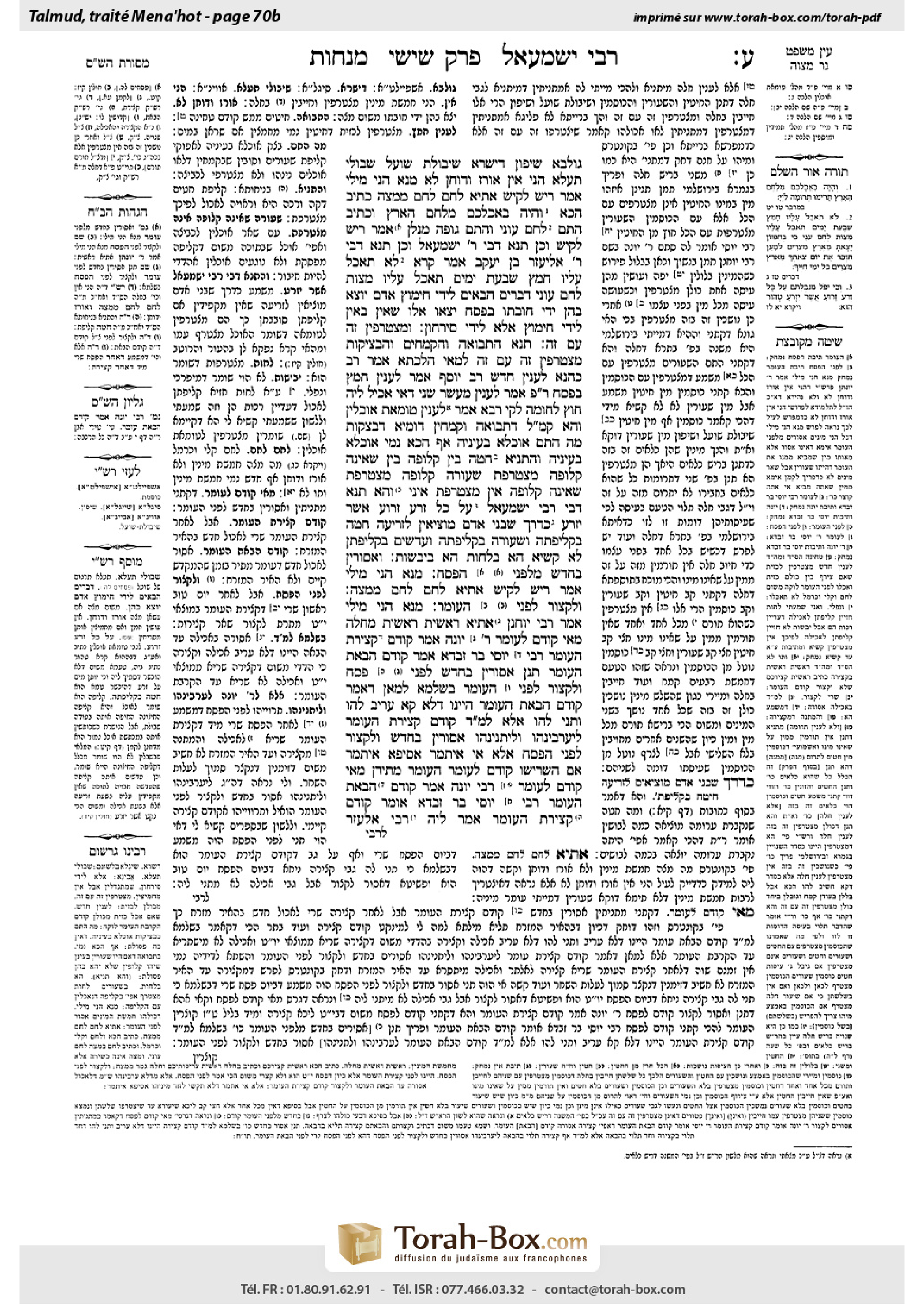
Menachot 70b: Talmud study for Daf Yomi
Daf Yomi is the daily study of one Talmud folio. Explore 37 tractates with scans, Hebrew text, Sefaria English and AI-generated French translations where annotated.
Passage selection and English or AI-generated French translation are available where the scan has annotations. Daf Study is independent of Torah-Box and Sefaria.
Browse Menachot · מנחות · All tractatesMenachot 70b text and translations
This page of Menachot includes the Aramaic text, an English translation and an AI-generated French translation, alongside the scan above.
מנחות ע׳ ב · Aramaic and Hebrew text
גּוּלְבָּא, שִׁיפוֹן – דִּישְׁרָא, שִׁיבּוֹלֶת שׁוּעָל – שֻׁבְלֵי תַּעֲלָא. הָנֵי – אִין, אוֹרֶז וְדוֹחַן – לָא.
מְנָא הָנֵי מִילֵּי? אָמַר רֵישׁ לָקִישׁ: אָתְיָא ״לֶחֶם״ ״לֶחֶם״ מִמַּצָּה. כְּתִיב הָכָא: ״וְהָיָה בַּאֲכׇלְכֶם מִלֶּחֶם הָאָרֶץ״, וּכְתִיב הָתָם: ״לֶחֶם עֹנִי״.
וְהָתָם גּוּפַהּ מְנָלַן? אָמַר רֵישׁ לָקִישׁ, וְכֵן תָּנָא דְּבֵי רַבִּי יִשְׁמָעֵאל, וְכֵן תָּנָא דְּבֵי רַבִּי אֱלִיעֶזֶר בֶּן יַעֲקֹב: אָמַר קְרָא ״לֹא תֹאכַל עָלָיו חָמֵץ שִׁבְעַת יָמִים תֹּאכַל עָלָיו מַצּוֹת לֶחֶם עֹנִי״ – דְּבָרִים הַבָּאִים לִידֵי חִימּוּץ אָדָם יוֹצֵא בָּהֶן יְדֵי חוֹבָתוֹ בַּפֶּסַח, יָצְאוּ אֵלּוּ שֶׁאֵין בָּאִין לִידֵי חִימּוּץ אֶלָּא לִידֵי סֵירָחוֹן.
וּמִצְטָרְפִין זֶה עִם זֶה. תָּנָא: הַתְּבוּאָה וְהַקְּמָחִים וְהַבְּצֵיקוֹת מִצְטָרְפִין זֶה עִם זֶה. לְמַאי הִלְכְתָא?
אָמַר רַב כָּהֲנָא: לְעִנְיַן חָדָשׁ. רַב יוֹסֵף אָמַר: לְעִנְיַן חָמֵץ בַּפֶּסַח. רַב פָּפָּא אָמַר: לְעִנְיַן מַעֲשֵׂר שֵׁנִי, דְּאִי אָכֵיל לֵיהּ חוּץ לַחוֹמָה – לָקֵי.
רָבָא אָמַר: לְעִנְיַן טוּמְאַת אֳכָלִין, וְהָא קָא מַשְׁמַע לַן: דִּתְבוּאָה וּקְמָחִין דּוּמְיָא דִּבְצֵקוֹת – מָה הָתָם אוּכְלָא בְּעֵינֵיהּ, אַף הָכָא נָמֵי אוּכְלָא בְּעֵינֵיהּ.
וְהָתַנְיָא: חִטָּה, בֵּין קְלוּפָה בֵּין שֶׁאֵינָהּ קְלוּפָה – מִצְטָרֶפֶת; שְׂעוֹרָה, קְלוּפָה – מִצְטָרֶפֶת, שֶׁאֵינָהּ קְלוּפָה – אֵין מִצְטָרֶפֶת.
אִינִי? וְהָא תָּנָא דְּבֵי רַבִּי יִשְׁמָעֵאל: ״עַל כׇּל זֶרַע זֵרוּעַ אֲשֶׁר יִזָּרֵעַ״ – כְּדֶרֶךְ שֶׁבְּנֵי אָדָם מוֹצִיאִין לִזְרִיעָה: חִטָּה בִּקְלִיפָּתָהּ, וּשְׂעוֹרָה בִּקְלִיפָּתָהּ, וַעֲדָשִׁים בִּקְלִיפָּתָן.
לָא קַשְׁיָא, הָא בְּלַחוֹת, הָא בִּיבֵשׁוֹת.
וַאֲסוּרִין בֶּחָדָשׁ מִלִּפְנֵי הַפֶּסַח, מְנָא הָנֵי מִילֵּי? אָמַר רֵישׁ לָקִישׁ: אָתְיָא ״לֶחֶם״ ״לֶחֶם״ מִמַּצָּה.
וְלִקְצוֹר לִפְנֵי הָעוֹמֶר, מְנָא הָנֵי מִילֵּי? אָמַר רַבִּי יוֹחָנָן: אָתְיָא ״רֵאשִׁית״ ״רֵאשִׁית״ מֵחַלָּה.
מַאי קוֹדֶם לָעוֹמֶר? רַבִּי יוֹנָה אָמַר: קוֹדֶם קְצִירַת הָעוֹמֶר, רַבִּי יוֹסֵי בַּר זַבְדָּא אָמַר: קוֹדֶם הֲבָאַת הָעוֹמֶר.
תְּנַן: אֲסוּרִין בֶּחָדָשׁ לִפְנֵי פֶסַח, וְלִקְצוֹר לִפְנֵי הָעוֹמֶר. בִּשְׁלָמָא לְמַאן דְּאָמַר קוֹדֶם הֲבָאַת הָעוֹמֶר – הַיְינוּ דְּלָא קָא עָרֵיב לְהוּ וְתָנֵי לְהוּ.
אֶלָּא לְמַאן דְּאָמַר קוֹדֶם קְצִירַת הָעוֹמֶר, לִיעָרְבִינְהוּ וְלִיתְנִינְהוּ: אֲסוּרִין בֶּחָדָשׁ וְלִקְצוֹר לִפְנֵי הַפֶּסַח!
אֶלָּא, אִי אִיתְּמַר – אַסֵּיפָא אִיתְּמַר: אִם הִשְׁרִישׁוּ קוֹדֶם לָעוֹמֶר – הָעוֹמֶר מַתִּירָן. מַאי קוֹדֶם לָעוֹמֶר? רַבִּי יוֹנָה אָמַר: קוֹדֶם הֲבָאַת הָעוֹמֶר, רַבִּי יוֹסֵי בַּר זַבְדָּא אוֹמֵר: קוֹדֶם קְצִירַת הָעוֹמֶר.
אֲמַר לֵיהּ רַבִּי אֶלְעָזָר
Menachot 70b · English translation
gulva, rye is dishra, and oats are shibbolei ta’ala. The Gemara infers: With regard to these species, yes, the obligation of ḥalla applies to them, but concerning rice and millet, no, the obligation of ḥalla does not apply to them.
The Gemara asks: From where is this matter, that only these five grains are obligated in the separations of ḥalla, derived? Reish Lakish said: This principle is derived by means of a verbal analogy between “bread” and “bread” from the case of matza. It is written here, with regard to ḥalla: “And it shall be that when you eat of the bread of the land, you shall set apart a portion for a gift to the Lord” (Numbers 15:19), and it is written there, with regard to matza: “Bread of affliction” (Deuteronomy 16:3). Just as matza can be prepared only from one of those five grains, so too the obligation of ḥalla applies only to bread from one of those five grains.
The Gemara asks: And there, with regard to matza itself, from where do we derive that it must be from one of those five grains? The Gemara answers: Reish Lakish said, and likewise a Sage of the school of Rabbi Yishmael taught, and likewise a Sage of the school of Rabbi Eliezer ben Ya’akov taught, that the verse states: “You shall eat no leavened bread with it; seven days you shall eat with it matza, the bread of affliction” (Deuteronomy 16:3). This verse indicates that only with regard to substances that will come to a state of leavening does a person fulfill his obligation to eat matza by eating them on Passover, provided that he prevents them from becoming leavened. This serves to exclude these foods, i.e., rice, millet, and similar grains, which, even if flour is prepared from them and water is added to their flour, do not come to a state of leavening but to a state of decay [sirḥon].
§ The mishna teaches that each one of the five types of grain joins together with the others to constitute the measure that obligates one to separate ḥalla. It was taught in a baraita: With regard to grain from produce and flours and pieces of dough, each one of these joins together with the others. The Gemara asks: With regard to what halakha was this taught?
Rav Kahana says: It was taught with regard to the prohibition of eating of the new crop prior to the sacrifice of the omer offering on the sixteenth of Nisan. If one ate grain, flour, and dough of the new crop that combined to equal the size of an olive-bulk, he is liable to receive lashes for transgressing a prohibition. Rav Yosef says: It was taught with regard to the prohibition of eating leavened bread on Passover. Rav Pappa says: It was taught with regard to the prohibition of eating second tithe outside the walls of Jerusalem. As, if one ate a combined olive-bulk’s worth of grain, flour and dough of the second tithe outside the wall of Jerusalem, he is flogged.
Rava says: The baraita is referring to the matter of the ritual impurity of food; and this is what it teaches us: That grains of barley produce and flours are similar to pieces of dough. Just as there, concerning pieces of dough, they combine to form the minimal measure of ritually impure food only if the combination of food is as is, without other additives, so too here also, concerning grain and flour, they combine to form the minimal measure of ritually impure food only when the mixture is food as is, without any shell or other additives.
The Gemara cites support for this opinion, as it is taught in a baraita: Wheat, whether shelled or unshelled, combines to form the minimal measure of food that is susceptible to ritual impurity. But as for barley, it combines only when it is shelled. When it is not shelled, it does not combine together, as the inedible shell interposes between the different grains. This supports Rava’s interpretation of the baraita, that it addresses barley in the form of grain, flour, and dough.
The Gemara asks: Is that so, that the shell of barley is not considered part of the grain with regard to combining for ritual impurity? But didn’t the school of Rabbi Yishmael teach in a baraita: Before a food item comes in contact with liquid it is not susceptible to ritual impurity, as the verse states: “And if anything falls from their carcasses upon any sowing seed that is sown, it is pure. But if water be put upon the seed, and any of the carcass fall thereon, it is impure unto you” (Leviticus 11:37–38). The baraita teaches that the term “that is sown” indicates that the entire seed is susceptible to ritual impurity when it is in a state where it is typical for people to take it out to the field for sowing. This applies to wheat in its shell, barley in its shell, and lentils in their shells. This demonstrates that shells are considered part of the grain with regard to ritual impurity.
The Gemara answers: It is not difficult. The ruling of this baraita, which teaches that the shells of kernels are considered part of it with regard to ritual impurity, is stated with regard to moist kernels, whereas the ruling of that baraita, which teaches that the shells are not part of the seed, is stated with regard to dry kernels, in which the shells crumble and fall away.
§ The mishna teaches with regard to the five grains: And they are forbidden due to the prohibition of partaking of the new crop prior to the Passover festival. The Gemara asks: From where is this matter derived? Reish Lakish said: It is derived by means of a verbal analogy between “bread” written in connection with the prohibition of the new crop (see Leviticus 23:14), and “bread” written with regard to matza (see Deuteronomy 16:3). Just as matza can be prepared only from one of the five grains, so too the prohibition against eating of the new crop applies only to the five grains.
§ The mishna further teaches with regard to the five grains: And it is prohibited to reap them prior to the omer offering. The Gemara asks: From where are these matters derived? Rabbi Yoḥanan said: It is derived by means of a verbal analogy between “the first” written in conjunction with the new crop: “You shall bring the sheaf of the first fruits of your harvest to the priest” (Leviticus 23:10), and “the first” written with regard to ḥalla: “Of the first of your dough you shall set apart a cake for a gift” (Numbers 15:20). Just as the obligation to separate ḥalla applies only to bread prepared from the five grains, so too the prohibition against reaping the new crop prior to the omer offering applies only to crops of the five grains.
The Gemara asks: What does the mishna mean when it says: Prior to the omer? Does it mean prior to the reaping of the omer grain or prior to the sacrifice of the omer offering? Rabbi Yona says: It means prior to the reaping of the omer grain, i.e., the new crop is permitted at daybreak on the sixteenth of Nisan. Rabbi Yosei bar Zavda says: Prior to the bringing of the omer offering later that day.
The Gemara cites a proof from that which we learned in the mishna: And they are forbidden due to the prohibition of partaking of the new crop prior to the Passover Festival, and likewise it is prohibited to reap them prior to the sacrifice of the omer offering. Granted, according to the one who said that the prohibition applies prior to the bringing of the omer offering, this is the reason that the mishna did not combine the clauses together and teach them as one, since the time frame for each prohibition is different. The prohibition of harvesting the new crop is lifted at daybreak after the omer crop was harvested at night, whereas the prohibition against consuming the new crop ends only with the sacrifice of the omer offering later that day.
But according to the one who said that the prohibition applies prior to the reaping of the omer grain, then both the consuming and the harvesting of the new crop are permitted at daybreak of the sixteenth of Nisan. If so, let the mishna combine them and teach them together, as follows: And they are forbidden due to the prohibition of partaking of the new crop, and likewise it is prohibited to reap them prior to the Passover Festival.
The Gemara answers: Rather, if a dispute was stated in this matter, it was stated with regard to the latter clause of the mishna, which teaches: If these grains took root prior to the omer offering, the omer permits their consumption. What does the mishna mean when it says: Prior to the omer? Rabbi Yona says: Prior to the bringing of the omer sacrifice. Rabbi Yosei bar Zavda says: Prior to the harvesting of the omer grain.
Rabbi Elazar said to
Menachot 70b · Traduction française (IA)
Le gulva, c’est le dishra, le seigle, et l’avoine, ce sont les shibbolei ta’ala. La Guemara en déduit que l’obligation de prélever la ‘hala s’applique bien à ces espèces, mais qu’elle ne s’applique ni au riz ni au millet.
La Guemara demande : d’où déduit-on que seules ces cinq espèces de céréales sont soumises à l’obligation de prélever la ‘hala ? Reish Lakish dit : ce principe se déduit au moyen d’une analogie verbale entre « pain » et « pain », à partir du cas de la matsa. Il est écrit ici, à propos de la ‘hala : « Et lorsque vous mangerez du pain du pays, vous en prélèverez une offrande pour le Seigneur » (Nombres 15:19), et il est écrit là, à propos de la matsa : « pain de misère » (Deutéronome 16:3). De même que la matsa ne peut être préparée qu’à partir de l’une de ces cinq espèces, de même l’obligation de prélever la ‘hala ne s’applique qu’au pain préparé à partir de l’une de ces cinq espèces.
La Guemara demande : et concernant la matsa elle-même, d’où déduit-on qu’elle doit provenir de l’une de ces cinq espèces ? La Guemara répond : Reish Lakish a dit, et de même un Sage de l’école de Rabbi Yishmael a enseigné, et un Sage de l’école de Rabbi Eliezer ben Ya’akov a également enseigné, que le verset dit : « Tu ne mangeras avec lui aucun pain levé ; pendant sept jours, tu mangeras avec lui des matsot, le pain de misère » (Deutéronome 16:3). Ce verset indique qu’on ne s’acquitte de l’obligation de manger de la matsa à Pessa’h qu’en mangeant des aliments susceptibles de lever, à condition de les empêcher de lever. Cela exclut le riz, le millet et les céréales semblables, qui, même si l’on en fait de la farine et qu’on y ajoute de l’eau, ne lèvent pas, mais se décomposent [sirḥon].
§ La Michna enseigne que chacune des cinq espèces de céréales s’ajoute aux autres pour constituer la quantité qui oblige à prélever la ‘hala. Il a été enseigné dans une baraïta : les grains, la farine et les morceaux de pâte s’ajoutent les uns aux autres. La Guemara demande : à propos de quelle halakha cela a-t-il été enseigné ?
Rav Kahana dit : cela a été enseigné à propos de l’interdiction de consommer la nouvelle récolte avant le sacrifice de l’offrande du omer, le seize nissan. Si quelqu’un a mangé des grains, de la farine et de la pâte de la nouvelle récolte dont la quantité combinée équivaut au volume d’une olive, il est passible de flagellation pour avoir transgressé une interdiction. Rav Yosef dit : cela a été enseigné à propos de l’interdiction de manger du pain levé à Pessa’h. Rav Pappa dit : cela a été enseigné à propos de l’interdiction de consommer la seconde dîme hors des murs de Jérusalem. En effet, si quelqu’un a mangé hors des murs de Jérusalem un volume d’olive composé de grains, de farine et de pâte de seconde dîme, il est passible de flagellation.
Rava dit : la baraïta traite de l’impureté rituelle des aliments. Voici ce qu’elle nous enseigne : les grains d’orge et les farines sont comparables aux morceaux de pâte. De même que, dans le cas des morceaux de pâte, ils ne s’ajoutent pour atteindre la quantité minimale d’un aliment susceptible de contracter l’impureté rituelle que si la combinaison est constituée de l’aliment tel quel, sans autres ajouts, de même ici, dans le cas des grains et de la farine, ils ne s’ajoutent pour atteindre cette quantité minimale que lorsque le mélange est constitué de l’aliment tel quel, sans enveloppe ni autre ajout.
La Guemara apporte un appui à cette opinion, car il est enseigné dans une baraïta : le blé, qu’il soit décortiqué ou non, s’ajoute pour atteindre la quantité minimale d’un aliment susceptible de contracter l’impureté rituelle. Mais l’orge ne s’ajoute que lorsqu’elle est décortiquée. Lorsqu’elle ne l’est pas, elle ne s’ajoute pas, car l’enveloppe non comestible s’interpose entre les différents grains. Cela appuie l’interprétation de Rava selon laquelle la baraïta traite de l’orge sous forme de grains, de farine et de pâte.
La Guemara demande : est-il vrai que l’enveloppe de l’orge n’est pas considérée comme faisant partie du grain lorsqu’il s’agit de les additionner en vue de l’impureté rituelle ? Pourtant, l’école de Rabbi Yishmael n’a-t-elle pas enseigné dans une baraïta : avant qu’un aliment entre en contact avec un liquide, il n’est pas susceptible de contracter l’impureté rituelle, ainsi qu’il est écrit : « Si quelque chose tombe de leurs cadavres sur toute semence destinée aux semailles, elle est pure. Mais si de l’eau a été mise sur la semence et qu’une partie du cadavre tombe dessus, elle sera impure pour vous » (Lévitique 11:37–38). La baraïta enseigne que l’expression « destinée aux semailles » indique que la semence entière est susceptible de contracter l’impureté rituelle lorsqu’elle se trouve dans un état où il est d’usage de l’emporter au champ pour la semer. Cela concerne le blé dans son enveloppe, l’orge dans son enveloppe et les lentilles dans leurs enveloppes. Cela démontre que les enveloppes sont considérées comme faisant partie du grain en matière d’impureté rituelle.
La Guemara répond : il n’y a pas de difficulté. La décision de cette baraïta, selon laquelle les enveloppes des grains sont considérées comme en faisant partie en matière d’impureté rituelle, porte sur des grains humides ; tandis que la décision de l’autre baraïta, selon laquelle les enveloppes ne font pas partie de la semence, porte sur des grains secs, dont les enveloppes s’effritent et tombent.
§ La Michna enseigne à propos des cinq espèces de céréales : elles sont interdites en vertu de l’interdiction de consommer la nouvelle récolte avant la fête de Pessa’h. La Guemara demande : d’où déduit-on cela ? Reish Lakish dit : cela se déduit au moyen d’une analogie verbale entre « pain », écrit à propos de l’interdiction de consommer la nouvelle récolte (voir Lévitique 23:14), et « pain », écrit à propos de la matsa (voir Deutéronome 16:3). De même que la matsa ne peut être préparée qu’à partir de l’une des cinq espèces de céréales, de même l’interdiction de consommer la nouvelle récolte ne s’applique qu’aux cinq espèces.
§ La Michna enseigne encore à propos des cinq espèces de céréales : il est interdit de les moissonner avant l’offrande du omer. La Guemara demande : d’où déduit-on cela ? Rabbi Yoḥanan dit : cela se déduit au moyen d’une analogie verbale entre « premier », écrit à propos de la nouvelle récolte : « Vous apporterez au prêtre la gerbe des prémices de votre moisson » (Lévitique 23:10), et « premier », écrit à propos de la ‘hala : « Vous prélèverez une galette sur les prémices de votre pâte, en offrande » (Nombres 15:20). De même que l’obligation de prélever la ‘hala ne s’applique qu’au pain préparé à partir des cinq espèces de céréales, de même l’interdiction de moissonner la nouvelle récolte avant l’offrande du omer ne s’applique qu’aux récoltes des cinq espèces.
La Guemara demande : que signifie, dans la Michna, « avant le omer » ? Cela signifie-t-il avant la moisson des céréales destinées au omer ou avant le sacrifice de l’offrande du omer ? Rabbi Yona dit : cela signifie avant la moisson des céréales destinées au omer, c’est-à-dire que la nouvelle récolte devient permise à l’aube du seize nissan. Rabbi Yosei bar Zavda dit : cela signifie avant la présentation de l’offrande du omer, plus tard dans la journée.
La Guemara apporte une preuve à partir de ce que nous avons appris dans la Michna : elles sont interdites en vertu de l’interdiction de consommer la nouvelle récolte avant la fête de Pessa’h, et il est également interdit de les moissonner avant le sacrifice de l’offrande du omer. Il est compréhensible, selon celui qui dit que l’interdiction s’applique jusqu’à la présentation de l’offrande du omer, que la Michna n’ait pas regroupé les clauses en une seule, car la période concernée par chacune des interdictions est différente. L’interdiction de moissonner la nouvelle récolte est levée à l’aube, après que les céréales destinées au omer ont été moissonnées pendant la nuit, tandis que l’interdiction de consommer la nouvelle récolte ne prend fin qu’avec le sacrifice de l’offrande du omer, plus tard dans la journée.
Mais selon celui qui dit que l’interdiction s’applique jusqu’à la moisson des céréales destinées au omer, la consommation et la moisson de la nouvelle récolte sont toutes deux permises à l’aube du seize nissan. Dans ce cas, que la Michna les regroupe et les enseigne ensemble, comme suit : elles sont interdites en vertu de l’interdiction de consommer la nouvelle récolte, et il est également interdit de les moissonner avant la fête de Pessa’h.
La Guemara répond : en réalité, si une controverse a été rapportée à ce sujet, elle portait sur la dernière clause de la Michna, qui enseigne : si ces céréales ont pris racine avant l’offrande du omer, le omer en permet la consommation. Que signifie, dans la Michna, « avant le omer » ? Rabbi Yona dit : avant la présentation de l’offrande du omer. Rabbi Yosei bar Zavda dit : avant la moisson des céréales destinées au omer.
Rabbi Elazar lui dit :
Traduction française générée par IA à partir de l’édition anglaise de Sefaria. Vérifie toujours un passage avec le texte source.
Text from Sefaria: William Davidson Edition - Vocalized Aramaic (unknown); William Davidson Edition - English (CC BY NC).