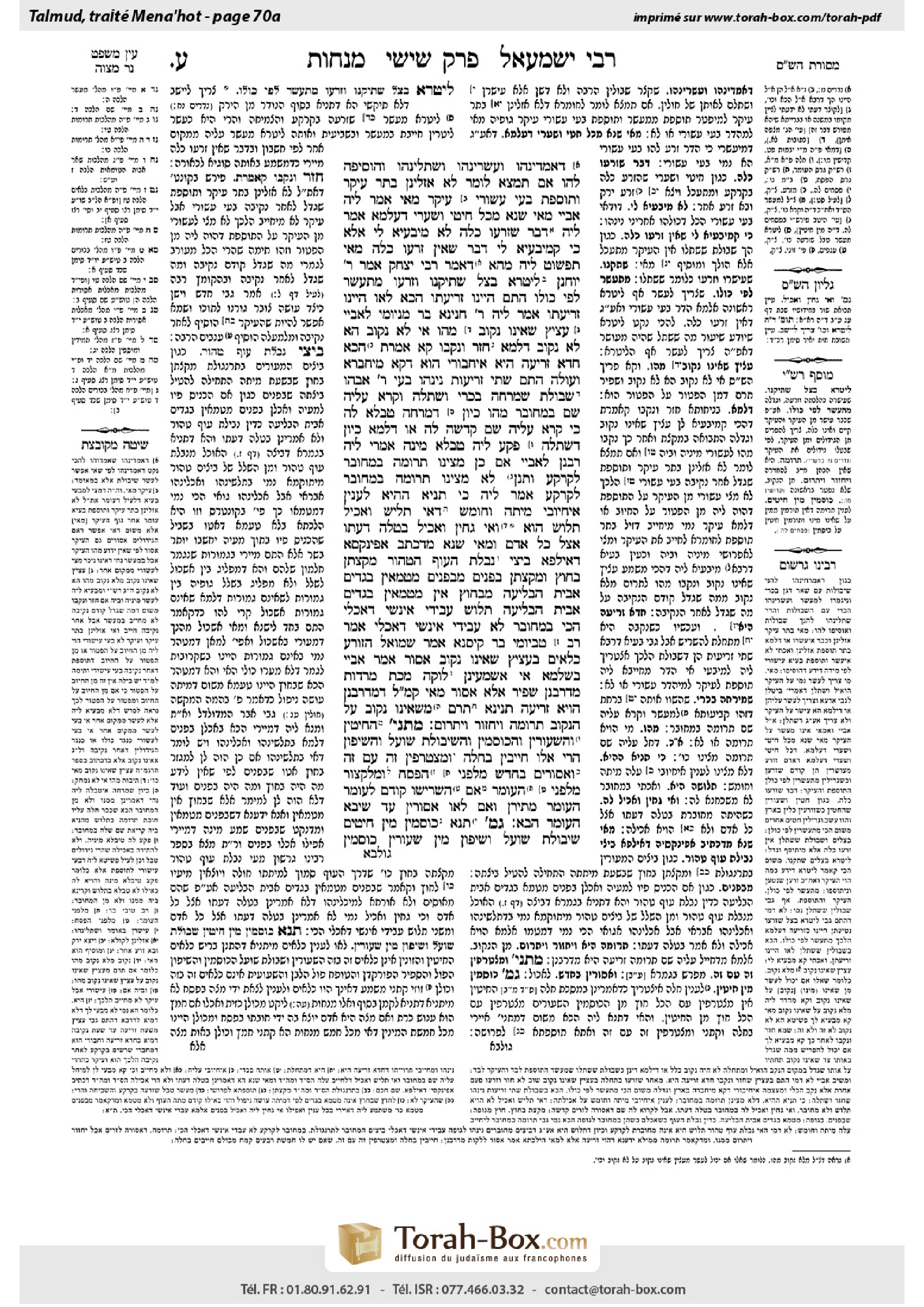
Menachot 70a: Talmud study for Daf Yomi
Daf Yomi is the daily study of one Talmud folio. Explore 37 tractates with scans, Hebrew text, Sefaria English and AI-generated French translations where annotated.
Passage selection and English or AI-generated French translation are available where the scan has annotations. Daf Study is independent of Torah-Box and Sefaria.
Browse Menachot · מנחות · All tractatesMenachot 70a text and translations
This page of Menachot includes the Aramaic text, an English translation and an AI-generated French translation, alongside the scan above.
מנחות ע׳ א · Aramaic and Hebrew text
דְּאַמְדִינְהוּ וְעַשְּׂרִינְהוּ וְשַׁתְלִינְהוּ (וְהוֹסִיפָה) [וְאוֹסִיפָא] לְהוּ.
אִם תִּמְצָא לוֹמַר, לָא אָזְלִינַן בָּתַר עִיקָּר, וְתוֹסֶפֶת בָּעֵי עַשּׂוֹרֵי – עִיקָּר מַאי? אֲמַר לֵיהּ אַבָּיֵי: מַאי שְׁנָא מִכׇּל חִיטֵּי וּשְׂעָרֵי דְּעָלְמָא?
אֲמַר לֵיהּ: דָּבָר שֶׁזַּרְעוֹ כָּלֶה – לָא מִיבַּעְיָא לִי, אֶלָּא כִּי קָמִיבַּעְיָא לִי – דָּבָר שֶׁאֵין זַרְעוֹ כָּלֶה, מַאי?
תִּפְשׁוֹט לֵיהּ מֵהָא דְּאָמַר רַבִּי יִצְחָק אָמַר רַבִּי יוֹחָנָן: לִיטְרָא בָּצָל שֶׁתִּיקְּנוֹ וּזְרָעוֹ – מִתְעַשֵּׂר לְפִי כּוּלּוֹ.
הָתָם – הַיְינוּ זְרִיעָתוֹ, הָכָא – לָאו הַיְינוּ זְרִיעָתוֹ.
אֲמַר לֵיהּ רַבִּי חֲנִינָא בַּר מִנְיוֹמֵי לְאַבָּיֵי: עָצִיץ שֶׁאֵינוֹ נָקוּב, מַהוּ? אִי לֹא נָקוּב – הָא לֹא נָקוּב!
דִּלְמָא חָזַר וּנְקָבוֹ, קָא אָמְרַתְּ?
הָכָא, חֲדָא זְרִיעָה הִיא, אִיחַבּוֹרֵי הוּא דְּקָא מִיחַבְּרָא וְעוֹלָה; הָתָם – שְׁתֵּי זְרִיעוֹת נִינְהוּ.
בָּעֵי רַבִּי אֲבָהוּ: שִׁבּוֹלֶת שֶׁמֵּרְחָהּ בִּכְרִי, וּשְׁתָלָהּ, וְקָרָא עָלֶיהָ שֵׁם בִּמְחוּבָּר – מַהוּ? כֵּיוָן דְּמֵרְחָהּ טָבְלָא לַהּ, כִּי קָרָא עָלֶיהָ שֵׁם קָדְשָׁה לַהּ, אוֹ דִלְמָא, כֵּיוָן דְּשַׁתְלַהּ – פְּקַע לֵיהּ טִבְלָא מִינַּהּ.
אָמְרִי לֵיהּ רַבָּנַן לְאַבָּיֵי: אִם כֵּן, מָצִינוּ תְּרוּמָה בִּמְחוּבָּר לַקַּרְקַע, וּתְנַן: לֹא מָצִינוּ תְּרוּמָה בִּמְחוּבָּר לַקַּרְקַע!
אֲמַר לֵיהּ: כִּי תַּנְיָא הָהִיא – לְעִנְיַן אִיחַיּוֹבֵי מִיתָה וָחוֹמֶשׁ, דְּאִי תָּלֵישׁ וְאָכֵיל – תָּלוּשׁ הוּא, וְאִי גָּחֵין וְאָכֵיל – בָּטְלָה דַּעְתּוֹ אֵצֶל כׇּל אָדָם.
וּמַאי שְׁנָא מִדִּכְתַב אַפִּינַקְסָא דְּאִילְפָא: בֵּיצֵי נִבְלַת הָעוֹף הַטָּהוֹר, מִקְצָתָן בַּחוּץ וּמִקְצָתָן בִּפְנִים – מִבִּפְנִים מְטַמְּאִין בְּגָדִים אַבֵּית הַבְּלִיעָה, מִבַּחוּץ אֵין מְטַמְּאִין בְּגָדִים אַבֵּית הַבְּלִיעָה.
תָּלוּשׁ – עֲבִידִי אִינָשֵׁי דְּאָכְלִי הָכִי, בִּמְחוּבָּר – לָא עֲבִידִי אִינָשֵׁי דְּאָכְלִי.
אָמַר רַב טָבְיוֹמֵי בַּר קִיסְנָא, אָמַר שְׁמוּאֵל: הַזּוֹרֵעַ כִּלְאַיִם בְּעָצִיץ שֶׁאֵינוֹ נָקוּב – אָסוּר. אָמַר אַבָּיֵי: בִּשְׁלָמָא אִי אַשְׁמְעִינַן לוֹקֶה מַכַּת מַרְדּוּת מִדְּרַבָּנַן – שַׁפִּיר, אֶלָּא אָסוּר – מַאי קָא מַשְׁמַע לַן?
דְּמִדְּרַבָּנַן הָוְיָא זְרִיעָה? תְּנֵינָא: תָּרַם מִשֶּׁאֵינוֹ נָקוּב עַל הַנָּקוּב – תְּרוּמָה, וְיַחְזוֹר וְיִתְרוֹם.
מַתְנִי׳ הַחִיטִּין, וְהַשְּׂעוֹרִין, וְהַכּוּסְּמִין, וְהַשִּׁיבּוֹלֶת שׁוּעָל, וְהַשִּׁיפוֹן – הֲרֵי אֵלּוּ חַיָּיבִין בַּחַלָּה, וּמִצְטָרְפִין זֶה עִם זֶה, וַאֲסוּרִים בֶּחָדָשׁ מִלִּפְנֵי הַפֶּסַח, וּמִלִּקְצוֹר מִלִּפְנֵי הָעוֹמֶר. אִם הִשְׁרִישׁוּ קוֹדֶם לָעוֹמֶר – הָעוֹמֶר מַתִּירָן, וְאִם לָאו – אֲסוּרִין עַד שֶׁיָּבֹא הָעוֹמֶר הַבָּא.
גְּמָ׳ תָּנָא: כּוּסְּמִין – מִין חִיטִּים, שִׁיבּוֹלֶת שׁוּעָל וְשִׁיפוֹן – מִין שְׂעוֹרִין. כּוּסְּמִין –
Menachot 70a · English translation
one estimated the amount of tithe necessary, and then he separated those tithes, and then he planted the grain again and it added to its growth. The question is whether we follow the initial growth, and therefore the subsequent growth is exempt from the obligation to separate tithes, or do we follow the additional growth and deem it obligated in tithes?
Rabba adds: If you say that we do not follow the main growth and therefore the additional growth requires the separation of tithes, what is the halakha with regard to the main, initial growth? Does it require an additional separation of tithes, or does it not, as tithes were already set aside for it? Abaye said to Rabba: In what way is this case different from any general case of wheat or barley? When grain is tithed and replanted, the obligation of tithes always applies to what then grows.
Rabba said to Abaye: I do not raise the dilemma with regard to a substance whose seed disintegrates in the ground. In such a case it is clear that the new growth requires a new tithe to be separated, as the original seed is no longer extant. Rather, when I raise the dilemma it is with regard to a substance whose original seed does not disintegrate. What is the halakha? Do we follow the original growth, for which tithes have already been separated, or do we follow the additional growth that is still being generated by that original seed?
The Gemara asks: Let him resolve the dilemma from that which Rabbi Yitzḥak said that Rabbi Yoḥanan said: With regard to a litra of onions that one tithed, and then he sowed a field with the entire litra of onions, when the field yields a crop it is tithed according to the entire crop. Although some of the onions he sowed were already tithed, he is obligated to tithe them again because the growths exceed the original onions and therefore the entire crop has untithed status.
The Gemara rejects that resolution: There, in the case of the field sowed with the tithed onions, the entire field must be tithed because that is the normal way in which a field is sowed. One generally replants a full onion, and therefore the focus is not on the original onion but on the yield, which must be fully tithed. Here, in the case of grain, this is not the normal way in which a field is sowed. Generally one plants individual kernels, not fully grown ears of grain. Consequently, any subsequent growth from that fully grown ear is considered part of the original growth.
Rabbi Ḥanina bar Minyumi said to Abaye: In a case of a flowerpot [atzitz] that is not perforated, what is the halakha with regard to separating teruma and tithes? Abaye replied: What is the difficulty here? If it is not perforated, this halakha is the same as that of any non-perforated flowerpot, i.e., the separation of teruma and tithes is required by rabbinic law.
Abaye continues: Perhaps what you meant to say is that he subsequently went and perforated it. In such a case the question is whether one may separate teruma and tithes from the initial growth of the plant. Is the initial growth considered a separate entity, in which case one part of the growth requires the separation of teruma and tithes by rabbinic law and the rest by Torah law, and therefore one may not separate from the initial growth? Alternatively, perhaps the initial growth is nullified by the subsequent growth, which would mean that the obligation of teruma and tithes applies to the entire plant by Torah law. Consequently, this obligation can be fulfilled by separating teruma and tithes from the initial growth of the plant. This would be similar to Rabba’s dilemma with regard to an ear of grain that is replanted.
Abaye explains that the two cases are not comparable. Here, in the case of the non-perforated flowerpot which was subsequently perforated, it is one single sowing. Therefore, although the original growth occurred while the pot was not perforated, since it is now perforated, the plant is considered attached to the ground and it rises and grows from there. Consequently, the obligation of teruma and tithes applies to the entire plant by Torah law. There, in Rabba’s dilemma involving the replanting of an ear of grain, there are two distinct sowings. Therefore, there is room to debate whether or not the additional, second sowing is part of the original, first sowing.
§ Rabbi Abbahu raises a dilemma: With regard to an ear of grain that one smoothed into a pile and then sowed it again and subsequently designated it as teruma or tithes while it was attached to the ground, what is the halakha? Does one say that since he smoothed it, which is the act that renders produce subject to the obligation of teruma and tithes, he has given it the status of untithed produce, and therefore when he subsequently designated it he thereby sanctified it? Or perhaps, since he had sowed it again after he had smoothed it, its status as untithed produce lapsed from it.
The Sages said to Abaye: If so, that the grain is sanctified in this situation, we have found a case of teruma that is sanctified while it is still attached to the ground. But we learn in a baraita: We do not find a case of teruma attached to the ground. Therefore, one must conclude that its status as untithed produce has been removed, and his designation does not render it teruma.
Abaye said to one of those Sages: When that baraita is taught, it is taught with regard to teruma, which renders a non-priest liable to death at the hand of Heaven or payment of a fifth. If a non-priest ate teruma intentionally he is liable to receive death at the hand of Heaven; if he ate it unintentionally, he must restore the amount he ate with the addition of one-fifth (see Leviticus 22:9, 14). The reason there is no penalty for eating teruma that is attached to the ground is that if one detaches it and eats it, it is considered detached. And if he stooped down and ate it while it was attached to the ground he is not liable, as his intention is rendered irrelevant by the opinions of all other people. In other words, this is an abnormal manner of eating, for which one is not liable.
The Gemara asks: In what way is this case different from the halakha that is written on the tablet [appinkesa] of Ilfa: With regard to eggs found with the carcass of a kosher bird, some of them outside the bird and some of them inside the bird, if one ate from those inner eggs directly from inside the bird, they render the garments of one who swallows them ritually impure when they are in the throat. If he removed those same eggs and ate from them when they were outside the bird, they do not render the garments of one who swallows them ritually impure when they are in the throat. Apparently, even the abnormal method of eating eggs while they are inside the bird is still considered eating. If so, the same should apply to consuming teruma abnormally by stooping down and eating it while it is still attached to the ground.
The Gemara answers: With regard to an item that is detached, i.e., the eggs inside the bird, it is relatively common for people to eat even in this manner. But with regard to an item that is attached to the ground, it is not common for people to eat such produce at all.
§ Rav Tavyumei bar Kisna says that Shmuel says: With regard to one who plants diverse kinds of plants in a non-perforated flowerpot, this is prohibited. Abaye said: What is novel about this halakha? Granted if Shmuel had taught us that one who plants in this manner is flogged with lashes for rebelliousness by rabbinic law, it is well and understandable. But with this basic ruling he stated, that it is prohibited, what is he teaching us?
Is he teaching that planting in a non-perforated flowerpot is considered sowing by rabbinic law? We already learn this in a mishna (Demai 5:10): If one separated teruma from produce grown in a non-perforated pot for produce of a perforated pot, it is teruma by rabbinic law, and he must again separate teruma from the produce obligated in teruma by Torah law to render the produce grown in the perforated pot permitted in consumption. Since this separation has the status of teruma by rabbinic law, evidently sowing in a non-perforated pot is considered sowing.
MISHNA: Wheat, barley, spelt, oats, and rye; these are obligated in the separation of ḥalla, and each one of them joins together with the others to constitute the measure that obligates one to separate ḥalla. And they are prohibited due to the prohibition of partaking of the new crop prior to the Passover Festival, and likewise it is prohibited to reap them prior to the omer offering. If these grains took root prior to the omer offering, the omer permits their consumption; and if not, they are prohibited until the next omer is brought and sacrificed the following year.
GEMARA: The Gemara discusses the identity of the species mentioned in the mishna. A Sage taught in a baraita: Spelt is a type of wheat, while oats and rye are a type of barley. The Gemara translates the lesser-known species into the vernacular Aramaic: Spelt is called
Menachot 70a · Traduction française (IA)
On estimait la quantité de dîme nécessaire, puis on prélevait ces dîmes. Ensuite, on replantait le grain, qui poursuivait sa croissance. La question est de savoir si l’on tient compte de la croissance initiale, auquel cas la croissance ultérieure est dispensée de l’obligation de prélever les dîmes, ou si l’on tient compte de la croissance supplémentaire, auquel cas celle-ci est assujettie aux dîmes.
Rabba ajoute : Si tu dis que l’on ne tient pas compte de la croissance principale, et que la croissance supplémentaire doit donc être soumise au prélèvement des dîmes, quelle est la halakha concernant la croissance principale, initiale ? Doit-elle faire l’objet d’un nouveau prélèvement des dîmes, ou non, puisqu’on en a déjà prélevé pour elle ? Abayé dit à Rabba : En quoi ce cas diffère-t-il de tout cas ordinaire de blé ou d’orge ? Lorsque du grain soumis aux dîmes est replanté, l’obligation des dîmes s’applique toujours à ce qui pousse ensuite.
Rabba dit à Abayé : Je ne soulève pas cette question à propos d’une substance dont la semence se désagrège dans la terre. Dans un tel cas, il est clair que la nouvelle croissance doit faire l’objet d’un nouveau prélèvement de la dîme, puisque la semence initiale n’existe plus. Je soulève plutôt cette question à propos d’une substance dont la semence initiale ne se désagrège pas. Quelle est la halakha ? Tient-on compte de la croissance initiale, pour laquelle les dîmes ont déjà été prélevées, ou de la croissance supplémentaire, qui continue à être produite par cette semence initiale ?
La Guemara demande : Qu’il résolve cette question à partir de ce que Rabbi Yitzḥak a dit au nom de Rabbi Yoḥanan : Dans le cas d’une litra d’oignons soumis à la dîme, que l’on a ensuite plantée entièrement dans un champ, lorsque le champ produit une récolte, la dîme est prélevée sur la récolte entière. Bien que certains des oignons plantés aient déjà été soumis à la dîme, il faut les soumettre à nouveau à la dîme, car la croissance dépasse les oignons d’origine ; toute la récolte est donc considérée comme non soumise à la dîme.
La Guemara rejette cette résolution : Dans le cas du champ ensemencé avec des oignons soumis à la dîme, la dîme doit être prélevée sur la récolte entière, car c’est la manière habituelle d’ensemencer un champ. En général, on replante un oignon entier ; l’accent ne porte donc pas sur l’oignon d’origine, mais sur le rendement, qui doit être entièrement soumis à la dîme. Ici, dans le cas du grain, ce n’est pas la manière habituelle d’ensemencer un champ. En général, on plante des grains individuels, et non des épis déjà mûrs. Par conséquent, toute croissance ultérieure issue de cet épi déjà mûr est considérée comme faisant partie de la croissance initiale.
Rabbi Ḥanina bar Minyumi dit à Abayé : Dans le cas d’un pot de fleurs [atzitz] non percé, quelle est la halakha concernant le prélèvement de la terouma et des dîmes ? Abayé répond : Quelle est la difficulté ? S’il n’est pas percé, la halakha est la même que pour tout pot de fleurs non percé : le prélèvement de la terouma et des dîmes est requis par décret rabbinique.
Abayé poursuit : Peut-être voulais-tu dire qu’on l’a ensuite percé. Dans ce cas, la question est de savoir si l’on peut prélever la terouma et les dîmes sur la croissance initiale de la plante. La croissance initiale est-elle considérée comme une entité distincte, auquel cas une partie de la croissance doit être soumise au prélèvement de la terouma et des dîmes par décret rabbinique, et le reste selon la Torah, de sorte qu’on ne peut pas prélever sur la croissance initiale ? Ou bien la croissance initiale est-elle annulée par la croissance ultérieure, ce qui signifierait que l’obligation de prélever la terouma et les dîmes s’applique à la plante entière selon la Torah ? Par conséquent, on pourrait s’acquitter de cette obligation en prélevant la terouma et les dîmes sur la croissance initiale de la plante. Ce cas serait semblable à la question soulevée par Rabba au sujet d’un épi de grain replanté.
Abayé explique que les deux cas ne sont pas comparables. Ici, dans le cas du pot de fleurs non percé qui a ensuite été percé, il s’agit d’un seul et même ensemencement. Par conséquent, bien que la croissance initiale se soit produite alors que le pot n’était pas percé, dès lors qu’il l’est désormais, la plante est considérée comme rattachée au sol et pousse à partir de là. L’obligation de prélever la terouma et les dîmes s’applique donc à la plante entière selon la Torah. Là, dans la question de Rabba concernant la replantation d’un épi de grain, il y a deux ensemencements distincts. Il y a donc lieu de débattre pour savoir si la croissance supplémentaire issue du second ensemencement fait ou non partie du premier ensemencement.
§ Rabbi Abbahu soulève une question : Dans le cas d’un épi de grain que l’on a mis en tas, puis replanté, et que l’on a ensuite désigné comme terouma ou comme dîme alors qu’il était rattaché au sol, quelle est la halakha ? Dit-on que, puisqu’on l’a mis en tas — acte qui assujettit les produits à l’obligation de terouma et de dîmes —, il a acquis le statut de produits non soumis à la dîme, et que sa désignation ultérieure l’a donc sanctifié ? Ou bien, puisqu’on l’a replanté après l’avoir mis en tas, a-t-il perdu son statut de produits non soumis à la dîme ?
Les Sages dirent à Abayé : Si tel est le cas, si le grain est sanctifié dans cette situation, nous avons trouvé un cas de terouma sanctifiée alors qu’elle est encore rattachée au sol. Or nous apprenons dans une baraïta : « Nous ne trouvons pas de cas de terouma rattachée au sol. » Il faut donc conclure qu’il a perdu son statut de produit non soumis à la dîme et que sa désignation ne le rend pas terouma.
Abayé dit à l’un de ces Sages : Lorsque cette baraïta est enseignée, elle concerne la terouma, dont la consommation par un non-prêtre entraîne la mort par la main du Ciel ou le paiement d’un cinquième. Si un non-prêtre mange intentionnellement de la terouma, il encourt la mort par la main du Ciel ; s’il en mange involontairement, il doit restituer la quantité consommée, augmentée d’un cinquième (voir Lévitique 22, 9 et 14). S’il n’y a pas de peine pour la consommation de terouma rattachée au sol, c’est parce que, si on la détache avant de la manger, elle est considérée comme détachée. Et si l’on se penche pour la manger alors qu’elle est rattachée au sol, on n’encourt pas de peine, car l’intention de celui qui agit ainsi n’est pas prise en compte au regard de l’opinion de tous les autres. Autrement dit, il s’agit d’une manière anormale de manger, qui n’entraîne pas de peine.
La Guemara demande : En quoi ce cas diffère-t-il de la halakha inscrite sur la tablette [appinkesa] d’Ilfa : dans le cas d’œufs trouvés avec la carcasse d’un oiseau pur, certains à l’extérieur et d’autres à l’intérieur de l’oiseau, si quelqu’un mange ces œufs intérieurs directement à l’intérieur de l’oiseau, ils rendent rituellement impurs les vêtements de celui qui les avale lorsqu’ils se trouvent dans sa gorge. S’il retire ces mêmes œufs et les mange alors qu’ils sont à l’extérieur de l’oiseau, ils ne rendent pas rituellement impurs les vêtements de celui qui les avale lorsqu’ils se trouvent dans sa gorge. Il apparaît donc que même la manière anormale de manger des œufs à l’intérieur de l’oiseau est considérée comme une consommation. Si tel est le cas, il devrait en aller de même lorsqu’on consomme de la terouma de manière anormale, en se penchant pour la manger alors qu’elle est encore rattachée au sol.
La Guemara répond : Pour un élément détaché, c’est-à-dire les œufs à l’intérieur de l’oiseau, il est relativement courant que les gens mangent même de cette manière. En revanche, pour un élément rattaché au sol, il n’est pas du tout courant que les gens mangent de tels produits.
§ Rav Tavyumei bar Kisna dit au nom de Shmuel : Celui qui plante des espèces végétales différentes dans un pot de fleurs non percé commet une transgression. Abayé dit : Qu’y a-t-il de nouveau dans cette halakha ? Certes, si Shmuel nous avait enseigné que celui qui plante de cette manière reçoit des coups de fouet pour rébellion en vertu du droit rabbinique, ce serait clair et compréhensible. Mais que nous enseigne-t-il par cette règle élémentaire, à savoir que c’est interdit ?
Enseigne-t-il que planter dans un pot non percé est considéré comme un ensemencement selon le droit rabbinique ? Nous l’apprenons déjà dans une Michna (Demai 5, 10) : Si quelqu’un prélève la terouma sur des produits cultivés dans un pot non percé pour des produits cultivés dans un pot percé, ce prélèvement a valeur de terouma en vertu d’un décret rabbinique, et il doit prélever à nouveau la terouma sur les produits assujettis à la terouma selon la Torah afin de permettre la consommation des produits cultivés dans le pot percé. Puisque ce prélèvement a valeur de terouma en vertu d’un décret rabbinique, il est évident que planter dans un pot non percé est considéré comme un ensemencement.
MICHNA : Le blé, l’orge, l’épeautre, l’avoine et le seigle sont assujettis au prélèvement de la ḥalla, et chacun d’eux s’associe aux autres pour atteindre la quantité qui oblige à prélever la ḥalla. Il est interdit de les consommer en raison de l’interdiction de consommer la nouvelle récolte avant la fête de Pessaḥ ; il est également interdit de les moissonner avant l’offrande du omer. Si ces céréales ont pris racine avant l’offrande du omer, le omer permet leur consommation ; sinon, elles restent interdites jusqu’à ce que le omer soit apporté et offert l’année suivante.
GUEMARA : La Guemara examine l’identité des espèces mentionnées dans la Michna. Un Sage enseigna dans une baraïta : L’épeautre est une espèce de blé, tandis que l’avoine et le seigle sont des espèces d’orge. La Guemara traduit les noms des espèces les moins connues en araméen vernaculaire : l’épeautre s’appelle
Traduction française générée par IA à partir de l’édition anglaise de Sefaria. Vérifie toujours un passage avec le texte source.
Text from Sefaria: William Davidson Edition - Vocalized Aramaic (unknown); William Davidson Edition - English (CC BY NC).