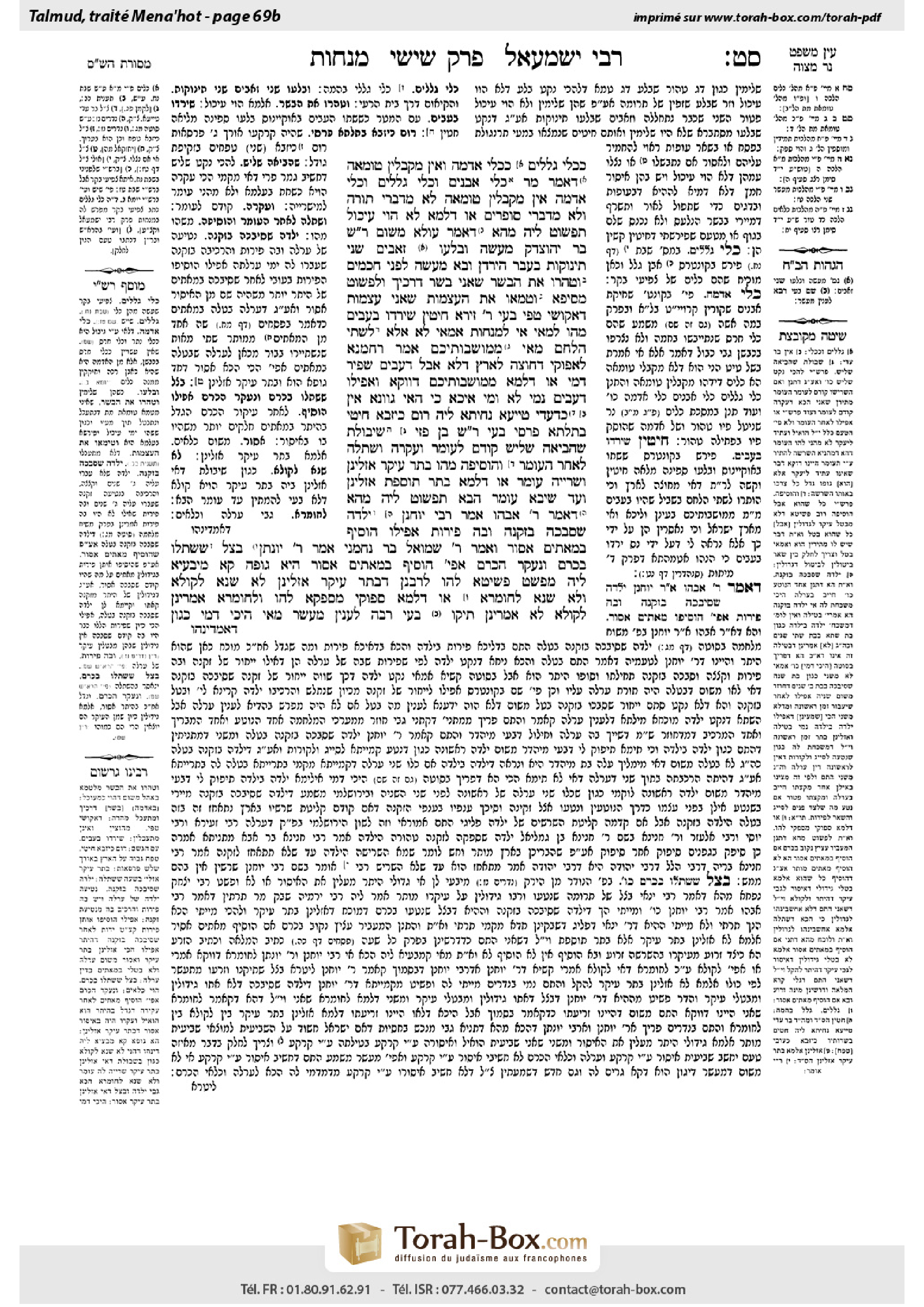
Menachot 69b: Talmud study for Daf Yomi
Daf Yomi is the daily study of one Talmud folio. Explore 37 tractates with scans, Hebrew text, Sefaria English and AI-generated French translations where annotated.
Passage selection and English or AI-generated French translation are available where the scan has annotations. Daf Study is independent of Torah-Box and Sefaria.
Browse Menachot · מנחות · All tractatesMenachot 69b text and translations
This page of Menachot includes the Aramaic text, an English translation and an AI-generated French translation, alongside the scan above.
מנחות ס״ט ב · Aramaic and Hebrew text
כִּכְלֵי גְלָלִים, כִּכְלֵי אֲדָמָה, וְאֵין מְקַבְּלִין טוּמְאָה – דְּאָמַר מָר: כְּלֵי אֲבָנִים וּכְלֵי גְלָלִים וּכְלֵי אֲדָמָה אֵין מְקַבְּלִין טוּמְאָה לֹא מִדִּבְרֵי תוֹרָה וְלֹא מִדִּבְרֵי סוֹפְרִים, אוֹ דִלְמָא לָא הָוֵי עִיכּוּל?
תִּפְשׁוֹט לֵיהּ מֵהָא דְּאָמַר עוּלָּא מִשּׁוּם רַבִּי שִׁמְעוֹן בַּר יְהוֹצָדָק: מַעֲשֶׂה וּבָלְעוּ זְאֵבִים שְׁנֵי תִינוֹקוֹת בְּעֵבֶר הַיַּרְדֵּן, וּבָא מַעֲשֶׂה לִפְנֵי חֲכָמִים, וְטִהֲרוּ אֶת הַבָּשָׂר.
שָׁאנֵי בָּשָׂר, דְּרַכִּיךְ. וְלִפְשׁוֹט מִסֵּיפָא: וְטִמְּאוּ אֶת הָעֲצָמוֹת! שָׁאנֵי עֲצָמוֹת, דַּאֲקוֹשֵׁי טְפֵי.
בָּעֵי רַבִּי זֵירָא: חִיטִּין שֶׁיָּרְדוּ בֶּעָבִים, מַהוּ? לְמַאי? אִי לִמְנָחוֹת – אַמַּאי לָא? אֶלָּא לִשְׁתֵּי הַלֶּחֶם, מַאי?
״מִמּוֹשְׁבֹתֵיכֶם״ אָמַר רַחֲמָנָא, לְאַפּוֹקֵי דְּחוּצָה לָאָרֶץ דְּלָא, אֲבָל דְּעָבִים שַׁפִּיר דָּמֵי; אוֹ דִלְמָא ״מִמּוֹשְׁבֹתֵיכֶם״ דַּוְוקָא, וַאֲפִילּוּ דְּעָבִים נָמֵי לָא.
וּמִי אִיכָּא כִּי הַאי גַוְונָא? אִין, כְּדַעֲדִי טַיָּיעָא, נְחִיתָא לֵיהּ רוּם כִּיזְבָא חִיטֵּי בִּתְלָתָא פַּרְסֵי.
בָּעֵי רַבִּי שִׁמְעוֹן בֶּן פַּזִּי: שִׁיבּוֹלֶת שֶׁהֵבִיאָה שְׁלִישׁ קוֹדֶם לָעוֹמֶר, וַעֲקָרָהּ וּשְׁתָלָהּ לְאַחַר הָעוֹמֶר, וְהוֹסִיפָה – מַהוּ? בָּתַר עִיקָּר אָזְלִינַן וְשַׁרְיַיהּ עוֹמֶר, אוֹ דִלְמָא בָּתַר תּוֹסֶפֶת אָזְלִינַן, וְעַד שֶׁיָּבֹא עוֹמֶר הַבָּא?
תִּפְשׁוֹט לֵיהּ מֵהָא דְּאָמַר רַבִּי אֲבָהוּ אָמַר רַבִּי יוֹחָנָן: יַלְדָּה שֶׁסִּבְּכָהּ בִּזְקֵנָה, וּבָהּ פֵּירוֹת, אֲפִילּוּ הוֹסִיף בְּמָאתַיִם – אָסוּר.
וְאָמַר רַבִּי שְׁמוּאֵל בַּר נַחְמָנִי, אָמַר רַבִּי יוֹנָתָן: בָּצָל שֶׁשְּׁתָלוֹ בַּכֶּרֶם, וְנֶעֱקַר הַכֶּרֶם, אֲפִילּוּ הוֹסִיף בְּמָאתַיִם – אָסוּר.
הִיא גּוּפַהּ קָא מִיבַּעְיָא לֵיהּ: מִפְשָׁט פְּשִׁיטָא לְהוּ לְרַבָּנַן דְּבָתַר עִיקָּר אָזְלִינַן, לָא שְׁנָא לְקוּלָּא וְלָא שְׁנָא לְחוּמְרָא? אוֹ דִלְמָא סַפּוֹקֵי מְסַפְּקָא לְהוּ, וּלְחוּמְרָא אָמְרִינַן, לְקוּלָּא לָא אָמְרִינַן? תֵּיקוּ.
בָּעֵי רַבָּה: לְעִנְיַן מַעֲשֵׂר מַאי? הֵיכִי דָּמֵי? כְּגוֹן
Menachot 69b · English translation
like dung vessels and like earth vessels, and these are not susceptible to ritual impurity, as the Master said: Stone vessels and dung vessels and earth vessels are not susceptible to ritual impurity, neither by Torah law nor by rabbinic law? Or perhaps this is not considered digestion, as these palm leaves remained intact, and therefore the vessel prepared from them is susceptible to ritual impurity like any other wooden vessel.
The Gemara suggests: Resolve the dilemma from that which Ulla says in the name of Rabbi Shimon bar Yehotzadak: An incident occurred in which wolves swallowed two children and excreted them on the east bank of the Jordan, and the incident came before the Sages for a ruling. They were asked whether the remains of the children were ritually impure even after they had passed through the animal’s digestive tract, and they deemed the flesh ritually pure, as it is no longer considered human flesh but wolf excrement. Similarly, the swallowed palm leaves should be considered like elephant dung and therefore the basket made from them should not be susceptible to ritual impurity.
The Gemara rejects this resolution: That case of flesh is different, as flesh is soft and digestible. Palm leaves, by contrast, are hard and not easily digested. The Gemara suggests: But in that case, let us resolve the dilemma from the last clause of the account of that incident: The Sages ruled that flesh was ritually pure, but they deemed the intact bones ritually impure. The bones, which are a harder substance than the flesh, are not considered digested. Likewise, the hard palm leaves should also not be considered digested, and the wicker basket fashioned from them should be susceptible to ritual impurity. The Gemara answers: The case of bones is different, as they are harder. Therefore, one cannot cite a proof from here with regard to palm leaves, which are a comparatively softer substance.
§ Rabbi Zeira raises a dilemma: With regard to wheat that fell from the clouds, what is the halakha? The Gemara asks: With regard to what issue was this dilemma raised? If it is referring to using this wheat for meal offerings, why not? There should be no problem with using the wheat, since wheat for meal offerings does not have to come from Eretz Yisrael. Rather, the dilemma is whether this wheat can be used for the offering of the two loaves on Shavuot. What is the halakha?
The Gemara explains the two possibilities. The verse states: “You shall bring out of your dwellings two wave-loaves of two-tenths of an ephah; they shall be of fine flour, they shall be baked with leaven, for first fruits to the Lord” (Leviticus 23:17). When the Merciful One states: “Out of your dwellings,” does this serve to exclude wheat that came from outside Eretz Yisrael, teaching that it may not be used for the two loaves; but wheat that fell from the clouds is permitted? Or perhaps the verse means specifically: “Out of your dwellings,” i.e., only from Eretz Yisrael; and if so, even wheat that fell from the clouds is also not acceptable.
With regard to this dilemma, the Gemara asks: But is there a case like this? Is it possible for wheat to fall from the clouds? The Gemara answers: Yes, as in an incident involving Adi the Arab [taya’a], about whom it is related that it rained down on him wheat of a height of one handbreadth spread over an area of three parasangs.
§ Rabbi Shimon ben Pazi raises a dilemma: In a case where one had an ear of grain that reached one-third of its growth prior to the bringing of the omer offering, and then he uprooted it and planted it again after the omer, and then it added to its growth, what is the halakha? Do we follow the original growth, which was permitted by the omer offering, and therefore the additional growth is also permitted? Or perhaps we follow the additional growth, which was not permitted by the omer, as it grew afterward. And if so, it will remain prohibited until the next omer offering is brought.
The Gemara suggests: Resolve the dilemma from that which Rabbi Abbahu says that Rabbi Yoḥanan says: With regard to a young vine within three years of its planting, whose fruits are prohibited as orla, that one grafted onto an old, permitted vine, and there were fruits on the younger vine, even if the older vine added two hundred parts of growth to the existing fruit, it is still prohibited. The two hundred permitted parts, which are generally sufficient to nullify one part of orla, are ineffective in this case, because the subsequent additional growth is considered subordinate to the original prohibited growth. This proves that we follow the original growth, and therefore in Rabbi Shimon ben Pazi’s case the original growth that was permitted by the omer should render the entire plant, including the subsequent growth, permitted in consumption.
The Gemara cites another proof from a similar case. And likewise Rabbi Shmuel bar Naḥmani says that Rabbi Yonatan says: With regard to an onion that one planted in a vineyard, creating a forbidden mixture of food crops in a vineyard, and the vineyard was subsequently uprooted, so that most of the onion grew in a permitted manner, even if the onion added two hundred parts of growth, the onion is prohibited. The reason the entire onion is prohibited is apparently because we follow the original growth, which is forbidden.
The Gemara states that these proofs are inconclusive, as that itself is what Rabbi Shimon ben Pazi raises as a dilemma: Is it entirely obvious to the Sages that we follow the main growth, and there is no difference whether this leads to a leniency or whether it leads to a stringency? Or perhaps they are uncertain about the matter, and therefore they rule that when it leads to a stringency, e.g., prohibiting the additional growth of orla fruit or the additional growth of an onion that had grown in a vineyard, we say that we follow the original growth, but when it leads to a leniency, such as allowing the consumption of grain after the omer, we do not say that we follow the original growth. The Gemara concludes: The dilemma shall stand unresolved.
§ In connection to the previous discussion with regard to an ear of grain that had grown one-third prior to the omer and was subsequently uprooted and replanted, Rabba raises a dilemma: With regard to the obligation to tithe, what is the halakha of such grain? The Gemara asks: What are the circumstances? The circumstances involve a case where
Menachot 69b · Traduction française (IA)
comme des récipients en fumier et des récipients en terre, qui ne sont pas susceptibles de contracter l’impureté rituelle, comme l’a enseigné le Maître : les récipients en pierre, en fumier et en terre ne sont susceptibles d’impureté rituelle ni selon la Torah ni selon la loi rabbinique ? Ou peut-être cela n’est-il pas considéré comme une digestion, puisque ces feuilles de palmier sont restées intactes, et que le récipient confectionné avec elles est donc susceptible d’impureté rituelle, comme tout autre récipient en bois.
La Guemara propose de résoudre le dilemme à partir de ce qu’Oula dit au nom de Rabbi Shimon bar Yehotzadak : un incident s’est produit où des loups ont avalé deux enfants, puis les ont rejetés sur la rive orientale du Jourdain. L’affaire fut soumise aux Sages pour qu’ils statuent. On leur demanda si les restes des enfants étaient encore impurs rituellement après avoir traversé le tube digestif de l’animal, et ils déclarèrent la chair pure rituellement, car elle n’est plus considérée comme de la chair humaine, mais comme des excréments de loup. De même, les feuilles de palmier avalées devraient être considérées comme des excréments d’éléphant, et le panier fabriqué avec elles ne devrait donc pas être susceptible d’impureté rituelle.
La Guemara rejette cette résolution : le cas de la chair est différent, car la chair est molle et se digère facilement. Les feuilles de palmier, en revanche, sont dures et difficiles à digérer. La Guemara propose : Mais dans ce cas, résolvons le dilemme à partir de la dernière partie du récit de cet incident : les Sages statuèrent que la chair était pure rituellement, mais déclarèrent les os intacts impurs rituellement. Les os, qui sont une substance plus dure que la chair, ne sont pas considérés comme digérés. De même, les feuilles de palmier dures ne devraient pas être considérées comme digérées, et le panier tressé avec elles devrait être susceptible d’impureté rituelle. La Guemara répond : le cas des os est différent, car ils sont plus durs. On ne peut donc pas en tirer une preuve concernant les feuilles de palmier, qui sont relativement plus molles.
§ Rabbi Zeira soulève un dilemme : quel est le statut du blé tombé des nuages ? La Guemara demande : À quel sujet ce dilemme se pose-t-il ? S’il s’agit d’utiliser ce blé pour les offrandes de farine, pourquoi pas ? Il ne devrait y avoir aucun problème à l’utiliser, puisque le blé destiné aux offrandes de farine n’a pas à provenir de la terre d’Israël. Le dilemme porte plutôt sur la possibilité d’utiliser ce blé pour l’offrande des deux pains à Chavouot. Quel est le statut ?
La Guemara expose les deux possibilités. Le verset dit : « Vous apporterez de vos lieux d’habitation deux pains de balancement, faits de deux dixièmes d’épha ; ils seront de fleur de farine, cuits avec du levain, comme prémices pour le Seigneur » (Lévitique 23:17). Lorsque le Miséricordieux dit : « De vos lieux d’habitation », est-ce pour exclure le blé provenant de l’extérieur de la terre d’Israël, enseignant qu’il ne peut pas être utilisé pour les deux pains, tandis que le blé tombé des nuages est permis ? Ou peut-être le verset signifie-t-il précisément : « De vos lieux d’habitation », c’est-à-dire uniquement de la terre d’Israël ; dans ce cas, le blé tombé des nuages n’est pas non plus acceptable.
À propos de ce dilemme, la Guemara demande : Mais un tel cas existe-t-il ? Est-il possible que du blé tombe des nuages ? La Guemara répond : Oui, comme dans l’incident concernant Adi l’Arabe [taya’a], au sujet duquel on rapporte qu’il plut sur lui du blé formant une couche d’une palme de hauteur sur une étendue de trois parasanges.
§ Rabbi Shimon ben Pazi soulève un dilemme : dans le cas où un épi de céréale avait atteint un tiers de sa croissance avant l’offrande de l’omer, puis fut arraché et replanté après l’omer, après quoi il continua de pousser, quel est le statut ? Suivons-nous la croissance initiale, qui avait été rendue permise par l’offrande de l’omer, de sorte que la croissance supplémentaire est également permise ? Ou peut-être suivons-nous la croissance supplémentaire, qui n’a pas été rendue permise par l’omer, puisqu’elle s’est développée ensuite. Dans ce cas, elle restera interdite jusqu’à ce que la prochaine offrande de l’omer soit apportée.
La Guemara propose de résoudre le dilemme à partir de ce que Rabbi Abbahou dit au nom de Rabbi Yoḥanan : au sujet d’une jeune vigne de moins de trois ans, dont les fruits sont interdits au titre de l’orla, qu’on a greffée sur une vieille vigne dont les fruits sont permis, et qui portait des fruits, même si la vieille vigne a produit une croissance supplémentaire représentant deux cents parts par rapport aux fruits existants, les fruits restent interdits. Les deux cents parts permises, qui suffisent généralement à annuler une part d’orla, sont sans effet dans ce cas, car la croissance supplémentaire ultérieure est considérée comme subordonnée à la croissance initiale interdite. Cela prouve que nous suivons la croissance initiale ; par conséquent, dans le cas de Rabbi Shimon ben Pazi, la croissance initiale, rendue permise par l’omer, devrait rendre toute la plante propre à la consommation, y compris la croissance ultérieure.
La Guemara apporte une autre preuve tirée d’un cas similaire. De même, Rabbi Shmuel bar Naḥmani dit au nom de Rabbi Yonatan : au sujet d’un oignon qu’on a planté dans une vigne, créant ainsi un mélange interdit de cultures dans une vigne, puis que la vigne a été arrachée, de sorte que la majeure partie de l’oignon a poussé dans des conditions permises, même si l’oignon a connu une croissance supplémentaire représentant deux cents parts, il reste interdit. La raison pour laquelle l’oignon tout entier est interdit est apparemment que nous suivons la croissance initiale, qui est interdite.
La Guemara indique que ces preuves ne sont pas concluantes, car c’est précisément la question que Rabbi Shimon ben Pazi soulève : est-il évident aux yeux des Sages que nous suivons la croissance principale, sans distinction selon que cela conduit à une indulgence ou à une rigueur ? Ou bien ont-ils un doute à ce sujet et statuent-ils donc que, lorsque cela conduit à une rigueur — par exemple, interdire la croissance supplémentaire des fruits d’orla ou celle d’un oignon qui avait poussé dans une vigne —, nous disons que nous suivons la croissance initiale, mais que, lorsque cela conduit à une indulgence, comme permettre la consommation du grain après l’omer, nous ne disons pas que nous suivons la croissance initiale ? La Guemara conclut : le dilemme reste sans réponse.
§ En lien avec la discussion précédente concernant un épi de céréale qui avait atteint un tiers de sa croissance avant l’omer, puis avait été arraché et replanté, Rabba soulève un dilemme : quel est le statut d’un tel grain au regard de l’obligation de prélever la dîme ? La Guemara demande : Dans quelles circonstances ? Il s’agit d’un cas où
Traduction française générée par IA à partir de l’édition anglaise de Sefaria. Vérifie toujours un passage avec le texte source.
Text from Sefaria: William Davidson Edition - Vocalized Aramaic (unknown); William Davidson Edition - English (CC BY NC).