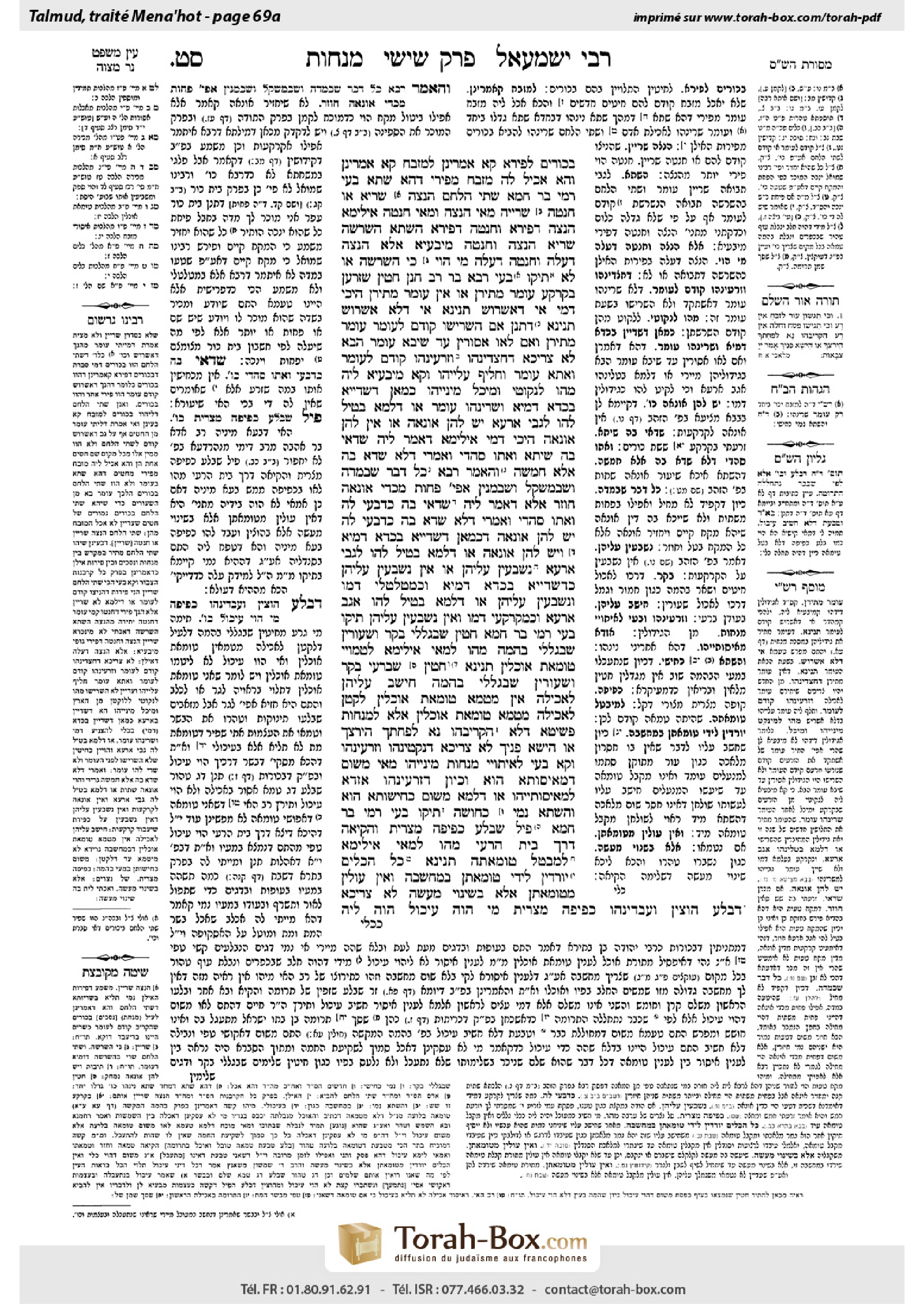
Menachot 69a: Talmud study for Daf Yomi
Daf Yomi is the daily study of one Talmud folio. Explore 37 tractates with scans, Hebrew text, Sefaria English and AI-generated French translations where annotated.
Passage selection and English or AI-generated French translation are available where the scan has annotations. Daf Study is independent of Torah-Box and Sefaria.
Browse Menachot · מנחות · All tractatesMenachot 69a text and translations
This page of Menachot includes the Aramaic text, an English translation and an AI-generated French translation, alongside the scan above.
מנחות ס״ט א · Aramaic and Hebrew text
בִּכּוּרִים לְפֵירָא קָא אָמְרִינַן? לְמִזְבֵּחַ קָא אָמְרִינַן! וְהָא אָכֵיל לֵהּ מִזְבֵּחַ מִפֵּירֵי דְּהָא שַׁתָּא.
בָּעֵי רָמֵי בַּר חָמָא: שְׁתֵּי הַלֶּחֶם – הֲנָצָה שָׁרְיָא, אוֹ חֲנָטָה שָׁרְיָיה? מַאי הֲנָצָה, וּמַאי חֲנָטָה? אִילֵּימָא הֲנָצָה דְּפֵירָא וַחֲנָטָה דְּפֵירָא – הַשְׁתָּא הַשְׁרָשָׁה שָׁרְיָא, הֲנָצָה וַחֲנָטָה מִיבַּעְיָא?
אֶלָּא, הֲנָצָה דְּעָלֶה וַחֲנָטָה דְּעָלֶה, מִי הָוֵי כִּי הַשְׁרָשָׁה אוֹ לָא? תֵּיקוּ.
בָּעֵי רָבָא בַּר רַב חָנָן: חִטִּין שֶׁזְּרָעָן בַּקַּרְקַע, עוֹמֶר מַתִּירָן אוֹ אֵין עוֹמֶר מַתִּירָן? הֵיכִי דָמֵי? אִי דְּאַשְׁרוּשׁ – תְּנֵינָא, אִי דְּלָא אַשְׁרוּשׁ – תְּנֵינָא.
דִּתְנַן: אִם הִשְׁרִישׁוּ קוֹדֶם לָעוֹמֶר – עוֹמֶר מַתִּירָן, וְאִם לָאו – אֲסוּרִין עַד שֶׁיָּבֹא עוֹמֶר הַבָּא.
לָא צְרִיכָא, דְּחַצְדִינְהוּ וְזַרְעִינְהוּ קוֹדֶם לָעוֹמֶר, וַאֲתָא עוֹמֶר וַחֲלֵיף עֲלַיְיהוּ, וְקָא מִיבַּעְיָא לֵיהּ: מַהוּ לְנַקּוֹטֵי וּמֵיכַל מִינַּיְיהוּ? כְּמַאן דְּשַׁדְיָיא בְּכַדָּא דָּמְיָא, וּשְׁרִינְהוּ עוֹמֶר, אוֹ דִלְמָא בַּטֵּיל לְהוּ לְגַבֵּי אַרְעָא?
יֵשׁ לָהֶן אוֹנָאָה, אוֹ אֵין לָהֶן אוֹנָאָה?
הֵיכִי דָּמֵי? אִילֵימָא דְּאָמַר לֵיהּ: שְׁדַאי בַּהּ שִׁיתָּא, וַאֲתוֹ סָהֲדִי וְאָמְרִי דְּלָא שְׁדָא בַּהּ אֶלָּא חַמְשָׁה – וְהָאָמַר רָבָא: כׇּל דָּבָר שֶׁבְּמִדָּה וְשֶׁבְּמִשְׁקָל וְשֶׁבְּמִנְיָן, אֲפִילּוּ פָּחוֹת מִכְּדֵי אוֹנָאָה חוֹזֵר!
אֶלָּא, דַּאֲמַר לֵיהּ: שְׁדַאי בַּהּ כִּדְבָעֵי לַהּ, וַאֲתוֹ סָהֲדִי וְאָמְרִי דְּלָא שְׁדָא בַּהּ כִּדְבָעֵי לַהּ. יֵשׁ לָהֶן אוֹנָאָה, דִּכְמַאן דְּשַׁדְיָיא בְּכַדָּא דָּמְיָא וְיֵשׁ לָהֶן אוֹנָאָה, אוֹ דִלְמָא בַּטֵּיל לְהוּ לְגַבֵּי אַרְעָא?
נִשְׁבָּעִין עֲלֵיהֶן, אוֹ אֵין נִשְׁבָּעִין עֲלֵיהֶן? כִּדְשַׁדְיָיא בְּכַדָּא דָּמְיָא, וּכְמִטַּלְטְלֵי דָּמוּ, וְנִשְׁבָּעִין עֲלֵיהֶן, אוֹ דִלְמָא בַּטֵּיל לְהוּ אַגַּב אַרְעָא, וְכִמְקַרְקְעֵי דָּמוּ, וְאֵין נִשְׁבָּעִין עֲלֵיהֶן? תֵּיקוּ.
בָּעֵי רָמֵי בַּר חָמָא: חִטִּין שֶׁבְּגֶלְלֵי בָקָר, וּשְׂעוֹרִין שֶׁבְּגֶלְלֵי בְהֵמָה – מַהוּ? לְמַאי? אִילֵימָא לְטַמּוֹיֵי טוּמְאַת אֳכָלִין – תְּנֵינָא: חִטִּין שֶׁבִּרְעִי בָקָר וּשְׂעוֹרִין שֶׁבְּגֶלְלֵי בְהֵמָה, חִישֵּׁב עֲלֵיהֶן לַאֲכִילָה – אֵין מִטַּמֵּא טוּמְאַת אֳכָלִין, לִקְּטָן לַאֲכִילָה – מְטַמֵּא טוּמְאַת אֳכָלִין.
אֶלָּא לִמְנָחוֹת, פְּשִׁיטָא דְּלָא, ״הַקְרִיבֵהוּ נָא לְפֶחָתֶךָ הֲיִרְצְךָ אוֹ הֲיִשָּׂא פָנֶיךָ״!
לָא צְרִיכָא, דְּנַקְטִינְהוּ וְזַרְעִינְהוּ, וְקָא בָעֵי לְאֵיתוֹיֵי מְנָחוֹת מִינַּיְיהוּ. מַאי? מִשּׁוּם דִּמְאִיסוּתָא הוּא, וְכֵיוָן דְּזַרְעִינְהוּ אַזְדָּא (למאיסותייהו) [מְאִיסוּתַיְיהוּ], אוֹ דִלְמָא מִשּׁוּם כְּחִישׁוּתָא הוּא, וְהַשְׁתָּא נָמֵי כְּחוּשָׁה? תֵּיקוּ.
בָּעֵי רָמֵי בַּר חָמָא: פִּיל שֶׁבָּלַע כְּפִיפָה מִצְרִית, וֶהֱקִיאָהּ דֶּרֶךְ בֵּית הָרְעִי, מַהוּ? לְמַאי?
אִילֵּימָא לְמִבְטַל טוּמְאָתַהּ, תְּנֵינָא: כׇּל הַכֵּלִים יוֹרְדִין לִידֵי טוּמְאָתָן בְּמַחְשָׁבָה, וְאֵין עוֹלִין מִטּוּמְאָתָן אֶלָּא בְּשִׁינּוּי מַעֲשֶׂה.
לָא צְרִיכָא, דִּבְלַע הוּצִין וְעַבְדִינְהוּ כְּפִיפָה מִצְרִית. מִי הָוֵה עִיכּוּל, הָוֵה לֵיהּ
Menachot 69a · English translation
that when we say the two loaves must come from the first fruits, the verse is referring to the new fruit crop grown this year? This is not so. Rather, we say that the two loaves must come from the first fruits sacrificed upon the altar this year. Therefore, even in Rabba’s case the two loaves cannot come from wheat, as the altar had already consumed from the fruit, i.e., the wheat used for the omer offering, of this year.
§ Rami bar Ḥama raises a dilemma: With regard to the two loaves that permit the bringing of first fruit, are all fruit that are budding at the time of the sacrifice permitted, or are only fruit that has gone through formation permitted? The Gemara asks: What is meant here by budding and what is the meaning of formation? If we say that this is referring to the budding of the fruit and the formation of the fruit, this is difficult: Now that it is taught (70a) that even in the case of the grain taking root prior to the bringing of the two loaves, that grain is permitted by their sacrifice, is it necessary to discuss the budding or formation of fruit, which corresponds to a later stage than the taking root of grain?
The Gemara answers: Rather, Rami bar Ḥama is referring to the budding of a fruit tree’s leaf and the formation of a fruit tree’s leaf. The question is whether the budding of the fruit tree’s leaves is like the taking root of grain, and therefore all the tree’s first fruit is permitted by the two loaves, or whether this budding is not similar to the taking root of grain, and therefore the tree’s fruit is not permitted by the two loaves. The Gemara concludes: The dilemma shall stand unresolved.
§ Rava bar Rav Ḥanan raises a dilemma: With regard to wheat kernels that one sowed in the ground, does the bringing of the omer offering permit them to be eaten or does the omer not permit them in consumption? The Gemara asks: What are the circumstances? If this is referring to a case where the wheat kernel has already taken root prior to the bringing of the omer offering, we already learn this in a mishna. If it is referring to a case where the wheat stalk has not yet taken root, we already learn this in a mishna as well.
The Gemara cites the source for this claim. As we learned in a mishna (70a): If crops took root before the sacrifice of the omer offering, the omer permits them to be eaten. And if not, i.e., they took root only after the sacrifice of the omer offering, they are prohibited until the next omer is sacrificed the following year.
The Gemara explains: No, Rava bar Rav Ḥanan’s dilemma is necessary only in a case where one reaped grain and sowed it again prior to the omer, and the time of the omer arrived and passed while the grain was in the ground but before it had taken root. And this is the dilemma that he raises: What is the halakha in such a case? Is it permitted to take these kernels and eat from them? Is their halakhic status considered like that of kernels cast into a jug, i.e., disconnected from the ground, and consequently the sacrifice of the omer offering renders their consumption permitted? Or perhaps he subordinated them to the ground, in which case their halakhic status is that of seeds that did not take root and are therefore prohibited.
Rava bar Rav Ḥanan raises another dilemma with regard to grains that were reaped and then sowed again: Does the halakha of exploitation apply to them in a case of a disparity of one-sixth between their sale price and their market value, which would render the exploiter obligated to refund the difference between the purchase price and the market value, or does the halakha of exploitation not apply to them? Since the halakhot of exploitation apply only to movable property, not to land, this matter depends on whether these grains are considered like detached movable property or whether they have been subordinated to the land.
The Gemara asks: What are the circumstances? If we say that one said: I sowed six kav of grain in the field, and witnesses came and said that he sowed only five kav in it, that is difficult: But doesn’t Rava say: With regard to any item that is otherwise subject to the halakhot of exploitation, and it is sold by measure, or by weight, or by number, even if the disparity was less than the measure of exploitation in the transaction, the transaction is reversed. A disparity of one-sixth between the value of an item and its price constitutes exploitation only in cases where there is room for error in assessing the value of an item. In a case where the sale item is easily quantifiable, any deviation from the designated quantity results in a nullification of the transaction, even if the sale item in question is subordinate to the ground.
Rather, it is a case where the seller said: I cast kernels in the field as required, without quantifying the measure of the kernels that he cast, and witnesses came and said that he did not cast kernels in the field as required. Are they subject to the halakhot of exploitation, as the halakhic status of these kernels is like that of kernels cast into a jug, and they are subject to the halakhot of exploitation? Or, perhaps the laborer subordinated them to the ground, in which case they have the status of land, which is not subject to the halakhot of exploitation.
Rava bar Rav Ḥanan raises yet another dilemma with regard to grains that were reaped and then sowed again. The halakha is that one does not take oaths with regard to claims on land. Consequently, if one admitted to part of a claim with regard to such grain, which generally obligates him in an oath, does he take an oath with regard to the kernels or does he not take an oath with regard to the kernels? Is their halakhic status like that of kernels cast into a jug, and they are like movable property and one takes an oath with regard to them? Or, perhaps he subordinated them to the ground, and they are like land and one does not take an oath with regard to them. The Gemara concludes: The dilemma shall stand unresolved.
§ Rami bar Ḥama raises another dilemma: With regard to wheat kernels that are found in the dung of cattle, or barley kernels found in the dung of an animal, what is the halakha? The Gemara asks: With regard to what issue was this dilemma raised? If we say it was with regard to their capacity to become susceptible to the ritual impurity of food, we already learn this in a baraita, as it is taught: If one found wheat kernels in the dung of cattle or barley kernels in the dung of animals, they do not become susceptible to the ritual impurity of food. But if he collected them for eating, they do become susceptible to the ritual impurity of food.
The Gemara provides another suggestion: Rather, perhaps Rami bar Ḥama’s dilemma is referring to the use of these kernels for meal offerings. The Gemara rejects this: It is obvious that they may not be used for meal offerings, as it is written with regard to those who offer inferior items to the Temple: “Present it now unto your governor; will he be pleased with you or show you favor? Says the Lord of hosts” (Malachi 1:8). Any item that one would not feel comfortable bringing to a governor or local ruler may certainly not be brought to the Temple.
The Gemara explains: No; it is necessary to raise the dilemma in a case where one collected these kernels and sowed them in the ground, and now he wants to bring meal offerings from them. What is the halakha? Is the reason one may not use them initially for meal offerings because they are disgusting, and since he sowed them again their disgusting quality has left? Or perhaps they were initially disqualified because they are considered weakened after having been digested by an animal. And if so, even the grains that have now grown after they were replanted are also weakened, like the kernels that gave rise to them. The Gemara concludes: The dilemma shall stand unresolved.
Rami bar Ḥama raises yet another dilemma: In the case of an elephant that swallowed an Egyptian wicker basket and excreted it intact along with its waste, what is the halakha? The Gemara asks: With regard to what matter was this dilemma raised?
If we say that the dilemma was raised with regard to a case where the wicker basket was ritually impure and the question is if its ritual impurity is nullified by the elephant swallowing it, we already learn in a mishna (Kelim 25:9): All vessels descend into their state of ritual impurity by means of thought. Although an unfinished vessel cannot become ritually impure, if the craftsman decided not to finish it, it immediately assumes the halakhic status of a completed vessel and can become ritually impure. But they ascend from their state of ritual impurity only by means of a change resulting from an action. A ritually impure vessel, once it undergoes physical change, is no longer ritually impure. Therefore, as the wicker basket remained intact without physical change, it is clear that it remains ritually impure.
The Gemara answers: No, it is necessary to raise this dilemma in a case where the elephant had swallowed ends of palm leaves [hutzin] whole, and after the leaves were excreted one made them into an Egyptian wicker basket. The dilemma is as follows: Is this considered digestion, and therefore the basket prepared from the leaves is
Menachot 69a · Traduction française (IA)
Lorsque nous disons que les deux pains doivent provenir des prémices, le verset fait-il référence à la nouvelle récolte de fruits produite cette année ? Ce n’est pas le cas. Nous disons plutôt que les deux pains doivent provenir des premiers fruits offerts sur l’autel cette année. Par conséquent, même dans le cas de Rabba, les deux pains ne peuvent pas provenir du blé, puisque l’autel avait déjà consommé les fruits de cette année, c’est-à-dire le blé utilisé pour l’offrande de l’omer.
§ Rami bar Ḥama soulève un dilemme : concernant les deux pains qui autorisent l’apport des prémices, tous les fruits qui bourgeonnent au moment de l’offrande sont-ils permis, ou seuls les fruits qui ont atteint leur formation le sont-ils ? La Guemara demande : Qu’entend-on ici par bourgeonnement et par formation ? Si nous disons qu’il s’agit du bourgeonnement du fruit et de sa formation, cela pose problème : puisqu’il est enseigné (70a) que même les grains qui ont pris racine avant l’offrande des deux pains sont permis grâce à cette offrande, est-il nécessaire de discuter du bourgeonnement ou de la formation des fruits, qui correspondent à un stade ultérieur à la prise de racine du grain ?
La Guemara répond : Rami bar Ḥama parle plutôt du bourgeonnement des feuilles d’un arbre fruitier et de la formation de ses feuilles. La question est de savoir si le bourgeonnement des feuilles de l’arbre fruitier équivaut à la prise de racine du grain et si, par conséquent, tous les premiers fruits de l’arbre sont permis grâce aux deux pains, ou si ce bourgeonnement n’est pas comparable à la prise de racine du grain, auquel cas les fruits de l’arbre ne sont pas permis grâce aux deux pains. La Guemara conclut : le dilemme reste sans solution.
§ Rava bar Rav Ḥanan soulève un dilemme : concernant des grains de blé qu’on a semés en terre, l’offrande de l’omer les rend-elle permis à la consommation, ou ne les rend-elle pas permis ? La Guemara demande : Dans quelles circonstances ? S’il s’agit d’un cas où les grains ont déjà pris racine avant l’offrande de l’omer, nous l’avons déjà appris dans une Michna. S’il s’agit d’un cas où les grains n’ont pas encore pris racine, nous l’avons également déjà appris dans une Michna.
La Guemara cite la source de cette affirmation. En effet, nous avons appris dans une Michna (70a) : si des cultures ont pris racine avant le sacrifice de l’omer, l’omer les rend permises à la consommation. Sinon, c’est-à-dire si elles n’ont pris racine qu’après le sacrifice de l’omer, elles sont interdites jusqu’au sacrifice de l’omer suivant, l’année prochaine.
La Guemara explique : Non, le dilemme de Rava bar Rav Ḥanan ne se pose que dans le cas où quelqu’un a récolté du grain et l’a semé de nouveau avant l’omer, et où le moment de l’omer est arrivé puis passé alors que le grain était en terre, mais avant qu’il ait pris racine. Voici le dilemme qu’il soulève : quelle est la halakha dans un tel cas ? Est-il permis de prendre ces grains et de les manger ? Leur statut halakhique est-il comparable à celui de grains jetés dans une jarre, c’est-à-dire détachés du sol, de sorte que le sacrifice de l’omer en autorise la consommation ? Ou bien les a-t-il soumis au sol, auquel cas leur statut halakhique est celui de semences qui n’ont pas pris racine et qui sont donc interdites ?
Rava bar Rav Ḥanan soulève un autre dilemme concernant des grains qui ont été récoltés puis semés de nouveau : la halakha de la fraude commerciale s’applique-t-elle à eux en cas d’écart d’un sixième entre leur prix de vente et leur valeur marchande, ce qui obligerait l’exploiteur à restituer la différence entre le prix d’achat et la valeur marchande, ou bien cette halakha ne s’applique-t-elle pas à eux ? Puisque les halakhot de la fraude commerciale ne s’appliquent qu’aux biens mobiliers, et non aux terres, la question dépend de savoir si ces grains sont considérés comme des biens mobiliers détachés du sol ou s’ils ont été rattachés au sol.
La Guemara demande : Dans quelles circonstances ? Si nous disons que quelqu’un a déclaré : « J’ai semé six kav de grain dans le champ », et que des témoins sont venus affirmer qu’il n’en avait semé que cinq, cela pose problème. Rava ne dit-il pas que, pour tout objet qui relève par ailleurs des halakhot de la fraude commerciale et qui est vendu à la mesure, au poids ou au nombre, même si l’écart est inférieur au seuil de la fraude commerciale, la vente est annulée ? Un écart d’un sixième entre la valeur d’un objet et son prix ne constitue une fraude commerciale que lorsqu’il est possible de se tromper dans l’estimation de sa valeur. Lorsque l’objet vendu peut être facilement quantifié, tout écart par rapport à la quantité convenue entraîne l’annulation de la vente, même si l’objet en question est rattaché au sol.
Il s’agit plutôt d’un cas où le vendeur a dit : « J’ai semé des grains dans le champ comme il se doit », sans préciser la quantité semée, et où des témoins sont venus affirmer qu’il n’avait pas semé les grains dans le champ comme il se devait. Ces grains sont-ils soumis aux halakhot de la fraude commerciale, puisque leur statut halakhique est comparable à celui de grains jetés dans une jarre et qu’ils relèvent donc de ces halakhot ? Ou bien l’ouvrier les a-t-il rattachés au sol, auquel cas ils ont le statut de la terre, qui ne relève pas des halakhot de la fraude commerciale ?
Rava bar Rav Ḥanan soulève encore un autre dilemme concernant des grains qui ont été récoltés puis semés de nouveau. La halakha est qu’on ne prête pas serment au sujet de revendications portant sur des terres. Par conséquent, si quelqu’un reconnaît une partie d’une réclamation concernant de tels grains — ce qui l’oblige généralement à prêter serment — doit-il prêter serment au sujet des grains ou non ? Leur statut halakhique est-il comparable à celui de grains jetés dans une jarre, auquel cas ils sont des biens mobiliers et l’on doit prêter serment à leur sujet ? Ou bien les a-t-il rattachés au sol, auquel cas ils sont comme la terre et l’on ne doit pas prêter serment à leur sujet ? La Guemara conclut : le dilemme reste sans solution.
§ Rami bar Ḥama soulève un autre dilemme : quelle est la halakha concernant des grains de blé trouvés dans les excréments du bétail, ou des grains d’orge trouvés dans les excréments d’un animal ? La Guemara demande : À propos de quelle question ce dilemme a-t-il été soulevé ? S’il s’agit de leur aptitude à devenir réceptifs à l’impureté rituelle des aliments, nous l’avons déjà appris dans une baraïta, car il est enseigné : si quelqu’un trouve des grains de blé dans les excréments du bétail ou des grains d’orge dans les excréments d’animaux, ils ne deviennent pas réceptifs à l’impureté rituelle des aliments. Mais s’il les a ramassés pour les manger, ils deviennent réceptifs à l’impureté rituelle des aliments.
La Guemara propose une autre possibilité : Rami bar Ḥama fait peut-être référence à l’utilisation de ces grains pour des offrandes de farine. La Guemara rejette cette hypothèse : il est évident qu’ils ne peuvent pas être utilisés pour des offrandes de farine, car il est écrit à propos de ceux qui apportent des offrandes de qualité inférieure au Temple : « Présente-le donc à ton gouverneur ! T’en saura-t-il gré, te fera-t-il bon accueil ? dit l’Éternel des armées » (Malachie 1,8). Tout objet qu’on n’oserait pas présenter à un gouverneur ou à un dirigeant local ne peut certainement pas être apporté au Temple.
La Guemara explique : Non, le dilemme doit être soulevé dans le cas où quelqu’un a ramassé ces grains et les a semés en terre, et souhaite maintenant en faire des offrandes de farine. Quelle est la halakha ? La raison pour laquelle on ne peut pas les utiliser d’emblée pour des offrandes de farine est-elle qu’ils sont répugnants, auquel cas leur caractère répugnant a disparu puisqu’il les a semés de nouveau ? Ou bien ont-ils été disqualifiés dès le départ parce qu’on les considère comme affaiblis après avoir été digérés par un animal ? Si tel est le cas, les grains qui ont maintenant poussé après avoir été replantés sont eux aussi affaiblis, comme les grains dont ils sont issus. La Guemara conclut : le dilemme reste sans solution.
Rami bar Ḥama soulève encore un autre dilemme : quelle est la halakha dans le cas d’un éléphant qui a avalé un panier égyptien en osier et l’a excrété intact avec ses déjections ? La Guemara demande : À propos de quelle question ce dilemme a-t-il été soulevé ?
Si nous disons que le dilemme a été soulevé à propos d’un panier en osier qui était rituellement impur, et que la question est de savoir si l’éléphant l’a purifié en l’avalant, nous l’avons déjà appris dans une Michna (Kelim 25,9) : tous les ustensiles accèdent à l’état d’impureté rituelle par la pensée. Bien qu’un ustensile inachevé ne puisse pas devenir rituellement impur, si l’artisan décide de ne pas le terminer, il acquiert immédiatement le statut halakhique d’un ustensile achevé et peut devenir rituellement impur. En revanche, les ustensiles ne perdent cet état d’impureté rituelle que par une transformation résultant d’une action. Un ustensile rituellement impur, dès lors qu’il subit une transformation physique, n’est plus rituellement impur. Par conséquent, puisque le panier en osier est resté intact, sans transformation physique, il est évident qu’il demeure rituellement impur.
La Guemara répond : Non, il est nécessaire de soulever ce dilemme dans le cas où l’éléphant avait avalé entiers des bouts de feuilles de palmier [hutzin], et où, après que les feuilles ont été excrétées, quelqu’un en a fait un panier égyptien en osier. Voici le dilemme : faut-il considérer cela comme une digestion, et par conséquent le panier fabriqué à partir des feuilles est
Traduction française générée par IA à partir de l’édition anglaise de Sefaria. Vérifie toujours un passage avec le texte source.
Text from Sefaria: William Davidson Edition - Vocalized Aramaic (unknown); William Davidson Edition - English (CC BY NC).