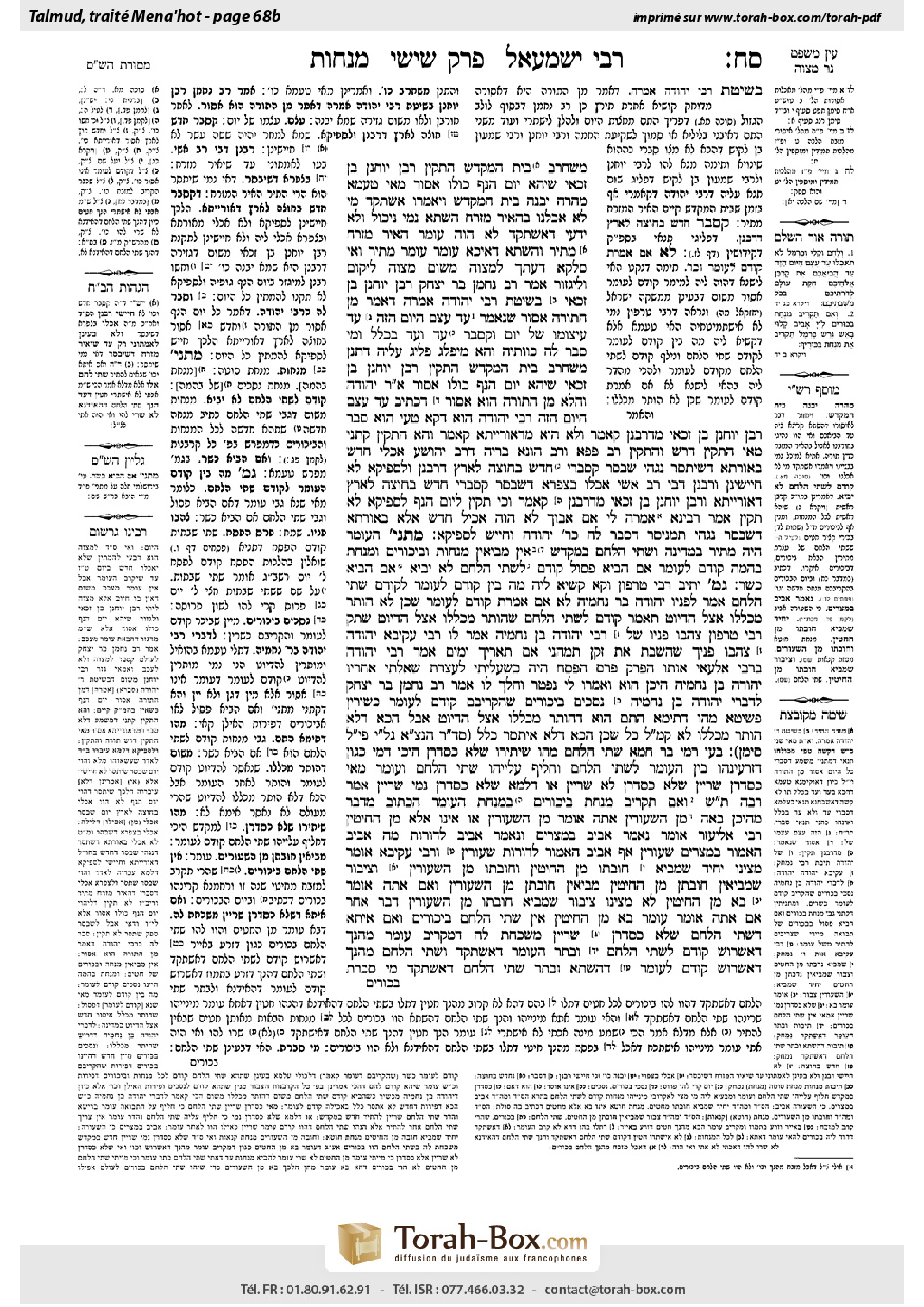
Menachot 68b: Talmud study for Daf Yomi
Daf Yomi is the daily study of one Talmud folio. Explore 37 tractates with scans, Hebrew text, Sefaria English and AI-generated French translations where annotated.
Passage selection and English or AI-generated French translation are available where the scan has annotations. Daf Study is independent of Torah-Box and Sefaria.
Browse Menachot · מנחות · All tractatesMenachot 68b text and translations
This page of Menachot includes the Aramaic text, an English translation and an AI-generated French translation, alongside the scan above.
מנחות ס״ח ב · Aramaic and Hebrew text
מִשֶּׁחָרַב בֵּית הַמִּקְדָּשׁ, הִתְקִין רַבָּן יוֹחָנָן בֶּן זַכַּאי שֶׁיְּהֵא יוֹם הֶנֶף כּוּלּוֹ אָסוּר. מַאי טַעְמָא? מְהֵרָה יִבָּנֶה בֵּית הַמִּקְדָּשׁ, וְיֹאמְרוּ: אֶשְׁתָּקַד מִי לֹא אָכַלְנוּ בְּהֵאִיר מִזְרָח? הַשְׁתָּא נָמֵי נֵיכוֹל!
וְלָא יָדְעִי, דְּאֶשְׁתָּקַד לָא הֲוָה עוֹמֶר, הֵאִיר מִזְרָח מַתִּיר, וְהַשְׁתָּא דְּאִיכָּא עוֹמֶר – עוֹמֶר מַתִּיר. וְאִי סָלְקָא דַעְתָּךְ לְמִצְוָה, מִשּׁוּם מִצְוָה לֵיקוּם וְלִיגְזוֹר?
אָמַר רַב נַחְמָן בַּר יִצְחָק: רַבָּן יוֹחָנָן בֶּן זַכַּאי בְּשִׁיטַת רַבִּי יְהוּדָה אֲמָרָהּ, דְּאָמַר: מִן הַתּוֹרָה אָסוּר, שֶׁנֶּאֱמַר: ״עַד עֶצֶם הַיּוֹם הַזֶּה״ –
עַד עִיצּוּמוֹ שֶׁל יוֹם, וְקָסָבַר ״עַד״ וְעַד בַּכְּלָל.
וּמִי סָבַר לַהּ כְּוָותֵיהּ? וְהָא מִיפְלָג פְּלִיג עֲלֵיהּ! דִּתְנַן: מִשֶּׁחָרַב בֵּית הַמִּקְדָּשׁ, הִתְקִין רַבָּן יוֹחָנָן בֶּן זַכַּאי שֶׁיְּהֵא יוֹם הֶנֶף כּוּלּוֹ אָסוּר. אָמַר רַבִּי יְהוּדָה: וַהֲלֹא מִן הַתּוֹרָה הוּא אָסוּר, דִּכְתִיב ״עַד עֶצֶם הַיּוֹם הַזֶּה״!
רַבִּי יְהוּדָה הוּא דְּקָא טָעֵי, הוּא סָבַר רַבָּן יוֹחָנָן בֶּן זַכַּאי מִדְּרַבָּנַן קָאָמַר, וְלָא הִיא, מִדְּאוֹרָיְיתָא קָאָמַר. וְהָא ״הִתְקִין״ קָתָנֵי? מַאי ״הִתְקִין״? דָּרַשׁ וְהִתְקִין.
רַב פָּפָּא וְרַב הוּנָא בְּרֵיהּ דְּרַב יְהוֹשֻׁעַ אָכְלִי חָדָשׁ בְּאוּרְתָּא דְּשִׁיתְּסַר נַגְהֵי שִׁבְסַר, קָסָבְרִי: חָדָשׁ בְּחוּצָה לָאָרֶץ דְּרַבָּנַן, וְלִסְפֵיקָא לָא חָיְישִׁינַן.
וְרַבָּנַן דְּבֵי רַב אָשֵׁי אָכְלִי בְּצַפְרָא דְּשִׁבְסַר, קָסָבְרִי: חָדָשׁ בְּחוּצָה לָאָרֶץ דְּאוֹרָיְיתָא.
וְרַבָּן יוֹחָנָן בֶּן זַכַּאי מִדְּרַבָּנַן קָאָמַר, וְכִי תַּקֵּין לְיוֹם הֶנֶף – לִסְפֵיקָא לָא תַּקֵּין.
אָמַר רָבִינָא: אָמְרָה לִי אֵם – אֲבוּךְ לָא הֲוָה אָכֵיל חָדָשׁ אֶלָּא בְּאוּרְתָּא דְּשִׁבְסַר נַגְהֵי תְּמָנֵיסַר, דְּסָבַר לַהּ כְּרַבִּי יְהוּדָה, וְחָיֵישׁ לִסְפֵיקָא.
מַתְנִי׳ הָעוֹמֶר הָיָה מַתִּיר בַּמְּדִינָה, וּשְׁתֵּי הַלֶּחֶם בְּמִקְדָּשׁ. אֵין מְבִיאִין מְנָחוֹת, וּבִיכּוּרִים, וּמִנְחַת בְּהֵמָה קוֹדֶם לָעוֹמֶר, אִם הֵבִיא – פָּסוּל. קוֹדֶם לִשְׁתֵּי הַלֶּחֶם לֹא יָבִיא, אִם הֵבִיא – כָּשֵׁר.
גְּמָ׳ יָתֵיב רַבִּי טַרְפוֹן וְקָא קַשְׁיָא לֵיהּ: מָה בֵּין קוֹדֶם לָעוֹמֶר לְקוֹדֶם שְׁתֵּי הַלֶּחֶם?
אָמַר לְפָנָיו יְהוּדָה בַּר נְחֶמְיָה: לֹא, אִם אָמַרְתָּ קוֹדֶם לָעוֹמֶר, שֶׁכֵּן לֹא הוּתַּר מִכְּלָלוֹ אֵצֶל הֶדְיוֹט, תֹּאמַר קוֹדֶם לִשְׁתֵּי הַלֶּחֶם, שֶׁהוּתַּר מִכְּלָלוֹ אֵצֶל הֶדְיוֹט?
שָׁתַק רַבִּי טַרְפוֹן, צָהֲבוּ פָּנָיו שֶׁל רַבִּי יְהוּדָה בֶּן נְחֶמְיָה, אָמַר לוֹ רַבִּי עֲקִיבָא: יְהוּדָה, צָהֲבוּ פָּנֶיךָ שֶׁהֵשַׁבְתָּ אֶת זָקֵן? תְּמֵהַנִי אִם תַּאֲרִיךְ יָמִים. אָמַר רַבִּי יְהוּדָה בְּרַבִּי אִלְעַאי: אוֹתוֹ הַפֶּרֶק פְּרֹס הַפֶּסַח הָיָה, כְּשֶׁעָלִיתִי לָעֲצֶרֶת שָׁאַלְתִּי אַחֲרָיו: יְהוּדָה בֶּן נְחֶמְיָה הֵיכָן הוּא? וְאָמְרוּ לִי: נִפְטַר וְהָלַךְ לוֹ.
אָמַר רַב נַחְמָן בַּר יִצְחָק: לְדִבְרֵי יְהוּדָה בֶּן נְחֶמְיָה, נְסָכִים בִּיכּוּרִים שֶׁהִקְרִיבָם קוֹדֶם לָעוֹמֶר – כְּשֵׁירִין. פְּשִׁיטָא!
מַהוּ דְּתֵימָא: הָתָם הוּא דְּהוּתַּר מִכְּלָלוֹ אֵצֶל הֶדְיוֹט, אֲבָל הָכָא דְּלֹא הוּתַּר מִכְּלָלוֹ – לָא. קָא מַשְׁמַע לַן: כׇּל שֶׁכֵּן הָכָא, דְּלָא אִיתְּסַר כְּלָל.
(סֵדֶר הֲנָצָא גְּלֵי פִּיל סִימָן.) בָּעֵי רָמֵי בַּר חָמָא: שְׁתֵּי הַלֶּחֶם מַהוּ שֶׁיַּתִּירוּ שֶׁלֹּא כְּסִדְרָן?
הֵיכִי דָּמֵי? כְּגוֹן דְּזַרְעִינְהוּ בֵּין הָעוֹמֶר לִשְׁתֵּי הַלֶּחֶם, וַחֲלֵיף עֲלַיְיהוּ שְׁתֵּי הַלֶּחֶם וְעוֹמֶר. מַאי? כְּסִדְרָן שַׁרְיָין, שֶׁלֹּא כְּסִדְרָן לָא שַׁרְיָין? אוֹ דִלְמָא שֶׁלֹּא כְּסִדְרָן נָמֵי שַׁרְיָין.
אָמַר רַבָּה: תָּא שְׁמַע, ״וְאִם תַּקְרִיב מִנְחַת בִּכּוּרִים״ – בְּמִנְחַת הָעוֹמֶר הַכָּתוּב מְדַבֵּר. מֵהֵיכָן בָּאָה? מִן הַשְּׂעוֹרִין. אַתָּה אוֹמֵר מִן הַשְּׂעוֹרִין, אוֹ אֵינוֹ אֶלָּא מִן הַחִיטִּין?
רַבִּי אֱלִיעֶזֶר אוֹמֵר: נֶאֱמַר ״אָבִיב״ בְּמִצְרַיִם, וְנֶאֱמַר ״אָבִיב״ לְדוֹרוֹת. מָה ״אָבִיב״ הָאָמוּר בְּמִצְרַיִם – שְׂעוֹרִין, אַף ״אָבִיב״ הָאָמוּר לְדוֹרוֹת – שְׂעוֹרִין.
וְרַבִּי עֲקִיבָא אוֹמֵר: מָצִינוּ יָחִיד שֶׁמֵּבִיא חוֹבָתוֹ מִן הַחִיטִּין, וְחוֹבָתוֹ מִן הַשְּׂעוֹרִין.
וְצִיבּוּר שֶׁמְּבִיאִין חוֹבָתָן מִן הַחִיטִּין, מְבִיאִין חוֹבָתָן מִן הַשְּׂעוֹרִין, וְאִם אַתָּה אוֹמֵר בָּא מִן הַחִיטִּין – לֹא מָצִינוּ צִיבּוּר שֶׁמֵּבִיא חוֹבָתוֹ מִן הַשְּׂעוֹרִין.
דָּבָר אַחֵר: אִם אַתָּה אוֹמֵר עוֹמֶר בָּא מִן הַחִיטִּין – אֵין שְׁתֵּי הַלֶּחֶם ״בִּיכּוּרִים״.
וְאִם אִיתָא דִּשְׁתֵּי הַלֶּחֶם שֶׁלֹּא כְּסִדְרָן שַׁרְיָין, מַשְׁכַּחַתְּ לַהּ דְּמַקְרֵיב עוֹמֶר מֵהָנָךְ דְּאַשְׁרוּשׁ קוֹדֶם לִשְׁתֵּי הַלֶּחֶם, וּבָתַר הָעוֹמֶר דְּאֶשְׁתָּקַד.
וּשְׁתֵּי הַלֶּחֶם מֵהָנָךְ דְּאַשְׁרוּשׁ קוֹדֶם לָעוֹמֶר דְּהַשְׁתָּא, וּבָתַר שְׁתֵּי הַלֶּחֶם דְּאֶשְׁתָּקַד.
מִי סָבְרַתְּ
Menachot 68b · English translation
The Gemara questions the claim that the purpose of waiting until the sacrifice of the omer is only in order to fulfill the mitzva in the most optimal fashion. The mishna teaches: From the time that the Temple was destroyed, Rabban Yoḥanan ben Zakkai instituted that partaking from the new crop on the day of waving the omer, the sixteenth of Nisan, is completely prohibited and one may partake of the new crop only the next day. The Gemara analyzes this statement. What is the reason for this? It is that soon the Temple will be rebuilt, and people will say: Last year [eshtakad], when there was no Temple, didn’t we eat of the new crop as soon as the eastern horizon was illuminated, as the new crop was permitted immediately upon the advent of the morning of the sixteenth of Nisan? Now, too, let us eat the new grain at that time.
And they would not know that last year, when there was no Temple, the illuminating of the eastern horizon permitted one to eat the new grain immediately, but now that the Temple has been rebuilt and there is an omer offering, it is the omer that permits the consumption of the new grain. When the Temple is standing, the new grain is not permitted until the omer offering has been sacrificed. The Gemara concludes its question: And if it enters your mind to say that one waits to partake of the new crop until the omer offering permits the new grain only in order to perform the mitzva in the optimal fashion, would we arise and decree that the entire sixteenth of Nisan is entirely prohibited only due to the performance of a mitzva in the optimal manner?
Rav Naḥman bar Yitzḥak said: Rabban Yoḥanan ben Zakkai stated his ordinance in accordance with the opinion of Rabbi Yehuda, who says that it is prohibited by Torah law to eat of the new grain until the seventeenth of Nisan, as it is stated: “And you shall eat neither bread nor parched grain, nor fresh stalks, until this selfsame [etzem] day, until you have brought the offering of your God” (Leviticus 23:14).
This does not mean that it is permitted to eat the new grain on the morning of the sixteenth, when the eastern horizon is illuminated. Rather, it is prohibited until the essence [itzumo] of the day. And Rabbi Yehuda holds that when the verse says “until,” it means until and including, meaning that the grain is permitted only after the conclusion of the sixteenth. If so, by Torah law, eating the new grain is permitted only after the conclusion of the sixteenth, unless the omer offering was sacrificed, in which case it is permitted to eat the new grain immediately afterward.
The Gemara asks: And does Rabban Yoḥanan ben Zakkai hold in accordance with the opinion of Rabbi Yehuda? But he disagrees with him, as we learned in the mishna: From the time that the Temple was destroyed, Rabban Yoḥanan ben Zakkai instituted that partaking from the new crop on the day of waving the omer, the sixteenth of Nisan, is entirely prohibited. Rabbi Yehuda says: But isn’t it forbidden by Torah law, as it is written: “Until this selfsame day”? This indicates that Rabban Yoḥanan ben Zakkai disagrees with Rabbi Yehuda.
The Gemara rejects this. It is Rabbi Yehuda who is mistaken. He thought that Rabban Yoḥanan ben Zakkai is saying that eating new grain on the sixteenth of Nisan is prohibited by rabbinic law. And that is not so; Rabban Yoḥanan ben Zakkai is actually saying that it is prohibited by Torah law. The Gemara asks: But it is taught in the mishna that Rabban Yoḥanan ben Zakkai instituted, which indicates that it is a rabbinic ordinance. The Gemara answers: What is the meaning of the term: Instituted, in this context? It means that he interpreted the verses in the Torah and instituted public notice for the multitudes to conduct themselves accordingly.
§ Rav Pappa and Rav Huna, son of Rav Yehoshua, ate from the new crop on the evening of the conclusion of the sixteenth of Nisan, leading into the seventeenth of Nisan. They held that the prohibition against eating the new crop outside Eretz Yisrael applies by rabbinic law. And therefore we are not concerned for the uncertainty that perhaps the day we think is the sixteenth of Nisan is really the fifteenth, due to the court proclaiming the previous month of Adar a full thirty days long.
And conversely, the Sages of the study hall of Rav Ashi ate from the new crop only on the morning of the seventeenth. They held that the prohibition against eating the new crop outside Eretz Yisrael applies by Torah law. Consequently, they did entertain the concern that the day they thought was the sixteenth might actually be the fifteenth of Nisan, which would mean that the new crop is permitted only the following morning.
This is problematic, as if there is a concern that the sixteenth is really the fifteenth of Nisan, then the seventeenth would be the sixteenth of Nisan. Accordingly, how could they eat from the new crop on that morning? Didn’t Rabbi Yoḥanan ben Zakkai institute that the new crop is prohibited the entire day? The Gemara explains that those Sages of the study hall of Rav Ashi held: And Rabban Yoḥanan ben Zakkai is saying that eating new grain on the sixteenth of Nisan nowadays is prohibited by rabbinic law. And the Sages instituted this prohibition only for the actual day of waving the omer offering, whereas it was not instituted for a day with regard to which the real date is uncertain.
Ravina said: My mother told me: Your father would eat from the new crop only on the evening at the conclusion of the seventeenth of Nisan, leading into the eighteenth. The reason for this was that he held in accordance with the opinion of Rabbi Yehuda that nowadays it is prohibited to eat of the new crop on the sixteenth of Nisan by Torah law, and he was therefore concerned for the uncertainty that perhaps the sixteenth of Nisan was really the fifteenth, and consequently the seventeenth was really the sixteenth. Therefore he waited until the eve of the eighteenth, when he could be sure that there was no prohibition by Torah law against eating from the new crop.
MISHNA: Sacrifice of the omer offering would permit consumption of the new crop in the rest of the country outside the Temple, and the two loaves offering would permit the sacrifice of the new crop in the Temple. One may not bring meal offerings, or first fruits, or the meal offering brought with libations accompanying animal offerings, from the new crop prior to the sacrifice of the omer, and if he brought them from the new crop they are unfit. After the omer but prior to the two loaves one may not bring these offerings from the new crop, but if he brought them from the new crop, they are fit.
GEMARA: The mishna teaches that meal offerings brought from the new crop prior to the sacrifice of the omer offering are unfit, whereas those brought after the omer but prior to the two loaves are fit. Rabbi Tarfon sat and posed the following difficulty: What is the difference between meal offerings brought before the omer and those brought before the two loaves?
Rabbi Yehuda bar Neḥemya said before Rabbi Tarfon: No, one cannot compare the two situations. If you said that this is the halakha with regard to before the omer sacrifice, this is because at that stage there are no circumstances in which the new crop’s general prohibition was permitted, even with regard to an ordinary person; shall you also say that this is the halakha with regard to before the sacrifice of the two loaves, when the new crop’s general prohibition was permitted with regard to an ordinary person? The new crop ingredient in the meal offering is at least permitted in consumption after the omer is brought. Therefore, the meal offerings that were brought after the omer but before the two loaves are fit.
Rabbi Tarfon was silent, and Rabbi Yehuda ben Neḥemya’s face brightened. Rabbi Akiva said to him: Yehuda, has your face brightened because you answered the elder? I will be astonished if the days of your life will be lengthy. Rabbi Yehuda, son of Rabbi Ilai, said: That period in which that interaction occurred was half a month before Passover. When I ascended again to the study hall for the festival of Shavuot, I asked about him: Where is Rabbi Yehuda ben Neḥemya? And they said to me: He passed away and left this world.
Rav Naḥman bar Yitzḥak says: According to the statement of Rabbi Yehuda ben Neḥemya, libations from first fruits that one brought before the omer offering is sacrificed should be valid. The reason is that the prohibition of the new crop does not apply to fruits at all, and therefore they are never prohibited to ordinary people. When the mishna states that first fruits are prohibited it is referring to first fruits of grain, not the fruit of a tree. The Gemara asks: Isn’t it obvious that libations from first fruits brought before the omer offering are valid? Why would one think that they should not be valid?
The Gemara answers that Rav Naḥman bar Yitzḥak’s statement is necessary, lest you say: It is only there, in the case of the meal offering of grain brought after the omer sacrifice, that it is valid, as the new crop’s general prohibition was permitted with regard to an ordinary person. But here, since with regard to these fruits there are no circumstances in which its general prohibition was permitted, one might say that the libation should not be valid. Therefore, Rav Naḥman bar Yitzḥak teaches us that the opposite is the case: All the more so here it is a valid offering, where the fruit was not prohibited at all.
§ The Gemara presents a mnemonic for the ensuing discussions in the Gemara: Order, sprouting, dung of, elephant. The mishna teaches that a meal offering using the new crop may not be brought prior to the omer sacrifice or the two loaves. Rami bar Ḥama raises a dilemma: With regard to the two loaves offering on Shavuot, what is the halakha as to whether they permit the new grain to be used in the Temple, if this sacrifice was performed out of their order? The sacrifice of the omer permits ordinary people to eat from the new grain, whereas the sacrifice of the two loaves permits the new grain to be used in the Temple. What is the halakha if a new crop sprouted after the omer offering was brought but before the two loaves were brought?
The Gemara asks: What are the circumstances of this case? The Gemara explains: This is referring to a case where they planted the grain in between the time of the sacrifice of the omer and the time of the two loaves offering. And therefore the sacrifice of two loaves passed by first, and then the time of the omer offering of the following year. What is the halakha in such a case? The Gemara explains the two possibilities: Does the sacrifice of the omer and two loaves permit the new grain to be used for meal offerings if sacrificed only in their proper order, whereas if sacrificed out of their order the sacrifice does not permit the new crop? Or perhaps they permit the new grain to be used for meal offerings even when sacrificed out of their order.
Rabba said: Come and hear proof from a baraita: “And if you bring a meal offering of first fruits to the Lord, you shall bring for the meal offering of your first fruits grain in the ear parched with fire, even groats of the fresh ear” (Leviticus 2:14). The verse is speaking of the omer meal offering. From where, i.e., of which grain, is it brought? It is brought from barley. The baraita asks: Do you say that it is brought from barley, or perhaps it is only from wheat?
Rabbi Eliezer says that it is stated “in the ear” with regard to the plague of hail in Egypt: “And the flax and the barley were smitten; for the barley was in the ear, and the flax was in bloom” (Exodus 9:31), and it is stated “in the ear” with regard to the mitzva of the new crop, which is for all generations. Just as the term “in the ear” that is stated with regard to plague of hail in Egypt is referring to barley, as is clear from the next verse: “But the wheat and the spelt were not smitten, for they ripen late” (Exodus 9:32), so too the term “in the ear” that is stated with regard to the new crop for all generations is referring to barley.
The baraita cites another proof that the omer offering is brought from barley. And Rabbi Akiva says: We found an individual who brings his obligation of a meal offering from wheat, which is brought by a poor person for a false oath of testimony, a false oath of utterance, or for entering the Temple while ritually impure, and one who brings his obligation of a meal offering from barley, in the case of a sinner’s meal offering or the meal offering of a sota.
And we also found with regard to the community that they bring their obligation of a meal offering from wheat, in the case of the two loaves offering of Shavuot, and therefore, to keep the halakha of a community parallel to that of an individual there should be a case where the community brings their obligation of a meal offering from barley. And if you say that the omer offering comes from wheat, then we will not have found a case of a community that brings its obligation of a meal offering from barley. Consequently, it must be that the omer offering comes from barley.
Rabbi Akiva suggests another proof: Alternatively, if you say that the omer offering comes from wheat, then the two loaves offering would not be from the first fruits. The verse states that the two loaves offering of Shavuot should come from the first fruits: “Also in the day of the first fruits, when you bring a new meal offering to the Lord in your feast of weeks” (Numbers 28:26). If the omer is from wheat, then the two loaves offering would not be the first offering of the first fruit, as the omer offering of Passover precedes it. Therefore, the omer offering must come from barley. This concludes the baraita.
Rabba resolves Rami bar Ḥama’s dilemma from this last proof of Rabbi Akiva: And if it is so, that the two loaves sacrificed not in their proper order still permit the use of the new crop for meal offerings, you can in fact find a case where the two loaves are from the first fruits even though they are also brought from wheat, just like the omer offering. This is a case where the community sacrifices the current omer offering from these wheat grains that took root prior to the bringing of the two loaves offering but after the bringing of the omer offering of last year.
And the current two loaves offering is brought from these grains that took root prior to the current omer offering and after the two loaves offering of last year. In this scenario, the two loaves come from wheat of this year’s crop and yet they are still called the first fruits, despite the fact that the omer offering also came from wheat, as that wheat is considered the previous year’s crop. Since this case is not mentioned in the baraita, evidently if the two loaves are not in the proper order with regard to a certain crop they do not permit that crop to be used in offerings in the Temple. This resolves Rami bar Ḥama’s dilemma.
In this manner Rabba has attempted to prove that the proper order of the omer offering followed by the two loaves is necessary to permit the new grain for use in meal offerings. The Gemara rejects the proof: Do you hold
Menachot 68b · Traduction française (IA)
La Guemara met en question l’affirmation selon laquelle attendre jusqu’à l’offrande du omer aurait seulement pour but d’accomplir la mitsva de la manière la plus optimale. La Michna enseigne : Depuis la destruction du Temple, Rabban Yoḥanan ben Zakkaï institua qu’il soit totalement interdit de consommer la nouvelle récolte le jour de la présentation du omer, le seize nissan, et que l’on ne puisse en consommer que le lendemain. La Guemara analyse cet énoncé. Pour quelle raison ? Parce que le Temple pourrait bientôt être reconstruit, et les gens diraient : L’année dernière [eshtakad], lorsqu’il n’y avait pas de Temple, n’avons-nous pas mangé de la nouvelle récolte dès que l’horizon oriental s’est éclairé, puisque la nouvelle récolte était permise dès le matin du seize nissan ? Mangeons donc, cette fois aussi, le nouveau grain à ce moment-là.
Ils ne sauraient pas que l’année dernière, en l’absence du Temple, l’éclaircissement de l’horizon oriental permettait de manger immédiatement le nouveau grain, tandis que maintenant que le Temple a été reconstruit et qu’il y a une offrande de omer, c’est le omer qui permet de consommer le nouveau grain. Lorsque le Temple est debout, le nouveau grain n’est permis qu’après le sacrifice du omer. La Guemara achève son objection : Et si l’on envisageait que l’on attende que le omer rende le nouveau grain permis uniquement afin d’accomplir la mitsva de la manière optimale, décréterait-on que tout le seize nissan est entièrement interdit simplement pour accomplir une mitsva de manière optimale ?
Rav Naḥman bar Yitzḥak dit : Rabban Yoḥanan ben Zakkaï a énoncé son ordonnance conformément à l’opinion de Rabbi Yehouda, qui affirme qu’il est interdit par la Torah de manger le nouveau grain jusqu’au dix-sept nissan, comme il est dit : « Vous ne mangerez ni pain, ni grain grillé, ni épis frais, jusqu’à ce jour même [etzem], jusqu’à ce que vous ayez apporté l’offrande de votre Dieu » (Lévitique 23:14).
Cela ne signifie pas qu’il soit permis de manger le nouveau grain le matin du seize, dès que l’horizon oriental s’éclaire. Il est plutôt interdit jusqu’à l’essence [itzumo] du jour. Rabbi Yehouda considère que lorsque le verset dit « jusqu’à », cela inclut la limite indiquée : le grain n’est donc permis qu’après la fin du seize. Ainsi, selon la Torah, on ne peut manger le nouveau grain qu’après la fin du seize, à moins que l’offrande de omer ait été sacrifiée, auquel cas le nouveau grain est permis immédiatement après.
La Guemara demande : Rabban Yoḥanan ben Zakkaï est-il donc de l’avis de Rabbi Yehouda ? Pourtant, il est en désaccord avec lui, comme nous l’avons appris dans la Michna : Depuis la destruction du Temple, Rabban Yoḥanan ben Zakkaï institua qu’il soit totalement interdit de consommer la nouvelle récolte le jour de la présentation du omer, le seize nissan. Rabbi Yehouda dit : Mais n’est-ce pas interdit par la Torah, comme il est écrit : « Jusqu’à ce jour même » ? Cela indique que Rabban Yoḥanan ben Zakkaï est en désaccord avec Rabbi Yehouda.
La Guemara rejette cette explication. C’est Rabbi Yehouda qui se trompe : il pensait que Rabban Yoḥanan ben Zakkaï disait que manger le nouveau grain le seize nissan était interdit par décret rabbinique. Or, ce n’est pas le cas : Rabban Yoḥanan ben Zakkaï dit en réalité que c’est interdit par la Torah. La Guemara demande : Pourtant, il est enseigné dans la Michna que Rabban Yoḥanan ben Zakkaï l’institua, ce qui indique qu’il s’agit d’une ordonnance rabbinique. La Guemara répond : Que signifie ici le terme « institua » ? Il signifie qu’il interpréta les versets de la Torah et fit proclamer publiquement aux foules qu’elles devaient se conduire en conséquence.
§ Rav Pappa et Rav Houna, fils de Rav Yehoshoua, mangèrent de la nouvelle récolte le soir qui suivit la fin du seize nissan, à l’entrée du dix-sept nissan. Ils estimaient que l’interdiction de manger le nouveau grain hors d’Eretz Israël relève d’un décret rabbinique. Ils ne craignaient donc pas que le jour qu’ils pensaient être le seize nissan soit en réalité le quinze, parce que le tribunal aurait déclaré que le mois précédent, adar, comptait trente jours complets.
À l’inverse, les Sages de l’école de Rav Ashi ne mangèrent de la nouvelle récolte que le matin du dix-sept. Ils estimaient que l’interdiction de manger le nouveau grain hors d’Eretz Israël relève de la Torah. Par conséquent, ils tenaient compte de la possibilité que le jour qu’ils pensaient être le seize soit en réalité le quinze nissan, auquel cas le nouveau grain ne serait permis que le lendemain matin.
Cela pose problème : s’il est à craindre que le seize soit en réalité le quinze nissan, alors le dix-sept serait le seize nissan. Comment auraient-ils donc pu manger du nouveau grain ce matin-là ? Rabban Yoḥanan ben Zakkaï n’a-t-il pas institué que le nouveau grain soit interdit toute la journée ? La Guemara explique que ces Sages de l’école de Rav Ashi estimaient que Rabban Yoḥanan ben Zakkaï disait qu’à l’époque actuelle, manger du nouveau grain le seize nissan est interdit par décret rabbinique. Les Sages n’instituèrent cette interdiction que pour le jour réel de la présentation de l’offrande de omer, et non pour un jour dont la date exacte est incertaine.
Ravina dit : Ma mère m’a raconté que ton père ne mangeait de la nouvelle récolte que le soir qui suivait la fin du dix-sept nissan, à l’entrée du dix-huit. La raison en était qu’il était de l’avis de Rabbi Yehouda, selon lequel, à l’époque actuelle, il est interdit par la Torah de manger le nouveau grain le seize nissan. Il tenait donc compte de la possibilité que le seize nissan soit en réalité le quinze et, par conséquent, que le dix-sept soit en réalité le seize. Il attendait donc la veille du dix-huit, moment où il pouvait être certain qu’aucune interdiction de la Torah ne s’opposait à la consommation du nouveau grain.
MICHNA : Le sacrifice de l’offrande de omer permettait de consommer la nouvelle récolte dans le reste du pays, hors du Temple, et l’offrande des deux pains permettait d’utiliser la nouvelle récolte dans le Temple. On ne peut apporter d’offrandes de farine, de prémices ni l’offrande de farine accompagnant les libations des sacrifices d’animaux à partir de la nouvelle récolte avant le sacrifice du omer ; si on les a apportées à partir de la nouvelle récolte, elles sont invalides. Après le omer, mais avant les deux pains, on ne peut pas apporter ces offrandes à partir de la nouvelle récolte ; toutefois, si on les a apportées à partir de la nouvelle récolte, elles sont valides.
GUEMARA : La Michna enseigne que les offrandes de farine apportées à partir de la nouvelle récolte avant le sacrifice du omer sont invalides, tandis que celles apportées après le omer, mais avant les deux pains, sont valides. Rabbi Tarfon siégeait et souleva la difficulté suivante : Quelle différence y a-t-il entre les offrandes de farine apportées avant le omer et celles apportées avant les deux pains ?
Rabbi Yehouda bar Neḥemya dit devant Rabbi Tarfon : Non, on ne peut pas comparer les deux situations. Si tu dis que telle est la halakha avant le sacrifice du omer, c’est parce qu’à ce stade, l’interdiction générale du nouveau grain n’a encore été levée dans aucune circonstance, même pour une personne ordinaire. Dirais-tu aussi que telle est la halakha avant le sacrifice des deux pains, alors que l’interdiction générale du nouveau grain a été levée pour une personne ordinaire ? Le nouveau grain entrant dans la composition de l’offrande de farine est au moins permis à la consommation après l’apport du omer. Par conséquent, les offrandes de farine apportées après le omer, mais avant les deux pains, sont valides.
Rabbi Tarfon garda le silence, et le visage de Rabbi Yehouda ben Neḥemya s’illumina. Rabbi Akiva lui dit : Yehouda, ton visage s’est-il illuminé parce que tu as répondu à l’ancien ? Je m’étonnerais que tu vives longtemps. Rabbi Yehouda, fils de Rabbi Ilaï, dit : Cette interaction eut lieu environ un demi-mois avant Pessaḥ. Lorsque je remontai à la maison d’étude pour la fête de Chavouot, je demandai à son sujet : Où est Rabbi Yehouda ben Neḥemya ? On me répondit : Il est mort et a quitté ce monde.
Rav Naḥman bar Yitzḥak dit : D’après les propos de Rabbi Yehouda ben Neḥemya, les libations provenant des prémices apportées avant le sacrifice de l’offrande de omer devraient être valides. En effet, l’interdiction du nouveau grain ne s’applique pas du tout aux fruits, qui ne sont donc jamais interdits aux personnes ordinaires. Lorsque la Michna dit que les prémices sont interdites, elle parle des prémices de céréales, et non des fruits d’un arbre. La Guemara demande : N’est-il pas évident que les libations provenant des prémices apportées avant le sacrifice du omer sont valides ? Pourquoi penserait-on qu’elles ne le seraient pas ?
La Guemara répond que la déclaration de Rav Naḥman bar Yitzḥak est nécessaire, de peur que tu ne dises : C’est seulement dans le cas d’une offrande de farine de céréales apportée après le sacrifice du omer qu’elle est valide, puisque l’interdiction générale du nouveau grain a été levée pour une personne ordinaire. Mais ici, puisqu’il n’existe aucune circonstance où l’interdiction générale de ces fruits ait été levée, on pourrait dire que la libation n’est pas valide. Rav Naḥman bar Yitzḥak nous enseigne donc le contraire : à plus forte raison, ici, l’offrande est valide, puisque le fruit n’a jamais été interdit.
§ La Guemara présente un moyen mnémotechnique pour les discussions qui suivent : ordre, germination, fumier de, éléphant. La Michna enseigne qu’on ne peut apporter une offrande de farine utilisant le nouveau grain avant le sacrifice du omer ou des deux pains. Rami bar Ḥama soulève un dilemme : Concernant l’offrande des deux pains à Chavouot, quelle est la halakha quant à savoir si elle permet d’utiliser le nouveau grain dans le Temple lorsque le sacrifice a été accompli dans le désordre ? Le sacrifice du omer permet aux personnes ordinaires de manger le nouveau grain, tandis que le sacrifice des deux pains permet d’utiliser le nouveau grain dans le Temple. Quelle est la halakha si une nouvelle récolte a germé après l’offrande de omer, mais avant celle des deux pains ?
La Guemara demande : Dans quelles circonstances cette question se pose-t-elle ? Elle explique : Il s’agit d’un cas où l’on a semé le grain entre le moment du sacrifice du omer et celui de l’offrande des deux pains. Par conséquent, le sacrifice des deux pains de l’année suivante a eu lieu d’abord, puis est venu le moment de l’offrande de omer de l’année d’après. Quelle est la halakha dans un tel cas ? La Guemara expose les deux possibilités : Le sacrifice du omer et celui des deux pains ne permettent-ils d’utiliser le nouveau grain pour les offrandes de farine que s’ils sont sacrifiés dans l’ordre approprié, de sorte que, s’ils sont sacrifiés dans le désordre, ils ne permettent pas l’utilisation de la nouvelle récolte ? Ou bien permettent-ils d’utiliser le nouveau grain pour les offrandes de farine même lorsqu’ils sont sacrifiés dans le désordre ?
Rabba dit : Écoute une preuve tirée d’une baraïta : « Si tu apportes au Seigneur une offrande de farine de prémices, tu apporteras comme offrande de farine de tes prémices des épis grillés au feu, c’est-à-dire des grains concassés de l’épi frais » (Lévitique 2:14). Le verset parle de l’offrande de farine du omer. De quel grain, c’est-à-dire de quelle céréale, est-elle apportée ? Elle est apportée à partir de l’orge. La baraïta demande : Dis-tu qu’elle est apportée à partir de l’orge, ou peut-être l’est-elle uniquement à partir du blé ?
Rabbi Eliezer dit qu’il est écrit « en épi » à propos de la plaie de grêle en Égypte : « Le lin et l’orge furent frappés ; car l’orge était en épi, et le lin en fleur » (Exode 9:31), et qu’il est écrit « en épi » à propos de la mitsva du nouveau grain, valable pour toutes les générations. De même que le terme « en épi » employé à propos de la plaie de grêle en Égypte désigne l’orge, comme le montre clairement le verset suivant : « Mais le blé et l’épeautre ne furent pas frappés, car ils mûrissent tard » (Exode 9:32), de même, le terme « en épi » employé à propos du nouveau grain pour toutes les générations désigne l’orge.
La baraïta cite une autre preuve que l’offrande de omer est apportée à partir de l’orge. Rabbi Akiva dit : Nous avons trouvé un particulier qui apporte son offrande de farine obligatoire à partir du blé : c’est le pauvre qui l’apporte à la suite d’un faux serment concernant un témoignage, d’un faux serment concernant une déclaration, ou après être entré dans le Temple en état d’impureté rituelle. Nous avons aussi trouvé un particulier qui apporte son offrande de farine obligatoire à partir de l’orge, dans le cas de l’offrande de farine du pécheur ou de celle d’une sota.
Nous avons également trouvé, pour la communauté, qu’elle apporte son offrande de farine obligatoire à partir du blé, dans le cas de l’offrande des deux pains de Chavouot. Par conséquent, pour que la halakha concernant la communauté soit parallèle à celle concernant le particulier, il faudrait un cas où la communauté apporte son offrande de farine obligatoire à partir de l’orge. Si tu dis que l’offrande de omer est faite à partir du blé, nous n’aurions trouvé aucun cas où la communauté apporte son offrande de farine obligatoire à partir de l’orge. Il faut donc que l’offrande de omer soit faite à partir de l’orge.
Rabbi Akiva propose une autre preuve : Autrement, si tu dis que l’offrande de omer est faite à partir du blé, l’offrande des deux pains ne serait pas issue des prémices. Le verset dit que l’offrande des deux pains de Chavouot doit venir des prémices : « Le jour des prémices également, lorsque vous apporterez une nouvelle offrande de farine au Seigneur pour votre fête des Semaines » (Nombres 28:26). Si le omer est fait à partir du blé, l’offrande des deux pains ne serait pas la première offrande de la nouvelle récolte, puisque l’offrande de omer de Pessaḥ la précède. L’offrande de omer doit donc être faite à partir de l’orge. La baraïta s’achève ici.
Rabba résout le dilemme de Rami bar Ḥama à partir de cette dernière preuve de Rabbi Akiva : si les deux pains sacrifiés dans le désordre permettaient malgré tout d’utiliser le nouveau grain pour les offrandes de farine, on pourrait en fait trouver un cas où les deux pains seraient issus des prémices tout en étant faits à partir du blé, comme l’offrande de omer. Ce serait le cas où la communauté sacrifierait l’offrande de omer de l’année en cours à partir de ces grains de blé qui ont pris racine avant l’offrande des deux pains, mais après l’offrande de omer de l’année précédente.
L’offrande des deux pains de l’année en cours serait apportée à partir de ces grains qui ont pris racine avant l’offrande de omer de l’année en cours, mais après celle des deux pains de l’année précédente. Dans ce cas, les deux pains proviennent du blé de la récolte de l’année en cours et sont pourtant toujours appelés les prémices, bien que l’offrande de omer ait elle aussi été faite à partir du blé, car ce blé est considéré comme appartenant à la récolte de l’année précédente. Puisque ce cas n’est pas mentionné dans la baraïta, il apparaît que si les deux pains ne sont pas dans l’ordre approprié par rapport à une récolte donnée, ils ne permettent pas d’utiliser cette récolte pour les offrandes dans le Temple. Cela résout le dilemme de Rami bar Ḥama.
Rabba a ainsi tenté de prouver que l’ordre approprié — l’offrande de omer suivie des deux pains — est nécessaire pour permettre l’utilisation du nouveau grain dans les offrandes de farine. La Guemara rejette cette preuve : Estimes-tu que…
Traduction française générée par IA à partir de l’édition anglaise de Sefaria. Vérifie toujours un passage avec le texte source.
Text from Sefaria: William Davidson Edition - Vocalized Aramaic (unknown); William Davidson Edition - English (CC BY NC).