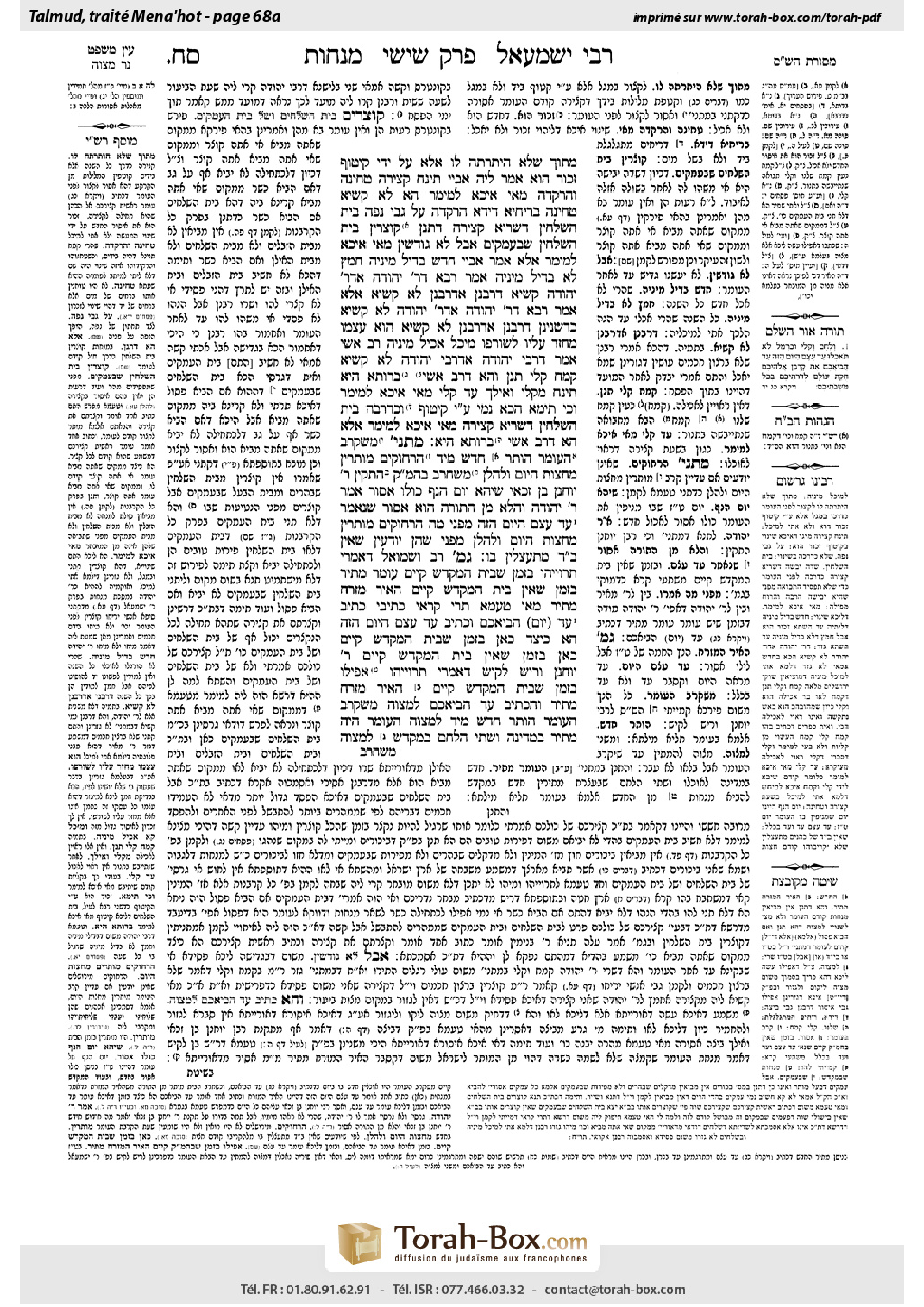
Menachot 68a: Talmud study for Daf Yomi
Daf Yomi is the daily study of one Talmud folio. Explore 37 tractates with scans, Hebrew text, Sefaria English and AI-generated French translations where annotated.
Passage selection and English or AI-generated French translation are available where the scan has annotations. Daf Study is independent of Torah-Box and Sefaria.
Browse Menachot · מנחות · All tractatesMenachot 68a text and translations
This page of Menachot includes the Aramaic text, an English translation and an AI-generated French translation, alongside the scan above.
מנחות ס״ח א · Aramaic and Hebrew text
מִתּוֹךְ שֶׁלֹּא הִיתַּרְתָּה לוֹ אֶלָּא עַל יְדֵי קִיטּוּף, זָכוּר הוּא.
אֲמַר לֵיהּ אַבָּיֵי: תִּינַח קְצִירָה, טְחִינָה וְהַרְקָדָה, מַאי אִיכָּא לְמֵימַר?
הָא לָא קַשְׁיָא, טְחִינָה – בְּרִיחְיָא דִּידָא, הַרְקָדָה – עַל גַּבֵּי נָפָה.
בֵּית הַשְּׁלָחִין, דְּשַׁרְיָא קְצִירָה, דִּתְנַן: קוֹצְרִין בֵּית הַשְּׁלָחִין שֶׁבַּעֲמָקִים, אֲבָל לֹא גּוֹדְשִׁין – מַאי אִיכָּא לְמֵימַר?
אֶלָּא אָמַר אַבָּיֵי: חָדָשׁ – בָּדֵיל מִינֵּיהּ, חָמֵץ – לָא בָּדֵיל מִינֵּיהּ.
אָמַר רָבָא: דְּרַבִּי יְהוּדָה אַדְּרַבִּי יְהוּדָה קַשְׁיָא, דְּרַבָּנַן אַדְּרַבָּנַן לָא קַשְׁיָא?
אֶלָּא אָמַר רָבָא: דְּרַבִּי יְהוּדָה אַדְּרַבִּי יְהוּדָה לָא קַשְׁיָא, כִּדְשַׁנֵּינַן. דְּרַבָּנַן אַדְּרַבָּנַן לָא קַשְׁיָא: הוּא עַצְמוֹ מְחַזֵּר עָלָיו לְשׂוֹרְפוֹ, מֵיכַל אָכֵיל מִינֵּיהּ?!
רַב אָשֵׁי אָמַר: דְּרַבִּי יְהוּדָה אַדְּרַבִּי יְהוּדָה לָא קַשְׁיָא, ״קֶמַח קָלִי״ תְּנַן.
וְהָא דְּרַב אָשֵׁי בְּרוּתָא הִיא, תִּינַח מִקָּלִי וְאֵילָךְ, עַד קָלִי מַאי אִיכָּא לְמֵימַר?
וְכִי תֵּימָא, הָכָא נָמֵי עַל יְדֵי קִיטּוּף, וְכִדְרַבָּה, בֵּית הַשְּׁלָחִין דְּשַׁרְיָא קְצִירָה מַאי אִיכָּא לְמֵימַר? אֶלָּא, הָא דְּרַב אָשֵׁי בְּרוּתָא הִיא.
מַתְנִי׳ מִשֶּׁקָּרַב הָעוֹמֶר הוּתַּר חָדָשׁ מִיָּד, הָרְחוֹקִים מוּתָּרִין מֵחֲצוֹת הַיּוֹם וּלְהַלָּן. מִשֶּׁחָרַב בֵּית הַמִּקְדָּשׁ, הִתְקִין רַבָּן יוֹחָנָן בֶּן זַכַּאי שֶׁיְּהֵא יוֹם הֶנֶף כּוּלּוֹ אָסוּר.
אָמַר רַבִּי יְהוּדָה: וַהֲלֹא מִן הַתּוֹרָה הוּא אָסוּר, שֶׁנֶּאֱמַר ״עַד עֶצֶם הַיּוֹם הַזֶּה״, מִפְּנֵי מָה הָרְחוֹקִים מוּתָּרִין מֵחֲצוֹת הַיּוֹם וּלְהַלָּן? מִפְּנֵי שֶׁהֵן יוֹדְעִין שֶׁאֵין בֵּית דִּין מִתְעַצְּלִין בּוֹ.
גְּמָ׳ רַב וּשְׁמוּאֵל דְּאָמְרִי תַּרְוַיְיהוּ: בִּזְמַן שֶׁבֵּית הַמִּקְדָּשׁ קַיָּים – עוֹמֶר מַתִּיר, בִּזְמַן שֶׁאֵין בֵּית הַמִּקְדָּשׁ קַיָּים – הֵאִיר מִזְרָח מַתִּיר.
מַאי טַעְמָא? תְּרֵי קְרָאֵי כְּתִיבִי: כְּתִיב ״עַד יוֹם הֲבִיאֲכֶם״, וּכְתִיב ״עַד עֶצֶם הַיּוֹם הַזֶּה״. הָא כֵּיצַד?
כָּאן – בִּזְמַן שֶׁבֵּית הַמִּקְדָּשׁ קַיָּים, כָּאן – בִּזְמַן שֶׁאֵין בֵּית הַמִּקְדָּשׁ קַיָּים.
רַבִּי יוֹחָנָן וְרֵישׁ לָקִישׁ דְּאָמְרִי תַּרְוַיְיהוּ: אֲפִילּוּ בִּזְמַן שֶׁבֵּית הַמִּקְדָּשׁ קַיָּים, הֵאִיר מִזְרָח מַתִּיר. וְהָכְתִיב: ״עַד הֲבִיאֲכֶם״! לְמִצְוָה.
מִשֶּׁקָּרַב הָעוֹמֶר, הוּתַּר חָדָשׁ מִיָּד! לְמִצְוָה.
הָעוֹמֶר הָיָה מַתִּיר בַּמְּדִינָה, וּשְׁתֵּי הַלֶּחֶם בַּמִּקְדָּשׁ! לְמִצְוָה.
Menachot 68a · English translation
Since before the omer you permitted one to harvest the crop only by picking it by hand and not in the typical manner, he will remember the prohibition and refrain from eating it. With regard to searching for leaven, there is no reminder.
Abaye said to him: This works out well in explaining Rabbi Yehuda’s opinion with regard to picking the grain. But with regard to grinding and sifting, what can be said? Apparently, it is permitted to perform these acts in a typical manner. Why, then, is there no concern that one may eat the grain at that stage?
The Gemara responds: This is not difficult, as one also performs grinding in an atypical manner. One must grind the grain before the sacrificing of the omer with a hand mill, not with a mill powered by an animal or by water. Likewise, sifting is performed unusually, not in the interior of the sifter. Instead, it is performed on top of the sifter. Since all of these actions are performed in an atypical manner, there is no concern that one might eat the grain.
The Gemara raises another difficulty from the case of a field that requires irrigation, where typical harvesting is permitted, as we learned in a mishna (71a): One may harvest grain from an irrigated field and from fields in the valleys, as their grain ripens long before the omer is sacrificed, but one may not pile the produce. The use of the term: One may harvest, indicates that the grain was harvested in a typical manner, not by hand. In this case, what can be said? Why doesn’t Rabbi Yehuda issue a decree lest someone eat from the new grain?
Rather, Abaye said: This difference between the cases of the omer and leaven is not based on the manner in which one harvests, grinds, or sifts. Instead, the reason for the different rulings is that one distances himself from new grain, as it is prohibited to eat the new grain all year until the omer is sacrificed. By contrast, one does not distance himself from leavened bread, as eating it is permitted during the rest of the year. Therefore, he is more likely to eat leavened bread unwittingly.
Rava said: Does the contradiction between one statement of Rabbi Yehuda and the other statement of Rabbi Yehuda pose a difficulty, while the contradiction between one statement of the Rabbis and the other statement of the Rabbis does not pose a difficult? There is also an apparent contradiction between the opinion of the Rabbis, who claim that the Sages issued a decree with regard to new grain but did not issue a decree with regard to leaven.
Rather, Rava said that the contradiction between one statement of Rabbi Yehuda and the other statement of Rabbi Yehuda is not difficult, as we resolved it previously. The contradiction between one ruling of the Rabbis and the other ruling of the Rabbis is also not difficult: The Rabbis maintain that there is no need to issue a decree prohibiting searching for leaven after it becomes prohibited, as with regard to one who himself is seeking out leaven specifically in order to burn it, will he eat from it? By contrast, in the case of new grain he is processing the grain and preparing it for consumption. Consequently, there is a concern that he might eat it unwittingly.
Rav Ashi said: The contradiction between one statement of Rabbi Yehuda and the other statement of Rabbi Yehuda is not difficult, as the difficulty can be resolved in another manner. As we learned in the mishna that the markets of Jerusalem were filled with flour of parched grain. It is permitted to prepare only such foods before the omer, as they are not eaten without further preparation. Therefore, there is no concern lest one eat it unwittingly before the omer offering is sacrificed.
The Gemara rejects this interpretation: And this statement of Rav Ashi is an error [baruta], as this suggestion can easily be refuted: That works out well with regard to the status of the grain from the point that it was processed into flour of parched grain and forward, as there is no concern that perhaps one will come to eat it. But with regard to its status initially, until it became parched grain, what can be said? There must have been a certain point when the grain kernels were edible before they were transformed into parched grain. Why is there no concern that one might eat the kernels at this earlier stage?
And if you would say that here too the grain is distinguished by the atypical manner in which it is harvested, through picking by hand, in accordance with the earlier statement of Rabba, nevertheless with regard to the difficulty raised to Rabba’s opinion from the case of an irrigated field, which is permitted to be harvested in the typical manner, what can be said? Rather, the Gemara rejects this explanation and concludes that this statement of Rav Ashi is an error.
MISHNA: From the moment that the omer offering was sacrificed, the produce of the new crop was permitted immediately. For those distant from Jerusalem, the new crop is permitted from midday and beyond. From the time that the Temple was destroyed, Rabban Yoḥanan ben Zakkai instituted that the day of waving the omer, the sixteenth of Nisan, is entirely prohibited, i.e., one may partake of the new crop only the next day.
Rabbi Yehuda said: But isn’t it forbidden by Torah law, as it is stated: “And you shall eat neither bread, nor parched grain, nor fresh grain, until this selfsame day, until you have brought the offering of your God” (Leviticus 23:14)? This means that the new crop is prohibited on the day of the waving unless permitted by sacrifice of the offering. And if so, for what reason is it permitted for those distant to eat the new crop from midday and beyond, when the Temple is standing? It is due to the fact that they know that the members of the court are not indolent in its sacrifice, and certainly by midday the sacrifice of the omer offering has been completed.
GEMARA: The opinion of Rabbi Yehuda, as presented in the mishna, is that after the destruction of the Temple the new crop is prohibited throughout the entire sixteenth of Nisan by Torah law. With regard to the dissenting opinion that the new crop is permitted on the sixteenth of Nisan, Rav and Shmuel both say: When the Temple is standing, the sacrifice of the omer offering permits the new crop. When the Temple is not standing, the illumination of the eastern horizon on the sixteenth of Nisan permits it.
The Gemara asks: What is the reason? Two verses are written with regard to the new crop. More precisely, there are two clauses in the same verse: “And you shall eat neither bread, nor parched grain, nor fresh grain, until this selfsame day, until you have brought the offering of your God” (Leviticus 23:14). It is written that the new crop is prohibited “until you have brought the offering,” and it is also written that the new crop is prohibited only “until the selfsame day.” How so? How can these clauses be reconciled?
The Gemara answers: Here, when the verse permits the new crop only after the sacrifice of the omer offering, it is referring to the period when the Temple is standing. There, when the verse permits the new crop immediately upon the sixteenth of Nisan, it is speaking of the period when the Temple is not standing.
Rabbi Yoḥanan and Reish Lakish both say: Even when the Temple is standing, the illumination of the eastern horizon permits the new crop. The Gemara asks: But isn’t it written: “Until you have brought the offering,” which indicates that the new crop is not permitted at daybreak, but only after the omer offering is sacrificed? The Gemara answers: The verse means that one should wait to partake of the new crop until after the omer offering is brought ab initio, in order to fulfill the mitzva in the optimal fashion, but nevertheless it is permitted at daybreak.
The Gemara raises another difficulty. The mishna states: From the moment that the omer offering was sacrificed, the produce of the new crop was permitted immediately. This indicates that the new crop is not permitted at the illumination of the eastern horizon. The Gemara again answers that the mishna means that one should wait to partake of the new crop until after the sacrifice of the omer offering in order to fulfill the mitzva in the optimal fashion, but it is permitted at daybreak.
The Gemara raises yet another difficulty from the next mishna (68b): Sacrifice of the omer offering would permit consumption of the new crop in the rest of the country [bamedina] outside the Temple, and the two loaves offering permitted the sacrifice of the new crop in the Temple. Here, too, the Gemara answers: One should wait to partake of the new crop until after the sacrifice of the omer offering in order to fulfill the mitzva in the optimal fashion.
Menachot 68a · Traduction française (IA)
Puisqu’avant le omer vous n’autorisiez la récolte qu’en cueillant les épis à la main, et non de la manière habituelle, il se souviendra de l’interdiction et s’abstiendra d’en manger. En revanche, la recherche du hamets ne lui rappelle rien.
Abayé lui dit : Cela explique bien l’opinion de Rabbi Yehouda concernant la récolte du grain. Mais que peut-on dire de la mouture et du tamisage ? Apparemment, il est permis d’effectuer ces opérations de la manière habituelle. Pourquoi, dès lors, ne craint-on pas que l’on mange le grain à ce stade ?
La Guemara répond : Cela ne pose pas de difficulté, car on moud également le grain d’une manière inhabituelle. Avant le sacrifice du omer, il faut moudre le grain avec un moulin à bras, et non avec un moulin actionné par un animal ou par l’eau. De même, le tamisage se fait d’une manière inhabituelle : non pas à l’intérieur du tamis, mais au-dessus. Puisque toutes ces opérations sont effectuées d’une manière inhabituelle, on ne craint pas que l’on mange le grain.
La Guemara soulève une autre difficulté à partir du cas d’un champ qui nécessite une irrigation, où la récolte habituelle est permise, comme nous l’avons appris dans une Michna (71a) : On peut récolter le grain d’un champ irrigué et des champs des vallées, car leur grain mûrit longtemps avant le sacrifice du omer, mais on ne peut pas mettre la récolte en tas. L’expression « on peut récolter » indique que le grain est récolté de la manière habituelle, et non à la main. Que peut-on dire dans ce cas ? Pourquoi Rabbi Yehouda ne décrète-t-il pas que l’on risque d’en venir à manger du grain nouveau ?
Abayé dit plutôt : La différence entre les cas du omer et du hamets ne tient pas à la manière de récolter, de moudre ou de tamiser. Les décisions diffèrent plutôt parce que l’on se tient à distance du grain nouveau, puisqu’il est interdit d’en manger toute l’année jusqu’au sacrifice du omer. En revanche, on ne se tient pas à distance du pain levé, car il est permis d’en manger le reste de l’année. On risque donc davantage d’en manger par inadvertance.
Rava dit : La contradiction entre une déclaration de Rabbi Yehouda et une autre déclaration de Rabbi Yehouda pose-t-elle une difficulté, alors que la contradiction entre une déclaration des Sages et une autre déclaration des Sages n’en pose aucune ? Il y a aussi une contradiction apparente dans l’opinion des Sages, qui soutiennent que les Sages ont décrété une interdiction concernant le grain nouveau, mais n’en ont pas décrété au sujet du hamets.
Rava dit plutôt que la contradiction entre une déclaration de Rabbi Yehouda et une autre déclaration de Rabbi Yehouda ne pose pas de difficulté, car nous l’avons résolue précédemment. La contradiction entre une décision des Sages et une autre décision des Sages ne pose pas non plus de difficulté : les Sages estiment qu’il n’est pas nécessaire de décréter une interdiction de rechercher le hamets une fois qu’il est interdit, car celui qui recherche lui-même du hamets précisément pour le brûler, va-t-il en manger ? En revanche, dans le cas du grain nouveau, il travaille le grain et le prépare à la consommation. Il est donc à craindre qu’il en mange par inadvertance.
Rav Achi dit : La contradiction entre une déclaration de Rabbi Yehouda et une autre déclaration de Rabbi Yehouda ne pose pas de difficulté, car on peut la résoudre d’une autre manière. Nous avons appris dans la Michna que les marchés de Jérusalem étaient remplis de farine de grain grillé. Seuls des aliments de ce type peuvent être préparés avant le omer, car ils ne se mangent pas sans préparation supplémentaire. On ne craint donc pas que quelqu’un en mange par inadvertance avant le sacrifice de l’offrande du omer.
La Guemara rejette cette interprétation : cette déclaration de Rav Achi est une erreur [baruta], car cette proposition peut facilement être réfutée. Cela convient pour le statut du grain à partir du moment où il a été transformé en farine de grain grillé, et par la suite, puisqu’on ne craint pas que quelqu’un en vienne à en manger. Mais que peut-on dire de son statut initial, avant qu’il ne soit devenu du grain grillé ? Il a forcément existé un moment où les grains étaient comestibles, avant d’être transformés en grain grillé. Pourquoi ne craint-on pas que quelqu’un mange les grains à ce stade antérieur ?
Et si tu dis qu’ici aussi le grain se distingue par la manière inhabituelle dont il est récolté, à savoir par cueillette à la main, conformément à la déclaration précédente de Rabba, que peut-on néanmoins dire de la difficulté opposée à l’opinion de Rabba à partir du cas d’un champ irrigué, dont la récolte habituelle est permise ? La Guemara rejette donc cette explication et conclut que cette déclaration de Rav Achi est une erreur.
MICHNA : Dès que l’offrande du omer était sacrifiée, les produits de la nouvelle récolte étaient immédiatement permis. Pour ceux qui se trouvaient loin de Jérusalem, le grain nouveau était permis à partir de midi. Depuis la destruction du Temple, Rabban Yoḥanan ben Zakkaï a institué que le jour de l’ondoiement du omer, le seize nissan, soit entièrement interdit, c’est-à-dire qu’on ne puisse consommer le grain nouveau que le lendemain.
Rabbi Yehouda dit : Mais cela n’est-il pas interdit par la Torah, comme il est dit : « Vous ne mangerez ni pain, ni grain grillé, ni grain frais, jusqu’à ce jour même, jusqu’à ce que vous ayez apporté l’offrande de votre Dieu » (Lévitique 23:14) ? Cela signifie que le grain nouveau est interdit le jour de l’ondoiement, à moins que le sacrifice de l’offrande ne le permette. Si tel est le cas, pour quelle raison ceux qui sont loin peuvent-ils manger le grain nouveau à partir de midi, lorsque le Temple est debout ? C’est parce qu’ils savent que les membres du tribunal ne tardent pas à accomplir le sacrifice ; celui de l’offrande du omer est certainement achevé avant midi.
GUEMARA : Selon l’opinion de Rabbi Yehouda telle qu’elle est présentée dans la Michna, après la destruction du Temple, le grain nouveau est interdit par la Torah pendant toute la journée du seize nissan. Au sujet de l’opinion divergente, selon laquelle le grain nouveau est permis le seize nissan, Rav et Chmouel disent tous deux : Lorsque le Temple est debout, le sacrifice de l’offrande du omer permet le grain nouveau. Lorsque le Temple n’est pas debout, c’est la lueur de l’horizon oriental, le seize nissan, qui le permet.
La Guemara demande : Quelle en est la raison ? Deux formulations figurent au sujet du grain nouveau. Plus précisément, deux propositions apparaissent dans le même verset : « Vous ne mangerez ni pain, ni grain grillé, ni grain frais, jusqu’à ce jour même, jusqu’à ce que vous ayez apporté l’offrande de votre Dieu » (Lévitique 23:14). Il est écrit que le grain nouveau est interdit « jusqu’à ce que vous ayez apporté l’offrande », et il est également écrit qu’il est interdit seulement « jusqu’à ce jour même ». Comment comprendre cela ? Comment concilier ces propositions ?
La Guemara répond : Ici, lorsque le verset ne permet le grain nouveau qu’après le sacrifice de l’offrande du omer, il s’agit de la période où le Temple est debout. Là, lorsque le verset permet le grain nouveau dès le seize nissan, il s’agit de la période où le Temple n’est pas debout.
Rabbi Yoḥanan et Rech Lakich disent tous deux : Même lorsque le Temple est debout, la lueur de l’horizon oriental permet le grain nouveau. La Guemara demande : Mais n’est-il pas écrit « jusqu’à ce que vous ayez apporté l’offrande », ce qui indique que le grain nouveau n’est pas permis à l’aube, mais seulement après le sacrifice de l’offrande du omer ? La Guemara répond : Le verset signifie qu’il faut, a priori, attendre que l’offrande du omer ait été apportée avant de consommer le grain nouveau, afin d’accomplir la mitsva de la manière optimale ; néanmoins, il est permis dès l’aube.
La Guemara soulève une autre difficulté. La Michna dit : Dès que l’offrande du omer était sacrifiée, les produits de la nouvelle récolte étaient immédiatement permis. Cela indique que le grain nouveau n’est pas permis dès la lueur de l’horizon oriental. La Guemara répond de nouveau que la Michna signifie qu’il faut attendre le sacrifice de l’offrande du omer avant de consommer le grain nouveau, afin d’accomplir la mitsva de la manière optimale ; toutefois, il est permis dès l’aube.
La Guemara soulève encore une difficulté à partir de la Michna suivante (68b) : Le sacrifice de l’offrande du omer permettait la consommation du grain nouveau dans le reste du pays [bamedina], hors du Temple, tandis que l’offrande des deux pains permettait de consommer le grain nouveau dans le Temple. Ici aussi, la Guemara répond qu’il faut attendre le sacrifice de l’offrande du omer avant de consommer le grain nouveau, afin d’accomplir la mitsva de la manière optimale.
Traduction française générée par IA à partir de l’édition anglaise de Sefaria. Vérifie toujours un passage avec le texte source.
Text from Sefaria: William Davidson Edition - Vocalized Aramaic (unknown); William Davidson Edition - English (CC BY NC).