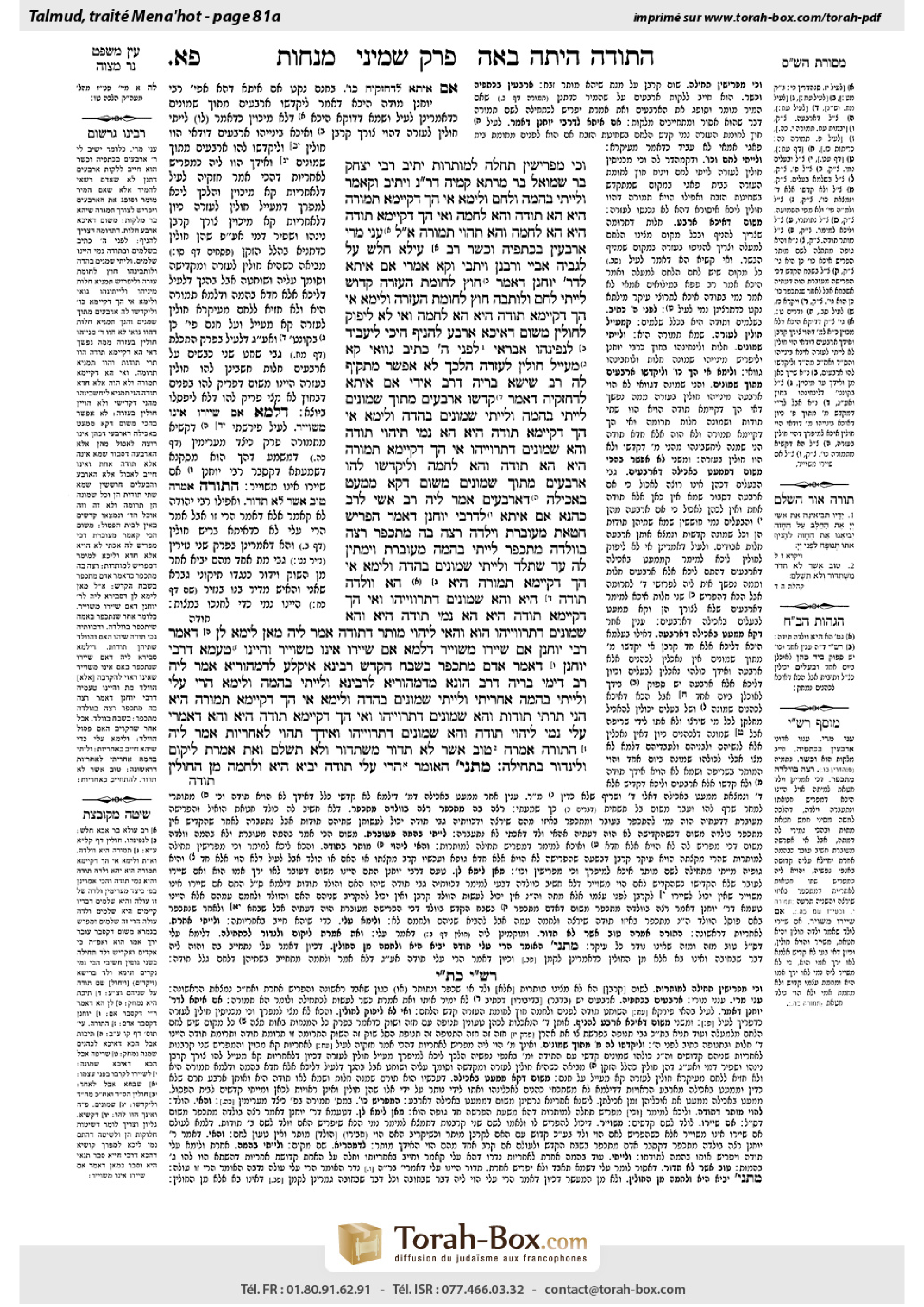
Menachot 81a: Talmud study for Daf Yomi
Daf Yomi is the daily study of one Talmud folio. Explore 37 tractates with scans, Hebrew text, Sefaria English and AI-generated French translations where annotated.
Passage selection and English or AI-generated French translation are available where the scan has annotations. Daf Study is independent of Torah-Box and Sefaria.
Browse Menachot · מנחות · All tractatesMenachot 81a text and translations
This page of Menachot includes the Aramaic text, an English translation and an AI-generated French translation, alongside the scan above.
מנחות פ״א א · Aramaic and Hebrew text
וְכִי מַפְרִישִׁין תְּחִלָּה לְמוֹתָרוֹת?
יָתֵיב רַבִּי יִצְחָק בַּר שְׁמוּאֵל בַּר מָרְתָא קַמֵּיהּ דְּרַב נַחְמָן, וְיָתֵיב וְקָאָמַר: וְלַיְיתֵי בְּהֵמָה וְלֶחֶם, וְלֵימָא: אִי הָךְ דְּקָיְימָא תְּמוּרָה הִיא – הָא תּוֹדָה וְהָא לַחְמָהּ, וְאִי הָךְ דְּקָיְימָא תּוֹדָה הִיא – הָא לַחְמָהּ וְהָא תִּהְוֵי תְּמוּרָה.
אֲמַר לֵיהּ: עֲנִי מָרִי, אַרְבְּעִין בְּכַתְפֵּיהּ, וְכָשֵׁר?!
רַב עִילָּא חֲלַשׁ, עָל לְגַבֵּיהּ אַבָּיֵי וְרַבָּנַן, וְיָתְבִי וְקָא אָמְרִי: אִם אִיתַהּ לִדְרַבִּי יוֹחָנָן דְּאָמַר: חוּץ לְחוֹמַת הָעֲזָרָה קָדוֹשׁ, לַיְיתֵי לֶחֶם וְלוֹתְבַהּ חוּץ לְחוֹמַת הָעֲזָרָה, וְלֵימָא: אִי הָךְ דְּקָיְימָא תּוֹדָה הִיא – הָא לַחְמָהּ, וְאִי לָא – לִיפּוֹק לְחוּלִּין.
מִשּׁוּם דְּאִיכָּא אַרְבַּע לְהָנִיף, הֵיכִי לֶיעְבֵּיד? לַנְפִינְהוּ אַבָּרַאי? ״לִפְנֵי ה׳״ כְּתִיב! גַּוַּואי? קָא מְעַיֵּיל חוּלִּין לָעֲזָרָה! הִלְכָּךְ, לָא אֶפְשָׁר.
מַתְקֵיף לַהּ רַב שִׁישָׁא בְּרֵיהּ דְּרַב אִידִי: אִם אִיתַהּ לִדְחִזְקִיָּה, דְּאָמַר קָדְשׁוּ אַרְבָּעִים מִתּוֹךְ שְׁמוֹנִים – לַיְיתֵי בְּהֵמָה, וְלַיְיתֵי שְׁמוֹנִים בַּהֲדַהּ, וְלֵימָא: אִי הָךְ דְּקָיְימָא תּוֹדָה הִיא – הָא נָמֵי תֶּיהְוֵי תּוֹדָה, וְהָא שְׁמוֹנִים דְּתַרְוַיְיהוּ; אִי הָךְ דְּקָיְימָא תְּמוּרָה הִיא – הָא תּוֹדָה וְהָא לַחְמָהּ, וְלִיקְדְּשׁוּ לְהוּ אַרְבָּעִים מִתּוֹךְ שְׁמוֹנִים!
מִשּׁוּם דְּקָא מְמַעֵט בַּאֲכִילָה דְּאַרְבָּעִים.
אֲמַר לֵיהּ רַב אָשֵׁי לְרַב כָּהֲנָא: אִם אִיתָא לִדְרַבִּי יוֹחָנָן, דְּאָמַר: הִפְרִישׁ חַטָּאת מְעוּבֶּרֶת וְיָלְדָה – רָצָה בָּהּ מִתְכַּפֵּר, רָצָה בִּוְולָדָהּ מִתְכַּפֵּר, לַיְיתֵי בְּהֵמָה מְעוּבֶּרֶת וְיַמְתִּין לָהּ עַד שֶׁתֵּלֵד, וְלַיְיתֵי שְׁמוֹנִים בַּהֲדַהּ, וְלֵימָא: אִי הָךְ דְּקָיְימָא תְּמוּרָה הִיא – הָא וּוְלָדָהּ תּוֹדָה הִיא, וְהָא שְׁמוֹנִים דְּתַרְוַויְיהוּ; וְאִי הָךְ דְּקָיְימָא תּוֹדָה הִיא – הָא נָמֵי תּוֹדָה הִיא, וְהָא שְׁמוֹנִים דְּתַרְוַויְיהוּ הוּא, וְהַאי לֶיהֱוֵי מוֹתָר דְּתוֹדָה.
אֲמַר לֵיהּ: מַאן לֵימָא לַן דְּאָמַר רַבִּי יוֹחָנָן אִם שִׁיְּירוֹ מְשׁוּיָּיר? דִּלְמָא אִם שִׁיְּירוֹ אֵינוֹ מְשׁוּיָּיר, וְהַיְינוּ טַעְמָא דְּרַבִּי יוֹחָנָן, דְּאָמַר: אָדָם מִתְכַּפֵּר בִּשְׁבַח הֶקְדֵּשׁ.
רָבִינָא אִיקְּלַע לְדַמְהַורְיָא, אֲמַר לֵיהּ רַב דִּימִי בְּרֵיהּ דְּרַב הוּנָא מִדַּמְהַורְיָא לְרָבִינָא: וְלַיְיתֵי בְּהֵמָה, וְלֵימָא ״הֲרֵי עָלַי״, וְלַיְיתֵי בְּהֵמָה אַחֲרִיתִי, וְלַיְיתֵי שְׁמוֹנִים בַּהֲדַהּ, וְלֵימָא: אִי הָךְ דְּקָיְימָא תְּמוּרָה הִיא – הָנֵי תַּרְתֵּי תּוֹדוֹת, וְהָא שְׁמוֹנִים דְּתַרְוַיְיהוּ; וְאִי הָךְ דְּקָיְימָא תּוֹדָה הִיא – וְהָא דְּאָמְרִי ״עֲלַי״ נָמֵי לֶיהֱוֵי תּוֹדָה, וְהָא שְׁמוֹנִים דְּתַרְוַיְיהוּ, וְאִידַּךְ תִּהְוֵי לְאַחְרָיוּת.
אֲמַר לֵיהּ: הַתּוֹרָה אָמְרָה ״טוֹב אֲשֶׁר לֹא תִדֹּר מִשֶּׁתִּדּוֹר וְלֹא תְשַׁלֵּם״, וְאַתְּ אָמְרַתְּ: לֵיקוּם וְלִינְדּוֹר בַּתְּחִילָּה?!
מַתְנִי׳ הָאוֹמֵר ״הֲרֵי עָלַי תּוֹדָה״ – יָבִיא הִיא וְלַחְמָהּ מִן הַחוּלִּין.
Menachot 81a · English translation
Rabbi Yehuda HaNasi explains why: And does one separate an animal as a leftover ab initio?
The Gemara suggests another solution: Rabbi Yitzḥak bar Shmuel bar Marta was sitting before Rav Naḥman, and he was sitting and saying: And let him bring another animal with loaves and let him say: If this animal that is extant is the substitute, then let this be the thanks offering and these its loaves. And if this animal that is extant is the thanks offering, then let these be its loaves and this will be a substitute, as the substitute of a thanks offering is not sacrificed with loaves, and it may be consumed for the same duration as the thanks offering itself.
Rav Naḥman said to him: Answer me, my Master: The halakha is that one who separates a substitute is liable to receive forty lashes on his shoulders, and yet you say it is fit to separate a substitute ab initio?
The Gemara relates that Rav Ila took ill, and Abaye and the Sages went to visit him, and they were sitting and saying: If one accepts the ruling of Rabbi Yoḥanan, who said: If the loaves of the thanks offering were within Jerusalem, i.e., the area of consumption of a thanks offering and its loaves, even if they were outside the wall of the Temple courtyard when the thanks offering was slaughtered they are consecrated, then let the owner bring loaves and set them outside the wall of the Temple courtyard and let him say: If this animal that is extant is the thanks offering, then let these be its loaves, and if it is not, let them go out and be consumed as non-sacred loaves.
The Gemara responds: This too is not a valid remedy, because there are four loaves of the forty that one must wave. How would he perform the mitzva of waving them? Shall he wave them outside the Temple courtyard? He may not, since “waved for a wave offering before the Lord” (Leviticus 7:30) is written in the verse, and waving performed outside the Temple courtyard is not considered “before the Lord.” Shall he wave them inside the Temple courtyard? He will have brought non-sacred food into the Temple courtyard. Therefore, it is not possible.
Rav Sheisha, son of Rav Idi, objects to this: If one accepts the ruling of Ḥizkiyya, who said with regard to a thanks offering that one slaughtered accompanied by eighty loaves rather than the required forty: Forty of the eighty loaves are consecrated, then let the owner bring an animal and let him bring eighty loaves with it and say: If this animal that is extant is the thanks offering, then this additional animal should also be a thanks offering and these eighty loaves should be for both of them. And if this animal that is extant is the substitute, then let this additional animal be a thanks offering and these shall be its loaves, and let forty of the eighty be consecrated for it.
The Gemara rejects this: This is not a valid remedy, because it reduces the consumption of the forty additional loaves, as the priests may not be able to consume the four loaves given from the additional forty, and the owner cannot consume them because they may be the portion of the priest.
Rav Ashi said to Rav Kahana: If one accepts the ruling of Rabbi Yoḥanan, who said: If one separated a pregnant animal as a sin offering and it gave birth, if he wants he can achieve atonement with it, and if he wants he can achieve atonement with its offspring; then let the owner bring a pregnant animal and wait until it gives birth, and let him bring eighty loaves with it and say: If this animal that is extant is the substitute, then this and its offspring are thanks offerings, and these eighty loaves should be for both of them. And if this animal that is extant is the thanks offering, then this mother should also be a thanks offering, and these eighty loaves should be for both of them, and let this offspring be the leftover of the thanks offering.
Rav Kahana said to him: Who shall say to us that the reasoning of Rabbi Yoḥanan is that he said that the offspring is considered the property of the one who dedicated the pregnant mother, such that if he reserved it for a specific consecration it is considered reserved for that consecration? Perhaps Rabbi Yoḥanan holds that if he reserved it, it is not considered reserved, and this is the reason that Rabbi Yoḥanan holds that one can achieve atonement with the offspring of a pregnant animal separated as a sin offering, as he said: A person achieves atonement with the enhancement of consecrated property, such as the offspring of an animal that was consecrated when pregnant.
Ravina happened to come to Dimhorya. Rav Dimi, son of Rav Huna from Dimhorya, said to Ravina: And let the owner bring an animal and say: It is incumbent upon me to bring an animal for a thanks offering, and let him separate this animal in fulfillment of his vow, and then let him bring another animal, and let him bring eighty loaves with it and say: If this animal that is extant is the substitute, then these two additional animals are thanks offerings and these eighty loaves should be for both of them. And if this animal that is extant is the thanks offering, then this one for which I said: It is incumbent upon me, should also be a thanks offering, and these eighty loaves are for both of them, and let the other animal be for a guarantee, to be sacrificed if my thanks offering gets lost, and it does not require loaves.
Ravina said to him: The Torah said: “Better is it that you should not vow, than that you should vow and not pay” (Ecclesiastes 5:4), and you say: Let him rise up and vow ab initio? Taking a vow to bring an offering is not encouraged. As all possible remedies have been rejected, the statement of Rabbi Ḥiyya, that there is no remedy in a case where a thanks offering and its substitute were intermingled and one of them died, stands.
MISHNA: One who says: It is incumbent upon me to bring a thanks offering, must bring it and its loaves from non-sacred money in his possession and not second-tithe money. Since he said: It is incumbent upon me, bringing the offering is an obligation, and one may not fulfill an obligation with second-tithe money.
Menachot 81a · Traduction française (IA)
Rabbi Yehuda HaNasi explique pourquoi : peut-on désigner d’emblée un animal comme surplus ?
La Guemara propose une autre solution : Rabbi Yitzḥak bar Shmuel bar Marta était assis devant Rav Naḥman et disait : « Qu’il apporte un autre animal avec des pains et déclare : “Si cet animal qui est là est le substitut, que celui-ci soit le sacrifice de remerciement et que ces pains soient les siens. Et si cet animal qui est là est le sacrifice de remerciement, que ces pains soient les siens et que celui-ci soit un substitut”, car le substitut d’un sacrifice de remerciement n’est pas offert avec des pains et peut être consommé pendant la même durée que le sacrifice de remerciement lui-même. »
Rav Naḥman lui dit : « Réponds-moi, mon maître : la halakha est que celui qui désigne un substitut est passible de quarante coups sur les épaules, et pourtant tu dis qu’il est permis de désigner d’emblée un substitut ? »
La Guemara rapporte que Rav Ila tomba malade, et qu’Abaye et les Sages vinrent lui rendre visite. Ils étaient assis et disaient : « Si l’on accepte la décision de Rabbi Yoḥanan, qui a dit que si les pains du sacrifice de remerciement se trouvaient à l’intérieur de Jérusalem, c’est-à-dire dans la zone où le sacrifice de remerciement et ses pains peuvent être consommés, ils sont consacrés même s’ils se trouvaient à l’extérieur du mur de la cour du Temple au moment où le sacrifice de remerciement fut égorgé, que le propriétaire apporte alors des pains, les place à l’extérieur du mur de la cour du Temple et déclare : “Si cet animal qui est là est le sacrifice de remerciement, que ces pains soient les siens ; et si ce n’est pas le cas, qu’ils soient libérés et consommés comme des pains profanes.” »
La Guemara répond : ce n’est pas non plus une solution valable, car quatre des quarante pains doivent être agités. Comment accomplirait-il la mitsva de les agiter ? Les agiterait-il à l’extérieur de la cour du Temple ? Il ne le peut pas, puisque le verset dit : « Agité en offrande d’agitation devant le Seigneur » (Lévitique 7:30), et qu’une agitation accomplie à l’extérieur de la cour du Temple n’est pas considérée comme ayant été faite « devant le Seigneur ». Les agiterait-il à l’intérieur de la cour du Temple ? Il y aurait alors introduit des aliments profanes. Cela n’est donc pas possible.
Rav Sheisha, fils de Rav Idi, objecte : « Si l’on accepte la décision de Ḥizkiyya, qui a dit au sujet d’un sacrifice de remerciement égorgé avec quatre-vingts pains au lieu des quarante requis que quarante des quatre-vingts pains sont consacrés, que le propriétaire apporte alors un animal avec quatre-vingts pains et déclare : “Si cet animal qui est là est le sacrifice de remerciement, que cet autre animal soit lui aussi un sacrifice de remerciement et que ces quatre-vingts pains soient pour les deux. Et si cet animal qui est là est le substitut, que cet autre animal soit un sacrifice de remerciement et que ces pains soient les siens ; que quarante des quatre-vingts lui soient consacrés.” »
La Guemara rejette cette solution : elle n’est pas valable, car elle réduit la possibilité de consommer les quarante pains supplémentaires. En effet, les prêtres pourraient ne pas être en mesure de consommer les quatre pains prélevés sur ces quarante pains supplémentaires, et le propriétaire ne peut pas les consommer, puisqu’ils pourraient constituer la part du prêtre.
Rav Ashi dit à Rav Kahana : « Si l’on accepte la décision de Rabbi Yoḥanan, qui a dit que si quelqu’un désigne une femelle enceinte comme sacrifice expiatoire et qu’elle met bas, il peut, s’il le souhaite, obtenir l’expiation avec elle ou, s’il le souhaite, avec son petit, que le propriétaire apporte alors une femelle enceinte et attende qu’elle mette bas, puis apporte quatre-vingts pains et déclare : “Si cet animal qui est là est le substitut, que cette femelle et son petit soient des sacrifices de remerciement et que ces quatre-vingts pains soient pour les deux. Et si cet animal qui est là est le sacrifice de remerciement, que cette mère soit elle aussi un sacrifice de remerciement, que ces quatre-vingts pains soient pour les deux, et que ce petit soit le surplus du sacrifice de remerciement.” »
Rav Kahana lui dit : « Qui nous garantit que le raisonnement de Rabbi Yoḥanan est qu’il considère le petit comme la propriété de celui qui a consacré la mère enceinte, de sorte que, s’il l’a réservé à une consécration précise, le petit est considéré comme réservé à cette même consécration ? Peut-être Rabbi Yoḥanan estime-t-il que, même s’il l’a réservé, le petit n’est pas considéré comme réservé. La raison pour laquelle Rabbi Yoḥanan estime qu’on peut obtenir l’expiation avec le petit d’une femelle enceinte désignée comme sacrifice expiatoire est peut-être celle qu’il a énoncée : une personne obtient l’expiation grâce à l’accroissement d’un bien consacré, tel le petit d’un animal consacré alors qu’il était encore dans le ventre de sa mère. »
Ravina arriva par hasard à Dimhorya. Rav Dimi, fils de Rav Huna de Dimhorya, dit à Ravina : « Que le propriétaire apporte un animal et déclare : “Je suis tenu d’apporter un animal pour un sacrifice de remerciement”, puis désigne cet animal pour s’acquitter de son vœu. Qu’il apporte ensuite un autre animal avec quatre-vingts pains et déclare : “Si cet animal qui est là est le substitut, que ces deux autres animaux soient des sacrifices de remerciement et que ces quatre-vingts pains soient pour les deux. Et si cet animal qui est là est le sacrifice de remerciement, que celui-ci, au sujet duquel j’ai dit : ‘Je suis tenu’, soit lui aussi un sacrifice de remerciement, et que ces quatre-vingts pains soient pour les deux ; que l’autre animal serve de garantie, pour être offert si mon sacrifice de remerciement se perd, sans qu’il ait besoin de pains.” »
Ravina lui dit : « La Torah a dit : “Mieux vaut ne pas faire de vœu que d’en faire un et de ne pas l’acquitter” (Ecclésiaste 5:4), et toi, tu dis : qu’il se lève et fasse un vœu d’emblée ? » On n’encourage pas à faire le vœu d’apporter une offrande. Toutes les solutions possibles ayant été rejetées, la déclaration de Rabbi Ḥiyya reste valable : il n’existe pas de solution lorsqu’un sacrifice de remerciement et son substitut se sont mélangés et que l’un d’eux est mort.
Michna : Celui qui dit : « Je suis tenu d’apporter un sacrifice de remerciement » doit l’apporter, ainsi que ses pains, avec des fonds profanes en sa possession, et non avec l’argent de la seconde dîme. Puisqu’il a dit : « Je suis tenu », l’apport du sacrifice est une obligation, et l’on ne peut pas s’acquitter d’une obligation avec l’argent de la seconde dîme.
Traduction française générée par IA à partir de l’édition anglaise de Sefaria. Vérifie toujours un passage avec le texte source.
Text from Sefaria: William Davidson Edition - Vocalized Aramaic (unknown); William Davidson Edition - English (CC BY NC).