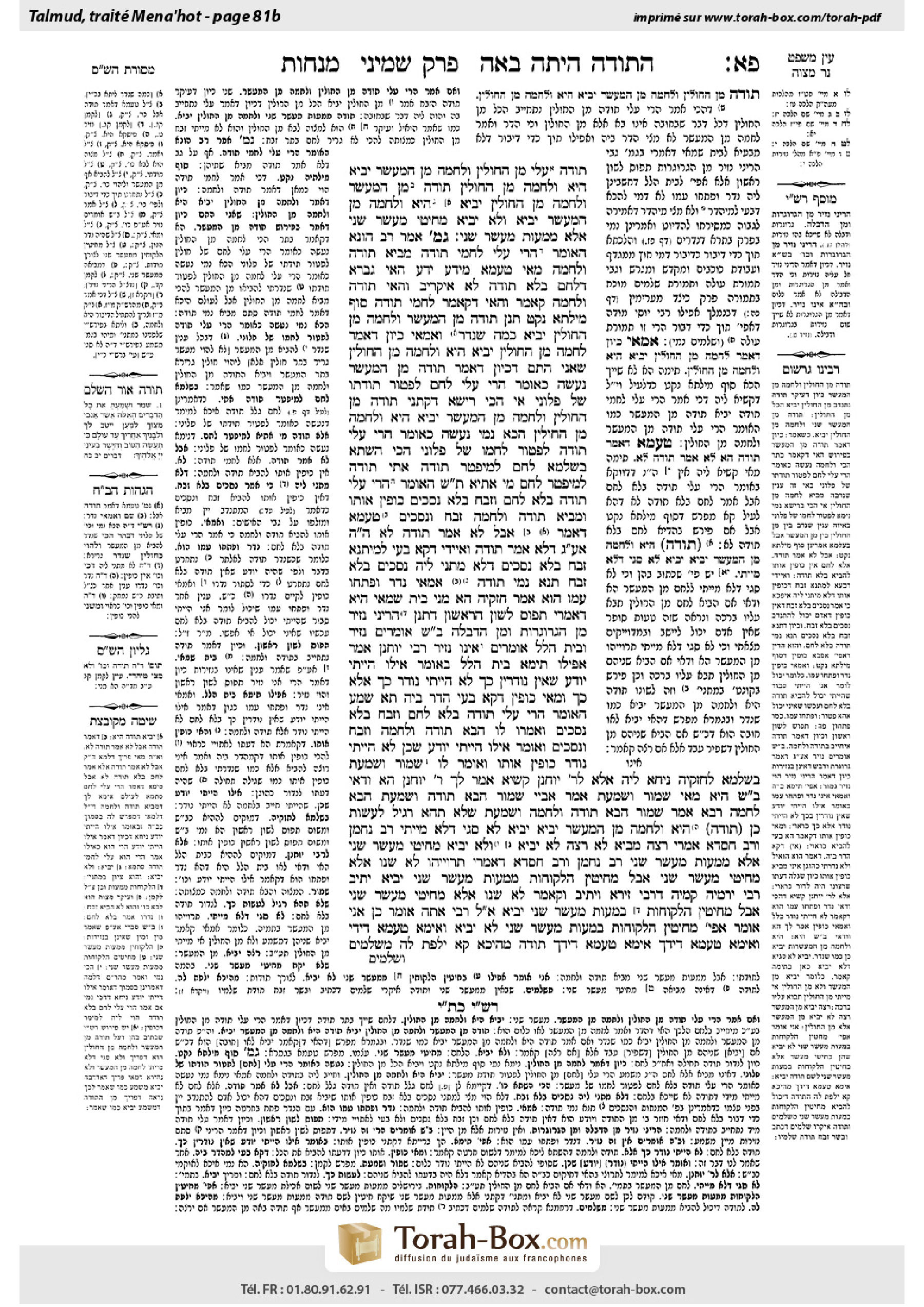
Menachot 81b: Talmud study for Daf Yomi
Daf Yomi is the daily study of one Talmud folio. Explore 37 tractates with scans, Hebrew text, Sefaria English and AI-generated French translations where annotated.
Passage selection and English or AI-generated French translation are available where the scan has annotations. Daf Study is independent of Torah-Box and Sefaria.
Browse Menachot · מנחות · All tractatesMenachot 81b text and translations
This page of Menachot includes the Aramaic text, an English translation and an AI-generated French translation, alongside the scan above.
מנחות פ״א ב · Aramaic and Hebrew text
״תּוֹדָה עָלַי מִן הַחוּלִּין וְלַחְמָהּ מִן הַמַּעֲשֵׂר״ – יָבִיא הִיא וְלַחְמָהּ מִן הַחוּלִּין. ״תּוֹדָה מִן הַמַּעֲשֵׂר וְלַחְמָהּ מִן הַחוּלִּין״ – יָבִיא. ״הִיא וְלַחְמָהּ מִן הַמַּעֲשֵׂר״ – יָבִיא. וְלֹא יָבִיא מֵחִיטֵּי מַעֲשֵׂר שֵׁנִי, אֶלָּא מִמְּעוֹת מַעֲשֵׂר שֵׁנִי.
גְּמָ׳ אָמַר רַב הוּנָא: הָאוֹמֵר ״הֲרֵי עָלַי לַחְמֵי תוֹדָה״ – מֵבִיא תּוֹדָה וְלַחְמָהּ. מַאי טַעְמָא? מִידָּע יָדַע הַאי גַּבְרָא דְּלֶחֶם בְּלֹא תּוֹדָה לָא איקָרֵיב, וְהַאי תּוֹדָה וְלַחְמָהּ קָאָמַר, וְהַאי דְּקָאָמַר ״לַחְמֵי תוֹדָה״ – סוֹף מִילְּתָא נָקֵט.
תְּנַן: תּוֹדָה מִן הַמַּעֲשֵׂר וְלַחְמָהּ מִן הַחוּלִּין – יָבִיא כְּמָה שֶׁנָּדַר. וְאַמַּאי? כֵּיוָן דְּאָמַר ״לַחְמָהּ מִן הַחוּלִּין״ – יָבִיא הִיא וְלַחְמָהּ מִן הַחוּלִּין!
שָׁאנֵי הָתָם, דְּכֵיוָן דְּאָמַר ״תּוֹדָה מִן הַמַּעֲשֵׂר״, נַעֲשָׂה כְּאוֹמֵר ״הֲרֵי עָלַי לֶחֶם לִפְטוֹר תּוֹדָתוֹ שֶׁל פְּלוֹנִי״.
אִי הָכִי, רֵישָׁא דְּקָתָנֵי: תּוֹדָה מִן הַחוּלִּין וְלַחְמָהּ מִן הַמַּעֲשֵׂר – יָבִיא הִיא וְלַחְמָהּ מִן הַחוּלִּין, הָכָא נָמֵי נַעֲשָׂה כְּאוֹמֵר ״הֲרֵי עָלַי תּוֹדָה לִפְטוֹר לַחְמוֹ שֶׁל פְּלוֹנִי״!
הָכִי הַשְׁתָּא? בִּשְׁלָמָא לֶחֶם לְמִיפְטַר תּוֹדָה אָתֵי, תּוֹדָה לְמִיפְטַר לֶחֶם מִי אָתְיָא?
תָּא שְׁמַע: הָאוֹמֵר ״הֲרֵי עָלַי תּוֹדָה בְּלֹא לֶחֶם״ וְ״זֶבַח בְּלֹא נְסָכִים״ – כּוֹפִין אוֹתוֹ, וּמֵבִיא תּוֹדָה וְלַחְמָהּ, זֶבַח וּנְסָכִים.
טַעְמָא דְּאָמַר, אֲבָל לָא אָמַר תּוֹדָה – לָא.
הוּא הַדִּין אַף עַל גַּב דְּלָא אָמַר ״תּוֹדָה״, וְאַיְּידֵי דְּקָא בָּעֵי לְמִיתְנֵא ״זֶבַח בְּלֹא נְסָכִים״, דְּלָא מִתְּנֵי לֵיהּ ״נְסָכִים בְּלֹא זֶבַח״, תְּנָא נָמֵי ״תּוֹדָה״.
אַמַּאי? נֶדֶר וּפִתְחוֹ עִמּוֹ הוּא!
אָמַר חִזְקִיָּה: הָא מַנִּי? בֵּית שַׁמַּאי הִיא, דְּאָמְרִי: תְּפוֹס לָשׁוֹן הָרִאשׁוֹן. דִּתְנַן: ״הֲרֵינִי נָזִיר מִן הַגְּרוֹגְרוֹת וּמִן הַדְּבֵלָה״ – בֵּית שַׁמַּאי אוֹמְרִים: נָזִיר, וּבֵית הִלֵּל אוֹמְרִים: אֵינוֹ נָזִיר.
רַבִּי יוֹחָנָן אָמַר: אֲפִילּוּ תֵּימָא בֵּית הִלֵּל, בְּאוֹמֵר: אִילּוּ הָיִיתִי יוֹדֵעַ שֶׁאֵין נוֹדְרִין כָּךְ, לֹא הָיִיתִי נוֹדֵר כָּךְ, אֶלָּא כָּךְ. וּמַאי כּוֹפִין? דְּקָא בָּעֵי הָדַר בֵּיהּ.
תָּא שְׁמַע: הָאוֹמֵר ״הֲרֵי עָלַי תּוֹדָה בְּלֹא לֶחֶם״, וְ״זֶבַח בְּלֹא נְסָכִים״, וְאָמְרוּ לוֹ: ״הָבֵא תּוֹדָה וְלַחְמָהּ״, וְ״זֶבַח וּנְסָכִים״, וְאוֹמֵר: ״אִילּוּ הָיִיתִי יוֹדֵעַ שֶׁכֵּן לֹא הָיִיתִי נוֹדֵר״ – כּוֹפִין אוֹתוֹ, וְאוֹמֵר לוֹ: ״שְׁמֹר וְשָׁמַעְתָּ״.
בִּשְׁלָמָא לְחִזְקִיָּה, נִיחָא לֵיהּ, אֶלָּא לְרַבִּי יוֹחָנָן קַשְׁיָא! אָמַר לָךְ רַבִּי יוֹחָנָן: הָא וַדַּאי בֵּית שַׁמַּאי הִיא.
מַאי ״שְׁמֹר וְשָׁמַעְתָּ״? אָמַר אַבָּיֵי: ״שְׁמֹר״ – הָבֵא תּוֹדָה, ״וְשָׁמַעְתָּ״ – הָבֵא לַחְמָהּ. רָבָא אָמַר: ״שְׁמֹר״ – הָבֵא תּוֹדָה וְלַחְמָהּ, ״וְשָׁמַעְתָּ״ – שֶׁלֹּא תְּהֵא רָגִיל לַעֲשׂוֹת כֵּן.
״תּוֹדָה הִיא וְלַחְמָהּ מִן הַמַּעֲשֵׂר״ – יָבִיא. יָבִיא? לָא סַגִּי דְּלָא מַיְיתֵי? רַב נַחְמָן וְרַב חִסְדָּא אָמְרִי: רָצָה מֵבִיא, לֹא רָצָה לֹא יָבִיא.
וְלֹא יָבִיא מֵחִיטֵּי מַעֲשֵׂר שֵׁנִי, אֶלָּא מִמְּעוֹת מַעֲשֵׂר שֵׁנִי. רַב נַחְמָן וְרַב חִסְדָּא דְּאָמְרִי תַּרְוַיְיהוּ: לֹא שָׁנוּ אֶלָּא מֵחִיטֵּי מַעֲשֵׂר שֵׁנִי, אֲבָל מֵחִיטִּין הַלְּקוּחוֹת מִמְּעוֹת מַעֲשֵׂר שֵׁנִי – יָבִיא.
יָתֵיב רַבִּי יִרְמְיָה קַמֵּיהּ דְּרַבִּי זֵירָא, וְיָתֵיב וְקָאָמַר: לֹא שָׁנוּ אֶלָּא מֵחִיטֵּי מַעֲשֵׂר שֵׁנִי, אֲבָל מֵחִיטִּין הַלְּקוּחוֹת בִּמְעוֹת מַעֲשֵׂר שֵׁנִי – יָבִיא. אֲמַר לֵיהּ: רַבִּי, אַתָּה אוֹמֵר כֵּן? אֲנִי אוֹמֵר אֲפִילּוּ מֵחִיטִּין הַלְּקוּחוֹת בִּמְעוֹת מַעֲשֵׂר שֵׁנִי לֹא יָבִיא. וְאֵימָא טַעְמָא דִידִי, וְאֵימָא טַעְמָא דִּידָךְ. אֵימָא טַעְמָא דִּידָךְ: תּוֹדָה מֵהֵיכָא קָא יָלְפַתְּ לַהּ? מִשְּׁלָמִים,
Menachot 81b · English translation
If one said: It is incumbent upon me to bring a thanks offering from non-sacred money and its loaves from second-tithe money, he must bring the thanks offering and its loaves from non-sacred money. If one said: It is incumbent upon me to bring a thanks offering from second-tithe money and its loaves from non-sacred money, he may bring it in that manner. Likewise, if one said: It is incumbent upon me to bring a thanks offering and its loaves from second-tithe money, he may bring it in that manner. And he may not bring the loaves from second-tithe wheat; rather, he purchases the flour with second-tithe money.
GEMARA: With regard to the various ways in which one can take a vow to bring a thanks offering and its loaves, Rav Huna says: One who says: It is incumbent upon me to bring loaves of a thanks offering, must bring a thanks offering and its loaves, even though he did not expressly take upon himself the obligation to bring the thanks offering itself. What is the reason? This man knows that loaves are not brought without a thanks offering, and by stating the vow in this manner, he was effectively saying: It is incumbent upon me to bring a thanks offering and its loaves. And the reason he stated his vow in this manner, namely, by saying: It is incumbent upon me to bring loaves of a thanks offering, was that he was citing the end of the matter, as the sacrifice of a thanks offering is completed with the bringing of the loaves.
The Gemara raises a difficulty with the statement of Rav Huna from that which we learned in the mishna: If one said: It is incumbent upon me to bring a thanks offering from second-tithe money and its loaves from non-sacred money, he may bring it as he vowed. The Gemara asks: And according to the opinion of Rav Huna that one who takes a vow to bring the loaves of a thanks offering intends to bring the thanks offering as well, why does the mishna state that he may bring the thanks offering from second-tithe money? Since he said: Its loaves from non-sacred money, he should bring a thanks offering and its loaves from non-sacred money.
The Gemara responds: It is different there, in the case of the mishna, as since he said initially: It is incumbent upon me to bring a thanks offering from second-tithe money, and then said: And its loaves from non-sacred money, he is considered as one who says: It is incumbent upon me to bring loaves to exempt the thanks offering of so-and-so. His vow to bring the loaves is not considered a new vow, but rather as a vow to bring loaves for the specific offering he vowed to bring.
The Gemara asks: If that is so, then with regard to the first clause of the mishna, which teaches that if one says: It is incumbent upon me to bring a thanks offering from non-sacred money and its loaves from second-tithe money, then he must bring the thanks offering and its loaves from non-sacred money, here too let it be said that he is considered as one who says: It is incumbent upon me to bring a thanks offering to exempt the loaves of so-and-so, and he therefore should bring a thanks offering from second tithe. His initial vow to bring a thanks offering from non-sacred money should not include the bringing of the loaves.
The Gemara rejects this: How can these cases be compared? Granted, in a case where one says: It is incumbent upon me to bring a thanks offering from second-tithe money and its loaves from non-sacred money, it can be said that he intends that the loaves should be brought to complete the vow of one who is obligated to bring a thanks offering, because loaves come to exempt the thanks offering. But in a case where one says: It is incumbent upon me to bring a thanks offering from non-sacred money and its loaves from second-tithe money, it cannot be said that the thanks offering is meant to complete the vow of one who is obligated to bring the loaves of a thanks offering, as does a thanks offering come to exempt the loaves?
The Gemara continues to discuss the statement of Rav Huna that one who says: It is incumbent upon me to bring loaves of a thanks offering, must bring a thanks offering and its loaves. Come and hear a proof from a baraita that contradicts the opinion of Rav Huna: In the case of one who says: It is incumbent upon me to bring a thanks offering without loaves, or an animal offering without libations, the court coerces him, and he brings a thanks offering with its loaves, or an offering with its libations.
The Gemara infers: The reason that he is coerced to bring a thanks offering with its loaves is that he said that it is incumbent upon himself to bring a thanks offering. But if he did not say that it is incumbent upon himself to bring a thanks offering, but instead said that it is incumbent upon himself to bring the loaves of a thanks offering, he would not be coerced to bring a thanks offering with the loaves, in contradiction to the opinion of Rav Huna.
The Gemara rejects this: Actually, the same is true even if he did not say that it is incumbent upon himself to bring a thanks offering, but said only: It is incumbent upon me to bring the loaves. And this is the reason that the tanna of the baraita mentions specifically the case of one who renders himself obligated to bring a thanks offering without loaves: Since the tanna wants to teach the case of one who renders himself obligated to bring an animal offering without libations, concerning which he could not teach a case where one renders himself obligated to bring libations without an offering, because, unlike the loaves of a thanks offering, libations are in fact brought on their own and one can take a vow to bring them on their own, he therefore also taught the case of one who renders himself obligated to bring a thanks offering.
The Gemara addresses the actual statement of the baraita and asks: Why is he coerced to bring a thanks offering and its loaves? Isn’t this an instance of a vow with its inherent opening? That is, the vow should be dissolved entirely on the grounds that the one who took the vow may claim that he thought it was possible to bring a thanks offering without loaves, and now that he has been made aware that he cannot, he regrets taking the vow.
Ḥizkiyya said: In accordance with whose opinion is this baraita? It is in accordance with the opinion of Beit Shammai, who say: In the case of one who stated a declaration comprising two contradictory statements, attend to only the first statement. As we learned in a mishna (Nazir 9a): If one says: I am hereby a nazirite from dried figs and from pressed figs, which is a contradictory statement, as figs are not prohibited to a nazirite, Beit Shammai say: He is a full-fledged nazirite, as one attends only to the first statement, i.e., I am hereby a nazirite, and the second part is discounted. And Beit Hillel say: The second part of his statement is not discounted, and therefore he is not a nazirite, as he did not accept naziriteship upon himself.
Rabbi Yoḥanan says: You may even say that the baraita is in accordance with the opinion of Beit Hillel, and the ruling of the baraita is with regard to one who says: Had I known that one does not vow in this manner, i.e., to bring a thanks offering without loaves or an animal offering without libations, I would not have vowed in this manner but in that manner, i.e., I would have vowed to bring a thanks offering with its loaves. There is therefore no opening for a dissolution. And what does the baraita mean when it states that the court coerces him? Why would he require coercion if he says that he would have willingly taken the proper vow? The baraita is referring to a case where, despite the fact that he would have taken the proper vow initially, he now wants to retract his vow altogether.
The Gemara cites a baraita in support of the response of Ḥizkiyya: Come and hear: In a case involving one who says: It is incumbent upon me to bring a thanks offering without loaves, or: It is incumbent upon me to bring an animal offering without libations, and the Sages said to him: Bring a thanks offering with its loaves, or: Bring an animal offering with its libations, and he says: Had I known that such is the requirement I would not have vowed at all; the halakha is that the court coerces him, and says to him: “Observe and hear” (Deuteronomy 12:28).
The Gemara continues: Granted, this works out well according to Ḥizkiyya, who says that the baraita is in accordance with the opinion of Beit Shammai that one attends only to the first statement, since this baraita can also be explained in accordance with the opinion of Beit Shammai. But according to Rabbi Yoḥanan, who says that the baraita discusses a case where the person who took the vow says: Had I known that one does not vow in this manner I would have vowed to bring a thanks offering with its loaves, this baraita presents a difficulty, as although the individual claims that he would not have taken any vow, he must still bring a thanks offering and its loaves. The Gemara responds: Rabbi Yoḥanan could have said to you: This latter baraita is certainly in accordance with the opinion of Beit Shammai, but the previous baraita may still be explained in accordance with the opinion of Beit Hillel.
The Gemara turns to analyze the baraita itself: What is the relevance of the phrase in the verse that says: “Observe and hear,” to one who vows to bring a thanks offering without its loaves? Abaye says: “Observe” means: Bring a thanks offering; “and hear” means: Bring its loaves. Rava says: “Observe” means: Bring a thanks offering and its loaves; “and hear” means that you should not act in this manner regularly.
§ The mishna teaches that if one states: It is incumbent upon me to bring a thanks offering and its loaves from second-tithe money, he shall bring it in that manner. The Gemara asks: Why does the mishna teach: He shall bring, which suggests that he must bring the thanks offering and loaves from second-tithe money? Is it not sufficient to fulfill his vow even if he does not bring it from second-tithe money but from non-sacred money? In fact, it is preferable that he bring the offering from non-sacred money. Rav Naḥman and Rav Ḥisda say: The mishna does not mean that he must bring it specifically from second-tithe money; rather, if he wants, he brings it from second-tithe money, and if he does not want, he does not need to bring it from second-tithe money.
§ The mishna teaches: And he may not bring the loaves from second-tithe wheat; rather, he purchases the flour with second-tithe money. With regard to this, Rav Naḥman and Rav Ḥisda both say: The mishna taught only that the loaves may not be brought from second-tithe wheat itself, but he may bring the loaves from wheat purchased with second-tithe money.
The Gemara relates: Rabbi Yirmeya was sitting before Rabbi Zeira, and he was sitting and saying: The mishna taught only that the loaves may not be brought from second-tithe wheat itself, but he may bring the loaves from wheat purchased from second-tithe money. Rabbi Zeira said to him: My teacher, do you say so? I say that he may not bring the loaves even from wheat purchased from second-tithe money. And I will say my reasoning and I will say your reasoning. I will say your reasoning first: From where do you derive that the loaves of a thanks offering may be brought from wheat purchased with second-tithe money? You derive it from the halakha of a peace offering. A thanks offering is a type of peace offering, as the verse states: “And the flesh of the sacrifice of his peace offerings for thanks” (Leviticus 7:15), and a peace offering may be brought from second-tithe money.
Menachot 81b · Traduction française (IA)
Si quelqu’un dit : « Je suis tenu d’apporter une offrande de reconnaissance avec des biens profanes et ses pains avec de l’argent de seconde dîme », il doit apporter l’offrande de reconnaissance et ses pains avec des biens profanes. S’il dit : « Je suis tenu d’apporter une offrande de reconnaissance avec de l’argent de seconde dîme et ses pains avec des biens profanes », il peut l’apporter de cette manière. De même, s’il dit : « Je suis tenu d’apporter une offrande de reconnaissance et ses pains avec de l’argent de seconde dîme », il peut l’apporter de cette manière. Il ne peut toutefois pas apporter les pains à partir de blé de seconde dîme ; il achète plutôt la farine avec de l’argent de seconde dîme.
GUEMARA : À propos des différentes façons de faire vœu d’apporter une offrande de reconnaissance et ses pains, Rav Houna dit : Celui qui dit : « Je suis tenu d’apporter les pains d’une offrande de reconnaissance » doit apporter une offrande de reconnaissance et ses pains, bien qu’il n’ait pas expressément pris sur lui l’obligation d’apporter l’offrande de reconnaissance elle-même. Pour quelle raison ? Cet homme sait qu’on n’apporte pas de pains sans offrande de reconnaissance ; en formulant son vœu de cette manière, il a donc effectivement dit : « Je suis tenu d’apporter une offrande de reconnaissance et ses pains. » S’il a formulé son vœu ainsi, c’est-à-dire : « Je suis tenu d’apporter les pains d’une offrande de reconnaissance », c’est parce qu’il a mentionné la fin de l’affaire, puisque l’offrande de reconnaissance est achevée par l’apport des pains.
La Guemara soulève une difficulté à propos de la déclaration de Rav Houna à partir de ce que nous avons appris dans la Michna : Si quelqu’un dit : « Je suis tenu d’apporter une offrande de reconnaissance avec de l’argent de seconde dîme et ses pains avec des biens profanes », il peut l’apporter comme il l’a promis. La Guemara demande : Selon l’opinion de Rav Houna, d’après laquelle celui qui fait vœu d’apporter les pains d’une offrande de reconnaissance entend également apporter l’offrande de reconnaissance, pourquoi la Michna dit-elle qu’il peut apporter l’offrande de reconnaissance avec de l’argent de seconde dîme ? Puisqu’il a dit : « Ses pains avec des biens profanes », il devrait apporter l’offrande de reconnaissance et ses pains avec des biens profanes.
La Guemara répond : Le cas de la Michna est différent, car, puisqu’il a d’abord dit : « Je suis tenu d’apporter une offrande de reconnaissance avec de l’argent de seconde dîme », puis : « Et ses pains avec des biens profanes », il est considéré comme ayant dit : « Je suis tenu d’apporter des pains afin d’acquitter l’offrande de reconnaissance d’un tel. » Son vœu d’apporter les pains n’est pas considéré comme un nouveau vœu, mais comme un vœu d’apporter des pains pour l’offrande précise qu’il a promis d’apporter.
La Guemara demande : Si tel est le cas, à propos de la première partie de la Michna, qui enseigne que si quelqu’un dit : « Je suis tenu d’apporter une offrande de reconnaissance avec des biens profanes et ses pains avec de l’argent de seconde dîme », il doit apporter l’offrande de reconnaissance et ses pains avec des biens profanes, ici aussi, qu’on dise qu’il est considéré comme ayant dit : « Je suis tenu d’apporter une offrande de reconnaissance afin d’acquitter les pains d’un tel » ; il devrait donc apporter une offrande de reconnaissance avec de l’argent de seconde dîme. Son vœu initial d’apporter une offrande de reconnaissance avec des biens profanes ne devrait pas inclure l’apport des pains.
La Guemara rejette cette comparaison : Comment comparer ces cas ? Certes, lorsqu’il dit : « Je suis tenu d’apporter une offrande de reconnaissance avec de l’argent de seconde dîme et ses pains avec des biens profanes », on peut dire qu’il entend que les pains sont apportés pour compléter le vœu de celui qui est tenu d’apporter une offrande de reconnaissance, car les pains viennent acquitter l’offrande de reconnaissance. Mais lorsqu’il dit : « Je suis tenu d’apporter une offrande de reconnaissance avec des biens profanes et ses pains avec de l’argent de seconde dîme », on ne peut pas dire que l’offrande de reconnaissance vient compléter le vœu de celui qui est tenu d’apporter les pains d’une offrande de reconnaissance : une offrande de reconnaissance vient-elle acquitter les pains ?
La Guemara poursuit l’examen de la déclaration de Rav Houna, selon laquelle celui qui dit : « Je suis tenu d’apporter les pains d’une offrande de reconnaissance » doit apporter une offrande de reconnaissance et ses pains. Écoute une preuve tirée d’une baraïta qui contredit l’opinion de Rav Houna : dans le cas de celui qui dit : « Je suis tenu d’apporter une offrande de reconnaissance sans pains », ou : « Une offrande animale sans libations », le tribunal le contraint à apporter une offrande de reconnaissance avec ses pains, ou une offrande avec ses libations.
La Guemara en déduit : La raison pour laquelle il est contraint d’apporter une offrande de reconnaissance avec ses pains est qu’il a dit être tenu d’apporter une offrande de reconnaissance. Mais s’il n’avait pas dit être tenu d’apporter une offrande de reconnaissance et avait seulement dit être tenu d’apporter les pains d’une offrande de reconnaissance, on ne le contraindrait pas à apporter une offrande de reconnaissance avec les pains, ce qui contredit l’opinion de Rav Houna.
La Guemara rejette cette objection : En réalité, il en va de même même s’il n’a pas dit être tenu d’apporter une offrande de reconnaissance, mais a seulement dit : « Je suis tenu d’apporter les pains. » Si le tanna de la baraïta mentionne précisément le cas de celui qui s’engage à apporter une offrande de reconnaissance sans pains, c’est parce qu’il veut enseigner le cas de celui qui s’engage à apporter une offrande animale sans libations. Or, il ne pouvait pas enseigner le cas de celui qui s’engage à apporter des libations sans offrande, car, contrairement aux pains d’une offrande de reconnaissance, les libations sont effectivement apportées séparément et l’on peut faire vœu de les apporter seules. Il a donc également enseigné le cas de celui qui s’engage à apporter une offrande de reconnaissance.
La Guemara examine la déclaration même de la baraïta et demande : Pourquoi le contraint-on à apporter une offrande de reconnaissance et ses pains ? N’est-ce pas un vœu comportant une ouverture inhérente ? Autrement dit, le vœu devrait être annulé dans son intégralité, au motif que celui qui l’a prononcé peut prétendre qu’il pensait qu’il était possible d’apporter une offrande de reconnaissance sans pains et que, maintenant qu’on lui a appris que ce n’est pas possible, il regrette d’avoir fait ce vœu.
Ḥizkiyya dit : Selon l’opinion de qui cette baraïta est-elle formulée ? Selon celle de Beit Chammaï, qui disent que, lorsqu’une déclaration comporte deux affirmations contradictoires, on ne tient compte que de la première. En effet, nous avons appris dans une Michna (Nazir 9a) : Si quelqu’un dit : « Me voici nazir pour les figues sèches et les figues pressées », ce qui est une déclaration contradictoire, puisque les figues ne sont pas interdites au nazir, Beit Chammaï disent : Il est nazir à part entière, car on ne tient compte que de la première affirmation, c’est-à-dire : « Me voici nazir », et on écarte la seconde. Beit Hillel disent : On n’écarte pas la seconde partie de sa déclaration ; il n’est donc pas nazir, puisqu’il n’a pas accepté le naziréat.
Rabbi Yoḥanan dit : On peut même dire que la baraïta est conforme à l’opinion de Beit Hillel et que sa décision concerne celui qui dit : « Si j’avais su qu’on ne fait pas vœu de cette manière, c’est-à-dire d’apporter une offrande de reconnaissance sans pains ou une offrande animale sans libations, je n’aurais pas fait ce vœu de cette manière, mais de cette autre manière, c’est-à-dire que j’aurais fait vœu d’apporter une offrande de reconnaissance avec ses pains. » Il n’y a donc pas d’ouverture permettant l’annulation. Que signifie alors, dans la baraïta, le fait que le tribunal le contraigne ? Pourquoi aurait-il besoin d’être contraint s’il dit qu’il aurait volontiers fait le vœu approprié ? La baraïta parle d’un cas où, bien qu’il aurait initialement fait le vœu approprié, il veut maintenant rétracter entièrement son vœu.
La Guemara cite une baraïta à l’appui de la réponse de Ḥizkiyya : Écoute : dans le cas de celui qui dit : « Je suis tenu d’apporter une offrande de reconnaissance sans pains », ou : « Je suis tenu d’apporter une offrande animale sans libations », et à qui les Sages disent : « Apporte une offrande de reconnaissance avec ses pains », ou : « Apporte une offrande animale avec ses libations », et qui répond : « Si j’avais su que telle était l’obligation, je n’aurais pas fait de vœu du tout », la halakha est que le tribunal le contraint et lui dit : « Observe et écoute » (Deutéronome 12:28).
La Guemara poursuit : Cela s’accorde bien avec l’opinion de Ḥizkiyya, qui dit que la baraïta est conforme à l’opinion de Beit Chammaï, selon laquelle on ne tient compte que de la première affirmation, puisque cette baraïta aussi peut être expliquée conformément à l’opinion de Beit Chammaï. Mais selon Rabbi Yoḥanan, qui dit que la baraïta traite du cas où celui qui a fait le vœu dit : « Si j’avais su qu’on ne fait pas vœu de cette manière, j’aurais fait vœu d’apporter une offrande de reconnaissance avec ses pains », cette baraïta pose une difficulté : bien que l’individu affirme qu’il n’aurait fait aucun vœu, il doit tout de même apporter une offrande de reconnaissance et ses pains. La Guemara répond : Rabbi Yoḥanan aurait pu te dire que cette dernière baraïta est certainement conforme à l’opinion de Beit Chammaï, mais que la baraïta précédente peut tout de même être expliquée conformément à l’opinion de Beit Hillel.
La Guemara analyse la baraïta elle-même : En quoi l’expression du verset « Observe et écoute » concerne-t-elle celui qui fait vœu d’apporter une offrande de reconnaissance sans ses pains ? Abayé dit : « Observe » signifie : apporte une offrande de reconnaissance ; « et écoute » signifie : apporte ses pains. Rava dit : « Observe » signifie : apporte une offrande de reconnaissance et ses pains ; « et écoute » signifie : ne prends pas l’habitude d’agir ainsi.
§ La Michna enseigne que si quelqu’un déclare : « Je suis tenu d’apporter une offrande de reconnaissance et ses pains avec de l’argent de seconde dîme », il l’apportera de cette manière. La Guemara demande : Pourquoi la Michna enseigne-t-elle : « Il l’apportera », ce qui laisse entendre qu’il doit apporter l’offrande de reconnaissance et les pains avec de l’argent de seconde dîme ? Ne suffit-il pas d’accomplir son vœu même s’il ne les apporte pas avec de l’argent de seconde dîme, mais avec des biens profanes ? En réalité, il est préférable qu’il apporte l’offrande avec des biens profanes. Rav Naḥman et Rav Ḥisda disent : La Michna ne veut pas dire qu’il doit nécessairement l’apporter avec de l’argent de seconde dîme ; s’il le souhaite, il l’apporte avec de l’argent de seconde dîme, et s’il ne le souhaite pas, il n’est pas obligé de l’apporter avec de l’argent de seconde dîme.
§ La Michna enseigne : « Il ne peut pas apporter les pains à partir de blé de seconde dîme ; il achète plutôt la farine avec de l’argent de seconde dîme. » À ce sujet, Rav Naḥman et Rav Ḥisda disent tous deux : La Michna enseigne seulement que les pains ne peuvent pas être apportés à partir de blé de seconde dîme lui-même, mais qu’il peut les apporter à partir de blé acheté avec de l’argent de seconde dîme.
La Guemara rapporte : Rabbi Yirmeya était assis devant Rabbi Zeira et disait : La Michna enseigne seulement que les pains ne peuvent pas être apportés à partir de blé de seconde dîme lui-même, mais qu’il peut les apporter à partir de blé acheté avec de l’argent de seconde dîme. Rabbi Zeira lui dit : « Mon maître, est-ce bien là ce que tu dis ? Moi, je dis qu’il ne peut pas apporter les pains, même à partir de blé acheté avec de l’argent de seconde dîme. Je vais exposer mon raisonnement, puis le tien. Je vais d’abord exposer le tien : d’où déduis-tu que les pains d’une offrande de reconnaissance peuvent être apportés à partir de blé acheté avec de l’argent de seconde dîme ? Tu le déduis de la halakha relative à une offrande de paix. Une offrande de reconnaissance est une sorte d’offrande de paix, comme le dit le verset : “Et la chair du sacrifice de ses offrandes de paix de reconnaissance” (Lévitique 7:15) ; or, une offrande de paix peut être apportée avec de l’argent de seconde dîme. »
Traduction française générée par IA à partir de l’édition anglaise de Sefaria. Vérifie toujours un passage avec le texte source.
Text from Sefaria: William Davidson Edition - Vocalized Aramaic (unknown); William Davidson Edition - English (CC BY NC).