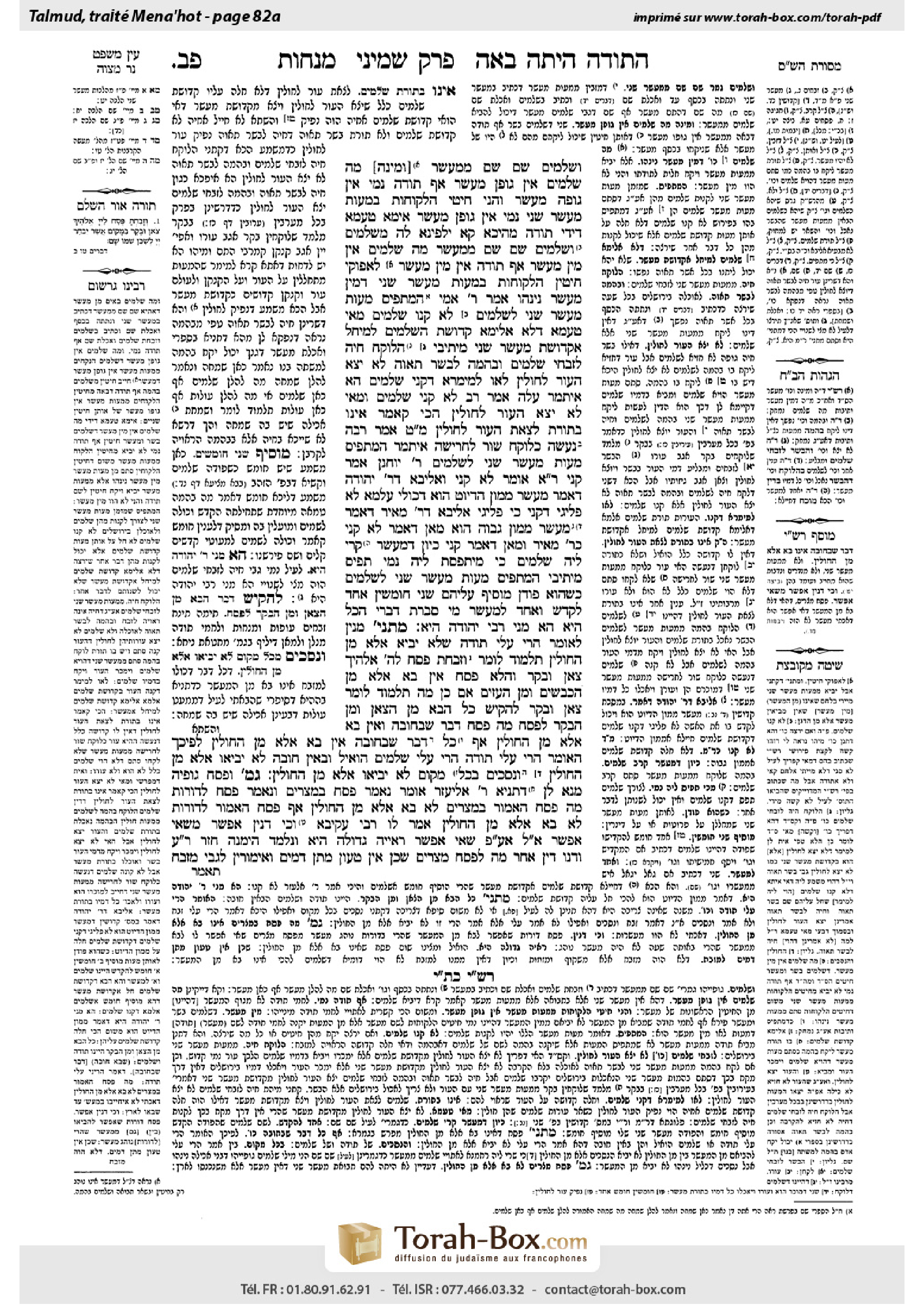
Menachot 82a: Talmud study for Daf Yomi
Daf Yomi is the daily study of one Talmud folio. Explore 37 tractates with scans, Hebrew text, Sefaria English and AI-generated French translations where annotated.
Passage selection and English or AI-generated French translation are available where the scan has annotations. Daf Study is independent of Torah-Box and Sefaria.
Browse Menachot · מנחות · All tractatesMenachot 82a text and translations
This page of Menachot includes the Aramaic text, an English translation and an AI-generated French translation, alongside the scan above.
מנחות פ״ב א · Aramaic and Hebrew text
וּשְׁלָמִים ״שָׁם״ ״שָׁם״ מִמַּעֲשֵׂר. וּמִינַּהּ: מָה שְׁלָמִים אֵין גּוּפָן מַעֲשֵׂר – אַף תּוֹדָה נָמֵי אֵין גּוּפָהּ מַעֲשֵׂר, וְהָנֵי חִיטֵּי הַלְּקוּחוֹת בִּמְעוֹת מַעֲשֵׂר שֵׁנִי נָמֵי אֵין גּוּפָן מַעֲשֵׂר.
אֵימָא טַעְמָא דִידִי: תּוֹדָה מֵהֵיכָא קָא יָלֵיפְנָא לַהּ? מִשְּׁלָמִים, וּשְׁלָמִים – ״שָׁם״ ״שָׁם״ מִמַּעֲשֵׂר. מָה שְׁלָמִים אֵין מִין מַעֲשֵׂר, אַף תּוֹדָה אֵין מִין מַעֲשֵׂר, לְאַפּוֹקֵי חִיטִּין הַלְּקוּחוֹת בִּמְעוֹת מַעֲשֵׂר שֵׁנִי, דְּמִין מַעֲשֵׂר נִינְהוּ.
אָמַר רַבִּי אַמֵּי: הַמַּתְפִּיס מְעוֹת מַעֲשֵׂר שֵׁנִי לִשְׁלָמִים – לֹא קָנוּ שְׁלָמִים. מַאי טַעְמָא? דְּלָא אַלִּימָא קְדוּשָּׁה דִּשְׁלָמִים לְמֵיחַל אַקְּדוּשַּׁת מַעֲשֵׂר שֵׁנִי.
מֵיתִיבִי: הַלּוֹקֵחַ חַיָּה לְזִבְחֵי שְׁלָמִים, וּבְהֵמָה לִבְשַׂר תַּאֲוָה – לֹא יָצָא הָעוֹר לְחוּלִּין. לָאו לְמֵימְרָא דְּקָנֵי שְׁלָמִים?
הָא אִיתְּמַר עֲלַהּ, אָמַר רַב: לָא קָנֵי שְׁלָמִים, וּמַאי ״לֹא יָצָא הָעוֹר לְחוּלִּין״? הָכִי קָאָמַר: אֵינוֹ בְּתוֹרַת לָצֵאת הָעוֹר לְחוּלִּין, מַאי טַעְמָא? אָמַר רַבָּה: נַעֲשָׂה כְּלוֹקֵחַ שׁוֹר לַחֲרִישָׁה.
אִיתְּמַר, הַמַּתְפִּיס מְעוֹת מַעֲשֵׂר שֵׁנִי לִשְׁלָמִים: רַבִּי יוֹחָנָן אָמַר: קָנֵי, רַבִּי אֶלְעָזָר אוֹמֵר: לָא קָנֵי.
וְאַלִּיבָּא דְּרַבִּי יְהוּדָה, דְּאָמַר: מַעֲשֵׂר מָמוֹן הֶדְיוֹט הוּא – דְּכוּלֵּי עָלְמָא לָא פְּלִיגִי דְּקָנֵי. כִּי פְּלִיגִי אַלִּיבָּא דְּרַבִּי מֵאִיר, דְּאָמַר: מַעֲשֵׂר מָמוֹן גָּבוֹהַּ הוּא. מַאן דְּאָמַר לָא קָנֵי – כְּרַבִּי מֵאִיר, וּמַאן דְּאָמַר קָנֵי – כֵּיוָן דְּמַעֲשֵׂר (קרי) [קָרֵיב] לֵיהּ שְׁלָמִים, כִּי מַיתְפְּסַתְּ לֵיהּ נָמֵי תָּפֵיס.
מֵיתִיבִי: הַמַּתְפִּיס מְעוֹת מַעֲשֵׂר שֵׁנִי לִשְׁלָמִים, כְּשֶׁהוּא פּוֹדָן – מוֹסִיף עֲלֵיהֶם שְׁנֵי חוּמְשִׁין, אֶחָד לְהֶקְדֵּשׁ וְאֶחָד לְמַעֲשֵׂר.
מִי סָבְרַתְּ דִּבְרֵי הַכֹּל הִיא? הָא מַנִּי? רַבִּי יְהוּדָה הִיא.
מַתְנִי׳ מִנַּיִן לָאוֹמֵר ״הֲרֵי עָלַי תּוֹדָה״, שֶׁלֹּא יָבִיא אֶלָּא מִן הַחוּלִּין? תַּלְמוּד לוֹמַר ״וְזָבַחְתָּ פֶּסַח לַה׳ אֱלֹהֶיךָ צֹאן וּבָקָר״. וַהֲלֹא פֶּסַח אֵין בָּא אֶלָּא מִן הַכְּבָשִׂים וּמִן הָעִזִּים, אִם כֵּן מָה תַּלְמוּד לוֹמַר ״צֹאן וּבָקָר״? לְהַקִּישׁ כׇּל הַבָּא מִן הַצֹּאן וּמִן הַבָּקָר לְפֶסַח: מָה פֶּסַח דָּבָר שֶׁבְּחוֹבָה וְאֵין בָּא אֶלָּא מִן הַחוּלִּין, אַף כׇּל דָּבָר שֶׁבְּחוֹבָה אֵין בָּא אֶלָּא מִן הַחוּלִּין.
לְפִיכָךְ, הָאוֹמֵר ״הֲרֵי עָלַי תּוֹדָה״, ״הֲרֵי עָלַי שְׁלָמִים״, הוֹאִיל וּבָאִין חוֹבָה – לֹא יָבֹאוּ אֶלָּא מִן הַחוּלִּין, וּנְסָכִים בְּכׇל מָקוֹם – לֹא יָבֹאוּ אֶלָּא מִן הַחוּלִּין.
גְּמָ׳ וּפֶסַח גּוּפֵיהּ מְנָא לַן? דְּתַנְיָא: רַבִּי אֱלִיעֶזֶר אוֹמֵר: נֶאֱמַר פֶּסַח בְּמִצְרַיִם, וְנֶאֱמַר פֶּסַח לְדוֹרוֹת, מָה פֶּסַח הָאָמוּר בְּמִצְרַיִם לֹא בָּא אֶלָּא מִן הַחוּלִּין, אַף פֶּסַח הָאָמוּר לְדוֹרוֹת לֹא בָּא אֶלָּא מִן הַחוּלִּין.
אָמַר לוֹ רַבִּי עֲקִיבָא: וְכִי דָּנִין אֶפְשָׁר מִשֶּׁאִי אֶפְשָׁר? אָמַר לוֹ: אַף עַל פִּי שֶׁאִי אֶפְשָׁר, רְאָיָיה גְּדוֹלָה הִיא, וְנִלְמַד הֵימֶנָּה.
חָזַר רַבִּי עֲקִיבָא וְדָנוֹ דִּין אַחֵר: מָה לְפֶסַח מִצְרַיִם, שֶׁכֵּן אֵין טָעוּן מַתַּן דָּמִים וְאֵימוּרִין לְגַבֵּי מִזְבֵּחַ,
Menachot 82a · English translation
And the halakha that a peace offering may be brought from second-tithe money is derived by a verbal analogy between “there” and “there” from the verse discussing second tithe. The verse states with regard to a peace offering: “And you shall sacrifice peace offerings and you shall eat there” (Deuteronomy 27:7), and the verse states with regard to second tithe: “And you shall eat before the Lord your God, in the place that He shall choose to cause His name to dwell there” (Deuteronomy 14:23). And from this it may be concluded: Just as peace offerings are not themselves brought from second tithe, as they are not produce, so too with regard to the loaves of a thanks offering, they are not themselves brought from second tithe. And that wheat which is purchased with second-tithe money is also not itself second tithe; it may therefore be used for the loaves of the thanks offering.
Now I will say my reasoning for why one may not prepare the loaves of a thanks offering with wheat that was purchased with second-tithe money: From where do I derive the halakha that a thanks offering may be brought from second-tithe money? I derive it from the halakhot of a peace offering. And the halakha that a peace offering may be brought from second-tithe money is derived by a verbal analogy between “there” and “there” from second tithe. Therefore, just as a peace offering is not of the same species as second tithe, so too the loaves of a thanks offering may not be of the same species as second tithe. This serves to exclude wheat purchased with second-tithe money, which is of the same species as second tithe.
§ Rabbi Ami says: In a case involving one who designates second-tithe money for a peace offering, the money does not assume the status of a peace offering. What is the reason? The reason is that the sanctity of the peace offering is not strong enough to take effect upon items that have the sanctity of second tithe.
The Gemara raises an objection from a mishna (Ma’aser Sheni 1:4): Ideally, one should use second-tithe money to purchase peace offerings. If one purchases a peace offering with second-tithe money, only the flesh of the animal is consecrated, while its hide is non-sacred. The mishna teaches: With regard to one who uses second-tithe money in an improper manner and purchases an undomesticated animal for a peace offering, a purpose for which an undomesticated animal cannot be used, or purchases a domesticated animal for meat of desire, i.e., ordinary meat, the Sages penalized him and decreed that the hide does not become non-sacred. The Gemara asks: Is that not to say that the hide of the animal purchased with the second-tithe money assumes the status of a peace offering, and it must be sold and the money used to purchase a peace offering, in contradiction to the statement of Rabbi Ami?
The Gemara rejects this: Wasn’t it stated concerning that mishna that Rav said: The hide of the animal purchased with the second-tithe money does not assume the status of a peace offering; and what is the meaning of the mishna that the hide does not become non-sacred? This is what the mishna is saying: The hide, as part of an undomesticated animal, is not in the category of a peace offering at all so that its hide would become non-sacred. What is the reason? Rabba says: Since he used the second-tithe money in an improper manner, it is considered as if he purchased an ox for plowing, to which no sanctity of second tithe applies.
§ It was stated that there is an amoraic dispute with regard to one who designates second-tithe money for a peace offering. Rabbi Yoḥanan says: The money assumes the status of a peace offering, and Rabbi Elazar says: The money does not assume the status of a peace offering.
The Gemara elaborates: And according to the opinion of Rabbi Yehuda, who said: Second tithe is non-sacred property, everyone agrees that the money assumes the status of a peace offering. When they disagree, it is according to the opinion of Rabbi Meir, who said: Second tithe is property belonging to the Most High. The one who says that the money does not assume the status of a peace offering holds in accordance with the opinion of Rabbi Meir, and one may not designate property of the Most High for another purpose. And the one who says that the money assumes the status of a peace offering holds that since second tithe is called a peace offering, as an animal purchased with second-tithe money without specification is brought as a peace offering, when he designates the money for a peace offering, it as well is designated with the sanctity of a peace offering.
The Gemara raises an objection to the statement of Rabbi Elazar from a baraita: In a case involving one who designates second-tithe money for a peace offering, the sanctity of a peace offering is applied to this money in addition to the sanctity of second tithe. Therefore, when he redeems this money, he adds to it two-fifths: One-fifth for the redemption of the sacrificial sanctity of a peace offering and one-fifth for the redemption of second tithe. Evidently, the sanctity of a peace offering does take effect on second-tithe money.
The Gemara responds: Do you maintain that this baraita is agreed upon by everyone? In accordance with whose opinion is this? It is in accordance with the opinion of Rabbi Yehuda, who holds that second-tithe money is non-sacred property. Accordingly, the sanctity of a peace offering takes effect on the money. Rabbi Elazar holds in accordance with the opinion of Rabbi Meir.
MISHNA: From where is it derived with regard to one who says: It is incumbent upon me to bring a thanks offering, that he may bring it only from non-sacred money? It is derived from a verse, as the verse states: “And you shall sacrifice the Paschal offering to the Lord your God, of the flock and the herd” (Deuteronomy 16:2). The verse is difficult: Doesn’t the Paschal offering come only from lambs and goats? If so, why does the verse state: “The flock and the herd”? It is to juxtapose all offerings that come from the flock and from the herd to the Paschal offering, teaching that just as the Paschal offering is a matter of obligation and comes only from non-sacred money, so too any matter of obligation comes only from non-sacred money.
Therefore, in the case of one who says: It is incumbent upon me to bring a thanks offering, or: It is incumbent upon me to bring a peace offering, since these offerings come as an obligation due to his vow, they may be brought only from non-sacred money. And libations, in any case, may be brought only from non-sacred money, and not from second-tithe money, because second-tithe money must be used to purchase items eaten by people, while libations are poured out next to the altar.
GEMARA: The mishna teaches that the halakha that any matter of obligation must be brought from non-sacred property is derived from the halakha of the Paschal offering. The Gemara asks: And concerning the Paschal offering itself, from where do we derive that it is brought only from non-sacred property? As it is taught in a baraita: Rabbi Eliezer says: “Paschal offering” is stated in the Torah with regard to the offering sacrificed in Egypt (see Exodus 12:3), and “Paschal offering” is stated with regard to the yearly obligation throughout the generations (see Exodus 12:25). Therefore, just as the Paschal offering stated with regard to Egypt was brought only from non-sacred property, as there was no second tithe in Egypt, so too the Paschal offering stated with regard to the obligation throughout the generations may be brought only from non-sacred property.
Rabbi Akiva said to him: But does one derive the possible from the impossible? Does one derive the halakha with regard to the Paschal offering of the generations, when there exists the possibility of using second-tithe money, from the halakha with regard to the Paschal offering sacrificed in Egypt, when there was no second tithe? Rabbi Eliezer said to him: Even though it was impossible to bring the Paschal offering in Egypt from consecrated money, it is a great proof, and we shall derive this halakha from it.
Rabbi Akiva then presented a different logical derivation to reject the proof of Rabbi Eliezer: One cannot derive the halakha with regard to the Paschal offering of the generations from that of the Paschal offering in Egypt, as what is notable about the Paschal offering sacrificed in Egypt? It is notable in that it did not require the placement of blood on the altar nor that the sacrificial portions be consumed by the altar.
Menachot 82a · Traduction française (IA)
La halakha selon laquelle un sacrifice de paix peut être acheté avec l’argent de la seconde dîme se déduit d’une analogie verbale entre « là » et « là », à partir du verset relatif à la seconde dîme. Au sujet du sacrifice de paix, le verset dit : « Tu sacrifieras des sacrifices de paix et tu mangeras là » (Deutéronome 27,7), et au sujet de la seconde dîme, il dit : « Tu mangeras devant le Seigneur ton Dieu, dans le lieu qu’Il choisira pour y faire résider Son nom » (Deutéronome 14,23). On peut en conclure que, de même que les sacrifices de paix ne sont pas eux-mêmes achetés avec l’argent de la seconde dîme, puisqu’ils ne sont pas des produits agricoles, les pains de l’offrande de remerciement ne sont pas non plus eux-mêmes achetés avec l’argent de la seconde dîme. Le blé acheté avec l’argent de la seconde dîme n’est pas non plus lui-même de la seconde dîme ; il peut donc servir à préparer les pains de l’offrande de remerciement.
J’exposerai maintenant mon raisonnement pour expliquer pourquoi on ne peut pas préparer les pains de l’offrande de remerciement avec du blé acheté avec l’argent de la seconde dîme. D’où déduis-je la halakha selon laquelle une offrande de remerciement peut être achetée avec l’argent de la seconde dîme ? Je la déduis des halakhot du sacrifice de paix. Or, la halakha selon laquelle un sacrifice de paix peut être acheté avec l’argent de la seconde dîme se déduit d’une analogie verbale entre « là » et « là », à partir de la seconde dîme. Par conséquent, de même qu’un sacrifice de paix n’est pas de la même espèce que la seconde dîme, les pains de l’offrande de remerciement ne peuvent pas non plus être de la même espèce que la seconde dîme. Cela exclut le blé acheté avec l’argent de la seconde dîme, qui est de la même espèce que la seconde dîme.
§ Rabbi Ami dit : Lorsqu’une personne désigne l’argent de la seconde dîme pour un sacrifice de paix, cet argent ne prend pas le statut de sacrifice de paix. Pourquoi ? Parce que la sainteté du sacrifice de paix n’est pas assez forte pour s’appliquer à des biens qui ont le statut de sainteté de la seconde dîme.
La Guemara soulève une objection à partir d’une Michna (Ma’aser Sheni 1,4) : en principe, on doit utiliser l’argent de la seconde dîme pour acheter des sacrifices de paix. Si l’on achète un sacrifice de paix avec cet argent, seule la chair de l’animal est consacrée, tandis que sa peau reste profane. La Michna enseigne qu’une personne qui fait un usage impropre de l’argent de la seconde dîme en achetant un animal sauvage pour un sacrifice de paix, alors qu’un animal sauvage ne peut pas être utilisé à cette fin, ou en achetant un animal domestique pour en consommer la viande à titre ordinaire, est pénalisée par les Sages, qui décrètent que la peau ne devient pas profane. La Guemara demande : cela ne signifie-t-il pas que la peau de l’animal acheté avec l’argent de la seconde dîme prend le statut de sacrifice de paix, et qu’il faut donc la vendre puis utiliser l’argent pour acheter un sacrifice de paix, en contradiction avec l’avis de Rabbi Ami ?
La Guemara rejette cette objection : n’a-t-il pas été rapporté au sujet de cette Michna que Rav a dit que la peau de l’animal acheté avec l’argent de la seconde dîme ne prend pas le statut de sacrifice de paix ? Que signifie donc, dans la Michna, que la peau ne devient pas profane ? Voici le sens de la Michna : la peau d’un animal sauvage n’entre absolument pas dans la catégorie des sacrifices de paix, de sorte que sa peau pourrait devenir profane. Pourquoi ? Rabba dit : puisqu’il a fait un usage impropre de l’argent de la seconde dîme, c’est comme s’il avait acheté un bœuf pour labourer, auquel ne s’applique aucune sainteté de la seconde dîme.
§ Il a été rapporté qu’il existe une controverse entre les amoraïm au sujet de celui qui désigne l’argent de la seconde dîme pour un sacrifice de paix. Rabbi Yoḥanan dit que l’argent prend le statut de sacrifice de paix, tandis que Rabbi Elazar dit qu’il ne prend pas ce statut.
La Guemara précise : selon l’opinion de Rabbi Yehuda, qui dit que la seconde dîme est un bien profane, tous conviennent que l’argent prend le statut de sacrifice de paix. Leur désaccord concerne l’opinion de Rabbi Meir, qui dit que la seconde dîme est un bien appartenant au Très-Haut. Celui qui dit que l’argent ne prend pas le statut de sacrifice de paix suit l’opinion de Rabbi Meir : on ne peut pas affecter un bien appartenant au Très-Haut à une autre fin. Celui qui dit que l’argent prend le statut de sacrifice de paix considère que, puisque la seconde dîme est appelée sacrifice de paix — car un animal acheté sans précision avec l’argent de la seconde dîme est apporté comme sacrifice de paix —, lorsqu’on désigne cet argent pour un sacrifice de paix, il est lui aussi affecté à la sainteté d’un sacrifice de paix.
La Guemara soulève une objection à l’avis de Rabbi Elazar à partir d’une baraïta : lorsqu’une personne désigne l’argent de la seconde dîme pour un sacrifice de paix, la sainteté du sacrifice de paix s’ajoute à celle de la seconde dîme qui s’applique à cet argent. Par conséquent, lorsqu’elle rachète cet argent, elle y ajoute deux cinquièmes : un cinquième pour le rachat de la sainteté du sacrifice de paix et un cinquième pour le rachat de la seconde dîme. Il apparaît donc que la sainteté du sacrifice de paix s’applique bien à l’argent de la seconde dîme.
La Guemara répond : crois-tu que cette baraïta fasse l’unanimité ? De quelle opinion relève-t-elle ? De celle de Rabbi Yehuda, qui tient l’argent de la seconde dîme pour un bien profane. La sainteté du sacrifice de paix s’applique donc à cet argent. Rabbi Elazar, lui, suit l’opinion de Rabbi Meir.
MICHNA : D’où déduit-on qu’une personne qui dit : « Je suis tenu d’apporter une offrande de remerciement » ne peut l’apporter qu’avec des fonds profanes ? On le déduit d’un verset, qui dit : « Tu sacrifieras l’offrande pascale au Seigneur ton Dieu, du menu et du gros bétail » (Deutéronome 16,2). Ce verset pose problème : l’offrande pascale ne provient-elle pas uniquement d’agneaux et de chèvres ? Pourquoi le verset dit-il alors : « du menu et du gros bétail » ? C’est pour rapprocher de l’offrande pascale toutes les offrandes provenant du menu et du gros bétail, et enseigner que, de même que l’offrande pascale est une obligation et ne peut être achetée qu’avec des fonds profanes, toute obligation ne peut elle aussi être accomplie qu’avec des fonds profanes.
Par conséquent, celui qui dit : « Je suis tenu d’apporter une offrande de remerciement » ou « Je suis tenu d’apporter un sacrifice de paix » ne peut apporter ces offrandes qu’avec des fonds profanes, puisqu’elles sont dues à son vœu. Les libations, en tout état de cause, ne peuvent être apportées qu’avec des fonds profanes, et non avec l’argent de la seconde dîme, car celui-ci doit servir à acheter des denrées consommées par les personnes, tandis que les libations sont versées à côté de l’autel.
GUEMARA : La Michna enseigne que la halakha selon laquelle toute obligation doit être accomplie avec des biens profanes se déduit de la halakha de l’offrande pascale. La Guemara demande : et concernant l’offrande pascale elle-même, d’où déduit-on qu’elle ne peut être apportée qu’avec des biens profanes ? Une baraïta enseigne que Rabbi Eliezer dit : l’expression « offrande pascale » figure dans la Torah à propos de l’offrande sacrifiée en Égypte (voir Exode 12,3), et l’expression « offrande pascale » figure aussi à propos de l’obligation annuelle pour les générations (voir Exode 12,25). Par conséquent, de même que l’offrande pascale mentionnée à propos de l’Égypte ne pouvait être achetée qu’avec des biens profanes, puisqu’il n’y avait pas de seconde dîme en Égypte, l’offrande pascale mentionnée à propos de l’obligation pour les générations ne peut elle aussi être achetée qu’avec des biens profanes.
Rabbi Akiva lui dit : mais peut-on déduire le possible de l’impossible ? Peut-on déduire la halakha relative à l’offrande pascale des générations, alors qu’il est possible d’utiliser l’argent de la seconde dîme, de celle de l’offrande pascale sacrifiée en Égypte, où il n’y avait pas de seconde dîme ? Rabbi Eliezer lui répondit : même s’il était impossible d’apporter l’offrande pascale en Égypte avec de l’argent consacré, cela constitue une preuve de poids, et nous en déduirons cette halakha.
Rabbi Akiva présenta ensuite un autre raisonnement pour réfuter la preuve de Rabbi Eliezer : on ne peut pas déduire la halakha relative à l’offrande pascale des générations de celle de l’offrande pascale en Égypte. Qu’est-ce qui caractérise l’offrande pascale sacrifiée en Égypte ? Le fait qu’il n’était nécessaire ni d’asperger le sang sur l’autel ni de faire consumer les parties sacrificielles par l’autel.
Traduction française générée par IA à partir de l’édition anglaise de Sefaria. Vérifie toujours un passage avec le texte source.
Text from Sefaria: William Davidson Edition - Vocalized Aramaic (unknown); William Davidson Edition - English (CC BY NC).