Menachot 82b: Talmud study for Daf Yomi
Daf Yomi is the daily study of one Talmud folio. Explore 37 tractates with scans, Hebrew text, Sefaria English and AI-generated French translations where annotated.
Passage selection and English or AI-generated French translation are available where the scan has annotations. Daf Study is independent of Torah-Box and Sefaria.
Browse Menachot · מנחות · All tractatesMenachot 82b text and translations
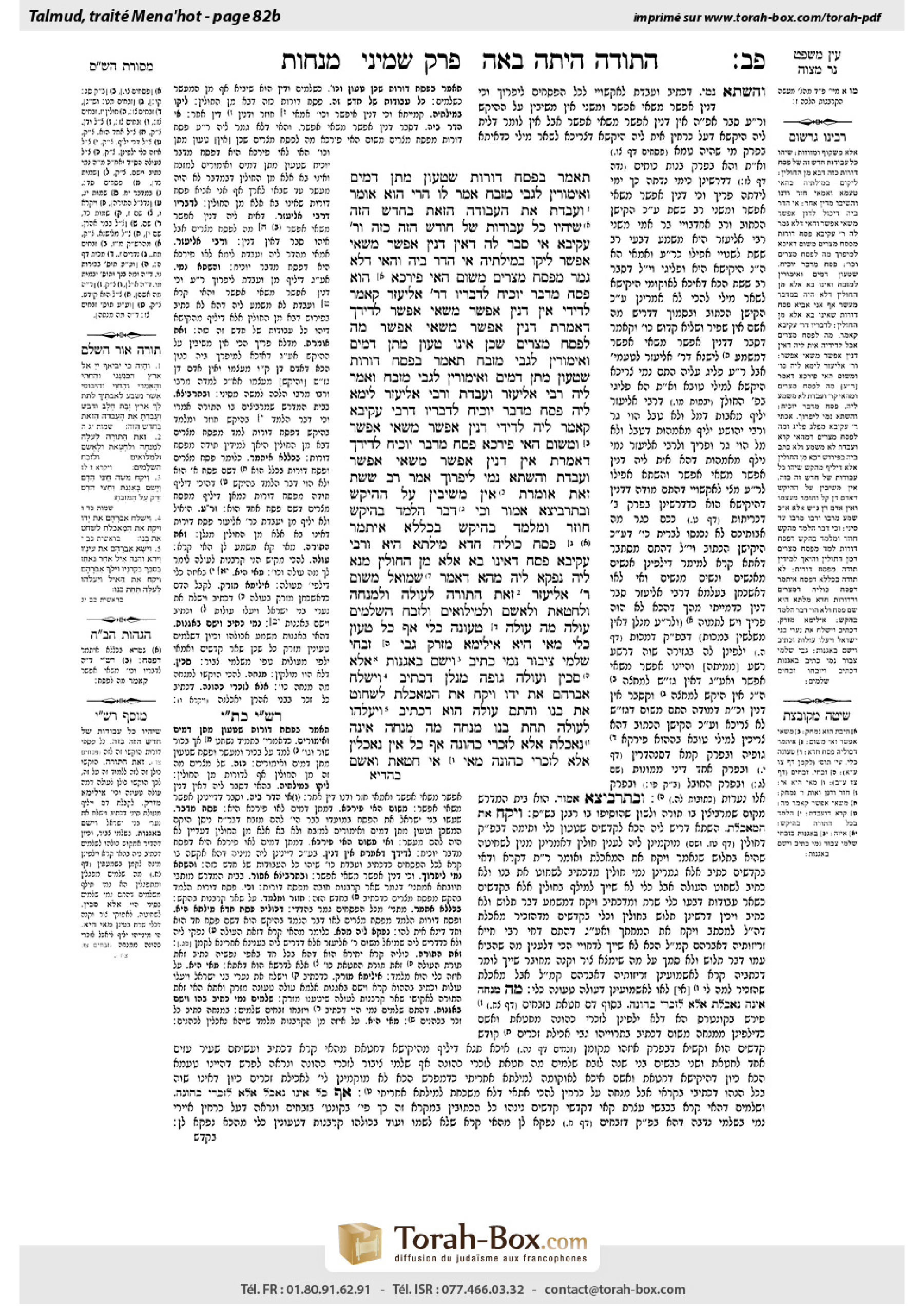
This page of Menachot includes the Aramaic text, an English translation and an AI-generated French translation, alongside the scan above.
מנחות פ״ב ב · Aramaic and Hebrew text
תֹּאמַר בְּפֶסַח דּוֹרוֹת שֶׁטָּעוּן מַתַּן דָּמִים וְאֵימוּרִין לְגַבֵּי מִזְבֵּחַ?
אָמַר לוֹ: הֲרֵי הוּא אוֹמֵר: ״וְעָבַדְתָּ אֶת הָעֲבֹדָה הַזֹּאת בַּחֹדֶשׁ הַזֶּה״, שֶׁיִּהְיוּ כׇּל עֲבוֹדוֹת שֶׁל חוֹדֶשׁ הַזֶּה כָּזֶה.
וְרַבִּי עֲקִיבָא, אִי סָבַר לַהּ דְּאֵין דָּנִין אֶפְשָׁר מִשֶּׁאִי אֶפְשָׁר – לֵיקוּ בְּמִילְּתֵיהּ!
אִי הֲדַר בֵּיהּ, וְהַאי דְּלָא גָּמַר מִפֶּסַח מִצְרַיִם מִשּׁוּם הַאי פִּירְכָא הוּא, פֶּסַח מִדְבָּר יוֹכִיחַ!
לִדְבָרָיו דְּרַבִּי אֱלִיעֶזֶר קָאָמַר: לְדִידִי אֵין דָּנִין אֶפְשָׁר מִשֶּׁאִי אֶפְשָׁר, לְדִידָךְ דְּאָמְרַתְּ דָּנִין אֶפְשָׁר מִשֶּׁאִי אֶפְשָׁר – מָה לְפֶסַח מִצְרַיִם שֶׁכֵּן אֵינוֹ טָעוּן מַתַּן דָּמִים וְאֵימוּרִין לְגַבֵּי מִזְבֵּחַ, תֹּאמַר בְּפֶסַח דּוֹרוֹת שֶׁטָּעוּן מַתַּן דָּמִים וְאֵימוּרִין לְגַבֵּי מִזְבֵּחַ?
וַאֲמַר לֵיהּ רַבִּי אֱלִיעֶזֶר: ״וְעָבַדְתָּ״.
וְרַבִּי אֱלִיעֶזֶר, לֵימָא לֵיהּ: פֶּסַח מִדְבָּר יוֹכִיחַ!
לִדְבָרָיו דְּרַבִּי עֲקִיבָא קָאָמַר לֵיהּ, לְדִידִי דָּנִין אֶפְשָׁר מִשֶּׁאִי אֶפְשָׁר, וּמִשּׁוּם הַאי פִּירְכָא – פֶּסַח מִדְבָּר יוֹכִיחַ, לְדִידָךְ דְּאָמְרַתְּ אֵין דָּנִין אֶפְשָׁר מִשֶּׁאִי אֶפְשָׁר – ״וְעָבַדְתָּ״.
וְהַשְׁתָּא נָמֵי לִיפְרוֹךְ? אָמַר רַב שֵׁשֶׁת: זֹאת אוֹמֶרֶת, אֵין מְשִׁיבִין עַל הַהֶיקֵּשׁ.
וּבְתַרְבִּיצָא אֲמוּר: וְכִי דָּבָר הַלָּמֵד בְּהֶיקֵּשׁ חוֹזֵר וּמְלַמֵּד בְּהֶיקֵּשׁ? בִּכְלָלָא אִיתְּמַר, פֶּסַח כּוּלֵּיהּ חֲדָא מִילְּתָא הִיא.
וְרַבִּי עֲקִיבָא, פֶּסַח דְּאֵינוֹ בָּא אֶלָּא מִן הַחוּלִּין מְנָא לֵיהּ? נָפְקָא לֵיהּ מֵהָא דְּאָמַר שְׁמוּאֵל מִשּׁוּם רַבִּי אֱלִיעֶזֶר: ״זֹאת הַתּוֹרָה לָעֹלָה וְלַמִּנְחָה וְלַחַטָּאת וְלָאָשָׁם וְלַמִּלּוּאִים וּלְזֶבַח הַשְּׁלָמִים״.
״עוֹלָה״ – מָה עוֹלָה טְעוּנָה כְּלִי, אַף כֹּל טָעוּן כְּלִי. מַאי הִיא? אִילֵימָא מִזְרָק, גַּבֵּי זִבְחֵי שַׁלְמֵי צִיבּוּר נָמֵי כְּתִיב ״וַיָּשֶׂם בָּאַגָּנֹת״.
אֶלָּא סַכִּין, וְעוֹלָה גּוּפַהּ מְנָלַן? דִּכְתִיב: ״וַיִּשְׁלַח אַבְרָהָם אֶת יָדוֹ וַיִּקַּח אֶת הַמַּאֲכֶלֶת לִשְׁחֹט אֶת בְּנוֹ״, וְהָתָם עוֹלָה הוּא, דִּכְתִיב: ״וַיַּעֲלֵהוּ לְעֹלָה תַּחַת בְּנוֹ״.
״מִנְחָה״ – מָה מִנְחָה אֵינָהּ נֶאֱכֶלֶת אֶלָּא לְזִכְרֵי כְהוּנָּה, אַף כֹּל אֵין נֶאֱכָלִין אֶלָּא לְזִכְרֵי כְהוּנָּה. מַאי? אִי חַטָּאת וְאָשָׁם –
Menachot 82b · English translation
Can you say the same with regard to the Paschal offering of the generations, which requires the placement of blood on the altar and that the sacrificial portions be consumed by the altar?
Rabbi Eliezer said to him: The Paschal offerings should be compared, as the verse states with regard to the Paschal offering of the generations: “And it shall be when the Lord shall bring you into the land of the Canaanite, and the Hittite, and the Amorite, and the Hivite, and the Jebusite, which He swore to your fathers to give you, a land flowing with milk and honey, that you shall perform this service in this month” (Exodus 13:5). This indicates that all the services of this month for the generations shall be like this, the Paschal offering of Egypt.
The Gemara discusses the opinion of Rabbi Akiva: Initially, Rabbi Akiva rejects the statement of Rabbi Eliezer based on the claim that one cannot derive the possible from the impossible. He then rejects the statement of Rabbi Eliezer on a technicality, namely that the two Paschal offerings have different sacrificial requirements. The Gemara therefore challenges: And as for Rabbi Akiva, if he holds that one does not derive the possible from the impossible, then let him stand by his statement.
And if he retracted and conceded that one derives the possible from the impossible, and the fact that he did not derive the halakha with regard to the Paschal offering of the generations from the halakha of the Paschal offering in Egypt is due to that refutation that he proposed, i.e., that the Paschal offerings are different, then the Paschal offering that was sacrificed in the second year in the wilderness will prove that this refutation is incorrect. That offering did require placement of the blood and sacrificial portions on the altar, yet it was brought only from non-sacred money, as there were no tithes in the wilderness.
The Gemara explains: Rabbi Akiva stated this objection in accordance with the statement of Rabbi Eliezer. He meant as follows: According to my opinion, one does not derive the possible from the impossible, and this is a sufficient reason why one cannot derive the halakha with regard to the Paschal offering of the generations from the halakha of the Paschal offering in Egypt. And even according to your opinion, in which you said that one derives the possible from the impossible, this comparison can be refuted: What is notable about the Paschal offering sacrificed in Egypt? It is notable in that it did not require the placement of blood on the altar nor that the sacrificial portions be consumed by the altar. Can you say the same with regard to the Paschal offering of the generations, which requires the placement of blood on the altar and that the sacrificial portions be consumed by the altar?
And in response to this, Rabbi Eliezer said to him that the halakha with regard to the Paschal offering of the generations should be derived from the halakha of the Paschal offering in Egypt, since the verse states with regard to the Paschal offering of the generations: “That you shall keep this service in this month.”
The Gemara asks: But why must Rabbi Eliezer cite this verse? Let him say to Rabbi Akiva: The Paschal offering brought in the wilderness will prove that this refutation is incorrect, since it did require placement of the blood and consumption of sacrificial portions on the altar, yet it was brought only from non-sacred money.
The Gemara responds: Rabbi Eliezer stated his opinion in accordance with the statement of Rabbi Akiva. He meant as follows: In my opinion, one derives the possible from the impossible. And as for that refutation that you raised, that the Paschal offering in Egypt and the Paschal offering of the generations have different sacrificial requirements, the Paschal offering of the wilderness will prove that this is not a valid refutation. According to your opinion, in which you said that one does not derive the possible from the impossible, the verse states: “That you shall keep this service in this month,” indicating that the Paschal offering of the generations is compared to the Paschal offering in Egypt.
The Gemara challenges: But even now, let Rabbi Akiva refute this comparison by the same claim that one cannot derive the possible from the impossible. Rav Sheshet says: That is to say that one cannot refute a juxtaposition, i.e., one cannot refute such a derivation based on reasoning.
And in the study hall [uvetarbitza] they discussed the statement of the mishna that the halakha that all obligatory offerings must be brought from non-sacred property is derived from the Paschal offering of the generations, and they said: But can a matter derived via juxtaposition, i.e., the Paschal offering of the generations, whose halakha is derived by juxtaposition from the Paschal offering in Egypt, again teach a matter via another juxtaposition? The Gemara responds: This is not considered an instance of a matter derived by juxtaposition teaching a matter derived by another juxtaposition. Rather, the statement of the mishna that all offerings are juxtaposed to the Paschal offering was stated in a general manner, since the entire Paschal offering is one matter. The Paschal offering in Egypt and the Paschal offering of the generations are both referred to as a Paschal offering.
The Gemara asks: And as for Rabbi Akiva, who rejects the proofs of Rabbi Eliezer, from where does he derive that the Paschal offering comes only from non-sacred money? The Gemara responds: Rabbi Akiva derives it from that which Shmuel said in the name of Rabbi Eliezer: It is stated: “This is the law of the burnt offering, of the meal offering, and of the sin offering, and of the guilt offering, and of the inauguration offering, and of the sacrifice of peace offerings” (Leviticus 7:37). This verse connects all of the specified offerings, such that individual aspects of each offering are applicable to all of the offerings.
The Gemara details these aspects. The verse states: “Of the burnt offering,” to teach that all of the offerings are like a burnt offering in that just as a burnt offering requires a utensil in its preparation, so too do all animal offerings require a utensil. What is the utensil? If we say it is a bowl, a utensil used for collecting the blood, as is learned from the burnt offerings that were sacrificed at Mount Sinai, that cannot be correct, as a utensil for collecting blood does not need to be learned from a burnt offering. With regard to communal peace offerings it is also written: “And they offered burnt offerings, and they sacrificed peace offerings…And Moses took half of the blood and put it in basins” (Exodus 24:5–6).
Rather, the term utensil must be referring to a knife, as the slaughter may be performed only with a knife and not with a sharp stone or reed. The Gemara asks: And with regard to a burnt offering itself, from where do we derive that it must be slaughtered with a knife? This is learned from that which is written: “And Abraham stretched forth his hand, and took the knife to slaughter his son” (Genesis 22:10); and there, Abraham was sacrificing a burnt offering, as it is written: “And offered it up for a burnt offering instead of his son” (Genesis 22:13).
The Gemara continues to expound the aforementioned verse (Leviticus 7:37). When the verse mentions a meal offering, it teaches that just as a meal offering is eaten only by males of the priesthood (see Leviticus 6:9–11), so too are all of the offerings mentioned in this verse eaten only by males of the priesthood. The Gemara asks: With regard to what offering is it that this halakha must be derived? If one suggests that it is with regard to the sin offering and the guilt offering,
Menachot 82b · Traduction française (IA)
Peut-on en dire autant du sacrifice pascal des générations, qui exige que le sang soit appliqué sur l’autel et que les parts sacrificielles soient consumées sur l’autel ?
Rabbi Eliezer lui dit : Il faut comparer les sacrifices pascals, comme l’indique le verset au sujet du sacrifice pascal des générations : « Et il arrivera, lorsque le Seigneur t’aura fait entrer dans le pays du Cananéen, du Hittite, de l’Amoréen, du Hivite et du Jébuséen, qu’il a juré à tes pères de te donner, un pays où coulent le lait et le miel, que tu accompliras ce service en ce mois » (Exode 13:5). Cela indique que, pour les générations, tous les services de ce mois seront conformes à ceux de celui-ci, le sacrifice pascal d’Égypte.
La Guemara examine l’opinion de Rabbi Akiva : tout d’abord, Rabbi Akiva rejette l’argument de Rabbi Eliezer au motif qu’on ne peut pas déduire le possible de l’impossible. Il rejette ensuite l’argument de Rabbi Eliezer pour une raison technique, à savoir que les deux sacrifices pascals sont soumis à des exigences sacrificielles différentes. La Guemara objecte donc : quant à Rabbi Akiva, s’il estime qu’on ne déduit pas le possible de l’impossible, qu’il s’en tienne alors à sa position.
Et s’il est revenu sur sa position et a admis qu’on déduit le possible de l’impossible, et s’il n’a pas déduit la halakha concernant le sacrifice pascal des générations de celle du sacrifice pascal d’Égypte en raison de la réfutation qu’il a avancée, à savoir que les sacrifices pascals sont différents, alors le sacrifice pascal offert la deuxième année dans le désert prouvera que cette réfutation est erronée. Ce sacrifice exigeait que le sang et les parts sacrificielles soient déposés sur l’autel, et pourtant il fut offert uniquement avec des fonds profanes, puisqu’il n’y avait pas de dîmes dans le désert.
La Guemara explique : Rabbi Akiva a formulé cette objection conformément à la position de Rabbi Eliezer. Il voulait dire ceci : selon mon opinion, on ne déduit pas le possible de l’impossible, et cela suffit à expliquer pourquoi on ne peut pas déduire la halakha concernant le sacrifice pascal des générations de celle du sacrifice pascal d’Égypte. Et même selon ton opinion, selon laquelle on déduit le possible de l’impossible, cette comparaison peut être réfutée : qu’est-ce qui distingue le sacrifice pascal offert en Égypte ? Il se distingue par le fait qu’il n’exigeait ni que le sang soit appliqué sur l’autel ni que les parts sacrificielles soient consumées sur l’autel. Peut-on en dire autant du sacrifice pascal des générations, qui exige que le sang soit appliqué sur l’autel et que les parts sacrificielles soient consumées sur l’autel ?
En réponse, Rabbi Eliezer lui dit que la halakha concernant le sacrifice pascal des générations doit être déduite de celle du sacrifice pascal d’Égypte, puisque le verset dit au sujet du sacrifice pascal des générations : « Tu observeras ce service en ce mois. »
La Guemara demande : Mais pourquoi Rabbi Eliezer doit-il citer ce verset ? Qu’il dise à Rabbi Akiva : le sacrifice pascal offert dans le désert prouvera que cette réfutation est erronée, puisqu’il exigeait que le sang soit appliqué et que les parts sacrificielles soient consumées sur l’autel, et pourtant il fut offert uniquement avec des fonds profanes.
La Guemara répond : Rabbi Eliezer a exprimé son opinion conformément à la position de Rabbi Akiva. Il voulait dire ceci : selon mon opinion, on déduit le possible de l’impossible. Quant à la réfutation que tu as avancée, selon laquelle le sacrifice pascal d’Égypte et celui des générations sont soumis à des exigences sacrificielles différentes, le sacrifice pascal du désert prouvera qu’elle n’est pas valable. Selon ton opinion, selon laquelle on ne déduit pas le possible de l’impossible, le verset dit : « Tu observeras ce service en ce mois », indiquant que le sacrifice pascal des générations est comparé au sacrifice pascal d’Égypte.
La Guemara objecte : mais même à présent, que Rabbi Akiva réfute cette comparaison en invoquant le même argument, selon lequel on ne peut pas déduire le possible de l’impossible. Rav Sheshet dit : cela signifie qu’on ne peut pas réfuter un rapprochement scripturaire, c’est-à-dire qu’on ne peut pas réfuter par un raisonnement une déduction de ce type.
Et, dans la maison d’étude [uvetarbitza], ils ont discuté de l’énoncé de la Michna selon lequel la halakha imposant que toutes les offrandes obligatoires proviennent de biens profanes est déduite du sacrifice pascal des générations. Ils ont demandé : une règle déduite par rapprochement scripturaire, à savoir celle du sacrifice pascal des générations, dont la halakha est déduite par rapprochement scripturaire de celle du sacrifice pascal d’Égypte, peut-elle à son tour enseigner une règle par un autre rapprochement scripturaire ? La Guemara répond : il ne s’agit pas ici d’une règle déduite par rapprochement scripturaire qui en enseigne une autre, elle aussi déduite par rapprochement scripturaire. En réalité, l’énoncé de la Michna selon lequel toutes les offrandes sont rapprochées du sacrifice pascal a été formulé de manière générale, car le sacrifice pascal tout entier constitue une seule catégorie. Le sacrifice pascal d’Égypte et celui des générations sont tous deux désignés comme des sacrifices pascals.
La Guemara demande : et Rabbi Akiva, qui rejette les preuves de Rabbi Eliezer, d’où déduit-il que le sacrifice pascal ne provient que de fonds profanes ? La Guemara répond : Rabbi Akiva le déduit de ce que Shmuel a dit au nom de Rabbi Eliezer : il est écrit : « Telle est la loi de l’holocauste, de l’offrande de farine, du sacrifice expiatoire, du sacrifice de culpabilité, du sacrifice d’investiture et du sacrifice de paix » (Lévitique 7:37). Ce verset relie toutes les offrandes qu’il mentionne, de sorte que des aspects particuliers à chacune d’elles s’appliquent à toutes les offrandes.
La Guemara détaille ces aspects. Le verset dit : « De l’holocauste », pour enseigner que toutes les offrandes sont semblables à un holocauste en ceci : de même qu’un holocauste nécessite un ustensile pour sa préparation, toutes les offrandes animales nécessitent également un ustensile. De quel ustensile s’agit-il ? Si l’on dit qu’il s’agit d’un bassin, ustensile servant à recueillir le sang, comme on l’apprend des holocaustes offerts au mont Sinaï, cela ne convient pas, car la nécessité d’un ustensile pour recueillir le sang ne doit pas être déduite d’un holocauste. Au sujet des sacrifices de paix communautaires, il est également écrit : « Ils offrirent des holocaustes et sacrifièrent des sacrifices de paix […] Et Moïse prit la moitié du sang et la mit dans des bassins » (Exode 24:5–6).
Il faut plutôt comprendre que le terme « ustensile » désigne un couteau, car l’abattage ne peut être effectué qu’avec un couteau, et non avec une pierre tranchante ou un roseau. La Guemara demande : et concernant l’holocauste lui-même, d’où déduit-on qu’il doit être abattu avec un couteau ? On l’apprend de ce qui est écrit : « Abraham étendit la main et prit le couteau pour égorger son fils » (Genèse 22:10) ; or, là, Abraham offrait un holocauste, comme il est écrit : « Et il l’offrit en holocauste à la place de son fils » (Genèse 22:13).
La Guemara poursuit l’explication du verset susmentionné (Lévitique 7:37). Lorsque le verset mentionne l’offrande de farine, cela enseigne que, de même qu’une offrande de farine n’est consommée que par les membres masculins de la prêtrise (voir Lévitique 6:9–11), toutes les offrandes mentionnées dans ce verset ne sont, elles aussi, consommées que par les membres masculins de la prêtrise. La Guemara demande : pour quelle offrande faut-il déduire cette halakha ? Si l’on suggère qu’il s’agit du sacrifice expiatoire et du sacrifice de culpabilité,
Traduction française générée par IA à partir de l’édition anglaise de Sefaria. Vérifie toujours un passage avec le texte source.
Text from Sefaria: William Davidson Edition - Vocalized Aramaic (unknown); William Davidson Edition - English (CC BY NC).