Menachot 83a: Talmud study for Daf Yomi
Daf Yomi is the daily study of one Talmud folio. Explore 37 tractates with scans, Hebrew text, Sefaria English and AI-generated French translations where annotated.
Passage selection and English or AI-generated French translation are available where the scan has annotations. Daf Study is independent of Torah-Box and Sefaria.
Browse Menachot · מנחות · All tractatesMenachot 83a text and translations
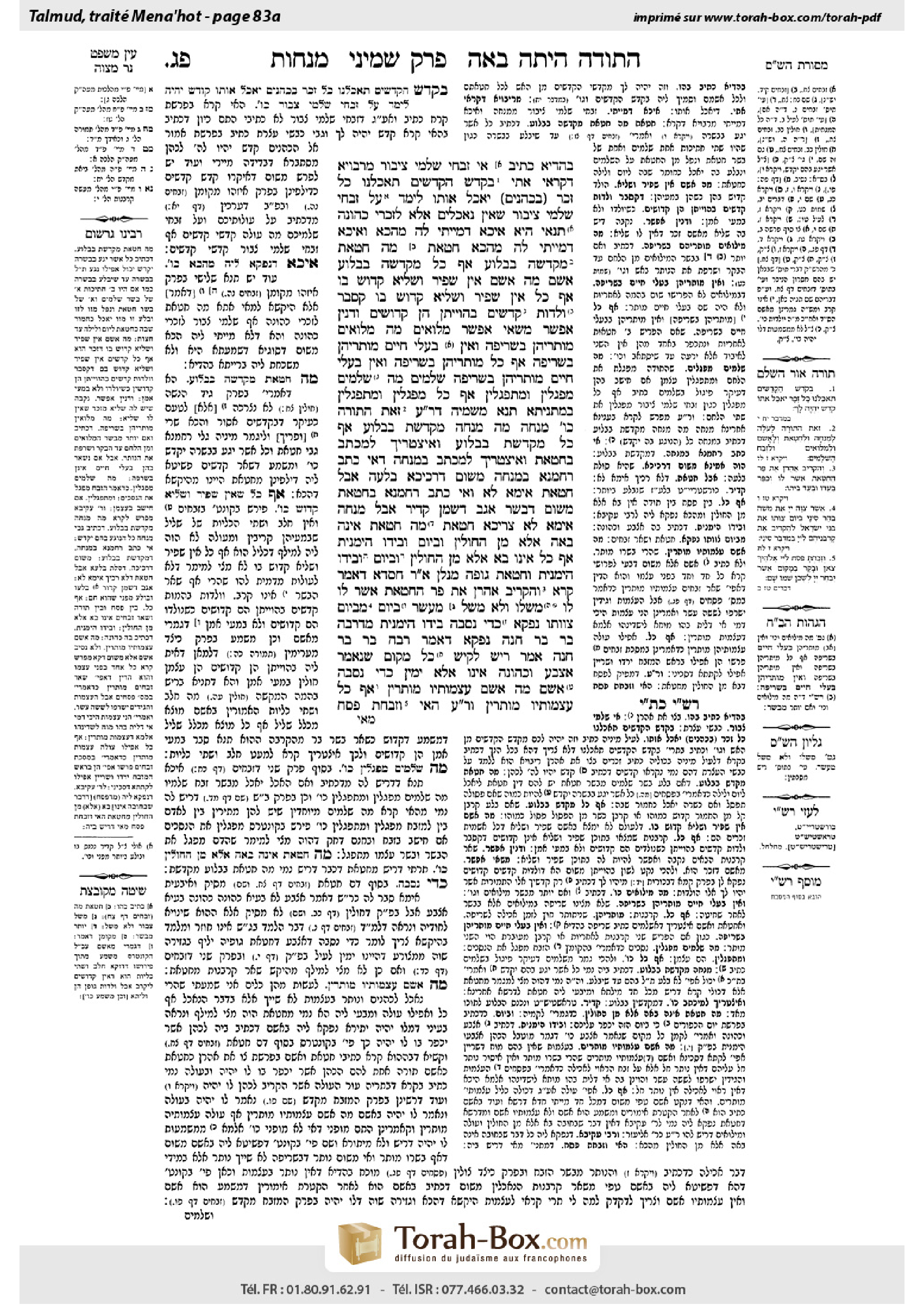
This page of Menachot includes the Aramaic text, an English translation and an AI-generated French translation, alongside the scan above.
מנחות פ״ג א · Aramaic and Hebrew text
בְּהֶדְיָא כְּתִיב!
אִי זִבְחֵי שַׁלְמֵי צִיבּוּר – מֵרִבּוּיָא דִּקְרָאֵי אָתֵי: ״בְּקֹדֶשׁ הַקֳּדָשִׁים תֹּאכְלֶנּוּ כׇּל זָכָר (בַּכֹּהֲנִים) יֹאכַל אֹתוֹ״, לִימֵּד עַל זִבְחֵי שַׁלְמֵי צִיבּוּר שֶׁאֵין נֶאֱכָלִים אֶלָּא לְזִכְרֵי כְהוּנָּה!
תַּנָּאֵי הִיא, אִיכָּא דְּמַיְיתֵי לַהּ מֵהָכָא, וְאִיכָּא דְּמַיְיתֵי לַהּ מֵהָכָא.
״חַטָּאת״ – מָה חַטָּאת מְקַדֶּשֶׁת בְּבִלּוּעַ, אַף כֹּל מְקַדֵּשׁ בְּבִלּוּעַ.
״אָשָׁם״ – מָה אָשָׁם אֵין שָׁפִיר וְשִׁלְיָא קָדוֹשׁ בּוֹ, אַף כֹּל אֵין שָׁפִיר וְשִׁלְיָא קָדוֹשׁ בּוֹ. קָסָבַר: וַלְדוֹת קָדָשִׁים בַּהֲוָיָיתָן הֵן קְדוֹשִׁים, וְדָנִין אֶפְשָׁר מִשֶּׁאִי אֶפְשָׁר.
״מִלּוּאִים״ – מָה מִלּוּאִים מוֹתְרֵיהֶן בִּשְׂרֵיפָה, וְאֵין בַּעֲלֵי חַיִּים מוֹתְרֵיהֶן בִּשְׂרֵיפָה, אַף כׇּל מוֹתְרֵיהֶן בִּשְׂרֵיפָה, וְאֵין בַּעֲלֵי חַיִּים מוֹתְרֵיהֶן בִּשְׂרֵיפָה.
״שְׁלָמִים״ – מָה שְׁלָמִים מְפַגְּלִין וּמִתְפַּגְּלִין, אַף כֹּל מְפַגְּלִין וּמִתְפַּגְּלִין.
בְּמַתְנִיתָא תָּנָא מִשְּׁמֵיהּ דְּרַבִּי עֲקִיבָא: ״זֹאת הַתּוֹרָה כּוּ׳ מִנְחָה״ – מָה מִנְחָה מְקַדֶּשֶׁת בְּבִלּוּעַ, אַף כֹּל מְקַדֶּשֶׁת בְּבִלּוּעַ.
וְאִיצְטְרִיךְ לְמִכְתַּב בְּחַטָּאת, וְאִיצְטְרִיךְ לְמִכְתַּב בְּמִנְחָה. דְּאִי כְּתַב רַחֲמָנָא בְּמִנְחָה – מִשּׁוּם דְּרַכִּיכָא בָּלְעָה, אֲבָל חַטָּאת אֵימָא לָא. וְאִי כְּתַב רַחֲמָנָא בְּחַטָּאת – מִשּׁוּם דְּבָשָׂר אַגַּב דְּשַׁמִּין (קָדִיר) [קָרִיר], אֲבָל מִנְחָה אֵימָא לָא, צְרִיכָא.
״חַטָּאת״ – מָה חַטָּאת אֵינָהּ בָּאָה אֶלָּא מִן הַחוּלִּין, וּבַיּוֹם, וּבְיָדוֹ הַיְמָנִית, אַף כֹּל אֵינוֹ בָּא אֶלָּא מִן הַחוּלִּין, וּבַיּוֹם, וּבְיָדוֹ הַיְמָנִית.
וְחַטָּאת גּוּפַהּ מְנָלַן? אָמַר רַב חִסְדָּא, דְּאָמַר קְרָא: ״וְהִקְרִיב אַהֲרֹן אֶת פַּר הַחַטָּאת אֲשֶׁר לוֹ״ – ״לוֹ״ מִשֶּׁלּוֹ, וְלֹא מִשֶּׁל מַעֲשֵׂר.
בַּיּוֹם – מִ״בְּיוֹם צַוֹּתוֹ״ נָפְקָא! כְּדִי נַסְבַהּ.
בְּיָדוֹ הַיְמָנִית – מִדְּרַבָּה בַּר בַּר חָנָה נָפְקָא, דְּאָמַר רַבָּה בַּר בַּר חָנָה אָמַר רֵישׁ לָקִישׁ: כׇּל מָקוֹם שֶׁנֶּאֱמַר אֶצְבַּע וּכְהֻנָּה – אֵינוֹ אֶלָּא יָמִין! כְּדִי נַסְבַהּ.
״אָשָׁם״ – מָה אָשָׁם עַצְמוֹתָיו מוּתָּרִין, אַף כֹּל עַצְמוֹתָיו מוּתָּרִין.
וְרַבִּי עֲקִיבָא, הַאי ״וְזָבַחְתָּ פֶּסַח״
Menachot 83a · English translation
this halakha is explicitly written of them. With regard to the sin offering, it is stated: “Every male among the priests may eat it” (Leviticus 6:22), and with regard to the guilt offering, it is stated: “Every male among the priests may eat of it” (Leviticus 7:6).
If one suggests that the halakha must be derived with regard to communal peace offerings, i.e., the two lambs that were sacrificed as communal offerings on Shavuot together with the offering of the two loaves (see Leviticus 23:19), this halakha is derived from the amplification of the verse stated with regard to meal offerings, sin offerings, and guilt offerings. The verse states: “In a most sacred place shall you eat of it; every male may eat it” (Numbers 18:10), and it is taught in a baraita: The verse teaches with regard to communal peace offerings that they are eaten only by males of priestly families.
The Gemara explains: It is a dispute between tanna’im. There is one tanna who cites it, the halakha that only males of priestly families may eat of the communal peace offering, from here, i.e., the precedent mentioned explicitly with regard to the meal offering; and there is one tanna who cites it from there, i.e., the amplification of the verse stated with regard to meal offerings, sin offerings, and guilt offerings.
The Gemara continues expounding the verse: “This is the law of the burnt offering, of the meal offering, and of the sin offering, and of the guilt offering, and of the inauguration offering, and of the sacrifice of peace offerings.” “Sin offering” teaches: Just as with regard to a sin offering, whatever it touches is sanctified through the substance that becomes absorbed, so too for all offerings mentioned in this verse, whatever they touch is sanctified through the absorbed portions.
“Guilt offering” teaches: Just as with regard to a guilt offering, a fetal sac and a placenta are not sacred within it, because a guilt offering is always male and as such never holds a fetal sac or a placenta, so too for any of the offerings mentioned in the verse, a fetal sac and a placenta are not sacred if found within it. The Gemara notes: Evidently, this tanna holds that with regard to offspring of sacrificial animals, they are sanctified only as they are from the moment of their births, but not in utero. And he also holds that one derives the possible from the impossible, so that the halakha of a fetal sac and a placenta in the case of female animals may be derived from the halakha of a male animal.
“Inauguration offering” teaches: Just as with regard to the inauguration offering, the rams and the bread of which were brought during the seven days of inauguration of the Tabernacle and which the priests ate, their leftovers were disposed of by incineration, as is stated: “And if any of the flesh of the inauguration offering, or of the bread, remain until the morning, then you shall burn the remainder with fire” (Exodus 29:34), and there were no living animals counted among their leftovers disposed of by incineration, so too for all offerings mentioned, their leftovers are disposed of by incineration, and there are no living animals counted among their leftovers disposed of by incineration. Accordingly, if one sanctifies two animals so that either one may be brought if the other is lost, when one animal is sacrificed, the surviving animal is not killed and incinerated.
“Peace offering” teaches: Just as with regard to the peace offering, its components may render components of the offering piggul and are rendered piggul, so too with regard to all offerings mentioned in this verse, their components render components of the offering piggul and are rendered piggul.
§ It was taught in a baraita in the name of Rabbi Akiva that the verse states: “This is the law of the burnt offering, of the meal offering, and of the sin offering, and of the guilt offering, and of the inauguration offering, and of the sacrifice of peace offerings” (Leviticus 7:37). From the term “meal offering” it is derived: Just as with regard to a meal offering, whatever it touches is sanctified through the substance that becomes absorbed, as it is stated: “Whatever shall touch them shall be sacred” (Leviticus 6:11), so too for all offerings mentioned in this verse, whatever they touch is sanctified through the absorbed portions.
The Gemara notes: And it was necessary to write the halakha of absorption with regard to a sin offering, and it was necessary to write the halakha of absorption with regard to a meal offering. As, had the Merciful One written this halakha only with regard to a meal offering, I would say that since it is soft, it is absorbed and therefore sanctifies what it touches; but with regard to the meat of a sin offering, I would say that it does not sanctify what it touches. And had the Merciful One written this halakha only with regard to a sin offering, I would say that it is because, on account of its fattiness, the meat penetrates [kadeir] into whatever it touches and sanctifies it; but with regard to a meal offering, I would say that it does not sanctify what it touches. Therefore, it is necessary for the Torah to write both.
The cited baraita continues: “Sin offering” teaches: Just as a sin offering is brought only from non-sacred animals, and it is sacrificed specifically in the daytime, and its service must be performed with the priest’s right hand, so too all offerings mentioned are brought only from non-sacred animals, and are sacrificed specifically in the daytime, and each one’s service must be performed with the priest’s right hand.
And with regard to a sin offering itself, from where do we derive that it is brought only from non-sacred animals? Rav Ḥisda said: It is derived from a verse, as the verse states: “And Aaron shall present the bull of the sin offering, which is his” (Leviticus 16:11). This teaches that the animal must come from his cattle, and not from money with which the second tithe has been redeemed.
The Gemara asks: Why is it necessary to derive from the halakha of a sin offering that an offering is sacrificed in the daytime? Isn’t this principle derived from the expression: “On the day of His commanding” (Leviticus 7:38), which is understood to be referring to all offerings? The Gemara answers: Indeed, the baraita cited the principle from the model of a sin offering for no reason [kedi], and it was mentioned here on account of the other principles.
The Gemara asks: Why must the baraita teach that the halakha of the sin offering teaches that the rites of offerings must be performed with the priest’s right hand? Isn’t this derived from the statement of Rabba bar bar Ḥana? As Rabba bar bar Ḥana says that Reish Lakish says: In any place in the Torah that it is stated that an action is performed with a finger, or that it is performed by priesthood, the halakha is that the rite is performed only with the right hand. This is derived from the Torah’s statement with regard to the leper: “And the priest shall dip his right finger” (Leviticus 14:16). The Gemara answers: The baraita cited the principle from the model of a sin offering for no reason, since it is actually derived from Rabba bar bar Ḥana’s statement.
The cited baraita continues: “Guilt offering” teaches: Just as with regard to a guilt offering, its bones have no sanctity and are permitted for any use, so too with regard to any mentioned offering, its bones are permitted.
The mishna teaches that the verse that states: “And you shall sacrifice the Paschal offering to the Lord your God, of the flock and the herd” (Deuteronomy 16:2), indicates by juxtaposition that every obligatory offering, like the Paschal offering, may be brought only from non-sacred money. The Gemara therefore asks: And as for Rabbi Akiva, who derives this from the verse: “This is the law of…the sin offering,” that verse: “And you shall sacrifice the Paschal offering,”
Menachot 83a · Traduction française (IA)
Cette halakha est explicitement écrite à leur sujet. À propos du sacrifice expiatoire, il est dit : « Tout mâle parmi les prêtres pourra en manger » (Lévitique 6:22), et à propos du sacrifice de culpabilité, il est dit : « Tout mâle parmi les prêtres pourra en manger » (Lévitique 7:6).
Si l’on suggère que la halakha doit être déduite au sujet des sacrifices de paix communautaires, c’est-à-dire des deux agneaux offerts comme sacrifices communautaires à Chavouot avec l’offrande des deux pains (voir Lévitique 23:19), cette halakha se déduit de l’amplification du verset énoncé au sujet des offrandes végétales, des sacrifices expiatoires et des sacrifices de culpabilité. Le verset dit : « Dans un lieu très saint, vous en mangerez ; tout mâle pourra en manger » (Nombres 18:10), et une baraïta enseigne que le verset apprend, au sujet des sacrifices de paix communautaires, qu’ils ne sont mangés que par les mâles des familles sacerdotales.
La Guemara explique : il s’agit d’une controverse entre tannaïm. Un tanna déduit cette halakha — selon laquelle seuls les mâles des familles sacerdotales peuvent manger des sacrifices de paix communautaires — d’ici, c’est-à-dire du précédent explicitement mentionné au sujet de l’offrande végétale ; un autre tanna la déduit de là, c’est-à-dire de l’amplification du verset énoncé au sujet des offrandes végétales, des sacrifices expiatoires et des sacrifices de culpabilité.
La Guemara poursuit l’interprétation du verset : « Telle est la loi de l’holocauste, de l’offrande végétale, du sacrifice expiatoire, du sacrifice de culpabilité, du sacrifice d’investiture et des sacrifices de paix. » « Sacrifice expiatoire » enseigne : de même que, pour un sacrifice expiatoire, tout ce qu’il touche est sanctifié par la substance qui y est absorbée, de même, pour toutes les offrandes mentionnées dans ce verset, tout ce qu’elles touchent est sanctifié par les substances absorbées.
« Sacrifice de culpabilité » enseigne : de même que, pour un sacrifice de culpabilité, une poche fœtale et un placenta ne sont pas sacrés à l’intérieur de celui-ci, car un sacrifice de culpabilité est toujours mâle et ne contient donc jamais de poche fœtale ni de placenta, de même, pour chacune des offrandes mentionnées dans le verset, une poche fœtale et un placenta ne sont pas sacrés s’ils s’y trouvent. La Guemara fait remarquer : il ressort de là que ce tanna considère que les petits des animaux consacrés ne sont sanctifiés qu’à partir de leur naissance, et non lorsqu’ils sont encore dans le ventre de leur mère. Il considère également que l’on déduit le possible de l’impossible, de sorte que la halakha concernant la poche fœtale et le placenta chez les femelles peut être déduite de celle qui concerne un animal mâle.
« Sacrifice d’investiture » enseigne : de même que, pour le sacrifice d’investiture — dont les béliers et les pains furent apportés pendant les sept jours de l’investiture du Tabernacle et consommés par les prêtres —, les restes étaient éliminés par incinération, comme il est dit : « Et s’il reste jusqu’au matin de la chair du sacrifice d’investiture ou du pain, tu brûleras le reste par le feu » (Exode 29:34), et qu’aucun animal vivant ne faisait partie des restes éliminés par incinération, de même, pour toutes les offrandes mentionnées, les restes sont éliminés par incinération, et aucun animal vivant ne fait partie de ces restes. Par conséquent, si quelqu’un consacre deux animaux afin que l’un ou l’autre puisse être offert si l’autre est perdu, lorsque l’un des animaux est sacrifié, l’animal qui reste n’est pas tué puis incinéré.
« Sacrifice de paix » enseigne : de même que, pour le sacrifice de paix, ses éléments peuvent rendre les éléments de l’offrande piggoul et être eux-mêmes rendus piggoul, de même, pour toutes les offrandes mentionnées dans ce verset, leurs éléments peuvent rendre les éléments de l’offrande piggoul et être eux-mêmes rendus piggoul.
§ Une baraïta enseigne au nom de Rabbi Akiva que le verset dit : « Telle est la loi de l’holocauste, de l’offrande végétale, du sacrifice expiatoire, du sacrifice de culpabilité, du sacrifice d’investiture et des sacrifices de paix » (Lévitique 7:37). Du terme « offrande végétale », on déduit : de même que, pour une offrande végétale, tout ce qu’elle touche est sanctifié par la substance qui y est absorbée, comme il est dit : « Tout ce qui les touchera sera sacré » (Lévitique 6:11), de même, pour toutes les offrandes mentionnées dans ce verset, tout ce qu’elles touchent est sanctifié par les substances absorbées.
La Guemara fait remarquer qu’il fallait écrire la halakha de l’absorption au sujet du sacrifice expiatoire et également au sujet de l’offrande végétale. En effet, si le Miséricordieux avait écrit cette halakha uniquement au sujet de l’offrande végétale, j’aurais dit que, puisqu’elle est molle, elle est absorbée et sanctifie donc ce qu’elle touche ; mais j’aurais dit que la viande d’un sacrifice expiatoire ne sanctifie pas ce qu’elle touche. Et si le Miséricordieux avait écrit cette halakha uniquement au sujet du sacrifice expiatoire, j’aurais dit que, du fait de sa graisse, la viande pénètre [kadeir] dans tout ce qu’elle touche et le sanctifie ; mais j’aurais dit que l’offrande végétale ne sanctifie pas ce qu’elle touche. Il fallait donc que la Torah écrive les deux.
La baraïta citée poursuit : « Sacrifice expiatoire » enseigne : de même qu’un sacrifice expiatoire ne peut être offert qu’à partir d’animaux non consacrés, qu’il est sacrifié uniquement pendant la journée et que son service doit être accompli de la main droite du prêtre, de même, toutes les offrandes mentionnées ne peuvent être offertes qu’à partir d’animaux non consacrés, sont sacrifiées uniquement pendant la journée et doivent chacune faire l’objet d’un service accompli de la main droite du prêtre.
Et concernant le sacrifice expiatoire lui-même, d’où déduisons-nous qu’il ne peut être offert qu’à partir d’animaux non consacrés ? Rav Ḥisda a dit : cela se déduit d’un verset, car il est dit : « Et Aaron présentera le taureau du sacrifice expiatoire qui lui appartient » (Lévitique 16:11). Cela enseigne que l’animal doit provenir de son troupeau, et non de l’argent ayant servi à racheter la seconde dîme.
La Guemara demande : pourquoi est-il nécessaire de déduire de la halakha du sacrifice expiatoire qu’un sacrifice est offert pendant la journée ? Ce principe ne se déduit-il pas de l’expression « le jour où Il l’ordonna » (Lévitique 7:38), comprise comme se rapportant à toutes les offrandes ? La Guemara répond : en effet, la baraïta a cité sans raison [kedi] ce principe en prenant pour modèle le sacrifice expiatoire ; elle l’a mentionné ici à cause des autres principes.
La Guemara demande : pourquoi la baraïta doit-elle enseigner que la halakha du sacrifice expiatoire enseigne que les rites des offrandes doivent être accomplis de la main droite du prêtre ? Cela ne se déduit-il pas de la déclaration de Rabba bar bar Ḥana ? Car Rabba bar bar Ḥana dit au nom de Reish Lakish : partout dans la Torah où il est indiqué qu’une action est accomplie avec un doigt, ou qu’elle est accomplie par un prêtre, la halakha est que le rite doit être accompli uniquement de la main droite. Cela se déduit de ce que dit la Torah au sujet du lépreux : « Le prêtre trempera son doigt droit » (Lévitique 14:16). La Guemara répond : la baraïta a cité sans raison ce principe en prenant pour modèle le sacrifice expiatoire, puisqu’il se déduit en réalité de la déclaration de Rabba bar bar Ḥana.
La baraïta citée poursuit : « Sacrifice de culpabilité » enseigne : de même que, pour un sacrifice de culpabilité, ses os ne sont pas sanctifiés et peuvent être utilisés à toute fin, de même, pour chacune des offrandes mentionnées, les os peuvent être utilisés.
La Michna enseigne que le verset qui dit : « Tu sacrifieras l’offrande pascale à l’Éternel, ton Dieu, du menu et du gros bétail » (Deutéronome 16:2), indique par juxtaposition que toute offrande obligatoire, comme l’offrande pascale, ne peut être apportée qu’avec de l’argent non consacré. La Guemara demande donc : et quant à Rabbi Akiva, qui déduit cela du verset « Telle est la loi du… sacrifice expiatoire », pourquoi le verset « Tu sacrifieras l’offrande pascale »
Traduction française générée par IA à partir de l’édition anglaise de Sefaria. Vérifie toujours un passage avec le texte source.
Text from Sefaria: William Davidson Edition - Vocalized Aramaic (unknown); William Davidson Edition - English (CC BY NC).