Menachot 83b: Talmud study for Daf Yomi
Daf Yomi is the daily study of one Talmud folio. Explore 37 tractates with scans, Hebrew text, Sefaria English and AI-generated French translations where annotated.
Passage selection and English or AI-generated French translation are available where the scan has annotations. Daf Study is independent of Torah-Box and Sefaria.
Browse Menachot · מנחות · All tractatesMenachot 83b text and translations
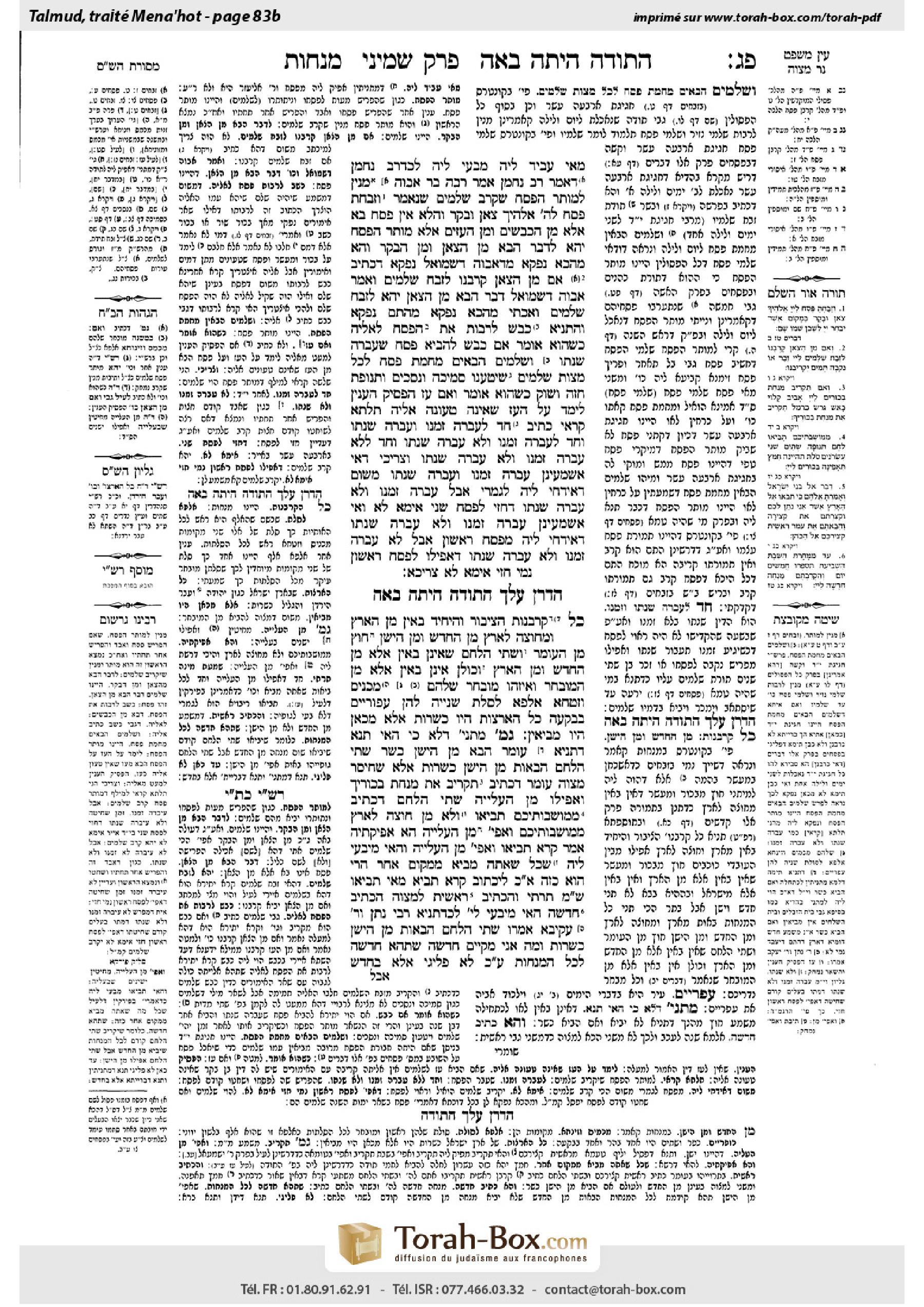
This page of Menachot includes the Aramaic text, an English translation and an AI-generated French translation, alongside the scan above.
מנחות פ״ג ב · Aramaic and Hebrew text
מַאי עָבֵיד לֵיהּ? מִבְּעֵי לֵיהּ לְכִדְרַב נַחְמָן, דְּאָמַר רַב נַחְמָן אָמַר רַבָּה בַּר אֲבוּהּ: מִנַּיִן לְמוֹתַר הַפֶּסַח שֶׁקָּרֵב שְׁלָמִים? שֶׁנֶּאֱמַר: ״וְזָבַחְתָּ פֶּסַח לַה׳ אֱלֹהֶיךָ צֹאן וּבָקָר״, וַהֲלֹא אֵין פֶּסַח בָּא אֶלָּא מִן הַכְּבָשִׂים וּמִן הָעִזִּים! אֶלָּא מוֹתַר הַפֶּסַח יְהֵא לְדָבָר הַבָּא מִן הַצֹּאן וּמִן הַבָּקָר.
וְהָא מֵהָכָא נָפְקָא? מִדַּאֲבוּהּ דִּשְׁמוּאֵל נָפְקָא, דִּכְתִיב: ״אִם מִן הַצֹּאן קׇרְבָּנוֹ לְזֶבַח שְׁלָמִים״, וְאָמַר אֲבוּהּ דִּשְׁמוּאֵל: דָּבָר הַבָּא מִן הַצֹּאן יְהֵא לְזֶבַח שְׁלָמִים.
וְאַכַּתִּי מֵהָכָא נָפְקָא? מֵהָתָם נָפְקָא! וְהָתַנְיָא: ״כֶּבֶשׂ״ – לְרַבּוֹת אֶת הַפֶּסַח לְאַלְיָה.
כְּשֶׁהוּא אוֹמֵר: ״אִם כֶּבֶשׂ״ – לְהָבִיא פֶּסַח שֶׁעָבְרָה שְׁנָתוֹ, וּשְׁלָמִים הַבָּאִים מֵחֲמַת פֶּסַח, לְכׇל מִצְוַת שְׁלָמִים: שֶׁיִּטְעֲנוּ סְמִיכָה, וּנְסָכִים, וּתְנוּפַת חָזֶה וָשׁוֹק.
כְּשֶׁהוּא אוֹמֵר ״וְאִם עֵז״ – הִפְסִיק הָעִנְיָן, לִימֵּד עַל הָעֵז שֶׁאֵינָהּ טְעוּנָה אַלְיָה.
תְּלָתָא קְרָאֵי כְּתִיב: חַד לְעִבְּרָה זְמַנּוֹ וְעִבְּרָה שְׁנָתוֹ, וְחַד לְעִבְּרָה זְמַנּוֹ וְלֹא עִבְּרָה שְׁנָתוֹ, וְחַד לְלֹא עִבְּרָה זְמַנּוֹ וְלֹא עִבְּרָה שְׁנָתוֹ.
וּצְרִיכִי, דְּאִי אַשְׁמְעִינַן עִבְּרָה זְמַנּוֹ וְעִבְּרָה שְׁנָתוֹ, מִשּׁוּם דְּאִידְּחִי לֵיהּ לִגְמָרֵי, אֲבָל עִבְּרָה זְמַנּוֹ וְלֹא עִבְּרָה שְׁנָתוֹ, דַּחֲזֵי לְפֶסַח שֵׁנִי, אֵימָא לָא.
וְאִי אַשְׁמְעִינַן עִבְּרָה זְמַנּוֹ וְלֹא עִבְּרָה שְׁנָתוֹ, דְּאִידְּחִי לֵיהּ מִפֶּסַח רִאשׁוֹן, אֲבָל לֹא עִבְּרָה זְמַנּוֹ וְלֹא עִבְּרָה שְׁנָתוֹ, דַּאֲפִילּוּ לְפֶסַח רִאשׁוֹן נָמֵי חֲזֵי, אֵימָא לָא, צְרִיכָא.
הֲדַרַן עֲלָךְ הַתּוֹדָה הָיְתָה בָּאָה.
מַתְנִי׳ כׇּל קׇרְבְּנוֹת הַצִּיבּוּר וְהַיָּחִיד בָּאִין מִן הָאָרֶץ וּמֵחוּצָה לָאָרֶץ, מִן הֶחָדָשׁ וּמִן הַיָּשָׁן, חוּץ מִן הָעוֹמֶר וּשְׁתֵּי הַלֶּחֶם, שֶׁאֵינָן בָּאִין אֶלָּא מִן הֶחָדָשׁ וּמִן הָאָרֶץ.
וְכוּלָּן אֵינָן בָּאִין אֶלָּא מִן הַמּוּבְחָר, וְאֵיזֶהוּ מוּבְחָר שֶׁלָּהֶם? (מִכְנֵיס וְזַטְחָא) [מִכְמָס וְזוֹנֵחָא] – אַלְפָּא לַסֹּלֶת, שְׁנִיָּיה לָהֶן – עֲפוֹרַיִים בַּבִּקְעָה.
כׇּל הָאֲרָצוֹת הָיוּ כְּשֵׁרוֹת, אֶלָּא מִכָּאן הָיוּ מְבִיאִין.
גְּמָ׳ מַתְנִיתִין דְּלָא כִּי הַאי תַּנָּא, דְּתַנְיָא: עוֹמֶר הַבָּא מִן הַיָּשָׁן – כָּשֵׁר, שְׁתֵּי הַלֶּחֶם הַבָּאוֹת מִן הַיָּשָׁן – כְּשֵׁרוֹת, אֶלָּא שֶׁחִיסֵּר מִצְוָה.
עוֹמֶר – דִּכְתִיב ״תַּקְרִיב אֵת מִנְחַת בִּכּוּרֶיךָ״, וַאֲפִילּוּ מִן הָעֲלִיָּיה.
שְׁתֵּי הַלֶּחֶם – דִּכְתִיב: ״מִמּוֹשְׁבֹתֵיכֶם תָּבִיאּוּ״, וְלֹא מִן חוּצָה לָאָרֶץ. ״מִמּוֹשְׁבֹתֵיכֶם״ – וַאֲפִילּוּ מִן הָעֲלִיָּיה.
הָא אַפֵּיקְתֵּיהּ? אָמַר קְרָא ״תָּבִיאּוּ״, וַאֲפִילּוּ מִן הָעֲלִיָּיה.
וְהַאי מִיבְּעֵי לֵיהּ, שֶׁכֹּל שֶׁאַתָּה מֵבִיא מִמָּקוֹם אַחֵר – הֲרֵי הוּא כָּזֶה! אִם כֵּן, לִיכְתּוֹב קְרָא ״תָּבִיא״, מַאי ״תָּבִיאּוּ״? שְׁמַע מִינַּהּ תַּרְתֵּי.
וְהָכְתִיב ״רֵאשִׁית״? לְמִצְוָה.
הָכְתִיב ״חֲדָשָׁה״? הַאי מִיבְּעֵי לֵיהּ לְכִדְתַנְיָא: רַבִּי נָתָן וְרַבִּי עֲקִיבָא אָמְרוּ: שְׁתֵּי הַלֶּחֶם הַבָּאוֹת מִן הַיָּשָׁן – כְּשֵׁרוֹת, וּמָה אֲנִי מְקַיֵּים ״חֲדָשָׁה״? שֶׁתְּהֵא חֲדָשָׁה לְכׇל הַמְּנָחוֹת.
עַד כָּאן לָא פְּלִיגִי אֶלָּא בְּחָדָשׁ,
Menachot 83b · English translation
what does he make of it, i.e., what does he derive from it? He requires it for that which was stated by Rav Naḥman, as Rav Naḥman says that Rabba bar Avuh says: From where is it derived that a leftover Paschal offering, an animal consecrated but not ultimately sacrificed on Passover eve, is sacrificed as a peace offering afterward? It is derived from that which is stated: “And you shall sacrifice the Passover offering unto the Lord, your God, of the flock and the herd.” The verse is difficult: But isn’t a Paschal offering brought only from the sheep and from the goats? Rather, it is derived from here that a leftover Paschal offering should be sacrificed as an offering brought both from the flock and from the herd, i.e., a peace offering.
The Gemara asks: But is it derived from here that a leftover Paschal offering is sacrificed as a peace offering? It is derived from the verse that Shmuel’s father cites: As it is written: “And if his offering for a sacrifice of peace offerings to the Lord is of the flock” (Leviticus 3:6); and Shmuel’s father said: This teaches that an offering that is brought only from the flock, i.e., the Paschal offering, will be a sacrifice of peace offerings.
But still it must be asked: Is it derived from here? It is derived from there, from the verse cited in the following baraita. And isn’t it taught in a baraita: Even though the verse already states that peace offerings come from the flock, as it is written: “And if his offering for a sacrifice of peace offerings to the Lord be of the flock, male or female, he shall sacrifice it without blemish” (Leviticus 3:6), the verse goes on to specify: “If he bring a lamb for his offering…and if his offering be a goat” (Leviticus 3:7–12). The word “lamb” is written to include the Paschal offering in the requirement that the fat tail be sacrificed on the altar, which is written subsequently with regard to a peace offering (Leviticus 3:9), since this halakha is not mentioned in the verses concerning the Paschal offering.
The baraita continues: When the verse states: “If he brings a lamb,” it is to include in all the mitzvot of peace offerings a Paschal offering whose first year has passed and is therefore too old to be sacrificed as a Paschal offering, and peace offerings brought due to a Paschal offering. Specifically, this indicates that they require placing hands on the head of the offering, libations, and the waving of the breast and thigh.
And when the verse states: “And if his offering is a goat,” it interrupted the previous matter and taught that the sacrifice of a goat does not require that the fat tail be burned on the altar. In any event, the verse indicates that a Paschal offering that was disqualified as such because it has reached its second year, i.e., the leftover of a Paschal offering, is sacrificed as a peace offering. It may therefore be asked: Why are there three verses to indicate this one halakha?
Rather, none of these derivations are superfluous, as three verses are written that teach the halakha that a Paschal offering that is sacrificed not on Passover eve is sacrificed as a peace offering. One verse teaches this halakha in a case where its time of sacrifice, Passover eve, has passed, and its first year has also passed, disqualifying it for sacrifice as a Paschal offering. And one verse teaches the halakha in a case where its time of sacrifice has passed, but not its first year. And the third one teaches a case where neither its time of sacrifice nor its first year has passed, but it was sacrificed before Passover eve.
And all these verses are necessary. As had the Merciful One written only the case where both its first year and its time of sacrifice have passed, one could say that only such a Paschal offering should be sacrificed as a peace offering, as it was completely rejected from its status as a Paschal offering; but in a case where its time of sacrifice has passed but its first year has not passed, in which case it is still fit to be sacrificed as a Paschal offering on the second Pesaḥ, I would say that it is not sacrificed as a peace offering.
And if the Torah had taught us only that a leftover Paschal offering whose time has passed but whose year has not passed is sacrificed as a peace offering, one might think that this is because the Paschal offering was rejected from the first Pesaḥ; but in a case where neither its time of sacrifice nor its first year have passed, in which case it is still fit to be sacrificed as a Paschal offering on Passover eve, I would say that it is not sacrificed as a peace offering. Therefore, all three verses are necessary.
MISHNA: All communal and individual meal offerings may come from produce grown in Eretz Yisrael and from outside Eretz Yisrael, from the new crop, i.e., the current year’s crop, and from the old crop from previous years. This is the halakha of all meal offerings except for the omer, i.e., the measure of barley brought as a communal offering on the sixteenth of Nisan, and the two loaves, i.e., the communal offering brought on the festival of Shavuot, as they come only from the new crop and from Eretz Yisrael.
And all meal offerings come only from the optimal-quality grain. And which places have the optimal grain for them? Fields in Makhnis and Zateḥa are the primary [alfa] source for fine flour. Secondary to them is Aforayim in the valley.
All the regions were valid as the source of the grain, but it is from here, the primary and secondary places, that they would bring grain, because it was of optimal quality.
GEMARA: The mishna states that the omer meal offering and the two loaves are prepared only from the new crop. The wording of the mishna indicates that this is an essential requirement. The Gemara notes: The mishna is not in accordance with the opinion of this following tanna, as it is taught in a baraita: An omer meal offering that comes from the old crop is valid. Similarly, the two loaves that come from the old crop are valid, but by bringing them from the old crop one lacks the proper fulfillment of its mitzva.
The Gemara provides the biblical sources for the rulings of the baraita: The source for the ruling concerning the omer meal offering is as it is written: “And when you shall bring a meal offering of first fruits to the Lord, it is ripened grain, toasted over fire, even groats of the fresh ear, you shall bring the meal offering of your first fruits” (Leviticus 2:14). The superfluous repetition of the term “you shall bring” teaches that the omer is valid even if brought from an old crop that was stored away in the attic.
The source for the ruling concerning the two loaves is as it is written: “And you shall offer a new meal offering to the Lord. From your dwellings you shall bring two wave-loaves” (Leviticus 23:16–17). The term “your dwellings” is a reference to Eretz Yisrael. Therefore, the verse indicates that the two loaves must be brought from grain grown there, and not from outside of Eretz Yisrael. Furthermore, the term “from your dwellings” teaches that the offering may come from any grain grown in Eretz Yisrael and even from an old crop that was stored away in the attic.
The Gemara asks how two halakhot can be derived from the same term: Didn’t you already expound that term to teach that one can use grain only if it is grown in Eretz Yisrael? How can you also derive from it that the grain can be brought from an old crop? The Gemara explains: That is derived from the next term, as the verse states: “From your dwellings you shall bring” (Leviticus 23:17), which teaches that one may bring them from any grain grown in Eretz Yisrael and even from an old crop that was stored away in the attic.
The Gemara questions this answer: But that term is necessary to teach that any leavened bread offering that you bring in another instance, i.e., the loaves of the thanksgiving offering, is to be like this offering of the two loaves, i.e., the same requirements apply to it (see 77b). How, then, can you expound the term to also teach that grain from an old crop can be used for the two loaves? The Gemara explains: If so, that the term is written only to teach about the requirements for other leavened bread offerings, then let the verse write: You shall bring [tavi], using the singular form. For what reason then, does it write: “You shall bring [tavi’u],” using the plural form? It is written so that one can learn from it two different halakhot.
The Gemara questions the ruling of the baraita that the omer and the two loaves are valid even if brought from an old crop: But isn’t the term “first” written with regard to both the omer and the two loaves? This indicates they must come from the new crop. The omer is referred to as “the first of your harvest” (Leviticus 23:10), and the two loaves are referred to as “an offering of the first” (Leviticus 2:12). The Gemara answers: The term indicates that only the new crop should be used, but that is only for the proper fulfillment of the mitzva. If an old crop was used, the offerings are still valid.
The Gemara asks: But isn’t it written with regard to the two loaves: “A new meal offering” (Leviticus 23:16), which indicates that only the new crop can be used? The fact that with regard to the two loaves the Torah repeats this requirement twice suggests that it is indispensable. The Gemara answers: The word “new” cannot teach that the use of the new crop is essential, as it is necessary for that which is taught in a baraita: Rabbi Natan and Rabbi Akiva said that even if the two loaves are brought from the old crop, they are valid. How do I realize the meaning of: “A new meal offering”? This teaches that the two loaves are to be the first of all the other meal offerings. No other meal offerings may be brought from the new crop until the meal offering of the two loaves has been brought.
§ The Gemara defines the limits of the dispute between the mishna and baraita: They disagree only with regard to whether it is essential for the omer and the two loaves to be brought from the new crop.
Menachot 83b · Traduction française (IA)
Qu’en fait-il, c’est-à-dire que déduit-il de ce verset ? Il en a besoin pour ce qu’a enseigné Rav Naḥman, car Rav Naḥman dit au nom de Rabba bar Avuh : d’où sait-on qu’un sacrifice pascal restant, un animal consacré qui n’a finalement pas été sacrifié la veille de Pessaḥ, est ensuite sacrifié comme offrande de paix ? On l’apprend de ce qui est écrit : « Tu sacrifieras le sacrifice pascal à l’Éternel, ton Dieu, pris dans le menu et le gros bétail. » Le verset pose problème : un sacrifice pascal n’est-il pas apporté uniquement parmi les moutons et les chèvres ? Il faut plutôt en déduire qu’un sacrifice pascal restant doit être sacrifié comme une offrande provenant à la fois du menu et du gros bétail, c’est-à-dire comme une offrande de paix.
La Guemara demande : Mais est-ce de là qu’on apprend qu’un sacrifice pascal restant est sacrifié comme offrande de paix ? On l’apprend du verset cité par le père de Shmuel, comme il est écrit : « Si son offrande est un sacrifice d’offrandes de paix à l’Éternel, pris dans le menu bétail » (Lévitique 3:6). Le père de Shmuel a dit : cela enseigne qu’une offrande apportée uniquement parmi le menu bétail, c’est-à-dire le sacrifice pascal, sera un sacrifice d’offrandes de paix.
Mais il faut encore demander : est-ce de là qu’on l’apprend ? On l’apprend de cet autre verset, cité dans la baraïta suivante. N’est-il pas enseigné dans une baraïta : bien que le verset indique déjà que les offrandes de paix proviennent du menu bétail, comme il est écrit : « Si son offrande est un sacrifice d’offrandes de paix à l’Éternel, pris dans le menu bétail, mâle ou femelle, il l’offrira sans défaut » (Lévitique 3:6), le verset précise ensuite : « S’il apporte un agneau en offrande […] et si son offrande est une chèvre » (Lévitique 3:7–12). Le mot « agneau » est écrit pour inclure le sacrifice pascal dans l’obligation de brûler sur l’autel la queue grasse, mentionnée ensuite à propos d’une offrande de paix (Lévitique 3:9), puisque cette halakha n’est pas mentionnée dans les versets concernant le sacrifice pascal.
La baraïta poursuit : lorsque le verset dit : « S’il apporte un agneau », cela inclut, parmi toutes les mitsvot relatives aux offrandes de paix, un sacrifice pascal qui a dépassé sa première année et est donc trop âgé pour être sacrifié comme sacrifice pascal, ainsi que les offrandes de paix apportées en raison d’un sacrifice pascal. Plus précisément, cela indique qu’il faut leur imposer les mains, apporter des libations et balancer la poitrine et la cuisse.
Et lorsque le verset dit : « Et si son offrande est une chèvre », il interrompt le sujet précédent et enseigne que le sacrifice d’une chèvre n’exige pas que la queue grasse soit brûlée sur l’autel. Quoi qu’il en soit, le verset indique qu’un sacrifice pascal disqualifié en tant que tel parce qu’il est entré dans sa deuxième année, c’est-à-dire un sacrifice pascal restant, est sacrifié comme offrande de paix. On peut donc demander : pourquoi trois versets sont-ils nécessaires pour indiquer cette unique halakha ?
Il faut plutôt dire qu’aucune de ces déductions n’est superflue, car trois versets enseignent la halakha selon laquelle un sacrifice pascal qui n’est pas sacrifié la veille de Pessaḥ est sacrifié comme offrande de paix. Un verset enseigne cette halakha dans le cas où le moment de son sacrifice, la veille de Pessaḥ, est passé et où sa première année est également achevée, ce qui le disqualifie comme sacrifice pascal. Un autre verset enseigne la halakha dans le cas où le moment de son sacrifice est passé, mais pas sa première année. Le troisième enseigne le cas où ni le moment de son sacrifice ni sa première année ne sont passés, mais où il a été sacrifié avant la veille de Pessaḥ.
Tous ces versets sont nécessaires. En effet, si le Miséricordieux n’avait écrit que le cas où sa première année et le moment de son sacrifice sont tous deux passés, on aurait pu dire que seul un tel sacrifice pascal doit être sacrifié comme offrande de paix, puisqu’il a été entièrement écarté de son statut de sacrifice pascal ; mais dans le cas où le moment de son sacrifice est passé tandis que sa première année n’est pas achevée, auquel cas il peut encore être sacrifié comme sacrifice pascal à Pessaḥ chéni, on aurait dit qu’il n’est pas sacrifié comme offrande de paix.
Et si la Torah ne nous avait enseigné que le cas d’un sacrifice pascal restant dont le moment du sacrifice est passé, mais dont l’année n’est pas achevée, qui est sacrifié comme offrande de paix, on aurait pu penser que c’est parce que le sacrifice pascal a été écarté lors du premier Pessaḥ ; mais dans le cas où ni le moment de son sacrifice ni sa première année ne sont passés, auquel cas il peut encore être sacrifié comme sacrifice pascal la veille de Pessaḥ, on aurait dit qu’il n’est pas sacrifié comme offrande de paix. C’est pourquoi les trois versets sont nécessaires.
MICHNA : Toutes les offrandes de farine, publiques ou individuelles, peuvent provenir de produits cultivés en Eretz Yisrael ou hors d’Eretz Yisrael, de la nouvelle récolte, c’est-à-dire celle de l’année en cours, ou de l’ancienne récolte, des années précédentes. Cette halakha concerne toutes les offrandes de farine, à l’exception de l’omer, c’est-à-dire la mesure d’orge apportée comme offrande publique le seize Nissan, et des deux pains, c’est-à-dire l’offrande publique apportée à la fête de Chavouot, car ceux-ci ne peuvent provenir que de la nouvelle récolte et d’Eretz Yisrael.
Toutes les offrandes de farine doivent provenir de céréales de qualité supérieure. Et quels endroits fournissent les meilleures céréales pour ces offrandes ? Les champs de Makhnis et de Zateḥa sont la source principale [alfa] de farine fine. Le site secondaire est Aforayim, dans la vallée.
Toutes les régions pouvaient fournir les céréales, mais c’est de ces endroits, les sites principaux et secondaires, qu’on apportait les céréales, parce qu’elles étaient de qualité supérieure.
GUEMARA : La Michna affirme que l’offrande de farine de l’omer et les deux pains sont préparés uniquement à partir de la nouvelle récolte. La formulation de la Michna laisse entendre qu’il s’agit d’une condition indispensable. La Guemara fait remarquer que la Michna ne suit pas l’opinion du tanna suivant, car il est enseigné dans une baraïta : une offrande de farine de l’omer provenant de l’ancienne récolte est valide. De même, les deux pains provenant de l’ancienne récolte sont valides, mais les apporter de l’ancienne récolte ne permet pas d’accomplir correctement la mitsva.
La Guemara donne les sources bibliques des décisions de la baraïta. La source concernant l’offrande de farine de l’omer est le verset suivant : « Lorsque vous apporterez à l’Éternel une offrande de farine des prémices, ce sera du grain mûri, grillé au feu, des grains tirés de l’épi frais ; vous apporterez l’offrande de farine de vos prémices » (Lévitique 2:14). La répétition superflue des mots « vous apporterez » enseigne que l’omer est valide même s’il provient d’une ancienne récolte conservée dans le grenier.
La source concernant les deux pains est le verset suivant : « Vous offrirez à l’Éternel une nouvelle offrande de farine. De vos demeures, vous apporterez deux pains de balancement » (Lévitique 23:16–17). Les mots « vos demeures » désignent Eretz Yisrael. Le verset indique donc que les deux pains doivent provenir de céréales qui y ont été cultivées, et non de céréales provenant de l’extérieur d’Eretz Yisrael. En outre, les mots « de vos demeures » enseignent que l’offrande peut provenir de toute céréale cultivée en Eretz Yisrael, même d’une ancienne récolte conservée dans le grenier.
La Guemara demande comment deux halakhot peuvent être déduites d’une même expression : n’as-tu pas déjà interprété ces mots pour enseigner qu’on ne peut utiliser que des céréales cultivées en Eretz Yisrael ? Comment peux-tu également en déduire que les céréales peuvent provenir d’une ancienne récolte ? La Guemara explique : cela se déduit de l’expression suivante, car le verset dit : « De vos demeures, vous apporterez » (Lévitique 23:17), ce qui enseigne qu’on peut les apporter à partir de toute céréale cultivée en Eretz Yisrael, même d’une ancienne récolte conservée dans le grenier.
La Guemara conteste cette réponse : mais cette expression est nécessaire pour enseigner que toute offrande de pain levé que tu apportes dans un autre cas, c’est-à-dire les pains de l’offrande de remerciement, doit être comme cette offrande des deux pains ; autrement dit, les mêmes exigences s’appliquent à elle (voir 77b). Comment peux-tu donc interpréter cette expression pour enseigner que les deux pains peuvent provenir de céréales d’une ancienne récolte ? La Guemara explique : si cette expression était écrite uniquement pour enseigner les exigences concernant les autres offrandes de pain levé, le verset devrait dire : « tu apporteras » [tavi], au singulier. Pourquoi écrit-il alors : « vous apporterez » [tavi’u], au pluriel ? C’est afin qu’on puisse en déduire deux halakhot distinctes.
La Guemara remet en question la décision de la baraïta selon laquelle l’omer et les deux pains sont valides même s’ils proviennent d’une ancienne récolte : le terme « premier » n’est-il pas écrit aussi bien à propos de l’omer que des deux pains ? Cela indique qu’ils doivent provenir de la nouvelle récolte. L’omer est appelé « le premier de votre récolte » (Lévitique 23:10), et les deux pains sont appelés « une offrande des prémices » (Lévitique 2:12). La Guemara répond : ce terme indique qu’il faut utiliser la nouvelle récolte, mais uniquement pour accomplir correctement la mitsva. Si l’on a utilisé une ancienne récolte, les offrandes restent valides.
La Guemara demande : mais n’est-il pas écrit à propos des deux pains : « une nouvelle offrande de farine » (Lévitique 23:16), ce qui indique que seule la nouvelle récolte peut être utilisée ? Le fait que la Torah répète deux fois cette exigence à propos des deux pains semble indiquer qu’elle est indispensable. La Guemara répond : le mot « nouvelle » ne peut enseigner que l’utilisation de la nouvelle récolte est indispensable, car il est nécessaire pour ce qui est enseigné dans une baraïta : Rabbi Natan et Rabbi Akiva ont dit que même si les deux pains proviennent de l’ancienne récolte, ils sont valides. Comment faut-il alors comprendre les mots « une nouvelle offrande de farine » ? Ils enseignent que les deux pains doivent être les premiers de toutes les autres offrandes de farine. Aucune autre offrande de farine ne peut provenir de la nouvelle récolte tant que l’offrande de farine des deux pains n’a pas été apportée.
§ La Guemara définit les limites du désaccord entre la Michna et la baraïta : elles ne sont en désaccord que sur la question de savoir s’il est indispensable que l’omer et les deux pains proviennent de la nouvelle récolte.
Traduction française générée par IA à partir de l’édition anglaise de Sefaria. Vérifie toujours un passage avec le texte source.
Text from Sefaria: William Davidson Edition - Vocalized Aramaic (unknown); William Davidson Edition - English (CC BY NC).