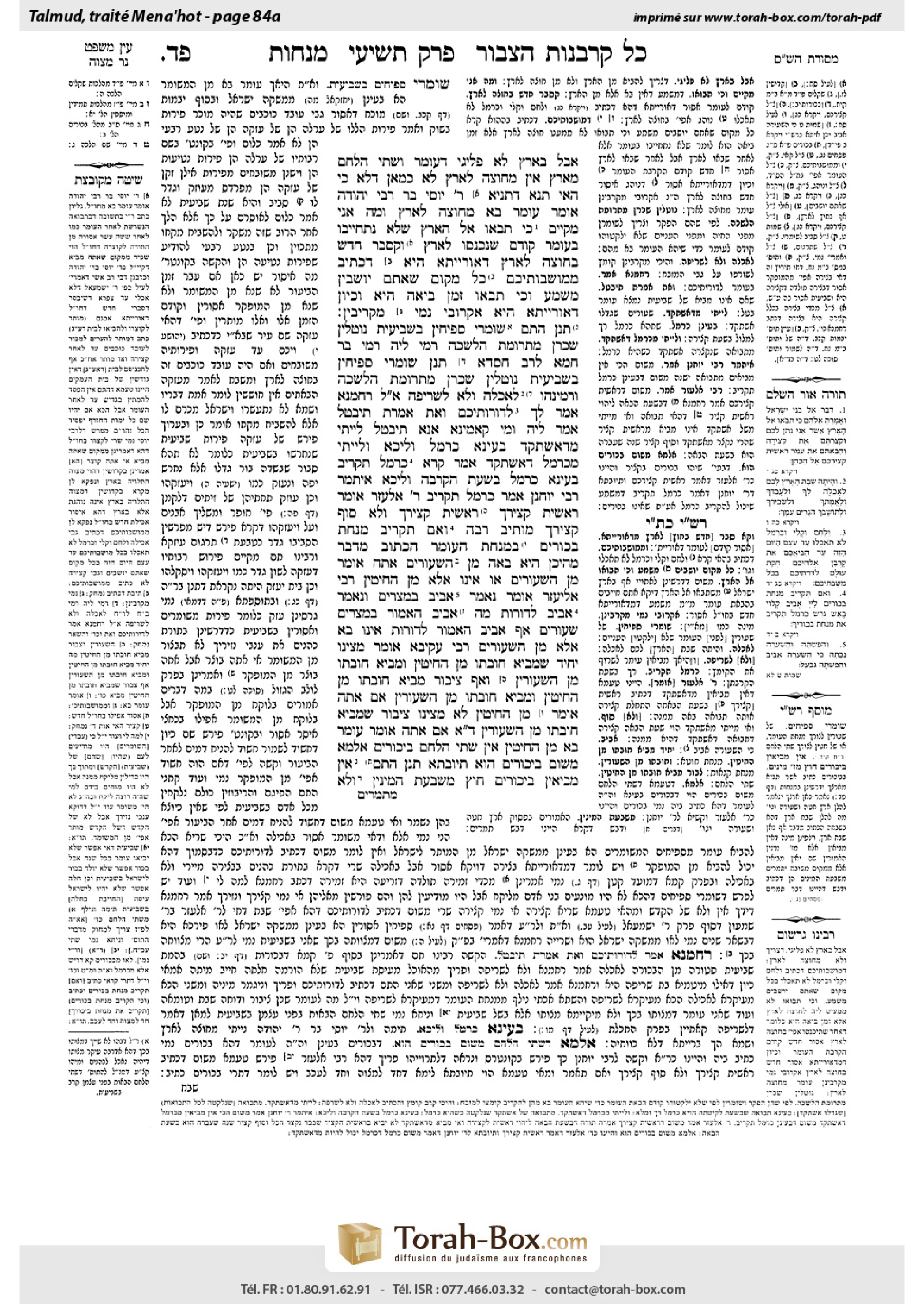
Menachot 84a: Talmud study for Daf Yomi
Daf Yomi is the daily study of one Talmud folio. Explore 37 tractates with scans, Hebrew text, Sefaria English and AI-generated French translations where annotated.
Passage selection and English or AI-generated French translation are available where the scan has annotations. Daf Study is independent of Torah-Box and Sefaria.
Browse Menachot · מנחות · All tractatesMenachot 84a text and translations
This page of Menachot includes the Aramaic text, an English translation and an AI-generated French translation, alongside the scan above.
מנחות פ״ד א · Aramaic and Hebrew text
אֲבָל בָּאָרֶץ לָא פְּלִיגִי, דְּעוֹמֶר וּשְׁתֵּי הַלֶּחֶם מֵאָרֶץ – אִין, מֵחוּצָה לָאָרֶץ – לָא.
כְּמַאן? דְּלָא כִּי הַאי תַּנָּא, דְּתַנְיָא: רַבִּי יוֹסֵי בַּר רַבִּי יְהוּדָה אוֹמֵר: עוֹמֶר בָּא מֵחוּצָה לָאָרֶץ, וּמָה אֲנִי מְקַיֵּים ״כִּי תָבֹאוּ אֶל הָאָרֶץ״? שֶׁלֹּא נִתְחַיְּיבוּ בָּעוֹמֶר קוֹדֶם שֶׁנִּכְנְסוּ לָאָרֶץ.
וְקָסָבַר חָדָשׁ בְּחוּצָה לָאָרֶץ דְּאוֹרָיְיתָא הִיא, דִּכְתִיב ״מִמּוֹשְׁבֹתֵיכֶם״, כׇּל מָקוֹם שֶׁאַתֶּם יוֹשְׁבִין מַשְׁמַע, וְ״כִּי תָבֹאוּ״ זְמַן בִּיאָה הִיא, וְכֵיוָן דְּאוֹרָיְיתָא הִיא – אַקְרוֹבֵי נָמֵי מַקְרִיבִין.
תְּנַן הָתָם: שׁוֹמְרֵי סְפִיחִין בַּשְּׁבִיעִית, נוֹטְלִין שְׂכָרָן מִתְּרוּמַת הַלִּשְׁכָּה.
רָמֵי לֵיהּ רָמֵי בַּר חָמָא לְרַב חִסְדָּא: תְּנַן שׁוֹמְרֵי סְפִיחִין בַּשְּׁבִיעִית נוֹטְלִין שְׂכָרָן מִתְּרוּמַת הַלִּשְׁכָּה, וּרְמִינְהוּ: ״לְאׇכְלָה״ – וְלֹא לִשְׂרֵיפָה.
אֲמַר לֵיהּ: רַחֲמָנָא אָמַר לָךְ ״לְדֹרֹתֵיכֶם״, וְאַתְּ אָמְרַתְּ תִּיבְטַל?
אֲמַר לֵיהּ: וּמִי קָאָמֵינָא אֲנָא תִּיבְטַל?! לַיְיתֵי מִדְּאֶשְׁתָּקַד! בָּעֵינָא ״כַּרְמֶל״, וְלֵיכָּא.
וְלַיְיתֵי מִכַּרְמֶל דְּאֶשְׁתָּקַד? אָמַר קְרָא: ״כַּרְמֶל תַּקְרִיב״, בָּעֵינָא כַּרְמֶל בִּשְׁעַת הַקְרָבָה, וְלֵיכָּא.
אִיתְּמַר: רַבִּי יוֹחָנָן אָמַר ״כַּרְמֶל תַּקְרִיב״, רַבִּי אֶלְעָזָר אוֹמֵר ״רֵאשִׁית קְצִירְךָ״ – רֵאשִׁית קְצִירְךָ, וְלֹא סוֹף קְצִירְךָ.
מוֹתֵיב רַבָּה: ״וְאִם תַּקְרִיב מִנְחַת בִּכּוּרִים״ – בְּמִנְחַת הָעוֹמֶר הַכָּתוּב מְדַבֵּר. מֵהֵיכָן הִיא בָּאָה? מִן הַשְּׂעוֹרִים. אַתָּה אוֹמֵר מִן הַשְּׂעוֹרִים, אוֹ אֵינוֹ אֶלָּא מִן הַחִיטִּין?
רַבִּי אֱלִיעֶזֶר אוֹמֵר: נֶאֱמַר ״אָבִיב״ בְּמִצְרַיִם, וְנֶאֱמַר ״אָבִיב״ לְדוֹרוֹת. מָה ״אָבִיב״ הָאָמוּר בְּמִצְרַיִם – שְׂעוֹרִים, אַף ״אָבִיב״ הָאָמוּר לְדוֹרוֹת – אֵינוֹ בָּא אֶלָּא מִן הַשְּׂעוֹרִים.
רַבִּי עֲקִיבָא אוֹמֵר: מָצִינוּ יָחִיד שֶׁמֵּבִיא חוֹבָתוֹ מִן הַחִיטִּין, וּמֵבִיא חוֹבָתוֹ מִן הַשְּׂעוֹרִין, וְאַף צִיבּוּר מֵבִיא חוֹבָתוֹ מִן הַחִיטִּין וּמֵבִיא חוֹבָתוֹ מִן הַשְּׂעוֹרִין. אִם אַתָּה אוֹמֵר מִן הַחִיטִּין – לֹא מָצִינוּ צִיבּוּר שֶׁמֵּבִיא חוֹבָתוֹ מִן הַשְּׂעוֹרִין!
דָּבָר אַחֵר: אִם אַתָּה אוֹמֵר עוֹמֶר בָּא מִן הַחִיטִּין – אִין שְׁתֵּי הַלֶּחֶם ״בִּיכּוּרִים״. אַלְמָא מִשּׁוּם ״בִּיכּוּרִים״ הוּא, תְּיוּבְתָּא.
תְּנַן הָתָם: אֵין מְבִיאִין בִּיכּוּרִים חוּץ מִשִּׁבְעַת הַמִּינִין, וְלֹא
Menachot 84a · English translation
But with regard to the requirement to use grain grown in Eretz Yisrael, they do not disagree that if the omer and the two loaves come from Eretz Yisrael, indeed, they are valid, but if they come from outside of Eretz Yisrael, they are not valid.
In accordance with whose opinion is this? It is not in accordance with the opinion of this following tanna, as it is taught in a baraita: Rabbi Yosei, son of Rabbi Yehuda, says that the omer may come from outside of Eretz Yisrael. How do I realize the meaning of the verse that introduces the obligation to bring the omer: “When you come into the land which I give to you” (Leviticus 23:10)? This verse appears to indicate that the bringing of the omer is restricted to Eretz Yisrael. That verse teaches that the Jewish people were not obligated in the mitzva of bringing the omer before they entered Eretz Yisrael.
The Gemara explains the basis of Rabbi Yosei’s opinion: And he holds that even outside of Eretz Yisrael, consuming the new crop is prohibited by Torah law, as it is written: “From all your dwellings” (Leviticus 23:17), which indicates that the prohibition applies anywhere that you dwell, even outside of Eretz Yisrael. Accordingly, the earlier verse, which introduces the prohibition with: “When you come into the land which I give to you” (Leviticus 23:10), is a reference to the time of the Jewish people entering Eretz Yisrael, and it indicates that the prohibition takes effect only from that time. And since Rabbi Yosei holds that the new crop outside of Eretz Yisrael is prohibited for consumption by Torah law, he consequently holds that one may also offer the omer from crops grown there.
§ We learned in a mishna elsewhere (Shekalim 4:1): The guards who are appointed by the court to protect some of the produce that grew without being purposely planted [sefiḥin] during the Sabbatical Year, in order that it can be used for the omer and the offering of the two loaves, collect their wages from the collection of the Temple treasury chamber.
Rami bar Ḥama raises a contradiction to Rav Ḥisda: We learned in that mishna that the guards of sefiḥin during the Sabbatical Year collect their wages from the collection of the Temple treasury chamber. This indicates that even in the Sabbatical Year, the omer is brought from that year’s crop. And one can raise a contradiction to this from a baraita: The verse states: “And the Sabbatical Year of the land shall be for you for eating” (Leviticus 25:6), which indicates it is to be used for eating, but not for burning. Accordingly, since the omer is burned on the altar, it should not be brought from produce of the Sabbatical Year.
Rav Ḥisda said to him: The Merciful One said to you about the omer: “It is a statute forever throughout your generations” (Leviticus 23:14), indicating that the mitzva can be fulfilled in all times, and you say the omer should be canceled in a Sabbatical Year?
Rami bar Ḥama said to him: But am I saying that the omer should be canceled? Certainly not. Let one bring the omer from grain that sprouted during the previous year, concerning which there is no prohibition against burning it. Rav Ḥisda rejects this suggestion: But to fulfill the mitzva I require that the grain be of the “fresh ear” (Leviticus 2:14), i.e., young grain, and this requirement is not fulfilled with grain that sprouted during the previous year, as it has already been growing a long time.
Rami bar Ḥama persists: But let one bring the omer from the young grain that was cut during the harvest of the previous year, when it was still fresh. Rav Ḥisda rejects this suggestion: The verse states: “Fresh ear, you shall bring” (Leviticus 2:14). The juxtaposition of the mitzva to bring the grain with the requirement that it be young indicates that I need it to still be young grain at the time of offering it, and this condition is not fulfilled if one uses grain from the previous year’s harvest. Young grain is soft (see 66b), whereas grain that was reaped during the previous year would have become brittle.
§ An amoraic dispute was stated concerning the source of the halakha that the omer may not be brought from the previous year’s crop: Rabbi Yoḥanan says it is derived from: “Fresh ear, you shall bring,” as Rav Ḥisda explains. Rabbi Elazar says it is derived from the fact that the omer is referred to as: “The first of your harvest” (Leviticus 23:10), which indicates that the omer is brought only from the first of your harvest, i.e., from the first produce of the current year’s crop, and not from the last of your harvest, i.e., from produce taken from the remainder of the previous year’s crop.
Rabba raises an objection to Rabbi Yoḥanan’s opinion, from a baraita: The verse states: “And when you shall bring a meal offering of first fruits to the Lord” (Leviticus 2:14). The verse is speaking of the omer meal offering. From which type of grain does it come? It comes from barley. Do you say that it comes from barley, or does it come only from wheat?
Rabbi Eliezer says that it is stated “in the ear,” with regard to the plague of hail in Egypt: “And the flax and the barley were smitten; for the barley was in the ear, and the flax was in bloom” (Exodus 9:31), and it is stated “in the ear” with regard to the mitzva of the new crop, which is for all generations. Just as the term “in the ear” that is stated with regard to the plague of hail in Egypt is referring to barley, as is clear from the next verse: “But the wheat and the spelt were not smitten; for they ripen late” (Exodus 9:32), so too the term “in the ear” that is stated with regard to the new crop for all generations is referring to barley.
The baraita cites another proof that the omer offering is brought from barley. And Rabbi Akiva says: We found an individual who brings his obligation of a meal offering from wheat, which is brought by a poor person for a false oath of testimony, a false oath of utterance, or for entering the Temple while ritually impure, and one who brings his obligation of a meal offering from barley, in the case of a sinner’s meal offering or the meal offering of a sota. And we also found with regard to the community that they bring their obligation of a meal offering from wheat, in the case of the two loaves offering of Shavuot, and therefore, to keep the halakha of the offering of a community parallel to that of an individual there should be a case where the community brings their obligation of a meal offering from barley. And if you say that the omer offering comes from wheat, then we will not have found a case of a community that brings their obligation of a meal offering from barley. Consequently, it must be that the omer offering comes from barley.
Rabbi Akiva suggests another proof: Alternatively, if you say that the omer offering comes from wheat, then the two loaves offering would not be brought from the first fruits. The verse states that the two loaves offering of Shavuot should come from the first fruits: “Also in the day of the first fruits, when you bring a new meal offering to the Lord in your feast of weeks” (Numbers 28:26). If the omer is from wheat, then the two loaves offering would not be the first offering of the first fruit, as the omer offering of Passover precedes it. Therefore, the omer offering must come from barley. Rabba explains the objection to Rabbi Yoḥanan’s opinion: Evidently, the omer offering is brought from the new crop because the grain used is referred to as first fruits, i.e., “the first of your harvest.” The Gemara concludes: This baraita is a conclusive refutation of Rabbi Yoḥanan’s opinion.
§ We learned in a mishna elsewhere (Bikkurim 1:3): One may bring first fruits only from the seven species with which Eretz Yisrael is praised in the verse: “A land of wheat and barley, vines, figs and pomegranates, a land of olive oil and honey” (Deuteronomy 8:8). But one may not
Menachot 84a · Traduction française (IA)
Mais, en ce qui concerne l’obligation d’utiliser des céréales cultivées en Eretz Israël, ils ne sont pas en désaccord : si l’omer et les deux pains proviennent d’Eretz Israël, ils sont bien valides ; mais s’ils proviennent de l’extérieur d’Eretz Israël, ils ne sont pas valides.
Selon l’opinion de quel tanna est-ce ? Ce n’est pas l’opinion du tanna suivant, comme il est enseigné dans une baraïta : Rabbi Yossei, fils de Rabbi Yehouda, dit que l’omer peut provenir de l’extérieur d’Eretz Israël. Comment comprendre le verset qui introduit l’obligation d’apporter l’omer : « Lorsque vous entrerez dans le pays que Je vous donne » (Lévitique 23:10) ? Ce verset semble indiquer que l’omer ne peut être apporté qu’en Eretz Israël. Il enseigne que le peuple juif n’était pas astreint à la mitsva d’apporter l’omer avant son entrée en Eretz Israël.
La Guemara explique le fondement de l’opinion de Rabbi Yossei : il considère que, même en dehors d’Eretz Israël, la consommation de la nouvelle récolte est interdite par la Torah écrite, comme il est écrit : « Dans toutes vos demeures » (Lévitique 23:17), ce qui indique que l’interdiction s’applique partout où vous habitez, même en dehors d’Eretz Israël. Ainsi, le verset précédent, qui introduit l’interdiction par les mots « Lorsque vous entrerez dans le pays que Je vous donne » (Lévitique 23:10), fait référence au moment où le peuple juif entre en Eretz Israël et indique que l’interdiction ne prend effet qu’à partir de ce moment. Puisque Rabbi Yossei considère que la consommation de la nouvelle récolte est interdite par la Torah écrite en dehors d’Eretz Israël, il considère par conséquent qu’on peut également offrir l’omer à partir de céréales qui y ont été cultivées.
§ Nous avons appris dans une Michna ailleurs (Chekalim 4:1) : les gardiens désignés par le tribunal pour protéger certains produits ayant poussé spontanément [sefiḥin] pendant l’année sabbatique, afin qu’ils puissent servir à l’omer et à l’offrande des deux pains, perçoivent leur salaire sur les fonds de la collecte du Trésor du Temple.
Rami bar Ḥama soulève une contradiction à Rav Ḥisda : nous avons appris dans cette Michna que les gardiens des sefiḥin pendant l’année sabbatique perçoivent leur salaire sur les fonds de la collecte du Trésor du Temple. Cela indique que, même pendant l’année sabbatique, l’omer est apporté à partir de la récolte de cette année-là. Or, une baraïta semble contredire cela : le verset dit : « L’année sabbatique de la terre sera pour vous une nourriture » (Lévitique 25:6), ce qui indique qu’elle doit servir à l’alimentation, mais non à être brûlée. Par conséquent, puisque l’omer est brûlé sur l’autel, il ne devrait pas être apporté à partir des produits de l’année sabbatique.
Rav Ḥisda lui dit : Le Miséricordieux t’a dit au sujet de l’omer : « C’est une loi perpétuelle pour vos générations » (Lévitique 23:14), ce qui indique que la mitsva peut être accomplie en tout temps ; et toi, tu dis que l’omer devrait être supprimé pendant une année sabbatique ?
Rami bar Ḥama lui dit : Mais est-ce que je dis que l’omer devrait être supprimé ? Certainement pas. Qu’on apporte l’omer à partir de céréales qui ont germé l’année précédente, qu’il n’est pas interdit de brûler. Rav Ḥisda rejette cette proposition : Mais, pour accomplir la mitsva, j’exige que les céréales soient « en épi frais » (Lévitique 2:14), c’est-à-dire jeunes ; or, cette exigence n’est pas satisfaite par des céréales qui ont germé l’année précédente, puisqu’elles poussent depuis longtemps.
Rami bar Ḥama insiste : Qu’on apporte donc l’omer à partir des jeunes céréales coupées lors de la récolte de l’année précédente, alors qu’elles étaient encore fraîches. Rav Ḥisda rejette cette proposition : le verset dit : « Tu apporteras un épi frais » (Lévitique 2:14). Le rapprochement entre l’obligation d’apporter les céréales et l’exigence qu’elles soient jeunes indique qu’elles doivent encore être jeunes au moment de l’offrande ; cette condition n’est pas remplie si l’on utilise des céréales de la récolte de l’année précédente. Les jeunes céréales sont tendres (voir 66b), tandis que celles qui ont été moissonnées l’année précédente seraient devenues cassantes.
§ Un désaccord entre amoraïm a été formulé au sujet de la source de la halakha selon laquelle l’omer ne peut pas être apporté à partir de la récolte de l’année précédente : Rabbi Yoḥanan dit que cela se déduit des mots « Tu apporteras un épi frais », comme l’explique Rav Ḥisda. Rabbi Elazar dit que cela se déduit du fait que l’omer est appelé « les prémices de ta récolte » (Lévitique 23:10), ce qui indique que l’omer est apporté uniquement à partir des premiers produits de ta récolte, c’est-à-dire de la première récolte de l’année en cours, et non de la fin de ta récolte, c’est-à-dire des produits provenant du reste de la récolte de l’année précédente.
Rabba soulève une objection à l’opinion de Rabbi Yoḥanan à partir d’une baraïta : le verset dit : « Et lorsque tu apporteras au Seigneur une offrande de prémices » (Lévitique 2:14). Le verset parle de l’offrande de l’omer. De quel type de céréales provient-elle ? Elle provient de l’orge. Dirais-tu qu’elle provient de l’orge, ou bien provient-elle uniquement du blé ?
Rabbi Eliezer dit que l’expression « en épi » est employée à propos de la plaie de grêle en Égypte : « Le lin et l’orge furent frappés, car l’orge était en épi et le lin en fleur » (Exode 9:31), et qu’elle est également employée à propos de la mitsva de la nouvelle récolte, qui vaut pour toutes les générations. De même que l’expression « en épi », employée à propos de la plaie de grêle en Égypte, désigne l’orge, comme l’indique clairement le verset suivant : « Mais le blé et l’épeautre ne furent pas frappés, car ils mûrissent tardivement » (Exode 9:32), de même l’expression « en épi », employée à propos de la nouvelle récolte pour toutes les générations, désigne l’orge.
La baraïta apporte une autre preuve que l’offrande de l’omer est apportée à partir d’orge. Rabbi Akiva dit : nous avons trouvé un particulier qui apporte son offrande d’obligation à base de blé — celle qu’apporte un pauvre pour un faux serment de témoignage, un faux serment verbal ou pour être entré dans le Temple en état d’impureté rituelle — et un particulier qui apporte son offrande d’obligation à base d’orge, dans le cas du sacrifice expiatoire du pécheur ou de l’offrande de farine d’une sota. Nous avons également constaté que la communauté apporte son offrande d’obligation à base de blé, dans le cas de l’offrande des deux pains de Chavouot. Par conséquent, pour que l’halakha concernant l’offrande de la communauté soit parallèle à celle du particulier, il doit exister un cas où la communauté apporte son offrande d’obligation à base d’orge. Or, si tu dis que l’offrande de l’omer provient du blé, nous n’aurions trouvé aucun cas où la communauté apporte son offrande d’obligation à base d’orge. Il faut donc que l’offrande de l’omer provienne de l’orge.
Rabbi Akiva propose une autre preuve : autrement dit, si tu dis que l’offrande de l’omer provient du blé, alors l’offrande des deux pains ne serait pas apportée à partir des prémices. Le verset dit que l’offrande des deux pains de Chavouot doit provenir des prémices : « Le jour des prémices également, lorsque vous apporterez au Seigneur une nouvelle offrande de farine, lors de votre fête des Semaines » (Nombres 28:26). Si l’omer provient du blé, l’offrande des deux pains ne serait pas la première offrande des prémices, puisque l’offrande de l’omer de Pessaḥ la précède. L’offrande de l’omer doit donc provenir de l’orge. Rabba explique l’objection à l’opinion de Rabbi Yoḥanan : il ressort que l’offrande de l’omer est apportée à partir de la nouvelle récolte, car les céréales utilisées sont appelées prémices, c’est-à-dire « les prémices de ta récolte ». La Guemara conclut : cette baraïta réfute définitivement l’opinion de Rabbi Yoḥanan.
§ Nous avons appris dans une Michna ailleurs (Bikkourim 1:3) : on ne peut apporter les prémices qu’à partir des sept espèces par lesquelles Eretz Israël est louée dans le verset : « Un pays de blé et d’orge, de vignes, de figuiers et de grenadiers, un pays d’oliviers à huile et de miel » (Deutéronome 8:8). Mais on ne peut pas
Traduction française générée par IA à partir de l’édition anglaise de Sefaria. Vérifie toujours un passage avec le texte source.
Text from Sefaria: William Davidson Edition - Vocalized Aramaic (unknown); William Davidson Edition - English (CC BY NC).