Menachot 84b: Talmud study for Daf Yomi
Daf Yomi is the daily study of one Talmud folio. Explore 37 tractates with scans, Hebrew text, Sefaria English and AI-generated French translations where annotated.
Passage selection and English or AI-generated French translation are available where the scan has annotations. Daf Study is independent of Torah-Box and Sefaria.
Browse Menachot · מנחות · All tractatesMenachot 84b text and translations
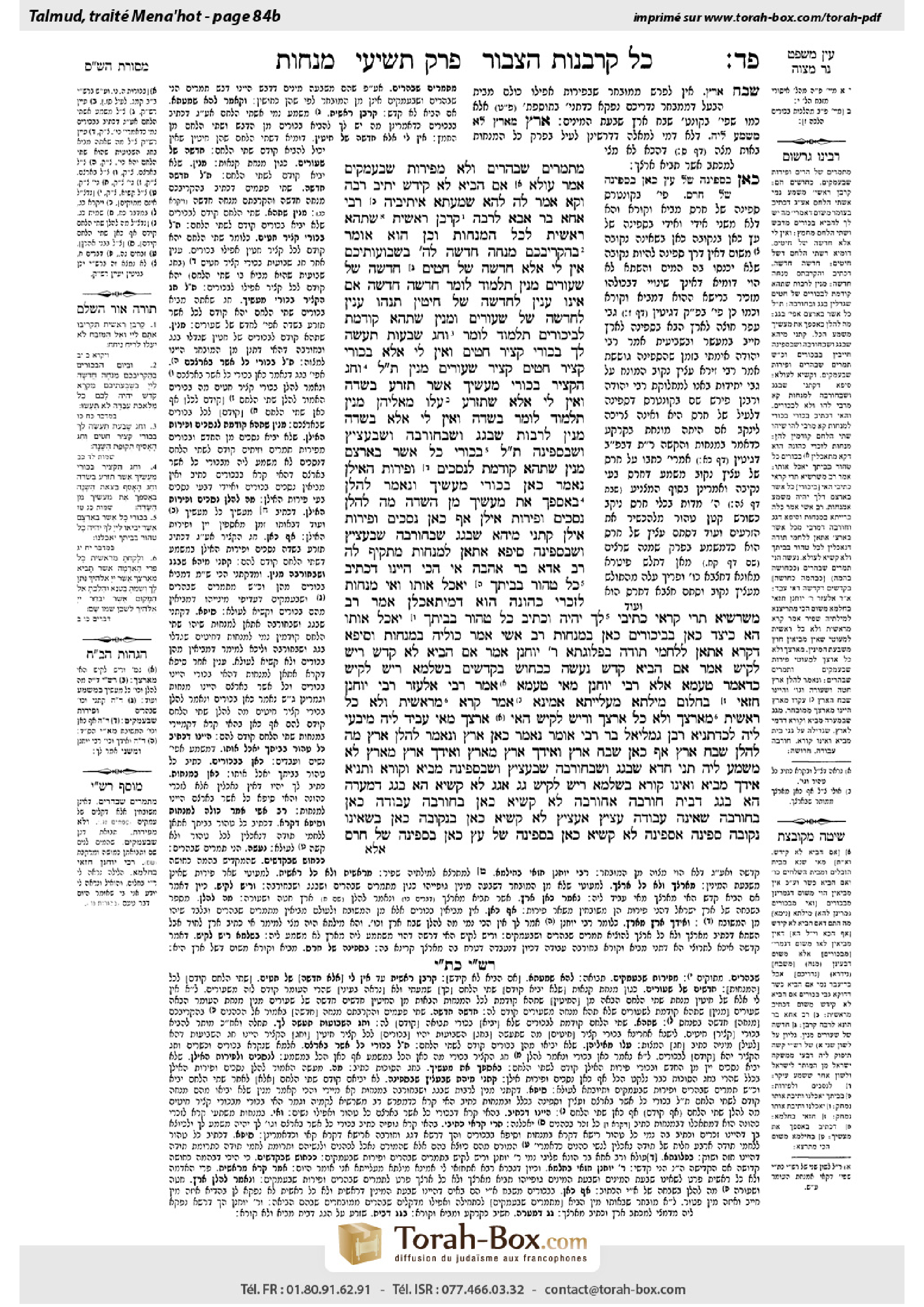
This page of Menachot includes the Aramaic text, an English translation and an AI-generated French translation, alongside the scan above.
מנחות פ״ד ב · Aramaic and Hebrew text
מִתְּמָרִים שֶׁבֶּהָרִים וְלֹא מִפֵּירוֹת שֶׁבָּעֲמָקִים. אָמַר עוּלָּא: אִם הֵבִיא לֹא קִידֵּשׁ.
יָתֵיב רַבָּה וְקָא אָמַר לַהּ לְהָא שְׁמַעְתָּא, אֵיתִיבֵיהּ רַבִּי אַחָא בַּר אַבָּא לְרַבָּה: ״קׇרְבַּן רֵאשִׁית״ – שֶׁתְּהֵא רֵאשִׁית לְכׇל הַמְּנָחוֹת, וְכֵן הוּא אוֹמֵר: ״בְּהַקְרִיבְכֶם מִנְחָה חֲדָשָׁה לַה׳ בְּשָׁבֻעֹתֵיכֶם״.
אֵין לִי אֶלָּא חֲדָשָׁה שֶׁל חִטִּים, חֲדָשָׁה שֶׁל שְׂעוֹרִים מִנַּיִן? תַּלְמוּד לוֹמַר ״חֲדָשָׁה״, ״חֲדָשָׁה״. אִם אֵינוֹ עִנְיָן לַחֲדָשָׁה שֶׁל חִיטִּין – תְּנֵהוּ עִנְיָן לַחֲדָשָׁה שֶׁל שְׂעוֹרִים.
וּמִנַּיִן שֶׁתְּהֵא קוֹדֶמֶת לְבִיכּוּרִים? תַּלְמוּד לוֹמַר: ״וְחַג שָׁבֻעֹת תַּעֲשֶׂה לְךָ בִּכּוּרֵי קְצִיר חִטִּים״, וְאֵין לִי אֶלָּא בִּכּוּרֵי קְצִיר חִטִּים, קְצִיר שְׂעוֹרִים מִנַּיִן? תַּלְמוּד לוֹמַר: ״וְחַג הַקָּצִיר בִּכּוּרֵי מַעֲשֶׂיךָ אֲשֶׁר תִּזְרַע בַּשָּׂדֶה״.
וְאֵין לִי אֶלָּא שֶׁתִּזְרַע, עָלוּ מֵאֲלֵיהֶן מִנַּיִן? תַּלְמוּד לוֹמַר ״בַּשָּׂדֶה״.
וְאֵין לִי אֶלָּא בַּשָּׂדֶה, מִנַּיִן לְרַבּוֹת שֶׁבְּגַג, וְשֶׁבְּחוּרְבָּה, וְשֶׁבְּעָצִיץ, וְשֶׁבִּסְפִינָה? תַּלְמוּד לוֹמַר ״בִּכּוּרֵי כׇּל אֲשֶׁר בְּאַרְצָם״.
מִנַּיִן שֶׁתְּהֵא קוֹדֶמֶת לִנְסָכִים וּפֵירוֹת הָאִילָן? נֶאֱמַר כָּאן ״בִּכּוּרֵי מַעֲשֶׂיךָ״, וְנֶאֱמַר לְהַלָּן ״בְּאׇסְפְּךָ אֶת מַעֲשֶׂיךָ מִן הַשָּׂדֶה״ – מָה לְהַלָּן נְסָכִים וּפֵירוֹת אִילָן, אַף כָּאן נְסָכִים וּפֵירוֹת אִילָן.
קָתָנֵי מִיהָא: שֶׁבְּגַג, שֶׁבְּחוּרְבָּה, שֶׁבְּעָצִיץ, וְשֶׁבִּסְפִינָה. סֵיפָא אֲתָאן לִמְנָחוֹת.
מַתְקֵיף לַהּ רַב אַדָּא בַּר אַהֲבָה: אִי הָכִי, הַיְינוּ דִּכְתִיב ״כׇּל טָהוֹר בְּבֵיתְךָ יֹאכַל אֹתוֹ״, וְאִי מְנָחוֹת, לְזִכְרֵי כְהוּנָּה הוּא דְּמִיתְאַכְלָן!
אָמַר רַב מְשַׁרְשְׁיָא: תְּרֵי קְרָאֵי כְּתִיבִי, ״לְךָ יִהְיֶה״, וּכְתִיב ״כׇּל טָהוֹר בְּבֵיתְךָ יֹאכַל אֹתוֹ״. הָא כֵּיצַד? כָּאן – בְּבִיכּוּרִים, כָּאן – בִּמְנָחוֹת.
רַב אָשֵׁי אָמַר: כּוּלֵּיהּ בִּמְנָחוֹת, וְסֵיפָא דִּקְרָא אֲתָאן לְלַחְמֵי תוֹדָה.
בִּפְלוּגְתָּא: רַבִּי יוֹחָנָן אָמַר – אִם הֵבִיא לֹא קִדֵּשׁ, רֵישׁ לָקִישׁ אָמַר – אִם הֵבִיא קִדֵּשׁ, נַעֲשָׂה כְּכָחוּשׁ בְּקָדָשִׁים.
בִּשְׁלָמָא רֵישׁ לָקִישׁ, כִּדְאָמַר טַעְמָא. אֶלָּא רַבִּי יוֹחָנָן, מַאי טַעְמָא? אָמַר רַבִּי אֶלְעָזָר: רַבִּי יוֹחָנָן חֲזַאי בַּחֲלוֹם, מִילְּתָא מְעַלַּיְיתָא אָמֵינָא. אָמַר קְרָא: ״מֵרֵאשִׁית״ – וְלֹא כׇּל רֵאשִׁית, ״מֵאַרְצְךָ״ – וְלֹא כׇּל אַרְצְךָ.
וְרֵישׁ לָקִישׁ, הַאי ״אַרְצְךָ״ מַאי עָבֵיד לֵיהּ? מִיבְּעֵי לֵיהּ לְכִדְתַנְיָא: רַבָּן גַּמְלִיאֵל בַּר רַבִּי אוֹמֵר, נֶאֱמַר כָּאן ״אֶרֶץ״, וְנֶאֱמַר לְהַלָּן ״אֶרֶץ״, מָה לְהַלָּן שֶׁבַח אֶרֶץ, אַף כָּאן שֶׁבַח אֶרֶץ.
וְאִידַּךְ, ״אֶרֶץ״ ״מֵאֶרֶץ״.
וְאִידַּךְ, ״אֶרֶץ״ ״מֵאָרֶץ״ לָא מַשְׁמַע לֵיהּ.
תָּנֵי חֲדָא: שֶׁבְּגַג, וְשֶׁבְּחוּרְבָּה, שֶׁבְּעָצִיץ, וְשֶׁבִּסְפִינָה – מֵבִיא וְקוֹרֵא. וְתַנְיָא אִידַּךְ: מֵבִיא וְאֵינוֹ קוֹרֵא.
בִּשְׁלָמָא רֵישׁ לָקִישׁ, גַּג אַגַּג לָא קַשְׁיָא: הָא – בְּגַג דִּמְעָרָה, הָא – בְּגַג דְּבַיִת.
חוּרְבָּה אַחוּרְבָּה – לָא קַשְׁיָא: כָּאן בְּחוּרְבָּה עֲבוּדָה, כָּאן בְּחוּרְבָּה שֶׁאֵינָהּ עֲבוּדָה.
עָצִיץ אַעָצִיץ – לָא קַשְׁיָא: כָּאן בְּנָקוּב, כָּאן בְּשֶׁאֵינוֹ נָקוּב.
סְפִינָה אַסְּפִינָה – לָא קַשְׁיָא, כָּאן בִּסְפִינָה שֶׁל עֵץ, כָּאן בִּסְפִינָה שֶׁל חֶרֶס.
Menachot 84b · English translation
bring them from dates that grow in the mountains, and one may not bring them from produce that grows in the valleys. Such produce is of inferior quality and may not be used. Ulla says: Even if one did bring such produce, he does not thereby consecrate it, i.e., it does not attain the consecrated status of first fruits.
Rabba sat in the study hall and stated this halakha. Rabbi Aḥa bar Abba raised an objection to Rabba from a baraita: The Torah refers to the two loaves offering as: “A first offering to the Lord” (Leviticus 2:11), which indicates that it is to be the first of all the meal offerings that come from the new crop. And similarly the verse states with regard to the festival of Shavuot: “On the day of the first fruits, when you bring a new meal offering to the Lord” (Numbers 28:26). By designating the two loaves as “new,” the verse indicates that they should be brought from the first of the new crop.
I have derived only that it must be new, i.e., the first, of all wheat meal offerings. From where do I derive that it must also be new, i.e., the first, of all barley meal offerings, e.g., the meal offering of a sota? With regard to the two loaves, the verse states the word “new,” and again states the word “new,” once in Numbers 28:26 and again in Leviticus 23:16. If the second mention is not needed to teach the matter of being the new meal offering of wheat, apply it to the matter of being the new meal offering of barley.
The baraita continues: And from where is it derived that the two loaves precede the bringing of the first fruits as well? The verse states: “And you shall make for yourself a festival of Shavuot, the first fruits of the wheat harvest” (Exodus 34:22). The order of the verse teaches that the offering of the Festival, which is the two loaves offering, precedes the bringing of the first fruits of the wheat harvest. I have derived only that the two loaves precede the first fruits of the wheat harvest. From where do I derive that they also precede the bringing of the first fruits of the barley harvest? The verse states with regard to the festival of Shavuot: “And the festival of the harvest, the first fruits of your labors, which you will sow in the field” (Exodus 23:16). The order of the verse teaches that the offering of the Festival, which is the two loaves offering, precedes all forms of first fruits that are sown in the field, which includes barley.
From this verse, I have derived only that the two loaves precede the bringing of the first fruits that sprouted from seeds you sowed, as the verse states: “Which you will sow.” From where do I derive that they precede even the bringing of first fruits that sprouted by themselves? The continuation of that verse states: “In the field” (Exodus 23:16). The term is superfluous and serves to include even produce that sprouted by itself.
The baraita continues: From this verse, I have derived only that the two loaves precede the bringing of produce that grew in a field. From where do I derive to include even produce that grew on a roof, or that grew in a ruin, or that grew in a flowerpot, or that grew on a ship? The verse states with regard to the priestly gifts: “The first fruit of all that grows in their land, which they shall bring to the Lord, shall be yours” (Numbers 18:13). The term “first fruits” in this verse is referring to all types of first fruits. This teaches that when the two loaves are referred to as the first fruits (see Exodus 34:22), the intention is that they should be brought first before all other types of produce.
The baraita concludes: From where is it derived that the offering of the two loaves is to precede both the bringing of libations from grapes of the new crop and the bringing of the first fruits of the tree? It is stated here, with regard to the two loaves: “The first fruits of your labors” (Exodus 23:16), and it is stated there at the end of that verse: “When you gather in the products of your labors from the field.” Just as there, the term “your labors” is referring both to fruits used for the libations and the fruit of the tree, so too, here, the term is referring to both fruits used for the libations and the fruit of the tree.
Rabbi Aḥa bar Abba explains how the baraita poses a challenge to Ulla’s ruling: In any event, it was taught in this baraita that bringing the two loaves must precede even the bringing of produce that grew on a roof, that grew in a ruin, that grew in a flowerpot, or that grew on a ship. This indicates that all these types of produce are valid to be brought as first fruits, despite the fact that they are of inferior quality. This would appear to contradict Ulla’s ruling that dates that grow in the mountains and produce grown in the valleys are not fit to be brought as first fruits. Rabba explains: Whereas in the first clause, the baraita discusses which types of produce can be used for the first fruits, in the latter clause we come to discuss which grains can be used for meal offerings. Produce that grew in these atypical locations is valid to be brought as meal offerings, but not as first fruits.
The later clause of the baraita explained that the verse: “The first fruit of all that grows in their land” (Numbers 18:13), is referring to produce that grows in atypical locations. Rabba defended Ulla’s opinion by explaining that the verse concerns meal offerings only. Rav Adda bar Ahava objects to this: If so, that which is written in the latter part of the verse: “Any pure member of your household may eat of it,” is difficult, as the phrase “your household” includes a priest’s wife and daughters and teaches that they may also partake of the priestly gifts referred to in the verse; but if the verse is referring to meal offerings, that is problematic as they are permitted to be eaten only by male priests.
In resolution of this difficulty, Rav Mesharshiyya said: Perforce this verse should be read as if two verses are written, as otherwise it contains an inherent contradiction: The first clause states: “The first fruit…shall be yours” (Numbers 18:13), indicating that only a priest himself may partake of the priestly gifts. And it is written in the continuation of the verse: “Any pure member of your household may eat of it,” indicating that even female family members may partake of it. How can these texts be reconciled? Here, the latter part of the verse, concerns the first fruits, which even female family members may eat, and there, the first part of the verse, concerns meal offerings, which may be eaten only by male priests.
Rav Ashi said that there is an alternative resolution: The verse in its entirety concerns meal offerings, but with the latter clause of the verse we come to the specific case of the loaves of a thanks offering, which even female family members of the priest may eat.
§ The Gemara notes: Ulla and Rav Aḥa bar Abba disagree with regard to the issue that is the subject of the dispute of earlier amora’im: Rabbi Yoḥanan says: Even if one did bring mountain dates or valley produce as first fruits, he does not thereby consecrate them, i.e., they do not attain the sanctified status of first fruits. Reish Lakish says: If one did bring them, he has consecrated them; they are regarded just like a gaunt animal with regard to sacrificial animals. Although it is improper to consecrate such animals or such produce as an offering, if one does, the consecration certainly takes effect.
The Gemara discusses the dispute: Granted, the opinion of Reish Lakish is well founded, as he stated the reason for his ruling. But as for Rabbi Yoḥanan, what is the reason for his ruling? Rabbi Elazar said: I have an explanation of Rabbi Yoḥanan’s ruling and since I was privileged to see Rabbi Yoḥanan in a dream, I know that I am saying a proper matter. The verse states with regard to first fruits: “And you shall take from the first of all the fruit” (Deuteronomy 26:2). The addition of the word “from” indicates that one should take from some of the first fruits, but not from all the first fruits. This teaches that one should use only the seven species for the mitzva. The verse continues: “That you shall bring from your land.” The addition of the word “from” indicates that one should take first fruits from some areas of the land, but not from all areas in your land. This teaches that one should not take dates from the mountains or produce from the valleys.
The Gemara asks: And as for Reish Lakish, for what halakha does he use this term “your land”? He holds that the term is necessary for that which is taught in a baraita: Rabban Gamliel, son of Rabbi Yehuda HaNasi, says: “From your land” is stated here (Deuteronomy 26:2), with regard to the first fruits, and “land” is stated there with regard to the praise of Eretz Yisrael: “A land of wheat and barley, vines, figs, and pomegranates, a land of olive oil and honey” (Deuteronomy 8:8), which are the seven species. This serves as the basis for a verbal analogy and teaches that just as there, the verse is referring only to the produce that is the praise of Eretz Yisrael, so too, here, with regard to the mitzva to bring the first fruits, the verse is referring only to the produce that is the praise of Eretz Yisrael, i.e., the seven species.
The Gemara asks: And the other one, Rabbi Yoḥanan, since he has already expounded the term “from your land” to teach that one may not use mountain dates or valley produce, from where does he derive that only the seven species may be used? Rabbi Yoḥanan holds that since the Torah could have just written “your land” but instead writes “from your land,” the word “land” can be used to form the verbal analogy while the word “from” can teach that one may not use mountain dates or valley produce.
And the other one, Reish Lakish, what does he derive from the fact that the Torah adds the word “from”? He does not learn anything from the fact the Torah could have just written “your land” but instead writes “from your land.” In Hebrew, the term: From your land, is expressed by a single word: Me’artzekha. Reish Lakish holds that the verbal analogy uses the entire word.
§ It is taught in one baraita: With regard to produce that grew on a roof, or that grew in a ruin, or that grew in a flowerpot, or that grew on a ship, the owner brings it to the Temple and recites the accompanying passage of thanks to God (see Deuteronomy 26:1–11). And it is taught in another baraita with regard to such fruits: The owner brings them but does not recite the accompanying passage.
The Gemara attempts to reconcile the baraitot: Granted according to Reish Lakish, both baraitot accord with his opinion that even inferior produce can be brought as first fruits, and they contradict each other only with regard to whether or not one should recite the accompanying passage. And even with regard to that, the fact that the ruling of one baraita about produce that grew on a roof is contradicted by the ruling of the other baraita about produce that grew on a roof is not difficult. One can explain that this baraita, which states that the passage is recited, is referring to a roof of a cave, which is considered part of the ground, whereas that baraita, which states that the passage is not recited, is referring to a roof of a house.
Similarly, the fact that the ruling of one baraita about produce that grew in a ruin is contradicted by the ruling of the other baraita about produce that grew in a ruin is not difficult. One can explain that here, the baraita that states that the passage is recited, is referring to a cultivated ruin, whereas there, the baraita that states that the passage is not recited, is referring to an uncultivated ruin.
And the fact that the ruling of one baraita about produce that grew in a flowerpot is contradicted by the ruling of the other baraita about produce that grew in a flowerpot is not difficult. One can explain that here, the baraita that states that the passage is recited, is referring to a perforated flowerpot, where the produce is able to draw nourishment from the soil beneath it, whereas there, the baraita that states that the passage is not recited, is referring to an unperforated flowerpot.
And the fact that the ruling of one baraita about fruit that grew on a ship is contradicted by the ruling of the other baraita about fruit that grew on a ship is not difficult. One can explain that here, the baraita that states that the passage is recited is referring to a ship made of wood, where the fruit was able to draw nourishment through the wood from the ground, whereas, there, the baraita that states that the passage is not recited is referring to a ship made of earthenware.
Menachot 84b · Traduction française (IA)
On doit les apporter à partir de dattes qui poussent dans les montagnes, et non de produits qui poussent dans les vallées. Ces produits sont de qualité inférieure et ne peuvent être utilisés. Oulla dit : Même si quelqu’un a apporté de tels produits, il ne les a pas consacrés par là, c’est-à-dire qu’ils n’acquièrent pas le statut consacré des prémices.
Rabba était assis à la maison d’étude et énonça cette halakha. Rabbi Aḥa bar Abba souleva une objection contre Rabba à partir d’une baraïta : La Torah désigne l’offrande des deux pains comme « une première offrande pour le Seigneur » (Lévitique 2:11), ce qui indique qu’elle doit être la première de toutes les offrandes de farine provenant de la nouvelle récolte. De même, le verset dit au sujet de la fête de Chavouot : « Le jour des prémices, quand vous apportez une nouvelle offrande de farine au Seigneur » (Nombres 28:26). En qualifiant les deux pains de « nouveaux », le verset indique qu’ils doivent être apportés à partir des premiers produits de la nouvelle récolte.
J’ai établi seulement qu’elle doit être nouvelle, c’est-à-dire la première, parmi toutes les offrandes de farine de blé. D’où déduis-je qu’elle doit aussi être nouvelle, c’est-à-dire la première, parmi toutes les offrandes de farine d’orge, par exemple l’offrande de farine d’une sota ? Au sujet des deux pains, le verset emploie le mot « nouvelle », puis le répète, une fois en Nombres 28:26 et une autre fois en Lévitique 23:16. Si cette seconde mention n’est pas nécessaire pour enseigner qu’il s’agit de la nouvelle offrande de farine de blé, appliquons-la à l’enseignement qu’il s’agit de la nouvelle offrande de farine d’orge.
La baraïta poursuit : D’où déduit-on que les deux pains doivent aussi précéder l’apport des prémices ? Le verset dit : « Tu célébreras pour toi la fête de Chavouot, les prémices de la moisson du blé » (Exode 34:22). L’ordre du verset enseigne que l’offrande de la fête, à savoir l’offrande des deux pains, précède l’apport des prémices de la moisson du blé. J’ai établi seulement que les deux pains précèdent les prémices de la moisson du blé. D’où déduis-je qu’ils précèdent également l’apport des prémices de la moisson de l’orge ? Au sujet de la fête de Chavouot, le verset dit : « La fête de la moisson, les prémices de tes travaux, que tu sèmeras dans le champ » (Exode 23:16). L’ordre du verset enseigne que l’offrande de la fête, à savoir l’offrande des deux pains, précède toutes les sortes de prémices semées dans le champ, ce qui inclut l’orge.
À partir de ce verset, j’ai établi seulement que les deux pains précèdent l’apport des produits qui ont germé à partir de graines que vous avez semées, puisque le verset dit : « Que tu sèmeras ». D’où déduis-je qu’ils précèdent même l’apport des prémices qui ont germé spontanément ? La suite de ce verset dit : « Dans le champ » (Exode 23:16). Cette expression est superflue et sert à inclure même les produits qui ont germé spontanément.
La baraïta poursuit : À partir de ce verset, j’ai établi seulement que les deux pains précèdent l’apport des produits qui ont poussé dans un champ. D’où déduis-je qu’il faut inclure même les produits qui ont poussé sur un toit, dans une ruine, dans un pot de fleurs ou sur un bateau ? Au sujet des dons sacerdotaux, le verset dit : « Les prémices de tout ce qui pousse dans leur pays, qu’ils apporteront au Seigneur, seront à toi » (Nombres 18:13). L’expression « prémices » dans ce verset désigne toutes les sortes de prémices. Cela enseigne que lorsque les deux pains sont appelés les prémices (voir Exode 34:22), il faut comprendre qu’ils doivent être apportés avant tous les autres types de produits.
La baraïta conclut : D’où déduit-on que l’offrande des deux pains doit précéder aussi bien l’apport des libations faites avec des raisins de la nouvelle récolte que l’apport des prémices des arbres ? Il est dit ici, au sujet des deux pains : « Les prémices de tes travaux » (Exode 23:16), et il est dit là, à la fin de ce verset : « Lorsque tu recueilleras les produits de tes travaux des champs ». De même que là, l’expression « tes travaux » désigne à la fois les fruits utilisés pour les libations et les fruits des arbres, de même ici, elle désigne à la fois les fruits utilisés pour les libations et les fruits des arbres.
Rabbi Aḥa bar Abba explique en quoi la baraïta met en cause la décision d’Oulla : Quoi qu’il en soit, il a été enseigné dans cette baraïta que l’apport des deux pains doit précéder même l’apport des produits qui ont poussé sur un toit, dans une ruine, dans un pot de fleurs ou sur un bateau. Cela indique que toutes ces sortes de produits peuvent être apportées comme prémices, bien qu’elles soient de qualité inférieure. Cela semble contredire la décision d’Oulla selon laquelle les dattes qui poussent dans les montagnes et les produits qui poussent dans les vallées ne peuvent pas être apportés comme prémices. Rabba explique : Alors que la première partie de la baraïta traite des sortes de produits qui peuvent être utilisées comme prémices, la dernière partie traite des céréales qui peuvent être utilisées pour les offrandes de farine. Les produits qui ont poussé dans ces endroits inhabituels peuvent être apportés comme offrandes de farine, mais pas comme prémices.
La dernière partie de la baraïta expliquait que le verset « Les prémices de tout ce qui pousse dans leur pays » (Nombres 18:13) désigne les produits qui poussent dans des endroits inhabituels. Rabba a défendu l’avis d’Oulla en expliquant que le verset concerne seulement les offrandes de farine. Rav Adda bar Ahava objecte : Dans ce cas, les mots qui suivent dans le verset, « Tout membre pur de ta maison pourra en manger », posent problème : l’expression « ta maison » inclut l’épouse et les filles d’un prêtre et enseigne qu’elles peuvent, elles aussi, consommer les dons sacerdotaux visés par le verset ; mais si le verset se rapporte aux offrandes de farine, cela pose problème, puisqu’elles ne peuvent être consommées que par des prêtres de sexe masculin.
Pour résoudre cette difficulté, Rav Mesharshiyya dit : Il faut nécessairement lire ce verset comme s’il y en avait deux, faute de quoi il contient une contradiction intrinsèque. La première partie dit : « Les prémices… seront à toi » (Nombres 18:13), ce qui indique que seul le prêtre lui-même peut consommer les dons sacerdotaux. Pourtant, la suite du verset dit : « Tout membre pur de ta maison pourra en manger », ce qui indique que même les membres féminins de la famille peuvent en consommer. Comment concilier ces textes ? Ici, la dernière partie du verset concerne les prémices, que les membres féminins de la famille peuvent aussi consommer ; là, la première partie du verset concerne les offrandes de farine, que seuls les prêtres de sexe masculin peuvent consommer.
Rav Ashi dit qu’il existe une autre façon de résoudre la difficulté : le verset dans son intégralité concerne les offrandes de farine, mais, dans sa dernière partie, il s’agit du cas particulier des pains d’une offrande de reconnaissance, que les membres féminins de la famille du prêtre peuvent eux aussi consommer.
§ La Guemara relève : Oulla et Rav Aḥa bar Abba sont en désaccord sur la question qui fait l’objet du différend entre des amoraïm antérieurs. Rabbi Yoḥanan dit : Même si quelqu’un a apporté comme prémices des dattes des montagnes ou des produits des vallées, il ne les a pas consacrés par là, c’est-à-dire qu’ils n’acquièrent pas le statut consacré des prémices. Reish Lakish dit : S’il les a apportés, il les a consacrés ; ils sont considérés comme un animal décharné au regard des animaux destinés aux sacrifices. Bien qu’il soit inapproprié de consacrer de tels animaux ou de tels produits comme offrande, si on le fait, la consécration prend certainement effet.
La Guemara examine le différend : L’avis de Reish Lakish est fondé, puisqu’il a donné la raison de sa décision. Mais, selon Rabbi Yoḥanan, quelle est la raison de sa décision ? Rabbi Elazar dit : J’ai une explication de la décision de Rabbi Yoḥanan et, puisque j’ai eu le privilège de voir Rabbi Yoḥanan en rêve, je sais que ce que je dis est juste. Au sujet des prémices, le verset dit : « Tu prendras des premiers fruits » (Deutéronome 26:2). L’ajout du mot « de » indique qu’on doit prendre parmi les premiers fruits, mais pas tous les premiers fruits. Cela enseigne qu’on doit utiliser uniquement les sept espèces pour la mitsva. Le verset poursuit : « Que tu apporteras de ton pays ». L’ajout du mot « de » indique qu’on doit prendre des prémices dans certaines régions du pays, mais pas dans toutes les régions de ton pays. Cela enseigne qu’on ne doit pas prendre de dattes des montagnes ni de produits des vallées.
La Guemara demande : Et Reish Lakish, à quelle halakha applique-t-il l’expression « ton pays » ? Il estime que cette expression est nécessaire pour l’enseignement transmis dans une baraïta : Rabban Gamliel, fils de Rabbi Yehuda HaNasi, dit : « De ton pays » est mentionné ici (Deutéronome 26:2), au sujet des prémices, et le mot « pays » est mentionné là, à propos de l’éloge d’Eretz Yisrael : « Un pays de blé et d’orge, de vignes, de figuiers et de grenadiers, un pays d’huile d’olive et de miel » (Deutéronome 8:8), qui sont les sept espèces. Cela sert de base à une analogie verbale et enseigne que, de même que là, le verset ne concerne que les produits qui font l’éloge d’Eretz Yisrael, de même ici, au sujet de la mitsva d’apporter les prémices, le verset ne concerne que les produits qui font l’éloge d’Eretz Yisrael, c’est-à-dire les sept espèces.
La Guemara demande : Et l’autre, Rabbi Yoḥanan, puisqu’il a déjà interprété l’expression « de ton pays » comme enseignant qu’on ne peut pas utiliser des dattes des montagnes ou des produits des vallées, d’où déduit-il que seules les sept espèces peuvent être utilisées ? Rabbi Yoḥanan estime que, puisque la Torah aurait pu écrire simplement « ton pays », mais écrit plutôt « de ton pays », le mot « pays » peut servir à établir l’analogie verbale, tandis que le mot « de » peut enseigner qu’on ne peut pas utiliser des dattes des montagnes ou des produits des vallées.
Et l’autre, Reish Lakish, que déduit-il du fait que la Torah ajoute le mot « de » ? Il ne déduit rien du fait que la Torah aurait pu écrire simplement « ton pays », mais écrit plutôt « de ton pays ». En hébreu, l’expression « de ton pays » est rendue par un seul mot : Me’artzekha. Reish Lakish estime que l’analogie verbale porte sur le mot entier.
§ Il est enseigné dans une baraïta : Pour les produits qui ont poussé sur un toit, dans une ruine, dans un pot de fleurs ou sur un bateau, leur propriétaire les apporte au Temple et récite le passage de remerciement à Dieu qui accompagne l’offrande (voir Deutéronome 26:1–11). Une autre baraïta enseigne au sujet de tels fruits : leur propriétaire les apporte, mais ne récite pas le passage qui accompagne l’offrande.
La Guemara tente de concilier les baraïtot : Il est compréhensible que, selon Reish Lakish, les deux baraïtot concordent avec son avis selon lequel même des produits de qualité inférieure peuvent être apportés comme prémices et qu’elles ne se contredisent que sur la question de savoir s’il faut ou non réciter le passage qui accompagne l’offrande. Même sur ce point, il n’est pas difficile que la décision d’une baraïta concernant les produits qui ont poussé sur un toit contredise celle de l’autre baraïta concernant les produits qui ont poussé sur un toit. On peut expliquer que cette baraïta, qui indique que le passage est récité, parle d’un toit de grotte, considéré comme faisant partie du sol, tandis que cette baraïta, qui indique que le passage n’est pas récité, parle du toit d’une maison.
De même, il n’est pas difficile que la décision d’une baraïta concernant les produits qui ont poussé dans une ruine contredise celle de l’autre baraïta concernant les produits qui ont poussé dans une ruine. On peut expliquer qu’ici, la baraïta qui indique que le passage est récité parle d’une ruine cultivée, tandis que là, la baraïta qui indique que le passage n’est pas récité parle d’une ruine non cultivée.
Et il n’est pas difficile que la décision d’une baraïta concernant les produits qui ont poussé dans un pot de fleurs contredise celle de l’autre baraïta concernant les produits qui ont poussé dans un pot de fleurs. On peut expliquer qu’ici, la baraïta qui indique que le passage est récité parle d’un pot de fleurs percé, où les produits peuvent puiser leur nourriture dans le sol situé en dessous, tandis que là, la baraïta qui indique que le passage n’est pas récité parle d’un pot de fleurs non percé.
Et il n’est pas difficile que la décision d’une baraïta concernant les fruits qui ont poussé sur un bateau contredise celle de l’autre baraïta concernant les fruits qui ont poussé sur un bateau. On peut expliquer qu’ici, la baraïta qui indique que le passage est récité parle d’un bateau en bois, dont le bois permettait aux fruits de puiser leur nourriture dans le sol, tandis que là, la baraïta qui indique que le passage n’est pas récité parle d’un bateau en terre cuite.
Traduction française générée par IA à partir de l’édition anglaise de Sefaria. Vérifie toujours un passage avec le texte source.
Text from Sefaria: William Davidson Edition - Vocalized Aramaic (unknown); William Davidson Edition - English (CC BY NC).