Menachot 85a: Talmud study for Daf Yomi
Daf Yomi is the daily study of one Talmud folio. Explore 37 tractates with scans, Hebrew text, Sefaria English and AI-generated French translations where annotated.
Passage selection and English or AI-generated French translation are available where the scan has annotations. Daf Study is independent of Torah-Box and Sefaria.
Browse Menachot · מנחות · All tractatesMenachot 85a text and translations
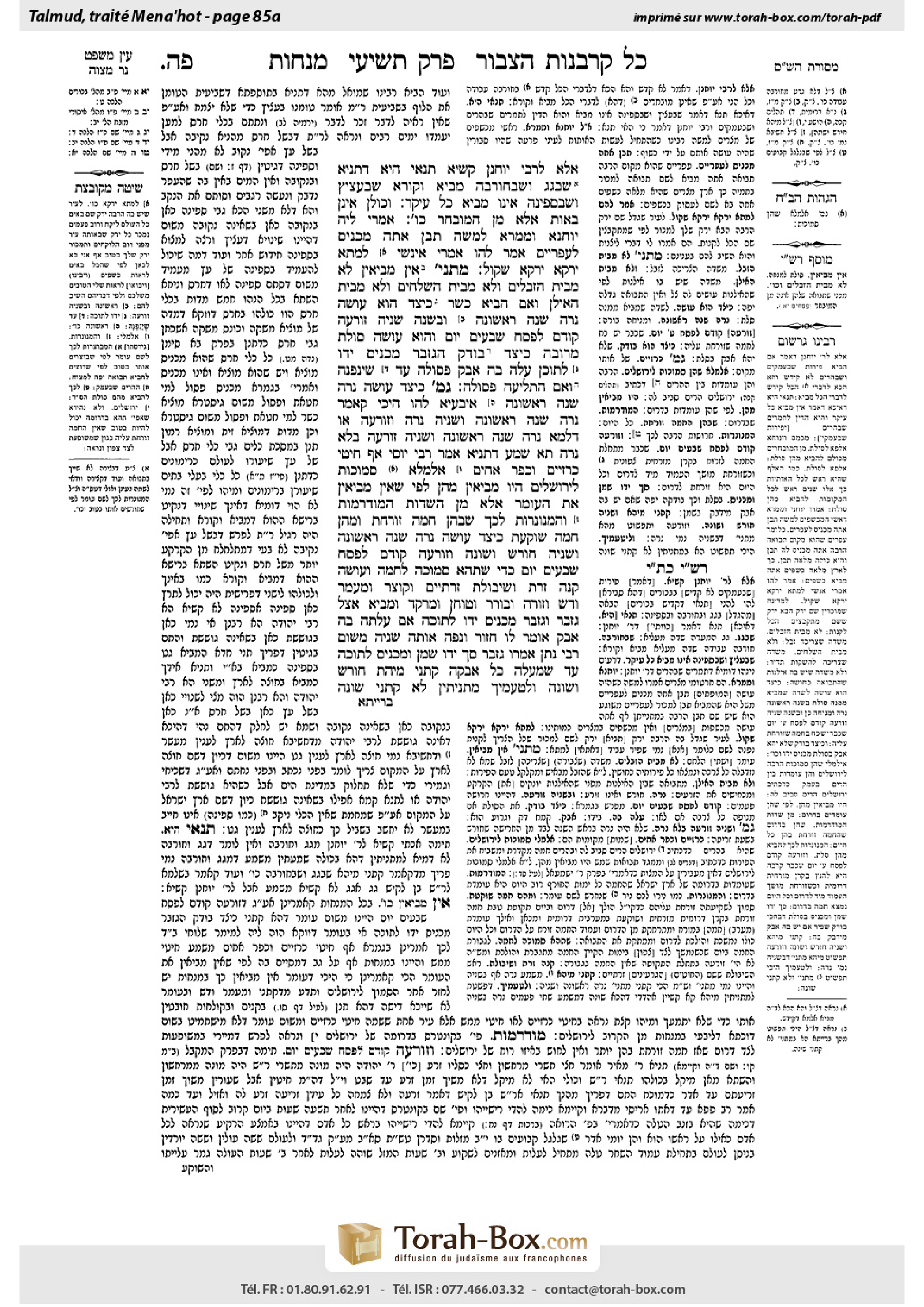
This page of Menachot includes the Aramaic text, an English translation and an AI-generated French translation, alongside the scan above.
מנחות פ״ה א · Aramaic and Hebrew text
אֶלָּא לְרַבִּי יוֹחָנָן, קַשְׁיָא?
תַּנָּאֵי הִיא, דְּתַנְיָא: שֶׁבְּגַג וְשֶׁבְּחוּרְבָּה – מֵבִיא וְקוֹרֵא, שֶׁבְּעָצִיץ וְשֶׁבִּסְפִינָה – אֵינוֹ מֵבִיא כׇּל עִיקָּר.
וְכוּלָּן אֵינָן בָּאוֹת אֶלָּא מִן הַמּוּבְחָר כּוּ׳. אָמְרִי לֵיהּ יוֹחָנָא וּמַמְרֵא לְמֹשֶׁה: תֶּבֶן אַתָּה מַכְנִיס לְעֶפְרַיִים! אֲמַר לְהוּ: אָמְרִי אִינָשֵׁי ״לְמָתָא יַרְקָא – יַרְקָא שְׁקוֹל״.
מַתְנִי׳ אֵין מְבִיאִין לֹא מִבֵּית הַזְּבָלִים, וְלֹא מִבֵּית הַשְּׁלָחִים, וְלֹא מִבֵּית הָאִילָן, וְאִם הֵבִיא – כָּשֵׁר.
כֵּיצַד הוּא עוֹשֶׂה? נָרָהּ שָׁנָה רִאשׁוֹנָה, וּבְשָׁנָה שְׁנִיָּה זוֹרְעָהּ קוֹדֶם לַפֶּסַח שִׁבְעִים יוֹם, וְהִוא עוֹשָׂה סוֹלֶת מְרוּבָּה.
כֵּיצַד בּוֹדֵק הַגִּזְבָּר? מַכְנִיס יָדוֹ לְתוֹכָהּ. עָלָה בָּהּ אָבָק – פְּסוּלָה, עַד שֶׁיְּנַפֶּנָּה.
וְאִם הִתְלִיעָה – פְּסוּלָה.
גְּמָ׳ כֵּיצַד עוֹשֶׂה? נָרָהּ שָׁנָה רִאשׁוֹנָה. אִיבַּעְיָא לְהוּ: הֵיכִי קָאָמַר? נָרָהּ שָׁנָה רִאשׁוֹנָה וּשְׁנִיָּה נָרָהּ וְזוֹרְעָהּ, אוֹ דִלְמָא נָרָהּ שָׁנָה רִאשׁוֹנָה וּשְׁנִיָּה זוֹרְעָהּ בְּלֹא נָרָהּ?
תָּא שְׁמַע, דְּתַנְיָא: אָמַר רַבִּי יוֹסֵי: אַף חִיטֵּי כָּרָזִיִּים וּכְפַר אַחִים, אִלְמָלֵא סְמוּכוֹת לִירוּשָׁלַיִם – הָיוּ מְבִיאִין מֵהֶן, לְפִי שֶׁאֵין מְבִיאִין אֶת הָעוֹמֶר אֶלָּא מִן הַשָּׂדוֹת הַמּוּדְרָמוֹת וְהַמְנוֹנָרוֹת לְכָךְ, שֶׁבָּהֶן חַמָּה זוֹרַחַת, וּמֵהֶן חַמָּה שׁוֹקַעַת.
כֵּיצַד עוֹשֶׂה? נָרָהּ שָׁנָה רִאשׁוֹנָה, וּשְׁנִיָּה חוֹרֵשׁ וְשׁוֹנֶה, וְזוֹרְעָהּ קוֹדֶם לַפֶּסַח שִׁבְעִים יוֹם, כְּדֵי שֶׁתְּהֵא סְמוּכָה לַחַמָּה, וְעוֹשָׂה קָנֶה זֶרֶת וְשִׁיבּוֹלֶת זִרְתַּיִים.
וְקוֹצֵר וּמְעַמֵּר, וְדָשׁ, וְזוֹרֶה, וּבוֹרֵר, וְטוֹחֵן, וּמְרַקֵּד, וּמֵבִיא אֵצֶל גִּזְבָּר, וְגִזְבָּר מַכְנִיס יָדוֹ לְתוֹכָהּ. אִם עָלְתָה בָּהּ אָבָק – אוֹמֵר לוֹ: ״חֲזוֹר וְנַפֵּה אוֹתָהּ שְׁנִיָּה״. מִשּׁוּם רַבִּי נָתָן אָמְרוּ: גִּזְבָּר סָךְ יָדוֹ שֶׁמֶן, וּמַכְנִיס לְתוֹכָהּ עַד שֶׁמַּעֲלֶה כׇּל אֲבָקָהּ.
קָתָנֵי מִיהַת חוֹרֵשׁ וְשׁוֹנֶה.
וּלְטַעְמָיךְ, מַתְנִיתִין לָא קָתָנֵי ״שׁוֹנֶה״,
Menachot 85a · English translation
Having reconciled all the apparent contradictions between the two baraitot according to the opinion of Reish Lakish, the Gemara asks: But according to Rabbi Yoḥanan, who holds inferior produce cannot be consecrated as first fruits, the first baraita is difficult, as it states that inferior produce can be consecrated.
The Gemara answers: The baraitot cited above contradict Rabbi Yoḥanan’s opinion. But there is a dispute between tanna’im with regard to this issue, as it is taught in a baraita: With regard to produce that grew on a roof, or that grew in a ruin, the owner brings it and recites the accompanying passage. With regard to produce that grew in a flowerpot, or that grew on a ship, the owner does not bring it at all. Rabbi Yoḥanan holds in accordance with that baraita.
§ The mishna states: And all meal offerings come only from the optimal produce. One of the places the mishna mentions as having good-quality produce is Aforayim. The superior quality of its produce was so well known that Aforayim was used as an example in colloquial aphorisms. In Moses and Aaron’s first meeting with Pharaoh, Aaron cast his staff to the ground, whereupon it turned into a serpent. Pharaoh’s necromancers then duplicated the feat using their incantations, only to then be confounded when Aaron’s staff swallowed up all of theirs (see Exodus 7:10–12). The Gemara relates the conversation that took place: Pharaoh’s two leading necromancers, Yoḥana and Mamre, said to Moses: Are you bringing straw to Afarayim? Performing necromancy in Egypt, the world leader in sorcery, is like bringing straw to Afarayim, which is rich in the finest grains. Moses said to them: It is as people say: To a city rich in herbs, take herbs. If you want to guarantee that people will appreciate your merchandise, bring it to a place where they are familiar with it.
MISHNA: Even when selecting grain for meal offerings from the locations mentioned in the previous mishna, one may not bring as a meal offering grain from a fertilized field, nor from an irrigated field, nor from a field of trees, as such fields do not produce grain of optimal quality. But if one did bring a meal offering of grain from such fields, it is fit.
How does one produce optimal-quality grain? He plows the field during the first year, but he does not sow it, and in the second year, he sows it seventy days before Passover, and in that manner it produces grain that will provide an abundance of fine, high-quality flour.
How does the Temple treasurer inspect the flour to determine whether it is of sufficiently high quality? The treasurer inserts his hand into the flour. If, when he removes his hand, flour powder covers it, the flour is unfit, until one sifts it with a fine sifter, so that no powder will remain.
And if the flour became wormy, it is unfit for use in a meal offering.
GEMARA: The mishna states: How does one produce optimal-quality grain? He plows the field during the first year, and in the second year he sows it. The Gemara clarifies what should be done in the second year: A dilemma was raised before the Sages: What is the tanna saying? Is he saying that he plows the field during the first year, and in the second year he plows it and sows it? Or perhaps he is saying that he plows the field during the first year, and in the second year he sows it without plowing it.
The Gemara suggests: Come and hear a resolution, as it is taught in a baraita: Rabbi Yosei says: Also concerning grain grown in Kerazayim and Kefar Aḥim, if only those places had been close to Jerusalem, they would have brought barley from them for the omer. As the halakha is that one brings the omer only from the southern fields and those that were plowed for that purpose, as upon such fields, the sun rises and shines, and from those fields, the sun also sets. In other words, those fields are exposed to a lot of sunlight, so they produce a superior-quality crop. Kerazayim and Kefar Aḥim were such fields, but they were too far from Jerusalem for their barley to be used for the omer offering.
The baraita continues: How does one produce optimal-quality grain? He plows the field during the first year, and in the second year, he plows it once and then repeats the plowing a second time, and he sows it seventy days before Passover. It is done this way in order that the sowing will be done close to the time when the strength of the sun reaches its climax, and will thereby produce a high-quality crop in which the length of a stalk is a handspan and the ear itself is two handspans.
And then one reaps the grain and gathers it together into a pile, and then he threshes the grain and winnows it, and then he sorts the inedible admixture from the edible grain, and then he grinds the grain and sifts it and brings the flour produced to the Temple treasurer. And the treasurer inserts his hand into it in order to check its quality. If upon removing his hand powder covers it, the treasurer says to the owner: Go back and sift it a second time. The Sages say in the name of Rabbi Natan that the treasurer would perform a more thorough examination of the flour’s quality. He douses his hand with oil and then inserts it into the flour until all of its powder will be brought up.
The Gemara explains that the baraita provides a resolution to the dilemma: In any event, the baraita teaches that during the second year, the owner of the field plows it once and then repeats the plowing. It is explicit, then, that during the second year the field should be plowed.
The Gemara rejects this proof: But even according to your reasoning, ultimately the mishna does not teach that he plows the field and then repeats the plowing;
Menachot 85a · Traduction française (IA)
Après avoir résolu, selon l’opinion de Reish Lakish, toutes les contradictions apparentes entre les deux baraïtot, la Guemara demande : Mais selon Rabbi Yoḥanan, qui soutient que des produits de qualité inférieure ne peuvent pas être consacrés comme prémices, la première baraïta pose problème, puisqu’elle affirme que de tels produits peuvent être consacrés.
La Guemara répond : Les baraïtot citées plus haut contredisent l’opinion de Rabbi Yoḥanan. Toutefois, les tannaïm sont en désaccord sur cette question, comme l’enseigne une baraïta : le propriétaire apporte les produits qui ont poussé sur un toit ou dans une ruine et récite le passage qui les accompagne. En revanche, il n’apporte pas du tout les produits qui ont poussé dans un pot de fleurs ou sur un bateau. Rabbi Yoḥanan suit l’opinion de cette baraïta.
§ La Michna enseigne : Toutes les offrandes de farine ne proviennent que des meilleurs produits. Aforayim est l’un des lieux mentionnés par la Michna pour la qualité de ses produits. La qualité supérieure de ses récoltes était si réputée qu’Aforayim servait d’exemple dans des dictons populaires. Lors de la première rencontre de Moïse et Aaron avec Pharaon, Aaron jeta son bâton à terre, où il se transforma en serpent. Les devins de Pharaon reproduisirent alors le prodige au moyen de leurs incantations, mais furent ensuite confondus lorsque le bâton d’Aaron engloutit tous les leurs (voir Exode 7:10–12). La Guemara rapporte la conversation qui eut lieu : les deux principaux devins de Pharaon, Yoḥana et Mamre, dirent à Moïse : « Vous apportez de la paille à Afarayim ? » Pratiquer la magie en Égypte, première puissance mondiale en matière de sorcellerie, c’est comme apporter de la paille à Afarayim, réputée pour ses céréales de première qualité. Moïse leur répondit : « Comme disent les gens : dans une ville riche en herbes, apportez des herbes. » Si vous voulez être sûrs que les gens apprécieront votre marchandise, apportez-la dans un endroit où ils la connaissent.
MICHNA : Même lorsqu’on choisit du grain pour les offrandes de farine dans les lieux mentionnés dans la Michna précédente, on ne peut pas apporter, pour une offrande de farine, du grain provenant d’un champ fertilisé, ni d’un champ irrigué, ni d’un champ planté d’arbres, car ces champs ne produisent pas de grain de qualité optimale. Toutefois, si l’on a apporté une offrande de farine faite avec du grain provenant de tels champs, elle est valide.
Comment produit-on du grain de qualité optimale ? On laboure le champ la première année sans y semer, puis, la deuxième année, on y sème soixante-dix jours avant Pessaḥ. Ainsi, le champ produit du grain qui donnera une grande quantité de farine fine et de qualité supérieure.
Comment le trésorier du Temple vérifie-t-il si la farine est de qualité suffisante ? Il plonge sa main dans la farine. Si, lorsqu’il la retire, de la poudre de farine la recouvre, la farine est impropre jusqu’à ce qu’on la tamise avec un tamis fin, de sorte qu’il ne reste aucune poudre.
Et si la farine est devenue véreuse, elle est impropre à l’usage pour une offrande de farine.
GUEMARA : La Michna enseigne : Comment produit-on du grain de qualité optimale ? On laboure le champ la première année, puis on y sème la deuxième année. La Guemara précise ce qu’il faut faire la deuxième année : les Sages posèrent la question suivante : que dit le tanna ? Dit-il qu’on laboure le champ la première année, puis qu’on le laboure et qu’on y sème la deuxième année ? Ou bien dit-il qu’on laboure le champ la première année et qu’on y sème la deuxième année sans le labourer ?
La Guemara propose : Venons et entendons une réponse, comme l’enseigne une baraïta : Rabbi Yosei dit : Même pour le grain cultivé à Kerazayim et à Kefar Aḥim, si seulement ces lieux avaient été proches de Jérusalem, on en aurait apporté de l’orge pour l’omer. En effet, selon la halakha, on n’apporte l’omer que des champs du sud, labourés à cette fin, car le soleil se lève sur ces champs et les éclaire, et c’est également sur eux qu’il se couche. Autrement dit, ces champs sont très exposés au soleil et produisent donc une récolte de qualité supérieure. Kerazayim et Kefar Aḥim possédaient de tels champs, mais ils étaient trop éloignés de Jérusalem pour que leur orge puisse être utilisée pour l’offrande de l’omer.
La baraïta poursuit : Comment produit-on du grain de qualité optimale ? On laboure le champ la première année, puis, la deuxième année, on le laboure une première fois, puis une seconde fois, et on y sème soixante-dix jours avant Pessaḥ. On procède ainsi afin que les semailles aient lieu au moment où la force du soleil atteint son apogée, ce qui produit une récolte de qualité supérieure, dont la tige mesure une palme et l’épi lui-même deux palmes.
Ensuite, on moissonne le grain et on le rassemble en tas, puis on le bat et on le vanne, puis on sépare les éléments non comestibles du grain comestible, puis on moud le grain, on le tamise et on apporte la farine obtenue au trésorier du Temple. Celui-ci y plonge la main pour en vérifier la qualité. Si, lorsqu’il la retire, de la poudre la recouvre, le trésorier dit au propriétaire : « Retourne la tamiser une seconde fois. » Les Sages disent au nom de Rabbi Natan que le trésorier procédait à un examen plus approfondi de la qualité de la farine. Il enduisait sa main d’huile, puis la plongeait dans la farine, de sorte que toute la poudre y adhère et soit retirée.
La Guemara explique que la baraïta apporte une réponse à la question : en tout état de cause, la baraïta enseigne que, pendant la deuxième année, le propriétaire du champ le laboure une première fois, puis une seconde fois. Il est donc clairement indiqué que le champ doit être labouré pendant la deuxième année.
La Guemara rejette cette preuve : Mais même selon votre raisonnement, la Michna n’enseigne finalement pas qu’il laboure le champ, puis le laboure une seconde fois ;
Traduction française générée par IA à partir de l’édition anglaise de Sefaria. Vérifie toujours un passage avec le texte source.
Text from Sefaria: William Davidson Edition - Vocalized Aramaic (unknown); William Davidson Edition - English (CC BY NC).