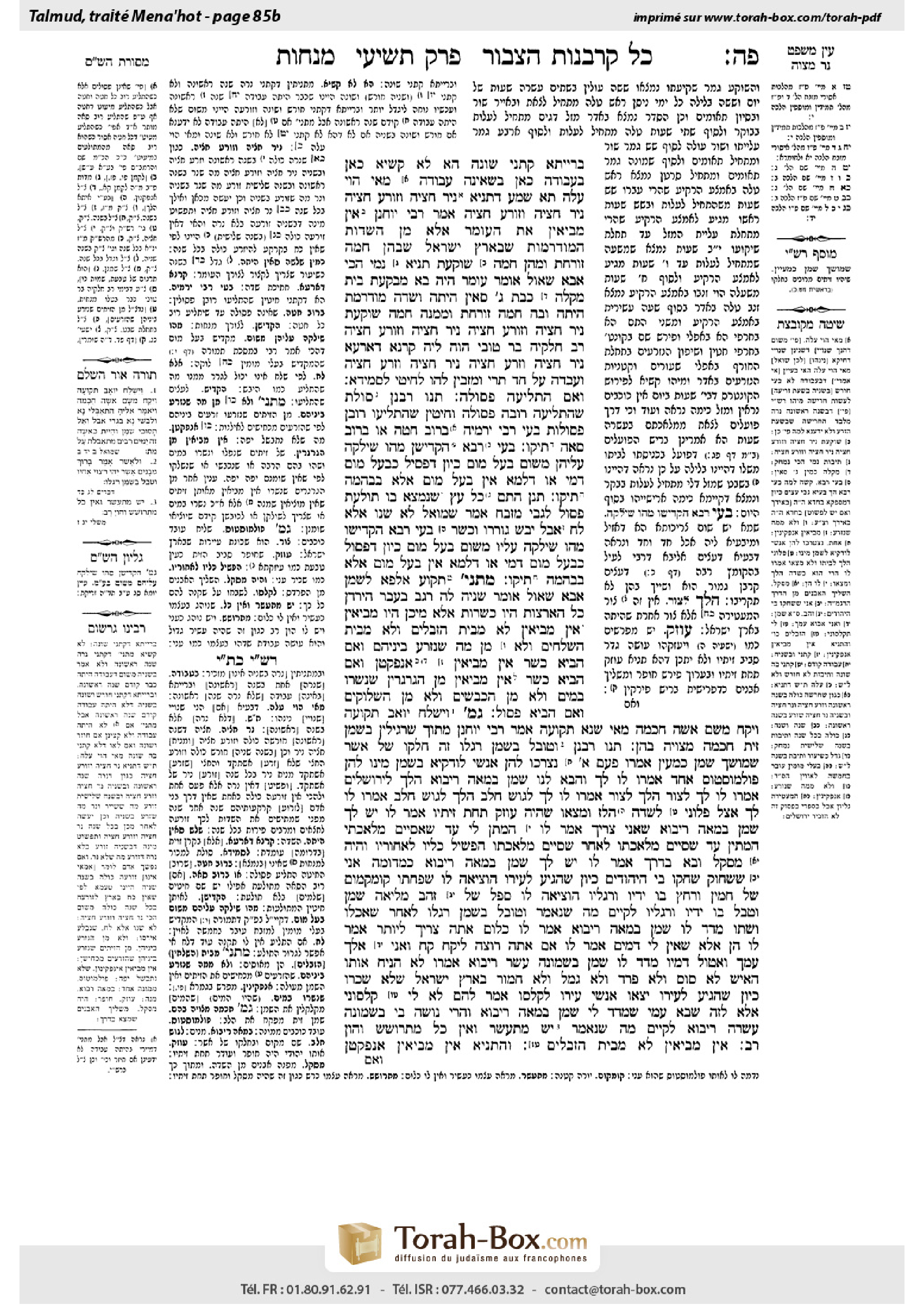
Menachot 85b: Talmud study for Daf Yomi
Daf Yomi is the daily study of one Talmud folio. Explore 37 tractates with scans, Hebrew text, Sefaria English and AI-generated French translations where annotated.
Passage selection and English or AI-generated French translation are available where the scan has annotations. Daf Study is independent of Torah-Box and Sefaria.
Browse Menachot · מנחות · All tractatesMenachot 85b text and translations
This page of Menachot includes the Aramaic text, an English translation and an AI-generated French translation, alongside the scan above.
מנחות פ״ה ב · Aramaic and Hebrew text
בָּרַיְיתָא קָתָנֵי ״שׁוֹנֶה״.
הָא לָא קַשְׁיָא, כָּאן בַּעֲבוּדָה, כָּאן בְּשֶׁאֵינָהּ עֲבוּדָה.
מַאי הָוֵי עֲלַהּ? תָּא שְׁמַע, דְּתַנְיָא: נָר חֶצְיָהּ וְזוֹרֵעַ חֶצְיָהּ, נָר חֶצְיָהּ וְזוֹרֵעַ חֶצְיָהּ.
אָמַר רַבִּי יוֹחָנָן: אֵין מְבִיאִין אֶת הָעוֹמֶר אֶלָּא מִן הַשָּׂדוֹת הַמּוּדְרָמוֹת שֶׁבְּאֶרֶץ יִשְׂרָאֵל, שֶׁבָּהֶן חַמָּה זוֹרַחַת, וּמֵהֶן חַמָּה שׁוֹקַעַת.
תַּנְיָא נָמֵי הָכִי, אַבָּא שָׁאוּל אוֹמֵר: עוֹמֶר הָיָה בָּא מִבִּקְעַת בֵּית מִקְלָה, כְּבַת שָׁלֹשׁ סְאִין הָיְתָה, וְשָׂדֶה מוּדְרֶמֶת הָיְתָה, וּבָהּ חַמָּה זוֹרַחַת וּמִמֶּנָּה חַמָּה שׁוֹקַעַת. נָיר חֶצְיָהּ וְזוֹרֵעַ חֶצְיָהּ, נָיר חֶצְיָהּ וְזוֹרֵעַ חֶצְיָהּ.
רַב חִלְקִיָּה בַּר טוֹבִי הֲוָה לֵיהּ קַרְנָא דְּאַרְעָא, נָר חֶצְיָהּ וְזָרַע חֶצְיָהּ, נָר חֶצְיָהּ וְזָרַע חֶצְיָהּ, וַעֲבַדָה עַל חַד תְּרֵי, וּמְזַבֵּין לְהוּ לְחִיטֵּי לִסְמִידָא.
וְאִם הִתְלִיעָה – פְּסוּלָה. תָּנוּ רַבָּנַן: סוֹלֶת שֶׁהִתְלִיעָה רוּבָּהּ – פְּסוּלָה, וְחִיטִּין שֶׁהִתְלִיעוּ רוּבָּן – פְּסוּלוֹת. בָּעֵי רַבִּי יִרְמְיָה: בְּרוֹב חִטָּה, אוֹ בְּרוֹב סְאָה? תֵּיקוּ.
בָּעֵי רָבָא: הִקְדִּישָׁן, מַהוּ שֶׁיִּלְקֶה עֲלֵיהֶן מִשּׁוּם בַּעַל מוּם? כֵּיוָן דְּפָסֵיל – כְּבַעַל מוּם דָּמֵי, אוֹ דִלְמָא אֵין בַּעַל מוּם אֶלָּא בִּבְהֵמָה? תֵּיקוּ.
תְּנַן הָתָם: כׇּל עֵץ שֶׁנִּמְצָא בּוֹ תּוֹלַעַת – פָּסוּל לְגַבֵּי מִזְבֵּחַ. אָמַר שְׁמוּאֵל: לֹא שָׁנוּ אֶלָּא לַח, אֲבָל יָבֵשׁ – גּוֹרְרוֹ וְכָשֵׁר.
בָּעֵי רָבָא: הִקְדִּישׁוֹ, מַהוּ שֶׁיִּלְקֶה עָלָיו מִשּׁוּם בַּעַל מוּם? כֵּיוָן דְּפָסוּל כְּבַעַל מוּם דָּמֵי, אוֹ דִלְמָא אֵין בַּעַל מוּם אֶלָּא בִּבְהֵמָה? תֵּיקוּ.
מַתְנִי׳ תְּקוֹעַ – אַלְפָּא לַשֶּׁמֶן. אַבָּא שָׁאוּל אוֹמֵר: שְׁנִיָּה לָהּ רֶגֶב בְּעֵבֶר הַיַּרְדֵּן. כׇּל הָאֲרָצוֹת הָיוּ כְּשֵׁרוֹת, אֶלָּא מִיכָּן הָיוּ מְבִיאִין.
אֵין מְבִיאִין לֹא מִבֵּית הַזְּבָלִים, וְלֹא מִבֵּית הַשְּׁלָחִים, וְלֹא מִן מַה שֶּׁנִּזְרַע בֵּינֵיהֶם, וְאִם הֵבִיא – כָּשֵׁר. אֵין מְבִיאִין אַנְפַּקְטָן, וְאִם הֵבִיא – כָּשֵׁר. אֵין מְבִיאִין מִן הַגַּרְגְּרִין שֶׁנִּשְׁרוּ בְּמַיִם, וְלֹא מִן הַכְּבָשִׁים, וְלֹא מִן הַשְּׁלוּקִים, וְאִם הֵבִיא – פָּסוּל.
גְּמָ׳ ״וַיִּשְׁלַח יוֹאָב תְּקוֹעָה וַיִּקַּח מִשָּׁם אִשָּׁה חֲכָמָה״, מַאי שְׁנָא תְּקוֹעָה? אָמַר רַבִּי יוֹחָנָן: מִתּוֹךְ שֶׁרְגִילִין בְּשֶׁמֶן זַיִת, חָכְמָה מְצוּיָה בָּהֶן.
תָּנוּ רַבָּנַן: ״וְטֹבֵל בְּשֶׁמֶן רַגְלוֹ״ – זֶה חֶלְקוֹ שֶׁל אָשֵׁר, שֶׁמּוֹשֵׁךְ שֶׁמֶן כְּמַעְיָן. אָמְרוּ: פַּעַם אַחַת נִצְרְכוּ לָהֶן אַנְשֵׁי לוּדְקִיָּא (בְּשֶׁמֶן) [לְשֶׁמֶן], מִינּוּ לָהֶן פּוּלְמוֹסְטוּס אֶחָד, אָמְרוּ לוֹ: לֵךְ וְהָבֵא לָנוּ שֶׁמֶן בְּמֵאָה רִיבּוֹא.
הָלַךְ לִירוּשָׁלַיִם, אָמְרוּ לוֹ: לֵךְ לְצוֹר, הָלַךְ לְצוֹר, אָמְרוּ לוֹ: לֵךְ לְגוּשׁ חָלָב, הָלַךְ לְגוּשׁ חָלָב, אָמְרוּ לוֹ: לֵךְ אֵצֶל פְּלוֹנִי לְשָׂדֶה הַלָּז, וּמְצָאוֹ שֶׁהָיָה עוֹזֵק תַּחַת זֵיתָיו. אָמַר לוֹ: יֵשׁ לְךָ שֶׁמֶן בְּמֵאָה רִיבּוֹא שֶׁאֲנִי צָרִיךְ? אָמַר לוֹ: הַמְתֵּן לִי עַד שֶׁאֲסַיֵּים מְלַאכְתִּי, הִמְתִּין עַד שֶׁסִּיֵּים מְלַאכְתּוֹ.
לְאַחַר שֶׁסִּיֵּים מְלַאכְתּוֹ, הִפְשִׁיל כֵּלָיו לַאֲחוֹרָיו, וְהָיָה מְסַקֵּל וּבָא בַּדֶּרֶךְ. אָמַר לוֹ: יֵשׁ לְךָ שֶׁמֶן בְּמֵאָה רִיבּוֹא? כִּמְדוּמֶּה אֲנִי שֶׁשְּׂחוֹק שָׂחֲקוּ בִּי הַיְּהוּדִים. כֵּיוָן שֶׁהִגִּיעַ לְעִירוֹ, הוֹצִיאָה לוֹ שִׁפְחָתוֹ קוּמְקְמוֹס שֶׁל חַמִּין, וְרָחַץ בּוֹ יָדָיו וְרַגְלָיו. הוֹצִיאָה לוֹ סֵפֶל שֶׁל זָהָב מְלֵיאָה שֶׁמֶן, וְטָבַל בּוֹ יָדָיו וְרַגְלָיו, לְקַיֵּים מַה שֶּׁנֶּאֱמַר: ״וְטוֹבֵל בַּשֶּׁמֶן רַגְלוֹ״.
לְאַחַר שֶׁאָכְלוּ וְשָׁתוּ, מָדַד לוֹ שֶׁמֶן בְּמֵאָה רִיבּוֹא. אָמַר לוֹ: כְּלוּם אַתָּה צָרִיךְ לְיוֹתֵר? אָמַר לוֹ: הֵן, אֶלָּא שֶׁאֵין לִי דָּמִים. אָמַר לוֹ: אִם אַתָּה רוֹצֶה לִיקַּח – קַח, וַאֲנִי אֵלֵךְ עִמְּךָ וְאֶטּוֹל דָּמָיו. מָדַד לוֹ שֶׁמֶן בִּשְׁמוֹנָה עָשָׂר רִיבּוֹא. אָמְרוּ: לֹא הִנִּיחַ אוֹתוֹ הָאִישׁ לֹא סוּס וְלֹא פֶּרֶד וְלֹא גָּמָל וְלֹא חֲמוֹר בְּאֶרֶץ יִשְׂרָאֵל שֶׁלֹּא שְׂכָרוֹ.
כֵּיוָן שֶׁהִגִּיעַ לְעִירוֹ, יָצְאוּ אַנְשֵׁי עִירוֹ לְקַלְּסוֹ. אָמַר לָהֶם: לֹא לִי קַלְּסוּנִי, אֶלָּא לָזֶה שֶׁבָּא עִמִּי, שֶׁמָּדַד לִי שֶׁמֶן בְּמֵאָה רִיבּוֹא, וַהֲרֵי נוֹשֶׁה בִּי בִּשְׁמוֹנֶה עֶשְׂרֵה רִיבּוֹא, לְקַיֵּים מַה שֶּׁנֶּאֱמַר: ״יֵשׁ מִתְעַשֵּׁר וְאֵין כֹּל מִתְרוֹשֵׁשׁ וְהוֹן רָב״.
אֵין מְבִיאִין לֹא מִבֵּית הַזְּבָלִים, וְהָתַנְיָא: אֵין מְבִיאִין אַנְפַּקְטָן,
Menachot 85b · English translation
it is only the baraita that teaches that he plows and then repeats the plowing. It would appear, then, that the mishna and baraita express different opinions, and it may be that according to the mishna one does not need to plow in the second year at all.
The Gemara dismisses this suggestion: This is not difficult; it is possible that the mishna and the baraita do not disagree, and here, the mishna, which does not require plowing a second time, is referring to a cultivated field, whereas there, the baraita is referring to an uncultivated field, and therefore it requires that the field be plowed a second time.
The Gemara concludes: What halakhic conclusion was reached about this matter? Come and hear the resolution from that which is taught in a baraita: For the first year, one plows the entire field during the first half of the year, and then he sows half of the field, leaving the other half fallow. For the second year, one again plows the entire field during the first half of the year, and then he sows the half of the field that was left fallow in the previous year. It is evident from this baraita that during the second year as well, the field is plowed before it is sown.
§ Rabbi Yoḥanan says: One brings the omer only from the southern fields of Eretz Yisrael, as upon those fields, the sun rises and shines, and from those fields, the sun also sets. Those fields are exposed to abundant sunlight, and so they produce a superior-quality crop.
This is also taught in a baraita: Abba Shaul says that the omer would come from grain grown in the valley of Beit Mikle. The field there was about three se’a, and it was a southern field, and the sun would rise and shine upon it, and the sun would set from it. During the first year, the farmer plowed the entire field during the first half of the year, and he then sowed half of the field, leaving the other half fallow. During the second year, he again plowed the entire field during the first half of the year, and he then sowed the half of the field that was left fallow in the previous year.
The Gemara demonstrates the efficacy of this method: Rav Ḥilkiya bar Tovi had a tract of land. He plowed the field during the first half of the year and then sowed half of it. The next year, he plowed the field during the first half of the year and then sowed the other half of it. And this method was so effective that his field produced twice as much wheat as other fields its size, and it was of such a superior quality that he sold the wheat to be used as fine flour [lismida] for the meal offerings in the Temple.
§ The mishna teaches: And if the flour became wormy, it is unfit for use in a meal offering. The Sages taught in a baraita: Fine flour the majority of which became wormy is unfit. And similarly, wheat kernels the majority of which became wormy are unfit, and they may not be used to produce fine flour for meal offerings. Rabbi Yirmeya asks: What is the meaning of this latter ruling? Is it saying only that if the majority of an individual wheat kernel becomes wormy the flour produced from it is unfit, or is it saying that when the majority of a se’a of kernels becomes wormy the entire se’a is unfit? The Gemara concludes: The dilemma shall stand unresolved.
Rava asks: If one consecrated grains of wormy wheat for use in a meal offering, what is the halakha with regard to whether he should be flogged for consecrating them due to the prohibition against consecrating a flawed item as an offering? One is flogged for consecrating a blemished animal as an offering (see Temura 6b); does the same apply to consecrating wormy wheat? Does one say that since the wheat is unfit, it is comparable to a blemished animal? Or perhaps, the prohibition against consecrating a flawed item applies only to an animal. The Gemara concludes: The dilemma shall stand unresolved.
§ We learned in a mishna elsewhere (Middot 2:5) with regard to the wood logs that are burned on the altar: Priests inspect them before they are used and any log in which a worm is found is unfit for use on the altar. In reference to this mishna, Shmuel says: They taught this halakha only with regard to a wet log, as a wormy section cannot be removed. But if a wormy section is found in a dry log, the priest scrapes the wormy spot away, and the log is fit for use.
Rava asks: If one consecrated a wormy log to be used on the altar, what is the halakha with regard to whether he should be flogged for consecrating it due to the prohibition against consecrating a flawed item as an offering? Does one say that since the log is unfit, it is comparable to a blemished animal? Or perhaps, the prohibition against consecrating a flawed item applies only to an animal. The Gemara concludes: The dilemma shall stand unresolved.
MISHNA: Olive trees in Tekoa are the primary source of oil to be used in meal offerings. Abba Shaul says: Secondary to Tekoa is Regev on the east bank of the Jordan River. All the regions were valid for oil to be brought from them, but it was from here that they would bring it.
One may not bring a meal offering containing oil from olives taken from a fertilized olive grove, nor from olives taken from an irrigated olive grove, nor from olives taken from an olive grove where grain was sown between the trees. But if one did bring a meal offering containing oil from such groves, it is valid. One may not bring a meal offering containing oil from unripe olives [anpiktan], but if one did bring it, it is valid. One may not bring a meal offering containing oil from olives that were soaked in water, nor from pickled olives, nor from boiled olives, and even if one did bring it, it is not valid.
GEMARA: The Gemara notes the effect of Tekoa’s oil on those living there: The verse states: “And Joab sent to Tekoa, and fetched from there a wise woman” (II Samuel 14:2). What is different about Tekoa that Joab chose to bring a woman from there? Rabbi Yoḥanan says: Since the residents of Tekoa are accustomed to use olive oil, wisdom is prevalent there.
§ The Gemara digresses to discuss the tribal portion of Asher, in which the city of Tekoa is located: The Sages taught in a baraita: In his blessing to the tribe of Asher, Moses said: “He will be pleasing to his brothers, and immerse his foot in oil” (Deuteronomy 33:24). This is referring to the portion of Asher, as the oil flows there like a spring. The Gemara relates: They said that once, the people of Laodicea were in need of oil. They appointed a gentile messenger [polmostos] and said to him: Go and bring us one million maneh worth of oil.
He first went to Jerusalem to procure the oil, but residents there did not have that quantity of oil. They said to him: Go to Tyre, which was a commercial city. He went to Tyre, but they also did not have enough oil. They said to him: Go to Gush Ḥalav, which is located in the portion of Asher. He went to Gush Ḥalav, and they said to him: Go to so-and-so, to that field. He went there and found someone hoeing [ozek] under his olive trees. The messenger said to that man: Do you have the one million maneh worth of oil that I need? The man said to him: Wait for me until I complete my labor, i.e., hoeing. The messenger waited until the man completed his labor.
After he completed his labor, the man slung his tools over his shoulders behind him, a manner typical of poor laborers, and started walking, and he was removing stones from his orchard as he went along the path. Upon seeing this behavior, which suggested the man was merely a laborer, the messenger questioned whether the man was truly able to provide him with the oil. He said to the man: Can it be that you really have the one million maneh worth of oil that I need? It seems to me that the Jews of Gush Ḥalav are making a laughingstock of me by sending me here. When he reached his city, the man’s maidservant brought out to him a kettle [kumkemos] of hot water, and he washed his hands and his feet. Afterward, she brought out to him a golden basin filled with oil, in which he immersed his hands and feet, in fulfillment of that which is stated with regard to the Tribe of Asher: “And immerse his foot in oil” (Deuteronomy 33:24).
After they ate and drank, the man measured out for the messenger one million maneh worth of oil. The man said to him: Are you sure that you do not need any more oil? The messenger said to him: Yes, I do need more, but I do not have the money for it. The man said to him: If you wish to take more oil, take it and I will go back to Laodicea with you and collect the money for the extra oil there. The messenger agreed and the man measured out an additional 180,000 maneh worth of oil. Concerning this incident, people said: The messenger had such an enormous burden of oil that he left neither a horse, nor a mule, nor a camel, nor a donkey in all of Eretz Yisrael that he did not rent in order to help transport the oil back to Laodicea.
When the messenger finally reached his city, the people of his city came out to praise him [lekaleso] for achieving this tremendous feat. The messenger said to them: Do not praise me. Rather, praise this man who has come with me, as it is he who measured for me one million maneh worth of oil, and he extended a debt to me for 180,000 maneh worth of oil. This incident was in fulfillment of that which is stated: “There is one who seems to be rich, yet has nothing; there is one who seems to be poor, yet has great wealth” (Proverbs 13:7).
§ The mishna teaches: One may not bring a meal offering containing oil made from olives from a fertilized olive grove. The mishna continues to state that one may not bring a meal offering containing oil from unripe olives, and, according to one version of the mishna’s text, it adds that even if one did bring a meal offering containing such oil, it is not valid. The Gemara asks: But isn’t it taught in a baraita: One may not bring a meal offering containing oil made from unripe olives,
Menachot 85b · Traduction française (IA)
Seule la baraïta enseigne qu’il laboure, puis laboure de nouveau. Il semblerait donc que la Michna et la baraïta expriment des opinions différentes, et que, selon la Michna, il ne soit peut-être pas nécessaire de labourer du tout la deuxième année.
La Guemara écarte cette suggestion : il n’y a pas de difficulté ; la Michna et la baraïta peuvent ne pas être en désaccord. Ici, la Michna, qui n’exige pas un deuxième labour, parle d’un champ cultivé ; là, la baraïta parle d’un champ non cultivé et exige donc que le champ soit labouré une deuxième fois.
La Guemara conclut : Quelle conclusion halakhique a-t-on tirée à ce sujet ? Viens et entends la réponse dans ce qui est enseigné dans une baraïta : La première année, on laboure tout le champ durant la première moitié de l’année, puis on en ensemence la moitié, en laissant l’autre moitié en jachère. La deuxième année, on laboure de nouveau tout le champ durant la première moitié de l’année, puis on ensemence la moitié du champ qui avait été laissée en jachère l’année précédente. Cette baraïta montre qu’au cours de la deuxième année également, le champ est labouré avant d’être ensemencé.
§ Rabbi Yoḥanan dit : On n’apporte l’omer que des champs du sud d’Eretz Israël, car le soleil se lève et brille sur ces champs, et c’est aussi au-dessus de ces champs qu’il se couche. Ces champs sont exposés à un ensoleillement abondant et produisent donc une récolte de qualité supérieure.
Cela est également enseigné dans une baraïta : Abba Shaul dit que l’omer provenait de céréales cultivées dans la vallée de Beit Mikle. Le champ avait une superficie d’environ trois séa ; il se trouvait au sud, le soleil se levait et brillait sur lui, puis s’y couchait. La première année, le cultivateur labourait tout le champ durant la première moitié de l’année, puis en ensemencait la moitié, en laissant l’autre moitié en jachère. La deuxième année, il labourait de nouveau tout le champ durant la première moitié de l’année, puis ensemencait la moitié qui avait été laissée en jachère l’année précédente.
La Guemara montre l’efficacité de cette méthode : Rav Ḥilkiya bar Tovi possédait une parcelle. Il laboura le champ durant la première moitié de l’année, puis en ensemenca la moitié. L’année suivante, il laboura le champ durant la première moitié de l’année, puis en ensemenca l’autre moitié. Cette méthode fut si efficace que son champ produisit deux fois plus de blé que les autres champs de même superficie ; le blé était d’une qualité si supérieure qu’il le vendit pour qu’il serve à fabriquer de la farine fine [lismida] destinée aux offrandes de farine dans le Temple.
§ La Michna enseigne : Si la farine est devenue véreuse, elle est impropre à une offrande de farine. Les Sages ont enseigné dans une baraïta : Une farine fine dont la majorité est devenue véreuse est impropre. De même, des grains de blé dont la majorité est devenue véreuse sont impropres et ne peuvent pas servir à produire de la farine fine destinée aux offrandes de farine. Rabbi Yirmeya demande : Quel est le sens de cette dernière règle ? Signifie-t-elle seulement que si la majorité d’un grain de blé donné est devenue véreuse, la farine qui en est produite est impropre, ou signifie-t-elle que lorsque la majorité d’un séa de grains est devenue véreuse, tout le séa est impropre ? La Guemara conclut : La question reste sans réponse.
Rava demande : Si quelqu’un a consacré du blé véreux pour une offrande de farine, doit-il être flagellé pour l’avoir consacré, en raison de l’interdiction de consacrer comme offrande un objet présentant un défaut ? On est flagellé pour avoir consacré comme offrande un animal atteint d’un défaut (voir Temoura 6b) ; en va-t-il de même pour la consécration de blé véreux ? Dira-t-on que, puisque le blé est impropre, il est comparable à un animal atteint d’un défaut ? Ou peut-être l’interdiction de consacrer un objet présentant un défaut ne s’applique-t-elle qu’à un animal. La Guemara conclut : La question reste sans réponse.
§ Nous avons appris dans une Michna ailleurs (Midot 2:5), à propos des bûches de bois brûlées sur l’autel : Les prêtres les inspectent avant leur utilisation, et toute bûche dans laquelle on trouve un ver est impropre à l’autel. À propos de cette Michna, Shmuel dit : Cette halakha n’a été enseignée que pour une bûche humide, car on ne peut pas retirer la partie véreuse. Mais si une partie véreuse est découverte dans une bûche sèche, le prêtre gratte l’endroit atteint par les vers, et la bûche est propre à l’usage.
Rava demande : Si quelqu’un a consacré une bûche véreuse pour qu’elle soit utilisée sur l’autel, doit-il être flagellé pour l’avoir consacrée, en raison de l’interdiction de consacrer comme offrande un objet présentant un défaut ? Dira-t-on que, puisque la bûche est impropre, elle est comparable à un animal atteint d’un défaut ? Ou peut-être l’interdiction de consacrer un objet présentant un défaut ne s’applique-t-elle qu’à un animal. La Guemara conclut : La question reste sans réponse.
MICHNA : Les oliviers de Tekoa sont la principale source d’huile destinée aux offrandes de farine. Abba Shaul dit : Après Tekoa vient Regev, sur la rive orientale du Jourdain. Toutes les régions pouvaient fournir de l’huile, mais c’est de ces endroits qu’on en apportait.
On ne peut pas apporter une offrande de farine contenant de l’huile provenant d’olives récoltées dans une oliveraie fertilisée, ni dans une oliveraie irriguée, ni dans une oliveraie où des céréales ont été semées entre les arbres. Toutefois, si quelqu’un apporte une offrande de farine contenant de l’huile provenant de telles oliveraies, elle est valide. On ne peut pas apporter une offrande de farine contenant de l’huile d’olives pas mûres [anpiktan], mais si quelqu’un en apporte, elle est valide. On ne peut pas apporter une offrande de farine contenant de l’huile d’olives trempées dans l’eau, ni d’olives marinées, ni d’olives bouillies ; même si quelqu’un en apporte, elle n’est pas valide.
GUEMARA : La Guemara relève l’effet de l’huile de Tekoa sur ses habitants : Le verset dit : « Joab envoya à Tekoa et en fit venir une femme avisée » (II Samuel 14:2). Qu’est-ce qui distinguait Tekoa, pour que Joab choisisse d’en faire venir une femme ? Rabbi Yoḥanan dit : Comme les habitants de Tekoa ont l’habitude d’utiliser de l’huile d’olive, la sagesse y est répandue.
§ La Guemara fait un détour pour parler du territoire tribal d’Acher, où se trouve la ville de Tekoa : Les Sages ont enseigné dans une baraïta : Dans sa bénédiction à la tribu d’Acher, Moïse a dit : « Il sera agréable à ses frères et baignera son pied dans l’huile » (Deutéronome 33:24). Cela fait référence au territoire d’Acher, car l’huile y coule comme une source. La Guemara rapporte : On raconte qu’un jour, les habitants de Laodicée eurent besoin d’huile. Ils désignèrent un messager non juif [polmostos] et lui dirent : Va nous chercher pour un million de mané d’huile.
Il se rendit d’abord à Jérusalem pour se procurer l’huile, mais les habitants n’en possédaient pas une telle quantité. Ils lui dirent : Va à Tyr, qui était une ville commerçante. Il se rendit à Tyr, mais là non plus, les habitants n’avaient pas assez d’huile. Ils lui dirent : Va à Gush Ḥalav, qui se trouve sur le territoire d’Acher. Il se rendit à Gush Ḥalav, et on lui dit : Va chez untel, dans ce champ. Il y alla et trouva quelqu’un qui sarclait [ozek] sous ses oliviers. Le messager demanda à cet homme : As-tu le million de mané d’huile dont j’ai besoin ? L’homme lui dit : Attends que j’aie terminé mon travail, c’est-à-dire le sarclage. Le messager attendit que l’homme ait terminé son travail.
Quand il eut terminé son travail, l’homme jeta ses outils sur ses épaules, derrière lui, comme le font les ouvriers pauvres, puis se mit en route ; il retirait des pierres de son verger en chemin. En voyant cette conduite, qui laissait penser que l’homme n’était qu’un ouvrier, le messager se demanda s’il était vraiment en mesure de lui fournir l’huile. Il lui dit : Est-il possible que tu aies réellement le million de mané d’huile dont j’ai besoin ? J’ai l’impression que les Juifs de Gush Ḥalav se moquent de moi en m’envoyant ici. Quand il arriva chez lui, la servante de l’homme lui apporta une bouilloire [kumkemos] d’eau chaude, et il se lava les mains et les pieds. Ensuite, elle lui apporta un bassin d’or rempli d’huile, dans lequel il trempa ses mains et ses pieds, accomplissant ainsi ce qui est dit au sujet de la tribu d’Acher : « Et baignera son pied dans l’huile » (Deutéronome 33:24).
Après qu’ils eurent mangé et bu, l’homme mesura pour le messager un million de mané d’huile. Il lui demanda : Es-tu sûr de ne pas avoir besoin de plus d’huile ? Le messager lui dit : Si, j’en ai besoin de davantage, mais je n’ai pas l’argent pour cela. L’homme lui dit : Si tu veux emporter plus d’huile, prends-en ; je retournerai avec toi à Laodicée et j’y percevrai le paiement de l’huile supplémentaire. Le messager accepta, et l’homme mesura 180 000 mané d’huile supplémentaires. À propos de cet épisode, on disait : Le messager avait une charge d’huile si énorme qu’il ne laissa en Eretz Israël aucun cheval, mulet, chameau ou âne qu’il n’ait loué pour aider à transporter l’huile jusqu’à Laodicée.
Quand le messager arriva enfin dans sa ville, les habitants sortirent pour le louer [lekaleso] d’avoir accompli cet exploit extraordinaire. Le messager leur dit : Ne me louez pas. Louez plutôt cet homme qui est venu avec moi, car c’est lui qui m’a mesuré un million de mané d’huile et m’a fait crédit de 180 000 mané d’huile. Cet épisode illustre ce qui est dit : « Il en est un qui paraît riche et n’a rien ; il en est un qui paraît pauvre et possède une grande richesse » (Proverbes 13:7).
§ La Michna enseigne : On ne peut pas apporter une offrande de farine contenant de l’huile provenant d’olives récoltées dans une oliveraie fertilisée. La Michna poursuit en disant qu’on ne peut pas apporter une offrande de farine contenant de l’huile d’olives pas mûres et, selon une version du texte de la Michna, elle ajoute que même si quelqu’un apporte une offrande de farine contenant une telle huile, elle n’est pas valide. La Guemara demande : Mais n’est-il pas enseigné dans une baraïta : On ne peut pas apporter une offrande de farine contenant de l’huile faite à partir d’olives pas mûres,
Traduction française générée par IA à partir de l’édition anglaise de Sefaria. Vérifie toujours un passage avec le texte source.
Text from Sefaria: William Davidson Edition - Vocalized Aramaic (unknown); William Davidson Edition - English (CC BY NC).