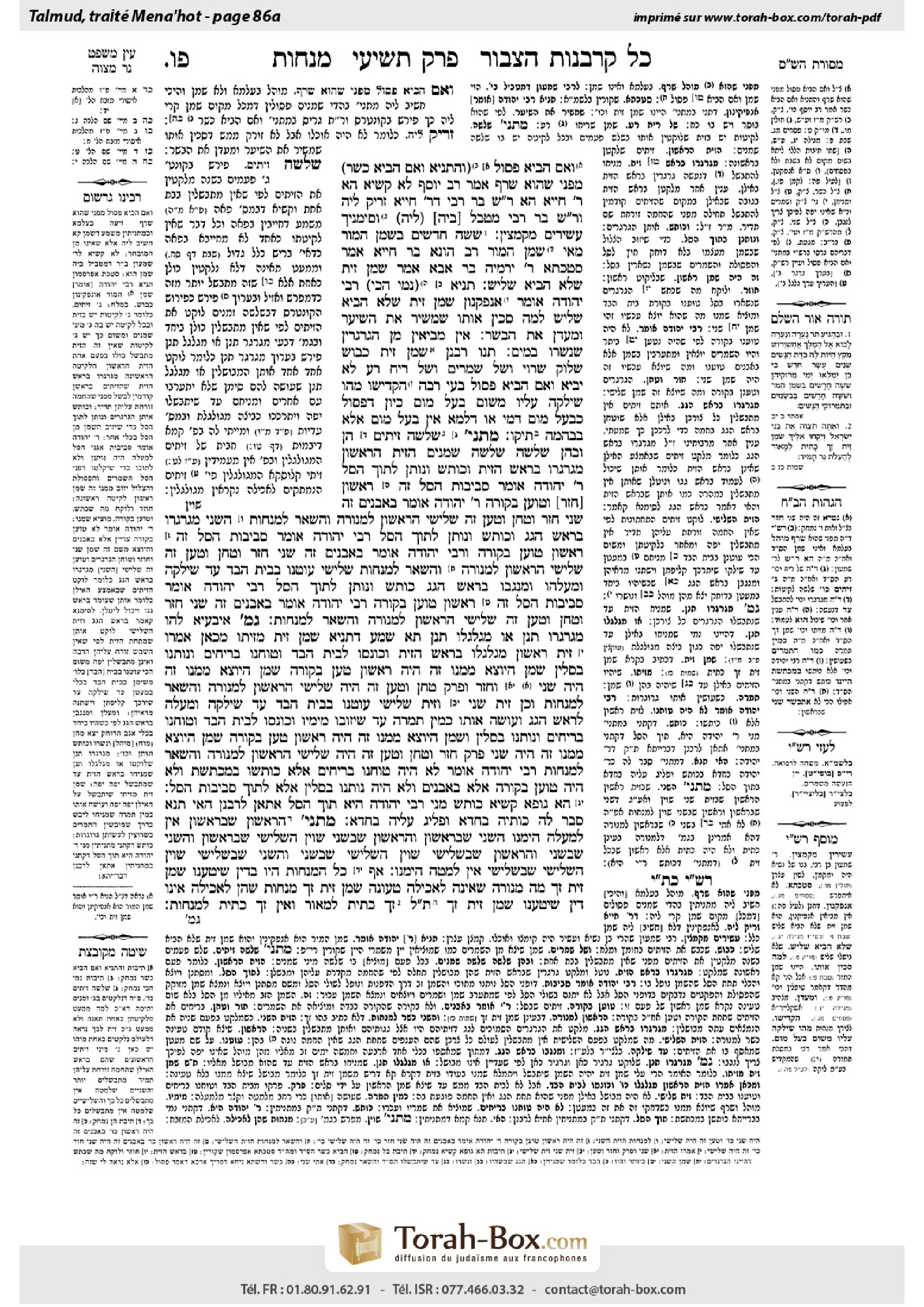
Menachot 86a: Talmud study for Daf Yomi
Daf Yomi is the daily study of one Talmud folio. Explore 37 tractates with scans, Hebrew text, Sefaria English and AI-generated French translations where annotated.
Passage selection and English or AI-generated French translation are available where the scan has annotations. Daf Study is independent of Torah-Box and Sefaria.
Browse Menachot · מנחות · All tractatesMenachot 86a text and translations
This page of Menachot includes the Aramaic text, an English translation and an AI-generated French translation, alongside the scan above.
מנחות פ״ו א · Aramaic and Hebrew text
וְאִם הֵבִיא – פָּסוּל (וְהָתַנְיָא: וְאִם הֵבִיא – כָּשֵׁר), מִפְּנֵי שֶׁהוּא שְׂרָף.
אָמַר רַב יוֹסֵף: לָא קַשְׁיָא, הָא רַבִּי חִיָּיא, הָא רַבִּי שִׁמְעוֹן בַּר רַבִּי, דְּרַבִּי חִיָּיא זָרֵיק לֵיהּ, וְרַבִּי שִׁמְעוֹן בַּר רַבִּי מְטַבֵּל [בֵּיהּ] (לֵיהּ), וְסִימָנָיךְ: עֲשִׁירִים מְקַמְּצִין.
״שִׁשָּׁה חֳדָשִׁים בְּשֶׁמֶן הַמּוֹר״ – מַאי ״שֶׁמֶן הַמּוֹר״? רַב הוּנָא בַּר חִיָּיא אָמַר: סְטָכְתָּא. רַבִּי יִרְמְיָה בַּר אַבָּא אָמַר: שֶׁמֶן זַיִת שֶׁלֹּא הֵבִיא שְׁלִישׁ.
תַּנְיָא נָמֵי הָכִי: רַבִּי יְהוּדָה אוֹמֵר: אַנְפִּקִנוֹן – שֶׁמֶן זַיִת שֶׁלֹּא הֵבִיא שְׁלִישׁ, לָמָּה סָכִין אוֹתוֹ? שֶׁמַּשִּׁיר אֶת הַשֵּׂיעָר וּמְעַדֵּן אֶת הַבָּשָׂר.
אֵין מְבִיאִין מִן הַגַּרְגְּרִין שֶׁנִּשְׁרוּ בְּמַיִם. תָּנוּ רַבָּנַן: שֶׁמֶן זַיִת כָּבוּשׁ, שָׁלוּק, שָׁרוּי, וְשֶׁל שְׁמָרִים, וְשֶׁל רֵיחַ רָע – לֹא יָבִיא, וְאִם הֵבִיא – פָּסוּל.
בָּעֵי רַבָּה: הִקְדִּישׁוֹ, מַהוּ שֶׁיִּלְקֶה עָלָיו מִשּׁוּם בַּעַל מוּם? כֵּיוָן דְּפָסוּל – כְּבַעַל מוּם דָּמֵי, אוֹ דִלְמָא אֵין בַּעַל מוּם אֶלָּא בִּבְהֵמָה? תֵּיקוּ.
מַתְנִי׳ שְׁלֹשָׁה זֵיתִים הֵן, וּבָהֶן שְׁלֹשָׁה שְׁלֹשָׁה שְׁמָנִים.
הַזַּיִת הָרִאשׁוֹן מְגַרְגְּרוֹ בְּרֹאשׁ הַזַּיִת, וְכוֹתֵשׁ וְנוֹתֵן לְתוֹךְ הַסַּל, רַבִּי יְהוּדָה אוֹמֵר: סְבִיבוֹת הַסַּל – זֶה רִאשׁוֹן.
חָזַר וְטוֹעֵן בְּקוֹרָה, רַבִּי יְהוּדָה אוֹמֵר: בַּאֲבָנִים – זֶה שֵׁנִי.
חָזַר וְטָחַן, וְטָעַן – זֶה שְׁלִישִׁי.
הָרִאשׁוֹן – לַמְּנוֹרָה, וְהַשְּׁאָר – לִמְנָחוֹת.
הַשֵּׁנִי – מְגַרְגְּרוֹ בְּרֹאשׁ הַגָּג, וְכוֹתֵשׁ, וְנוֹתֵן לְתוֹךְ הַסַּל, רַבִּי יְהוּדָה אוֹמֵר: סְבִיבוֹת הַסַּל – זֶה רִאשׁוֹן.
טוֹעֵן בְּקוֹרָה, וְרַבִּי יְהוּדָה אוֹמֵר: בַּאֲבָנִים – זֶה שֵׁנִי.
חָזַר וְטָחַן, וְטָעַן – זֶה שְׁלִישִׁי.
הָרִאשׁוֹן – לַמְּנוֹרָה, וְהַשְּׁאָר – לִמְנָחוֹת.
שְׁלִישִׁי: עוֹטְנוֹ בְּבֵית הַבַּד, עַד שֶׁיִּלְקֶה, וּמַעֲלֵהוּ וּמְנַגְּבוֹ בְּרֹאשׁ הַגָּג, כּוֹתֵשׁ וְנוֹתֵן לְתוֹךְ הַסַּל. רַבִּי יְהוּדָה אוֹמֵר: סְבִיבוֹת הַסַּל – זֶה רִאשׁוֹן.
טוֹעֵן בְּקוֹרָה, רַבִּי יְהוּדָה אוֹמֵר: בַּאֲבָנִים – זֶה שֵׁנִי.
חָזַר וְטָחַן וְטָעַן – זֶה שְׁלִישִׁי.
הָרִאשׁוֹן – לַמְּנוֹרָה, וְהַשְּׁאָר – לִמְנָחוֹת.
גְּמָ׳ אִיבַּעְיָא לְהוּ: מְגַרְגְּרוֹ תְּנַן, אוֹ מְגַלְגְּלוֹ תְּנַן?
תָּא שְׁמַע, דְּתַנְיָא: ״שֶׁמֶן זַיִת מִזֵּיתוֹ״ – מִכָּאן אָמְרוּ: זַיִת רִאשׁוֹן מְגַלְגְּלוֹ בְּרֹאשׁ הַזַּיִת, וְכוֹנְסוֹ לְבֵית הַבַּד, וְטוֹחֲנוֹ בְּרֵיחַיִם, וְנוֹתְנוֹ בְּסַלִּין. שֶׁמֶן הַיּוֹצֵא מִמֶּנּוּ, זֶה הָיָה רִאשׁוֹן.
טָעַן בְּקוֹרָה, שֶׁמֶן הַיּוֹצֵא מִמֶּנּוּ – זֶה הָיָה שֵׁנִי, וְחָזַר וּפָרַק, טָחַן וְטָעַן – זֶה הָיָה שְׁלִישִׁי. הָרִאשׁוֹן לַמְּנוֹרָה, וְהַשְּׁאָר לִמְנָחוֹת. וְכֵן זַיִת שֵׁנִי.
וְזַיִת שְׁלִישִׁי, עוֹטְנוֹ בְּבֵית הַבַּד עַד שֶׁיִּלְקֶה, וּמַעֲלֶה לְרֹאשׁ הַגָּג, וְעוֹשֶׂה אוֹתוֹ כְּמִין תְּמָרָה עַד שֶׁיָּזוּבוּ מֵימָיו, וְכוֹנְסוֹ לְבֵית הַבַּד, וְטוֹחֲנוֹ בָּרֵיחַיִם, וְנוֹתְנוֹ בְּסַלִּין, וָשֶׁמֶן הַיּוֹצֵא מִמֶּנּוּ – זֶה הָיָה רִאשׁוֹן.
טָעַן בְּקוֹרָה, שֶׁמֶן הַיּוֹצֵא מִמֶּנּוּ – זֶה הָיָה שֵׁנִי. פָּרַק חָזַר וְטָחַן וְטָעַן – זֶה הָיָה שְׁלִישִׁי. הָרִאשׁוֹן לַמְּנוֹרָה, וְהַשְּׁאָר לִמְנָחוֹת.
רַבִּי יְהוּדָה אוֹמֵר: לֹא הָיָה טוֹחֲנוֹ בָּרֵיחַיִם, אֶלָּא כּוֹתְשׁוֹ בְּמַכְתֶּשֶׁת, וְלֹא הָיָה טוֹעֵן בְּקוֹרָה אֶלָּא בַּאֲבָנִים, וְלֹא הָיָה נוֹתְנוֹ בְּסַלִּין אֶלָּא לְתוֹךְ סְבִיבוֹת הַסַּל.
הָא גוּפָא קַשְׁיָא: כּוֹתֵשׁ – מַנִּי? רַבִּי יְהוּדָה הִיא, תּוֹךְ הַסַּל – אֲתָאן לְרַבָּנַן!
הַאי תַּנָּא סָבַר לַהּ כְּוָתֵיהּ בַּחֲדָא, וּפָלֵיג עֲלֵיהּ בַּחֲדָא.
מַתְנִי׳ הָרִאשׁוֹן שֶׁבָּרִאשׁוֹן – אֵין לְמַעְלָה הֵימֶנּוּ. הַשֵּׁנִי שֶׁבָּרִאשׁוֹן וְהָרִאשׁוֹן שֶׁבַּשֵּׁנִי – שָׁוִין. הַשְּׁלִישִׁי שֶׁבָּרִאשׁוֹן וְהַשֵּׁנִי שֶׁבַּשֵּׁנִי וְהָרִאשׁוֹן שֶׁבַּשְּׁלִישִׁי – שָׁוִין. הַשְּׁלִישִׁי שֶׁבַּשֵּׁנִי וְהַשֵּׁנִי שֶׁבַּשְּׁלִישִׁי – שָׁוִין. הַשְּׁלִישִׁי שֶׁבַּשְּׁלִישִׁי – אֵין לְמַטָּה הֵימֶנּוּ.
אַף כׇּל הַמְּנָחוֹת הָיוּ בַּדִּין שֶׁיִּטְעֲנוּ שֶׁמֶן זַיִת זָךְ, מָה מְנוֹרָה שֶׁאֵינָהּ לַאֲכִילָה טְעוּנָה שֶׁמֶן זַיִת זָךְ, מְנָחוֹת שֶׁהֵן לַאֲכִילָה אֵינוֹ דִּין שֶׁיִּטְעֲנוּ שֶׁמֶן זַיִת זָךְ! תַּלְמוּד לוֹמַר ״זָךְ כָּתִית לְמָאוֹר״, וְאֵין זָךְ כָּתִית לִמְנָחוֹת.
Menachot 86a · English translation
but if one did bring a meal offering made of such oil, it is not valid. But isn’t it taught in a baraita that if one did bring it, it is valid, because it is regarded merely as sap and not as oil? This contradicts this mishna, which assumes that it is regarded as oil.
Rav Yosef said: It is not difficult to resolve this contradiction. This baraita expresses the opinion of Rabbi Ḥiyya, and that mishna expresses the opinion of Rabbi Shimon, son of Rabbi Yehuda HaNasi. As Rabbi Ḥiyya would toss such oil away, as he did not consider it to be oil, and Rabbi Shimon, son of Rabbi Yehuda HaNasi, would dip his food into it, as he considered it to be oil. The Gemara concludes: And your mnemonic by which to remember their respective opinions is: The wealthy are parsimonious, i.e., Rabbi Shimon, son of Rabbi Yehuda HaNasi, was wealthy, and he did not toss the oil away.
§ The Gemara digresses to discuss oil of myrrh: In describing the treatments provided to the women in preparation for their meeting with King Ahasuerus, the verse states: “For so were the days of their anointing accomplished: Six months with oil of myrrh, and six months with sweet odors and with other ointments of the women” (Esther 2:12). The Gemara asks: What is “oil of myrrh”? Rav Huna bar Ḥiyya says: It is the aromatic oil called setakhta. Rav Yirmeya bar Abba says: It is an oil derived from olives that have not yet reached one-third of their growth; the acidic oil is effective as a depilatory.
The Gemara notes: This explanation of Rav Yirmeya bar Abba is also taught in a baraita: Rabbi Yehuda says: The term anpikanon is referring to olive oil produced from olives that have not yet reached one-third of their growth. And why do women spread it on their bodies? They do so because it removes the hair and pampers the skin.
§ The mishna teaches: One may not bring meal offerings containing oil from olives that were soaked in water, nor from pickled olives, nor from boiled olives, and even if one did bring it, it is not valid. The Sages taught in a baraita: Olive oil produced from pickled olives, boiled olives, or olives soaked in water, and oil made from olive sediment, and oil with a foul odor may not be brought as part of a meal offering, and even if one did bring it, it is not valid.
Rava asks: If one consecrated one of these unfit oils for use in meal offerings, what is the halakha with regard to whether he should be flogged for consecrating it due to the prohibition against consecrating a flawed item as an offering? Does one say that since it is unfit, it is comparable to a blemished animal? Or perhaps the prohibition against consecrating a flawed item applies only to an animal. The Gemara concludes: The dilemma shall stand unresolved.
MISHNA: There are three harvests of olives each year, and in each of them, three different grades of oils are produced.
How is the first olive harvest processed? One picks the ripe olives at the top of the olive tree, as those are the first to ripen, and crushes them in a mortar and places them inside the bottom of a wicker basket that has many small holes in it. The oil will then drip from the olives through those holes into a vessel placed underneath the basket. Rabbi Yehuda says: One positions the olives on the walls, surrounding the basket. This produces more refined oil, as the dregs stick to the walls of the basket. This is the first grade of oil produced from the first harvest.
After the oil ceases to seep from the crushed olives, one then presses down with a wooden beam upon them, causing additional oil to flow from the basket into the vessel. Rabbi Yehuda says: The excessive pressure produced by pressing down with a beam would cause some of the flesh of the olives to get mixed in with the oil, compromising its quality. Rather, one applies pressure by placing stones upon the olives. This is the second grade of oil.
One then ground the olives with a millstone and pressed down with a beam on those olives to extract any remaining oil; this is the third grade of oil.
The first grade is fit for kindling the Candelabrum, which requires: “Refined olive oil” (Leviticus 24:2), and the rest are fit for use in meal offerings.
How is the second olive harvest processed? One picks the crop of olives that is accessible while one is standing on the rooftop. This was the second lot of olives to ripen. And one crushes it in a mortar and places those olives into a wicker basket, allowing the oil to drip through the holes into a vessel underneath. Rabbi Yehuda says: One positions the olives on the walls, surrounding the basket. This is the first grade of oil from the second harvest.
One then presses down upon those olives with a wooden beam, thereby producing more oil. And Rabbi Yehuda says: One applies pressure only by placing stones upon them. This is the second grade of oil.
One then ground the olives with a millstone and pressed down upon them with a beam, thereby extracting any remaining oil; this is the third grade of oil.
The first grade is fit for kindling the Candelabrum, and the rest are fit for use in meal offerings.
How is the third olive harvest processed? This harvest consists of all the olives that still remain on trees. One packs it into a vat [oteno] in the building that houses the olive press [beit habbad] where it remains until it softens, and then one raises it up to the roof and dries it on the rooftop to remove the foul-smelling liquid secreted from the olives while in the vat. Then, one crushes the olives in a mortar and places them into a wicker basket, allowing the oil to drip through the holes into a vessel underneath. Rabbi Yehuda says: One positions them on the walls, surrounding the basket. This is the first grade of oil.
One then presses down on those olives with a wooden beam, thereby producing more oil. And Rabbi Yehuda says: One applies pressure only by placing stones upon them. This is the second grade of oil.
One would then grind the olives with a millstone and press down upon them with a beam, thereby extracting any remaining oil; this is the third grade of oil.
The first grade is fit for kindling the Candelabrum, and the rest are fit for use in meal offerings.
GEMARA: A dilemma was raised before the Sages: What is the correct text of the mishna? Do we learn that one picks the olives at the top [megargero], i.e., one selects those that are ripe, or do we learn that one allows all the olives to ripen [megalgelo], and then picks them all?
The Gemara answers: Come and hear the resolution to this dilemma from that which is taught in a baraita. The verse states that the olive oil used for the kindling of the Candelabrum is to be: “Refined oil of an olive” (Exodus 27:20), which is interpreted to mean that the olives should be so ripe that the oil drips from them while they are still hanging on their olive tree, without them needing to be pressed. From here the Sages said that for the first olive harvest, one allows all the olives to ripen [megalgelo], picks the entire crop and brings it into the olive press, and he grinds it with a millstone and places it in wicker baskets, and this oil that would flow from it would be the first grade of oil.
The baraita continues: Then one presses down upon the olives with a wooden beam. As for the oil that flows from it, this would be the second grade of oil. And then one would remove the crushed olives from the baskets and grind them, and press down upon them with a beam or stones, thereby extracting any remaining oil; this would be the third grade of oil. The first grade is fit for kindling the Candelabrum, and the rest are fit for use in meal offerings. And the same process was similarly used for the second olive harvest.
The baraita continues: And for the third olive harvest, the entire crop is packed into a vat in the building that houses the olive press, where it remains until it softens, and then one raises it up to the roof and makes it into a sort of heap, wide at the bottom and narrow at the top, and leaves it there until the fluid it produced while in the vat flows away. And then one brings it to the olive press and grinds it with a millstone and places it into wicker baskets. As for the oil that would then flow from it, this would be the first grade of oil.
Then one presses down upon it with a wooden beam. As for the oil that would then flow from it, this would be the second grade of oil. And then one would remove the crushed olives from the baskets and grind them, and press down upon them with a beam or stones, thereby extracting any remaining oil; this would be the third grade of oil. The first grade is fit for kindling the Candelabrum, and the rest are fit for use in meal offerings.
The baraita concludes: Rabbi Yehuda disagrees with the Rabbis and says: One does not grind the crop of olives with a millstone; rather, one crushes it in a mortar. And one does not press down upon the olives with a wooden beam; rather, one presses on them with stones. And one does not place the olives into the bottom of the wicker baskets; rather, one positions them on the inner walls of the basket, all around the basket. In this baraita, the term: One allows all the olives to ripen [megalgelo], is used.
Having resolved the dilemma based on the baraita, the Gemara now clarifies the ruling of the mishna in light of it. The Gemara asks: This mishna itself is difficult, as the first tanna teaches that the olives should be crushed. From the baraita it is evident that whose opinion is it that the olives are crushed? It is the opinion of Rabbi Yehuda. Yet, when the first tanna states that the olives are placed inside the bottom of the basket, and not on its walls, we arrive at the opinion of the Rabbis who disagree with Rabbi Yehuda in the baraita.
The Gemara explains: This tanna of the mishna holds in accordance with the opinion of Rabbi Yehuda with regard to one issue, i.e., the need to crush the olives, but disagrees with him with regard to another issue, i.e., he holds that the olives should be placed inside the basket, not on its walls.
MISHNA: Having enumerated the nine grades of oils in the previous mishna, this mishna proceeds to rank them by their quality: As for the first grade of oil that is produced from the first harvest, there is none superior to it. The second grade of oil that is produced from the first harvest and the first grade of oil that is produced from the second harvest are of equal quality; there is no reason to choose one over the other. The third grade of oil that is produced from the first harvest and the second grade of oil that is produced from the second harvest and the first grade of oil that is produced from the third harvest are of equal quality. The third grade of oil that is produced from the second harvest and the second grade of oil that is produced from the third harvest are of equal quality. As for the third grade of oil that is produced from the third harvest, there is none inferior to it.
Also, with regard to all the meal offerings, it was logical that they should require the highest quality of refined olive oil, just like the Candelabrum. Because if the Candelabrum, whose oil is not to be consumed on the altar, requires refined olive oil, then meal offerings, which are to be consumed on the altar, is it not logical that they should require refined olive oil? To dispel this notion, the verse states: “Refined pounded olive oil for illumination” (Leviticus 24:2), which indicates that the high-quality, refined, pounded oil is required for the Candelabrum, but there is no need for refined pounded olive oil for meal offerings.
Menachot 86a · Traduction française (IA)
Mais si quelqu’un apportait une offrande de farine préparée avec une telle huile, elle ne serait pas valide. Or, n’est-il pas enseigné dans une baraïta que, si quelqu’un en apportait, elle serait valide, car cette substance est considérée comme de la sève et non comme de l’huile ? Cela contredit cette Michna, qui suppose qu’elle est considérée comme de l’huile.
Rav Yosef dit : Il n’est pas difficile de résoudre cette contradiction. Cette baraïta exprime l’opinion de Rabbi Ḥiyya, tandis que cette Michna exprime celle de Rabbi Shimon, fils de Rabbi Yehuda HaNasi. En effet, Rabbi Ḥiyya jetait cette huile, car il ne la considérait pas comme de l’huile, tandis que Rabbi Shimon, fils de Rabbi Yehuda HaNasi, y trempait ses aliments, car il la considérait comme de l’huile. La Guemara conclut : Voici le moyen mnémotechnique permettant de se rappeler leurs opinions respectives : les riches sont avares ; autrement dit, Rabbi Shimon, fils de Rabbi Yehuda HaNasi, était riche et ne jetait pas l’huile.
§ La Guemara s’écarte du sujet pour parler de l’huile de myrrhe. À propos des soins prodigués aux femmes en préparation de leur rencontre avec le roi Assuérus, le verset dit : « Car ainsi s’accomplissaient les jours de leur préparation : six mois avec de l’huile de myrrhe, et six mois avec des aromates et d’autres onguents pour femmes » (Esther 2,12). La Guemara demande : Qu’est-ce que l’« huile de myrrhe » ? Rav Huna bar Ḥiyya dit : C’est l’huile aromatique appelée setakhta. Rav Yirmeya bar Abba dit : C’est une huile extraite d’olives qui n’ont pas encore atteint le tiers de leur croissance ; cette huile acide est efficace pour épiler.
La Guemara fait remarquer que l’explication de Rav Yirmeya bar Abba est également enseignée dans une baraïta : Rabbi Yehuda dit : Le terme anpikanon désigne une huile d’olive produite à partir d’olives qui n’ont pas encore atteint le tiers de leur croissance. Et pourquoi les femmes s’en enduisent-elles le corps ? Parce qu’elle enlève les poils et adoucit la peau.
§ La Michna enseigne : On ne peut pas apporter d’offrandes de farine contenant de l’huile provenant d’olives trempées dans l’eau, ni d’olives saumurées, ni d’olives bouillies ; et même si quelqu’un en apportait, l’offrande ne serait pas valide. Les Sages ont enseigné dans une baraïta : L’huile produite à partir d’olives saumurées, bouillies ou trempées dans l’eau, l’huile faite à partir des résidus d’olives, ainsi que l’huile à l’odeur fétide ne peuvent pas être apportées dans le cadre d’une offrande de farine ; et même si quelqu’un en apportait, l’offrande ne serait pas valide.
Rava demande : Si quelqu’un consacrait l’une de ces huiles impropres à une offrande de farine, quelle est la halakha quant à savoir s’il doit être flagellé pour l’avoir consacrée, en raison de l’interdiction de consacrer comme offrande un objet présentant un défaut ? Peut-on dire que, puisqu’elle est impropre, elle est comparable à un animal atteint d’un défaut ? Ou peut-être l’interdiction de consacrer un objet présentant un défaut ne s’applique-t-elle qu’à un animal ? La Guemara conclut : Le dilemme demeure sans réponse.
MICHNA : Il y a trois récoltes d’olives chaque année, et chacune produit trois qualités différentes d’huile.
Comment traite-t-on la première récolte d’olives ? On cueille les olives mûres qui se trouvent au sommet de l’olivier, car ce sont les premières à mûrir, on les écrase dans un mortier et on les place au fond d’un panier d’osier percé de nombreux petits trous. L’huile s’écoule alors des olives par ces trous dans un récipient placé sous le panier. Rabbi Yehuda dit : On dispose les olives contre les parois, tout autour du panier. Cela produit une huile plus pure, car les résidus adhèrent aux parois du panier. C’est la première qualité d’huile produite à partir de la première récolte.
Lorsque l’huile cesse de s’écouler des olives écrasées, on appuie ensuite sur elles avec une poutre de bois, ce qui fait couler davantage d’huile du panier dans le récipient. Rabbi Yehuda dit : La pression excessive exercée par une poutre ferait se mêler à l’huile une partie de la pulpe des olives, ce qui en compromettrait la qualité. Il faut plutôt exercer la pression en posant des pierres sur les olives. C’est la deuxième qualité d’huile.
On broie ensuite les olives avec une meule et on appuie sur elles avec une poutre afin d’en extraire l’huile restante ; c’est la troisième qualité d’huile.
La première qualité convient pour allumer le Candélabre, pour lequel il faut de l’« huile d’olive pure » (Lévitique 24,2), et les autres conviennent aux offrandes de farine.
Comment traite-t-on la deuxième récolte d’olives ? On cueille les olives accessibles depuis le toit, lorsqu’on s’y tient. C’est le deuxième lot d’olives à mûrir. On les écrase dans un mortier et on les place dans un panier d’osier, laissant l’huile s’écouler par les trous dans un récipient placé dessous. Rabbi Yehuda dit : On dispose les olives contre les parois, tout autour du panier. C’est la première qualité d’huile de la deuxième récolte.
On appuie ensuite sur ces olives avec une poutre de bois, ce qui produit davantage d’huile. Rabbi Yehuda dit : On exerce la pression uniquement en posant des pierres dessus. C’est la deuxième qualité d’huile.
On broie ensuite les olives avec une meule et on appuie sur elles avec une poutre, ce qui permet d’en extraire l’huile restante ; c’est la troisième qualité d’huile.
La première qualité convient pour allumer le Candélabre, et les autres conviennent aux offrandes de farine.
Comment traite-t-on la troisième récolte d’olives ? Cette récolte comprend toutes les olives qui restent encore sur les arbres. On les entasse dans une cuve [oteno], dans le bâtiment qui abrite le pressoir à olives [beit habbad], où elles restent jusqu’à ce qu’elles ramollissent. On les monte ensuite sur le toit et on les fait sécher afin d’éliminer le liquide malodorant sécrété par les olives pendant qu’elles se trouvent dans la cuve. Puis on écrase les olives dans un mortier et on les place dans un panier d’osier, laissant l’huile s’écouler par les trous dans un récipient placé dessous. Rabbi Yehuda dit : On les dispose contre les parois, tout autour du panier. C’est la première qualité d’huile.
On appuie ensuite sur ces olives avec une poutre de bois, ce qui produit davantage d’huile. Rabbi Yehuda dit : On exerce la pression uniquement en posant des pierres dessus. C’est la deuxième qualité d’huile.
On broie ensuite les olives avec une meule et on appuie sur elles avec une poutre, ce qui permet d’en extraire l’huile restante ; c’est la troisième qualité d’huile.
La première qualité convient pour allumer le Candélabre, et les autres conviennent aux offrandes de farine.
GUEMARA : Une question fut soulevée devant les Sages : Quel est le texte exact de la Michna ? Faut-il lire qu’on cueille les olives au sommet [megargero], c’est-à-dire qu’on choisit celles qui sont mûres, ou faut-il lire qu’on laisse mûrir toutes les olives [megalgelo], puis qu’on les cueille toutes ?
La Guemara répond : Venez entendre la résolution de ce dilemme à partir de ce qui est enseigné dans une baraïta. Le verset dit que l’huile d’olive utilisée pour allumer le Candélabre doit être de l’« huile pure d’olive » (Exode 27,20), ce qui signifie que les olives doivent être si mûres que l’huile en dégoutte alors qu’elles sont encore suspendues à l’olivier, sans qu’il soit nécessaire de les presser. De là, les Sages ont dit que, pour la première récolte d’olives, on laisse mûrir toutes les olives [megalgelo], on cueille toute la récolte et on l’apporte au pressoir à olives ; on la broie avec une meule et on la place dans des paniers d’osier. L’huile qui en coule constitue la première qualité d’huile.
La baraïta poursuit : On appuie ensuite sur les olives avec une poutre de bois. L’huile qui en coule constitue la deuxième qualité d’huile. Puis on retire des paniers les olives écrasées, on les broie et on appuie sur elles avec une poutre ou des pierres afin d’en extraire l’huile restante ; cela constitue la troisième qualité d’huile. La première qualité convient pour allumer le Candélabre, et les autres conviennent aux offrandes de farine. Le même procédé était également employé pour la deuxième récolte d’olives.
La baraïta poursuit : Pour la troisième récolte d’olives, on entasse toute la récolte dans une cuve, dans le bâtiment qui abrite le pressoir à olives, où elle reste jusqu’à ce qu’elle ramollisse. On la monte ensuite sur le toit, on en fait une sorte de tas, large à la base et étroit au sommet, et on la laisse là jusqu’à ce que le liquide qu’elle a produit dans la cuve s’écoule. On l’apporte alors au pressoir à olives, on la broie avec une meule et on la place dans des paniers d’osier. L’huile qui en coule alors constitue la première qualité d’huile.
On appuie ensuite dessus avec une poutre de bois. L’huile qui en coule alors constitue la deuxième qualité d’huile. Puis on retire des paniers les olives écrasées, on les broie et on appuie sur elles avec une poutre ou des pierres afin d’en extraire l’huile restante ; cela constitue la troisième qualité d’huile. La première qualité convient pour allumer le Candélabre, et les autres conviennent aux offrandes de farine.
La baraïta conclut : Rabbi Yehuda n’est pas d’accord avec les Sages et dit : On ne broie pas la récolte d’olives avec une meule ; on l’écrase plutôt dans un mortier. On n’appuie pas sur les olives avec une poutre de bois ; on exerce plutôt la pression avec des pierres. On ne place pas les olives au fond des paniers d’osier ; on les dispose plutôt contre les parois intérieures du panier, tout autour. Dans cette baraïta, on emploie le terme « on laisse mûrir toutes les olives » [megalgelo].
Après avoir résolu le dilemme à partir de la baraïta, la Guemara précise à présent la décision de la Michna à sa lumière. La Guemara demande : La Michna elle-même est difficile, car le premier tanna enseigne qu’il faut écraser les olives. Or, d’après la baraïta, de qui est l’opinion selon laquelle les olives sont écrasées ? C’est celle de Rabbi Yehuda. Mais lorsque le premier tanna dit que les olives sont placées au fond du panier, et non contre ses parois, on en revient à l’opinion des Sages, qui ne sont pas d’accord avec Rabbi Yehuda dans la baraïta.
La Guemara explique : Ce tanna de la Michna s’accorde avec Rabbi Yehuda sur un point, à savoir qu’il faut écraser les olives, mais n’est pas d’accord avec lui sur un autre point : il estime que les olives doivent être placées à l’intérieur du panier, et non contre ses parois.
MICHNA : Après avoir énuméré les neuf qualités d’huile dans la Michna précédente, cette Michna les classe selon leur qualité : la première qualité d’huile produite à partir de la première récolte n’a pas d’égale. La deuxième qualité d’huile produite à partir de la première récolte et la première qualité d’huile produite à partir de la deuxième récolte sont de qualité égale ; il n’y a pas de raison de préférer l’une à l’autre. La troisième qualité d’huile produite à partir de la première récolte, la deuxième qualité d’huile produite à partir de la deuxième récolte et la première qualité d’huile produite à partir de la troisième récolte sont de qualité égale. La troisième qualité d’huile produite à partir de la deuxième récolte et la deuxième qualité d’huile produite à partir de la troisième récolte sont de qualité égale. Quant à la troisième qualité d’huile produite à partir de la troisième récolte, aucune n’est de qualité inférieure.
De plus, il serait logique que toutes les offrandes de farine exigent de l’huile d’olive pure de la meilleure qualité, tout comme le Candélabre. En effet, si le Candélabre, dont l’huile n’est pas consumée sur l’autel, exige de l’huile d’olive pure, les offrandes de farine, qui sont consumées sur l’autel, ne devraient-elles pas, à plus forte raison, exiger de l’huile d’olive pure ? Pour écarter cette idée, le verset dit : « Huile d’olive pure, concassée, pour l’éclairage » (Lévitique 24,2), ce qui indique que l’huile concassée pure de grande qualité est requise pour le Candélabre, mais que les offrandes de farine n’ont pas besoin d’huile concassée pure.
Traduction française générée par IA à partir de l’édition anglaise de Sefaria. Vérifie toujours un passage avec le texte source.
Text from Sefaria: William Davidson Edition - Vocalized Aramaic (unknown); William Davidson Edition - English (CC BY NC).