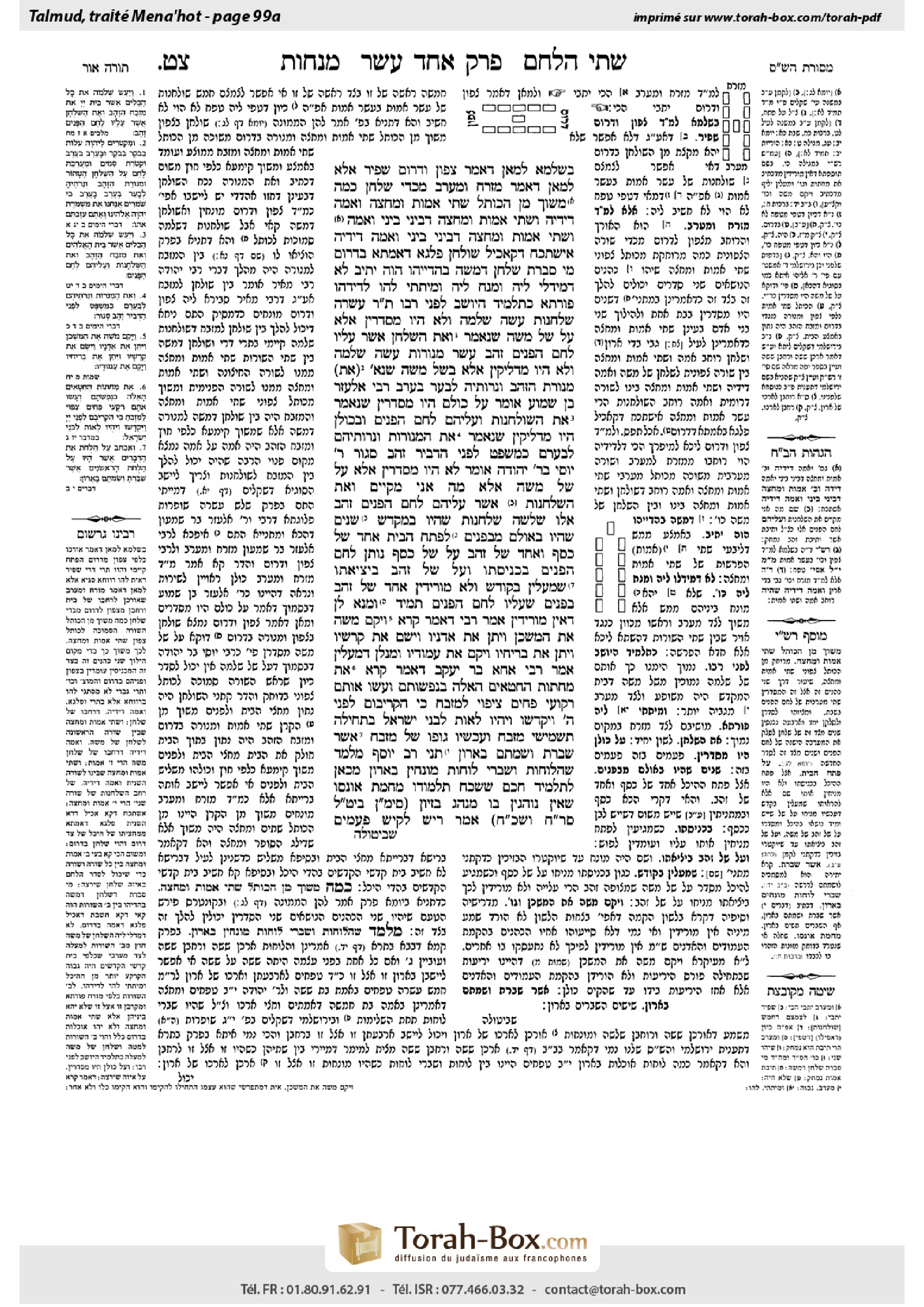
Menachot 99a: Talmud study for Daf Yomi
Daf Yomi is the daily study of one Talmud folio. Explore 37 tractates with scans, Hebrew text, Sefaria English and AI-generated French translations where annotated.
Passage selection and English or AI-generated French translation are available where the scan has annotations. Daf Study is independent of Torah-Box and Sefaria.
Browse Menachot · מנחות · All tractatesMenachot 99a text and translations
This page of Menachot includes the Aramaic text, an English translation and an AI-generated French translation, alongside the scan above.
מנחות צ״ט א · Aramaic and Hebrew text
בִּשְׁלָמָא לְמַאן דְּאָמַר צָפוֹן וְדָרוֹם, שַׁפִּיר.
אֶלָּא לְמַאן דְּאָמַר מִזְרָח וּמַעֲרָב, מִכְּדֵי שֻׁלְחָן כַּמָּה מָשׁוּךְ מִן הַכּוֹתֶל? שְׁתֵּי אַמּוֹת וּמֶחֱצָה, וְאַמָּה דִּידֵיהּ, וּשְׁתֵּי אַמּוֹת וּמֶחֱצָה דְּבֵינֵי בֵּינֵי.
וְאַמָּה, וּשְׁתֵּי אַמּוֹת וּמֶחֱצָה דְּבֵינֵי בֵּינֵי, וְאַמָּה דִּידֵיהּ – אִישְׁתְּכַח דְּקָאָכֵיל שׁוּלְחָן פַּלְגָא דְּאַמְּתָא בְּדָרוֹם.
מִי סָבְרַתְּ שֻׁלְחָן דְּמֹשֶׁה בַּהֲדַיְיהוּ הֲוָה יָתֵיב? לָא, דְּמַידְלֵי לֵיהּ, וּמַנַּח לֵיהּ, וּמְיתַתֵּי לְהוּ לְדִידְהוּ פּוּרְתָּא, כְּתַלְמִיד הַיּוֹשֵׁב לִפְנֵי רַבּוֹ.
תָּנוּ רַבָּנַן: עֲשָׂרָה שֻׁלְחָנוֹת עָשָׂה שְׁלֹמֹה, וְלֹא הָיוּ מְסַדְּרִין אֶלָּא עַל שֶׁל מֹשֶׁה, שֶׁנֶּאֱמַר: ״וְאֶת הַשֻּׁלְחָן אֲשֶׁר עָלָיו לֶחֶם הַפָּנִים זָהָב״.
עֶשֶׂר מְנוֹרוֹת עָשָׂה שְׁלֹמֹה, וְלֹא הָיוּ מַדְלִיקִין אֶלָּא בְּשֶׁל מֹשֶׁה, שֶׁנֶּאֱמַר: ״אֶת מְנוֹרַת הַזָּהָב וְנֵרֹתֶיהָ לְבָעֵר בָּעֶרֶב״.
רַבִּי אֶלְעָזָר בֶּן שַׁמּוּעַ אוֹמֵר: עַל כּוּלָּם הָיוּ מְסַדְּרִין, שֶׁנֶּאֱמַר: ״אֶת הַשֻּׁלְחָנוֹת וַעֲלֵיהֶם לֶחֶם הַפָּנִים״, וּבְכוּלָּן הָיוּ מַדְלִיקִין, שֶׁנֶּאֱמַר: ״אֶת הַמְּנֹרוֹת וְנֵרֹתֵיהֶם לְבַעֲרָם כַּמִּשְׁפָּט לִפְנֵי הַדְּבִיר זָהָב סָגוּר״.
רַבִּי יוֹסֵי בְּרַבִּי יְהוּדָה אוֹמֵר: לֹא הָיוּ מְסַדְּרִין אֶלָּא עַל שֶׁל מֹשֶׁה, אֶלָּא מָה אֲנִי מְקַיֵּים ״וְאֶת הַשֻּׁלְחָנוֹת אֲשֶׁר עֲלֵיהֶם לֶחֶם הַפָּנִים זָהָב״? אֵלּוּ שְׁלֹשָׁה שֻׁלְחָנוֹת שֶׁהָיוּ בַּמִּקְדָּשׁ: שְׁנַיִם שֶׁהָיוּ בְּאוּלָם מִבִּפְנִים לְפֶתַח הַבַּיִת, אֶחָד שֶׁל כֶּסֶף וְאֶחָד שֶׁל זָהָב.
עַל שֶׁל כֶּסֶף נוֹתֵן לֶחֶם הַפָּנִים בִּכְנִיסָתוֹ, וְעַל שֶׁל זָהָב בִּיצִיאָתוֹ, שֶׁמַּעֲלִין בַּקּוֹדֶשׁ וְלֹא מוֹרִידִין. אֶחָד שֶׁל זָהָב בִּפְנִים, שֶׁעָלָיו לֶחֶם הַפָּנִים תָּמִיד.
וּמְנָא לַן דְּאֵין מוֹרִידִין? אָמַר רַבִּי: דְּאָמַר קְרָא: ״וַיָּקֶם מֹשֶׁה אֶת הַמִּשְׁכָּן וַיִּתֵּן אֶת אֲדָנָיו וַיָּשֶׂם אֶת קְרָשָׁיו וַיִּתֵּן אֶת בְּרִיחָיו וַיָּקֶם אֶת עַמּוּדָיו״.
וּמְנָלַן דְּמַעֲלִין? אָמַר רַבִּי אַחָא בַּר יַעֲקֹב: דְּאָמַר קְרָא ״אֵת מַחְתּוֹת הַחַטָּאִים הָאֵלֶּה בְּנַפְשֹׁתָם וְעָשׂוּ אֹתָם רִקֻּעֵי פַחִים צִפּוּי לַמִּזְבֵּחַ כִּי הִקְרִיבֻם לִפְנֵי ה׳ וַיִּקְדָּשׁוּ וְיִהְיוּ לְאוֹת לִבְנֵי יִשְׂרָאֵל״ – בַּתְּחִילָּה תַּשְׁמִישֵׁי מִזְבֵּחַ, וְעַכְשָׁיו גּוּפוֹ שֶׁל מִזְבֵּחַ.
״אֲשֶׁר שִׁבַּרְתָּ וְשַׂמְתָּם בָּאָרוֹן״ – תָּנֵי רַב יוֹסֵף: מְלַמֵּד שֶׁהַלּוּחוֹת וְשִׁבְרֵי לוּחוֹת מוּנָּחִין בָּאָרוֹן. מִכָּאן לְתַלְמִיד חָכָם שֶׁשָּׁכַח תַּלְמוּדוֹ מֵחֲמַת אוֹנְסוֹ, שֶׁאֵין נוֹהֲגִין בּוֹ מִנְהַג בִּזָּיוֹן.
(סִימָן ״בִּיטֵּל״ ״סָרַח״ ״וְשָׁכַח״).
אָמַר רֵישׁ לָקִישׁ: פְּעָמִים
Menachot 99a · English translation
The Gemara continues: Granted, according to the one who said the tables were positioned along the width of the Sanctuary, from north to south, it works out well. According to this opinion there was enough room on the east and the west of the Table for the two priests arranging the new loaves to stand on one side of the Table and for the two priests removing the old loaves to stand on the other side.
But according to the one who said the tables were positioned along the length of the Sanctuary, from east to west, in which case the priests arranging and removing the shewbread would stand at the north and south of the Table, this is difficult. Now, consider how much space was taken up by the tables: How far was the Table removed from the northern wall of the Sanctuary? It was two and a half cubits away from the wall, as this is the space necessary for the two priests to pass. And to this one must add one cubit for the width of the northern row of tables itself, and another two and a half cubits that were between the northern row of five tables and Moses’ Table, as space for two priests to pass is required here as well.
The Gemara continues to calculate the area occupied by the tables: And then one must add one cubit for the width of the Table of Moses, and two and a half cubits that were between Moses’ Table and the southern row of tables, and another cubit for the width of the southern row itself. This totals ten and a half cubits, according to which it is found that the Table occupies half a cubit in the south of the Sanctuary, although the Table is supposed to be entirely in the north of the Sanctuary.
The Gemara answers: Do you maintain that the Table of Moses resided together with the other ten tables, i.e., parallel to them? It was not so. The Table of Moses was situated to the west of the other tables, in the space corresponding to the space between the two rows of tables, and its width should not be added to the width of the two rows of Solomon’s tables. All the tables were therefore situated in the north of the Sanctuary. Since the Temple was built on terrain that sloped downward from west to east, this means that the Table of Moses was raised above the tables of Solomon. The Table of Moses was placed to the west and the tables of Solomon were lowered slightly toward the east. Solomon’s tables therefore appeared in relation to Moses’ Table as a student who sits on a lower level before his teacher.
§ The Sages taught in a baraita: Solomon built ten tables that were situated in the Sanctuary, in addition to Moses’ Table, but the priests would arrange the shewbread only upon the Table of Moses. This is derived from a verse, as it is stated: “And Solomon made all the vessels that were in the House of the Lord, the golden altar, and the Table upon which the shewbread was, of gold” (I Kings 7:48), indicating that the shewbread was placed on only one Table.
Likewise, Solomon built ten candelabra, but the priests would kindle the lamps only on the Candelabrum of Moses. This is derived from a verse, as it is stated: “And they burn unto the Lord every morning and every evening burnt offerings and sweet incense; the shewbread also they arrange in order upon the pure Table, and the Candelabrum of gold with its lamps, to burn every evening” (II Chronicles 13:11). The singular form indicates that the lamps were kindled on only one Candelabrum.
Rabbi Elazar ben Shammua says: They would arrange the shewbread upon all the tables, as it is stated: “And Solomon made all the vessels that were in the House of God, the golden altar as well, and the tables upon which was the shewbread” (II Chronicles 4:19). The plural form indicates that the shewbread was arranged on all the tables. And they would kindle the lamps on all the candelabra, as it is stated in the subsequent verse: “And the candelabra with their lamps, which they should burn according to the ordinance before the Sanctuary, of pure gold” (II Chronicles 4:20).
Rabbi Yosei, son of Rabbi Yehuda, says: They would arrange the shewbread only upon the Table of Moses. Rather, how do I realize the meaning of the verse: “And the tables upon which was the shewbread…of pure gold” (II Chronicles 4:19–20)? These are the three tables that were in the Temple, of which there were two that were situated in the Entrance Hall to the Sanctuary, on the inside near to the entrance to the Temple, i.e., near the entrance to the Sanctuary. One of these tables was made of silver, and the other one was made of gold.
On the table of silver the priest places the new shewbread that has been baked, before its entrance into the Sanctuary, so that the loaves may cool a little from the heat of the oven. And when the old shewbread is removed from the shewbread Table it is placed on the table of gold upon its exit from the Sanctuary, until the frankincense is burned on the altar. The reason the shewbread is placed on a silver table before it is brought into the Sanctuary and on a gold one when it is removed is that one elevates to a higher level in matters of sanctity and one does not downgrade. Since it is set on the gold shewbread Table all week, it cannot be downgraded to a silver table upon its removal. The Gemara concludes: The third of the three tables is the one Table of gold inside the Sanctuary upon which the shewbread is always found.
The Gemara asks: And from where do we derive that one does not downgrade in matters of sanctity? Rabbi Yehuda HaNasi said: This is derived from a verse, as the verse states: “And Moses erected the Tabernacle, and he laid its sockets, and set up its boards, and put in its bars, and erected its pillars” (Exodus 40:18). This teaches that once Moses, who was at a greater level of sanctity than the rest of the people, began the work of erecting the Tabernacle, he alone completed it.
The Gemara asks: And from where do we derive that one elevates to a higher level in matters of sanctity? Rabbi Aḥa bar Ya’akov said: This is derived from a verse, as the verse states with regard to the coal pans of the men of Korah’s assembly, in which they burned incense before they were consumed by a fire: “The coal pans of these men who have sinned at the cost of their lives, and let them be made beaten plates for a covering of the altar, for they have become sacred because they were brought before the Lord, that they may be a sign to the children of Israel” (Numbers 17:3). Initially the coal pans had the status of articles used in the service of the altar, as they contained the incense, and now that they have been made into a covering for the altar their status has been elevated to that of the altar itself.
§ Having mentioned the principle that one does not downgrade in matters of sanctity, the Gemara cites a related issue. The verse states: “At that time the Lord said to me: Hew for yourself two tablets of stone like the first…And I will write on the tablets the words that were on the first tablets, which you broke, and you shall put them in the Ark” (Deuteronomy 10:1–2). Rav Yosef teaches a baraita: This verse teaches that both the tablets of the Covenant and the pieces of the broken tablets are placed in the Ark. One should learn from here that with regard to a Torah scholar who has forgotten his Torah knowledge due to circumstances beyond his control, e.g., illness, one may not behave toward him in a degrading manner. Although the first tablets were broken it is prohibited to treat them with disrespect, due to their sanctity. A Torah scholar who forgot the Torah knowledge he once possessed is likened to these broken tablets.
The Gemara notes a mnemonic for the following three statements of Reish Lakish, which are all related to the concept stated by Rav Yosef: One who caused dereliction of the study of Torah for the sake of a mitzva, a Torah scholar who sinned, and a Torah scholar who forgot his studies.
Reish Lakish says: Sometimes
Menachot 99a · Traduction française (IA)
La Guemara poursuit : Cela convient, selon celui qui dit que les tables étaient disposées dans la largeur du Sanctuaire, du nord au sud. Selon cette opinion, il y avait suffisamment de place à l’est et à l’ouest de la Table pour que les deux prêtres qui disposaient les nouveaux pains se tiennent d’un côté de la Table et que les deux prêtres qui retiraient les anciens pains se tiennent de l’autre côté.
Mais selon celui qui dit que les tables étaient disposées dans la longueur du Sanctuaire, d’est en ouest, auquel cas les prêtres qui disposaient et retiraient les pains de proposition se tenaient au nord et au sud de la Table, cela pose problème. Considérons maintenant l’espace occupé par les tables : à quelle distance de la paroi nord du Sanctuaire la Table se trouvait-elle ? Elle en était éloignée de deux coudées et demie, car c’est l’espace nécessaire au passage des deux prêtres. Il faut y ajouter une coudée pour la largeur de la rangée nord de tables elle-même, puis encore deux coudées et demie entre la rangée nord de cinq tables et la Table de Moïse, car il faut également ici un espace permettant le passage de deux prêtres.
La Guemara poursuit le calcul de l’espace occupé par les tables : il faut ensuite ajouter une coudée pour la largeur de la Table de Moïse, deux coudées et demie entre la Table de Moïse et la rangée sud de tables, puis encore une coudée pour la largeur de cette rangée sud. Le total est de dix coudées et demie. Il s’ensuit que la Table empiète d’une demi-coudée sur la partie sud du Sanctuaire, alors qu’elle est censée se trouver entièrement dans sa partie nord.
La Guemara répond : Penses-tu que la Table de Moïse se trouvait avec les dix autres tables, c’est-à-dire parallèlement à elles ? Il n’en était pas ainsi. La Table de Moïse se trouvait à l’ouest des autres tables, dans l’espace correspondant à celui qui séparait les deux rangées de tables ; sa largeur ne doit donc pas être ajoutée à celle des deux rangées de tables de Salomon. Toutes les tables se trouvaient donc dans la partie nord du Sanctuaire. Comme le Temple était bâti sur un terrain qui descendait d’ouest en est, la Table de Moïse était surélevée par rapport aux tables de Salomon. La Table de Moïse était placée à l’ouest, tandis que les tables de Salomon étaient légèrement plus bas, vers l’est. Par rapport à la Table de Moïse, les tables de Salomon se présentaient donc comme un élève assis à un niveau inférieur devant son maître.
§ Les Sages ont enseigné dans une baraïta : Salomon construisit dix tables qui se trouvaient dans le Sanctuaire, en plus de la Table de Moïse, mais les prêtres ne disposaient les pains de proposition que sur la Table de Moïse. Cela se déduit d’un verset, comme il est dit : « Salomon fit tous les ustensiles qui étaient dans la Maison de l’Éternel, l’autel d’or et la Table sur laquelle se trouvaient les pains de proposition, en or » (I Rois 7:48), ce qui indique que les pains de proposition étaient placés sur une seule Table.
De même, Salomon construisit dix candélabres, mais les prêtres n’allumaient les lampes que sur le candélabre de Moïse. Cela se déduit d’un verset, comme il est dit : « Ils offrent chaque matin et chaque soir à l’Éternel des holocaustes et de l’encens parfumé ; ils disposent aussi les pains de proposition sur la Table pure, et le candélabre d’or avec ses lampes, pour qu’il brûle chaque soir » (II Chroniques 13:11). La forme au singulier indique que les lampes n’étaient allumées que sur un seul candélabre.
Rabbi Elazar ben Shammua dit : Ils disposaient les pains de proposition sur toutes les tables, comme il est dit : « Salomon fit tous les ustensiles qui étaient dans la Maison de Dieu, ainsi que l’autel d’or et les tables sur lesquelles se trouvaient les pains de proposition » (II Chroniques 4:19). La forme au pluriel indique que les pains de proposition étaient disposés sur toutes les tables. Ils allumaient aussi les lampes sur tous les candélabres, comme il est dit dans le verset suivant : « Les candélabres et leurs lampes, qu’ils devaient faire brûler selon l’ordonnance devant le Sanctuaire, étaient d’or pur » (II Chroniques 4:20).
Rabbi Yosse, fils de Rabbi Yehouda, dit : Ils ne disposaient les pains de proposition que sur la Table de Moïse. Comment, dès lors, dois-je comprendre le sens du verset : « Les tables sur lesquelles se trouvaient les pains de proposition… en or pur » (II Chroniques 4:19–20) ? Il s’agit des trois tables qui se trouvaient dans le Temple, dont deux étaient placées dans le vestibule du Sanctuaire, à l’intérieur, près de l’entrée du Temple, c’est-à-dire près de l’entrée du Sanctuaire. L’une de ces tables était en argent et l’autre en or.
Sur la table d’argent, le prêtre déposait les nouveaux pains de proposition qui venaient d’être cuits, avant leur entrée dans le Sanctuaire, afin qu’ils refroidissent un peu après la chaleur du four. Lorsque les anciens pains de proposition étaient retirés de la Table des pains de proposition, ils étaient déposés sur la table d’or, à leur sortie du Sanctuaire, jusqu’à ce que l’encens soit brûlé sur l’autel. Si les pains de proposition étaient déposés sur une table d’argent avant d’être introduits dans le Sanctuaire et sur une table d’or à leur sortie, c’est parce qu’en matière de sainteté, on s’élève à un degré supérieur et l’on ne rétrograde pas. Puisqu’ils étaient posés toute la semaine sur la Table d’or des pains de proposition, ils ne pouvaient pas être abaissés au rang d’une table d’argent au moment de leur retrait. La Guemara conclut : la troisième de ces trois tables était l’unique Table d’or, à l’intérieur du Sanctuaire, sur laquelle se trouvaient toujours les pains de proposition.
La Guemara demande : d’où déduit-on qu’en matière de sainteté, on ne rétrograde pas ? Rabbi Yehouda HaNassi a dit : Cela se déduit d’un verset, comme il est dit : « Moïse érigea le Tabernacle, posa ses socles, dressa ses planches, mit ses traverses et érigea ses colonnes » (Exode 40:18). Cela enseigne que, dès lors que Moïse, dont le degré de sainteté était supérieur à celui du reste du peuple, avait commencé à ériger le Tabernacle, il en acheva seul la construction.
La Guemara demande : d’où déduit-on qu’en matière de sainteté, on s’élève à un degré supérieur ? Rabbi Aḥa bar Ya’akov a dit : Cela se déduit d’un verset concernant les encensoirs des hommes de l’assemblée de Koré, dans lesquels ils avaient brûlé de l’encens avant d’être consumés par le feu. Il est dit : « Les encensoirs de ces hommes qui ont péché au prix de leur vie, qu’on en fasse des plaques martelées pour recouvrir l’autel, car ils sont devenus saints puisqu’ils ont été présentés devant l’Éternel ; ils serviront de signe aux enfants d’Israël » (Nombres 17:3). Au départ, les encensoirs avaient le statut d’objets utilisés pour le service de l’autel, puisqu’ils contenaient l’encens ; maintenant qu’ils ont été transformés en revêtement pour l’autel, leur statut s’est élevé à celui de l’autel lui-même.
§ Après avoir mentionné le principe selon lequel on ne rétrograde pas en matière de sainteté, la Guemara cite une question connexe. Le verset dit : « En ce temps-là, l’Éternel me dit : Taille pour toi deux tables de pierre comme les premières… et j’écrirai sur les tables les paroles qui étaient sur les premières tables, que tu as brisées, et tu les placeras dans l’Arche » (Deutéronome 10:1–2). Rav Yossef enseigne dans une baraïta : ce verset enseigne que les tables de l’Alliance et les morceaux des tables brisées sont tous placés dans l’Arche. On doit en tirer que, s’agissant d’un érudit en Torah qui a oublié ses connaissances en Torah en raison de circonstances indépendantes de sa volonté, par exemple une maladie, il est interdit de se comporter envers lui de manière dégradante. Bien que les premières tables aient été brisées, il est interdit de les traiter avec irrespect en raison de leur sainteté. Un érudit en Torah qui a oublié les connaissances qu’il possédait est comparé à ces tables brisées.
La Guemara donne un moyen mnémotechnique pour les trois enseignements suivants de Reish Lakish, qui se rapportent tous au principe énoncé par Rav Yossef : celui qui a provoqué l’interruption de l’étude de la Torah pour accomplir une mitsva, l’érudit en Torah qui a péché et l’érudit en Torah qui a oublié ses études.
Reish Lakish dit : parfois
Traduction française générée par IA à partir de l’édition anglaise de Sefaria. Vérifie toujours un passage avec le texte source.
Text from Sefaria: William Davidson Edition - Vocalized Aramaic (unknown); William Davidson Edition - English (CC BY NC).