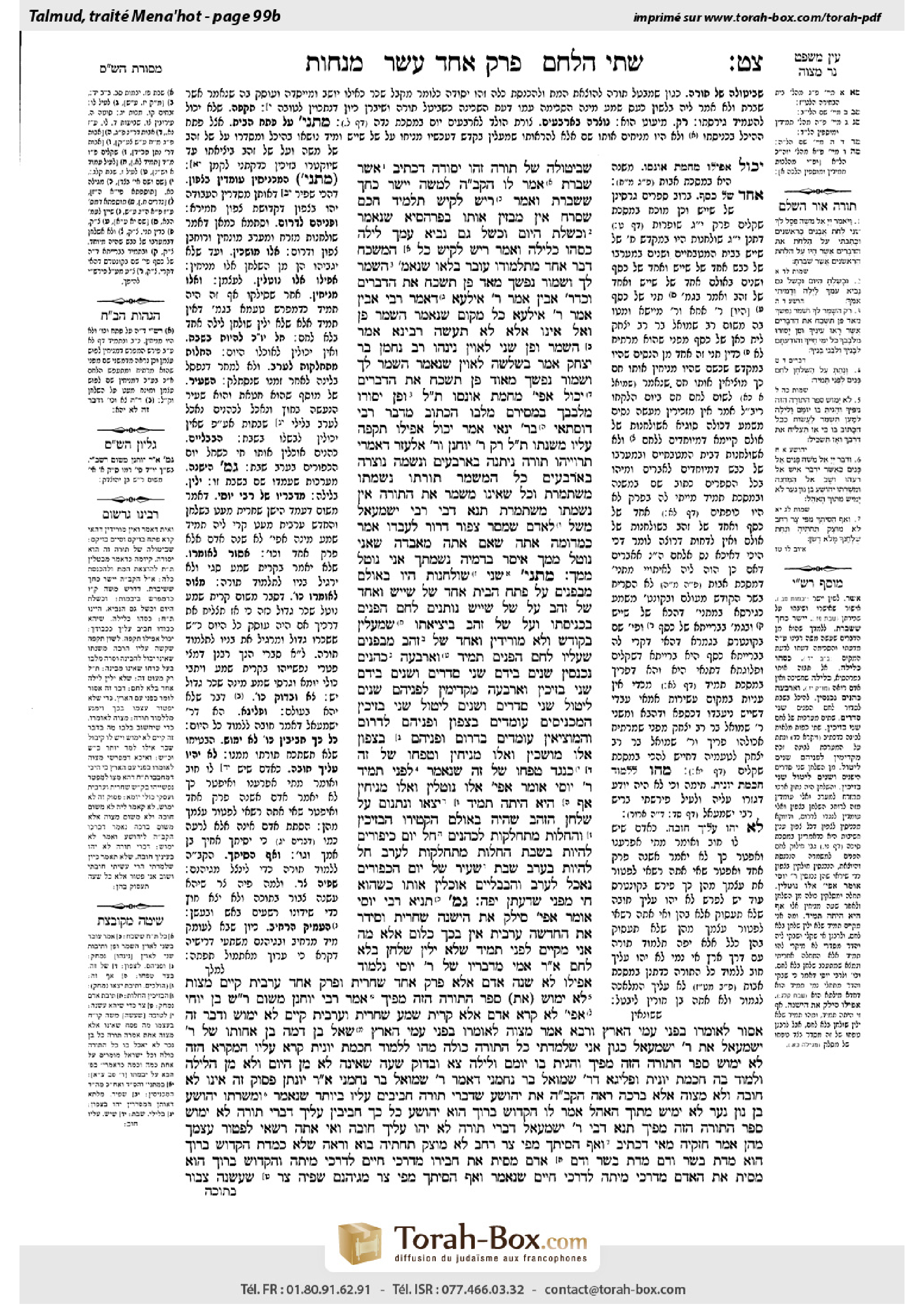
Menachot 99b: Talmud study for Daf Yomi
Daf Yomi is the daily study of one Talmud folio. Explore 37 tractates with scans, Hebrew text, Sefaria English and AI-generated French translations where annotated.
Passage selection and English or AI-generated French translation are available where the scan has annotations. Daf Study is independent of Torah-Box and Sefaria.
Browse Menachot · מנחות · All tractatesMenachot 99b text and translations
This page of Menachot includes the Aramaic text, an English translation and an AI-generated French translation, alongside the scan above.
מנחות צ״ט ב · Aramaic and Hebrew text
שֶׁבִּיטּוּלָהּ שֶׁל תּוֹרָה זֶהוּ יִסּוּדָהּ, דִּכְתִיב: ״אֲשֶׁר שִׁבַּרְתָּ״, אָמַר לוֹ הַקָּדוֹשׁ בָּרוּךְ הוּא לְמֹשֶׁה: יִישַׁר כֹּחֲךָ שֶׁשִּׁבַּרְתָּ.
וְאָמַר רֵישׁ לָקִישׁ: תַּלְמִיד חָכָם שֶׁסָּרַח, אֵין מְבַזִּין אוֹתוֹ בְּפַרְהֶסְיָא, שֶׁנֶּאֱמַר: ״וְכָשַׁלְתָּ הַיּוֹם וְכָשַׁל גַּם נָבִיא עִמְּךָ לָיְלָה״ – כַּסֵּהוּ כַּלַּיְלָה.
וְאָמַר רֵישׁ לָקִישׁ: כׇּל הַמְשַׁכֵּחַ דָּבָר אֶחָד מִתַּלְמוּדוֹ עוֹבֵר בְּלָאו, שֶׁנֶּאֱמַר: ״הִשָּׁמֶר לְךָ וּשְׁמֹר נַפְשְׁךָ מְאֹד פֶּן תִּשְׁכַּח אֶת הַדְּבָרִים״, וְכִדְרַבִּי אָבִין אָמַר רַבִּי אִילְעָא, דְּאָמַר רַבִּי אָבִין אָמַר רַבִּי אִילְעָא: כׇּל מָקוֹם שֶׁנֶּאֱמַר ״הִשָּׁמֶר״, ״פֶּן״, וְ״אַל״ – אֵינוֹ אֶלָּא לֹא תַעֲשֶׂה.
רָבִינָא אָמַר: ״הִשָּׁמֶר״ וּ״פֶן״ שְׁנֵי לָאוִין נִינְהוּ. רַב נַחְמָן בַּר יִצְחָק אָמַר: בִּשְׁלֹשָׁה לָאוִין, שֶׁנֶּאֱמַר: ״הִשָּׁמֶר לְךָ וּשְׁמֹר נַפְשְׁךָ מְאֹד פֶּן תִּשְׁכַּח אֶת הַדְּבָרִים״.
יָכוֹל אֲפִילּוּ מֵחֲמַת אוֹנְסוֹ? תַּלְמוּד לוֹמַר ״וּפֶן יָסוּרוּ מִלְּבָבְךָ״ – בִּמְסִירָם מִלִּבּוֹ הַכָּתוּב מְדַבֵּר. רַבִּי דּוֹסְתַּאי בְּרַבִּי יַנַּאי אָמַר: יָכוֹל אֲפִילּוּ תָּקְפָה עָלָיו מִשְׁנָתוֹ? תַּלְמוּד לוֹמַר ״רַק״.
רַבִּי יוֹחָנָן וְרַבִּי אֶלְעָזָר דְאָמְרִי תַּרְוַיְיהוּ: תּוֹרָה נִיתְּנָה בְּאַרְבָּעִים, וּנְשָׁמָה נוֹצְרָה בְּאַרְבָּעִים. כׇּל הַמְשַׁמֵּר תּוֹרָתוֹ – נִשְׁמָתוֹ מִשְׁתַּמֶּרֶת, וְכֹל שֶׁאֵינוֹ מְשַׁמֵּר אֶת הַתּוֹרָה – אֵין נִשְׁמָתוֹ מִשְׁתַּמֶּרֶת.
תָּנָא דְּבֵי רַבִּי יִשְׁמָעֵאל: מָשָׁל לְאָדָם שֶׁמָּסַר צִפּוֹר דְּרוֹר לְעַבְדּוֹ, אָמַר: כִּמְדוּמֶּה אַתָּה שֶׁאִם אַתָּה מְאַבְּדָהּ שֶׁאֲנִי נוֹטֵל מִמְּךָ אִיסָּר בְּדָמֶיהָ? נִשְׁמָתְךָ אֲנִי נוֹטֵל מִמְּךָ!
מַתְנִי׳ שְׁנֵי שׁוּלְחָנוֹת הָיוּ בָּאוּלָם מִבִּפְנִים, עַל פֶּתַח הַבַּיִת, אֶחָד שֶׁל שַׁיִישׁ וְאֶחָד שֶׁל זָהָב. עַל שֶׁל שַׁיִישׁ נוֹתְנִים לֶחֶם הַפָּנִים בִּכְנִיסָתוֹ, וְעַל שֶׁל זָהָב בִּיצִיאָתוֹ.
שֶׁמַּעֲלִין בַּקּוֹדֶשׁ וְלֹא מוֹרִידִין. וְאֶחָד שֶׁל זָהָב מִבִּפְנִים, שֶׁעָלָיו לֶחֶם הַפָּנִים תָּמִיד.
וְאַרְבָּעָה כֹּהֲנִים נִכְנָסִין, שְׁנַיִם בְּיָדָם שְׁנֵי סְדָרִים, וּשְׁנַיִם בְּיָדָם שְׁנֵי בָּזִיכִין, וְאַרְבָּעָה מַקְדִּימִין לִפְנֵיהֶם, שְׁנַיִם לִיטּוֹל שְׁנֵי סְדָרִים, וּשְׁנַיִם לִיטּוֹל שְׁנֵי בָּזִיכִין.
הַמַּכְנִיסִים עוֹמְדִים בַּצָּפוֹן, וּפְנֵיהֶם לַדָּרוֹם, וְהַמּוֹצִיאִין עוֹמְדִים בַּדָּרוֹם, וּפְנֵיהֶם בַּצָּפוֹן. אֵלּוּ מוֹשְׁכִין, וְאֵלּוּ מַנִּיחִין, וְטִפְחוֹ שֶׁל זֶה כְּנֶגֶד טִפְחוֹ שֶׁל זֶה, שֶׁנֶּאֱמַר: ״לְפָנַי תָּמִיד״.
רַבִּי יוֹסֵי אוֹמֵר: אֲפִילּוּ אֵלּוּ נוֹטְלִין וְאֵלּוּ מַנִּיחִין, אַף הִיא הָיְתָה ״תָּמִיד״.
יָצְאוּ וּנְתָנוּם עַל שֻׁלְחָן הַזָּהָב שֶׁהָיָה בָּאוּלָם, הִקְטִירוּ הַבָּזִיכִין, וְהַחַלּוֹת מִתְחַלְּקוֹת לַכֹּהֲנִים.
חָל יוֹם כִּיפּוּרִים לִהְיוֹת בְּשַׁבָּת, הַחַלּוֹת מִתְחַלְּקוֹת לָעֶרֶב. חָל לִהְיוֹת בְּעֶרֶב שַׁבָּת, שָׂעִיר שֶׁל יוֹם הַכִּפּוּרִים נֶאֱכָל לָעֶרֶב, וְהַבַּבְלִיִּים אוֹכְלִין אוֹתוֹ כְּשֶׁהוּא חַי, מִפְּנֵי שֶׁדַּעְתָּן יָפָה.
גְּמָ׳ תַּנְיָא: רַבִּי יוֹסֵי אוֹמֵר, אֲפִילּוּ סִילֵּק אֶת הַיְּשָׁנָה שַׁחֲרִית וְסִידֵּר אֶת הַחֲדָשָׁה עַרְבִית – אֵין בְּכָךְ כְּלוּם, אֶלָּא מָה אֲנִי מְקַיֵּים ״לְפָנַי תָּמִיד״? שֶׁלֹּא יָלִין שֻׁלְחָן בְּלֹא לֶחֶם.
אָמַר רַבִּי אַמֵּי: מִדְּבָרָיו שֶׁל רַבִּי יוֹסֵי נִלְמוֹד, אֲפִילּוּ לֹא שָׁנָה אָדָם אֶלָּא פֶּרֶק אֶחָד שַׁחֲרִית וּפֶרֶק אֶחָד עַרְבִית – קִיֵּים מִצְוַת ״לֹא יָמוּשׁ (אֵת) סֵפֶר הַתּוֹרָה הַזֶּה מִפִּיךָ״.
אָמַר רַבִּי יוֹחָנָן מִשּׁוּם רַבִּי שִׁמְעוֹן בֶּן יוֹחַי: אֲפִילּוּ לֹא קָרָא אָדָם אֶלָּא קְרִיַּת שְׁמַע שַׁחֲרִית וְעַרְבִית – קִיֵּים ״לֹא יָמוּשׁ״, וְדָבָר זֶה אָסוּר לְאוֹמְרוֹ בִּפְנֵי עַמֵּי הָאָרֶץ, וְרָבָא אָמַר: מִצְוָה לְאוֹמְרוֹ בִּפְנֵי עַמֵּי הָאָרֶץ.
שָׁאַל בֶּן דָּמָה, בֶּן אֲחוֹתוֹ שֶׁל רַבִּי יִשְׁמָעֵאל, אֶת רַבִּי יִשְׁמָעֵאל: כְּגוֹן אֲנִי, שֶׁלָּמַדְתִּי כׇּל הַתּוֹרָה כּוּלָּהּ, מַהוּ לִלְמוֹד חׇכְמַת יְוָנִית? קָרָא עָלָיו הַמִּקְרָא הַזֶּה: ״לֹא יָמוּשׁ סֵפֶר הַתּוֹרָה הַזֶּה מִפִּיךָ וְהָגִיתָ בּוֹ יוֹמָם וָלַיְלָה״. צֵא וּבְדוֹק שָׁעָה שֶׁאֵינָהּ לֹא מִן הַיּוֹם וְלֹא מִן הַלַּיְלָה, וּלְמוֹד בָּהּ חׇכְמַת יְוָנִית.
וּפְלִיגָא דְּרַבִּי שְׁמוּאֵל בַּר נַחְמָנִי, דְּאָמַר רַבִּי שְׁמוּאֵל בַּר נַחְמָנִי אָמַר רַבִּי יוֹנָתָן: פָּסוּק זֶה אֵינוֹ לֹא חוֹבָה וְלֹא מִצְוָה, אֶלָּא בְּרָכָה. רָאָה הַקָּדוֹשׁ בָּרוּךְ הוּא אֶת יְהוֹשֻׁעַ שֶׁדִּבְרֵי תוֹרָה חֲבִיבִים עָלָיו בְּיוֹתֵר, שֶׁנֶּאֱמַר: ״וּמְשָׁרְתוֹ יְהוֹשֻׁעַ בִּן נוּן נַעַר לֹא יָמִישׁ מִתּוֹךְ הָאֹהֶל״. אָמַר לוֹ הַקָּדוֹשׁ בָּרוּךְ הוּא: יְהוֹשֻׁעַ, כׇּל כָּךְ חֲבִיבִין עָלֶיךָ דִּבְרֵי תוֹרָה? ״לֹא יָמוּשׁ סֵפֶר הַתּוֹרָה הַזֶּה מִפִּיךָ״.
תָּנָא דְּבֵי רַבִּי יִשְׁמָעֵאל: דִּבְרֵי תוֹרָה לֹא יְהוּ עָלֶיךָ חוֹבָה, וְאִי אַתָּה רַשַּׁאי לִפְטוֹר עַצְמְךָ מֵהֶן.
אָמַר חִזְקִיָּה: מַאי דִּכְתִיב ״וְאַף הֲסִיתְךָ מִפִּי צָר רַחַב לֹא מוּצָק תַּחְתֶּיהָ״? בּוֹא וּרְאֵה שֶׁלֹּא כְּמִדַּת הַקָּדוֹשׁ בָּרוּךְ הוּא מִדַּת בָּשָׂר וְדָם. מִדַּת בָּשָׂר וָדָם אָדָם מֵסִית אֶת חֲבֵירוֹ מִדַּרְכֵי חַיִּים לְדַרְכֵי מִיתָה, וְהַקָּדוֹשׁ בָּרוּךְ הוּא מֵסִית אֶת הָאָדָם מִדַּרְכֵי מִיתָה לְדַרְכֵי חַיִּים, שֶׁנֶּאֱמַר ״וְאַף הֲסִיתְךָ מִפִּי צָר״ מִגֵּיהִנָּם, שֶׁפִּיהָ צָר, שֶׁעֲשָׁנָהּ צָבוּר
Menachot 99b · English translation
the apparent dereliction of the study of Torah is its foundation, e.g., if one breaks off his studies in order to participate in a funeral or a wedding procession. This is derived from a verse, as it is written: “And the Lord said to Moses: Hew for yourself two tablets of stone like the first, and I will write upon the tablets the words that were on the first tablets, which [asher] you broke” (Exodus 34:1). The word “asher” is an allusion to the fact that that the Holy One, Blessed be He, said to Moses: Your strength is true [yishar koḥakha] in that you broke the tablets, as the breaking of the first tablets led to the foundation of the Torah through the giving of the second tablets.
And Reish Lakish says: With regard to a Torah scholar who sinned, he is not disgraced in public, as it is stated: “Therefore, you shall stumble in the day, and the prophet also shall stumble with you in the night” (Hosea 4:5). One can derive from the verse that if a prophet or any other Torah scholar stumbles and sins, one should conceal his offense like the night and not punish him in public.
And Reish Lakish says: Anyone who causes himself to forget even one matter from his studies violates a prohibition, as it is stated with regard to the receiving of the Torah on Mount Sinai: “Only observe for yourself, and guard your soul diligently, lest you forget the matters that your eyes saw, and lest they depart from your heart all the days of your life, but you should make them known to your children and to your children’s children” (Deuteronomy 4:9). And this is in accordance with the principle that Rabbi Avin says that Rabbi Ile’a says, as Rabbi Avin says that Rabbi Ile’a says: Wherever it is stated: Observe, or: Lest, or: Do not, it is nothing other than a prohibition.
Ravina says: One who forgets his studies violates two prohibitions, as the verse uses both the term “observe” and the term “lest,” and these are two prohibitions. Rav Naḥman bar Yitzḥak says: He violates three prohibitions, as it is stated: “Only observe for yourself, and guard your soul diligently, lest you forget the matters that your eyes saw.” The term “Guard your soul” is derived from the same root as “observe” and is considered an additional prohibition.
The Gemara qualifies this statement: One might have thought this applies even to one who forgot his Torah knowledge due to circumstances beyond his control. Therefore, the verse states: “And lest they depart from your heart.” This indicates that the verse is speaking of one who willingly causes them to depart from his heart. Rabbi Dostai, son of Rabbi Yannai, says: One might have thought that this applies even if his studies were too hard for him to remember. Therefore, the verse states: “Only,” which excludes one who is unable to recall his studies.
Rabbi Yoḥanan and Rabbi Elazar both say: The Torah was given in forty days, when Moses ascended to Mount Sinai to receive it, and similarly the soul of man is formed in forty days, as the formation of the fetus in the womb takes forty days from the time of conception. This teaches that anyone who preserves his Torah studies, his soul is likewise preserved, and anyone who does not preserve his Torah studies, his soul is not preserved either.
The school of Rabbi Yishmael taught: This can be illustrated by a parable, as it is comparable to a person who delivered a sparrow to his slave for safekeeping, and said to him: Are you under the impression that if you lose it I will take from you an issar, a small coin, which is the value of the bird? It is not so; I will take your soul from you as punishment, meaning I will kill you. Similarly, one who fails to preserve the Torah entrusted to him will be severely punished.
MISHNA: There were two tables in the Entrance Hall, on the inside of the Entrance Hall, next to the entrance to the Temple, i.e., next to the entrance to the Sanctuary. One was of marble and one was of gold. On the table of marble, the priests place the new shewbread that has been baked, before its entrance into the Sanctuary, so that the loaves may cool a little from the heat of the oven and not spoil. And when the old shewbread is removed from the shewbread Table it is placed on the table of gold upon its exit from the Sanctuary, where it remains until the frankincense is burned on the altar.
The reason the shewbread is placed on a gold table when it is removed, rather than on a marble or silver table, is that one elevates to a higher level in matters of sanctity and one does not downgrade. Since it is set on the gold shewbread Table all week, it cannot be downgraded to a marble or silver table upon its removal. And there was one Table of gold within the Sanctuary, upon which the shewbread is always found.
The mishna describes the manner in which it is ensured that the shewbread is constantly on the Table: And four priests enter, two with the two arrangements of the new shewbread in their hands and two with the two bowls of frankincense in their hands. And four priests precede them, entering the Sanctuary before them, two to take the two arrangements of the old shewbread from the Table, and two to take the two bowls of frankincense.
Those bringing the new shewbread into the Sanctuary stand in the north and their faces are to the south, and those removing the old shewbread stand in the south and their faces are to the north. These priests draw the old shewbread from the Table and those priests place the new shewbread on the Table, and for each handbreadth of this old shewbread that is removed from the Table a handbreadth of that new shewbread is placed upon the Table, so that the Table is never without loaves upon it, as it is stated: “And you shall set upon the Table shewbread before Me always” (Exodus 25:30).
Rabbi Yosei says: Even if these priests were to remove the shewbread from the Table entirely, and only afterward those priests were to place the new shewbread upon the Table, this too would fulfill the requirement that the shewbread always be on the Table. It is unnecessary to ensure the uninterrupted presence of the shewbread upon the Table, as long as it does not remain a single night without shewbread upon it.
The mishna describes the manner in which the shewbread is distributed: The priests who carried the old shewbread loaves came out of the Sanctuary and placed them on the table of gold that was in the Entrance Hall. The priests then burned on the altar the frankincense that was in the bowls. And the loaves were subsequently distributed to the priests. This occurred on Shabbat, the day that the priestly watch that served in the Temple during the preceding week was replaced by the priestly watch that would serve during the following week. The shewbread was distributed to the priests of both watches.
If Yom Kippur occurs on Shabbat, the loaves are distributed at night, at the conclusion of the fast, since they may not be eaten during the day. If Yom Kippur occurs on Friday, i.e., when the holy day begins on Thursday evening, the goat sin offering of Yom Kippur is eaten by the priests at night, i.e., on Friday night, as it may be eaten only on the day that it is sacrificed or during the following night, until midnight. And since there is no possibility of cooking the meat, as one may not cook on Yom Kippur or Shabbat, the Babylonians, i.e., priests who had emigrated from Babylonia, eat it when it is raw, due to the fact that they are broad-minded with regard to their food, i.e., they are not particular and will eat meat even when it is not cooked.
GEMARA: The mishna teaches that according to Rabbi Yosei, even if the priest first removes the old shewbread entirely, and only then places the new shewbread upon the Table, this fulfills the requirement that the shewbread always be on the Table. Moreover, it is taught in a baraita that Rabbi Yosei says: Even if the priest removed the old shewbread on the morning of Shabbat, and arranged the new shewbread toward evening, there is nothing wrong with that. Rather, how do I realize the meaning of the verse: “And you shall set upon the Table shewbread before Me always” (Exodus 25:30)? This means that the Table should not be left overnight without bread upon it.
The baraita teaches that according to Rabbi Yosei, even if the old shewbread remained on the Table for a short while in the morning, and the new shewbread was placed on the Table toward evening, and even though it did not reside constantly on the Table, this fulfills the requirement that the shewbread should always be on the Table. Rabbi Ami says: From Rabbi Yosei’s statement we may learn that even if a person learned only one chapter of the Mishna in the morning and one chapter of the Mishna in the evening, he has thereby fulfilled the mitzva of: “This Torah scroll shall not depart from your mouth, and you shall contemplate in it day and night, that you may take heed to do according to all that is written in it, for then you shall make your ways prosperous, and then you shall have good success” (Joshua 1:8).
Rabbi Yoḥanan says in the name of Rabbi Shimon ben Yoḥai: Even if a person recited only the recitation of Shema in the morning and in the evening, he has fulfilled the mitzva of: “This Torah scroll shall not depart from your mouth.” And it is prohibited to state this matter in the presence of ignoramuses [amei ha’aretz], as they are likely to get the impression that there is no need to study Torah beyond this. And Rava says: On the contrary, it is a mitzva to state this matter in the presence of ignoramuses, as they will realize that if merely reciting the Shema leads to such a great reward, all the more so how great is the reward of those who study Torah all day and night.
Ben Dama, son of Rabbi Yishmael’s sister, asked Rabbi Yishmael: In the case of one such as I, who has learned the entire Torah, what is the halakha with regard to studying Greek wisdom? Rabbi Yishmael recited this verse about him: “This Torah scroll shall not depart from your mouth, and you shall contemplate in it day and night.” Go and search for an hour that is neither part of the day nor part of the night, and learn Greek wisdom in it.
The Gemara notes: And this statement of Rabbi Yishmael’s disagrees with the opinion of Rabbi Shmuel bar Naḥmani, as Rabbi Shmuel bar Naḥmani says that Rabbi Yonatan says: This verse is neither an obligation nor a mitzva, but a blessing. Rabbi Yonatan explains: The Holy One, Blessed be He, saw Joshua and observed that the words of Torah were very precious to him, as it is stated: “And the Lord spoke to Moses face-to-face…and his servant Joshua, son of Nun, a young man, did not depart from the Tent” (Exodus 33:11). The Holy One, Blessed be He, said to Joshua: Joshua, are the words of Torah so precious to you? I bless you that “this Torah scroll shall not depart from your mouth.”
The tanna of the school of Rabbi Yishmael teaches: The words of Torah should not be considered as an obligation upon you, i.e., one should not treat Torah study as a burden, but at the same time you are not permitted to exempt yourself from them.
Ḥizkiyya said: What is the meaning of that which is written: “He delivers the afflicted due to His affliction, and opens their ear by tribulation; and also He has allured you out of a narrow opening to a broad place without confines below it, and that which is set on your table is full of fatness” (Job 36:15–16)? Come and see that the attribute of flesh and blood is unlike the attribute of the Holy One, Blessed be He. The attribute of flesh and blood is that a person allures another from the paths of life to the paths of death, but the Holy One, Blessed be He, allures the person from the paths of death to the paths of life, as it is stated: “And also He has allured you out of a narrow opening,” i.e., from Gehenna, the opening of which is narrow so that its smoke is collected
Menachot 99b · Traduction française (IA)
L’apparente négligence de l’étude de la Torah en constitue le fondement, par exemple lorsqu’on interrompt son étude pour participer à un cortège funèbre ou à un cortège nuptial. Cela se déduit d’un verset, comme il est écrit : « Le Seigneur dit à Moïse : Taille-toi deux tables de pierre semblables aux premières, et j’écrirai sur ces tables les paroles qui étaient sur les premières tables, que tu as brisées » (Exode 34:1). Le mot « que » [asher] fait allusion au fait que le Saint, béni soit-Il, dit à Moïse : « Tu as bien fait » [yishar koḥakha] de briser les tables, car la brisure des premières tables a conduit à l’établissement de la Torah par le don des secondes tables.
Et Reish Lakish dit : Un érudit en Torah qui a fauté n’est pas déshonoré en public, comme il est dit : « Tu trébucheras le jour, et le prophète aussi trébuchera avec toi la nuit » (Osée 4:5). On peut déduire de ce verset que si un prophète ou tout autre érudit en Torah trébuche et faute, il faut dissimuler sa faute comme la nuit et ne pas le punir en public.
Et Reish Lakish dit : Quiconque se fait oublier ne serait-ce qu’un seul enseignement de ses études transgresse une interdiction, comme il est dit au sujet du don de la Torah sur le mont Sinaï : « Seulement, prends garde à toi et veille attentivement sur ton âme, de peur que tu n’oublies les choses que tes yeux ont vues et qu’elles ne s’éloignent de ton cœur tous les jours de ta vie ; mais fais-les connaître à tes enfants et aux enfants de tes enfants » (Deutéronome 4:9). Cela s’accorde avec le principe énoncé par Rabbi Avin au nom de Rabbi Ile’a : partout où il est dit « prends garde », « de peur que » ou « ne… pas », il s’agit nécessairement d’une interdiction.
Ravina dit : Celui qui oublie ses études transgresse deux interdictions, car le verset emploie à la fois le terme « prends garde » et le terme « de peur que », qui constituent deux interdictions. Rav Naḥman bar Yitzḥak dit : Il transgresse trois interdictions, comme il est dit : « Seulement, prends garde à toi et veille attentivement sur ton âme, de peur que tu n’oublies les choses que tes yeux ont vues. » L’expression « veille sur ton âme » dérive de la même racine que « prends garde » et est considérée comme une interdiction supplémentaire.
La Guemara précise cette déclaration : On aurait pu penser qu’elle s’applique même à celui qui a oublié ses connaissances en Torah en raison de circonstances indépendantes de sa volonté. C’est pourquoi le verset dit : « Et qu’elles ne s’éloignent pas de ton cœur. » Cela indique qu’il s’agit de celui qui les laisse délibérément s’éloigner de son cœur. Rabbi Dostai, fils de Rabbi Yannai, dit : On aurait pu penser que cela s’applique même si ses études étaient trop difficiles pour qu’il s’en souvienne. C’est pourquoi le verset dit : « Seulement », ce qui exclut celui qui est incapable de se rappeler ses études.
Rabbi Yoḥanan et Rabbi Elazar disent tous deux : La Torah a été donnée en quarante jours, lorsque Moïse est monté sur le mont Sinaï pour la recevoir ; de même, l’âme de l’homme se forme en quarante jours, car le fœtus se forme dans le ventre maternel en quarante jours à compter de la conception. Cela enseigne que quiconque préserve ses études de Torah voit également son âme préservée, tandis que quiconque ne préserve pas ses études de Torah ne voit pas non plus son âme préservée.
L’école de Rabbi Yishmael enseignait : Cela peut être illustré par une parabole : un homme confia un moineau à son esclave pour qu’il le garde, et lui dit : « Crois-tu que si tu le perds, je te réclamerai un issar, une petite pièce correspondant à la valeur de l’oiseau ? Il n’en est rien ; je te prendrai la vie en punition, c’est-à-dire que je te tuerai. » De même, celui qui ne préserve pas la Torah qui lui a été confiée sera sévèrement puni.
MICHNA : Il y avait deux tables dans le vestibule, à l’intérieur de celui-ci, près de l’entrée du Temple, c’est-à-dire près de l’entrée du Sanctuaire. L’une était en marbre et l’autre en or. Sur la table de marbre, les prêtres déposaient le nouveau pain de proposition qui venait d’être cuit, avant de le faire entrer dans le Sanctuaire, afin que les pains refroidissent un peu après la chaleur du four et ne s’abîment pas. Lorsque l’ancien pain de proposition était retiré de la table des pains de proposition, il était déposé sur la table d’or à sa sortie du Sanctuaire, où il restait jusqu’à ce que l’encens soit brûlé sur l’autel.
La raison pour laquelle le pain de proposition était déposé sur une table d’or lorsqu’on le retirait, plutôt que sur une table de marbre ou d’argent, est qu’en matière de sainteté, on s’élève à un degré supérieur et l’on ne rétrograde pas. Puisqu’il reposait toute la semaine sur la table d’or des pains de proposition, il ne pouvait pas être placé sur une table de marbre ou d’argent lorsqu’on le retirait. Il y avait également une table d’or dans le Sanctuaire, sur laquelle le pain de proposition se trouvait en permanence.
La Michna décrit comment on veillait à ce que le pain de proposition demeure constamment sur la table : quatre prêtres entraient, deux portant dans leurs mains les deux rangées du nouveau pain de proposition et deux portant les deux coupes d’encens. Quatre prêtres les précédaient et entraient dans le Sanctuaire avant eux : deux pour retirer de la table les deux rangées de l’ancien pain de proposition, et deux pour prendre les deux coupes d’encens.
Ceux qui apportaient le nouveau pain de proposition dans le Sanctuaire se tenaient au nord, le visage tourné vers le sud ; ceux qui retiraient l’ancien pain de proposition se tenaient au sud, le visage tourné vers le nord. Ces prêtres tiraient l’ancien pain de proposition de la table, tandis que ceux-là y déposaient le nouveau ; chaque fois qu’une largeur de paume de l’ancien pain était retirée de la table, une largeur de paume du nouveau pain y était déposée, afin que la table ne soit jamais dépourvue de pains, comme il est dit : « Tu placeras sur la table du pain de proposition devant Moi, en permanence » (Exode 25:30).
Rabbi Yosei dit : Même si ces prêtres retiraient entièrement le pain de proposition de la table, puis que ceux-là ne déposaient le nouveau pain sur la table qu’ensuite, cela satisferait également à l’exigence que le pain de proposition soit toujours sur la table. Il n’est pas nécessaire d’assurer sa présence ininterrompue sur la table, pourvu que celle-ci ne passe pas une nuit sans pain de proposition.
La Michna décrit la manière dont le pain de proposition était distribué : les prêtres qui avaient porté les anciens pains de proposition sortirent du Sanctuaire et les déposèrent sur la table d’or qui se trouvait dans le vestibule. Les prêtres brûlèrent ensuite sur l’autel l’encens qui se trouvait dans les coupes. Puis les pains furent distribués aux prêtres. Cela se produisait le Chabbat, jour où la garde sacerdotale qui avait servi dans le Temple durant la semaine précédente était remplacée par celle qui devait servir durant la semaine suivante. Le pain de proposition était distribué aux prêtres des deux gardes.
Si Yom Kippour tombe un Chabbat, les pains sont distribués le soir, à la fin du jeûne, puisqu’il est interdit de les manger pendant la journée. Si Yom Kippour tombe un vendredi, c’est-à-dire lorsque le jour saint commence le jeudi soir, le sacrifice expiatoire du bouc de Yom Kippour est mangé par les prêtres la nuit, c’est-à-dire le vendredi soir, car il ne peut être mangé que le jour où il est offert ou durant la nuit suivante, jusqu’à minuit. Comme il est impossible de cuire la viande, puisqu’il est interdit de cuisiner à Yom Kippour ou le Chabbat, les Babyloniens, c’est-à-dire les prêtres qui avaient émigré de Babylonie, la mangent crue, car ils sont peu exigeants en matière d’alimentation et mangent même la viande lorsqu’elle n’est pas cuite.
GUEMARA : La Michna enseigne que, selon Rabbi Yosei, même si le prêtre retire d’abord entièrement l’ancien pain de proposition, puis ne dépose le nouveau pain sur la table qu’ensuite, l’exigence que le pain de proposition soit toujours sur la table est satisfaite. En outre, une baraïta enseigne que Rabbi Yosei dit : Même si le prêtre avait retiré l’ancien pain de proposition le matin du Chabbat et disposé le nouveau pain vers le soir, cela ne pose aucun problème. Comment faut-il donc comprendre le verset : « Tu placeras sur la table du pain de proposition devant Moi, en permanence » (Exode 25:30) ? Cela signifie que la table ne doit pas rester une nuit entière sans pain.
La baraïta enseigne que, selon Rabbi Yosei, même si l’ancien pain de proposition restait sur la table pendant un court moment le matin et que le nouveau pain n’y était déposé que vers le soir, et bien qu’il ne s’y soit pas trouvé en permanence, l’exigence que le pain de proposition soit toujours sur la table était satisfaite. Rabbi Ami dit : De la déclaration de Rabbi Yosei, nous pouvons apprendre que même si une personne n’étudie qu’un chapitre de la Michna le matin et un chapitre de la Michna le soir, elle a ainsi accompli la mitsva de : « Que ce livre de la Torah ne s’éloigne pas de ta bouche ; médite-le jour et nuit, afin de veiller à agir selon tout ce qui y est écrit, car alors tu feras réussir tes voies et tu connaîtras le succès » (Josué 1:8).
Rabbi Yoḥanan dit au nom de Rabbi Shimon ben Yoḥai : Même si une personne ne récite que le Chéma matin et soir, elle a accompli la mitsva de : « Que ce livre de la Torah ne s’éloigne pas de ta bouche. » Il est interdit d’énoncer cette idée en présence d’ignorants [amei ha’aretz], car ils risquent de croire qu’il n’est pas nécessaire d’étudier la Torah au-delà de cela. Rava dit, au contraire : C’est une mitsva d’énoncer cette idée en présence d’ignorants, car ils comprendront que si la simple récitation du Chéma procure une si grande récompense, à combien plus forte raison la récompense de ceux qui étudient la Torah jour et nuit est-elle grande.
Ben Dama, fils de la sœur de Rabbi Yishmael, demanda à Rabbi Yishmael : Dans mon cas, moi qui ai étudié toute la Torah, quelle est la halakha concernant l’étude de la sagesse grecque ? Rabbi Yishmael cita à son sujet ce verset : « Que ce livre de la Torah ne s’éloigne pas de ta bouche ; médite-le jour et nuit. » Va chercher une heure qui ne relève ni du jour ni de la nuit, et étudie-y la sagesse grecque.
La Guemara relève que cette déclaration de Rabbi Yishmael est en désaccord avec l’opinion de Rabbi Shmuel bar Naḥmani, car Rabbi Shmuel bar Naḥmani dit que Rabbi Yonatan dit : Ce verset n’est ni une obligation ni une mitsva, mais une bénédiction. Rabbi Yonatan explique : Le Saint, béni soit-Il, vit Josué et constata que les paroles de Torah lui étaient très précieuses, comme il est dit : « Le Seigneur parlait à Moïse face à face… et son serviteur Josué, fils de Noun, jeune homme, ne quittait pas la Tente » (Exode 33:11). Le Saint, béni soit-Il, dit à Josué : « Josué, les paroles de Torah te sont-elles si précieuses ? Je te bénis afin que “ce livre de la Torah ne s’éloigne pas de ta bouche”. »
Le tanna de l’école de Rabbi Yishmael enseigne : Les paroles de Torah ne doivent pas être considérées comme une obligation qui pèse sur toi ; autrement dit, il ne faut pas traiter l’étude de la Torah comme un fardeau. Toutefois, tu n’as pas le droit de t’en dispenser.
Ḥizkiyya dit : Que signifie ce qui est écrit : « Il délivre l’affligé par son affliction et ouvre leur oreille par la tribulation ; et aussi, il t’a attiré hors d’un passage étroit vers un espace large, sans limites en dessous, et ce qui est posé sur ta table est plein de graisse » (Job 36:15–16) ? Viens et vois en quoi la conduite de l’homme de chair et de sang diffère de celle du Saint, béni soit-Il. L’homme de chair et de sang attire autrui des chemins de la vie vers les chemins de la mort, tandis que le Saint, béni soit-Il, attire l’homme des chemins de la mort vers les chemins de la vie, comme il est dit : « Et aussi, il t’a attiré hors d’un passage étroit », c’est-à-dire hors de la Géhenne, dont l’ouverture est étroite, de sorte que sa fumée s’y concentre.
Traduction française générée par IA à partir de l’édition anglaise de Sefaria. Vérifie toujours un passage avec le texte source.
Text from Sefaria: William Davidson Edition - Vocalized Aramaic (unknown); William Davidson Edition - English (CC BY NC).