Menachot 100a: Talmud study for Daf Yomi
Daf Yomi is the daily study of one Talmud folio. Explore 37 tractates with scans, Hebrew text, Sefaria English and AI-generated French translations where annotated.
Passage selection and English or AI-generated French translation are available where the scan has annotations. Daf Study is independent of Torah-Box and Sefaria.
Browse Menachot · מנחות · All tractatesMenachot 100a text and translations
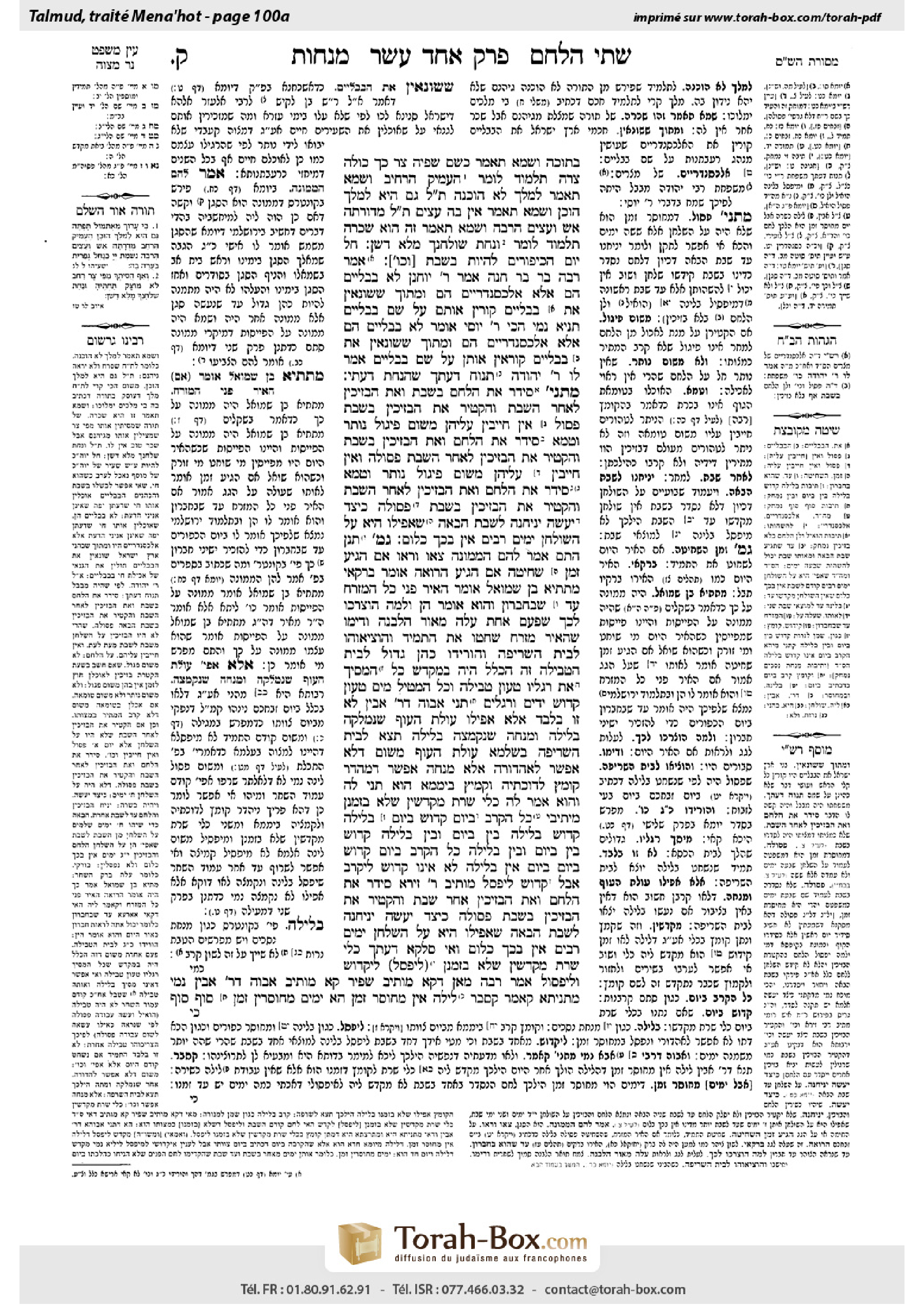
This page of Menachot includes the Aramaic text, an English translation and an AI-generated French translation, alongside the scan above.
מנחות ק׳ א · Aramaic and Hebrew text
בְּתוֹכָהּ. וְשֶׁמָּא תֹּאמַר כְּשֵׁם שֶׁפִּיהָ צַר כָּךְ כּוּלָּהּ צָרָה – תַּלְמוּד לוֹמַר ״הֶעֱמִיק הִרְחִב״.
וְשֶׁמָּא תֹּאמַר לַמֶּלֶךְ לֹא הוּכְנָה – תַּלְמוּד לוֹמַר ״גַּם הִיא לַמֶּלֶךְ הוּכָן״, וְשֶׁמָּא תֹּאמַר אֵין בָּהּ עֵצִים – תַּלְמוּד לוֹמַר ״מְדֻרָתָהּ אֵשׁ וְעֵצִים הַרְבֵּה״, וְשֶׁמָּא תֹּאמַר זֶה הוּא שְׂכָרָהּ – תַּלְמוּד לוֹמַר ״וְנַחַת שֻׁלְחָנְךָ מָלֵא דָשֶׁן״.
חָל יוֹם הַכִּיפּוּרִים לִהְיוֹת בְּשַׁבָּת [וְכוּ׳]. אָמַר רַבָּה בַּר בַּר חָנָה אָמַר רַבִּי יוֹחָנָן: לֹא בָּבְלִיִּים הֵם, אֶלָּא אֲלֶכְּסַנְדְּרִיִּים הֵם, וּמִתּוֹךְ שֶׁשּׂוֹנְאִין אֶת הַבָּבְלִיִּים – קוֹרִין אוֹתָם עַל שֵׁם בָּבְלִיִּים.
תַּנְיָא נָמֵי הָכִי, רַבִּי יוֹסֵי אוֹמֵר: לֹא בָּבְלִיִּים הֵם, אֶלָּא אֲלֶכְּסַנְדְּרִיִּים הֵם, וּמִתּוֹךְ שֶׁשּׂוֹנְאִין אֶת הַבָּבְלִיִּים – קוֹרְאִין אוֹתָן עַל שֵׁם בָּבְלִיִּים. אָמַר לוֹ רַבִּי יְהוּדָה: תָּנוּחַ דַּעְתְּךָ שֶׁהִנַּחְתָּ דַּעְתִּי.
מַתְנִי׳ סִידֵּר אֶת הַלֶּחֶם בַּשַּׁבָּת, וְאֶת הַבָּזִיכִין לְאַחַר הַשַּׁבָּת, וְהִקְטִיר אֶת הַבָּזִיכִין בַּשַּׁבָּת – פָּסוּל, אֵין חַיָּיבִין עֲלֵיהֶן מִשּׁוּם פִּיגּוּל, נוֹתָר, וְטָמֵא.
סִידֵּר אֶת הַלֶּחֶם וְאֶת הַבָּזִיכִין בַּשַּׁבָּת, וְהִקְטִיר אֶת הַבָּזִיכִין לְאַחַר הַשַּׁבָּת – פְּסוּלָה, וְאֵין חַיָּיבִין עֲלֵיהֶן מִשּׁוּם פִּיגּוּל, נוֹתָר, וְטָמֵא.
סִידֵּר אֶת הַלֶּחֶם וְאֶת הַבָּזִיכִין לְאַחַר הַשַּׁבָּת, וְהִקְטִיר אֶת הַבָּזִיכִין בַּשַּׁבָּת – פְּסוּלָה. כֵּיצַד יַעֲשֶׂה? יַנִּיחֶנָּה לְשַׁבָּת הַבָּאָה, שֶׁאֲפִילּוּ הִיא עַל הַשּׁוּלְחָן יָמִים רַבִּים – אֵין בְּכָךְ כְּלוּם.
גְּמָ׳ תְּנַן הָתָם: אָמַר לָהֶם הַמְמוּנֶּה: ״צְאוּ וּרְאוּ אִם הִגִּיעַ זְמַן שְׁחִיטָה״. אִם הִגִּיעַ, הָרוֹאֶה אוֹמֵר: ״בַּרְקַאי״. מַתִּתְיָא בֶּן שְׁמוּאֵל אוֹמֵר: ״הֵאִיר פְּנֵי כׇּל הַמִּזְרָח עַד שֶׁבְּחֶבְרוֹן״, וְהוּא אוֹמֵר: ״הֵן״.
וְלָמָּה הוּצְרְכוּ לְכָךְ? שֶׁפַּעַם אַחַת עָלָה מְאוֹר הַלְּבָנָה, וְדִימּוּ שֶׁהֵאִיר מִזְרָח, שָׁחֲטוּ אֶת הַתָּמִיד, וְהוֹצִיאוּהוּ לְבֵית הַשְּׂרֵיפָה.
וְהוֹרִידוּ כֹּהֵן גָּדוֹל לְבֵית הַטְּבִילָה. זֶה הַכְּלָל הָיָה בַּמִּקְדָּשׁ: כָּל הַמֵּסֵיךְ אֶת רַגְלָיו טָעוּן טְבִילָה, וְכׇל הַמֵּטִיל מַיִם טָעוּן קִדּוּשׁ יָדַיִם וְרַגְלַיִם.
תָּנֵי אֲבוּהּ דְּרַבִּי אָבִין: לֹא זוֹ בִּלְבַד, אֶלָּא אֲפִילּוּ עוֹלַת הָעוֹף שֶׁנִּמְלְקָה בַּלַּיְלָה, וּמִנְחָה שֶׁנִּקְמְצָה בַּלַּיְלָה – תֵּצֵא לְבֵית הַשְּׂרֵיפָה.
בִּשְׁלָמָא עוֹלַת הָעוֹף – מִשּׁוּם דְּלָא אֶפְשָׁר לְאַהְדּוֹרַהּ, אֶלָּא מִנְחָה – אֶפְשָׁר דְּמַהְדַּר קוֹמֶץ לְדוּכְתֵּיהּ וְקָמֵיץ בִּימָמָא.
הוּא תָּנֵי לַהּ, וְהוּא אָמַר לַהּ: כְּלֵי שָׁרֵת מְקַדְּשִׁין שֶׁלֹּא בִּזְמַנָּן.
מֵיתִיבִי: כׇּל הַקָּרֵב בַּיּוֹם – קָדוֹשׁ בַּיּוֹם, בַּלַּיְלָה – קָדוֹשׁ בַּלַּיְלָה, בֵּין בַּיּוֹם וּבֵין בַּלַּיְלָה – קָדוֹשׁ בֵּין בַּיּוֹם וּבֵין בַּלַּיְלָה.
כׇּל הַקָּרֵב בַּיּוֹם – קָדוֹשׁ בַּיּוֹם; ״בַּיּוֹם״ – אִין, ״בַּלַּיְלָה״ – לָא; אֵינוֹ קָדוֹשׁ לִיקְרַב, אֲבָל קָדוֹשׁ לִיפָּסֵל.
מוֹתֵיב רַבִּי זֵירָא: סִידֵּר אֶת הַלֶּחֶם וְאֶת הַבָּזִיכִין אַחַר שַׁבָּת, וְהִקְטִיר אֶת הַבָּזִיכִין בַּשַּׁבָּת – פְּסוּלָה. כֵּיצַד יַעֲשֶׂה? יַנִּיחֶנָּה לְשַׁבָּת הַבָּאָה, שֶׁאֲפִילּוּ הִיא עַל הַשֻּׁלְחָן יָמִים רַבִּים אֵין בְּכָךְ כְּלוּם.
וְאִי סָלְקָא דַעְתָּךְ כְּלֵי שָׁרֵת מְקַדְּשִׁין שֶׁלֹּא בִּזְמַנָּן (לִיפָּסֵל) – לִיקְדּוֹשׁ וְלִיפְּסוּל.
אָמַר רַבָּה: מַאן דְּקָא מוֹתֵיב – שַׁפִּיר קָא מוֹתֵיב, אֲבוּהּ דְּרַבִּי אָבִין נָמֵי מַתְנִיתָא קָאָמַר. קָסָבַר: לַיְלָה אֵין מְחוּסָּר זְמַן, הָא יָמִים מְחוּסָּרִין זְמַן.
סוֹף סוֹף,
Menachot 100a · English translation
within it. And lest you say: Just as the opening of Gehenna is narrow, so too, all of Gehenna is narrow, the verse states: “For Gehenna has been arranged of old, it has been prepared even for the king, deep and large, its pile is fire and much wood, the breath of the Lord kindles it like a stream of brimstone” (Isaiah 30:33).
And lest you say that Gehenna is prepared only for ordinary people, but it is not prepared for important individuals such as a king, the verse states: “It has been prepared even for the king.” And lest you say there is no wood in Gehenna, the verse states: “Its pile is fire and much wood.” And lest you say that this, i.e., escaping Gehenna, is the only reward for Torah study, the verse states: “And that which is set on your table is full of fatness” (Job 36:16). This indicates that one who obeys God and turns from the paths of death to the paths of life is not only saved from Gehenna, he also attains tranquility and prosperity.
§ The mishna states: If Yom Kippur occurs on Shabbat, the loaves are distributed on Saturday night. If Yom Kippur occurs on Friday, the goat sin offering of Yom Kippur is eaten Friday night, on Shabbat. Since there was no possibility of cooking the meat, the Babylonian priests would eat it raw. The Gemara notes: Rabba bar bar Ḥana says that Rabbi Yoḥanan says: These priests are not actually Babylonians. Rather, they are Alexandrians, i.e., priests who came from Egypt. But since the Jews of Eretz Yisrael hate the Jewish Babylonians, they would call the gluttonous Alexandrians by the name Babylonians.
This interpretation of the mishna is also taught in a baraita: Rabbi Yosei says: These priests are not actually Babylonians. Rather, they are Alexandrians. But since the Jews of Eretz Yisrael hate the Babylonians, they would call the gluttonous Alexandrians by the name Babylonians. Rabbi Yehuda, whose family originated from Babylonia, said to Rabbi Yosei, after hearing this explanation: May your mind be at ease, because you have put my mind at ease.
MISHNA: If one arranged the bread on the Table on Shabbat but arranged the bowls of frankincense only after Shabbat, then if he subsequently burned the frankincense placed in the bowls on the following Shabbat, the loaves are unfit for consumption, since the frankincense had not been on the Table for the entire week. Since the burning of the frankincense did not render the loaves permitted for consumption, one is not ever liable for eating them due to violation of the prohibitions of piggul or notar, or for partaking of the shewbread when one is ritually impure. One violates these prohibitions only if the frankincense is burned in a manner that permits consumption of the shewbread.
If one arranged the bread and the bowls of frankincense on Shabbat but then burned the frankincense that was in the bowls after the following Shabbat, that burning of the frankincense is not valid and the shewbread is unfit for consumption. And since the frankincense was not burned in a manner that permits consumption of the shewbread, one is not ever liable for eating them due to violation of the prohibitions of piggul or notar, or for partaking of the shewbread when one is ritually impure.
If one arranged the bread and the bowls of frankincense after Shabbat and burned the frankincense that was in the bowls on the subsequent Shabbat, the burning of the frankincense is not valid and the shewbread is unfit for consumption. How should one act to prevent the shewbread from being rendered unfit? One should not remove the shewbread and frankincense from the Table on the subsequent Shabbat. Rather, he should leave it on the Table until the following Shabbat, so that it remains on the Table for a full week from Shabbat to Shabbat. It is permitted to leave the bread and frankincense on the Table beyond seven days, as even if it is on the Table for many days there is nothing wrong with that, i.e., it is not rendered unfit.
GEMARA: We learned in a mishna there (Yoma 28a) with regard to the Yom Kippur service in the Temple: The appointed priest said to the other priests: Go out and stand on a high point in the Temple and see if it is day and the time for slaughtering the daily offering has arrived, as one may not slaughter offerings at night. If the time has arrived, the observer says: There is light [barkai]. Mattitya ben Shmuel maintained that one should wait until greater light is observed. Therefore, when he was the appointed priest, he would say: Is the entire eastern sky illuminated, even to Hebron? And the observer would say: Yes.
The mishna asks: And why did they need to institute this, to send someone to observe the first light from a high place? The mishna explains that this was deemed necessary because once, the light of the moon rose and the priests imagined that the eastern sky was illuminated with sunlight. They then slaughtered the daily offering, and when they realized that it had been slaughtered too early they had to take it out to the place designated for burning and burn it. In order to prevent similar errors in the future, the Sages instituted that they should carefully assess the situation and ensure that day has begun before slaughtering the daily offering.
The mishna continues: Once the daylight was observed on Yom Kippur, the priests led the High Priest down to the Hall of Immersion. The mishna comments: This was the principle in the Temple: Anyone who covers his legs, a euphemism for defecating, requires immersion afterward; and anyone who urinates requires sanctification of hands and feet with water from the Basin afterward.
The father of Rabbi Avin teaches a baraita: Not only in this case, with regard to slaughtering the daily offering, did the Sages say that if it is performed at night it is disqualified, but even in the case of a bird burnt offering whose nape was pinched at night, and in the case of a meal offering from which a handful was removed at night, the offering is disqualified and must be taken out to the place designated for burning.
The Gemara asks: Granted, a bird burnt offering is disqualified if pinched at night, as it cannot be restored to its former state. But in the case of a meal offering whose handful was removed at night, why is it burned? It is possible to remedy the situation, as the priest can restore the handful to its original place and then remove a handful from the meal offering once again during the day.
The Gemara replies that the father of Rabbi Avin teaches the baraita and he says its explanation: Service vessels sanctify their contents even when those contents are not placed in the vessel at the appointed time for that service. Once the handful is placed in the service vessel it acquires the sanctity inherent to the handful and the situation can no longer be remedied.
The Gemara raises an objection from a baraita. Any offering that is sacrificed during the day is consecrated by a service vessel only during the day, and any offering that is sacrificed at night is consecrated by a service vessel only at night, and any offering that is sacrificed both during the day and at night is consecrated both during the day and at night.
The baraita teaches that any offering that is sacrificed during the day is consecrated during the day, from which one can infer that during the day, yes, it is consecrated, but it is not consecrated at night. This indicates that the handful of the meal offering is not consecrated at night, contrary to the explanation of Rabbi Avin’s father. The Gemara answers: When an offering is placed in a service vessel not at the appointed time, the contents are not sufficiently consecrated to be sacrificed on the altar, but they are sufficiently consecrated to be disqualified.
Rabbi Zeira raises an objection from the mishna: If one arranged the bread and the bowls of frankincense after Shabbat and burned the frankincense that was in the bowls on the subsequent Shabbat, the burning of the frankincense is not valid and the shewbread is unfit for consumption. How should one act to prevent the shewbread from being rendered unfit? One should not remove the shewbread on the subsequent Shabbat. Rather, he should leave it on the Table until the following Shabbat, so that it remains on the Table for a full week from Shabbat to Shabbat. It is permitted to leave the bread and frankincense on the Table beyond seven days, as even if it is on the Table for many days there is nothing wrong with that, i.e., it is not rendered unfit.
Rabbi Zeira explains: And if it enters your mind to say that service vessels sanctify their contents to the extent that those contents are disqualified even when they are not placed in the vessel at the appointed time, then even if the shewbread is arranged after Shabbat it should be sanctified by the Table and subsequently disqualified by being left overnight.
Rabba said: The one who raises the objection, Rabbi Zeira, raises the objection well. Nevertheless, the father of Rabbi Avin is also stating a baraita, and the difficulty must therefore be resolved. Rabba explains: The tanna of the baraita cited by Rabbi Avin’s father maintains that in the case of a rite that should be performed during the day, if it is performed during the preceding night it is not considered a rite whose time has not yet arrived, as the night and day are considered a single unit. Therefore, if one places the handful in a service vessel at night the service vessel sanctifies the handful, and since the rite is not valid the offering is disqualified. But if a rite is performed several days earlier it is considered a rite whose time has not yet arrived. Therefore, the Table does not sanctify the shewbread that is placed on it on any day except Shabbat.
The Gemara asks: Ultimately,
Menachot 100a · Traduction française (IA)
à l’intérieur. Et de crainte que tu ne dises : De même que l’entrée de la Géhenne est étroite, toute la Géhenne l’est aussi, le verset dit : « Car la Géhenne a été préparée depuis longtemps ; elle est prête même pour le roi, profonde et vaste ; son bûcher est fait de feu et de beaucoup de bois, le souffle du Seigneur l’embrase comme un torrent de soufre » (Isaïe 30,33).
Et de crainte que tu ne dises que la Géhenne est préparée seulement pour les gens ordinaires, mais pas pour les personnes importantes, comme un roi, le verset dit : « Elle est prête même pour le roi. » Et de crainte que tu ne dises qu’il n’y a pas de bois dans la Géhenne, le verset dit : « Son bûcher est fait de feu et de beaucoup de bois. » Et de crainte que tu ne dises que ceci, c’est-à-dire échapper à la Géhenne, est la seule récompense de l’étude de la Torah, le verset dit : « Et ce qui est placé sur ta table est plein de graisse » (Job 36,16). Cela indique que celui qui obéit à Dieu et se détourne des voies de la mort pour suivre celles de la vie est non seulement sauvé de la Géhenne, mais accède aussi à la tranquillité et à la prospérité.
§ La Michna enseigne : Si Yom Kippour tombe un Chabbat, les pains sont distribués le samedi soir. Si Yom Kippour tombe un vendredi, le bouc du sacrifice expiatoire de Yom Kippour est mangé le vendredi soir, c’est-à-dire pendant le Chabbat. Comme il n’était pas possible de cuire la viande, les prêtres babyloniens la mangeaient crue. La Guemara relève : Rabba bar bar Ḥana dit au nom de Rabbi Yoḥanan : Ces prêtres n’étaient pas réellement babyloniens ; ils étaient plutôt alexandrins, c’est-à-dire des prêtres venus d’Égypte. Mais comme les Juifs d’Eretz Israël détestent les Juifs babyloniens, ils appelaient les gloutons alexandrins « Babyloniens ».
Cette interprétation de la Michna est également enseignée dans une baraïta : Rabbi Yosei dit : Ces prêtres n’étaient pas réellement babyloniens ; ils étaient plutôt alexandrins. Mais comme les Juifs d’Eretz Israël détestent les Babyloniens, ils appelaient les gloutons alexandrins « Babyloniens ». Rabbi Yehuda, dont la famille était originaire de Babylonie, dit à Rabbi Yosei après avoir entendu cette explication : « Que ton esprit soit apaisé, car tu as apaisé le mien. »
MICHNA : Si l’on a disposé les pains sur la Table le Chabbat, mais que l’on n’a disposé les coupes d’encens qu’après le Chabbat, puis que l’on a brûlé l’encens placé dans les coupes le Chabbat suivant, les pains sont impropres à la consommation, car l’encens n’est pas resté sur la Table pendant toute la semaine. Comme la combustion de l’encens n’a pas rendu les pains propres à la consommation, on n’est jamais passible pour les avoir mangés d’une violation des interdictions de piggoul ou de notar, ni pour avoir consommé les pains de proposition en état d’impureté rituelle. On ne viole ces interdictions que si l’encens est brûlé de manière à rendre les pains de proposition propres à la consommation.
Si l’on a disposé les pains et les coupes d’encens sur la Table le Chabbat, mais que l’on a ensuite brûlé l’encens qui se trouvait dans les coupes après le Chabbat suivant, cette combustion de l’encens n’est pas valide et les pains de proposition sont impropres à la consommation. Puisque l’encens n’a pas été brûlé de manière à rendre les pains de proposition propres à la consommation, on n’est jamais passible pour les avoir mangés d’une violation des interdictions de piggoul ou de notar, ni pour avoir consommé les pains de proposition en état d’impureté rituelle.
Si l’on a disposé les pains et les coupes d’encens après le Chabbat, puis que l’on a brûlé l’encens qui se trouvait dans les coupes le Chabbat suivant, cette combustion de l’encens n’est pas valide et les pains de proposition sont impropres à la consommation. Que faut-il faire pour éviter que les pains de proposition ne deviennent impropres ? Il ne faut pas retirer les pains de proposition et l’encens de la Table le Chabbat suivant. Il faut plutôt les laisser sur la Table jusqu’au Chabbat d’après, afin qu’ils y restent une semaine entière, d’un Chabbat à l’autre. Il est permis de laisser les pains et l’encens sur la Table plus de sept jours ; même s’ils y restent de nombreux jours, cela ne pose aucun problème, c’est-à-dire qu’ils ne deviennent pas impropres.
GUEMARA : Nous avons appris dans une Michna, là-bas (Yoma 28a), à propos du service de Yom Kippour dans le Temple : Le prêtre préposé dit aux autres prêtres : « Sortez et tenez-vous sur un point élevé du Temple ; voyez s’il fait jour et si l’heure de l’abattage de l’offrande quotidienne est arrivée, car on ne peut pas abattre des offrandes la nuit. » Si l’heure est arrivée, l’observateur dit : « Il fait jour [barkai]. » Mattitya ben Shmuel estimait qu’il fallait attendre qu’une lumière plus intense soit visible. Aussi, lorsqu’il était le prêtre préposé, disait-il : « Tout le ciel oriental est-il illuminé, jusqu’à Hébron ? » Et l’observateur répondait : « Oui. »
La Michna demande : Et pourquoi a-t-on dû instituer cette mesure, qui consiste à envoyer quelqu’un observer les premières lueurs depuis un point élevé ? La Michna explique que cela fut jugé nécessaire parce qu’un jour, la lune s’était levée et les prêtres avaient cru que le ciel oriental était illuminé par le soleil. Ils avaient alors abattu l’offrande quotidienne et, lorsqu’ils comprirent qu’elle avait été abattue trop tôt, ils durent l’emporter à l’endroit désigné pour la combustion et la brûler. Afin d’éviter de telles erreurs à l’avenir, les Sages instituèrent qu’ils évaluent attentivement la situation et s’assurent que le jour s’est levé avant d’abattre l’offrande quotidienne.
La Michna poursuit : Une fois le jour levé à Yom Kippour, les prêtres conduisaient le Grand Prêtre à la salle des immersions. La Michna précise : Telle était la règle dans le Temple : quiconque couvre ses jambes — euphémisme désignant le fait de déféquer — doit ensuite s’immerger ; quiconque urine doit ensuite se sanctifier les mains et les pieds avec l’eau du Bassin.
Le père de Rabbi Avin enseigne une baraïta : Les Sages n’ont pas seulement dit, à propos de l’abattage de l’offrande quotidienne, que si celui-ci est effectué la nuit, l’offrande est invalidée ; ils l’ont également dit dans le cas d’un holocauste d’oiseau dont la nuque a été pincée la nuit et dans celui d’une offrande de farine dont la poignée a été prélevée la nuit : l’offrande est invalidée et doit être emportée à l’endroit désigné pour la combustion.
La Guemara demande : Il est compréhensible qu’un holocauste d’oiseau soit invalidé si sa nuque est pincée la nuit, puisqu’on ne peut pas rétablir la situation antérieure. Mais dans le cas d’une offrande de farine dont la poignée a été prélevée la nuit, pourquoi la brûle-t-on ? Il est possible de remédier à la situation : le prêtre peut remettre la poignée à son emplacement initial, puis en prélever une nouvelle de l’offrande de farine pendant la journée.
La Guemara répond que le père de Rabbi Avin enseigne la baraïta et en donne l’explication : les ustensiles de service sanctifient leur contenu même lorsque celui-ci y est placé en dehors du moment fixé pour ce service. Dès que la poignée est placée dans l’ustensile de service, elle acquiert la sainteté propre à une poignée prélevée ; il n’est alors plus possible de remédier à la situation.
La Guemara soulève une objection à partir d’une baraïta : Toute offrande qui est sacrifiée pendant la journée n’est sanctifiée par un ustensile de service que pendant la journée ; toute offrande qui est sacrifiée la nuit n’est sanctifiée par un ustensile de service que la nuit ; et toute offrande qui est sacrifiée aussi bien pendant la journée que la nuit est sanctifiée aussi bien pendant la journée que la nuit.
La baraïta enseigne que toute offrande sacrifiée pendant la journée est sanctifiée pendant la journée ; on peut donc en déduire qu’elle est sanctifiée le jour, mais pas la nuit. Cela indique que la poignée de l’offrande de farine n’est pas sanctifiée la nuit, contrairement à l’explication du père de Rabbi Avin. La Guemara répond : Lorsqu’une offrande est placée dans un ustensile de service en dehors du moment fixé, son contenu n’est pas suffisamment sanctifié pour être sacrifié sur l’autel, mais il l’est suffisamment pour être invalidé.
Rabbi Zeira soulève une objection à partir de la Michna : Si l’on a disposé les pains et les coupes d’encens après le Chabbat, puis que l’on a brûlé l’encens qui se trouvait dans les coupes le Chabbat suivant, cette combustion de l’encens n’est pas valide et les pains de proposition sont impropres à la consommation. Que faut-il faire pour éviter que les pains de proposition ne deviennent impropres ? Il ne faut pas retirer les pains de proposition le Chabbat suivant. Il faut plutôt les laisser sur la Table jusqu’au Chabbat d’après, afin qu’ils y restent une semaine entière, d’un Chabbat à l’autre. Il est permis de laisser les pains et l’encens sur la Table plus de sept jours ; même s’ils y restent de nombreux jours, cela ne pose aucun problème, c’est-à-dire qu’ils ne deviennent pas impropres.
Rabbi Zeira explique : Si tu venais à dire que les ustensiles de service sanctifient leur contenu au point que celui-ci est invalidé même lorsqu’il est placé dans l’ustensile en dehors du moment fixé, alors, même si les pains de proposition sont disposés après le Chabbat, la Table devrait les sanctifier et ils devraient ensuite être invalidés s’ils y passent la nuit.
Rabba dit : Rabbi Zeira, celui qui soulève l’objection, la soulève à juste titre. Néanmoins, le père de Rabbi Avin enseigne lui aussi une baraïta ; il faut donc résoudre la difficulté. Rabba explique : Le tanna de la baraïta citée par le père de Rabbi Avin estime que, dans le cas d’un rite qui doit être accompli pendant la journée, s’il est accompli la nuit précédente, il n’est pas considéré comme accompli avant que son heure soit arrivée, car la nuit et le jour sont considérés comme une seule unité. Par conséquent, si l’on place la poignée dans un ustensile de service la nuit, cet ustensile sanctifie la poignée et, puisque le rite n’est pas valide, l’offrande est invalidée. En revanche, si un rite est accompli plusieurs jours à l’avance, il est considéré comme accompli avant que son heure soit arrivée. Par conséquent, la Table ne sanctifie les pains de proposition qui y sont déposés que le Chabbat.
La Guemara demande : En définitive,
Traduction française générée par IA à partir de l’édition anglaise de Sefaria. Vérifie toujours un passage avec le texte source.
Text from Sefaria: William Davidson Edition - Vocalized Aramaic (unknown); William Davidson Edition - English (CC BY NC).