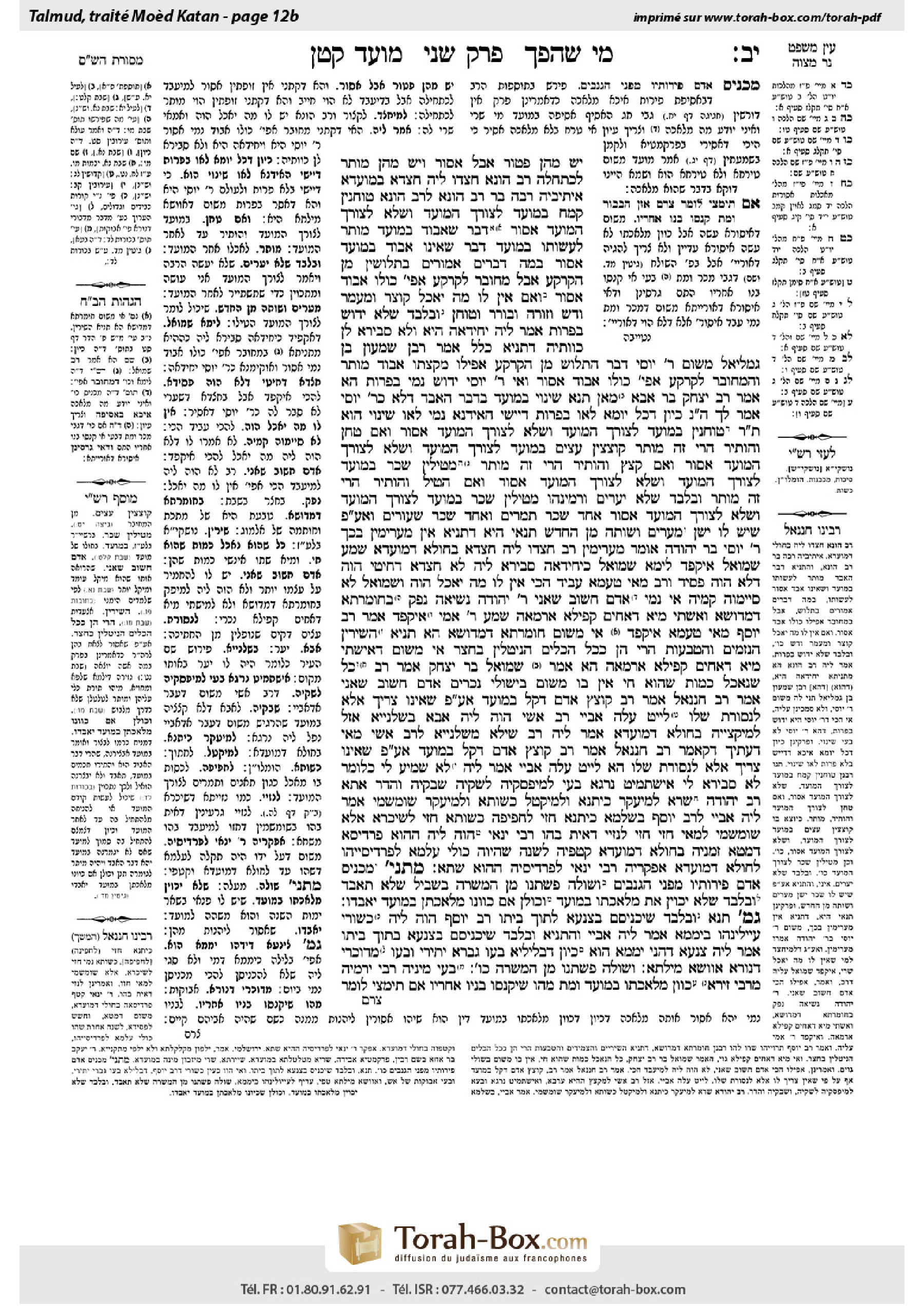
Moed Katan 12b: Talmud study for Daf Yomi
Daf Yomi is the daily study of one Talmud folio. Explore 37 tractates with scans, Hebrew text, Sefaria English and AI-generated French translations where annotated.
Passage selection and English or AI-generated French translation are available where the scan has annotations. Daf Study is independent of Torah-Box and Sefaria.
Browse Moed Katan · מועד קטן · All tractatesMoed Katan 12b text and translations
This page of Moed Katan includes the Aramaic text, an English translation and an AI-generated French translation, alongside the scan above.
מועד קטן י״ב ב · Aramaic and Hebrew text
יֵשׁ מֵהֶן פָּטוּר אֲבָל אָסוּר, וְיֵשׁ מֵהֶן מוּתָּר לְכַתְּחִלָּה.
רַב הוּנָא חֲצַדוּ לֵיהּ חֲצָדָא בְּמוֹעֲדָא. אֵיתִיבֵיהּ רַבָּה בַּר רַב הוּנָא לְרַב הוּנָא טוֹחֲנִין קֶמַח בַּמּוֹעֵד לְצוֹרֶךְ הַמּוֹעֵד, וְשֶׁלֹּא לְצוֹרֶךְ הַמּוֹעֵד — אָסוּר. דָּבָר שֶׁאָבוּד בַּמּוֹעֵד — מוּתָּר לַעֲשׂוֹתוֹ בַּמּוֹעֵד, דָּבָר שֶׁאֵינוֹ אָבוּד בַּמּוֹעֵד — אָסוּר.
בַּמָּה דְּבָרִים אֲמוּרִים — בִּתְלוּשִׁין מִן הַקַּרְקַע, אֲבָל מְחוּבָּר לַקַּרְקַע — אֲפִילּוּ כּוּלּוֹ אָבוּד אָסוּר. וְאִם אֵין לוֹ מַה יֹּאכַל, קוֹצֵר וּמְעַמֵּר וְדָשׁ וְזוֹרֶה וּבוֹרֵר וְטוֹחֵן, וּבִלְבַד שֶׁלֹּא יָדוּשׁ בְּפָרוֹת!
אֲמַר לֵיהּ: יְחִידָאָה הִיא, וְלָא סְבִירָא לַן כְּווֹתֵיהּ. דְּתַנְיָא, כְּלָל אָמַר רַבָּן שִׁמְעוֹן בֶּן גַּמְלִיאֵל מִשּׁוּם רַבִּי יוֹסֵי: דָּבָר הַתָּלוּשׁ מִן הַקַּרְקַע, אֲפִילּוּ מִקְצָתוֹ אָבוּד — מוּתָּר, וְהַמְחוּבָּר לַקַּרְקַע — אֲפִילּוּ כּוּלּוֹ אָבוּד אָסוּר.
וְאִי רַבִּי יוֹסֵי, יָדוּשׁ נָמֵי בְּפָרוֹת?! הָא אָמַר רַב יִצְחָק בַּר אַבָּא: מַאן תַּנָּא שִׁינּוּי בַּמּוֹעֵד בְּדָבָר הָאָבֵד — דְּלָא כְּרַבִּי יוֹסֵי!
אָמַר לָךְ: הָכָא נָמֵי, כֵּיוָן דְּכׇל יוֹמָא לָאו בְּפָרוֹת דָּיְישִׁי, הָאִידָּנָא נָמֵי לָאו שִׁינּוּי הוּא.
תָּנוּ רַבָּנַן: טוֹחֲנִין בַּמּוֹעֵד לְצוֹרֶךְ הַמּוֹעֵד, וְשֶׁלֹּא לְצוֹרֶךְ הַמּוֹעֵד — אָסוּר. וְאִם טָחַן וְהוֹתִיר — הֲרֵי זֶה מוּתָּר. קוֹצְצִין עֵצִים בַּמּוֹעֵד לְצוֹרֶךְ הַמּוֹעֵד, וְשֶׁלֹּא לְצוֹרֶךְ הַמּוֹעֵד — אָסוּר, וְאִם קָצַץ וְהוֹתִיר — הֲרֵי זֶה מוּתָּר.
מְטִילִין שֵׁכָר בַּמּוֹעֵד לְצוֹרֶךְ הַמּוֹעֵד, וְשֶׁלֹּא לְצוֹרֶךְ הַמּוֹעֵד — אָסוּר, וְאִם הֵטִיל וְהוֹתִיר — הֲרֵי זֶה מוּתָּר, וּבִלְבַד שֶׁלֹּא יַעֲרִים.
וּרְמִינְהוּ: מְטִילִין שֵׁכָר בַּמּוֹעֵד לְצוֹרֶךְ הַמּוֹעֵד, וְשֶׁלֹּא לְצוֹרֶךְ הַמּוֹעֵד — אָסוּר, אֶחָד שֵׁכַר תְּמָרִים, וְאֶחָד שֵׁכַר שְׂעוֹרִים. וְאַף עַל פִּי שֶׁיֵּשׁ לוֹ יָשָׁן, מַעֲרִים וְשׁוֹתֶה מִן הֶחָדָשׁ. תַּנָּאֵי הִיא. דְּתַנְיָא: אֵין מַעֲרִימִין בְּכָךְ, רַבִּי יוֹסֵי בַּר יְהוּדָה אוֹמֵר: מַעֲרִימִין.
רַב חֲצַדוּ לֵיהּ חֲצָדָא בְּחוּלָּא דְמוֹעֲדָא. שְׁמַע שְׁמוּאֵל, אִיקְּפַד. לֵימָא שְׁמוּאֵל כִּיחִידָאָה סְבִירָא לֵיהּ? לָא, חֲצָדָא דְחִיטֵּי הֲוָה, דְּלָא הֲוָה פָּסֵיד.
וְרַב מַאי טַעְמָא עָבֵיד הָכִי? אֵין לוֹ מַה יֹּאכַל הֲוָה. וּשְׁמוּאֵל — לָא סַיְּימוּהָ קַמֵּיהּ. אִי נָמֵי, אָדָם חָשׁוּב שָׁאנֵי.
רַבִּי יְהוּדָה נְשִׂיאָה נְפַק בְּחוּמַרְתָּא דִמְדוּשָׁא, וְאִשְׁתִּי מַיָּא דְּאַחֵים קַפִּילָא אֲרַמָּאָה. שְׁמַע רַבִּי אַמֵּי, אִיקְּפַד. אָמַר רַב יוֹסֵף: מַאי טַעְמָא אִיקְּפַד? אִי מִשּׁוּם חוּמַרְתָּא דִמְדוּשָׁא, הָא תַּנְיָא: הַשִּׁירִין, הַנְּזָמִים וְהַטַּבָּעוֹת — הֲרֵי הֵן כְּכׇל הַכֵּלִים הַנִּיטָּלִין בֶּחָצֵר.
אִי מִשּׁוּם דְּאִישְׁתִּי מַיָּא דְּאַחֵים קַפִּילָא אֲרַמָּאָה, הָא אָמַר שְׁמוּאֵל בַּר יִצְחָק אָמַר רַב: כֹּל שֶׁנֶּאֱכָל כְּמוֹת שֶׁהוּא חַי, אֵין בּוֹ מִשּׁוּם בִּישּׁוּלֵי גוֹיִם! אָדָם חָשׁוּב שָׁאנֵי.
אָמַר רַב חֲנַנְאֵל אָמַר רַב: קוֹצֵץ אָדָם דֶּקֶל בַּמּוֹעֵד, אַף עַל פִּי שֶׁאֵינוֹ צָרִיךְ אֶלָּא לַנְּסוֹרֶת שֶׁלּוֹ. לָיֵיט עֲלַהּ אַבָּיֵי.
רַב אָשֵׁי הֲוָה לֵיהּ אִבָּא בִּשְׁלַנְיָיא. אֲזַל לְמִיקְצְיֵיהּ בְּחוּלָּא דְמוֹעֲדָא, אֲמַר לֵיהּ רַב שֵׁילָא מִשְּׁלַנְיָיא לְרַב אָשֵׁי: מַאי דַּעְתָּיךְ, דְּקָאָמַר רַב חֲנַנְאֵל אָמַר רַב: קוֹצֵץ אָדָם דֶּקֶל בַּמּוֹעֵד אַף עַל פִּי שֶׁאֵינוֹ צָרִיךְ אֶלָּא לַנְּסוֹרֶת שֶׁלּוֹ — הָא לָיֵיט עֲלַהּ אַבָּיֵי! אֲמַר לֵיהּ: לָא שְׁמִיעַ לִי, כְּלוֹמַר, לָא סְבִירָא לִי. אִישְׁתְּמִיט נַרְגָּא, בָּעֵי לְמִיפְסְקֵיהּ לְשָׁקֵיהּ. שַׁבְקֵיהּ וַהֲדַר אֲתָא.
רַב יְהוּדָה שְׁרָא לְמִיעְקַר כִּיתָּנָא וּלְמִיקְטַל כְּשׁוּתָא, וּלְמִיעְקַר שׁוּמְשְׁמֵי. אָמַר לֵיהּ אַבָּיֵי לְרַב יוֹסֵף: בִּשְׁלָמָא כִּיתָּנָא — חֲזֵי לַחֲפִיפָה, כְּשׁוּתָא — חֲזֵי לְשִׁיכְרָא, אֶלָּא שׁוּמְשְׁמֵי לְמַאי חֲזֵי? חֲזֵי לְנַזְיֵי דְּאִית בְּהוּ.
רַבִּי יַנַּאי הֲוָה לֵיהּ הָהוּא פַּרְדֵּיסָא דִּמְטָא זִמְנֵיהּ בְּחוּלָּא דְמוֹעֲדָא, קַטְפֵיהּ. לְשָׁנָה שַׁהִיּוּה כּוּלֵּי עָלְמָא לְפַרְדֵּיסַיְיהוּ לְחוּלָּא דְמוֹעֲדָא. אַפְקְרֵיהּ רַבִּי יַנַּאי לְפַרְדֵּיסֵיהּ הָהִוא שַׁתָּא.
מַתְנִי׳ מַכְנִיס אָדָם פֵּירוֹתָיו מִפְּנֵי הַגַּנָּבִים, וְשׁוֹלֶה פִּשְׁתָּנוֹ מִן הַמִּשְׁרָה בִּשְׁבִיל שֶׁלֹּא תֹּאבַד, וּבִלְבַד שֶׁלֹּא יְכַוֵּין אֶת מְלַאכְתּוֹ בַּמּוֹעֵד. וְכוּלָּן אִם כִּוְּונוּ מְלַאכְתָּן בַּמּוֹעֵד — יֹאבֵדוּ.
גְּמָ׳ תָּנָא: וּבִלְבַד שֶׁיַּכְנִיסֵם בְּצִנְעָא לְתוֹךְ בֵּיתוֹ.
רַב יוֹסֵף הֲוָה לֵיהּ כְּשׁוּרֵי, עַיְּילִינְהוּ בִּימָמָא.
אֲמַר לֵיהּ אַבָּיֵי, וְהָתַנְיָא: וּבִלְבַד שֶׁיַּכְנִיסֵם בְּצִנְעָא בְּתוֹךְ בֵּיתוֹ! אֲמַר לֵיהּ: צִנְעָא דְּהָנֵי — יְמָמָא הוּא, כֵּיוָן דִּבְלֵילְיָא בָּעוּ גַּבְרֵי יַתִּירֵי, וּבָעוּ מַדְבּוּרֵי דְנוּרָא, אָוְושָׁא מִילְּתָא.
וְשׁוֹלֶה פִּשְׁתָּנוֹ מִן הַמִּשְׁרָה כּוּ׳. בָּעֵי מִינֵּיהּ רַבִּי יִרְמְיָה מֵרַבִּי זֵירָא: כִּוֵּון מְלַאכְתּוֹ בַּמּוֹעֵד וָמֵת, מַהוּ שֶׁיִּקְנְסוּ בָּנָיו אַחֲרָיו?
אִם תִּימְצֵי לוֹמַר
Moed Katan 12b · English translation
Some of the actions for which one is exempt by Torah law are nevertheless prohibited, and some of them are permitted ab initio.
§ The Gemara relates that Rav Huna had his crop harvested for him on the intermediate days of a Festival. Rabba bar Rav Huna raised an objection to his father Rav Huna from a baraita: One may grind flour on the intermediate days of a Festival for the sake of the Festival, but if it is not for the sake of the Festival, it is prohibited. With regard to a matter that, if unattended, will result in significant loss on the Festival, it is permitted to perform labor to prevent that loss on the intermediate days of the Festival. For a matter that will not result in loss if unattended during the intermediate days of the Festival, it is prohibited to perform labor.
In what case is this statement said? In the case of crops that are already detached from the ground, but in the case of crops that are still attached to the ground, even if it all will be lost, labor is prohibited during the intermediate days of the Festival. And if one does not have anything to eat, then he may reap and bind sheaves, and thresh, and winnow the grain in the wind, and separate the grain from the chaff, and grind the grain into flour, provided that he does not thresh with cows, the way that threshing is performed on an ordinary weekday. Why, then, did Rav Huna, who certainly had enough to eat, allow his workers to reap the field during the Festival week?
Rav Huna said to his son: The opinion expressed in this unattributed baraita is an individual opinion, and we do not hold in accordance with it; as it is taught in a different baraita: Rabban Shimon ben Gamliel stated a principle in the name of Rabbi Yosei: In the case of an item that is already detached from the ground, even if only a portion of it will be lost by not working during the Festival, it is permitted to perform labor to prevent the loss, whereas for crops that are still attached to the ground, even if all of them will be lost, it is prohibited to perform labor for them. The opinion that all labor is prohibited for crops that have not yet been harvested is the opinion of an individual authority, Rabbi Yosei, with whom the Rabbis disagree.
The Gemara asks: But if the unattributed baraita reflects the opinion of Rabbi Yosei, and it is permitted to work when one has nothing to eat, let him thresh even with cows. Didn’t Rav Yitzḥak bar Abba say: Who is the tanna who taught that labor performed on the intermediate days of a Festival must be done in an altered manner even with regard to a matter that will involve a loss if unattended? It is not in accordance with the opinion of Rabbi Yosei, as Rabbi Yosei does not require altering the manner in which one performs the labor. Why, then, does the baraita say that the threshing must be done in an altered manner and not with cows?
The Gemara rejects this argument: Rabbi Yosei could have said to you: Here, too, since one does not always thresh with cows, threshing without them now on the intermediate days of the Festival is also not considered threshing in an altered manner. The prohibition against threshing with cows is not because one must perform that labor in an altered manner but in order to avoid attracting public attention to the fact that one is working during the Festival week.
The Sages taught in a baraita: One may grind flour on the intermediate days of a Festival for the sake of the Festival, but if it is not for the sake of the Festival, it is prohibited. And if he ground and left some flour over, it is permitted for use after the Festival. Similarly, one may cut down trees on the intermediate days of a Festival for the sake of the Festival, but if it is not for the sake of the Festival it is prohibited. And if he cut down trees for the Festival and left some wood over, it is permitted for use after the Festival.
The baraita continues: One may brew beer on the intermediate days of a Festival for the sake of the Festival, but if it is not for the sake of the Festival, it is prohibited. And if he brewed beer for the sake of the Festival and left some over, it is permitted for use after the Festival provided that he does not employ an artifice, exploiting the allowance to work on a Festival by knowingly making more than was needed.
The Gemara raises a contradiction from a baraita: One may brew beer on the intermediate days of a Festival for the sake of the Festival, but if it is not for the sake of the Festival, it is prohibited. This applies both to date beer and to barley beer. And even though he has old beer, he may employ an artifice and drink from the new beer, i.e., he may say he prefers new beer and brew a new batch, although he has enough old beer for the Festival. This statement contradicts the previous baraita that prohibited circumventing the prohibition against labor through artifice. The Gemara answers: This matter is a dispute between tanna’im, as it is taught in a baraita: One may not employ an artifice in this regard, i.e., to circumvent the prohibition against labor during the intermediate days of a Festival. Rabbi Yosei bar Yehuda says: One may employ an artifice.
§ The Gemara relates that Rav had his crop harvested on the intermediate days of a Festival. Shmuel heard about this and was dismayed. The Gemara asks: Shall we say that Shmuel holds in accordance with the individual opinion of Rabbi Yosei, who prohibits all labor for crops that are attached to the ground, even if inattention will result in significant loss? The Gemara answers: No, it was a crop of wheat, which would not have been ruined had the harvest been pushed off a week, and therefore Shmuel was offended.
The Gemara asks: What is the reason that Rav acted in this manner? The Gemara answers: Rav is in the category of one who does not have anything to eat, and that is why it was permitted to harvest his crops. The Gemara asks: And why, then, did Shmuel disapprove? The Gemara explains: The people who reported Rav’s actions to Shmuel did not complete the story for him. Alternatively, an important person such as Rav is different, and Shmuel thought Rav should have been stringent even in his difficult circumstances.
It was further related that Rabbi Yehuda Nesia once went out on Shabbat with a coral seal [ḥumreta] on his ring and drank water heated by a gentile cook. Rabbi Ami heard about this and was dismayed about both things. Rav Yosef said: What is the reason that he was dismayed? If it was because of the coral seal, isn’t it taught in a baraita: Bracelets, nose rings, and rings are like all other utensils that may be carried in a courtyard? Therefore, Rabbi Yehuda Nesia’s action conformed to halakha.
And if Rabbi Ami was dismayed because Rabbi Yehuda Nesia drank water heated by a gentile cook [kapeila], didn’t Shmuel bar Yitzḥak say that Rav said: With regard to anything that is eaten raw, like water, even if it was cooked by a gentile, it is not subject to the prohibition against eating food cooked by gentiles? The Gemara resolves both difficulties: An important person is different, and Rabbi Ami believed that Rabbi Yehuda Nesia should have been more stringent.
Rav Ḥananel said that Rav said: A person may chop down a palm tree on the intermediate days of a Festival, although he needs only its sawdust. The Gemara comments: Abaye cursed it, i.e., the behavior of one who exerts such effort on the Festival for so small a need.
The Gemara relates that Rav Ashi had a forest [ava] in Shelaniya. He went to cut it down on the intermediate days of the Festival. Rav Sheila from Shelaniya said to Rav Ashi: What is your opinion about what you are doing? Do you rely on that which Rav Ḥananel said that Rav said: A person may chop down a palm tree on the intermediate days of a Festival even though he needs only its sawdust? Didn’t Abaye curse such behavior? Rav Ashi said to him: I did not hear that Abaye said that; that is to say, in a delicate way, I do not hold in accordance with his opinion. The iron of Rav Ashi’s ax then slipped and was about to cut off his leg. He left it, ceasing his chopping, and came back again to chop down the forest only after the Festival.
The Gemara relates that Rav Yehuda permitted uprooting flax, cutting hops, and uprooting sesame plants on the intermediate days of a Festival. Abaye said to Rav Yosef: Granted, this is reasonable in the case of flax, which is suitable for use as a cover [ḥafifa] for various objects and therefore has a use even during the Festival, and so too hops, which are suitable for making beer, but for what are sesame plants suitable, since the sesame seeds require a long drying period before oil can be extracted from them? Rav Yosef said to him: They are suitable for the seeds [nazyei] on them, which can be consumed immediately.
It was further mentioned that Rabbi Yannai had an orchard whose time for harvesting the fruit arrived during the intermediate days of the Festival. He harvested it during the Festival, as the fruit would otherwise have spoiled. The following year, everyone delayed the harvest of their orchards until the intermediate days of the Festival. Rabbi Yannai declared the earnings from his orchard ownerless that year, since his harvesting of his fruit provided a misleading example for the public, causing many people to adopt an inappropriate leniency.
MISHNA: A person may bring his fruit in from the field on the intermediate days of the Festival because he is concerned about thieves, and he may draw his flax out of the soaking pool so that it is not ruined from soaking too long in the water, provided that he does not plan from the outset to perform his work on the intermediate days of the Festival. And with regard to all of these cases, if one planned from the outset to perform his labor on the intermediate days of the Festival, the fruit of that labor must be lost and no benefit may be derived from it.
GEMARA: It is taught in a baraita that one may bring in crops out of concern for thieves, provided that he brings them into his house discreetly.
The Gemara relates: Rav Yosef had wooden beams, which he brought into his house during the day on one of the intermediate days of a Festival.
Abaye said to him: But isn’t it taught in a baraita: One may bring in items provided that he brings them into his house discreetly? Rav Yosef said to him: Discretion with respect to these beams is moving them during the day, since at night more people are required, and also torchbearers [medokhrei denura] are needed, and the matter would be more noticeable.
The mishna states: And he may draw his flax out of the soaking pool so that it is not ruined from soaking too long in the water, provided that he does not plan from the outset to do his work on the intermediate days of the Festival. And with regard to anyone, if he planned from the outset to perform his labor on the intermediate days of the Festival, the fruit of that labor must be destroyed. Rabbi Yirmeya asked Rabbi Zeira: If one planned from the outset to perform his labor on the intermediate days of a Festival, and he died after doing so, what is the halakha? Should his children be penalized after him and have to lose the products of their father’s labor?
Even if you might say that
Moed Katan 12b · Traduction française (IA)
Certaines activités dont on est dispensé par la Torah sont néanmoins interdites, tandis que d’autres sont permises a priori.
§ La Guemara rapporte que Rav Houna fit moissonner son champ pendant les jours intermédiaires de la fête. Rabba bar Rav Houna objecta à son père, Rav Houna, en citant une baraïta : On peut moudre de la farine pendant les jours intermédiaires de la fête pour les besoins de la fête, mais si ce n’est pas pour les besoins de la fête, cela est interdit. Lorsqu’une chose, si l’on n’intervient pas, entraînera une perte importante pendant la fête, il est permis d’effectuer un travail pendant les jours intermédiaires de la fête pour éviter cette perte. En revanche, si l’absence d’intervention n’entraînera aucune perte pendant les jours intermédiaires de la fête, il est interdit d’effectuer un travail.
Dans quel cas cette déclaration s’applique-t-elle ? Lorsque les récoltes sont déjà détachées du sol ; mais si elles y sont encore attachées, il est interdit d’effectuer un travail pendant les jours intermédiaires de la fête, même si tout doit être perdu. Si l’on n’a rien à manger, on peut alors moissonner et lier des gerbes, battre le grain, le vanner au vent, séparer le grain de la balle et le moudre en farine, à condition de ne pas le battre avec des vaches, comme on le fait un jour ordinaire de la semaine. Pourquoi, dès lors, Rav Houna, qui avait certainement assez à manger, a-t-il autorisé ses ouvriers à moissonner le champ pendant la semaine de fête ?
Rav Houna dit à son fils : L’opinion exprimée dans cette baraïta anonyme est celle d’un tanna isolé, et nous ne suivons pas son avis. En effet, il est enseigné dans une autre baraïta : Rabban Chimon ben Gamliel énonça un principe au nom de Rabbi Yossi : Lorsqu’une chose est déjà détachée du sol, même si seule une partie en sera perdue faute d’effectuer un travail pendant la fête, il est permis d’effectuer ce travail pour éviter la perte. En revanche, pour des récoltes encore attachées au sol, il est interdit d’effectuer un travail, même si elles doivent être entièrement perdues. L’opinion selon laquelle tout travail est interdit pour des récoltes qui n’ont pas encore été moissonnées est celle d’une autorité isolée, Rabbi Yossi, avec laquelle les Sages sont en désaccord.
La Guemara demande : Mais si la baraïta anonyme reflète l’opinion de Rabbi Yossi, et qu’il est permis de travailler lorsque l’on n’a rien à manger, qu’on le laisse donc battre le grain même avec des vaches ! Rav Yitzḥak bar Abba n’a-t-il pas dit : Quel est le tanna qui a enseigné que le travail effectué pendant les jours intermédiaires de la fête doit être accompli d’une manière inhabituelle, même lorsqu’il s’agit d’une chose dont l’absence de prise en charge entraînerait une perte ? Ce n’est pas conforme à l’opinion de Rabbi Yossi, car celui-ci n’exige pas que l’on modifie la manière d’effectuer le travail. Pourquoi, dès lors, la baraïta dit-elle que le battage doit être effectué d’une manière inhabituelle, et qu’il ne faut pas battre le grain avec des vaches ?
La Guemara rejette cet argument : Rabbi Yossi aurait pu te répondre qu’ici aussi, puisque l’on ne bat pas toujours le grain avec des vaches, le battre sans elles, à présent, pendant les jours intermédiaires de la fête, n’est pas considéré comme une manière inhabituelle de le battre. L’interdiction de battre le grain avec des vaches ne tient pas à l’obligation d’effectuer ce travail d’une manière inhabituelle ; elle vise à ne pas attirer l’attention du public sur le fait que l’on travaille pendant la semaine de fête.
Les Sages ont enseigné dans une baraïta : On peut moudre de la farine pendant les jours intermédiaires de la fête pour les besoins de la fête, mais si ce n’est pas pour les besoins de la fête, cela est interdit. Si l’on a moulu de la farine et qu’il en reste, on peut l’utiliser après la fête. De même, on peut couper des arbres pendant les jours intermédiaires de la fête pour les besoins de la fête, mais si ce n’est pas pour les besoins de la fête, cela est interdit. Si l’on a coupé des arbres pour la fête et qu’il reste du bois, on peut l’utiliser après la fête.
La baraïta poursuit : On peut brasser de la bière pendant les jours intermédiaires de la fête pour les besoins de la fête, mais si ce n’est pas pour les besoins de la fête, cela est interdit. Si l’on a brassé de la bière pour les besoins de la fête et qu’il en reste, on peut l’utiliser après la fête, à condition de ne pas recourir à un artifice en tirant parti de l’autorisation de travailler pendant la fête pour en produire sciemment davantage que nécessaire.
La Guemara soulève une contradiction à partir d’une baraïta : On peut brasser de la bière pendant les jours intermédiaires de la fête pour les besoins de la fête, mais si ce n’est pas pour les besoins de la fête, cela est interdit. Cela s’applique aussi bien à la bière de dattes qu’à la bière d’orge. Même si l’on a de la vieille bière, on peut recourir à un artifice et boire de la bière nouvelle : on peut dire que l’on préfère la bière nouvelle et en brasser une nouvelle quantité, bien que l’on ait assez de vieille bière pour la fête. Cette déclaration contredit la baraïta précédente, qui interdit de contourner l’interdiction de travailler au moyen d’un artifice. La Guemara répond : Il s’agit d’un désaccord entre tannaïm, comme il est enseigné dans une baraïta : On ne peut pas recourir à un artifice à cet égard, c’est-à-dire pour contourner l’interdiction de travailler pendant les jours intermédiaires de la fête. Rabbi Yossi bar Yehouda dit : On peut recourir à un artifice.
§ La Guemara rapporte que Rav fit moissonner son champ pendant les jours intermédiaires de la fête. Chmouel l’apprit et en fut contrarié. La Guemara demande : Faut-il en conclure que Chmouel suit l’opinion isolée de Rabbi Yossi, qui interdit tout travail sur des récoltes encore attachées au sol, même si l’absence de prise en charge entraînerait une perte importante ? La Guemara répond : Non, il s’agissait d’une récolte de blé, qui ne se serait pas abîmée si la moisson avait été reportée d’une semaine ; c’est pourquoi Chmouel fut contrarié.
La Guemara demande : Pourquoi Rav a-t-il agi ainsi ? Elle répond : Rav faisait partie de ceux qui n’avaient rien à manger ; c’est pourquoi il lui était permis de moissonner ses récoltes. La Guemara demande : Pourquoi, alors, Chmouel désapprouva-t-il ? La Guemara explique : Ceux qui rapportèrent à Chmouel les actes de Rav ne lui racontèrent pas toute l’histoire. Autre réponse : Le cas d’un personnage important comme Rav est différent, et Chmouel pensait que Rav aurait dû se montrer rigoureux, même dans ces circonstances difficiles.
On rapporte également que Rabbi Yehouda Nesia sortit un jour de Chabbat avec un sceau de corail [ḥumreta] à sa bague et but de l’eau chauffée par un cuisinier non juif. Rabbi Ami l’apprit et fut contrarié par ces deux faits. Rav Yossef dit : Pourquoi fut-il contrarié ? Si c’était à cause du sceau de corail, n’est-il pas enseigné dans une baraïta que les bracelets, les anneaux de nez et les bagues sont comme tous les autres ustensiles que l’on peut transporter dans une cour ? L’acte de Rabbi Yehouda Nesia était donc conforme à la halakha.
Et si Rabbi Ami fut contrarié parce que Rabbi Yehouda Nesia avait bu de l’eau chauffée par un cuisinier non juif [kapeila], Rav ne dit-il pas, selon Shmouel bar Yitzḥak : Tout ce qui se consomme cru, comme l’eau, n’est pas soumis à l’interdiction de consommer des aliments cuits par des non-Juifs, même si cela a été cuit par un non-Juif ? La Guemara résout les deux difficultés : le cas d’un personnage important est différent, et Rabbi Ami estimait que Rabbi Yehouda Nesia aurait dû se montrer plus rigoureux.
Rav Ḥananel dit au nom de Rav : Une personne peut abattre un palmier pendant les jours intermédiaires de la fête, bien qu’elle n’ait besoin que de sa sciure. La Guemara commente : Abayé maudit cette conduite, c’est-à-dire le comportement de celui qui déploie un tel effort pendant la fête pour un besoin si minime.
La Guemara rapporte que Rav Achi possédait une forêt [ava] à Shelaniya. Il s’y rendit pour la couper pendant les jours intermédiaires de la fête. Rav Sheila de Shelaniya dit à Rav Achi : Sur quoi te fondes-tu pour agir ainsi ? T’appuies-tu sur ce que Rav Ḥananel a dit au nom de Rav : Une personne peut abattre un palmier pendant les jours intermédiaires de la fête, même si elle n’a besoin que de sa sciure ? Abayé n’a-t-il pas maudit une telle conduite ? Rav Achi lui dit : Je n’ai pas entendu dire qu’Abayé avait dit cela ; autrement dit, pour le dire avec tact, je ne partage pas son opinion. Le fer de la hache de Rav Achi glissa alors et faillit lui couper la jambe. Il cessa de couper et laissa la hache ; il ne revint abattre la forêt qu’après la fête.
La Guemara rapporte que Rav Yehouda autorisa l’arrachage du lin, la coupe du houblon et l’arrachage des plants de sésame pendant les jours intermédiaires de la fête. Abayé dit à Rav Yossef : Cela se comprend dans le cas du lin, qui peut servir de couverture [ḥafifa] pour divers objets et a donc une utilité même pendant la fête, ainsi que dans celui du houblon, qui convient à la fabrication de la bière. Mais à quoi servent les plants de sésame, puisque les graines nécessitent une longue période de séchage avant qu’on puisse en extraire de l’huile ? Rav Yossef lui dit : Ils sont utiles pour leurs graines [nazyei], que l’on peut consommer immédiatement.
On mentionne également que Rabbi Yannai avait un verger dont les fruits étaient mûrs pour la récolte pendant les jours intermédiaires de la fête. Il les récolta pendant la fête, car autrement ils se seraient abîmés. L’année suivante, tout le monde retarda la récolte de ses vergers jusqu’aux jours intermédiaires de la fête. Cette année-là, Rabbi Yannai déclara les revenus de son verger sans propriétaire, car sa récolte avait donné au public un exemple trompeur, amenant beaucoup de gens à adopter une indulgence inappropriée.
Michna : On peut rapporter ses fruits des champs pendant les jours intermédiaires de la fête, par crainte des voleurs, et retirer son lin du bassin de rouissage afin qu’il ne s’abîme pas en restant trop longtemps dans l’eau, à condition de ne pas avoir prévu dès le départ d’effectuer ce travail pendant les jours intermédiaires de la fête. Dans tous ces cas, si l’on a prévu dès le départ d’effectuer son travail pendant les jours intermédiaires de la fête, le produit de ce travail doit être perdu et on ne peut en tirer aucun profit.
Guemara : Il est enseigné dans une baraïta qu’on peut rentrer des récoltes par crainte des voleurs, à condition de les faire entrer discrètement dans sa maison.
La Guemara rapporte que Rav Yossef avait des poutres en bois, qu’il fit entrer de jour dans sa maison, pendant l’un des jours intermédiaires de la fête.
Abayé lui dit : N’est-il pas enseigné dans une baraïta qu’on peut faire entrer des biens à condition de les introduire discrètement dans sa maison ? Rav Yossef lui dit : Pour ces poutres, la discrétion consiste à les déplacer de jour, car la nuit, il faut davantage de personnes, ainsi que des porteurs de torches [medokhrei denura], et cela se remarquerait davantage.
La Michna enseigne : On peut retirer son lin du bassin de rouissage afin qu’il ne s’abîme pas en restant trop longtemps dans l’eau, à condition de ne pas avoir prévu dès le départ d’effectuer son travail pendant les jours intermédiaires de la fête. Pour quiconque a prévu dès le départ d’effectuer son travail pendant les jours intermédiaires de la fête, le produit de ce travail doit être détruit. Rabbi Yirmeya demanda à Rabbi Zeira : Si quelqu’un a prévu dès le départ d’effectuer son travail pendant les jours intermédiaires de la fête, puis meurt après l’avoir fait, quelle est la halakha ? Faut-il aussi pénaliser ses enfants et leur faire perdre les produits du travail de leur père ?
Même si l’on pouvait dire que
Traduction française générée par IA à partir de l’édition anglaise de Sefaria. Vérifie toujours un passage avec le texte source.
Text from Sefaria: William Davidson Edition - Vocalized Aramaic (CC BY NC); William Davidson Edition - English (CC BY NC).