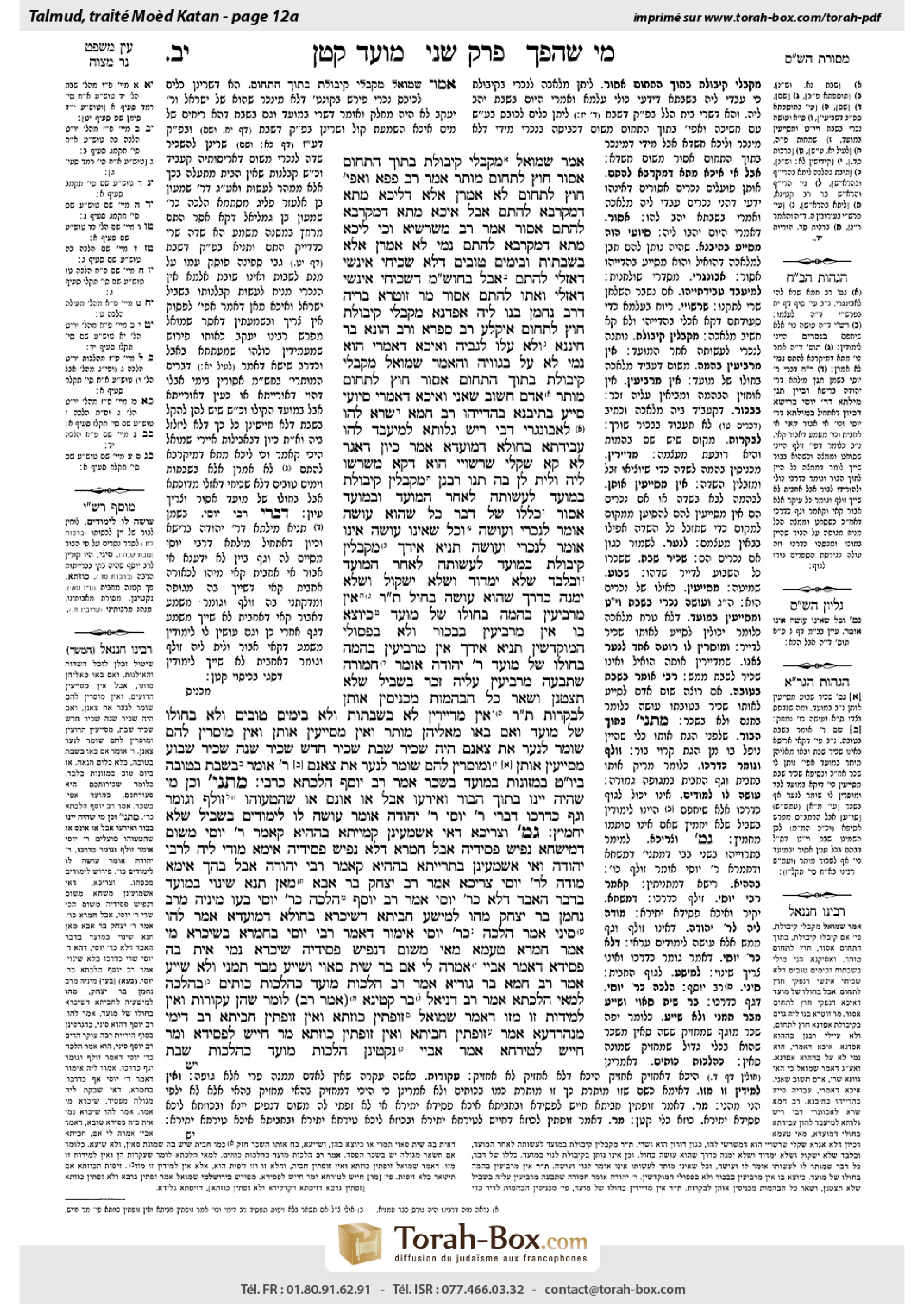
Moed Katan 12a: Talmud study for Daf Yomi
Daf Yomi is the daily study of one Talmud folio. Explore 37 tractates with scans, Hebrew text, Sefaria English and AI-generated French translations where annotated.
Passage selection and English or AI-generated French translation are available where the scan has annotations. Daf Study is independent of Torah-Box and Sefaria.
Browse Moed Katan · מועד קטן · All tractatesMoed Katan 12a text and translations
This page of Moed Katan includes the Aramaic text, an English translation and an AI-generated French translation, alongside the scan above.
מועד קטן י״ב א · Aramaic and Hebrew text
אָמַר שְׁמוּאֵל: מְקַבְּלֵי קִיבּוֹלֶת, בְּתוֹךְ הַתְּחוּם — אָסוּר. חוּץ לַתְּחוּם — מוּתָּר.
אָמַר רַב פָּפָּא: וַאֲפִילּוּ חוּץ לַתְּחוּם, לֹא אֲמַרַן אֶלָּא דְּלֵיכָּא מָתָא דִּמְקָרְבָא לְהָתָם, אֲבָל אִיכָּא מָתָא דִּמְקָרְבָא לְהָתָם — אָסוּר.
אָמַר רַב מְשַׁרְשְׁיָא: וְכִי לֵיכָּא מָתָא דִּמְקָרְבָא לְהָתָם נָמֵי, לָא אֲמַרַן אֶלָּא בְּשַׁבָּתוֹת וּבְיָמִים טוֹבִים, דְּלָא שְׁכִיחִי אִינָשֵׁי דְּאָזְלִי לְהָתָם, אֲבָל בְּחוּלּוֹ שֶׁל מוֹעֵד, דִּשְׁכִיחִי אִינָשֵׁי דְּאָזְלִי וְאָתוּ לְהָתָם — אָסוּר.
מָר זוּטְרָא בְּרֵיהּ דְּרַב נַחְמָן בְּנוּ לֵיהּ אַפַּדְנָא מְקַבְּלֵי קִיבּוֹלֶת חוּץ לַתְּחוּם. אִיקְּלַע רַב סָפְרָא וְרַב הוּנָא בַּר חִינָּנָא, וְלָא עַלּוּ לְגַבֵּיהּ. וְאִיכָּא דְּאָמְרִי: הוּא נָמֵי לָא עָל בְּגַוֵּויהּ.
וְהָאָמַר שְׁמוּאֵל: מְקַבְּלֵי קִיבּוֹלֶת — בְּתוֹךְ הַתְּחוּם אָסוּר, חוּץ לַתְּחוּם מוּתָּר! אָדָם חָשׁוּב שָׁאנֵי. וְאִיכָּא דְּאָמְרִי: סַיּוֹעֵי סַיַּיע בְּתִיבְנָא בַּהֲדַיְיהוּ.
רַב חָמָא שְׁרָא לְהוּ לְאַבְוָנְגָּרֵי דְּבֵי רֵישׁ גָּלוּתָא לְמֶיעְבַּד לְהוּ עֲבִידְתָּא בְּחוּלָּא דְמוֹעֲדָא, אֲמַר: כֵּיוָן דַּאֲגַר לָא קָא שָׁקְלִי, שַׁרְשׁוֹיֵי הוּא דְּקָא מְשָׁרְשׁוּ לֵיהּ, וְלֵית לַן בַּהּ.
תָּנוּ רַבָּנַן: מְקַבְּלִין קִיבּוֹלֶת בַּמּוֹעֵד לַעֲשׂוֹתָהּ לְאַחַר הַמּוֹעֵד, וּבַמּוֹעֵד אָסוּר. כְּלָלוֹ שֶׁל דָּבָר: כֹּל שֶׁהוּא עוֹשֶׂה — אוֹמֵר לְגוֹי וְעוֹשֶׂה, וְכֹל שֶׁאֵינוֹ עוֹשֶׂה — אֵינוֹ אוֹמֵר לְגוֹי וְעוֹשֶׂה. תַּנְיָא אִידַּךְ: מְקַבְּלִין קִיבּוֹלֶת בַּמּוֹעֵד לַעֲשׂוֹתָהּ לְאַחַר הַמּוֹעֵד, וּבִלְבַד שֶׁלֹּא יִמְדּוֹד וְשֶׁלֹּא יִשְׁקוֹל וְשֶׁלֹּא יִמְנֶה כְּדֶרֶךְ שֶׁהוּא עוֹשֶׂה בַּחוֹל.
תָּנוּ רַבָּנַן: אֵין מַרְבִּיעִין בְּהֵמָה בְּחוּלּוֹ שֶׁל מוֹעֵד. כַּיּוֹצֵא בּוֹ: אֵין מַרְבִּיעִין בִּבְכוֹר וְלֹא בִּפְסוּלֵי הַמּוּקְדָּשִׁין.
תַּנְיָא אִידַּךְ: אֵין מַרְבִּיעִין בְּהֵמָה בְּחוּלּוֹ שֶׁל מוֹעֵד, רַבִּי יְהוּדָה אוֹמֵר: חֲמוֹרָה שֶׁתָּבְעָה — מַרְבִּיעִין עָלֶיהָ זָכָר בִּשְׁבִיל שֶׁלֹּא תִּצְטַנֵּן, וּשְׁאָר כׇּל הַבְּהֵמוֹת — מַכְנִיסִין אוֹתָן לְבַקְרוּת.
תָּנוּ רַבָּנַן: אֵין מְדַיְּירִין לֹא בְּשַׁבָּתוֹת וְלֹא בְּיָמִים טוֹבִים וְלֹא בְּחוּלּוֹ שֶׁל מוֹעֵד. וְאִם בָּאוּ מֵאֲלֵיהֶן — מוּתָּר.
וְאֵין מְסַיְּיעִין אוֹתָן, וְאֵין מוֹסְרִין לָהֶם שׁוֹמֵר לְנַעֵר אֶת צֹאנָם. הָיָה שְׂכִיר שַׁבָּת, שְׂכִיר חֹדֶשׁ, שְׂכִיר שָׁנָה, שְׂכִיר שָׁבוּעַ — מְסַיְּיעִין אוֹתָן, וּמוֹסְרִין לָהֶם שׁוֹמֵר לְנַעֵר אֶת צֹאנָם. רַבִּי אוֹמֵר: בַּשַּׁבָּת — בְּטוֹבָה, בְּיוֹם טוֹב — בִּמְזוֹנוֹת, בַּמּוֹעֵד — בְּשָׂכָר. אָמַר רַב יוֹסֵף: הִלְכְתָא כְּרַבִּי.
מַתְנִי׳ וְכֵן מִי שֶׁהָיָה יֵינוֹ בְּתוֹךְ הַבּוֹר וְאֵירְעוֹ אֵבֶל אוֹ אוֹנֶס אוֹ שֶׁהִטְעוּהוּ — זוֹלֵף וְגוֹמֵר וְגָף כְּדַרְכּוֹ, דִּבְרֵי רַבִּי יוֹסֵי. רַבִּי יְהוּדָה אוֹמֵר: עוֹשֶׂה לוֹ לִימּוּדִים בִּשְׁבִיל שֶׁלֹּא יַחְמִיץ.
גְּמָ׳ וּצְרִיכָא. דְּאִי אַשְׁמְעִינַן קַמַּיְיתָא, בְּהַהִיא קָאָמַר רַבִּי יוֹסֵי — מִשּׁוּם דְּמִישְׁחָא נְפִישׁ פְּסֵידֵיהּ, אֲבָל חַמְרָא דְּלָא נְפִישׁ פְּסֵידֵיהּ — אֵימָא מוֹדֵי לֵיהּ לְרַבִּי יְהוּדָה. וְאִי אַשְׁמְעִינַן בָּתְרָיְיתָא, בְּהַהִיא קָאָמַר רַבִּי יְהוּדָה, אֲבָל בְּהָךְ אֵימָא מוֹדֶה לְרַבִּי יוֹסֵי. צְרִיכָא.
אָמַר רַב יִצְחָק בַּר אַבָּא: מַאן תַּנָּא שִׁינּוּי בַּמּוֹעֵד בְּדָבָר הָאָבֵד — דְּלָא כְּרַבִּי יוֹסֵי. אָמַר רַב יוֹסֵף: הֲלָכָה כְּרַבִּי יוֹסֵי.
בְּעוֹ מִינֵּיהּ מֵרַב נַחְמָן בַּר יִצְחָק: מַהוּ לְמֵישַׁע חָבִיתָא דְשִׁיכְרָא בְּחוּלָּא דְמוֹעֲדָא? אֲמַר לְהוּ: סִינַי אָמַר הֲלָכָה כְּרַבִּי יוֹסֵי. אֵימוֹר דְּאָמַר רַבִּי יוֹסֵי בְּחַמְרָא, בְּשִׁיכְרָא מִי אָמַר!
חַמְרָא טַעְמָא מַאי — מִשּׁוּם דִּנְפִישׁ פְּסֵידֵיהּ, שִׁיכְרָא נָמֵי אִית בֵּהּ פְּסֵידָא. דְּאָמַר אַבָּיֵי, אֲמַרָה לִי אֵם: בַּר שֵׁית סָאוֵי וּשְׁיִיעַ, מִבַּר תַּמְנֵי וְלָא שְׁיִיעַ.
אָמַר רַב חָמָא בַּר גּוּרְיָא אָמַר רַב: הִלְכוֹת מוֹעֵד כְּהִלְכוֹת כּוּתִים בַּהֲלָכָה. לְמַאי הִלְכְתָא? אָמַר רַב דָּנִיאֵל בַּר קַטִּינָא אָמַר רַב: לוֹמַר שֶׁהֵן עֲקוּרוֹת וְאֵין לְמֵידוֹת זוֹ מִזּוֹ.
דְּאָמַר שְׁמוּאֵל: זוֹפְתִין כּוּזְתָּא וְאֵין זוֹפְתִין חָבִיתָא. רַב דִּימִי מִנְּהַרְדְּעָא אָמַר: זוֹפְתִין חָבִיתָא וְאֵין זוֹפְתִין כּוּזְתָּא. מָר חָיֵישׁ לִפְסֵידָא, וּמָר חָיֵישׁ לְטִירְחָא.
אָמַר אַבָּיֵי: נָקְטִינַן הִלְכוֹת מוֹעֵד כְּהִלְכוֹת שַׁבָּת;
Moed Katan 12a · English translation
§ Shmuel said: With regard to gentile contractors, who are paid for the completed job rather than by the day, it is prohibited for them to work for a Jew within the boundaries of the Shabbat limit on a day that it is prohibited for the Jew to work. It looks like the Jew assigned work for them to do on that day, even though they in fact make their own schedule. Outside the Shabbat limit, where Jews will not see the work being done, it is permitted.
Rav Pappa said: And even outside the Shabbat limit, we said only that it is permissible to let them work when there is no other city in close proximity to there, but if there is another city in close proximity to there, it is prohibited, since the work is likely to be seen by a Jew.
Rav Mesharshiyya said: And even when there is no other city in close proximity, we said that it is permissible for gentile contractors to work for a Jew only on Shabbatot and Festivals, when Jewish people do not routinely go there, i.e., to the place where the work is being performed. However, on the intermediate days of a Festival, when Jewish people routinely come and go from there and see the work being done, it is prohibited.
The Gemara relates about Mar Zutra, son of Rav Naḥman, that gentile contractors built a mansion [apadana] for him outside the Shabbat limit. Rav Safra and Rav Huna bar Ḥinnana happened to come there, but they did not enter it, because it had been built on Shabbat in a prohibited manner. And there are those who say: Even he, Mar Zutra himself, did not enter it.
The Gemara asks: But didn’t Shmuel say: With regard to gentile contractors, within the boundaries of the Shabbat limit, it is prohibited to let them work on Shabbat, but outside the Shabbat limit it is permitted? The Gemara answers: An important person is different and must behave in a stricter manner. And there are those who say: He provided them with assistance with straw for making the bricks. Consequently, they were not fully independent contractors, and therefore it was prohibited for them to work on Shabbat, even outside the Shabbat limit.
The Gemara relates that Rav Ḥama permitted the bath attendants [abunagrei] of the Exilarch’s house to work for them, i.e., the Exilarch and his household, on the intermediate days of a Festival. He said in explanation of this leniency: Since they do not take payment for working during the week of the Festival, they are merely conferring a favor on the Exilarch. Therefore, it is not viewed as actual labor, and we have no problem with it.
The Sages taught in a baraita: Gentiles may receive contract work on the intermediate days of a Festival in order to execute it after the Festival, but it is prohibited to execute it during the Festival week itself. The principle of the matter is: Any action that a Jew may perform himself, he may tell a gentile to perform, and any action that he may not perform himself, he may not tell a gentile to perform. It is taught in another baraita: A gentile may receive contract work on the intermediate days of a Festival in order to execute it after the Festival, provided that he does not measure, weigh, or count, in order to plan the work, in the same manner as he does on an ordinary weekday.
The Sages taught in a baraita: One may not breed an animal, i.e., coax or compel a male to mate with a female, on the intermediate days of a Festival, as this is similar to prohibited labor. Similarly, one may not breed a firstborn animal, nor an unfit consecrated animal. It is prohibited to ever work these animals because of their sanctified status, and breeding them resembles working them.
It is taught in another baraita: One may not breed an animal on the intermediate days of a Festival. Rabbi Yehuda says: If a she-donkey yearns for a mate because she is in heat, one may breed her with a male, lest she cool off, i.e., lest her estrus cycle pass without her mating, which will cause a significant loss. With regard to all other animals that are in heat, they are merely brought into corrals in which there are males, there being no need for further human intervention.
The Sages taught in a baraita: One may not enclose livestock in particular areas of a field, in order to fertilize that area with their manure, on Shabbatot, or on Festivals, or on the intermediate days of a Festival. But if the animals came on their own to the field, it is permitted, and he need not remove them although he benefits from their manure.
The baraita continues: And one may not assist gentile shepherds in pasturing their sheep in his field so that it will be fertilized, nor may one provide them with a shepherd to help herd their sheep all around the field so that it is completely fertilized. If the gentile shepherds were hired by the week, by the month, by the year, or by the septennial period, i.e., the seven years from one Sabbatical Year to the next, one may assist them and provide them with a shepherd to herd their sheep. Since they were hired for an extended period of time, it is not as though they were hired specifically for Shabbat or the Festival. Rabbi Yehuda HaNasi says: On Shabbat one may have the gentile pasture the sheep in one’s field as a favor, i.e. in order to earn one’s good graces, but not for pay; on a Festival, it is permitted even in exchange for food; and on the intermediate days of the Festival, it is permitted for pay. Rav Yosef said: The halakha is in accordance with the opinion of Rabbi Yehuda HaNasi.
MISHNA: And similarly, with regard to one whose wine was already in the collection pit beside the wine press and needed to be removed lest it sour, and mourning for some close relative or some other unavoidable accident befell him, or his workers misled him, promising to come but failing to do so, during the intermediate days of the Festival he may draw off the wine and complete the process, and then plug each barrel of wine in its usual manner; this is the statement of Rabbi Yosei. Rabbi Yehuda says: He should construct a wooden panel to cover the collection pit so that the wine will not sour.
GEMARA: The Gemara comments: And both this mishna and the previous one (11b), about the olive press, are necessary, as, if the tanna teaches us only the first mishna, one might say that only in that case does Rabbi Yosei say that one is permitted to complete the process, because in the case of oil, the potential loss is considerable. However, in the case of wine, where the loss is not as considerable, one might say that he concedes to Rabbi Yehuda that it must be done in an altered manner. And if he teaches us only the last mishna, one might say that only in that case involving wine did Rabbi Yehuda say that one must be stringent, but in the other case involving oil one might say that he concedes to Rabbi Yosei and is lenient. Therefore, it is necessary to teach both cases.
Rav Yitzḥak bar Abba said: Who is the tanna who teaches that labor performed during the intermediate days of the Festival must be performed in an altered fashion even with regard to a matter that, if unattended, will result in significant loss? That ruling is not in accordance with Rabbi Yosei’s opinion, as Rabbi Yosei permits one to perform labor that will prevent such a loss even in the usual manner. Rav Yosef said: The halakha is in accordance with the opinion of Rabbi Yosei, and it is permitted in cases of loss to perform labor in the usual manner.
The students asked of Rav Naḥman bar Yitzḥak: What is the halakha with regard to sealing a barrel of beer during the intermediate days of the Festival? If it is not properly sealed, the beer will leak out through the sides of the barrel. He said to them: Sinai, i.e., Rav Yosef, said: The halakha is in accordance with the opinion of Rabbi Yosei. They asked: Say that Rabbi Yosei said that one may be lenient about wine, but about beer does he say the same thing? Beer is much cheaper than wine, and the loss would be much less significant.
The Gemara explains why no distinction should be made: With regard to wine, what is the reason that Rabbi Yosei was lenient? It is because the loss involved is considerable; with beer as well, there is a loss if the barrel is not properly sealed, as Abaye said: My foster mother told me: It is better to have a barrel of six se’a that is sealed than a barrel of eight se’a that is not sealed, as in the end more beer will remain in the smaller sealed barrel than in the larger unsealed one.
§ Rav Ḥama bar Gurya said that Rav said: The halakhot relating to the intermediate days of a Festival resemble the halakhot relating to the Samaritans in the halakha. The Gemara asks: With regard to what aspect of the halakha are they similar? Rav Daniel bar Ketina said that Rav said: He meant to convey that they are sterile, and one may not learn further halakhot by extrapolation one from one another in both of these areas of halakha.
The Gemara offers an example: For instance, Shmuel said: One may seal a jug with pitch, but one may not seal a barrel with pitch on the intermediate days of a Festival. Rav Dimi from Neharde’a said: One may seal a barrel with pitch, but one may not seal a small jug with pitch. Their reasoning is as follows: This Sage, i.e., Rav Dimi, was more concerned about possible financial loss, and so he permitted sealing the larger vessel, for which the potential for loss is great, but not the smaller one. And this Sage, i.e., Shmuel was concerned about unnecessary exertion on the Festival, and therefore he permitted sealing the smaller vessel, which requires less effort.
Abaye stated a different principle: We have a tradition that the halakhot of the intermediate days of a Festival are like the halakhot of Shabbat:
Moed Katan 12a · Traduction française (IA)
§ Shmuel a dit : Quant aux entrepreneurs non juifs, rémunérés pour le travail achevé plutôt qu’à la journée, il leur est interdit de travailler pour un Juif à l’intérieur du תחום שבת un jour où il est interdit au Juif de travailler. Cela donnerait l’impression que le Juif leur a confié du travail à effectuer ce jour-là, même s’ils organisent en réalité eux-mêmes leur emploi du temps. En dehors du תחום שבת, là où les Juifs ne verront pas le travail en cours, cela est permis.
Rav Pappa a dit : Même en dehors du תחום שבת, nous avons dit que les laisser travailler est permis uniquement lorsqu’il n’y a pas d’autre ville à proximité. Mais s’il y a une autre ville à proximité, cela est interdit, car un Juif risque de voir le travail en cours.
Rav Mesharshiyya a dit : Même lorsqu’il n’y a pas d’autre ville à proximité, nous avons dit qu’il est permis à des entrepreneurs non juifs de travailler pour un Juif uniquement les Chabbatot et les jours de fête, lorsque les Juifs ne se rendent pas habituellement là-bas, c’est-à-dire à l’endroit où le travail est effectué. En revanche, pendant les jours intermédiaires d’une fête, lorsque les Juifs s’y rendent et en repartent habituellement et voient le travail en cours, cela est interdit.
La Guemara rapporte que des entrepreneurs non juifs construisirent une demeure [apadana] pour Mar Zutra, fils de Rav Naḥman, en dehors du תחום שבת. Rav Safra et Rav Huna bar Ḥinnana se trouvèrent par hasard à cet endroit, mais ils n’y entrèrent pas, car elle avait été construite le Chabbat d’une manière interdite. Certains disent que Mar Zutra lui-même n’y entra pas non plus.
La Guemara demande : Mais Shmuel n’a-t-il pas dit qu’il est interdit de laisser des entrepreneurs non juifs travailler le Chabbat à l’intérieur du תחום שבת, mais que cela est permis en dehors du תחום שבת ? La Guemara répond : Un personnage important fait exception et doit se conduire avec plus de rigueur. Certains disent : Il leur avait fourni de la paille pour fabriquer les briques. Par conséquent, ils n’étaient pas des entrepreneurs entièrement indépendants et il leur était donc interdit de travailler le Chabbat, même en dehors du תחום שבת.
La Guemara rapporte que Rav Ḥama autorisa les préposés aux bains [abunagrei] de la maison de l’Exilarque à travailler pour lui, c’est-à-dire pour l’Exilarque et sa maisonnée, pendant les jours intermédiaires d’une fête. Il expliqua cette indulgence ainsi : puisqu’ils ne sont pas rémunérés pour travailler pendant la semaine de la fête, ils ne font que rendre service à l’Exilarque. Leur activité n’est donc pas considérée comme un véritable travail, et cela ne pose pas de problème.
Les Sages ont enseigné dans une baraïta : Des non-Juifs peuvent accepter un travail à la tâche pendant les jours intermédiaires d’une fête afin de l’exécuter après la fête, mais il est interdit de l’exécuter pendant la semaine de la fête elle-même. En principe, tout travail qu’un Juif peut accomplir lui-même, il peut demander à un non-Juif de l’accomplir ; tout travail qu’il ne peut pas accomplir lui-même, il ne peut pas demander à un non-Juif de l’accomplir. Une autre baraïta enseigne : Un non-Juif peut accepter un travail à la tâche pendant les jours intermédiaires d’une fête afin de l’exécuter après la fête, à condition qu’il ne mesure, ne pèse ni ne compte pour planifier le travail, comme il le ferait un jour de semaine ordinaire.
Les Sages ont enseigné dans une baraïta : On ne doit pas faire saillir un animal, c’est-à-dire inciter ou contraindre un mâle à s’accoupler avec une femelle, pendant les jours intermédiaires d’une fête, car cela s’apparente à un travail interdit. De même, on ne doit pas faire saillir un animal premier-né ni un animal consacré impropre au sacrifice. En raison de leur statut sacré, il est interdit de faire travailler ces animaux, et les faire saillir s’apparente au fait de les faire travailler.
Une autre baraïta enseigne : On ne doit pas faire saillir un animal pendant les jours intermédiaires d’une fête. Rabbi Yehuda dit : Si une ânesse en chaleur désire s’accoupler, on peut la faire saillir par un mâle, de peur que ses chaleurs ne passent sans accouplement, ce qui entraînerait une perte importante. Quant à tous les autres animaux en chaleur, on les conduit simplement dans des enclos où se trouvent des mâles, sans qu’une intervention humaine supplémentaire soit nécessaire.
Les Sages ont enseigné dans une baraïta : On ne doit pas parquer du bétail dans des zones précises d’un champ afin de les fertiliser avec son fumier, ni les Chabbatot, ni les jours de fête, ni pendant les jours intermédiaires d’une fête. Mais si les animaux sont venus d’eux-mêmes dans le champ, cela est permis et il n’est pas nécessaire de les en retirer, même si l’on tire profit de leur fumier.
La baraïta poursuit : On ne doit ni aider des bergers non juifs à faire paître leurs moutons dans son champ afin de le fertiliser, ni leur fournir un berger pour conduire leurs moutons dans tout le champ afin qu’il soit entièrement fertilisé. Si les bergers non juifs ont été engagés à la semaine, au mois, à l’année ou pour un cycle septennal, c’est-à-dire les sept années allant d’une année sabbatique à la suivante, on peut les aider et leur fournir un berger pour conduire leurs moutons. Puisqu’ils ont été engagés pour une longue période, c’est comme s’ils n’avaient pas été engagés spécialement pour le Chabbat ou la fête. Rabbi Yehuda HaNasi dit : Le Chabbat, on peut laisser le non-Juif faire paître les moutons dans son champ à titre de faveur, c’est-à-dire pour s’attirer ses bonnes grâces, mais pas contre rémunération ; un jour de fête, cela est permis même en échange de nourriture ; et pendant les jours intermédiaires de la fête, cela est permis contre rémunération. Rav Yosef a dit : La halakha est conforme à l’opinion de Rabbi Yehuda HaNasi.
MICHNA : De même, celui dont le vin se trouvait déjà dans la cuve de collecte près du pressoir et devait en être retiré de peur qu’il ne tourne, mais qui fut frappé par le deuil d’un proche ou par un autre contretemps inévitable, ou dont les ouvriers l’induisirent en erreur en promettant de venir sans le faire, peut, pendant les jours intermédiaires de la fête, soutirer le vin et achever le processus, puis boucher chaque tonneau de vin comme à l’accoutumée ; telle est la déclaration de Rabbi Yosei. Rabbi Yehuda dit : Il doit construire un panneau de bois pour couvrir la cuve de collecte afin que le vin ne tourne pas.
GUEMARA : La Guemara fait remarquer que cette Michna et la précédente (11b), au sujet du pressoir à olives, sont toutes deux nécessaires. En effet, si le tanna ne nous enseignait que la première Michna, on pourrait dire que Rabbi Yosei n’autorise à achever le processus que dans ce cas, car la perte potentielle est considérable pour l’huile. En revanche, pour le vin, où la perte est moins importante, on pourrait penser qu’il reconnaît à Rabbi Yehuda qu’il faut procéder de manière inhabituelle. Et si le tanna ne nous enseignait que la dernière Michna, on pourrait penser que Rabbi Yehuda n’exige de la rigueur que dans le cas du vin, mais que, dans l’autre cas, celui de l’huile, il reconnaît l’avis de Rabbi Yosei et se montre indulgent. Il est donc nécessaire d’enseigner les deux cas.
Rav Yitzḥak bar Abba a dit : Quel est le tanna qui enseigne que les travaux effectués pendant les jours intermédiaires d’une fête doivent l’être d’une manière inhabituelle, même lorsqu’il s’agit d’une tâche dont l’omission entraînera une perte importante ? Cette règle n’est pas conforme à l’avis de Rabbi Yosei, car Rabbi Yosei permet d’effectuer un travail qui évitera une telle perte même de la manière habituelle. Rav Yosef a dit : La halakha est conforme à l’avis de Rabbi Yosei et, en cas de perte, il est permis d’effectuer le travail de la manière habituelle.
Les étudiants demandèrent à Rav Naḥman bar Yitzḥak : Quelle est la halakha concernant le fait de boucher un tonneau de bière pendant les jours intermédiaires d’une fête ? S’il n’est pas correctement bouché, la bière s’écoulera par les côtés du tonneau. Il leur dit : Sinai, c’est-à-dire Rav Yosef, a dit que la halakha est conforme à l’avis de Rabbi Yosei. Ils demandèrent : Peut-être Rabbi Yosei a-t-il dit qu’on peut se montrer indulgent pour le vin, mais en dit-il autant pour la bière ? La bière est bien moins chère que le vin, et la perte serait beaucoup moins importante.
La Guemara explique pourquoi il ne faut pas faire de distinction : concernant le vin, pourquoi Rabbi Yosei s’est-il montré indulgent ? Parce que la perte encourue est considérable. Il y a également une perte pour la bière si le tonneau n’est pas correctement bouché, car Abaye a dit : Ma nourrice m’a appris qu’il vaut mieux avoir un tonneau de six séa bouché qu’un tonneau de huit séa non bouché, car, au bout du compte, il restera plus de bière dans le petit tonneau bouché que dans le grand tonneau non bouché.
§ Rav Ḥama bar Gurya a dit au nom de Rav : Les halakhot relatives aux jours intermédiaires d’une fête ressemblent, quant à leur statut halakhique, à celles relatives aux Samaritains. La Guemara demande : À quel aspect de la halakha ressemblent-elles ? Rav Daniel bar Ketina a dit au nom de Rav : Il voulait dire qu’elles sont stériles et qu’on ne peut pas déduire de nouvelles halakhot par extrapolation à partir de l’une ou de l’autre de ces deux catégories de halakha.
La Guemara donne un exemple : Shmuel a dit qu’on peut enduire de poix une cruche, mais pas un tonneau, pendant les jours intermédiaires d’une fête. Rav Dimi de Neharde’a a dit qu’on peut enduire de poix un tonneau, mais pas une petite cruche. Voici leur raisonnement : ce Sage, c’est-à-dire Rav Dimi, se préoccupait davantage d’une éventuelle perte financière ; il a donc permis de rendre étanche le grand récipient, où la perte potentielle est importante, mais pas le petit. L’autre Sage, c’est-à-dire Shmuel, se préoccupait des efforts inutiles pendant la fête ; il a donc permis de rendre étanche le petit récipient, qui demande moins d’efforts.
Abaye a énoncé un autre principe : Nous avons une tradition selon laquelle les halakhot des jours intermédiaires d’une fête sont semblables à celles du Chabbat :
Traduction française générée par IA à partir de l’édition anglaise de Sefaria. Vérifie toujours un passage avec le texte source.
Text from Sefaria: William Davidson Edition - Vocalized Aramaic (CC BY NC); William Davidson Edition - English (CC BY NC).