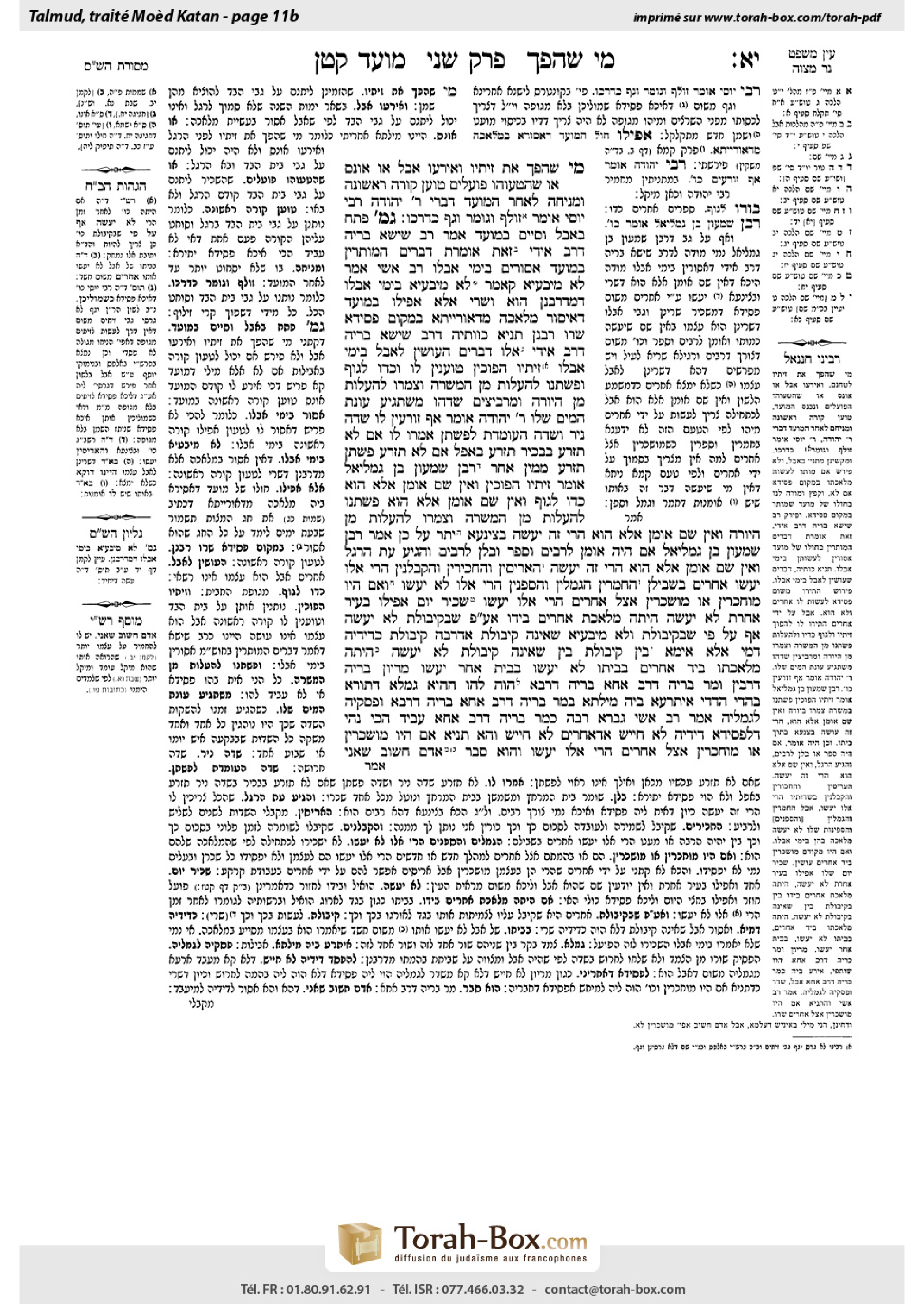
Moed Katan 11b: Talmud study for Daf Yomi
Daf Yomi is the daily study of one Talmud folio. Explore 37 tractates with scans, Hebrew text, Sefaria English and AI-generated French translations where annotated.
Passage selection and English or AI-generated French translation are available where the scan has annotations. Daf Study is independent of Torah-Box and Sefaria.
Browse Moed Katan · מועד קטן · All tractatesMoed Katan 11b text and translations
This page of Moed Katan includes the Aramaic text, an English translation and an AI-generated French translation, alongside the scan above.
מועד קטן י״א ב · Aramaic and Hebrew text
מִי שֶׁהָפַךְ אֶת זֵיתָיו וְאֵירְעוֹ אֵבֶל אוֹ אוֹנֶס, אוֹ שֶׁהִטְעוּהוּ פּוֹעֲלִים — טוֹעֵן קוֹרָה רִאשׁוֹנָה וּמַנִּיחָהּ לְאַחַר הַמּוֹעֵד, דִּבְרֵי רַבִּי יְהוּדָה.
רַבִּי יוֹסֵי אוֹמֵר: זוֹלֵף וְגוֹמֵר, וְגָף כְּדַרְכּוֹ.
גְּמָ׳ פָּתַח בְּאֵבֶל וְסִיֵּים בַּמּוֹעֵד. אָמַר רַב שִׁישָׁא בְּרֵיהּ דְּרַב אִידִי זֹאת אוֹמֶרֶת: דְּבָרִים הַמּוּתָּרִין בַּמּוֹעֵד, אֲסוּרִים בִּימֵי אֶבְלוֹ.
רַב אָשֵׁי אָמַר, לָא מִיבַּעְיָא קָאָמַר: לָא מִיבַּעְיָא בִּימֵי אֶבְלוֹ, דְּמִדְּרַבָּנַן הוּא וּשְׁרֵי, אֶלָּא אֲפִילּוּ בַּמּוֹעֵד, דְּאִיסּוּר מְלָאכָה מִדְּאוֹרָיְיתָא בִּמְקוֹם פְּסֵידָא — שָׁרוּ רַבָּנַן.
תַּנְיָא כְּווֹתֵיהּ דְּרַב שִׁישָׁא בְּרֵיהּ דְּרַב אִידִי. אֵלּוּ דְּבָרִים הָעוֹשִׂין לָאָבֵל בִּימֵי אֶבְלוֹ: זֵיתָיו הֲפוּכִין — טוֹעֲנִין לוֹ, וְכַדּוֹ לָגוּף וּפִשְׁתָּנוֹ לְהַעֲלוֹת מִן הַמִּשְׁרָה, וְצַמְרוֹ לְהַעֲלוֹת מִן הַיּוֹרָה, וּמַרְבִּיצִים שָׂדֵהוּ מִשֶּׁתַּגִּיעַ עוֹנַת הַמַּיִם שֶׁלּוֹ.
רַבִּי יְהוּדָה אוֹמֵר: אַף זוֹרְעִין לוֹ שְׂדֵה נִיר וְשָׂדֶה הָעוֹמֶדֶת לְפִשְׁתָּן. אָמְרוּ לוֹ: אִם לֹא תִּזָּרַע בְּבַכִּיר — תִּזָּרַע בְּאָפִל, אִם לֹא תִּזָּרַע פִּשְׁתָּן — תִּזָּרַע מִמִּין אַחֵר.
רַבָּן שִׁמְעוֹן בֶּן גַּמְלִיאֵל אוֹמֵר: זֵיתָיו הֲפוּכִין וְאֵין שָׁם אוּמָּן אֶלָּא הוּא, כַּדּוֹ לָגוּף וְאֵין שָׁם אוּמָּן אֶלָּא הוּא, פִּשְׁתָּנוֹ לְהַעֲלוֹת מִן הַמִּשְׁרָה וְצַמְרוֹ לְהַעֲלוֹת מִן הַיּוֹרָה וְאֵין שָׁם אוּמָּן אֶלָּא הוּא — הֲרֵי זֶה יַעֲשֶׂה בְּצִינְעָא.
יָתֵר עַל כֵּן אָמַר רַבָּן שִׁמְעוֹן בֶּן גַּמְלִיאֵל: אִם הָיָה אוּמָּן לָרַבִּים, וְסַפָּר וּבַלָּן לָרַבִּים, וְהִגִּיעַ עֵת הָרֶגֶל וְאֵין שָׁם אוּמָּן אֶלָּא הוּא — הֲרֵי זֶה יַעֲשֶׂה.
הָאֲרִיסִין וְהַחֲכִירִין וְהַקַּבְּלָנִין — הֲרֵי אֵלּוּ יַעֲשׂוּ אֲחֵרִים בִּשְׁבִילָן. הַחַמָּרִין הַגַּמָּלִין וְהַסַּפָּנִין — הֲרֵי אֵלּוּ לֹא יַעֲשׂוּ, וְאִם הָיוּ מוּחְכָּרִין אוֹ מוּשְׂכָּרִין אֵצֶל אֲחֵרִים — הֲרֵי אֵלּוּ יַעֲשׂוּ. שְׂכִיר יוֹם אֲפִילּוּ בְּעִיר אַחֶרֶת — לֹא יַעֲשֶׂה. הָיְתָה מְלֶאכֶת אֲחֵרִים בְּיָדוֹ, אַף עַל פִּי שֶׁבְּקִיבּוֹלֶת — לֹא יַעֲשֶׂה.
אַף עַל פִּי שֶׁבְּקִיבּוֹלֶת, וְלָא מִיבַּעְיָא שֶׁאֵינָהּ קִיבּוֹלֶת?! אַדְּרַבָּה, קִיבּוֹלֶת כְּדִידֵיהּ דָּמֵי! אֶלָּא אֵימָא: בֵּין קִיבּוֹלֶת בֵּין שֶׁאֵינָהּ קִיבּוֹלֶת — לֹא יַעֲשֶׂה.
הָיְתָה מְלַאכְתּוֹ בְּיַד אֲחֵרִים, בְּבֵיתוֹ — לֹא יַעֲשׂוּ, בְּבַיִת אַחֵר — יַעֲשׂוּ.
מָרִיּוֹן בְּרֵיהּ דְּרָבִין וּמָר בְּרֵיהּ דְּרַב אַחָא בְּרֵיהּ דְּרָבָא הֲוָה לְהוּ הַהוּא גַּמְלָא דְתוֹרָא בַּהֲדֵי הֲדָדֵי. אִיתְּרַעָא בֵּיהּ מִילְּתָא בְּמָר בְּרֵיהּ דְּרַב אַחָא בְּרֵיהּ דְּרָבָא וּפַסְקֵיהּ לְגַמְלֵיהּ. אָמַר רַב אָשֵׁי: גַּבְרָא רַבָּה כְּמָר בְּרֵיהּ דְּרַב אַחָא עָבֵיד הָכִי? נְהִי דְּלִפְסֵידָא דִּידֵיהּ לָא חָיֵישׁ, אַדַּאֲחֵרִים לָא חָיֵישׁ?! וְהָא תַּנְיָא: אִם הָיוּ מוּשְׂכָּרִין אוֹ מוּחְכָּרִין אֵצֶל אֲחֵרִים — הֲרֵי אֵלּוּ יַעֲשׂוּ!
וְהוּא סָבַר: אָדָם חָשׁוּב שָׁאנֵי.
Moed Katan 11b · English translation
MISHNA: The mishna discusses one who had already turned over his olives as part of the process of preparing them for pressing, and mourning for a close relative befell him and as a result he was prohibited from engaging in work, or some other unavoidable accident occurred, or his workers misled him, promising to come but failing to do so, so that he could not press his olives before the Festival. Under these circumstances, during the intermediate days of the Festival, he may place the olives in the press and load the beam with weights for the initial pressing of the olives and leave it this way until after the Festival; this is the statement of Rabbi Yehuda.
Rabbi Yosei says: He may press the olives and complete the process and then plug each barrel of oil in its usual manner. Since delay can entail financial loss, the Sages did not require him to alter the normal process of extracting the oil.
GEMARA: The Gemara asks: The tanna opens the mishna with a case of mourning and ends it with the halakhot of the intermediate days of the Festival, leaving the connection between them unclear. Rav Sheisha, son of Rav Idi, said: That is to say: Actions that are permitted on the intermediate days of a Festival are prohibited during the days of one’s mourning. Therefore, if a mourning period befell one before the Festival, and he could not prepare properly for the Festival due to the prohibition against performance of labor by a mourner, he is permitted to perform labor during the intermediate days of the Festival to avoid financial loss.
Rav Ashi said that the tanna of the mishna is speaking utilizing the didactic style of: It is not necessary, and he is teaching two separate halakhot, one about mourning and the other about the Festival: It is not necessary to state that during the days of his mourning, when the prohibition against labor is rabbinic, it is permitted to perform labor that, if delayed, could cause serious loss; but even on the intermediate days of the Festival, when the prohibition against performing labor is by Torah law, performing such labor is permitted because in a case of a loss the Sages permitted it.
The Gemara comments: It is taught in a baraita in accordance with the opinion of Rav Sheisha, son of Rav Idi: These are actions that others perform for the mourner during the days of his mourning: If his olives have already been turned over, they may load them for him into the olive press, and likewise if his cask needs to be plugged, or if his flax needs to be lifted out of the soaking pool where it will rot if not removed in time, or if his wool needs to be lifted from the cauldron into which it was placed for dyeing, they perform all these actions for him. They also irrigate his field when his turn for water arrives, as in many places, each field would receive water in turn according to a prearranged schedule. If one does not utilize the water when his turn arrives, he loses that water. This supports Rav Sheisha’s opinion that the prohibition against performing labor is waived in cases of loss only on the Festival. Under such circumstances, labor is prohibited to a mourner and in cases of loss may only be performed for him by others.
The baraita continues: Rabbi Yehuda says: They also sow for him a plowed field or a field set aside for flax, where the time of sowing is critical. If the field is sown later, it will cause a loss. The Sages said to him: If that field is not sown in the early season, it can be sown in the later season; and similarly, if it is not sown with flax, it can be sown with another species. Therefore, this is not considered a great loss, and the Sages did not permit it.
Rabban Shimon ben Gamliel says: If his olives have already been turned over and there is no skilled worker available who knows how to press them properly but him, or his cask needs to be plugged and there is no skilled worker available but him, or his flax needs to be lifted out of the soaking pool, or his wool needs to be lifted from the cauldron, and there is no skilled worker available but him, he may perform all of these actions himself in private.
Rabban Shimon ben Gamliel said further: If this mourner was a craftsman who serves the public, providing a necessary service, or a barber or a bath attendant for the public, and the time of the Festival arrived, i.e., it was the eve of a Festival, and there is no other skilled worker available but him, then he may perform the labor even in public, as the needs of the public takes precedence over the mourning of an individual.
The baraita continues: Tenant farmers, who farm others’ land in exchange for a certain percentage of the crop, and leasers, who work the land in exchange for a fixed amount of the crop, and contractors, who work the land in exchange for a set amount of money, are included amongst those for whom others may perform their labor when they are in mourning. In contrast, donkey drivers, camel drivers, and sailors are those for whom others may not perform their work during their mourning periods. However, if they or their animals were leased or hired out to others, then they may perform work, because they were hired personally and cannot be replaced without loss. A day laborer, even if he is in a different city where his mourning status is not public knowledge, may not perform his work. If a commission for others was his responsibility, even if it was by contract and he was paid not by the day but upon its completion, he may not perform that labor.
The statement in the baraita that one may not perform a task for others even if it was by contract implies that it is not necessary to state that if it was not by contract the work is prohibited to a mourner. The Gemara asks: On the contrary, when he works by contract it is considered as though it were his own work, since he simply receives payment for the completed task. Non-contracted labor, where he is paid for the time he works, is not viewed as his own and it is conceivable that it would be permitted during his mourning period. The Gemara concludes: Rather, emend the text and say that the baraita should read: If a commission for others was his responsibility, whether by contract or not by contract, he may not perform it.
The baraita continues: If he commissioned others to perform his work, then if it was in his house they may not perform the work, but if it was in another house they may perform it.
The Gemara relates that Maryon, son of Ravin, and Mar, son of Rav Aḥa, son of Rava, held a team of two oxen in partnership between them, one ox apiece. An event, i.e., a death in the family, befell Mar, son of Rav Aḥa, son of Rava, and he detached his ox from the team, preventing any work from being performed by the team, because he did not want work performed with his animal during his days of mourning. Rav Ashi said: A distinguished man like Mar, son of Rav Aḥa, is behaving this way? Granted, he is not concerned about his own loss, but is he not concerned about the loss of others, i.e., his partner? Isn’t it taught in the baraita cited above: If they or their animals were hired out or leased to others, then they may perform their work? In that case, why not allow the partner to work with the animal of Mar, son of Rav Aḥa?
The Gemara explains: But Mar, son of Rav Aḥa, maintains: An important person is different. Even if strictly speaking something is permitted, an important person must be more rigorous with himself, so that people learn not to take the halakha lightly.
Moed Katan 11b · Traduction française (IA)
MICHNA : La Michna traite du cas d’un homme qui avait déjà retourné ses olives dans le cadre de leur préparation au pressage, puis fut frappé par le deuil d’un proche, ce qui lui interdit de travailler, ou fut empêché par un autre accident inévitable, ou encore fut trompé par ses ouvriers, qui lui avaient promis de venir mais ne se présentèrent pas, de sorte qu’il ne put presser ses olives avant la fête. Dans ces circonstances, pendant les jours intermédiaires de la fête, il peut placer les olives dans le pressoir, charger la poutre de poids pour le premier pressage des olives et laisser l’ensemble ainsi jusqu’après la fête ; telle est la déclaration de Rabbi Yehouda.
Rabbi Yossi dit : Il peut presser les olives, achever le processus, puis boucher chaque tonneau d’huile de la manière habituelle. Comme un retard peut entraîner une perte financière, les Sages ne lui ont pas imposé de modifier la manière normale d’extraire l’huile.
GUEMARA : La Guemara demande : Le tanna ouvre la Michna par un cas de deuil et la termine par les lois des jours intermédiaires de la fête, sans que le lien entre les deux soit clair. Rav Cheicha, fils de Rav Idi, dit : Cela signifie que les actes permis pendant les jours intermédiaires d’une fête sont interdits pendant les jours de deuil. Par conséquent, si une période de deuil a commencé avant la fête et que l’intéressé n’a pas pu se préparer correctement à la fête en raison de l’interdiction faite à un endeuillé d’accomplir des travaux, il est autorisé à travailler pendant les jours intermédiaires de la fête afin d’éviter une perte financière.
Rav Achi dit que le tanna de la Michna s’exprime selon le procédé didactique du « il n’est pas nécessaire » et enseigne deux halakhot distinctes, l’une concernant le deuil et l’autre la fête : il n’est pas nécessaire de préciser que, pendant les jours de deuil, alors que l’interdiction de travailler est d’ordre rabbinique, il est permis d’accomplir un travail dont le report pourrait entraîner une perte importante ; mais même pendant les jours intermédiaires de la fête, alors que l’interdiction de travailler relève de la Torah, un tel travail est permis, car les Sages l’ont autorisé en cas de perte.
La Guemara remarque : Une baraïta enseigne conformément à l’opinion de Rav Cheicha, fils de Rav Idi : Voici les travaux que d’autres accomplissent pour l’endeuillé pendant ses jours de deuil : si ses olives ont déjà été retournées, on peut les charger pour lui dans le pressoir à olives ; de même, si son tonneau doit être bouché, si son lin doit être retiré du bassin de trempage où il pourrirait s’il n’était pas retiré à temps, ou si sa laine doit être retirée du chaudron où elle a été placée pour être teinte, on accomplit tous ces travaux pour lui. On irrigue également son champ lorsque vient son tour d’être arrosé, car en de nombreux endroits, chaque champ recevait l’eau à tour de rôle, selon un calendrier fixé à l’avance. Si l’on n’utilise pas l’eau quand vient son tour, on la perd. Cela appuie l’opinion de Rav Cheicha, selon laquelle l’interdiction de travailler n’est levée en cas de perte que pendant la fête. Dans de telles circonstances, le travail est interdit à l’endeuillé et, en cas de perte, seuls d’autres peuvent l’accomplir pour lui.
La baraïta poursuit : Rabbi Yehouda dit : On ensemence également pour lui un champ labouré ou un champ réservé au lin, pour lesquels le moment des semailles est crucial. Si l’on sème le champ plus tard, cela entraînera une perte. Les Sages lui répondirent : si ce champ n’est pas ensemencé au début de la saison, il peut l’être plus tard ; de même, s’il n’est pas ensemencé de lin, il peut l’être d’une autre espèce. Cela n’est donc pas considéré comme une perte importante, et les Sages ne l’ont pas permis.
Rabban Chimon ben Gamliel dit : si ses olives ont déjà été retournées et qu’il n’y a aucun ouvrier qualifié, à part lui, qui sache les presser correctement ; ou si son tonneau doit être bouché et qu’il n’y a aucun ouvrier qualifié, à part lui ; ou si son lin doit être retiré du bassin de trempage ; ou si sa laine doit être retirée du chaudron, et qu’il n’y a aucun ouvrier qualifié, à part lui, il peut accomplir lui-même tous ces travaux en privé.
Rabban Chimon ben Gamliel dit encore : si cet endeuillé était un artisan qui rend un service indispensable au public, un barbier ou un préposé aux bains publics, et que le moment de la fête arrive, c’est-à-dire la veille d’une fête, et qu’il n’y ait aucun autre ouvrier qualifié, à part lui, il peut accomplir ce travail même en public, car les besoins du public priment sur le deuil d’un particulier.
La baraïta poursuit : les métayers, qui cultivent les terres d’autrui en échange d’un certain pourcentage de la récolte, les fermiers à part de fruits, qui travaillent la terre en échange d’une quantité fixe de la récolte, et les entrepreneurs, qui travaillent la terre contre une somme d’argent déterminée, figurent parmi ceux dont d’autres peuvent accomplir les travaux pendant le deuil. En revanche, les conducteurs d’ânes, les chameliers et les marins sont des personnes pour lesquelles d’autres ne peuvent pas effectuer de travail pendant leur deuil. Toutefois, si eux-mêmes ou leurs animaux ont été loués ou engagés par d’autres, ils peuvent travailler, car ils ont été engagés personnellement et ne peuvent être remplacés sans entraîner une perte. Un journalier, même s’il se trouve dans une autre ville où son statut d’endeuillé n’est pas connu du public, ne peut pas travailler. Si un travail commandé par d’autres lui incombe, il ne peut pas l’accomplir, même s’il a été engagé à forfait et qu’il est payé non pas à la journée, mais une fois le travail achevé.
La déclaration de la baraïta selon laquelle on ne peut pas accomplir une tâche pour autrui même si l’on a été engagé à forfait implique qu’il n’est pas nécessaire de préciser que, si le travail n’est pas à forfait, il est interdit à un endeuillé. La Guemara demande : au contraire, lorsqu’il travaille à forfait, c’est comme si le travail lui appartenait, puisqu’il reçoit simplement un paiement pour la tâche achevée. Un travail sans forfait, pour lequel il est payé en fonction du temps travaillé, n’est pas considéré comme lui appartenant ; on pourrait donc penser qu’il est permis pendant sa période de deuil. La Guemara conclut : il faut plutôt corriger le texte et dire que la baraïta doit se lire ainsi : si un travail commandé par d’autres lui incombe, qu’il soit à forfait ou non, il ne peut pas l’accomplir.
La baraïta poursuit : s’il a chargé d’autres personnes d’accomplir son travail, si celui-ci doit être effectué chez lui, elles ne peuvent pas le faire ; mais s’il doit être effectué dans une autre maison, elles le peuvent.
La Guemara rapporte que Maryon, fils de Ravin, et Mar, fils de Rav Aḥa, fils de Rava, possédaient en association un attelage de deux bœufs, chacun en possédant un. Un événement, c’est-à-dire un décès dans la famille, frappa Mar, fils de Rav Aḥa, fils de Rava, qui détela son bœuf de l’attelage, empêchant ainsi tout travail avec les bœufs, car il ne voulait pas que l’on travaille avec son animal pendant ses jours de deuil. Rav Achi dit : Un homme éminent comme Mar, fils de Rav Aḥa, se comporte ainsi ? Certes, il ne se préoccupe pas de sa propre perte, mais ne se préoccupe-t-il pas de la perte d’autrui, à savoir de celle de son associé ? N’est-il pas enseigné dans la baraïta citée plus haut que, si eux-mêmes ou leurs animaux ont été engagés ou loués par d’autres, ils peuvent travailler ? Dans ce cas, pourquoi ne pas permettre à l’associé de travailler avec l’animal de Mar, fils de Rav Aḥa ?
La Guemara explique : mais Mar, fils de Rav Aḥa, soutient qu’un homme éminent fait exception. Même si, à strictement parler, une chose est permise, un homme éminent doit se montrer plus rigoureux envers lui-même, afin que les gens apprennent à ne pas prendre la halakha à la légère.
Traduction française générée par IA à partir de l’édition anglaise de Sefaria. Vérifie toujours un passage avec le texte source.
Text from Sefaria: William Davidson Edition - Vocalized Aramaic (CC BY NC); William Davidson Edition - English (CC BY NC).