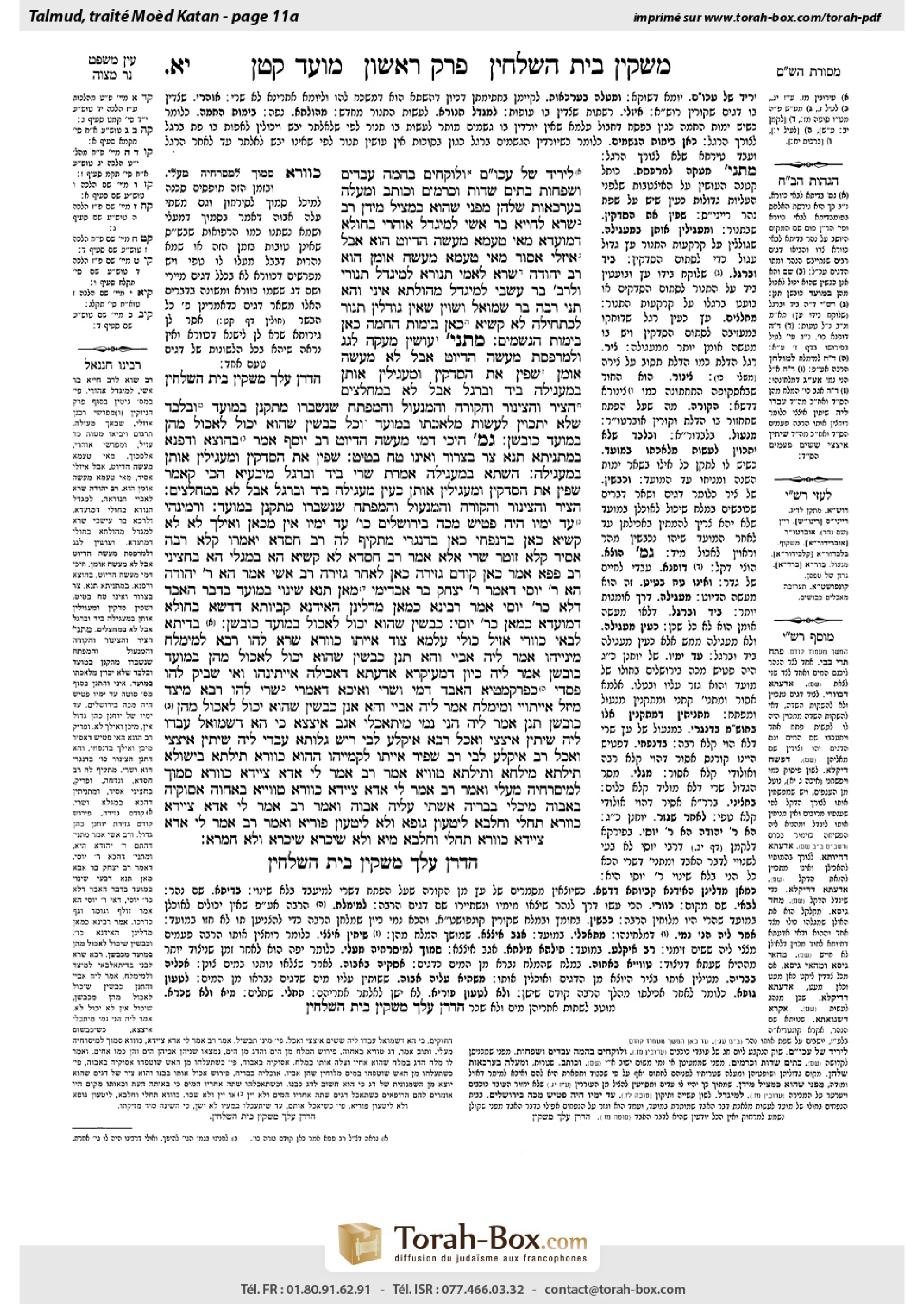
Moed Katan 11a: Talmud study for Daf Yomi
Daf Yomi is the daily study of one Talmud folio. Explore 37 tractates with scans, Hebrew text, Sefaria English and AI-generated French translations where annotated.
Passage selection and English or AI-generated French translation are available where the scan has annotations. Daf Study is independent of Torah-Box and Sefaria.
Browse Moed Katan · מועד קטן · All tractatesMoed Katan 11a text and translations
This page of Moed Katan includes the Aramaic text, an English translation and an AI-generated French translation, alongside the scan above.
מועד קטן י״א א · Aramaic and Hebrew text
לְיָרִיד שֶׁל גּוֹיִם, וְלוֹקְחִים בְּהֵמָה, עֲבָדִים וּשְׁפָחוֹת, בָּתִּים, שָׂדוֹת וּכְרָמִים, וְכוֹתֵב וּמַעֲלֶה בָּעַרְכָּאוֹת שֶׁלָּהֶן, מִפְּנֵי שֶׁהוּא כְּמַצִּיל מִיָּדָן.
רַב שְׁרָא לְחִיָּיא בַּר אָשֵׁי לְמִיגְדַּל אוּהָרִי בְּחוּלָּא דְמוֹעֲדָא. מַאי טַעְמָא — מַעֲשֵׂה הֶדְיוֹט הוּא, אֲבָל אִיזְלֵי — אָסוּר. מַאי טַעְמָא — מַעֲשֵׂה אוּמָּן הוּא.
רַב יְהוּדָה שְׁרָא לְאַמֵּי תַּנּוּרָאָה לְמִיגְדַּל תַּנּוּרֵי, וּלְרַבָּה בַּר עִשְׂבִּי לְמִיגְדַּל מַהוֹלָתָא. אִינִי? וְהָא תָּנֵי רַבָּה בַּר שְׁמוּאֵל: וְשָׁוִין שֶׁאֵין גּוֹדְלִין תַּנּוּר לְכַתְּחִילָּה! לָא קַשְׁיָא: כָּאן בִּימוֹת הַחַמָּה, כָּאן בִּימוֹת הַגְּשָׁמִים.
מַתְנִי׳ עוֹשִׂין מַעֲקֶה לַגַּג וְלַמִּרְפֶּסֶת מַעֲשֵׂה הֶדְיוֹט, אֲבָל לֹא מַעֲשֵׂה אוּמָּן. שָׁפִין אֶת הַסְּדָקִין וּמַעֲגִילִין אוֹתָן בַּמַּעֲגִילָה, בַּיָּד וּבָרֶגֶל אֲבָל לֹא בְּמַחְלָצַיִם.
הַצִּיר וְהַצִּינּוֹר וְהַקּוֹרָה וְהַמַּנְעוּל וְהַמַּפְתֵּחַ שֶׁנִּשְׁבְּרוּ — מְתַקְּנָן בַּמּוֹעֵד, וּבִלְבַד שֶׁלֹּא יִתְכַּוֵּין לַעֲשׂוֹת מְלַאכְתּוֹ בַּמּוֹעֵד.
וְכׇל כְּבָשִׁין שֶׁהוּא יָכוֹל לֶאֱכוֹל מֵהֶן בַּמּוֹעֵד כּוֹבְשָׁן.
גְּמָ׳ הֵיכִי דָמֵי מַעֲשֵׂה הֶדְיוֹט? רַב יוֹסֵף אָמַר: בְּהוּצָא וְדַפְנָא. בְּמַתְנִיתָא תָּנָא: צָר בִּצְרוֹר וְאֵינוֹ טָח בְּטִיט.
שָׁפִין אֶת הַסְּדָקִין וּמַעֲגִילִין אוֹתָן בַּמַּעֲגִילָה. הַשְׁתָּא בְּמַעֲגִילָה אָמְרַתְּ שְׁרֵי — בַּיָּד וּבָרֶגֶל מִיבַּעְיָא? הָכִי קָאָמַר: שָׁפִין אֶת הַסְּדָקִין וּמַעֲגִילִין אוֹתָן כְּעֵין מַעֲגִילָה, בַּיָּד וּבָרֶגֶל, אֲבָל לֹא בְּמַחְלָצַיִם.
הַצִּיר וְהַצִּינּוֹר וְהַקּוֹרָה וְהַמַּנְעוּל וְהַמַּפְתֵּחַ שֶׁנִּשְׁבְּרוּ — מְתַקְּנָן בַּמּוֹעֵד. וּרְמִינְהִי: עַד יָמָיו הָיָה פַּטִּישׁ מַכֶּה בִּירוּשָׁלַיִם כּוּ׳. עַד יָמָיו — אִין, מִכָּאן וְאֵילָךְ — לָא!
לָא קַשְׁיָא: כָּאן בִּדְנַפָּחֵי, כָּאן בִּדְנַגָּרֵי.
מַתְקֵיף לַהּ רַב חִסְדָּא: יֹאמְרוּ, קָלָא רַבָּה — אֲסִיר, קָלָא זוּטְרָא — שְׁרֵי! אֶלָּא אָמַר רַב חִסְדָּא, לָא קַשְׁיָא: הָא — בְּמַגָּלֵי, הָא — בַּחֲצִינֵי. רַב פָּפָּא אָמַר: כָּאן — קוֹדֶם גְּזֵירָה, כָּאן — לְאַחַר גְּזֵירָה.
רַב אָשֵׁי אָמַר: הָא — רַבִּי יְהוּדָה, הָא — רַבִּי יוֹסֵי. דְּאָמַר רַבִּי יִצְחָק בַּר אַבְדִּימִי: מַאן תַּנָּא שִׁינּוּי בַּמּוֹעֵד בְּדָבָר הָאָבֵד — דְּלָא כְּרַבִּי יוֹסֵי.
אָמַר רָבִינָא: כְּמַאן מְדַלִּינַן הָאִידָּנָא קִבְּיוָתָא דְּדַשָּׁא בְּחוּלָּא דְמוֹעֲדָא, כְּמַאן — כְּרַבִּי יוֹסֵי.
כְּבָשִׁין שֶׁהוּא יָכוֹל לֶאֱכוֹל בַּמּוֹעֵד — כּוֹבְשָׁן. בְּדִיתָא לְבַאי כְּווֹרֵי, אֲזוּל כּוּלֵּי עָלְמָא צוּד אַיְיתוֹ כְּווֹרֵי, שְׁרָא לְהוּ רָבָא לְמִימְלַח מִינַּיְיהוּ.
אֲמַר לֵיהּ אַבָּיֵי, וְהָא תְּנַן: כְּבָשִׁין שֶׁהוּא יָכוֹל לֶאֱכוֹל מֵהֶן בַּמּוֹעֵד — כּוֹבְשָׁן! אֲמַר לֵיהּ: כֵּיוָן דְּמֵעִיקָּרָא אַדַּעְתָּא דַאֲכִילָה אַיְיתִינְהוּ, וְאִי שָׁבֵיק לְהוּ פָּסְדִי, כִּפְרַקְמַטְיָא הָאָבֵד דָּמֵי, וּשְׁרֵי.
וְאִיכָּא דְּאָמְרִי, שְׁרָא לְהוּ רָבָא מֵיצָד מֵיזָל אַיְיתוֹיֵי וּמִימְלָח. אֲמַר לֵיהּ אַבָּיֵי: וְהָא אֲנַן, כְּבָשִׁין שֶׁהוּא יָכוֹל לֶאֱכוֹל מֵהֶן כּוֹבְשָׁן תְּנַן!
אֲמַר לֵיהּ: הָנֵי נָמֵי מִיתְאַכְלִי אַגַּב אִיצָצָא. כִּי הָא דִּשְׁמוּאֵל עֲבַדוּ לֵיהּ שִׁיתִּין אִיצָצֵי וַאֲכַל. רָבָא אִיקְּלַע לְבֵי רֵישׁ גָּלוּתָא, עָבְדִי לֵיהּ שִׁיתִּין אִיצָצֵי וַאֲכַל.
רַב אִיקְּלַע לְבֵי רַב שַׁפִּיר, אַיְיתוֹ לְקַמַּיְיהוּ הָהוּא כְּווֹרָא תִּילְתָּא בִּישּׁוּלָא תִּילְתָּא מִילְחָא וְתִילְתָּא טַוְויָא.
אָמַר רַב: אֲמַר לִי אַדָּא צַיָּידָא, כְּווֹרָא סָמוּךְ לְמִיסְרְחֵיהּ מְעַלֵּי. וְאָמַר רַב, אֲמַר לִי אַדָּא צַיָּידָא: כְּווֹרָא, טַוְויָיא בַּאֲחוּהּ, אַסּוֹקֵיהּ בַּאֲבוּהּ, מֵיכְלֵי[הּ] בִּבְרֵיהּ, מִשְׁתֵּי עֲלֵיהּ אֲבוּהּ.
וְאָמַר רַב, אֲמַר לִי אַדָּא צַיָּידָא: כְּווֹרָא, תַּחְלֵי, וַחֲלָבָא — לִיטְעוֹן גּוּפָא וְלָא לִיטְעוֹן פּוּרְיָא. וְאָמַר רַב, אֲמַר לִי אַדָּא צַיָּידָא: כְּווֹרָא, תַּחְלֵי, וַחֲלָבָא — מַיָּא וְלָא שִׁיכְרָא, שִׁיכְרָא וְלָא חַמְרָא.
הֲדַרַן עֲלָךְ מַשְׁקִין בֵּית הַשְּׁלָחִין
Moed Katan 11a · English translation
to a fair of pagan gentiles held on a day they have designated for idol worship and buy animals, slaves, maidservants, houses, fields, and vineyards from them. And he may write the necessary deeds and confirm them in their courts [arkaot] by verifying the signatures on the documents to prevent the sellers from appealing and retracting the sale. Although this behavior might be construed as a display of respect for the gentiles and their idols, it is nevertheless permitted because it is as if he were rescuing his property from their hands, as he would not have another opportunity to acquire these items. This indicates that time-sensitive transactions are considered like cases where one might suffer financial loss, and are permitted.
It was related that Rav permitted Ḥiyya bar Ashi to weave simple traps [oharei] on the intermediate days of a Festival. The Gemara explains: What is the reason for this? It is because it is the work of a layman. However, complex nets [izlei] are prohibited. What is the reason? It is the work of a craftsman, which is prohibited on the intermediate days of a Festival.
It was further related that Rav Yehuda permitted Ami the oven maker to construct ovens on the intermediate days of a Festival and Rabba bar Ashabi to craft sieves. The Gemara asks: Is that really so? Didn’t Rabba bar Shmuel teach the following baraita: And they all agree that one may not construct a new oven on the intermediate days of a Festival. The Gemara answers that this is not difficult: Here, where Rav Yehuda permitted constructing an oven, he was referring to the summer, i.e., when the weather is hot and dry, so the oven can dry out and already be fit for use on the Festival; there, where the baraita prohibits constructing an oven, it is referring to the rainy season, i.e., when the weather is such that the oven will not be ready for use on the Festival.
MISHNA: One may construct a railing for a roof or a balcony if it is done in a nonprofessional manner, as the work of a layman, but not if it is done skillfully, as the work of a craftsman. One may plaster the cracks in an oven and roll over them with a roller, a wooden tool used to smooth out clay, with a hand or a foot, but not with a presser, a tool that is specially designed for this task.
With regard to the hinge of a door, and the cylinder of the hinge, and the cross beam that holds the door, and a lock and a key that broke, one may fix them on the intermediate days of a Festival as these items are essential for the Festival and their repair cannot be delayed. This is permitted, provided that he does not intend ahead of time to do his labor on the Festival and delay it until that time.
And with regard to all preserved food from which one can eat on the Festival, since they become ready to be eaten in a short amount of time, he may preserve them on the intermediate days of a Festival.
GEMARA: The Gemara asks: What are the circumstances in which a railing is considered the work of a layman? Rav Yosef said: When it is made with palm branches and the branches of bay trees, which do not create a permanent structure. It was taught in a baraita that he fills in the space with stone but he does not plaster the stones with clay.
It was taught in the mishna: One may plaster the cracks in an oven and roll over them with a roller, with a hand or a foot, but not with a presser. The Gemara asks: Now that you said that it is permitted to roll over the cracks with a roller, is it necessary to say that one may plaster the cracks with a hand or a foot? The Gemara answers that this is what the mishna is saying: One may plaster the cracks in an oven and roll over them as if with a roller, meaning with a hand or a foot, but not with a presser, which is a craftsman’s tool made especially for this.
It was taught in the mishna: With regard to the hinge of a door, and the cylinder of the hinge, and the cross beam that holds the door, and a lock and a key that broke, one may fix them on the intermediate days of a Festival. The Gemara raises a contradiction to this from a different mishna (Ma’aser Sheni 5:15): Until the days of Yoḥanan the High Priest, workmen’s hammers would beat in Jerusalem on the intermediate days of a Festival. One can deduce from this mishna that until his days, yes, the workmen’s hammers would beat, but from then on, no, because Yoḥanan the High Priest banned such work. This seems to contradict the mishna here that permits fixing certain items on the intermediate days of the Festival.
The Gemara answers: This is not difficult: There, when it is prohibited, it is referring to the work of smiths, which generates a great deal of noise; here, where it is permitted, it is referring to the work of carpenters, which is much quieter.
Rav Ḥisda strongly objects to this: If so, people will say that a loud noise is prohibited, but a soft noise is permitted. Rather, Rav Ḥisda said that the apparent contradiction is not difficult for a different reason: This mishna that permits labor is referring to sickles, as sickles emit no noise at all; whereas that mishna that prohibits labor is referring to chisels. Rav Pappa said: Here in the mishna it is referring to the period before the decree of Yoḥanan the High Priest; whereas there in the other mishna it is referring to the period after the decree.
Rav Ashi said: That mishna, which prohibits this labor, was taught in accordance with the opinion of Rabbi Yehuda; while this mishna was taught in accordance with the opinion of Rabbi Yosei. As Rabbi Yitzḥak bar Avdimi said: Who is the tanna who taught that all labor performed on the intermediate days of a Festival must be done with a change, i.e., in an altered manner, even with regard to a matter that will be lost if timely action is not taken? It is not in accordance with the opinion of Rabbi Yosei, as Rabbi Yosei permits doing labor that will prevent financial loss even when it is done in the usual manner.
Ravina said: In accordance with whose opinion do we now lift the lintel above the door in order to drive in the nails that had loosened on the intermediate days of a Festival in the usual manner? In accordance with whose opinion is this done? It is done in accordance with the opinion of Rabbi Yosei, who permits labor that will prevent financial loss even when it is done in the usual manner.
§ It was taught in the mishna: With regard to all preserved food from which he can eat on the Festival, he may preserve them on the intermediate days of a Festival. The Gemara relates that the Bedita River once overflowed, depositing large quantities of fish in small water deposits on the river bank on the intermediate days of a Festival. Everyone went and trapped and brought home fish, and Rava permitted them to salt some of the fish.
Abaye said to him: Didn’t we learn in the mishna: With regard to all preserved food from which he can eat on the Festival, he may preserve them on the intermediate days of a Festival? In this case it was impossible to eat that much fish on the Festival, and therefore preserving them should have been prohibited. Rava said to him: Since they initially brought these fish with the intention of eating them on the Festival, and it only became clear afterward that they had brought too many, and if one would leave them without salting them they would be ruined, they are treated like merchandise that will be lost, and therefore preserving them is permitted.
And some say that it did not happen in this manner, rather, Rava permitted them to trap the fish, to bring them home, and to salt them. Abaye said to him: Didn’t we learn in the mishna: With regard to all preserved food from which he can eat on the Festival, he may preserve them on the intermediate days of a Festival? These fish were heavily salted and consequently could not be eaten until they thoroughly dried out.
Rava said to him: These fish that were just salted can also be eaten now, by pressing out the salt and brine, and therefore, they too are fit to be eaten on the Festival, as in that case of Shmuel, where they prepared recently salted fish for him by pressing it sixty times and he ate the fish. The Gemara relates that Rava happened to come to the house of the Exilarch and they prepared freshly salted fish for him by pressing it sixty times, and he ate it.
Apropos eating fish in various ways, the Gemara relates that Rav once happened to come to the house of Rav Shapir, and they brought before him a certain fish, of which one- third was cooked, one-third was salted and made edible via pressing, and one-third was broiled.
Rav said: Adda the fisherman told me that a fish that has sat for some time and is close to spoiling is at its best. And Rav also said: Adda the fisherman told me: With regard to a fish, broil it with its brother, i.e., with salt, which, like fish, also comes from the sea; place it in its father, i.e., in water; and eat it with its son, i.e., with fish brine which comes from it; and drink after it its father, i.e., water.
And in addition Rav said: Adda the fisherman told me: After eating fish, cress, and milk, let the body carry them and let not the bed carry them, i.e., it is advisable to go for a walk after eating them, rather than immediately going to sleep. And Rav said: Adda the fisherman told me: After eating fish, cress, and milk, it is better to drink water and not beer, and if he has no water, he should drink beer and not wine, in order to avoid harming his body.
Moed Katan 11a · Traduction française (IA)
à une foire de non-Juifs idolâtres, tenue un jour qu’ils ont désigné pour le culte des idoles, et leur acheter des animaux, des esclaves, des servantes, des maisons, des champs et des vignobles. Il peut rédiger les actes nécessaires et les faire authentifier dans leurs tribunaux [arkaot], en vérifiant les signatures apposées sur les documents, afin d’empêcher les vendeurs de contester la vente et de revenir sur leur décision. Bien que ce comportement puisse être interprété comme une marque de respect envers les non-Juifs et leurs idoles, il est néanmoins permis, car c’est comme s’il sauvait ses biens de leurs mains : il n’aurait pas d’autre occasion d’acquérir ces choses. Cela indique que les transactions qui ne peuvent être différées sont considérées comme des situations où l’on risque une perte financière et sont donc permises.
On rapporte que Rav autorisa Ḥiyya bar Ashi à tresser des pièges simples [oharei] pendant les jours intermédiaires de la fête. La Guemara explique : pour quelle raison ? Parce que c’est un travail de profane. En revanche, les filets complexes [izlei] sont interdits. Pour quelle raison ? C’est un travail d’artisan, interdit pendant les jours intermédiaires de la fête.
On rapporte également que Rav Yehuda autorisa Ami, le fabricant de fours, à construire des fours pendant les jours intermédiaires de la fête, et Rabba bar Ashabi à fabriquer des tamis. La Guemara demande : Est-ce vraiment le cas ? Rabba bar Shmuel n’a-t-il pas enseigné la baraïta suivante : tous conviennent qu’on ne peut pas construire un nouveau four pendant les jours intermédiaires de la fête. La Guemara répond que ce n’est pas difficile : ici, lorsque Rav Yehuda autorisa la construction d’un four, il s’agissait de l’été, c’est-à-dire d’une période chaude et sèche, de sorte que le four pouvait sécher et être déjà utilisable pendant la fête ; là, lorsque la baraïta interdit de construire un four, il s’agissait de la saison des pluies, c’est-à-dire d’une période où le four ne serait pas prêt à l’usage pendant la fête.
MICHNA : On peut construire une balustrade pour un toit ou un balcon si le travail est fait de manière non professionnelle, comme un travail de profane, mais pas s’il est exécuté avec habileté, comme un travail d’artisan. On peut enduire les fissures d’un four et les lisser avec un rouleau, outil de bois servant à lisser l’argile, avec la main ou le pied, mais pas avec un outil de pressage spécialement conçu à cet effet.
Si le gond d’une porte, le cylindre du gond, la traverse qui maintient la porte, une serrure ou une clé se casse, on peut réparer l’objet pendant les jours intermédiaires de la fête, car ces objets sont indispensables pour la fête et leur réparation ne peut être différée. Cela est permis à condition de ne pas avoir prévu à l’avance d’effectuer ce travail pendant la fête et de l’avoir repoussé jusque-là.
Quant à tout aliment conservé que l’on peut manger pendant la fête, on peut le conserver pendant les jours intermédiaires de la fête, puisqu’il devient consommable en peu de temps.
GUEMARA : La Guemara demande : Dans quelles circonstances une balustrade est-elle considérée comme un travail de profane ? Rav Yosef dit : lorsqu’elle est faite avec des branches de palmier et de laurier, qui ne forment pas une structure permanente. Une baraïta enseigne qu’on remplit l’espace avec des pierres, mais qu’on ne les enduit pas d’argile.
Il a été enseigné dans la Michna : On peut enduire les fissures d’un four et les lisser avec un rouleau, avec la main ou le pied, mais pas avec un outil de pressage. La Guemara demande : Puisqu’il a été dit qu’il est permis de lisser les fissures avec un rouleau, est-il nécessaire de préciser qu’on peut les enduire avec la main ou le pied ? La Guemara répond que voici ce que dit la Michna : on peut enduire les fissures d’un four et les lisser comme avec un rouleau, c’est-à-dire avec la main ou le pied, mais pas avec un outil de pressage, qui est un outil d’artisan spécialement conçu à cet effet.
Il a été enseigné dans la Michna : Si le gond d’une porte, le cylindre du gond, la traverse qui maintient la porte, une serrure ou une clé se casse, on peut réparer l’objet pendant les jours intermédiaires de la fête. La Guemara soulève une contradiction à partir d’une autre Michna (Ma’aser Sheni 5:15) : jusqu’à l’époque de Yoḥanan le Grand Prêtre, les marteaux des ouvriers résonnaient à Jérusalem pendant les jours intermédiaires de la fête. On peut en déduire que jusqu’à son époque, oui, les marteaux des ouvriers résonnaient, mais qu’à partir de là, non, car Yoḥanan le Grand Prêtre interdit ce travail. Cela semble contredire la Michna ici, qui autorise la réparation de certains objets pendant les jours intermédiaires de la fête.
La Guemara répond : ce n’est pas difficile. Là, où le travail est interdit, il s’agit du travail des forgerons, qui produit beaucoup de bruit ; ici, où il est permis, il s’agit du travail des charpentiers, qui est beaucoup plus silencieux.
Rav Ḥisda s’oppose vivement à cette explication : dans ce cas, les gens diront qu’un bruit fort est interdit, mais qu’un bruit faible est permis. Rav Ḥisda dit plutôt que la contradiction apparente s’explique autrement : cette Michna, qui autorise le travail, concerne les faucilles, qui ne font aucun bruit ; tandis que l’autre Michna, qui l’interdit, concerne les ciseaux. Rav Pappa dit : ici, dans la Michna, il s’agit de la période antérieure au décret de Yoḥanan le Grand Prêtre ; là, dans l’autre Michna, il s’agit de la période postérieure au décret.
Rav Ashi dit : cette Michna, qui interdit ce travail, a été enseignée conformément à l’opinion de Rabbi Yehuda, tandis que cette Michna a été enseignée conformément à celle de Rabbi Yosei. En effet, Rabbi Yitzḥak bar Avdimi a dit : quel est le tanna qui a enseigné que tout travail effectué pendant les jours intermédiaires de la fête doit être accompli de manière inhabituelle, même lorsqu’un retard entraînerait une perte ? Ce n’est pas conforme à l’opinion de Rabbi Yosei, puisque Rabbi Yosei autorise à effectuer un travail qui évite une perte financière, même de la manière habituelle.
Ravina dit : selon l’opinion de qui soulevons-nous maintenant le linteau au-dessus de la porte afin d’enfoncer les clous qui se sont desserrés pendant les jours intermédiaires de la fête, de la manière habituelle ? Selon l’opinion de qui le faisons-nous ? Selon celle de Rabbi Yosei, qui autorise à effectuer un travail permettant d’éviter une perte financière, même de la manière habituelle.
§ Il a été enseigné dans la Michna : Tout aliment conservé que l’on peut manger pendant la fête, on peut le conserver pendant les jours intermédiaires de la fête. La Guemara rapporte qu’un jour, la rivière Bedita déborda et laissa de grandes quantités de poissons dans de petites mares sur ses berges, pendant les jours intermédiaires de la fête. Tout le monde alla en attraper et en rapporta chez soi, et Rava leur permit de saler une partie des poissons.
Abaye lui dit : N’avons-nous pas appris dans la Michna : Tout aliment conservé que l’on peut manger pendant la fête, on peut le conserver pendant les jours intermédiaires de la fête ? Dans ce cas, il était impossible de manger autant de poissons pendant la fête ; leur conservation aurait donc dû être interdite. Rava lui dit : Comme ils avaient d’abord rapporté ces poissons dans l’intention de les manger pendant la fête et qu’ils ne s’étaient rendu compte qu’ensuite qu’ils en avaient pris trop, et que, si on les avait laissés sans les saler, ils auraient été abîmés, ces poissons sont considérés comme une marchandise qui risque de se perdre ; leur conservation est donc permise.
Certains rapportent que les choses ne se sont pas passées ainsi ; Rava leur aurait plutôt permis d’attraper les poissons, de les rapporter chez eux et de les saler. Abaye lui dit : N’avons-nous pas appris dans la Michna : Tout aliment conservé que l’on peut manger pendant la fête, on peut le conserver pendant les jours intermédiaires de la fête ? Ces poissons avaient été fortement salés et ne pouvaient donc être mangés avant d’avoir complètement séché.
Rava lui dit : Ces poissons fraîchement salés peuvent aussi être mangés dès maintenant, en faisant sortir le sel et la saumure par pression ; ils sont donc, eux aussi, propres à être consommés pendant la fête, comme dans le cas de Shmuel, à qui l’on prépara des poissons fraîchement salés en les pressant soixante fois, et qui les mangea. La Guemara rapporte que Rava se rendit par hasard chez l’Exilarque ; on lui prépara des poissons fraîchement salés en les pressant soixante fois, et il les mangea.
À propos des différentes façons de manger le poisson, la Guemara rapporte que Rav se rendit par hasard chez Rav Shapir, où l’on lui apporta un poisson préparé de trois façons : un tiers était cuit, un tiers salé puis rendu consommable par pression, et un tiers grillé.
Rav dit : Adda le pêcheur m’a dit qu’un poisson qui a reposé quelque temps et est sur le point de se gâter est à son meilleur. Rav dit aussi : Adda le pêcheur m’a dit : pour le poisson, faites-le griller avec son frère, c’est-à-dire le sel, qui, comme le poisson, vient aussi de la mer ; placez-le dans son père, c’est-à-dire dans l’eau ; mangez-le avec son fils, c’est-à-dire avec la saumure de poisson qui en provient ; et après, buvez son père, c’est-à-dire de l’eau.
Rav ajouta : Adda le pêcheur m’a dit : après avoir mangé du poisson, du cresson et du lait, laissez le corps les porter, et non le lit, c’est-à-dire qu’il est conseillé de faire une promenade après les avoir consommés plutôt que d’aller se coucher aussitôt. Rav dit aussi : Adda le pêcheur m’a dit : après avoir mangé du poisson, du cresson et du lait, mieux vaut boire de l’eau que de la bière ; et si l’on n’a pas d’eau, il faut boire de la bière plutôt que du vin, afin d’éviter de nuire à son corps.
Traduction française générée par IA à partir de l’édition anglaise de Sefaria. Vérifie toujours un passage avec le texte source.
Text from Sefaria: William Davidson Edition - Vocalized Aramaic (CC BY NC); William Davidson Edition - English (CC BY NC).