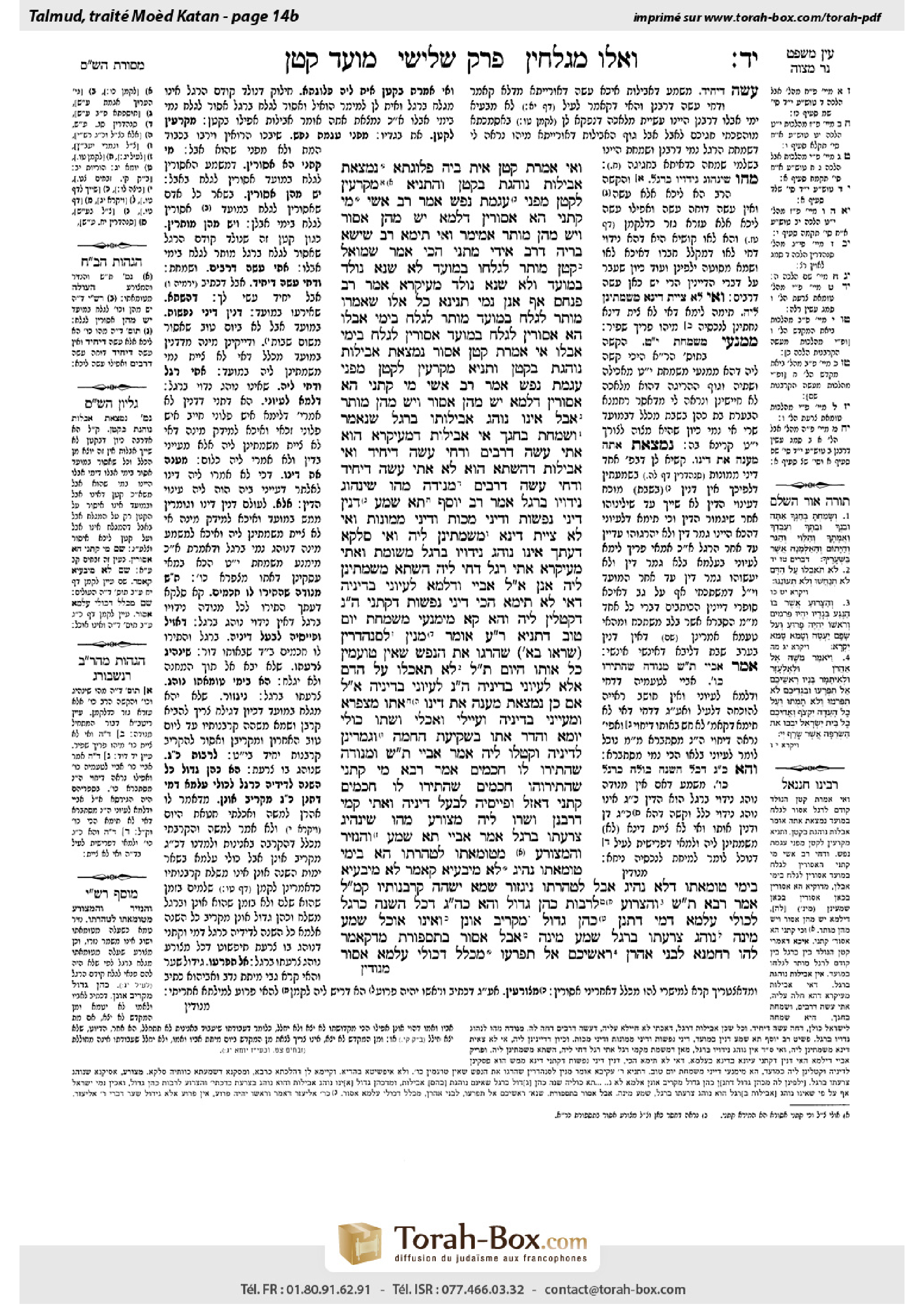
Moed Katan 14b: Talmud study for Daf Yomi
Daf Yomi is the daily study of one Talmud folio. Explore 37 tractates with scans, Hebrew text, Sefaria English and AI-generated French translations where annotated.
Passage selection and English or AI-generated French translation are available where the scan has annotations. Daf Study is independent of Torah-Box and Sefaria.
Browse Moed Katan · מועד קטן · All tractatesMoed Katan 14b text and translations
This page of Moed Katan includes the Aramaic text, an English translation and an AI-generated French translation, alongside the scan above.
מועד קטן י״ד ב · Aramaic and Hebrew text
וְאִי אָמְרַתְּ קָטָן אִית בֵּיהּ פְּלוּגְתָּא — נִמְצֵאת אֲבֵילוּת נוֹהֶגֶת בְּקָטָן.
וְהָתַנְיָא: מְקָרְעִין לַקָּטָן, מִפְּנֵי עׇגְמַת נֶפֶשׁ!
אָמַר רַב אָשֵׁי: מִי קָתָנֵי הָא אֲסוּרִין! דִּלְמָא יֵשׁ מֵהֶן אָסוּר וְיֵשׁ מֵהֶן מוּתָּר.
אַמֵּימָר, וְאִי תֵּימָא רַב שִׁישָׁא בְּרֵיהּ דְּרַב אִידִי, מַתְנֵי הָכִי. אָמַר שְׁמוּאֵל: קָטָן מוּתָּר לְגַלְּחוֹ בַּמּוֹעֵד, לָא שְׁנָא נוֹלַד בַּמּוֹעֵד וְלָא שְׁנָא נוֹלַד מֵעִיקָּרָא.
אָמַר רַב פִּנְחָס, אַף אֲנַן נָמֵי תְּנֵינָא: כׇּל אֵלּוּ שֶׁאָמְרוּ מוּתָּר לְגַלֵּחַ בַּמּוֹעֵד — מוּתָּר לְגַלֵּחַ בִּימֵי אֶבְלוֹ. הָא אֲסוּרִין לְגַלֵּחַ בַּמּוֹעֵד — אֲסוּרִין לְגַלֵּחַ בִּימֵי אֶבְלוֹ.
אִי אָמְרַתְּ קָטָן אָסוּר, נִמְצֵאת אֲבֵילוּת נוֹהֶגֶת בְּקָטָן. וְתַנְיָא: מְקָרְעִין לַקָּטָן מִפְּנֵי עׇגְמַת נֶפֶשׁ.
אָמַר רַב אָשֵׁי: מִי קָתָנֵי הָא אֲסוּרִין? דִּלְמָא יֵשׁ מֵהֶן אָסוּר וְיֵשׁ מֵהֶן מוּתָּר.
אָבֵל אֵינוֹ נוֹהֵג אֲבֵילוּתוֹ בָּרֶגֶל, שֶׁנֶּאֱמַר: ״וְשָׂמַחְתָּ בְּחַגֶּךָ״.
אִי אֲבֵילוּת דְּמֵעִיקָּרָא הוּא — אָתֵי עֲשֵׂה דְרַבִּים וְדָחֵי עֲשֵׂה דְיָחִיד. וְאִי אֲבֵילוּת דְּהַשְׁתָּא הוּא — לָא אָתֵי עֲשֵׂה דְיָחִיד וְדָחֵי עֲשֵׂה דְרַבִּים.
מְנוּדָּה, מַהוּ שֶׁיִּנְהוֹג נִידּוּיוֹ בָּרֶגֶל? אָמַר רַב יוֹסֵף, תָּא שְׁמַע: דָּנִין דִּינֵי נְפָשׁוֹת וְדִינֵי מַכּוֹת וְדִינֵי מָמוֹנוֹת, וְאִי לָא צָיֵית דִּינָא — מְשַׁמְּתִינַן לֵיהּ.
וְאִי סָלְקָא דַעְתָּךְ אֵינוֹ נוֹהֵג נִידּוּיוֹ בָּרֶגֶל, מְשׁוּמָּת וְאָתֵי מֵעִיקָּרָא, אָתֵי רֶגֶל דָּחֵי לֵיהּ — הַשְׁתָּא מְשַׁמְּתִינַן לֵיהּ אֲנַן?!
אֲמַר לֵיהּ אַבָּיֵי: וְדִלְמָא לְעַיּוֹנֵי בְּדִינֵיהּ? דְּאִי לָא תֵּימָא הָכִי, דִּינֵי נְפָשׁוֹת דְּקָתָנֵי, הָכָא נָמֵי דְּקָטְלִין לֵיהּ!
וְהָא קָא מִימַּנְעִי מִשִּׂמְחַת יוֹם טוֹב — דְּתַנְיָא, רַבִּי עֲקִיבָא אוֹמֵר: מִנַּיִן לְסַנְהֶדְרִין (שֶׁרָאוּ בְּאֶחָד) שֶׁהָרְגוּ אֶת הַנֶּפֶשׁ שֶׁאֵין טוֹעֲמִין כׇּל אוֹתוֹ הַיּוֹם, תַּלְמוּד לוֹמַר: ״לֹא תֹאכְלוּ עַל הַדָּם״.
אֶלָּא: לְעַיּוֹנֵי בְּדִינֵיהּ, הָכָא נָמֵי לְעַיּוֹנֵי בְּדִינֵיהּ. אֲמַר לֵיהּ: אִם כֵּן, נִמְצֵאתָ מְעַנֶּה אֶת דִּינוֹ!
אָתוּ מִצַּפְרָא וּמְעַיְּינִי בְּדִינֵיהּ, וְעָיְילִי, וְאָכְלִי וְשָׁתוּ כּוּלֵּי יוֹמָא, וַהֲדַר אָתוּ בִּשְׁקִיעַת הַחַמָּה וְגָמְרִי לְדִינֵיהּ וְקָטְלוּ לֵיהּ.
אָמַר אַבָּיֵי, תָּא שְׁמַע: וּמְנוּדֶּה שֶׁהִתִּירוּ לוֹ חֲכָמִים!
אָמַר רָבָא: מִי קָתָנֵי שֶׁהִתִּירוּהוּ חֲכָמִים? שֶׁהִתִּירוּ לוֹ חֲכָמִים קָתָנֵי, דַּאֲזַל וּפַיְּיסֵיהּ לְבַעַל דִּינֵיהּ, וַאֲתָא קַמֵּי דְרַבָּנַן וּשְׁרוֹ לֵיהּ.
מְצוֹרָע, מַהוּ שֶׁיַּנְהִיג צָרַעְתּוֹ בָּרֶגֶל? אָמַר אַבָּיֵי, תָּא שְׁמַע: וְהַנָּזִיר וְהַמְּצוֹרָע מִטּוּמְאָתוֹ לְטׇהֳרָתוֹ. הָא בִּימֵי טוּמְאָתוֹ — נָהֵיג.
לָא מִיבַּעְיָא קָאָמַר. לָא מִיבַּעְיָא בִּימֵי טוּמְאָתוֹ דְּלָא נָהֵיג, אֲבָל לְטׇהֳרָתוֹ נִיגְזוֹר שֶׁמָּא יְשַׁהֶה קׇרְבְּנוֹתָיו, קָמַשְׁמַע לַן!
אָמַר רָבָא, תָּא שְׁמַע: ״וְהַצָּרוּעַ״ — לְרַבּוֹת כֹּהֵן גָּדוֹל. וְהָא כֹּהֵן גָּדוֹל, דְּכׇל הַשָּׁנָה כְּרֶגֶל לְכוּלֵּי עָלְמָא דָּמֵי, דִּתְנַן: כֹּהֵן גָּדוֹל מַקְרִיב אוֹנֵן וְאֵינוֹ אוֹכֵל. שְׁמַע מִינַּהּ נוֹהֵג צָרַעְתּוֹ בָּרֶגֶל. שְׁמַע מִינַּהּ.
אָבֵל אָסוּר בְּתִסְפּוֹרֶת. מִדְּקָאָמַר לְהוּ רַחֲמָנָא לִבְנֵי אַהֲרֹן: ״רָאשֵׁיכֶם אַל תִּפְרָעוּ״, מִכְּלָל דְּכוּלֵּי עָלְמָא אָסוּר.
Moed Katan 14b · English translation
And if you say that with regard to a baby there is a distinction between being born before the Festival and being born on it, and in some cases it is prohibited to cut the hair of a baby, then you find that mourning is practiced even with a minor.
Isn’t it taught in a baraita: One rends the clothes of a minor whose relative has passed away, due to the desire to bring about feelings of grief among those who see him? However, there is no inherent requirement for the minor to observe any of the halakhot of mourning.
Rav Ashi said: Is it taught explicitly in the first baraita cited by Rav Pineḥas that if it is prohibited for one to have a haircut during the Festival, it is likewise prohibited to have a haircut during the week of mourning? That was merely an inference. Perhaps there are those among them, i.e., those listed in the mishna, for whom it is prohibited, while there are others among them for whom it is permitted, and the halakhot of mourning do not apply to a baby.
Ameimar, and some say it was Rav Sheisha, son of Rav Idi, taught that statement in this manner. Shmuel said: With regard to a baby, it is permitted to cut his hair during the Festival. It is no different whether he was born during the Festival, and it is no different whether he was born beforehand.
Rav Pineḥas said: We, too, learn in the baraita a support for this statement: All of those about whom the Sages said: It is permitted to shave and cut his hair on the intermediate days of the Festival, it is also permitted to shave and cut his hair during the days of his mourning. But from this it follows that one who is prohibited from shaving and cutting his hair on the intermediate days of a Festival is also prohibited from shaving and cutting his hair during the days of his mourning.
If you say that with regard to a baby it is prohibited to cut his hair, then you find that mourning is practiced even with a minor. And it was taught in a baraita: One rends the clothes of a minor whose relative has passed away due to the desire to bring about feelings of grief among those who see him. However, there is no inherent requirement for the minor to observe any of the halakhot of mourning.
Rav Ashi said: Is it taught explicitly in the first baraita cited by Rav Pineḥas that if it is prohibited for one to shave during the Festival, it is likewise prohibited to shave during the week of mourning? That was merely an inference. Perhaps there are those among them for whom it is prohibited, while there are others among them for whom it is permitted. If so, there is no clear support from this baraita for Shmuel’s statement.
§ A mourner does not practice the halakhot of his mourning on a Festival, as it is stated: “And you shall rejoice in your Festival” (Deuteronomy 16:14).
The Gemara explains: If it is a mourning period that had already begun at the outset of the Festival, the positive mitzva of rejoicing on the Festival, which is incumbent upon the community, comes and overrides the positive mitzva of the individual, i.e., the mourning. And if the mourning period began only now, i.e., the deceased died during the Festival, the positive mitzva of the individual does not come and override the positive mitzva of the community.
The Gemara asks: With regard to one who was ostracized, what is the halakha? Must he observe the practices of ostracism, or are they overridden by the mitzva to rejoice on the Festival? Rav Yosef said: Come and hear an answer from that which is taught: During the Festival the court judges cases of capital law, cases of lashes, and cases of monetary law. It is known that if one does not listen to and follow the judgment, among the possibilities of enforcement is that we ostracize him until he accepts the verdict.
And if it enters your mind that one does not observe the practices of ostracism during the Festival, the following a fortiori argument can be made: If, for one who has already been ostracized at the outset of the Festival, the Festival comes and overrides his observance of that status, is it reasonable that now we, the court, should ostracize he who does not listen to the judgment of the court during the Festival itself? Rather, it must be that one does observe the practices of ostracism, even during the Festival.
Abaye said to him: There is no proof from here, as perhaps when the baraita states that the court judges cases, what it meant is that it deliberates in judgment on the Festival, but it does not actually reach a verdict. Therefore, the court never ostracizes someone during the Festival. Accordingly, there is no a fortiori argument proving that one observes the practices of ostracism during the Festival. Because if you do not say so, that the baraita is referring to deliberation, then in the cases of capital law that are taught, here too, would we put someone to death on the Festival?
But if so, the judges would be prevented from rejoicing on the Festival, as it is taught in a baraita that Rabbi Akiva says: From where is it derived with regard to the Sanhedrin who put someone to death that they may not taste any food or drink for the entire rest of the day? The verse states: “You shall not eat with the blood” (Leviticus 19:26). It is not appropriate to eat during the same day that they caused bloodshed.
Rather, the statement of the baraita, that the court judges cases of capital law, must be referring to deliberating in judgment and not actually reaching a verdict. Here too, in cases of monetary law and of lashes, it is referring to deliberating in judgment, without the possibility of ostracizing anyone during the Festival. Rav Yosef said to him: If so, if only deliberations are conducted during the Festival, you find a perversion of justice by delaying his verdict.
Rather, the judges come in the morning as usual and deliberate in judgment. They then enter their homes and eat and drink all day, i.e., as much as they desire, in order to rejoice fully on the Festival. Then they come back to the courthouse close to sunset and complete his judgment, i.e., they dispense the verdict, and if necessary, they kill him. In this manner, they are not prevented from enjoying the Festival properly.
Abaye said: Come and hear another support from a baraita: And it is the case with regard to one who is ostracized, that the Sages permitted him to get a haircut during the intermediate days of the Festival. This indicates that one who is ostracized need not observe the practices of ostracism during the Festival.
Rava said: Is it taught in the baraita: That they permitted it, which would indicate that the Sages permitted all those who were ostracized to cut their hair on the intermediate days of the Festival? Rather, it is taught: They permitted him. This indicates that it is referring to an individual case, where one went and appeased his opposing litigant and the Sages came and released him from his decree of ostracism.
§ The Gemara asks a similar question: With regard to a leper, what is the halakha? Must he observe the practices of his leper status, or are they overridden by the mitzva to rejoice during the Festival? Abaye said: Come and hear a proof from a baraita: And both the nazirite and the leper who transfers from his state of ritual impurity to his new state of purity may shave on the intermediate days of the Festival. This implies that during the days of his impurity he must observe all of the ordinary practices, even during the Festival.
The Gemara rejects this proof: The baraita is speaking employing the didactic style of: Needless to say. Needless to say, during the days of his impurity on the Festival, he does not observe the practices of ostracism. However, with regard to one who regains his state of purity during the intermediate days of the Festival, one might think that we should issue a decree that he not be permitted to shave, lest he delay sacrificing his offerings until the last day of the Festival, when it is prohibited to sacrifice offerings of an individual. Perhaps prohibiting him from shaving will prevent this possibility. Therefore, because one might have thought that shaving should be prohibited, the baraita teaches us that it is, in fact, permitted for him to shave during the intermediate days of the Festival.
Rava said: Come and hear another source. The verse states: “And the leper in whom the plague is, his clothes shall be rent” (Leviticus 13:45). The extra emphasis of the phrase: “And the leper” comes to include the High Priest, teaching that all the halakhot of the leper apply to him. And the status of the High Priest during the entire year is like that of everyone on a Festival, as we learned in a mishna (Horayot 12b): The High Priest sacrifices animals when he has the status of an acute mourner, i.e., before the burial of a close relative who died, but he may not eat of the offering. Learn from it that a leper practices the customs of his leprosy during the Festival. The Gemara concludes: Indeed, learn from it that this is so.
§ The source for the halakha that it is prohibited for a mourner to receive a haircut is derived from the fact that the Merciful One states to the sons of Aaron: “Let not the hair of your heads go loose” (Leviticus 10:6). It was prohibited for them to let their hair grow long during their period of mourning over the death of their brothers, Nadav and Avihu. By inference, it is teaching that for everyone else, i.e., non-priests, it is prohibited to cut their hair during the period of mourning.
Moed Katan 14b · Traduction française (IA)
Et si tu dis qu’en ce qui concerne un bébé, il existe une distinction entre celui qui est né avant la fête et celui qui est né pendant celle-ci, et que, dans certains cas, il est interdit de lui couper les cheveux, il s’ensuit que le deuil est observé même par un mineur.
N’est-il pas enseigné dans une baraïta : « On déchire les vêtements d’un mineur dont un proche est décédé, afin de susciter des sentiments de tristesse chez ceux qui le voient » ? Toutefois, le mineur n’est pas tenu en soi d’observer les lois du deuil.
Rav Ashi dit : Est-il enseigné explicitement dans la première baraïta citée par Rav Pineḥas que, s’il est interdit de se faire couper les cheveux pendant la fête, il est également interdit de se faire couper les cheveux durant la semaine de deuil ? Ce n’était qu’une déduction. Peut-être que, parmi ceux qui sont mentionnés dans la Michna, cela est interdit pour certains et permis pour d’autres, et que les lois du deuil ne s’appliquent pas à un bébé.
Ameimar — et certains disent qu’il s’agissait de Rav Sheisha, fils de Rav Idi — enseigna cette déclaration de la manière suivante. Shmuel dit : En ce qui concerne un bébé, il est permis de lui couper les cheveux pendant la fête, qu’il soit né pendant celle-ci ou avant.
Rav Pineḥas dit : Nous aussi, nous trouvons dans la baraïta un appui à cette déclaration : Tous ceux dont les Sages ont dit qu’ils peuvent se raser et se couper les cheveux pendant les jours intermédiaires de la fête peuvent également le faire pendant les jours de leur deuil. Mais il s’ensuit que celui qui n’a pas le droit de se raser ni de se couper les cheveux pendant les jours intermédiaires d’une fête n’a pas non plus le droit de le faire pendant les jours de son deuil.
Si tu dis qu’il est interdit de couper les cheveux d’un bébé, il s’ensuit que le deuil est observé même par un mineur. Or, une baraïta enseigne : « On déchire les vêtements d’un mineur dont un proche est décédé, afin de susciter des sentiments de tristesse chez ceux qui le voient. » Toutefois, le mineur n’est pas tenu en soi d’observer les lois du deuil.
Rav Ashi dit : Est-il enseigné explicitement dans la première baraïta citée par Rav Pineḥas que, s’il est interdit de se raser pendant la fête, il est également interdit de se raser durant la semaine de deuil ? Ce n’était qu’une déduction. Peut-être que, parmi ceux qui sont mentionnés, cela est interdit pour certains et permis pour d’autres. Dans ce cas, cette baraïta n’apporte aucun appui concluant à la déclaration de Shmuel.
§ Un endeuillé n’observe pas les lois du deuil pendant une fête, comme il est dit : « Et tu te réjouiras pendant ta fête » (Deutéronome 16:14).
La Guemara explique : Si la période de deuil avait déjà commencé au début de la fête, la mitsva positive de se réjouir pendant la fête, qui incombe à la collectivité, vient l’emporter sur la mitsva positive de l’individu, c’est-à-dire le deuil. En revanche, si la période de deuil commence seulement maintenant, c’est-à-dire si le défunt meurt pendant la fête, la mitsva positive de l’individu ne vient pas l’emporter sur la mitsva positive de la collectivité.
La Guemara demande : Quelle est la halakha concernant celui qui a été mis au ban ? Doit-il observer les pratiques liées à cette mise au ban, ou sont-elles écartées par la mitsva de se réjouir pendant la fête ? Rav Yosef dit : Viens et entends une réponse tirée de ce qui est enseigné : Pendant la fête, le tribunal juge des affaires passibles de la peine capitale, des affaires passibles de coups de fouet et des affaires pécuniaires. On sait que si quelqu’un n’écoute pas le jugement et ne s’y conforme pas, l’une des mesures d’exécution possibles consiste à le mettre au ban jusqu’à ce qu’il accepte le verdict.
Et si tu envisages qu’on n’observe pas les pratiques liées à la mise au ban pendant la fête, on peut formuler le raisonnement a fortiori suivant : si la fête vient interrompre l’observance de ce statut pour celui qui a déjà été mis au ban au début de la fête, serait-il raisonnable que nous, le tribunal, mettions au ban pendant la fête même celui qui n’écoute pas le jugement du tribunal ? Il faut donc conclure qu’on observe bien les pratiques liées à la mise au ban, même pendant la fête.
Abaye lui dit : Il n’y a pas de preuve ici, car il se peut que, lorsque la baraïta dit que le tribunal juge des affaires, elle veuille dire qu’il délibère sur les affaires pendant la fête, sans rendre effectivement de verdict. Le tribunal ne met donc personne au ban pendant la fête. Par conséquent, aucun raisonnement a fortiori ne prouve qu’on observe les pratiques liées à la mise au ban pendant la fête. Car si tu ne l’admets pas et que la baraïta parle de délibérations, alors, pour les affaires passibles de la peine capitale qui y sont mentionnées, mettrait-on aussi quelqu’un à mort pendant la fête ?
Mais dans ce cas, les juges seraient empêchés de se réjouir pendant la fête, car une baraïta enseigne que Rabbi Akiva dit : « D’où déduit-on que les membres du Sanhédrin qui ont mis quelqu’un à mort ne peuvent goûter aucun aliment ni aucune boisson pendant tout le reste de la journée ? Le verset dit : “Tu ne mangeras pas avec le sang” (Lévitique 19:26). » Il ne convient pas de manger le jour même où ils ont fait couler le sang.
Il faut donc comprendre que la déclaration de la baraïta selon laquelle le tribunal juge des affaires passibles de la peine capitale fait référence aux délibérations, et non à un verdict effectivement rendu. De même, pour les affaires pécuniaires et celles passibles de coups de fouet, il s’agit de délibérer sans qu’il soit possible de mettre quelqu’un au ban pendant la fête. Rav Yosef lui dit : Dans ce cas, si l’on se contente de délibérer pendant la fête, on aboutit à une perversion de la justice en retardant le verdict.
Les juges viennent donc le matin, comme à l’accoutumée, et délibèrent. Ils rentrent ensuite chez eux et mangent et boivent toute la journée, c’est-à-dire autant qu’ils le souhaitent, afin de se réjouir pleinement pendant la fête. Puis ils reviennent au tribunal à l’approche du coucher du soleil et achèvent le procès, c’est-à-dire rendent leur verdict et, si nécessaire, le mettent à mort. Ainsi, ils ne sont pas empêchés de profiter pleinement de la fête.
Abaye dit : Viens et entends un autre appui tiré d’une baraïta : « Il en va de même pour celui qui a été mis au ban, puisque les Sages lui ont permis de se faire couper les cheveux pendant les jours intermédiaires de la fête. » Cela indique que celui qui a été mis au ban n’a pas à observer les pratiques liées à cette mise au ban pendant la fête.
Rava dit : Est-il enseigné dans la baraïta : « Ils le leur ont permis », ce qui indiquerait que les Sages ont permis à tous ceux qui ont été mis au ban de se couper les cheveux pendant les jours intermédiaires de la fête ? La baraïta enseigne plutôt : « Ils le lui ont permis. » Cela indique qu’il s’agit d’un cas particulier : quelqu’un est allé apaiser son adversaire dans le litige, puis les Sages sont venus et l’ont relevé de la mise au ban qui le frappait.
§ La Guemara pose une question semblable : Quelle est la halakha concernant un lépreux ? Doit-il observer les prescriptions liées à son statut de lépreux, ou sont-elles écartées par la mitsva de se réjouir pendant la fête ? Abaye dit : Viens et entends une preuve tirée d’une baraïta : « Tant le nazir que le lépreux qui passe de l’état d’impureté rituelle à son nouvel état de pureté peuvent se raser pendant les jours intermédiaires de la fête. » Cela implique que, pendant les jours où il est impur, il doit observer toutes les pratiques ordinaires, même pendant la fête.
La Guemara rejette cette preuve : La baraïta s’exprime selon le procédé didactique du « à plus forte raison ». À plus forte raison, pendant les jours d’impureté qui tombent pendant la fête, il n’observe pas les pratiques liées à son statut de lépreux. En revanche, pour celui qui retrouve son état de pureté pendant les jours intermédiaires de la fête, on pourrait penser qu’il faut décréter qu’il ne lui est pas permis de se raser, de peur qu’il ne retarde l’offrande de ses sacrifices jusqu’au dernier jour de la fête, où il est interdit d’offrir les sacrifices d’un particulier. Peut-être que lui interdire de se raser éviterait cette éventualité. C’est pourquoi, puisqu’on aurait pu penser qu’il est interdit de se raser, la baraïta nous enseigne qu’il lui est effectivement permis de le faire pendant les jours intermédiaires de la fête.
Rava dit : Viens et entends une autre source. Le verset dit : « Et le lépreux chez qui se trouve la plaie déchirera ses vêtements » (Lévitique 13:45). L’accent supplémentaire de l’expression « Et le lépreux » vient inclure le grand prêtre et enseigne que toutes les lois du lépreux s’appliquent à lui. Or, le statut du grand prêtre pendant toute l’année est semblable à celui de tous les autres pendant une fête, comme nous l’avons appris dans une Michna (Horayot 12b) : Le grand prêtre offre des animaux lorsqu’il est en état de deuil aigu, c’est-à-dire avant l’inhumation d’un proche parent décédé, mais il ne peut pas consommer de l’offrande. Apprends-en que le lépreux observe les pratiques liées à sa lèpre pendant la fête. La Guemara conclut : En effet, apprends-en qu’il en est ainsi.
§ La source de la halakha selon laquelle il est interdit à un endeuillé de se faire couper les cheveux est déduite du fait que le Miséricordieux dit aux fils d’Aaron : « Que les cheveux de vos têtes ne soient pas défaits » (Lévitique 10:6). Il leur était interdit de laisser pousser leurs cheveux pendant leur deuil à la suite de la mort de leurs frères, Nadav et Avihou. Par déduction, cela enseigne qu’il est interdit à tous les autres, c’est-à-dire aux non-prêtres, de se couper les cheveux pendant la période de deuil.
Traduction française générée par IA à partir de l’édition anglaise de Sefaria. Vérifie toujours un passage avec le texte source.
Text from Sefaria: William Davidson Edition - Vocalized Aramaic (CC BY NC); William Davidson Edition - English (CC BY NC).