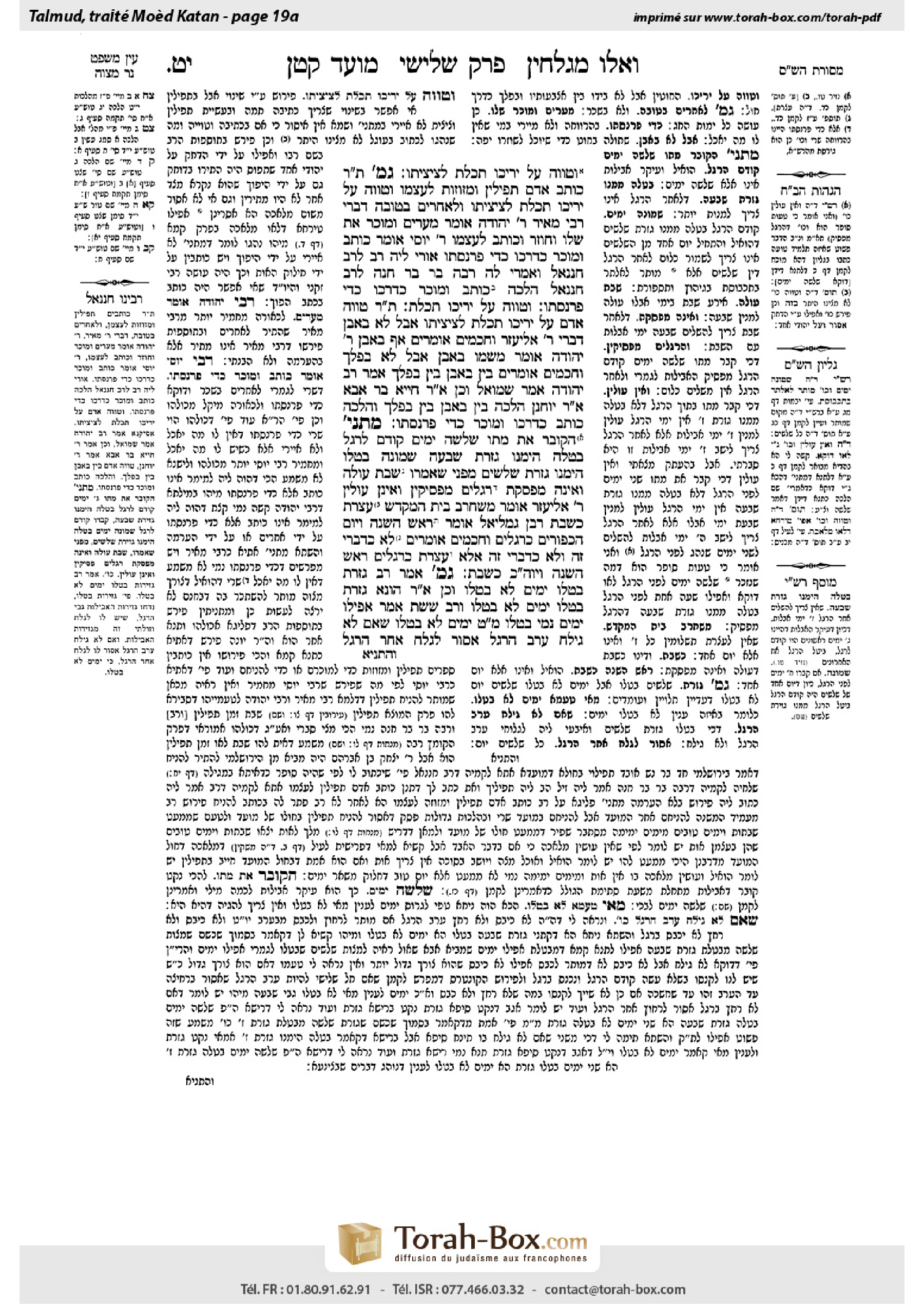
Moed Katan 19a: Talmud study for Daf Yomi
Daf Yomi is the daily study of one Talmud folio. Explore 37 tractates with scans, Hebrew text, Sefaria English and AI-generated French translations where annotated.
Passage selection and English or AI-generated French translation are available where the scan has annotations. Daf Study is independent of Torah-Box and Sefaria.
Browse Moed Katan · מועד קטן · All tractatesMoed Katan 19a text and translations
This page of Moed Katan includes the Aramaic text, an English translation and an AI-generated French translation, alongside the scan above.
מועד קטן י״ט א · Aramaic and Hebrew text
וְטוֹוֶה עַל יְרֵיכוֹ תְּכֵלֶת לְצִיצִיתוֹ.
גְּמָ׳ תָּנוּ רַבָּנַן: כּוֹתֵב אָדָם תְּפִילִּין וּמְזוּזוֹת לְעַצְמוֹ, וְטוֹוֶה עַל יְרֵיכוֹ תְּכֵלֶת לְצִיצִיתוֹ, וְלַאֲחֵרִים בְּטוֹבָה, דִּבְרֵי רַבִּי מֵאִיר. רַבִּי יְהוּדָה אוֹמֵר: מַעֲרִים, וּמוֹכֵר אֶת שֶׁלּוֹ, וְחוֹזֵר וְכוֹתֵב לְעַצְמוֹ. רַבִּי יוֹסֵי אוֹמֵר: כּוֹתֵב וּמוֹכֵר כְּדַרְכּוֹ כְּדֵי פַרְנָסָתוֹ.
אוֹרִי לֵיהּ רַב לְרַב חֲנַנְאֵל, וְאָמְרִי לַהּ רַבָּה בַּר בַּר חָנָה לְרַב חֲנַנְאֵל: הֲלָכָה, כּוֹתֵב וּמוֹכֵר כְּדַרְכּוֹ כְּדֵי פַרְנָסָתוֹ.
וְטוֹוֶה עַל יְרֵיכוֹ תְּכֵלֶת. תָּנוּ רַבָּנַן: טוֹוֶה אָדָם עַל יְרֵיכוֹ תְּכֵלֶת לְצִיצִיתוֹ, אֲבָל לֹא בְּאֶבֶן, דִּבְרֵי רַבִּי אֱלִיעֶזֶר. וַחֲכָמִים אוֹמְרִים: אַף בְּאֶבֶן. רַבִּי יְהוּדָה אוֹמֵר מִשְּׁמוֹ: בְּאֶבֶן אֲבָל לֹא בְּפֶלֶךְ, וַחֲכָמִים אוֹמְרִים: בֵּין בְּאֶבֶן בֵּין בְּפֶלֶךְ.
אָמַר רַב יְהוּדָה אָמַר שְׁמוּאֵל, וְכֵן אָמַר רַבִּי חִיָּיא בַּר אַבָּא אָמַר רַבִּי יוֹחָנָן: הֲלָכָה בֵּין בְּאֶבֶן בֵּין בְּפֶלֶךְ. וַהֲלָכָה: כּוֹתֵב כְּדַרְכּוֹ וּמוֹכֵר כְּדֵי פַרְנָסָתוֹ.
מַתְנִי׳ הַקּוֹבֵר אֶת מֵתוֹ שְׁלֹשָׁה יָמִים קוֹדֶם לָרֶגֶל — בָּטְלָה הֵימֶנּוּ גְּזֵרַת שִׁבְעָה. שְׁמוֹנָה — בָּטְלוּ הֵימֶנּוּ גְּזֵרַת שְׁלֹשִׁים.
מִפְּנֵי שֶׁאָמְרוּ: שַׁבָּת עוֹלָה, וְאֵינָהּ מַפְסֶקֶת. רְגָלִים מַפְסִיקִין, וְאֵינָן עוֹלִין.
רַבִּי אֱלִיעֶזֶר אוֹמֵר: מִשֶּׁחָרַב בֵּית הַמִּקְדָּשׁ, עֲצֶרֶת כַּשַּׁבָּת.
רַבָּן גַּמְלִיאֵל אוֹמֵר: רֹאשׁ הַשָּׁנָה וְיוֹם הַכִּפּוּרִים כָּרְגָלִים. וַחֲכָמִים אוֹמְרִים: לֹא כְּדִבְרֵי זֶה וְלֹא כְּדִבְרֵי זֶה, אֶלָּא: עֲצֶרֶת כָּרְגָלִים, רֹאשׁ הַשָּׁנָה וְיוֹם הַכִּפּוּרִים כַּשַּׁבָּת.
גְּמָ׳ אָמַר רַב: גְּזֵרוֹת — בָּטְלוּ, יָמִים — לֹא בָּטְלוּ, וְכֵן אָמַר רַבִּי הוּנָא: גְּזֵרוֹת — בָּטְלוּ, יָמִים — לֹא בָּטְלוּ. וְרַב שֵׁשֶׁת אָמַר: אֲפִילּוּ יָמִים נָמֵי בָּטְלוּ.
מַאי טַעְמָא יָמִים לֹא בָּטְלוּ? שֶׁאִם לֹא גִּילַּח עֶרֶב הָרֶגֶל — אָסוּר לְגַלֵּחַ אַחַר הָרֶגֶל.
Moed Katan 19a · English translation
And one may spin sky-blue wool for his ritual fringes on his thigh, but not in the ordinary manner with a spindle, as this procedure must be performed in an altered manner on the intermediate days of a Festival.
GEMARA: The Sages taught the following baraita: A person may write phylacteries and mezuzot for himself and spin sky-blue wool for his fringes on his thigh. And for others he may do these things as a favor, but not for payment. This is the statement of Rabbi Meir. Rabbi Yehuda says: If he initially made them for himself, he may employ artifice, sell his own and then go back and write new ones for himself. Rabbi Yosei says: He may write and sell them in his usual manner, in the amount that is enough to provide for his livelihood.
Rav ruled for Rav Ḥananel, and some say it was Rabba bar bar Ḥana who ruled for Rav Ḥananel: The halakha is that one may write and sell them in his usual manner, in the amount that is enough to provide for his livelihood.
§ The mishna taught: And one may spin sky-blue wool for his ritual fringes on his thigh. The Sages taught a baraita: A person may spin sky-blue wool for his ritual fringes on his thigh, but not with a stone, which can be used to form a small spindle and ease the spinning process; this is the statement of Rabbi Eliezer. But the Rabbis say: One may spin the sky-blue wool even with a stone. Rabbi Yehuda said in the name of Rabbi Eliezer: It is permitted with a stone, but not with a spindle. And the Rabbis say: One may spin this wool with either a stone or a spindle.
Rav Yehuda said that Shmuel said, and similarly Rabbi Ḥiyya bar Abba said that Rabbi Yoḥanan said: The halakha is that one may spin the sky-blue wool for fringes on the intermediate days of a Festival, both with a stone and with a spindle, owing to the importance of the mitzva of ritual fringes. And similarly the halakha is: One may write phylacteries and mezuzot on the intermediate days of a Festival in his usual manner and sell enough to provide for his livelihood.
MISHNA: One who buries his deceased relative three days before a pilgrimage Festival has the decree of the seven-day period of mourning, i.e., the halakhot and prohibitions associated with that period, nullified for him by the Festival. He is not required to complete this seven-day mourning period after the Festival. If one buries his deceased relative eight days before a pilgrimage Festival, then the decree of thirty days is nullified for him. The restrictions that ordinarily apply during this thirty-day mourning period no longer apply after the Festival.
This is because the Sages said a principle with regard to this issue: Shabbat counts as one of the days of mourning, although one may not mourn on it and it does not interrupt the mourning period, which continues after Shabbat. The pilgrimage Festivals, on the other hand, interrupt the mourning period, so that if one began mourning before such a Festival, then the mourning period is canceled by the Festival. They do not, however, count. If one did not begin mourning before the Festival, or if his relative died during the Festival, then he is required to complete his mourning period afterward, as the days of the Festival do not count toward the requisite days of mourning.
Rabbi Eliezer says: From the time that the Temple was destroyed, Shavuot is like Shabbat, because nowadays the days following Shavuot are not treated like Festival days. When the Temple stood, many of the Festival’s offerings that could not be sacrificed on Shavuot itself would be sacrificed during the six days following the Festival. Nowadays, however, when offerings are no longer sacrificed, Shavuot lasts for only one day in Eretz Yisrael, and therefore it is treated like Shabbat with regard to mourning: It counts as one of the days of mourning, but does not interrupt the period of mourning.
Rabban Gamliel says: Even Rosh HaShana and Yom Kippur are considered like the pilgrimage Festivals, in that they interrupt the mourning period but are not counted toward the days of mourning. And the Rabbis say: The halakha is neither in accordance with the statement of Rabbi Eliezer nor in accordance with the statement of Rabban Gamliel. Rather, with regard to mourning, Shavuot is treated like the other pilgrimage Festivals, whereas Rosh HaShana and Yom Kippur are treated like Shabbat.
GEMARA: With regard to the mishna’s statement that the seven- and thirty-day periods of mourning are nullified, Rav said: The decree, meaning the main prohibitions of the period, was nullified, but the days of mourning themselves were not entirely nullified. Instead, these periods of mourning remain to some degree. And so said Rav Huna: The decree was nullified, but the days of mourning themselves were not nullified. And Rav Sheshet said: Even the days of mourning were also nullified.
The Gemara asks: What is the reason that the days themselves were not nullified? The Gemara explains: It is so that if one observed eight days of mourning before the Festival, so that the prohibition against hair cutting was nullified before the Festival, but for whatever reason he did not cut his hair on the eve of the Festival, he is prohibited from cutting his hair after the Festival until the end of the thirty-day period of mourning. In other words, the mourning period was not entirely nullified, and since he did not take advantage of the allowance to cut his hair before the Festival, he must observe the prohibitions applying during the thirty-day period of mourning after the Festival as well.
Moed Katan 19a · Traduction française (IA)
On peut filer sur sa cuisse la laine bleu azur destinée à ses franges rituelles, mais pas de la manière habituelle, avec un fuseau, car cette opération doit être effectuée de façon inhabituelle pendant les jours intermédiaires de la fête.
GUEMARA : Les Sages ont enseigné la baraïta suivante : On peut écrire des téfilines et des mezouzot pour soi-même, et filer sur sa cuisse la laine bleu azur destinée à ses franges rituelles. Pour autrui, on peut faire ces choses à titre gracieux, mais pas contre rémunération. Telle est la déclaration de Rabbi Meïr. Rabbi Yehouda dit : S’il les a d’abord confectionnées pour lui-même, il peut user d’un artifice : vendre les siennes, puis écrire de nouvelles pour lui-même. Rabbi Yossi dit : Il peut les écrire et les vendre de la manière habituelle, en quantité suffisante pour subvenir à ses besoins.
Rav a statué en faveur de Rav Ḥananel — certains disent que c’est Rabba bar bar Ḥana qui a statué en sa faveur — : la halakha est qu’on peut les écrire et les vendre de la manière habituelle, en quantité suffisante pour subvenir à ses besoins.
§ La Michna a enseigné : On peut filer sur sa cuisse la laine bleu azur destinée à ses franges rituelles. Les Sages ont enseigné une baraïta : On peut filer cette laine sur sa cuisse, mais pas à l’aide d’une pierre, qui peut servir à former un petit fuseau et à faciliter le filage ; telle est la déclaration de Rabbi Eliezer. Mais les Sages disent : On peut filer la laine bleu azur même à l’aide d’une pierre. Rabbi Yehouda a dit au nom de Rabbi Eliezer : C’est permis à l’aide d’une pierre, mais pas avec un fuseau. Et les Sages disent : On peut filer cette laine aussi bien à l’aide d’une pierre qu’avec un fuseau.
Rav Yehouda a dit au nom de Shmuel, et de même Rabbi Ḥiyya bar Abba a dit au nom de Rabbi Yoḥanan : La halakha est qu’on peut filer la laine bleu azur destinée aux franges pendant les jours intermédiaires de la fête, aussi bien à l’aide d’une pierre qu’avec un fuseau, en raison de l’importance de la mitsva des franges rituelles. De même, la halakha est qu’on peut écrire des téfilines et des mezouzot pendant les jours intermédiaires de la fête de la manière habituelle, et en vendre une quantité suffisante pour subvenir à ses besoins.
MICHNA : Celui qui enterre un proche trois jours avant une fête de pèlerinage voit la prescription des sept jours de deuil — c’est-à-dire les halakhot et les interdictions propres à cette période — annulée par la fête. Il n’est pas tenu d’achever cette période de deuil de sept jours après la fête. Si quelqu’un enterre un proche huit jours avant une fête de pèlerinage, la prescription des trente jours est annulée pour lui. Les restrictions qui s’appliquent normalement pendant cette période de deuil de trente jours ne s’appliquent plus après la fête.
Car les Sages ont énoncé un principe à ce sujet : le Chabbat compte comme l’un des jours de deuil, bien qu’on ne puisse pas y observer le deuil et qu’il n’interrompe pas la période de deuil, qui se poursuit après le Chabbat. Les fêtes de pèlerinage, en revanche, interrompent la période de deuil : si quelqu’un a commencé son deuil avant une telle fête, celle-ci annule la période de deuil. Elles ne comptent toutefois pas. Si quelqu’un n’a pas commencé son deuil avant la fête, ou si son proche est décédé pendant la fête, il doit achever sa période de deuil par la suite, car les jours de la fête ne comptent pas parmi les jours de deuil requis.
Rabbi Eliezer dit : Depuis la destruction du Temple, Chavouot est comme le Chabbat, car de nos jours les jours qui suivent Chavouot ne sont pas considérés comme des jours de fête. Lorsque le Temple existait, de nombreuses offrandes de la fête qui ne pouvaient pas être sacrifiées le jour même de Chavouot l’étaient pendant les six jours qui suivaient la fête. De nos jours, toutefois, puisque les offrandes ne sont plus sacrifiées, Chavouot ne dure qu’un jour en Eretz Israël ; elle est donc considérée comme le Chabbat en matière de deuil : elle compte comme l’un des jours de deuil, mais n’interrompt pas la période de deuil.
Rabban Gamliel dit : Même Roch Hachana et Yom Kippour sont considérés comme les fêtes de pèlerinage : ils interrompent la période de deuil, mais ne comptent pas parmi les jours de deuil. Et les Sages disent : La halakha n’est conforme ni à la déclaration de Rabbi Eliezer ni à celle de Rabban Gamliel. Au contraire, en matière de deuil, Chavouot est traité comme les autres fêtes de pèlerinage, tandis que Roch Hachana et Yom Kippour sont traités comme le Chabbat.
GUEMARA : À propos de la déclaration de la Michna selon laquelle les périodes de deuil de sept et de trente jours sont annulées, Rav a dit : La prescription, c’est-à-dire les principales interdictions de la période, est annulée, mais les jours de deuil eux-mêmes ne sont pas entièrement annulés. Ces périodes de deuil subsistent plutôt dans une certaine mesure. Rav Houna a dit la même chose : la prescription est annulée, mais les jours de deuil eux-mêmes ne le sont pas. Rav Sheshet a dit : Même les jours de deuil eux-mêmes sont annulés.
La Guemara demande : Pourquoi les jours eux-mêmes ne sont-ils pas annulés ? La Guemara explique : C’est pour le cas où quelqu’un aurait observé huit jours de deuil avant la fête, de sorte que l’interdiction de se couper les cheveux ait été levée avant la fête, mais où, pour une raison quelconque, il ne se serait pas coupé les cheveux la veille de la fête. Il lui serait alors interdit de se couper les cheveux après la fête jusqu’à la fin de la période de deuil de trente jours. Autrement dit, la période de deuil n’a pas été entièrement annulée ; puisqu’il n’a pas profité de l’autorisation de se couper les cheveux avant la fête, il doit également observer après la fête les interdictions applicables pendant la période de deuil de trente jours.
Traduction française générée par IA à partir de l’édition anglaise de Sefaria. Vérifie toujours un passage avec le texte source.
Text from Sefaria: William Davidson Edition - Vocalized Aramaic (CC BY NC); William Davidson Edition - English (CC BY NC).