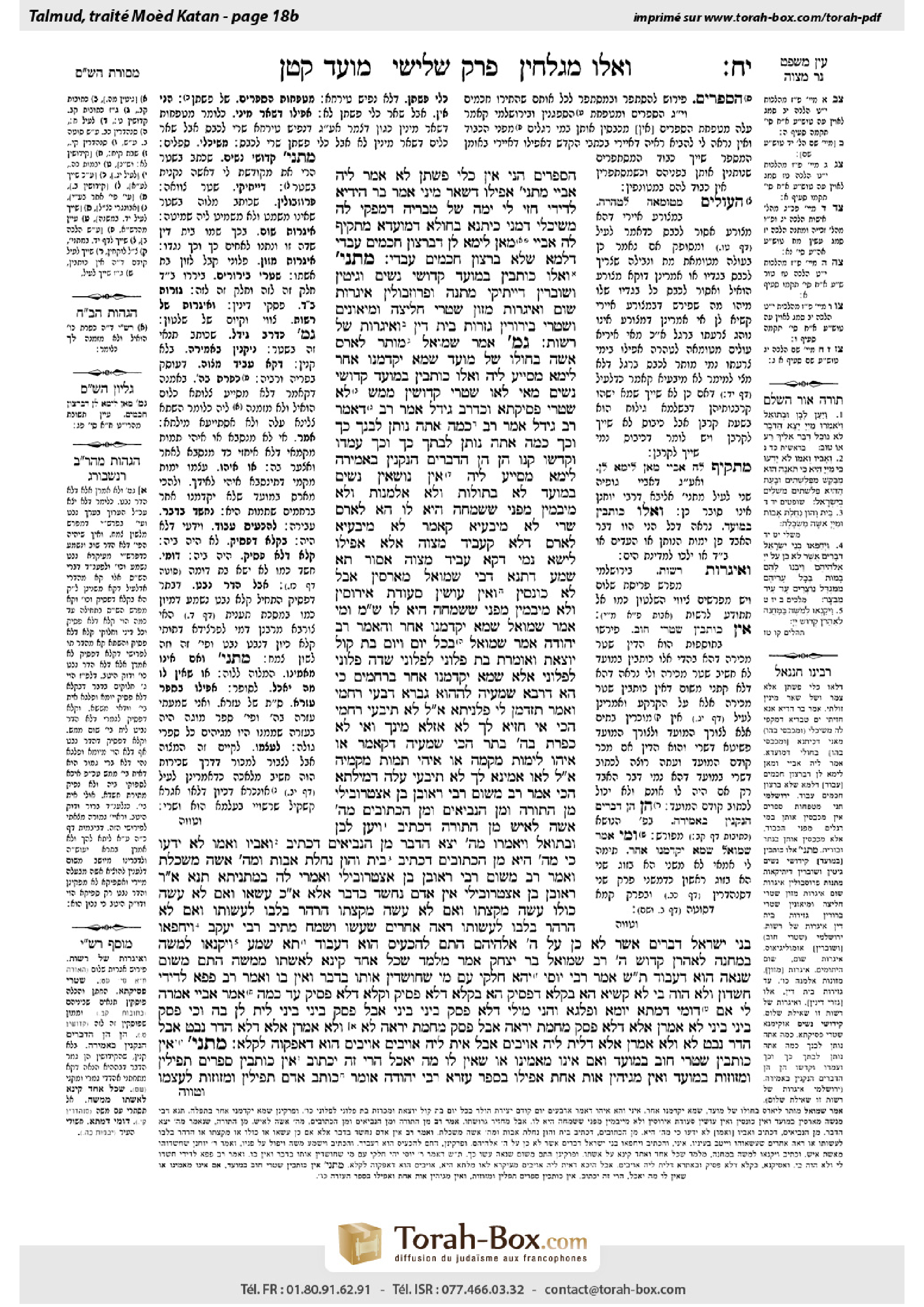
Moed Katan 18b: Talmud study for Daf Yomi
Daf Yomi is the daily study of one Talmud folio. Explore 37 tractates with scans, Hebrew text, Sefaria English and AI-generated French translations where annotated.
Passage selection and English or AI-generated French translation are available where the scan has annotations. Daf Study is independent of Torah-Box and Sefaria.
Browse Moed Katan · מועד קטן · All tractatesMoed Katan 18b text and translations
This page of Moed Katan includes the Aramaic text, an English translation and an AI-generated French translation, alongside the scan above.
מועד קטן י״ח ב · Aramaic and Hebrew text
הַסַּפָּרִים. הָנֵי — אִין, כְּלֵי פִשְׁתָּן — לָא.
אֲמַר לֵיהּ אַבָּיֵי: מַתְנִיתִין אֲפִילּוּ דִּשְׁאָר מִינֵי. אָמַר בַּר הִידְיָא: לְדִידִי חֲזֵי לִי יַמָּהּ שֶׁל טְבֶרְיָה, דְּמַפְּקִי לַהּ מְשִׁיכְלֵי דְּמָנֵי כִּיתָּנָא בְּחוּלָּא דְמוֹעֲדָא.
מַתְקֵיף לַהּ אַבָּיֵי: מַאן לֵימָא לַן דִּבְרָצוֹן חֲכָמִים עָבְדִי, דִּלְמָא שֶׁלֹּא בִּרְצוֹן חֲכָמִים עָבְדִי.
מַתְנִי׳ וְאֵלּוּ כּוֹתְבִין בַּמּוֹעֵד: קִדּוּשֵׁי נָשִׁים וְגִיטִּין וְשׁוֹבָרִין. דְּיָיתֵיקֵי, מַתָּנָה וּפְרוֹזְבּוּלִין. אִיגְּרוֹת שׁוּם וְאִיגְּרוֹת מָזוֹן.
שְׁטָרֵי חֲלִיצָה וּמֵיאוּנִים וּשְׁטָרֵי בֵירוּרִין. גְּזֵרוֹת בֵּית דִּין וְאִיגְּרוֹת שֶׁל רְשׁוּת.
גְּמָ׳ אָמַר שְׁמוּאֵל: מוּתָּר לְאָרֵס אִשָּׁה בְּחוּלּוֹ שֶׁל מוֹעֵד, שֶׁמָּא יִקְדְּמֶנּוּ אַחֵר. לֵימָא מְסַיַּיע לֵיהּ: וְאֵלּוּ כּוֹתְבִין בַּמּוֹעֵד — קִדּוּשֵׁי נָשִׁים,
מַאי לָאו שְׁטָרֵי קִדּוּשִׁין מַמָּשׁ? לָא, שְׁטָרֵי פְסִיקָתָא, וְכִדְרַב גִּידֵּל אָמַר רַב.
דְּאָמַר רַב גִּידֵּל אָמַר רַב: כַּמָּה אַתָּה נוֹתֵן לְבִנְךָ? כָּךְ וְכָךְ. כַּמָּה אַתָּה נוֹתֵן לְבִתְּךָ? כָּךְ וְכָךְ. עָמְדוּ וְקִדְּשׁוּ קָנוּ, הֵן הֵן הַדְּבָרִים הַנִּקְנִין בַּאֲמִירָה.
לֵימָא מְסַיַּיע לֵיהּ: אֵין נוֹשְׂאִין נָשִׁים בַּמּוֹעֵד, לֹא בְּתוּלוֹת וְלֹא אַלְמָנוֹת. וְלֹא מְיַבְּמִין, מִפְּנֵי שֶׁשִּׂמְחָה הִיא לוֹ. הָא לְאָרֵס — שָׁרֵי.
לָא מִיבַּעְיָא קָאָמַר. לָא מִיבַּעְיָא לְאָרֵס — דְּלָא קָעָבֵיד מִצְוָה, אֶלָּא אֲפִילּוּ לִישָּׂא נָמֵי, דְּקָא עָבֵיד מִצְוָה, אָסוּר.
תָּא שְׁמַע, דְּתָנָא דְּבֵי שְׁמוּאֵל: מְאָרְסִין, אֲבָל לֹא כּוֹנְסִין. וְאֵין עוֹשִׂין סְעוּדַת אֵירוּסִין, וְלֹא מְיַבְּמִין, מִפְּנֵי שֶׁשִּׂמְחָה הִיא לוֹ. שְׁמַע מִינַּהּ.
וּמִי אָמַר שְׁמוּאֵל שֶׁמָּא יִקְדְּמֶנּוּ אַחֵר? וְהָאָמַר רַב יְהוּדָה אָמַר שְׁמוּאֵל: בְּכׇל יוֹם וְיוֹם בַּת קוֹל יוֹצֵאת וְאוֹמֶרֶת: בַּת פְּלוֹנִי לִפְלוֹנִי, שְׂדֵה פְלוֹנִי לִפְלוֹנִי.
אֶלָּא: שֶׁמָּא יִקְדְּמֶנּוּ אַחֵר בְּרַחֲמִים.
כִּי הָא דְּרָבָא שַׁמְעֵיהּ לְהָהוּא גַּבְרָא דְּבָעֵי רַחֲמֵי וְאָמַר: תִּזְדְּמֵן לִי פְּלָנִיתָא. אֲמַר לֵיהּ: לָא תִּיבְעֵי רַחֲמֵי הָכִי. אִי חַזְיָא לָךְ — לָא אָזְלָא מִינָּךְ, וְאִי לָא — כָּפְרַתְּ בַּה׳. בָּתַר הָכִי, שַׁמְעֵיהּ דְּקָאָמַר: אוֹ אִיהוּ לֵימוּת מִקַּמַּהּ, אוֹ אִיהִי תְּמוּת מִקַּמֵּיהּ. אֲמַר לֵיהּ: לָאו אָמֵינָא לָךְ לָא תִּיבְעֵי עֲלַהּ דְּמִילְּתָא?
הָכִי אָמַר רַב מִשּׁוּם רַבִּי רְאוּבֵן בֶּן אִצְטְרוֹבִילִי: מִן הַתּוֹרָה וּמִן הַנְּבִיאִים וּמִן הַכְּתוּבִים — מֵה׳ אִשָּׁה לְאִישׁ. מִן הַתּוֹרָה, דִּכְתִיב: ״וַיַּעַן לָבָן וּבְתוּאֵל וַיֹּאמְרוּ מֵה׳ יָצָא הַדָּבָר״. מִן הַנְּבִיאִים, דִּכְתִיב: ״וְאָבִיו וְאִמּוֹ לֹא יָדְעוּ כִּי מֵה׳ הִיא״. מִן הַכְּתוּבִים, דִּכְתִיב: ״בַּיִת וָהוֹן נַחֲלַת אָבוֹת וּמֵה׳ אִשָּׁה מַשְׂכָּלֶת״.
וְאָמַר רַב מִשּׁוּם רַבִּי רְאוּבֵן בֶּן אִצְטְרוֹבִילִי, וְאָמְרִי לַהּ בְּמַתְנִיתָא תָּנָא, אָמַר רַבִּי רְאוּבֵן בֶּן אִצְטְרוֹבִילִי: אֵין אָדָם נֶחְשָׁד בְּדָבָר אֶלָּא אִם כֵּן עֲשָׂאוֹ, וְאִם לֹא עָשָׂה כּוּלּוֹ — עָשָׂה מִקְצָתוֹ, וְאִם לֹא עָשָׂה מִקְצָתוֹ — הִרְהֵר בְּלִבּוֹ לַעֲשׂוֹתוֹ, וְאִם לֹא הִרְהֵר בְּלִבּוֹ לַעֲשׂוֹתוֹ — רָאָה אֲחֵרִים שֶׁעָשׂוּ וְשָׂמַח.
מֵתִיב רַבִּי יַעֲקֹב: ״וַיְחַפְּאוּ בְנֵי יִשְׂרָאֵל דְּבָרִים אֲשֶׁר לֹא כֵן עַל ה׳ אֱלֹהֵיהֶם״! הָתָם לְהַכְעִיס הוּא דַּעֲבוּד.
תָּא שְׁמַע: ״וַיְקַנְאוּ לְמֹשֶׁה בַּמַּחֲנֶה לְאַהֲרֹן קְדוֹשׁ ה׳״, רַב שְׁמוּאֵל בַּר יִצְחָק אָמַר: מְלַמֵּד שֶׁכׇּל אֶחָד קִינֵּא לְאִשְׁתּוֹ מִמֹּשֶׁה! הָתָם מִשּׁוּם שִׂנְאָה הוּא דַּעֲבוּד.
תָּא שְׁמַע, אָמַר רַבִּי יוֹסֵי: יְהֵא חֶלְקִי עִם מִי שֶׁחוֹשְׁדִין אוֹתוֹ בְּדָבָר וְאֵין בּוֹ. וְאָמַר רַב פָּפָּא: לְדִידִי חַשְׁדוּן וְלָא הֲוָה בִּי!
לָא קַשְׁיָא: הָא בְּקָלָא דְּפָסֵיק, הָא בְּקָלָא דְלָא פָּסֵיק. וְקָלָא דְלָא פָּסֵיק עַד כַּמָּה? אָמַר אַבָּיֵי, אֲמַרָה לִי אֵם: דּוֹמֵי דְמָתָא יוֹמָא וּפַלְגָא.
וְהָנֵי מִילֵּי דְּלָא פְּסַק בֵּינֵי בֵּינֵי, אֲבָל פְּסַק בֵּינֵי בֵּינֵי — לֵית לַן בַּהּ. וְכִי פְּסַק בֵּינֵי בֵּינֵי, לָא אֲמַרַן אֶלָּא דְּלָא פְּסַק מֵחֲמַת יִרְאָה, אֲבָל פְּסַק מֵחֲמַת יִרְאָה — לָא.
וְלָא אֲמַרַן, אֶלָּא דְּלָא הָדַר נָבֵט, אֲבָל הָדַר נָבֵט — לָא. וְלָא אֲמַרַן אֶלָּא דְּלֵית לֵיהּ אוֹיְבִים, אֲבָל אִית לֵיהּ אוֹיְבִים — אוֹיְבִים הוּא דְּאַפְּקוּהּ לְקָלָא.
מַתְנִי׳ אֵין כּוֹתְבִין שְׁטָרֵי חוֹב בַּמּוֹעֵד. וְאִם אֵינוֹ מַאֲמִינוֹ, אוֹ שֶׁאֵין לוֹ מַה יֹּאכַל — הֲרֵי זֶה יִכְתּוֹב.
אֵין כּוֹתְבִין סְפָרִים תְּפִילִּין וּמְזוּזוֹת בַּמּוֹעֵד, וְאֵין מַגִּיהִין אוֹת אַחַת אֲפִילּוּ בְּסֵפֶר עֶזְרָא. רַבִּי יְהוּדָה אוֹמֵר: כּוֹתֵב אָדָם תְּפִילִּין וּמְזוּזוֹת לְעַצְמוֹ,
Moed Katan 18b · English translation
of barbers that are used to cover a person having a haircut, and body-drying towels may all be laundered on the intermediate days of a Festival. This statement implies that these garments, yes, they may be laundered, but other types of linen garments, no, they may not be laundered.
Abaye said to him: This is not a contradiction: The mishna is referring to garments made even of other types of materials; linen garments, however, may be laundered even when they serve other purposes. Bar Hedya said: I myself saw the Sea of Tiberias, the Sea of Galilee, to which basins full of linen garments were brought out to be laundered during the intermediate days of a Festival.
Abaye strongly objects to this: This report cannot be adduced as proof for the halakha, for who says to us that they did this in accordance with the will of the Sages? Perhaps they did it without the will of the Sages.
MISHNA: And these are the documents that may be written on the intermediate days of a Festival: Documents of betrothal of wives, through which bridegrooms betroth their brides; bills of divorce; receipts for the repayment of debts; wills [deyateiki]; deeds of gift; perozbolin, documents through which lenders authorize the courts to collect their loans on their behalf, thereby preventing the Sabbatical year from canceling their debts; letters of valuation, which were drawn up by the court when they valuated property and transferred it to the lender; and letters of sustenance, which were drawn up when one accepted upon himself to maintain another, e.g., his step-daughter.
The list continues: Documents of the ritual through which the brother-in-law frees the yevama of her levirate bonds [ḥalitza], thereby freeing her from the obligation to marry one of her deceased husband’s brothers; documents in which the court records the refusal of a girl upon reaching majority to remain married to the man to whom her mother or brothers married her as a minor after the death of her father; documents of arbitration, in which the court summarizes a conflict that had been resolved through arbitration; court rulings; and the official correspondence of the ruling authorities.
GEMARA: Shmuel said: It is permitted to betroth a woman on the intermediate days of a Festival, lest another come and betroth her first. The Gemara asks: Let us say that the mishna supports Shmuel, who said: And these are the documents that may be drawn up on the intermediate days of a Festival: Documents of betrothal.
What, is the mishna not referring to actual documents of betrothal, through which one would actually betroth a woman? The Gemara rejects this: No, the mishna is referring to documents of stipulation recording the amounts that the parents agree to pay as the dowry of their respective son or daughter, in accordance with what Rav Giddel said that Rav said.
For Rav Giddel said that Rav said: When two families negotiate the terms of marriage for their respective children, and one side says to the other: How much do you give to your son as a dowry? And the second side says: I give such and such amount; how much do you give to your daughter? And the first side responds: Such and such amount, then, once the bride and groom arose and pronounced the betrothal formula, then all of these obligations are acquired and therefore binding. These are among the things that are acquired through words alone. In other words, there is no need to perform an additional act of acquisition in order to confirm the agreement, and the mishna is referring to a document recording such an agreement. Although such a document may be drawn up even on the intermediate days of a Festival, this does not mean that one may actually betroth a woman during this period.
The Gemara asks: Let us say that the following mishna supports Shmuel: One may not marry a woman on the intermediate days of a Festival, neither a virgin nor a widow; nor may one then perform levirate marriage with his sister-in-law, if his brother died childless, because that would be a joyous occasion for him. This statement implies that it is only marrying that is prohibited, but betrothing is permitted.
The Gemara rejects this argument: This is not the correct way to understand the mishna, as it is speaking in the style of: Needless to say. It is needless to say that betrothal is not permitted, because the groom does not perform a mitzva through betrothal. Rather, the same is true even of marriage, through which one performs a mitzva, as marriage is preparation for fulfilling the mitzva of procreation. It is still not permitted.
The Gemara offers another support for Shmuel: Come and hear that which a Sage of the school of Shmuel taught in the following baraita: One may betroth a woman on the intermediate days of a Festival, but he may not marry her, nor may he make a betrothal feast, nor may he perform levirate marriage, because that would be a joyous occasion for him, and one may not mix the joy of a wedding with the joy of the Festival. The Gemara concludes: Learn from this a support for Shmuel’s opinion.
The Gemara raises a question about the ruling itself: And did Shmuel actually say that we are concerned that perhaps another man will come and betroth the woman first? But didn’t Rav Yehuda say that Shmuel said: Every day a Divine Voice issues forth and says: The daughter of so-and-so is destined to be the wife of so-and-so; the field of so-and-so will belong to so-and-so? If this is the case, why should one be concerned lest another betroth her first? It is predestined that he will marry his designated mate.
Rather, Shmuel’s statement should be understood as follows: Perhaps another man will come and betroth her first by means of praying for divine mercy. In other words, Shmuel is concerned that the rival may beseech God to cancel the decree of the Divine Voice, and therefore the first man needs to hurry and betroth the woman before the other one has a chance to pray that he should take her from him.
This is like this incident, in which Rava heard a certain man asking for mercy, i.e., praying, who said: Grant me so-and-so as a wife. Rava said to him: Do not pray and ask for mercy in this way. If she is fit for you, and it has been decreed that she will be your wife, she will not go away from you. And if she is not destined to be your wife, you will come to deny the Lord when you see that your prayer is not answered. After the man married this woman, Rava heard him say in prayer: Please either let him die before her or let her die before him. He was speaking about himself and his wife because he had grown to hate her so much. Rava said to him: Did I not say to you not to pray for this matter?
Rav said in the name of Rabbi Reuven ben Itzterobili as follows: From the Torah, and from the Prophets, and from the Writings; it implies that the decree that a specific woman is destined to be married to a specific man is from God. From where is this derived? It is from the Torah, as it is written: “Then Laban and Bethuel answered and said: The thing comes from the Lord, we cannot speak to you either bad or good” (Genesis 24:50). From the Prophets, as it is written: “But his father and his mother knew not that it was of the Lord” (Judges 14:4). From the Writings, as it is written: “House and riches are the inheritance of fathers; but a prudent woman is from the Lord” (Proverbs 19:14).
§ Apropos a teaching of Rabbi Reuven ben Itzterobili, the Gemara states that Rav said in the name of Rabbi Reuven ben Itzterobili, and some say that it was taught in a baraita that Rabbi Reuven ben Itzterobili said: A man is suspected of having done something wrong only if he has indeed done so. And if he did not do it wholly, then probably he did it partly. And if he did not do it even partly, then probably he thought in his heart to do it. And if he did not even think to himself to do it, then certainly he saw others doing it and was happy. Suspicions do not arbitrarily arise about a person; therefore there is certainly some basis for them.
Rabbi Ya’akov raised an objection: Does the verse not say: “And the children of Israel fabricated matters that were not right against the Lord their God” (II Kings 17:9), which indicates that it is possible to make up stories about someone else even though they are entirely baseless. The Gemara answers: There they did it in order to anger God, but they did not actually think that what they were saying was true.
Come and hear a challenge from a different source: The verse states: “And they were jealous of Moses in the camp, of Aaron the Lord’s holy one” (Psalms 106:16). Rav Shmuel bar Yitzḥak said: This verse teaches that every man warned his wife against seclusion with Moses because he was jealous. This implies that every man thought that his wife had secluded herself with Moses and sinned, although this was certainly not the case. This demonstrates that it is possible to suspect an absolutely innocent person. The Gemara answers: There they did it out of hatred for Moses. They did not actually suspect him of wrongdoing. Instead, their goal was to degrade him by leveling these false accusations against him.
The Gemara raises another challenge, based on yet another source: Come and hear that which Rabbi Yosei said: May my portion in the future world be with one who is suspected of a certain wrongdoing but is innocent, as the pain that such a person experiences atones for his sins. This statement also appears to imply that it is possible to suspect an absolutely innocent person. And Rav Pappa said: They suspected me of a certain wrongdoing but I was not guilty.
The Gemara answers: It is not difficult. This is referring to a rumor that stops, and therefore it is possible that it is groundless, whereas that is referring to a rumor that does not stop, and in that case there must be a factual basis for the suspicion. The Gemara asks: To be considered a rumor that does not stop, for how long must it persist? Abaye said: My nurse told me: Local gossip lasts for a day and a half, and then it is deemed to be a rumor that does not stop.
The Gemara comments: This applies only if the rumor did not stop in between, during the day and a half, but if it stopped in between then we have no problem with it, and it is not a persistent rumor. And if the rumor stopped in between, we said that it is considered baseless only if it stopped of its own accord and not out of fear, i.e., because the suspect is violent and therefore people are afraid to speak badly about him. But if the rumor stopped out of fear, then this dispensation does not apply, and it is still assumed that there must be some basis to the rumor.
And we said that a rumor that stopped is assumed to be baseless only if it did not arise again. But if it arose again, then this does not apply. And we said that a rumor that does not stop must be taken seriously only if the slandered person has no enemies. But if he has known enemies, then it can be assumed that it was the enemies who disseminated the rumor.
MISHNA: One may not write bills of debt on the intermediate days of a Festival. But if the lender does not trust the borrower, and he is concerned that the borrower will later deny the loan, or if the scribe has nothing to eat, then he may write a bill of debt during the Festival week.
One may not write Torah scrolls, phylacteries, or mezuzot on the intermediate days of a Festival, nor may one correct a single letter, even in the Torah scroll of Ezra, which was kept in the Temple and upon which all the Jewish communities relied. Rabbi Yehuda says: One may write phylacteries and mezuzot for himself on the intermediate days of a Festival if he needs them.
Moed Katan 18b · Traduction française (IA)
Les linges de barbier utilisés pour couvrir une personne qui se fait couper les cheveux, ainsi que les serviettes servant à sécher le corps, peuvent tous être lavés pendant les jours intermédiaires d’une fête. Cette déclaration implique que ces linges-là peuvent être lavés, mais que les autres types de linges, non.
Abayé lui dit : Il n’y a pas là de contradiction. La Michna parle de vêtements faits même d’autres matières ; les vêtements en lin, en revanche, peuvent être lavés même lorsqu’ils servent à d’autres usages. Bar Hedya dit : J’ai moi-même vu le lac de Tibériade, la mer de Galilée, où l’on apportait des bassines pleines de vêtements en lin pour les laver pendant les jours intermédiaires d’une fête.
Abayé objecte vivement : Ce témoignage ne peut pas être invoqué comme preuve de la halakha, car qui nous dit qu’ils ont agi conformément à la volonté des Sages ? Peut-être l’ont-ils fait sans l’autorisation des Sages.
MICHNA : Voici les documents qu’il est permis de rédiger pendant les jours intermédiaires d’une fête : les actes de fiançailles, par lesquels les fiancés se fiancent à leurs promises ; les actes de divorce ; les quittances de remboursement de dettes ; les testaments [deyateiki] ; les actes de donation ; les perozbolin, documents par lesquels les prêteurs habilitent les tribunaux à recouvrer leurs prêts en leur nom, empêchant ainsi l’année sabbatique d’annuler leurs dettes ; les actes d’évaluation, établis par le tribunal lorsqu’il évaluait un bien et le transférait au prêteur ; et les actes d’entretien, établis lorsqu’une personne s’engageait à entretenir une autre, par exemple sa belle-fille.
La liste se poursuit : les documents de la cérémonie par laquelle le beau-frère libère la yevama de ses liens de lévirat [ḥalitza], la dégageant ainsi de l’obligation d’épouser l’un des frères de son défunt mari ; les documents dans lesquels le tribunal consigne le refus d’une jeune fille, lorsqu’elle atteint la majorité, de rester mariée à l’homme auquel sa mère ou ses frères l’avaient mariée alors qu’elle était mineure, après la mort de son père ; les actes d’arbitrage, dans lesquels le tribunal résume un différend réglé par arbitrage ; les décisions de justice ; et la correspondance officielle des autorités dirigeantes.
GUEMARA : Chmouel dit : Il est permis de se fiancer avec une femme pendant les jours intermédiaires d’une fête, de peur qu’un autre ne vienne se fiancer avec elle avant lui. La Guemara demande : Peut-on dire que la Michna appuie Chmouel, qui a dit : « Voici les documents qu’il est permis de rédiger pendant les jours intermédiaires d’une fête : les actes de fiançailles » ?
La Michna parle-t-elle d’actes de fiançailles proprement dits, par lesquels on se fiancerait effectivement avec une femme ? La Guemara rejette cette interprétation : Non, la Michna parle de documents de stipulation consignant les sommes que les parents conviennent de verser comme dot pour leur fils ou leur fille, conformément à ce que Rav Giddel a dit au nom de Rav.
Car Rav Giddel a dit au nom de Rav : Lorsque deux familles négocient les conditions du mariage de leurs enfants respectifs, l’une demande à l’autre : « Quelle somme donnez-vous à votre fils comme dot ? » L’autre répond : « Telle et telle somme. » Puis elle demande : « Quelle somme donnez-vous à votre fille ? » La première répond : « Telle et telle somme. » Dès lors que les futurs mariés se sont levés et ont prononcé la formule des fiançailles, toutes ces obligations sont acquises et deviennent donc contraignantes. Ce sont là des choses qui s’acquièrent par les seules paroles. Autrement dit, aucun acte d’acquisition supplémentaire n’est nécessaire pour confirmer l’accord, et la Michna parle d’un document consignant un tel accord. Bien qu’un tel document puisse être rédigé même pendant les jours intermédiaires d’une fête, cela ne signifie pas qu’il soit permis de se fiancer effectivement avec une femme durant cette période.
La Guemara demande : Peut-on dire que la Michna suivante appuie Chmouel ? Il est interdit d’épouser une femme pendant les jours intermédiaires d’une fête, qu’elle soit vierge ou veuve ; il est également interdit d’accomplir alors le mariage léviratique avec sa belle-sœur, si son frère est mort sans enfant, car ce serait pour lui une occasion de réjouissance. Cette déclaration implique que seul le mariage est interdit, mais que les fiançailles sont permises.
La Guemara rejette cet argument : Il ne faut pas comprendre la Michna ainsi, car elle s’exprime selon le principe du « à plus forte raison ». Il va sans dire que les fiançailles ne sont pas permises, puisque le fiancé n’accomplit pas de mitsva en se fiançant. Il en va de même, à plus forte raison, pour le mariage, par lequel on accomplit une mitsva, car le mariage prépare à l’accomplissement de la mitsva de procréation. Cela reste néanmoins interdit.
La Guemara apporte un autre appui à l’avis de Chmouel : Écoute ce qu’un Sage de l’école de Chmouel a enseigné dans la baraïta suivante : Il est permis de se fiancer avec une femme pendant les jours intermédiaires d’une fête, mais il est interdit de l’épouser, de donner un festin de fiançailles ou d’accomplir un mariage léviratique, car ce serait pour lui une occasion de réjouissance, et l’on ne doit pas mêler la joie d’un mariage à celle de la fête. La Guemara conclut : On peut en déduire que l’avis de Chmouel est confirmé.
La Guemara soulève une question au sujet de la décision elle-même : Chmouel a-t-il vraiment dit que l’on craint qu’un autre homme ne vienne se fiancer avec la femme avant lui ? Rav Yehouda n’a-t-il pas dit au nom de Chmouel : « Chaque jour, une Voix céleste proclame : “La fille d’Untel est destinée à être l’épouse d’Untel ; le champ d’Untel appartiendra à Untel” » ? Si tel est le cas, pourquoi craindre qu’un autre ne se fiance avec elle avant lui ? Il est prédestiné à épouser celle qui lui est destinée.
Il faut plutôt comprendre ainsi la déclaration de Chmouel : Peut-être un autre homme viendra-t-il se fiancer avec elle avant lui en implorant la miséricorde divine. Autrement dit, Chmouel craint que son rival ne supplie Dieu d’annuler le décret de la Voix céleste. Le premier homme doit donc se hâter de se fiancer avec la femme avant que l’autre n’ait l’occasion de prier pour qu’elle lui soit attribuée.
Cela rappelle cet incident : Rava entendit un homme implorer la miséricorde divine, c’est-à-dire prier, en disant : « Accorde-moi Untelle pour épouse. » Rava lui dit : « Ne prie pas et n’implore pas la miséricorde divine de cette façon. Si elle te convient et qu’il a été décrété qu’elle sera ton épouse, elle ne te sera pas retirée. Et si elle ne t’est pas destinée, tu en viendras à renier le Seigneur lorsque tu verras que ta prière n’est pas exaucée. » Après que cet homme eut épousé cette femme, Rava l’entendit prier ainsi : « Je t’en prie, fais qu’il meure avant elle, ou qu’elle meure avant lui. » Il parlait de lui-même et de sa femme, car il en était venu à la haïr profondément. Rava lui dit : « Ne t’avais-je pas dit de ne pas prier à ce sujet ? »
Rav dit au nom de Rabbi Reuven ben Itzterobili : La Torah, les Prophètes et les Écrits indiquent que le décret selon lequel une femme précise est destinée à épouser un homme précis vient de Dieu. D’où le déduit-on ? De la Torah, comme il est écrit : « Alors Laban et Bethouel répondirent et dirent : “La chose vient du Seigneur ; nous ne pouvons te dire ni du mal ni du bien” » (Genèse 24:50). Des Prophètes, comme il est écrit : « Mais son père et sa mère ne savaient pas que cela venait du Seigneur » (Juges 14:4). Des Écrits, comme il est écrit : « Une maison et des richesses sont l’héritage des pères ; mais une femme avisée vient du Seigneur » (Proverbes 19:14).
§ À propos d’un enseignement de Rabbi Reuven ben Itzterobili, la Guemara rapporte que Rav a dit au nom de Rabbi Reuven ben Itzterobili ; certains disent qu’une baraïta enseignait que Rabbi Reuven ben Itzterobili a dit : On ne soupçonne un homme d’avoir commis une faute que s’il l’a effectivement commise. S’il ne l’a pas commise entièrement, il l’a probablement commise en partie. S’il ne l’a même pas commise en partie, il a probablement pensé en son cœur à la commettre. Et s’il n’a même pas pensé à la commettre, il a certainement vu d’autres la commettre et s’en est réjoui. Les soupçons ne naissent pas arbitrairement à propos d’une personne ; ils ont donc nécessairement un fondement.
Rabbi Yaakov objecta : Le verset ne dit-il pas : « Les enfants d’Israël inventèrent contre le Seigneur leur Dieu des choses qui n’étaient pas justes » (II Rois 17:9), ce qui indique qu’il est possible d’inventer des histoires au sujet d’autrui alors qu’elles sont entièrement sans fondement ? La Guemara répond : Ils agirent ainsi pour irriter Dieu, mais ils ne pensaient pas réellement que ce qu’ils disaient était vrai.
Écoute une objection tirée d’une autre source : Le verset dit : « Ils furent jaloux de Moïse dans le camp, et d’Aaron, le saint du Seigneur » (Psaumes 106:16). Rav Chmouel bar Yitzḥak dit : Ce verset enseigne que chaque homme avertissait sa femme de ne pas s’isoler avec Moïse, par jalousie. Cela implique que chaque homme pensait que sa femme s’était isolée avec Moïse et avait péché, alors que ce n’était certainement pas le cas. Cela montre qu’il est possible de soupçonner une personne absolument innocente. La Guemara répond : Ils agirent ainsi par haine de Moïse. En réalité, ils ne le soupçonnaient pas d’une faute. Ils cherchaient plutôt à le rabaisser en portant contre lui ces fausses accusations.
La Guemara soulève une autre objection, fondée sur une autre source : Écoute ce que Rabbi Yossé a dit : « Que ma part dans le monde futur soit avec celui qui est soupçonné d’une faute précise mais qui est innocent, car la souffrance qu’il éprouve expie ses péchés. » Cette déclaration semble également indiquer qu’il est possible de soupçonner une personne absolument innocente. Et Rav Pappa a dit : « On m’a soupçonné d’une faute précise, mais je n’en étais pas coupable. »
La Guemara répond : Il n’y a pas de difficulté. Ici, il s’agit d’une rumeur qui s’éteint, et elle peut donc être sans fondement ; là, il s’agit d’une rumeur qui ne s’éteint pas, auquel cas le soupçon doit nécessairement avoir un fondement factuel. La Guemara demande : Combien de temps une rumeur doit-elle persister pour être considérée comme une rumeur qui ne s’éteint pas ? Abayé dit : Ma nourrice m’a dit que les commérages locaux durent un jour et demi ; après quoi, ils sont considérés comme une rumeur qui ne s’éteint pas.
La Guemara précise : Cela ne s’applique que si la rumeur ne s’est pas interrompue pendant ce jour et demi. Mais si elle s’est interrompue entre-temps, il n’y a pas de difficulté à ce sujet : ce n’est pas une rumeur persistante. Si la rumeur s’est interrompue entre-temps, nous ne la considérons comme sans fondement que si elle s’est éteinte d’elle-même et non par crainte, c’est-à-dire parce que le suspect est violent et que les gens ont peur de parler en mal de lui. Mais si la rumeur s’est interrompue par crainte, cette dispense ne s’applique pas, et l’on présume toujours qu’elle a un certain fondement.
Et nous avons dit qu’une rumeur qui s’est éteinte est présumée sans fondement uniquement si elle n’est pas réapparue. Mais si elle est réapparue, cela ne s’applique pas. Et nous avons dit qu’une rumeur qui ne s’éteint pas doit être prise au sérieux uniquement si la personne diffamée n’a pas d’ennemis. Mais si elle a des ennemis connus, on peut supposer que ce sont eux qui ont répandu la rumeur.
MICHNA : Il est interdit de rédiger des actes de dette pendant les jours intermédiaires d’une fête. Mais si le prêteur ne fait pas confiance à l’emprunteur et craint que celui-ci ne nie plus tard le prêt, ou si le scribe n’a rien à manger, il peut rédiger un acte de dette pendant la semaine de la fête.
Il est interdit d’écrire des rouleaux de Torah, des téfilines ou des mezouzot pendant les jours intermédiaires d’une fête ; il est également interdit d’y corriger ne serait-ce qu’une seule lettre, même dans le rouleau de la Torah d’Ezra, qui était conservé dans le Temple et sur lequel toutes les communautés juives s’appuyaient. Rabbi Yehouda dit : On peut écrire des téfilines et des mezouzot pour soi-même pendant les jours intermédiaires d’une fête si l’on en a besoin.
Traduction française générée par IA à partir de l’édition anglaise de Sefaria. Vérifie toujours un passage avec le texte source.
Text from Sefaria: William Davidson Edition - Vocalized Aramaic (CC BY NC); William Davidson Edition - English (CC BY NC).