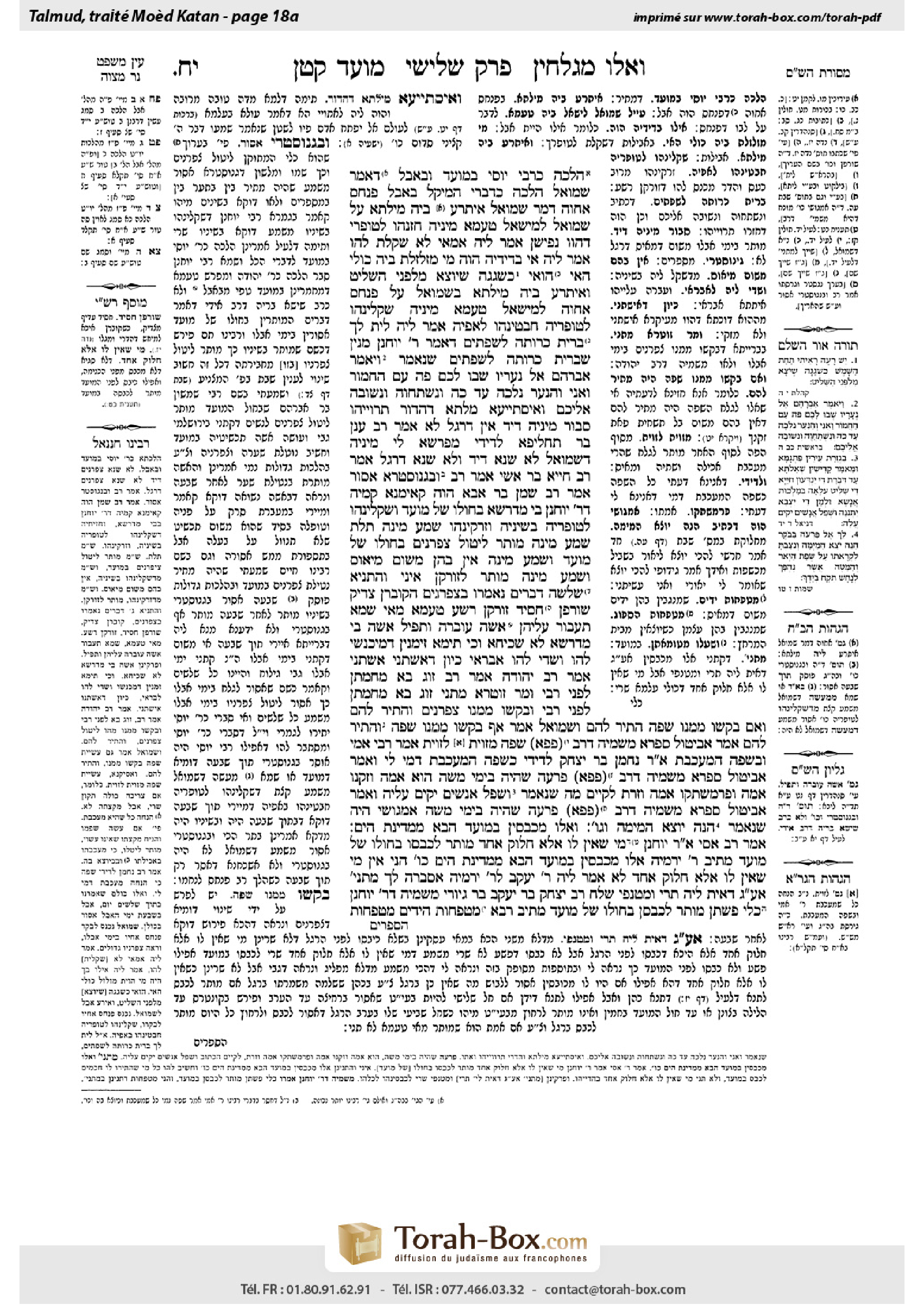
Moed Katan 18a: Talmud study for Daf Yomi
Daf Yomi is the daily study of one Talmud folio. Explore 37 tractates with scans, Hebrew text, Sefaria English and AI-generated French translations where annotated.
Passage selection and English or AI-generated French translation are available where the scan has annotations. Daf Study is independent of Torah-Box and Sefaria.
Browse Moed Katan · מועד קטן · All tractatesMoed Katan 18a text and translations
This page of Moed Katan includes the Aramaic text, an English translation and an AI-generated French translation, alongside the scan above.
מועד קטן י״ח א · Aramaic and Hebrew text
הֲלָכָה כְּרַבִּי יוֹסֵי בַּמּוֹעֵד וּבְאֵבֶל, דְּאָמַר שְׁמוּאֵל: הֲלָכָה כְּדִבְרֵי הַמֵּיקֵל בְּאֵבֶל.
פִּנְחָס אֲחוּהּ דְּמָר שְׁמוּאֵל אִיתְּרַע בֵּיהּ מִילְּתָא, עָל שְׁמוּאֵל לְמִישְׁאַל טַעְמָא מִינֵּיהּ. חֲזַנְהוּ לְטוּפְרֵי[הּ] דַּהֲווֹ נְפִישָׁן, אֲמַר לֵיהּ: אַמַּאי לָא שָׁקְלַתְּ לְהוּ? אֲמַר לֵיהּ: אִי בְּדִידֵיהּ הֲוָה, מִי מְזַלְזְלַתְּ בֵּיהּ כּוּלֵּי הַאי?
הֲוַאי ״כִּשְׁגָגָה שֶׁיֹּצָא מִלִּפְנֵי הַשַּׁלִּיט״, וְאִיתְּרַע בֵּיהּ מִילְּתָא בִּשְׁמוּאֵל. עָל פִּנְחָס אֲחוּהּ לְמִישְׁאַל טַעְמָא מִינֵּיהּ. שַׁקְלִינְהוּ לְטוּפְרֵיהּ חַבְטִינְהוּ לְאַפֵּיהּ. אֲמַר לֵיהּ: לֵית לָךָ בְּרִית כְּרוּתָה לַשְּׂפָתַיִם?
דְּאָמַר רַבִּי יוֹחָנָן: מִנַּיִן שֶׁבְּרִית כְּרוּתָה לַשְּׂפָתַיִם — שֶׁנֶּאֱמַר: ״וַיֹּאמֶר אַבְרָהָם אֶל נְעָרָיו שְׁבוּ לָכֶם פֹּה עִם הַחֲמוֹר וַאֲנִי וְהַנַּעַר נֵלְכָה עַד כֹּה וְנִשְׁתַּחֲוֶה וְנָשׁוּבָה אֲלֵיכֶם״, וְאִיסְתַּיְּיעָא מִלְּתָא דַּהֲדוּר תַּרְוַיְיהוּ.
סְבוּר מִינֵּיהּ דְּיָד — אִין, דְּרֶגֶל — לָא. אָמַר רַב עָנָן בַּר תַּחְלִיפָא: לְדִידִי מִפָּרְשָׁא לִי מִינֵּיהּ דִּשְׁמוּאֵל: לָא שְׁנָא דְּיָד וְלָא שְׁנָא דְּרֶגֶל.
אָמַר רַב חִיָּיא בַּר אָשֵׁי אָמַר רַב: וּבִגְנוּסְטְרָא — אָסוּר. אָמַר רַב שֶׁמֶן בַּר אַבָּא: הֲוָה קָאֵימְנָא קַמֵּיהּ דְּרַבִּי יוֹחָנָן בֵּי מִדְרְשָׁא בְּחוּלּוֹ שֶׁל מוֹעֵד, וְשַׁקְלִינְהוּ לְטוּפְרֵיהּ בְּשִׁינֵּיהּ וְזַרְקִינְהוּ.
שְׁמַע מִינַּהּ תְּלָת. שְׁמַע מִינַּהּ: מוּתָּר לִיטּוֹל צִפׇּרְנַיִם בְּחוּלּוֹ שֶׁל מוֹעֵד, וּשְׁמַע מִינַּהּ: אֵין בָּהֶן מִשּׁוּם מִיאוּס, וּשְׁמַע מִינַּהּ: מוּתָּר לְזוֹרְקָן.
אִינִי? וְהָתַנְיָא, שְׁלֹשָׁה דְּבָרִים נֶאֶמְרוּ בַּצִּפׇּרְנַיִם: הַקּוֹבְרָן — צַדִּיק, שׂוֹרְפָן — חָסִיד, זוֹרְקָן — רָשָׁע. טַעְמָא מַאי — שֶׁמָּא תַּעֲבוֹר עֲלֵיהֶן אִשָּׁה עוּבָּרָהּ וְתַפִּיל.
אִשָּׁה בֵּי מִדְרְשָׁא לָא שְׁכִיחָא. וְכִי תֵּימָא: זִימְנִין דִּמְיכַנְּשִׁי לְהוּ וְשָׁדֵי לְהוּ אַבָּרַאי — כֵּיוָן דְּאִשְׁתַּנִּי אִשְׁתַּנִּי.
אָמַר רַב יְהוּדָה אָמַר רַב: זוּג בָּא מֵחַמָּתָן לִפְנֵי רַבִּי, וּמָר זוּטְרָא מַתְנֵי: זוּג בָּא מֵחַמָּתָן לִפְנֵי רַבִּי, וּבִקְּשׁוּ מִמֶּנּוּ צִפׇּרְנַיִם — וְהִתִּיר לָהֶם. וְאִם בִּקְּשׁוּ מִמֶּנּוּ שָׂפָה — הִתִּיר לָהֶם, וּשְׁמוּאֵל אָמַר: אַף בִּקְּשׁוּ מִמֶּנּוּ שָׂפָה, וְהִתִּיר לָהֶם.
אָמַר אֲבִיטוּל סָפְרָא מִשְּׁמֵיהּ דְּרַב פָּפָּא: שָׂפָה מִזָּוִית לְזָוִית. אָמַר רַבִּי אַמֵּי: וּבְשָׂפָה הַמְעַכֶּבֶת. אָמַר רַב נַחְמָן בַּר יִצְחָק: לְדִידִי כְּשָׂפָה הַמְעַכֶּבֶת דָּמֵי לִי.
וַאֲמַר אֲבִיטוּל סָפְרָא מִשְּׁמֵיהּ דְּרַב פָּפָּא: פַּרְעֹה שֶׁהָיָה בִּימֵי מֹשֶׁה, הוּא אַמָּה, וּזְקָנוֹ אַמָּה, וּפַרְמַשְׁתְּקוֹ אַמָּה וָזֶרֶת, לְקַיֵּים מַה שֶּׁנֶּאֱמַר: ״וּשְׁפַל אֲנָשִׁים יָקִים עָלֶיהָ״.
וַאֲמַר אֲבִיטוּל סָפְרָא מִשְּׁמֵיהּ דְּרַב פָּפָּא: פַּרְעֹה שֶׁהָיָה בִּימֵי מֹשֶׁה אַמְגּוּשִׁי הָיָה, שֶׁנֶּאֱמַר: ״הִנֵּה יוֹצֵא הַמָּיְמָה וְגוֹ׳״.
וְאֵלּוּ מְכַבְּסִין בַּמּוֹעֵד, הַבָּא מִמְּדִינַת הַיָּם. אָמַר רַב אַסִּי אָמַר רַבִּי יוֹחָנָן: מִי שֶׁאֵין לוֹ אֶלָּא חָלוּק אֶחָד — מוּתָּר לְכַבְּסוֹ בְּחוּלּוֹ שֶׁל מוֹעֵד.
מֵתִיב רַבִּי יִרְמְיָה: אֵלּוּ מְכַבְּסִין בַּמּוֹעֵד, הַבָּא מִמְּדִינַת הַיָּם כּוּ׳. הָנֵי אִין, מִי שֶׁאֵין לוֹ אֶלָּא חָלוּק אֶחָד — לָא!
אֲמַר לֵיהּ רַבִּי יַעֲקֹב לְרַבִּי יִרְמְיָה: אַסְבְּרַהּ לָךְ, מַתְנִיתִין אַף עַל גַּב דְּאִית לֵיהּ תְּרֵי וּמִטַּנְּפִי.
שְׁלַח רַב יִצְחָק בַּר יַעֲקֹב בַּר גִּיּוֹרֵי מִשְּׁמֵיהּ דְּרַבִּי יוֹחָנָן: כְּלֵי פִשְׁתָּן — מוּתָּר לְכַבְּסָן בְּחוּלּוֹ שֶׁל מוֹעֵד. מֵתִיב רָבָא: מִטְפְּחוֹת הַיָּדַיִם, מִטְפְּחוֹת
Moed Katan 18a · English translation
The halakha is in accordance with the opinion of Rabbi Yosei with regard to the intermediate days of the Festival and with regard to mourning, as Shmuel said this general principle: The halakha is in accordance with the statement of the more lenient authority in matters relating to mourning.
It was related that something unpleasant happened to Pineḥas, brother of Mar Shmuel, that is to say, one of his close relatives died. Shmuel entered to ask him the reason, i.e., to console him. He saw that Pineḥas’s nails were long, and said to him: Why do you not cut them? Pineḥas replied: If it were your relative who died, and you were in mourning, would you treat the matter so lightly and cut your nails?
Pineḥas’s words were: “Like an error that proceeds from a ruler” (Ecclesiastes 10:5). As soon as he uttered them they come true, even though he did not intend them. Shortly after Pineḥas made his comment, something unpleasant happened to Shmuel, and one of his close relatives died. Pineḥas, his brother, entered to ask him the reason, i.e., to offer words of comfort. Shmuel took his nails and cast them in Pineḥas’s face. Shmuel then said to him: Do you not know the principle that a covenant is made with the lips? In other words, do you not know that what one says influences future events?
This is as Rabbi Yoḥanan said: From where is it derived that a covenant is made with the lips, and that one’s speech has the power to change events? For it is stated: “And Abraham said to his young men: Stay here with the donkey, and I and the lad will go onward; and we will worship, and we will come back to you” (Genesis 22:5). Abraham said this even though he thought that he was going to sacrifice his son as an offering and that Isaac would not be returning, yet this had an influence and they both came back.
With regard to this halakha pertaining to a mourner cutting his nails: They initially concluded from this: With regard to the nails on his hand, yes, a mourner may cut them; but as for the nails on his foot, no, he may not cut them, because long toenails are less repulsive. Rav Anan bar Taḥlifa said: It was explained to me by Shmuel himself: It is not different if it is the nails on the hand and it is not different if it is the nails on the foot, as in both cases cutting the nails is permitted.
Rav Ḥiyya bar Ashi said that Rav said: But with scissors [genustera] specifically for nail cutting it is prohibited, i.e., the mourner should cut his nails in an alternate manner. Rav Shemen bar Abba said: I once stood before Rabbi Yoḥanan in the study hall during the intermediate days of a Festival, and he cut his nails with his teeth and threw them down.
The Gemara comments: Learn from this incident of Rabbi Yoḥanan three halakhot: Learn from this that it is permitted to cut one’s nails on the intermediate days of a Festival. And learn from this that nails have no prohibition due to the fact that they are repulsive, i.e., there is no prohibition against biting them on that basis. Inasmuch as one is prohibited from placing something repulsive in his mouth, this incident teaches that nails do not fall into this category. And also learn from this that it is permitted to throw nails away.
The Gemara asks: Is that so? But isn’t it taught in a baraita: Three things were said about nails: One who buries them in the ground is deemed righteous. One who burns them is even better, as he is considered pious. One who merely throws them away is regarded as wicked. The Gemara explains: What is the reason that it is prohibited to throw away nail clippings? This is prohibited lest a pregnant women pass over them and miscarry, for the Sages had a tradition that it is dangerous for a pregnant woman to walk over fingernails.
The Gemara answers: A woman is not usually found in the study hall, and therefore Rabbi Yoḥanan was not concerned about throwing his nail clippings there. If you say that sometimes the nails are gathered together when the floor is swept and then thrown outside where a pregnant woman may walk over them, this is not a problem. Once their place has changed the nails themselves change and are no longer harmful.
Rav Yehuda said that Rav said: A pair of Sages from Ḥamatan came before Rabbi Yehuda HaNasi. And Mar Zutra taught it without the names of Rav Yehuda and Rav, simply as: A pair of Sages from Ḥamatan came before Rabbi Yehuda HaNasi. And they asked him whether or not a mourner is permitted to cut his nails, and he permitted it to them. And had they asked him whether or not a mourner may trim his mustache, he would also have permitted it to them. And Shmuel said: They also asked him about trimming a mustache, and he permitted it to them.
Avitul the scribe said in the name of Rav Pappa: A mustache may be trimmed from one corner to the other corner of the mouth. Rabbi Ami said: One may trim only the portion of the mustache that interferes with normal eating, but one may not trim the mustache for beautification. Rav Naḥman bar Yitzḥak said: For me, my entire mustache is considered like a mustache that interferes with normal eating, as I am particularly sensitive, and so I may trim my entire mustache.
§ Having mentioned Avitul the scribe, the Gemara records other statements of his: And Avitul the scribe said in the name of Rav Pappa: The Pharaoh who lived in the days of Moses was a cubit tall, his beard was a cubit long, and his penis [parmashtako] was a cubit and a span, i.e., a cubit and the distance between the thumb and the little finger, in length, in order to fulfill what is stated: “And He sets up over it the lowest of men” (Daniel 4:14), which teaches that Pharaoh was extremely short and lowly.
Avitul the scribe also said in the name of Rav Pappa: The Pharaoh who lived in the days of Moses was a sorcerer [amgushi], as it is stated: “Behold, he goes out to the water” (Exodus 7:15). Pharaoh would regularly go out to the water in order to engage in witchcraft.
§ The mishna taught: And these people may launder their clothes on the intermediate days of a Festival: One who comes from a country overseas. Rav Asi said that Rabbi Yoḥanan said: Anyone who has only one shirt is permitted to launder it on the intermediate days of a Festival.
Rabbi Yirmeya raised an objection from what was taught in the mishna: And these people may launder their clothes on the intermediate days of a Festival: One who comes from a country overseas, and one who is released from a house of captivity, and one who comes out of prison, and one who had been ostracized and the Rabbis released him from his decree of ostracism, etc. It may be inferred: Those who are mentioned in the mishna, yes, they may launder their clothes during the intermediate days of the Festival, but one who has only one shirt may not launder it.
Rabbi Ya’akov said to Rabbi Yirmeya: I will explain it to you. The mishna is referring to those cases where one is permitted to launder his clothes even if he has two changes of garments and they are dirty. Rabbi Yoḥanan speaks about one who has only one garment, and he rules that he may launder it in all circumstances.
Rav Yitzḥak bar Ya’akov bar Giyorei sent a message in the name of Rabbi Yoḥanan: With regard to linen garments, it is permitted to launder them during the intermediate days of the Festival because they are easily soiled. Rava raised an objection from what is taught in the mishna: Hand towels, the towels
Moed Katan 18a · Traduction française (IA)
La halakha suit l’opinion de Rabbi Yosse concernant les jours intermédiaires de la fête et le deuil, car Chemouel a énoncé ce principe général : la halakha suit l’avis de l’autorité la plus indulgente en matière de deuil.
On rapporte qu’un malheur frappa Pinḥas, le frère de Mar Chemouel : l’un de ses proches parents mourut. Chemouel entra pour lui demander la raison de son chagrin, c’est-à-dire pour le consoler. Il vit que les ongles de Pinḥas étaient longs et lui dit : « Pourquoi ne les coupes-tu pas ? » Pinḥas répondit : « Si c’était ton proche qui était mort et que tu étais en deuil, prendrais-tu la chose si légèrement que tu te couperais les ongles ? »
Les paroles de Pinḥas furent : « Comme une erreur qui vient d’un dirigeant » (Ecclésiaste 10, 5). Dès qu’il les prononça, elles se réalisèrent, bien qu’il ne l’eût pas voulu. Peu après sa remarque, un malheur frappa Chemouel et l’un de ses proches parents mourut. Pinḥas, son frère, entra pour lui demander la raison de son chagrin, c’est-à-dire pour lui adresser des paroles de réconfort. Chemouel prit ses ongles et les lui jeta au visage. Il lui dit alors : « Ne connais-tu pas le principe selon lequel une alliance est conclue avec les lèvres ? » Autrement dit, ne sais-tu pas que ce que l’on dit influe sur les événements à venir ?
Cela rejoint ce que Rabbi Yoḥanan a dit : d’où apprend-on qu’une alliance est conclue avec les lèvres et que la parole a le pouvoir de modifier les événements ? Car il est dit : « Abraham dit à ses jeunes gens : “Restez ici avec l’âne ; moi et le garçon, nous irons jusque-là, nous nous prosternerons, puis nous reviendrons vers vous” » (Genèse 22, 5). Abraham dit cela alors qu’il pensait offrir son fils en sacrifice et qu’Isaac ne reviendrait pas ; pourtant, ces paroles eurent un effet et tous deux revinrent.
Concernant cette halakha relative à l’endeuillé qui se coupe les ongles, on en conclut d’abord ceci : pour les ongles des mains, oui, l’endeuillé peut les couper ; mais pour les ongles des pieds, non, il ne le peut pas, car les ongles longs des pieds sont moins répugnants. Rav Anan bar Taḥlifa dit : « Chemouel lui-même m’a expliqué que cela ne fait aucune différence qu’il s’agisse des ongles des mains ou de ceux des pieds : dans les deux cas, il est permis de les couper. »
Rav Ḥiyya bar Ashi dit au nom de Rav : Toutefois, il est interdit de les couper précisément avec des ciseaux [genustera] conçus pour couper les ongles ; l’endeuillé doit donc les couper d’une autre manière. Rav Chemen bar Abba dit : « Un jour, je me tenais devant Rabbi Yoḥanan dans la maison d’étude, pendant les jours intermédiaires d’une fête, et il se coupa les ongles avec les dents, puis les jeta. »
La Guemara commente : De cet épisode de Rabbi Yoḥanan, tire trois halakhot. Apprends qu’il est permis de se couper les ongles pendant les jours intermédiaires d’une fête. Apprends aussi que les ongles ne sont pas interdits parce qu’ils sont répugnants, c’est-à-dire qu’il n’est pas interdit de les ronger pour cette raison. Puisqu’il est interdit de mettre quelque chose de répugnant dans sa bouche, cet épisode enseigne que les ongles n’entrent pas dans cette catégorie. Apprends également qu’il est permis de jeter les ongles.
La Guemara demande : Est-ce vraiment ainsi ? N’est-il pas enseigné dans une baraïta : « Trois choses ont été dites au sujet des ongles : celui qui les enterre est considéré comme juste ; celui qui les brûle est encore meilleur, car il est considéré comme pieux ; celui qui se contente de les jeter est considéré comme méchant. » La Guemara explique : Pourquoi est-il interdit de jeter les rognures d’ongles ? C’est interdit de peur qu’une femme enceinte ne passe dessus et ne fasse une fausse couche, car les Sages avaient reçu la tradition qu’il est dangereux pour une femme enceinte de marcher sur des ongles.
La Guemara répond : Une femme ne se trouve généralement pas dans la maison d’étude ; Rabbi Yoḥanan ne craignait donc pas de jeter ses rognures d’ongles à cet endroit. Si tu dis que les ongles sont parfois rassemblés lorsqu’on balaie le sol, puis jetés dehors, là où une femme enceinte pourrait passer dessus, cela ne pose pas de problème. Dès lors que leur emplacement a changé, les ongles eux-mêmes changent et ne sont plus dangereux.
Rav Yehouda dit au nom de Rav : Deux Sages de Ḥamatan se présentèrent devant Rabbi Yehouda HaNassi. Mar Zutra transmet cette tradition sans mentionner les noms de Rav Yehouda et de Rav, simplement ainsi : deux Sages de Ḥamatan se présentèrent devant Rabbi Yehouda HaNassi. Ils lui demandèrent s’il était permis ou non à un endeuillé de se couper les ongles, et il le leur permit. S’ils lui avaient demandé s’il était permis ou non à un endeuillé de tailler sa moustache, il le leur aurait également permis. Chemouel dit : Ils l’interrogèrent aussi au sujet de la taille de la moustache, et il le leur permit.
Avitul le scribe dit au nom de Rav Pappa : On peut tailler la moustache d’un coin de la bouche à l’autre. Rabbi Ami dit : On ne peut tailler que la partie de la moustache qui gêne l’alimentation normale, mais on ne peut pas la tailler pour des raisons d’embellissement. Rav Naḥman bar Yitzḥak dit : « Pour moi, toute ma moustache est considérée comme gênant l’alimentation normale, car je suis particulièrement sensible ; je peux donc la tailler entièrement. »
§ Puisqu’Avitul le scribe a été mentionné, la Guemara rapporte d’autres paroles de lui : Avitul le scribe dit au nom de Rav Pappa : « Le Pharaon qui vivait à l’époque de Moïse mesurait une coudée, sa barbe mesurait une coudée et son pénis [parmashtako] mesurait une coudée et un empan, c’est-à-dire la distance entre le pouce et l’auriculaire, afin d’accomplir ce qui est dit : “Il établit au-dessus d’elle le plus bas des hommes” (Daniel 4, 14), ce qui enseigne que Pharaon était extrêmement petit et de basse condition. »
Avitul le scribe dit également au nom de Rav Pappa : « Le Pharaon qui vivait à l’époque de Moïse était un sorcier [amgushi], comme il est dit : “Voici, il sort vers l’eau” (Exode 7, 15). Pharaon avait l’habitude de sortir vers l’eau pour pratiquer la sorcellerie. »
§ La Michna a enseigné : « Et les personnes suivantes peuvent laver leurs vêtements pendant les jours intermédiaires d’une fête : celui qui revient d’un pays d’outre-mer. » Rav Assi dit au nom de Rabbi Yoḥanan : Toute personne qui ne possède qu’une seule chemise est autorisée à la laver pendant les jours intermédiaires d’une fête.
Rabbi Yirmeya souleva une objection à partir de ce qui est enseigné dans la Michna : « Et les personnes suivantes peuvent laver leurs vêtements pendant les jours intermédiaires d’une fête : celui qui revient d’un pays d’outre-mer, celui qui est libéré d’un lieu de captivité, celui qui sort de prison et celui qui avait été frappé d’excommunication et que les Rabbins ont relevé de son excommunication, etc. » On peut en déduire que les personnes mentionnées dans la Michna, oui, peuvent laver leurs vêtements pendant les jours intermédiaires de la fête, mais que celui qui ne possède qu’une seule chemise ne peut pas la laver.
Rabbi Ya’akov dit à Rabbi Yirmeya : « Je vais te l’expliquer. La Michna traite des cas où l’on est autorisé à laver ses vêtements même si l’on possède deux tenues de rechange et qu’elles sont sales. Rabbi Yoḥanan parle de celui qui ne possède qu’un seul vêtement et statue qu’il peut le laver dans tous les cas. »
Rav Yitzḥak bar Ya’akov bar Giyorei envoya un message au nom de Rabbi Yoḥanan : Il est permis de laver les vêtements en lin pendant les jours intermédiaires d’une fête, car ils se salissent facilement. Rava souleva une objection à partir de ce qui est enseigné dans la Michna : « Les serviettes de table, les serviettes »
Traduction française générée par IA à partir de l’édition anglaise de Sefaria. Vérifie toujours un passage avec le texte source.
Text from Sefaria: William Davidson Edition - Vocalized Aramaic (CC BY NC); William Davidson Edition - English (CC BY NC).