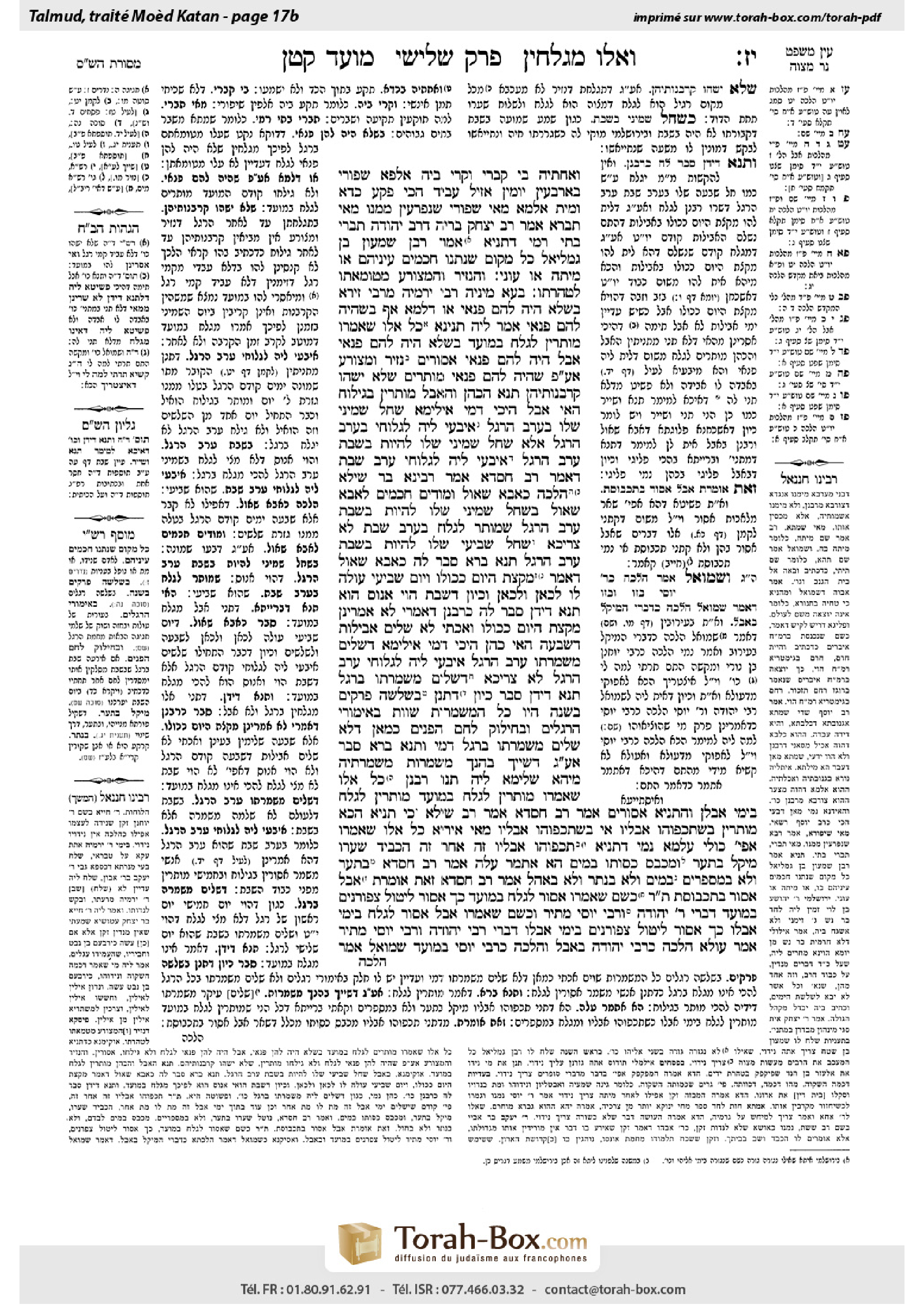
Moed Katan 17b: Talmud study for Daf Yomi
Daf Yomi is the daily study of one Talmud folio. Explore 37 tractates with scans, Hebrew text, Sefaria English and AI-generated French translations where annotated.
Passage selection and English or AI-generated French translation are available where the scan has annotations. Daf Study is independent of Torah-Box and Sefaria.
Browse Moed Katan · מועד קטן · All tractatesMoed Katan 17b text and translations
This page of Moed Katan includes the Aramaic text, an English translation and an AI-generated French translation, alongside the scan above.
מועד קטן י״ז ב · Aramaic and Hebrew text
וְאַחֲתֵיהּ בֵּי קִבְרֵי, וּקְרִי בֵּיהּ אַלְפָּא שִׁפּוּרֵי בְּאַרְבְּעִין יוֹמִין. אָזֵיל עָבֵיד הָכִי, פְּקַע כַּדָּא וּמִית אַלָּמָא. מַאי שִׁפּוּרֵי — שֶׁנִּפְרָעִין מִמֶּנּוּ.
מַאי תְּבָרָא? אָמַר רַב יִצְחָק בְּרֵיהּ דְּרַב יְהוּדָה: תָּבְרִי בָּתֵּי רָמֵי. דְּתַנְיָא, אָמַר רַבָּן שִׁמְעוֹן בֶּן גַּמְלִיאֵל: כׇּל מָקוֹם שֶׁ״נָּתְנוּ חֲכָמִים עֵינֵיהֶם״, אוֹ מִיתָה אוֹ עוֹנִי.
וְהַנָּזִיר וְהַמְּצוֹרָע מִטּוּמְאָתוֹ לְטׇהֳרָתוֹ. בְּעָא מִינֵּיהּ רַבִּי יִרְמְיָה מֵרַבִּי זֵירָא: בְּשֶׁלֹּא הָיָה לָהֶם פְּנַאי, אוֹ דִלְמָא אַף בְּשֶׁהָיָה לָהֶם פְּנַאי?
אֲמַר לֵיהּ, תְּנֵינָא: כׇּל אֵלּוּ שֶׁאָמְרוּ מוּתָּרִין לְגַלֵּחַ בַּמּוֹעֵד — בְּשֶׁלֹּא הָיָה לָהֶם פְּנַאי, אֲבָל הָיָה לָהֶם פְּנַאי — אֲסוּרִים.
נָזִיר וּמְצוֹרָע, אַף עַל פִּי שֶׁהָיָה לָהֶם פְּנַאי — מוּתָּרִים, שֶׁלֹּא יְשַׁהוּ קׇרְבְּנוֹתֵיהֶן.
תָּנָא: הַכֹּהֵן וְהָאָבֵל מוּתָּרִין בְּגִילּוּחַ. הַאי אָבֵל הֵיכִי דָמֵי? אִילֵּימָא שֶׁחָל שְׁמִינִי שֶׁלּוֹ בְּעֶרֶב הָרֶגֶל — אִיבְּעִי לֵיהּ לְגַלּוֹחֵי בָּעֶרֶב הָרֶגֶל! אֶלָּא, שֶׁחָל שְׁמִינִי שֶׁלּוֹ לִהְיוֹת בְּשַׁבָּת עֶרֶב הָרֶגֶל.
אִיבְּעִי לֵיהּ לְגַלּוֹחֵי עֶרֶב שַׁבָּת, דְּאָמַר רַב חִסְדָּא אָמַר רָבִינָא בַּר שֵׁילָא: הֲלָכָה כְּאַבָּא שָׁאוּל, וּמוֹדִים חֲכָמִים לְאַבָּא שָׁאוּל בְּשֶׁחָל שְׁמִינִי שֶׁלּוֹ לִהְיוֹת בְּשַׁבָּת עֶרֶב הָרֶגֶל שֶׁמּוּתָּר לְגַלֵּחַ בְּעֶרֶב שַׁבָּת!
לָא צְרִיכָא, שֶׁחָל שְׁבִיעִי שֶׁלּוֹ לִהְיוֹת בְּשַׁבָּת עֶרֶב הָרֶגֶל.
תַּנָּא בָּרָא סָבַר לַהּ כְּאַבָּא שָׁאוּל, דְּאָמַר: מִקְצָת הַיּוֹם כְּכוּלּוֹ, וְיוֹם שְׁבִיעִי עוֹלֶה לוֹ לְכָאן וּלְכָאן. וְכֵיוָן דְּשַׁבָּת הָוֵי — אָנוּס הוּא.
תַּנָּא דִידַן סָבַר לַהּ כְּרַבָּנַן, דְּאָמְרִי: לָא אָמְרִינַן מִקְצָת הַיּוֹם כְּכוּלּוֹ, וְאַכַּתִּי לָא שְׁלִים אֲבֵילוּת דְּשִׁבְעָה.
הַאי כֹּהֵן הֵיכִי דָּמֵי? אִילֵּימָא דִּשְׁלִים מִשְׁמַרְתּוֹ עֶרֶב הָרֶגֶל — אִיבְּעִי לֵיהּ לְגַלּוֹחֵי עֶרֶב הָרֶגֶל!
לָא צְרִיכָא, דִּשְׁלִים מִשְׁמַרְתּוֹ בָּרֶגֶל. תַּנָּא דִידַן סָבַר, כֵּיוָן דִּתְנַן: בִּשְׁלֹשָׁה פְּרָקִים בַּשָּׁנָה הָיוּ כׇּל הַמִּשְׁמָרוֹת שָׁווֹת, בְּאֵימוּרֵי הָרְגָלִים, וּבְחִילּוּק לֶחֶם הַפָּנִים — כְּמַאן דְּלָא שְׁלִים מִשְׁמַרְתּוֹ בָּרֶגֶל דָּמֵי. וְתַנָּא בָּרָא סָבַר: אַף עַל גַּב דְּשָׁיֵיךְ בְּהָנָךְ מִשְׁמָרוֹת, מִשְׁמַרְתֵּיהּ מִיהָא שְׁלִימָא לֵיהּ.
תָּנוּ רַבָּנַן: כׇּל אֵלּוּ שֶׁאָמְרוּ מוּתָּרִין לְגַלֵּחַ בַּמּוֹעֵד — מוּתָּרִין לְגַלֵּחַ בִּימֵי אֶבְלָן.
וְהָתַנְיָא: אֲסוּרִים! אָמַר רַב חִסְדָּא אָמַר רַב שֵׁילָא: כִּי תַּנְיָא הָכָא מוּתָּרִין — בְּשֶׁתְּכָפוּהוּ אֲבָלָיו.
אִי בְּשֶׁתְּכָפוּהוּ אֲבָלָיו, מַאי אִירְיָא כׇּל אֵלּוּ שֶׁאָמְרוּ, אֲפִילּוּ כּוּלֵּי עָלְמָא נָמֵי? דְּתַנְיָא: תְּכָפוּהוּ אֲבָלָיו זֶה אַחַר זֶה, הִכְבִּיד שְׂעָרוֹ — מֵיקֵל בְּתַעַר, וּמְכַבֵּס כְּסוּתוֹ בְּמַיִם.
הָא אִתְּמַר עֲלַהּ, אָמַר רַב חִסְדָּא: בְּתַעַר וְלֹא בְּמִסְפָּרַיִם, בְּמַיִם וְלֹא בְּנֶתֶר וְלֹא בְּאָהָל. אָמַר רַב חִסְדָּא: זֹאת אוֹמֶרֶת אָבֵל אָסוּר בְּתִכְבּוֹסֶת.
תָּנוּ רַבָּנַן: כְּשֵׁם שֶׁאָמְרוּ אָסוּר לְגַלֵּחַ בַּמּוֹעֵד, כָּךְ אָסוּר לִיטּוֹל צִפּוֹרְנַיִם בַּמּוֹעֵד, דִּבְרֵי רַבִּי יְהוּדָה. וְרַבִּי יוֹסֵי מַתִּיר.
וּכְשֵׁם שֶׁאָמְרוּ אָבֵל אָסוּר לְגַלֵּחַ בִּימֵי אֶבְלוֹ — כָּךְ אָסוּר לִיטּוֹל צִפּוֹרְנַיִם בִּימֵי אֶבְלוֹ, דִּבְרֵי רַבִּי יְהוּדָה. וְרַבִּי יוֹסֵי מַתִּיר.
אָמַר עוּלָּא: הֲלָכָה כְּרַבִּי יְהוּדָה בְּאֵבֶל, וַהֲלָכָה כְּרַבִּי יוֹסֵי בַּמּוֹעֵד. שְׁמוּאֵל אָמַר:
Moed Katan 17b · English translation
and set it down in a cemetery, where nobody is found, and sound a thousand, i.e., many, shofar blasts over the course of forty days. That man went and did this. The jug burst and the violent man died. The Gemara asks: What is the reason that shofarot are sounded when a decree of ostracism is pronounced? The shofarot allude to the fact that they extract punishment [shenifra’in] from the excommunicated person.
The Gemara asks further: What is the reason that broken blasts are sounded on the shofar when the excommunication is pronounced? Rav Yitzḥak, son of Rav Yehuda, said: It breaks tall buildings, i.e., a decree of ostracism can harm and break even the high and mighty, as it is taught in a baraita: Rabban Shimon ben Gamliel said: Wherever it says that the Sages set their eyes in anger upon a particular person, it causes either death or poverty.
§ It is taught in the mishna: And the nazirite whose term of naziriteship ended on the intermediate days of a Festival, and the leper who needs to purify himself on the intermediate days and must shave his entire body in order to leave his state of ritual impurity and regain his ritual purity, these people are permitted to cut their hair on the intermediate days of the Festival because they were not able to do so on the eve of the Festival. Rabbi Yirmeya raised a question before Rabbi Zeira: Is this allowance limited to the case where they did not have the time to cut their hair before the Festival, as it was prohibited for them to do so beforehand? Or perhaps they may cut their hair even in a case where they had the time to do so beforehand.
He said to him: We already learned this in a baraita: With regard to all those about whom the Sages said that they are permitted to cut their hair on the intermediate days of a Festival, they may do so only if they did not have time to cut their hair before the Festival. But if they had time before the Festival began, then they are prohibited from doing so.
However, a nazirite and a leper, even if they had the time to do so before the Festival, they are permitted to cut their hair. Why are they granted this special allowance? So that they will not delay bringing their offerings. Both a nazirite and a leper must cut their hair before sacrificing their offerings in completion of their purification process. Therefore, if they are not permitted to cut their hair, they will not be able to sacrifice their offerings at the proper time.
In was taught in a baraita: A priest and a mourner are permitted to cut their hair during the intermediate days of a Festival. The Gemara asks: What are the circumstances when the mourner is permitted to do so? If we say that the eighth day of his mourning occurred on the eve of the Festival, then he should have cut his hair on the eve of the Festival, as the more stringent restrictions of his mourning no longer applied. Rather, it must be that we are dealing with a case where the eighth day of his mourning occurred on a Shabbat that was the eve of the Festival, and so he could not have cut his hair on the Festival eve.
But if this is the case, he should have cut his hair on Friday, for Rav Ḥisda said that Ravina bar Sheila said: The halakha is in accordance with the opinion of Abba Shaul. If the deceased was buried seven days before the Festival, then not only has the mourner completed the seven-day mourning period, but he is even regarded as having begun the thirty-day mourning period, and so the Festival cancels this thirty-day period of mourning. And the Rabbis concede to the opinion of Abba Shaul when the eighth day of his mourning occurs on a Shabbat that is the eve of the Festival, and they maintain that he is permitted to cut his hair on Friday. Since he is unavoidably prevented from cutting his hair on the eighth day, the Rabbis allowed him to cut it already on the seventh day.
The Gemara answers: No, the ruling of the baraita is necessary in the case where the seventh day of his mourning occurs on a Shabbat that is the eve of the Festival. In that case, he certainly cannot cut his hair on Friday because it is only the sixth day of his mourning, and so he is permitted to cut his hair on the intermediate days of the Festival.
The Gemara comments: The tanna of the baraita, who permits a mourner to cut his hair during the intermediate days of the Festival, holds in accordance with the opinion of Abba Shaul, who said: The legal status of part of the day is like that of an entire day, and therefore the seventh day counts as both the final day of the seven-day mourning period and the first day of the thirty-day mourning period. From the perspective of the halakhot of mourning, one would be permitted to cut his hair; however since this day is Shabbat, he is unavoidably prevented from doing so, and therefore he is permitted to cut his hair during the intermediate days of the Festival.
The tanna of our mishna, on the other hand, who does not mention that a mourner is permitted to cut his hair on the intermediate days of a Festival, holds in accordance with the opinion of the Rabbis, who say: We do not say that the legal status of part of the day is like that of an entire day for a mourner. Therefore, he has not yet completed his seven-day period of mourning, and consequently he will not be permitted to cut his hair even after the Festival, until the completion of the thirty-day mourning period.
The Gemara continues and asks: The case of this priest, who is permitted to cut his hair during the intermediate days of a Festival, what are the circumstances? If we say that he completed his watch on the eve of the Festival, then he should have cut his hair on the eve of the Festival.
The Gemara answers: No, the ruling of the baraita is necessary in the case where one completed his watch during the Festival week itself. The tanna of our mishna holds that since we learned in a mishna (Sukka 55b): At the year, i.e., the three pilgrimage Festivals, all of the priestly watches share equally in the Festival offerings and in the division of the shewbread among the priests on Shabbat that occurs on the Festival, therefore, he is considered like one whose watch was not completed during the Festival, and he may not cut his hair until after the Festival. And the tanna of the baraita holds that although he belongs also to those other watches serving during the Festival, nevertheless, his own watch was completed before the Festival, and so he is permitted to cut his hair.
§ The Sages taught the following baraita: All those about whom it was said that they are permitted to cut their hair on the intermediate days of a Festival because they were unable to do so beforehand, they may similarly cut their hair during the period of their mourning if they had been unable to do so beforehand.
The Gemara asks: But isn’t it taught in another baraita: They are nevertheless prohibited from cutting their hair during the period of their mourning? Rav Ḥisda said that Rav Sheila said: When it is taught in the baraita that they are permitted to cut their hair, it is referring to one for whom two periods of mourning applied in succession. In other words, this person was required to practice one period of mourning immediately following another period of mourning, and he is unable to endure the prescribed restrictions for such an extended period.
The Gemara asks: If this is referring to a case where his mourning applied in succession, then why specifically does the baraita discuss all those about whom it was said that they may cut their hair? The allowance should apply even to everyone, not only to those who had been unavoidably prevented from cutting their hair in the preceding period, as it is taught in a baraita: If one’s mourning periods applied in succession, one after the other, and his hair grew long and became heavy, he may lighten it by cutting his hair with a razor, and he may wash his garment in water, so that he does not suffer for such a long time without cutting his hair or washing his clothes.
The Gemara answers: But wasn’t it said with regard to that baraita: Rav Ḥisda said: When it states that one may cut his hair, it means that he may do so with a razor, but not with scissors? Similarly, when it states that one may wash his clothes, it means that he may launder them with water, but not with neter or soap. Therefore, the baraita teaches that if one had been unavoidably prevented from performing these actions beforehand and then had to observe a double mourning period, he may cut his hair in an ordinary manner, without performing these actions in an altered way. Rav Ḥisda said: That is to say that, generally speaking, a mourner is prohibited from laundering his clothes.
The Sages taught the following baraita: Just as the Sages said that it is prohibited to cut one’s hair during the intermediate days of a Festival, so too it is prohibited to cut one’s nails during the intermediate days of a Festival; this is the statement of Rabbi Yehuda, whereas Rabbi Yosei permits cutting nails.
And just as the Sages said that a mourner is prohibited from cutting his hair during the period of his mourning, so too he is prohibited from cutting his nails during the period of his mourning; this is the statement of Rabbi Yehuda, whereas Rabbi Yosei permits a mourner to cut his nails.
Ulla said: The halakha is in accordance with the opinion of Rabbi Yehuda with regard to mourning, but the halakha is in accordance with the opinion of Rabbi Yosei with regard to the intermediate days of the Festival. Shmuel said:
Moed Katan 17b · Traduction française (IA)
et le déposer dans un cimetière, où personne ne se trouve, puis sonner mille fois du chofar, c’est-à-dire de nombreuses sonneries, au cours de quarante jours. Cet homme alla accomplir cela. La jarre éclata et l’homme violent mourut. La Guemara demande : Pourquoi sonne-t-on du chofar lorsqu’on prononce un décret d’excommunication ? Les sonneries du chofar évoquent le fait que l’on inflige une punition [shenifra’in] à la personne excommuniée.
La Guemara demande encore : Pourquoi sonne-t-on des sons brisés du chofar lorsqu’on prononce l’excommunication ? Rav Yitzḥak, fils de Rav Yehuda, dit : Cela brise les hauts édifices, c’est-à-dire qu’un décret d’excommunication peut frapper et briser même les puissants et les hauts placés. En effet, il est enseigné dans une baraïta : Rabban Shimon ben Gamliel dit : Chaque fois qu’il est dit que les Sages ont posé avec colère leur regard sur quelqu’un, cela entraîne soit la mort, soit la pauvreté.
§ Il est enseigné dans la Michna : Le nazir dont la période de naziréat s’achève pendant les jours intermédiaires d’une fête, ainsi que le lépreux qui doit se purifier pendant ces jours et se raser tout le corps pour sortir de son état d’impureté rituelle et retrouver la pureté rituelle, sont autorisés à se couper les cheveux pendant les jours intermédiaires de la fête, car ils n’ont pas pu le faire la veille de la fête. Rabbi Yirmeya posa une question à Rabbi Zeira : Cette permission se limite-t-elle au cas où ils n’ont pas eu le temps de se couper les cheveux avant la fête, parce qu’il leur était auparavant interdit de le faire ? Ou bien peuvent-ils se couper les cheveux même s’ils en avaient eu le temps ?
Il lui répondit : Nous avons déjà appris cela dans une baraïta : Tous ceux dont les Sages ont dit qu’ils sont autorisés à se couper les cheveux pendant les jours intermédiaires d’une fête ne peuvent le faire que s’ils n’ont pas eu le temps de se couper les cheveux avant la fête. Mais s’ils en ont eu le temps avant le début de la fête, cela leur est interdit.
Toutefois, un nazir et un lépreux sont autorisés à se couper les cheveux même s’ils en ont eu le temps avant la fête. Pourquoi leur accorde-t-on cette permission particulière ? Pour qu’ils ne retardent pas l’apport de leurs offrandes. Le nazir comme le lépreux doit se couper les cheveux avant de présenter ses offrandes, qui achèvent le processus de purification. Par conséquent, si on ne les autorise pas à se couper les cheveux, ils ne pourront pas présenter leurs offrandes au moment voulu.
Il est enseigné dans une baraïta : Un prêtre et une personne en deuil sont autorisés à se couper les cheveux pendant les jours intermédiaires d’une fête. La Guemara demande : Dans quelles circonstances la personne en deuil est-elle autorisée à le faire ? Si l’on dit que le huitième jour de son deuil est tombé la veille de la fête, elle aurait dû se couper les cheveux ce jour-là, car les restrictions les plus rigoureuses du deuil ne s’appliquaient plus. Il faut donc plutôt dire qu’il s’agit d’un cas où le huitième jour de son deuil est tombé un Chabbat, la veille de la fête ; elle n’a donc pas pu se couper les cheveux la veille de la fête.
Mais, dans ce cas, elle aurait dû se couper les cheveux le vendredi, car Rav Ḥisda a dit au nom de Ravina bar Sheila : La halakha est conforme à l’opinion d’Abba Shaul. Si le défunt a été enterré sept jours avant la fête, la personne en deuil a non seulement achevé les sept jours de deuil, mais on considère même qu’elle a commencé les trente jours de deuil ; la fête annule donc cette période de trente jours. Les Rabbins reconnaissent l’opinion d’Abba Shaul lorsque le huitième jour de deuil tombe un Chabbat, la veille de la fête, et considèrent que la personne en deuil est autorisée à se couper les cheveux le vendredi. Puisqu’elle est empêchée malgré elle de le faire le huitième jour, les Rabbins l’ont autorisée à le faire dès le septième jour.
La Guemara répond : Non, la baraïta est nécessaire dans le cas où le septième jour de deuil tombe un Chabbat, la veille de la fête. Dans ce cas, la personne ne peut certainement pas se couper les cheveux le vendredi, car ce n’est que le sixième jour de son deuil ; elle est donc autorisée à se couper les cheveux pendant les jours intermédiaires de la fête.
La Guemara fait remarquer : Le tanna de la baraïta, qui autorise une personne en deuil à se couper les cheveux pendant les jours intermédiaires de la fête, suit l’opinion d’Abba Shaul, qui dit : Une partie de la journée a le statut d’une journée entière. Par conséquent, le septième jour compte à la fois comme le dernier jour des sept jours de deuil et comme le premier jour des trente jours de deuil. Du point de vue des halakhot du deuil, la personne serait autorisée à se couper les cheveux ; toutefois, puisque ce jour est Chabbat, elle en est empêchée malgré elle et est donc autorisée à se couper les cheveux pendant les jours intermédiaires de la fête.
En revanche, le tanna de notre Michna, qui ne mentionne pas qu’une personne en deuil est autorisée à se couper les cheveux pendant les jours intermédiaires d’une fête, suit l’opinion des Rabbins, qui disent : Pour une personne en deuil, nous ne considérons pas qu’une partie de la journée a le statut d’une journée entière. Par conséquent, elle n’a pas encore achevé sa période de sept jours de deuil et ne sera pas autorisée à se couper les cheveux, même après la fête, avant la fin de la période de trente jours de deuil.
La Guemara poursuit et demande : Dans quelles circonstances ce prêtre, qui est autorisé à se couper les cheveux pendant les jours intermédiaires d’une fête, peut-il le faire ? Si l’on dit qu’il a achevé son tour de service la veille de la fête, il aurait dû se couper les cheveux ce jour-là.
La Guemara répond : Non, la baraïta est nécessaire dans le cas où il a achevé son tour de service pendant la semaine de la fête elle-même. Le tanna de notre Michna considère que, puisque nous avons appris dans une Michna (Soukka 55b) : Lors des fêtes de pèlerinage, au cours de l’année, toutes les gardes sacerdotales participent à parts égales aux offrandes de la fête et à la répartition du pain de proposition entre les prêtres lorsque Chabbat tombe pendant la fête, il est considéré comme quelqu’un dont le tour de service ne s’est pas achevé pendant la fête ; il ne peut donc se couper les cheveux qu’après la fête. Le tanna de la baraïta considère, quant à lui, que même s’il participe aussi au service avec les autres gardes pendant la fête, son propre tour de service s’est achevé avant la fête ; il est donc autorisé à se couper les cheveux.
§ Les Sages ont enseigné la baraïta suivante : Tous ceux dont il a été dit qu’ils sont autorisés à se couper les cheveux pendant les jours intermédiaires d’une fête parce qu’ils n’ont pas pu le faire auparavant peuvent également se couper les cheveux pendant leur période de deuil s’ils n’avaient pas pu le faire auparavant.
La Guemara demande : Mais n’est-il pas enseigné dans une autre baraïta qu’il leur est néanmoins interdit de se couper les cheveux pendant leur période de deuil ? Rav Ḥisda a dit au nom de Rav Sheila : Lorsque la baraïta enseigne qu’ils sont autorisés à se couper les cheveux, elle parle d’une personne soumise à deux périodes de deuil successives. Autrement dit, cette personne devait observer une période de deuil immédiatement après une autre et ne peut supporter pendant aussi longtemps les restrictions prescrites.
La Guemara demande : S’il s’agit d’un cas où ses périodes de deuil se succèdent, pourquoi la baraïta parle-t-elle précisément de ceux dont il a été dit qu’ils peuvent se couper les cheveux ? La permission devrait s’appliquer à tout le monde, et pas seulement à ceux qui avaient été empêchés malgré eux de se couper les cheveux pendant la période précédente, comme l’enseigne une baraïta : Si les périodes de deuil d’une personne se succèdent, l’une après l’autre, et que ses cheveux sont devenus longs et lourds, elle peut les alléger en les coupant au rasoir et laver son vêtement à l’eau, afin de ne pas souffrir aussi longtemps sans se couper les cheveux ni laver ses vêtements.
La Guemara répond : Mais n’a-t-on pas dit à propos de cette baraïta que Rav Ḥisda a précisé : lorsqu’elle dit qu’une personne peut se couper les cheveux, cela signifie qu’elle peut le faire au rasoir, mais pas aux ciseaux ; et lorsqu’elle dit qu’elle peut laver ses vêtements, cela signifie qu’elle peut les laver à l’eau, mais pas avec du néter ou du savon ? La baraïta enseigne donc que si une personne a été empêchée malgré elle d’accomplir ces actions auparavant, puis doit observer deux périodes de deuil successives, elle peut se couper les cheveux de manière ordinaire et laver ses vêtements sans devoir le faire de façon inhabituelle. Rav Ḥisda dit : On peut en déduire que, de manière générale, il est interdit à une personne en deuil de laver ses vêtements.
Les Sages ont enseigné la baraïta suivante : De même que les Sages ont dit qu’il est interdit de se couper les cheveux pendant les jours intermédiaires d’une fête, il est également interdit de se couper les ongles pendant ces jours ; telle est l’opinion de Rabbi Yehuda. Rabbi Yosei, quant à lui, autorise à se couper les ongles.
De même que les Sages ont dit qu’il est interdit à une personne en deuil de se couper les cheveux pendant sa période de deuil, il lui est également interdit de se couper les ongles pendant cette période ; telle est l’opinion de Rabbi Yehuda. Rabbi Yosei, quant à lui, autorise une personne en deuil à se couper les ongles.
Ulla dit : La halakha suit l’opinion de Rabbi Yehuda en ce qui concerne le deuil, mais celle de Rabbi Yosei en ce qui concerne les jours intermédiaires de la fête. Shmuel dit :
Traduction française générée par IA à partir de l’édition anglaise de Sefaria. Vérifie toujours un passage avec le texte source.
Text from Sefaria: William Davidson Edition - Vocalized Aramaic (CC BY NC); William Davidson Edition - English (CC BY NC).