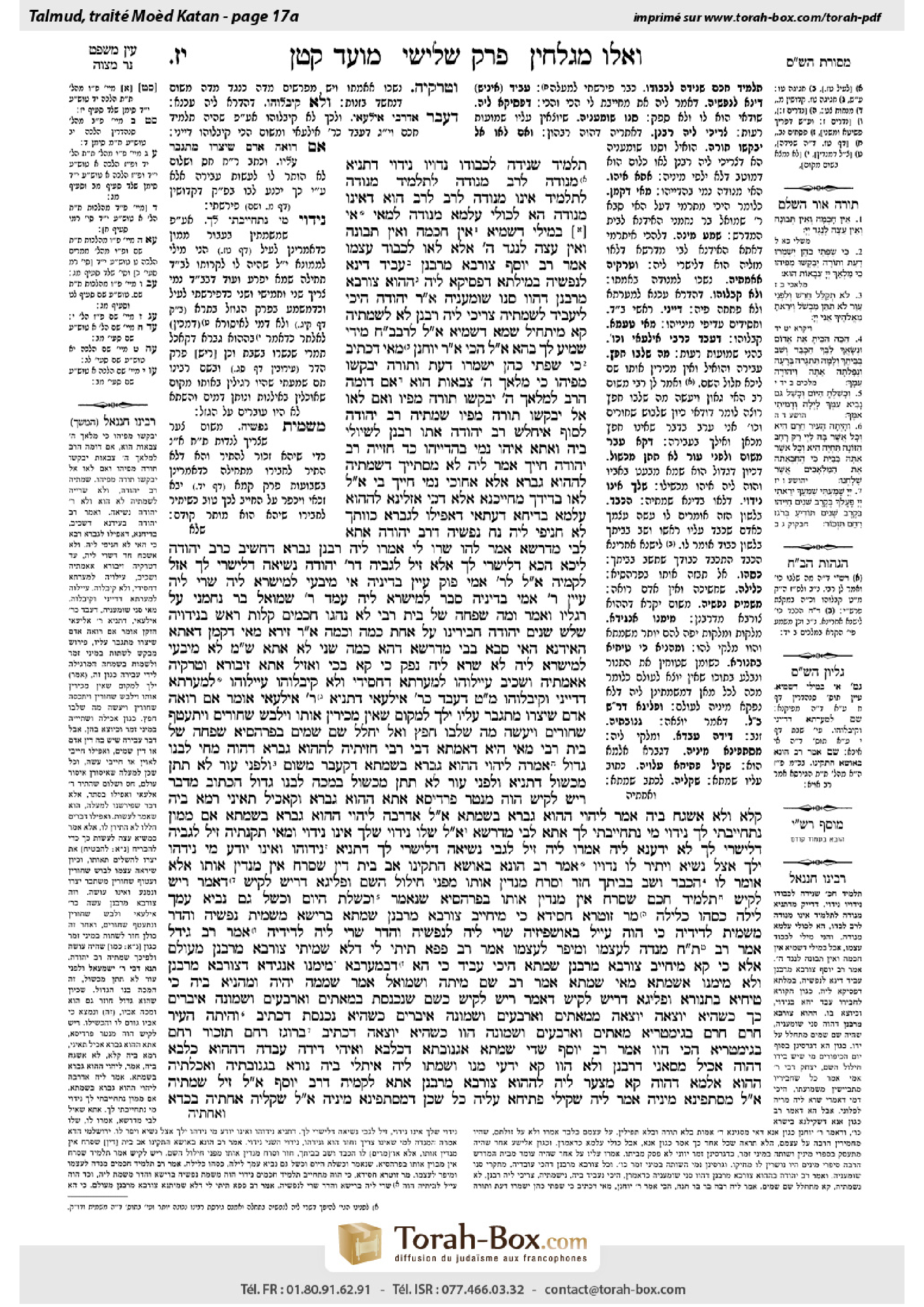
Moed Katan 17a: Talmud study for Daf Yomi
Daf Yomi is the daily study of one Talmud folio. Explore 37 tractates with scans, Hebrew text, Sefaria English and AI-generated French translations where annotated.
Passage selection and English or AI-generated French translation are available where the scan has annotations. Daf Study is independent of Torah-Box and Sefaria.
Browse Moed Katan · מועד קטן · All tractatesMoed Katan 17a text and translations
This page of Moed Katan includes the Aramaic text, an English translation and an AI-generated French translation, alongside the scan above.
מועד קטן י״ז א · Aramaic and Hebrew text
תַּלְמִיד שֶׁנִּידָּה לִכְבוֹדוֹ — נִדּוּיוֹ נִידּוּי, דְּתַנְיָא: מְנוּדֶּה לָרַב — מְנוּדֶּה לַתַּלְמִיד, מְנוּדֶּה לַתַּלְמִיד — אֵינוֹ מְנוּדֶּה לָרַב. לָרַב הוּא דְּאֵינוֹ מְנוּדֶּה, הָא לְכוּלֵּי עָלְמָא — מְנוּדֶּה.
לְמַאי? אִי בְּמִילֵּי דִשְׁמַיָּא — ״אֵין חׇכְמָה וְאֵין תְּבוּנָה וְאֵין עֵצָה לְנֶגֶד ה׳״! אֶלָּא לָאו, לִכְבוֹד עַצְמוֹ.
אָמַר רַב יוֹסֵף: צוּרְבָּא מֵרַבָּנַן עָבֵיד דִּינָא לְנַפְשֵׁיהּ בְּמִילְּתָא דִּפְסִיקָא לֵיהּ.
הָהוּא צוּרְבָּא מֵרַבָּנַן דַּהֲווֹ סְנוּ שׁוּמְעָנֵיהּ, אָמַר רַב יְהוּדָה: הֵיכִי לֶיעְבֵּיד? לְשַׁמְּתֵיהּ — צְרִיכִי לֵיהּ רַבָּנַן, לָא לְשַׁמְּתֵיהּ — קָא מִיתְּחִיל שְׁמָא דִשְׁמַיָּא.
אֲמַר לֵיהּ לְרַבָּה בַּר בַּר חָנָה: מִידֵּי שְׁמִיעַ לָךְ בְּהָא? אֲמַר לֵיהּ, הָכִי אָמַר רַבִּי יוֹחָנָן: מַאי דִּכְתִיב: ״כִּי שִׂפְתֵי כֹהֵן יִשְׁמְרוּ דַעַת וְתוֹרָה יְבַקְשׁוּ מִפִּיהוּ כִּי מַלְאַךְ ה׳ צְבָאוֹת הוּא״. אִם דּוֹמֶה הָרַב לְמַלְאַךְ ה׳ — יְבַקְּשׁוּ תּוֹרָה מִפִּיו, וְאִם לָאו — אַל יְבַקְּשׁוּ תּוֹרָה מִפִּיו.
שַׁמְּתֵיהּ רַב יְהוּדָה. לְסוֹף אִיחֲלַשׁ רַב יְהוּדָה. אֲתוֹ רַבָּנַן לְשַׁיּוֹלֵי בֵּיהּ וַאֲתָא אִיהוּ נָמֵי בַּהֲדַיְיהוּ, כַּד חַזְיֵיהּ רַב יְהוּדָה, חַיֵּיךְ.
אֲמַר לֵיהּ: לָא מִסָּתְיֵיהּ דְּשַׁמְּתֵיהּ לְהָהוּא גַּבְרָא, אֶלָּא אַחוֹכֵי נָמֵי חַיֵּיךְ בִּי?! אֲמַר לֵיהּ: לָאו בְּדִידָךְ מְחַיֵּיכְנָא, אֶלָּא דְּכִי אָזֵילְנָא לְהָהוּא עָלְמָא בְּדִיחָא דַּעְתַּאי, דַּאֲפִילּוּ לְגַבְרָא כְּווֹתָךְ לָא חַנֵּיפִי לֵיהּ.
נָח נַפְשֵׁיהּ דְּרַב יְהוּדָה. אֲתָא לְבֵי מִדְרְשָׁא, אֲמַר לְהוּ: שְׁרוֹ לִי! אֲמַרוּ לֵיהּ רַבָּנַן: גַּבְרָא דַּחֲשִׁיב כְּרַב יְהוּדָה לֵיכָּא הָכָא דְּלִישְׁרֵי לָךְ, אֶלָּא זִיל לְגַבֵּיהּ דְּרַבִּי יְהוּדָה נְשִׂיאָה דְּלִישְׁרֵי לָךְ. אֲזַל לְקַמֵּיהּ, אֲמַר לֵיהּ לְרַבִּי אַמֵּי: פּוֹק עַיֵּין בְּדִינֵיהּ, אִי מִיבְּעֵי לְמִישְׁרֵא לֵיהּ — שְׁרִי לֵיהּ.
עַיֵּין רַבִּי אַמֵּי בְּדִינֵיהּ, סְבַר לְמִישְׁרֵא לֵיהּ. עָמַד רַבִּי שְׁמוּאֵל בַּר נַחְמָנִי עַל רַגְלָיו וְאָמַר: וּמָה שִׁפְחָה שֶׁל בֵּית רַבִּי לֹא נָהֲגוּ חֲכָמִים קַלּוּת רֹאשׁ בְּנִידּוּיָהּ שָׁלֹשׁ שָׁנִים, יְהוּדָה חֲבֵירֵינוּ עַל אַחַת כַּמָּה וְכַמָּה.
אֲמַר רַבִּי זֵירָא: מַאי דְּקַמַּן דַּאֲתָא הָאִידָּנָא הַאי סָבָא בְּבֵי מִדְרְשָׁא, דְּהָא כַּמָּה שְׁנֵי לָא אֲתָא, שְׁמַע מִינַּהּ לָא מִיבְּעֵי לְמִישְׁרֵא לֵיהּ. לָא שְׁרָא לֵיהּ, נְפַק כִּי קָא בָכֵי וְאָזֵיל,
אֲתָא זִיבּוּרָא וְטַרְקֵיהּ אַאַמְּתֵיהּ וּשְׁכֵיב. עַיְּילוּהּ לִמְעָרְתָּא דַּחֲסִידֵי וְלָא קַיבְּלוּהּ, עַיְּילוּהּ לִמְעָרְתָּא דְּדַיָּינֵי וְקַיבְּלוּהּ.
מַאי טַעְמָא? דַּעֲבַד כְּרַבִּי אִילְעַאי. דְּתַנְיָא, רַבִּי אִילְעַאי אוֹמֵר: אִם רוֹאֶה אָדָם שֶׁיִּצְרוֹ מִתְגַּבֵּר עָלָיו — יֵלֵךְ לְמָקוֹם שֶׁאֵין מַכִּירִין אוֹתוֹ, וְיִלְבַּשׁ שְׁחוֹרִים וְיִתְעַטֵּף שְׁחוֹרִים, וְיַעֲשֶׂה מַה שֶּׁלִּבּוֹ חָפֵץ, וְאַל יְחַלֵּל שֵׁם שָׁמַיִם בְּפַרְהֶסְיָא.
שִׁפְחָה שֶׁל בֵּית רַבִּי מַאי הִיא? דְּאַמְּתָא דְבֵי רַבִּי חֲזֵיתֵיהּ לְהָהוּא גַּבְרָא דַּהֲוָה מָחֵי לִבְנוֹ גָּדוֹל, אֲמַרָה: לֶיהֱוֵי הָהוּא גַּבְרָא בְּשַׁמְתָּא, דְּקָעָבֵר מִשּׁוּם ״וְלִפְנֵי עִוֵּר לֹא תִתֵּן מִכְשׁוֹל״. דְּתַנְיָא: ״וְלִפְנֵי עִוֵּר לֹא תִתֵּן מִכְשׁוֹל״ — בְּמַכֶּה לִבְנוֹ גָּדוֹל הַכָּתוּב מְדַבֵּר.
רֵישׁ לָקִישׁ הֲוָה מְנַטַּר פַּרְדֵּיסָא. אֲתָא הָהוּא גַּבְרָא וְקָאָכֵיל תְּאֵינֵי, רְמָא בֵּיהּ קָלָא וְלָא אַשְׁגַּח בֵּיהּ. אֲמַר: לֶיהֱוֵי הָהוּא גַּבְרָא בְּשַׁמְתָּא. אֲמַר לֵיהּ: אַדְּרַבָּה, לֶיהֱוֵי הָהוּא גַּבְרָא בְּשַׁמְתָּא, אִם מָמוֹן נִתְחַיַּיבְתִּי לְךָ, נִידּוּי מִי נִתְחַיַּיבְתִּי לָךְ?
אֲתָא לְבֵי מִדְרְשָׁא, אֲמַרוּ לֵיהּ: שֶׁלּוֹ — נִידּוּי, שֶׁלְּךָ — אֵינוֹ נִידּוּי.
וּמַאי תַּקַּנְתֵּיהּ? זִיל לְגַבֵּיהּ דְּלִישְׁרֵי לָךְ. לָא יָדַעְנָא לֵיהּ. אֲמַרוּ לֵיהּ: זִיל לְגַבֵּי נְשִׂיאָה דְּלִישְׁרֵי לָךְ, דְּתַנְיָא: נִידּוּהוּ וְאֵינוֹ יוֹדֵעַ מִי נִידָּהוּ, יֵלֵךְ אֵצֶל נָשִׂיא וְיַתִּיר לוֹ נִדּוּיוֹ.
אָמַר רַב הוּנָא, בְּאוּשָׁא הִתְקִינוּ: אַב בֵּית דִּין שֶׁסָּרַח — אֵין מְנַדִּין אוֹתוֹ, אֶלָּא אוֹמֵר לוֹ: ״הִכָּבֵד וְשֵׁב בְּבֵיתֶךָ״. חָזַר וְסָרַח — מְנַדִּין אוֹתוֹ, מִפְּנֵי חִילּוּל הַשֵּׁם.
וּפְלִיגָא דְּרֵישׁ לָקִישׁ. דְּאָמַר רֵישׁ לָקִישׁ: תַּלְמִיד חָכָם שֶׁסָּרַח — אֵין מְנַדִּין אוֹתוֹ בְּפַרְהֶסְיָא, שֶׁנֶּאֱמַר: ״וְכָשַׁלְתָּ הַיּוֹם וְכָשַׁל גַּם נָבִיא עִמְּךָ לָיְלָה״ — כַּסֵּהוּ כַּלַּיְלָה.
מָר זוּטְרָא חֲסִידָא, כִּי מִיחַיַּיב צוּרְבָּא מֵרַבָּנַן שַׁמְתָּא, בְּרֵישָׁא מְשַׁמֵּית נַפְשֵׁיהּ, וַהֲדַר מְשַׁמֵּית לְדִידֵיהּ. כִּי הֲוָה עָיֵיל בְּאוּשְׁפִּיזֵיהּ שָׁרֵי לֵיהּ לְנַפְשֵׁיהּ, וַהֲדַר שָׁרֵי לֵיהּ לְדִידֵיהּ.
אָמַר רַב גִּידֵּל אָמַר רַב: תַּלְמִיד חָכָם מְנַדֶּה לְעַצְמוֹ, וּמֵיפֵר לְעַצְמוֹ. אָמַר רַב פָּפָּא: תֵּיתֵי לִי, דְּלָא שַׁמֵּיתִי צוּרְבָּא מֵרַבָּנַן מֵעוֹלָם. אֶלָּא כִּי קָא מִיחַיַּיב צוּרְבָּא מֵרַבָּנַן שַׁמְתָּא, הֵיכִי עָבֵיד? כִּי הָא דִּבְמַעְרְבָא מִימְּנוּ אַנְּגָדָא דְּצוּרְבָּא מֵרַבָּנַן וְלָא מִימְּנוּ אַשַּׁמְתָּא.
מַאי שַׁמְתָּא? אָמַר רַב: שָׁם מִיתָה. וּשְׁמוּאֵל אָמַר: שְׁמָמָה יִהְיֶה, וּמַהְנְיָא בֵּיהּ כִּי טִיחְיָא בְּתַנּוּרָא.
וּפְלִיגָא דְּרֵישׁ לָקִישׁ. דְּאָמַר רֵישׁ לָקִישׁ: כְּשֵׁם שֶׁנִּכְנֶסֶת בְּמָאתַיִם וְאַרְבָּעִים וּשְׁמוֹנָה אֵיבָרִים, כָּךְ כְּשֶׁהִיא יוֹצְאָה — יוֹצְאָה מִמָּאתַיִם וְאַרְבָּעִים וּשְׁמוֹנָה אֵיבָרִים.
כְּשֶׁהִיא נִכְנֶסֶת, דִּכְתִיב: ״וְהָיְתָה הָעִיר חֵרֶם״ — ״חֵרֶם״ בְּגִימַטְרִיָּא מָאתַיִם וְאַרְבָּעִים וּשְׁמוֹנָה הָווּ. כְּשֶׁהִיא יוֹצְאָה, דִּכְתִיב: ״בְּרוֹגֶז רַחֵם תִּזְכּוֹר״, ״רַחֵם״ בְּגִימַטְרִיָּא הָכִי הָווּ.
אָמַר רַב יוֹסֵף: שְׁדִי שַׁמְתָּא אַגְּנוּבְתָּא דְכַלְבָּא וְאִיהִי דִּידַהּ עָבְדָה. דְּהָהוּא כַּלְבָּא דַּהֲוָה אָכֵיל מְסָאנֵי דְרַבָּנַן וְלָא הֲווֹ קָא יָדְעִי מַנּוּ, וְשַׁמִּתוּ לֵיהּ. אִיתְּלַי בֵּיהּ נוּרָא בִּגְנוּבְתֵּיהּ וַאֲכַלְתֵּיהּ.
הָהוּא אַלָּמָא דַּהֲוָה קָא מְצַעַר לֵיהּ לְהָהוּא צוּרְבָּא מֵרַבָּנַן, אֲתָא לְקַמֵּיהּ דְּרַב יוֹסֵף, אֲמַר לֵיהּ: זִיל שַׁמְתֵּיהּ. אֲמַר לֵיהּ: מִסְתְּפֵינָא מִינֵּיהּ.
אֲמַר לֵיהּ: שְׁקֵיל פְּתִיחָא עֲלֵיהּ. כׇּל שֶׁכֵּן דְּמִסְתְּפֵינָא מִינֵּיהּ. אֲמַר לֵיהּ: שִׁקְלֵיהּ, אַחֲתֵיהּ בְּכַדָּא,
Moed Katan 17a · English translation
If a student ostracized someone else due to an insult to his dignity, and not because the ostracized person was guilty of some transgression, his decree of ostracism is valid, as it is taught in a baraita: One who is ostracized by the teacher is considered ostracized with regard to the student. However, one who is ostracized by the student is not considered ostracized with regard to the teacher. The Gemara attempts to draw an inference from a careful reading of this baraita: He is not considered ostracized with regard to the teacher, which implies that he is considered ostracized with regard to everyone else.
The Gemara clarifies the case: For what reason was he ostracized? If it was for a matter relating to Heaven, i.e., because he sinned, then why, if he was ostracized by the student, should he not be considered ostracized with regard to the teacher? Doesn’t the verse state: “There is no wisdom or understanding or counsel against the Lord” (Proverbs 21:30)? This means that when a sin is committed and God’s name is desecrated, all other considerations are ignored, even the eminence and knowledge of the teacher, and therefore he too must treat the offender as ostracized. Rather, is it not that the Gemara is referring to a case where the student ostracized the other person due to an insult to his own dignity? Therefore, it is apparent that his decree of ostracism is valid and binding upon all, with the exception of his teacher.
Rav Yosef said: A Torah scholar may execute judgment for himself with regard to a matter about which he is certain, and he is not required to first go to court and have the case decided for him. The same applies when another person behaves in a disrespectful manner toward him; he is permitted to go ahead on his own and ostracize him.
There was a certain Torah scholar who gained a bad reputation due to rumors about his conduct. Rav Yehuda said: What should be done? To excommunicate him is not an option. The Sages need him, as he is a great Torah authority. Not to excommunicate him is also not an option, as then the name of Heaven would be desecrated.
Rav Yehuda said to Rabba bar bar Ḥana: Have you heard anything with regard to this issue? He said to him: Rabbi Yoḥanan said as follows: What is the meaning of that which is written: “For the priest’s lips should keep knowledge, and they should seek Torah at his mouth; for he is a messenger [malakh] of the Lord of hosts” (Malachi 2:7)? This verse teaches: If the teacher is similar to an angel [malakh] of the Lord, then seek Torah from his mouth, but if he is not pure and upright, then do not seek Torah from his mouth; even if he is knowledgeable about Torah, do not learn from him.
Based on this statement, Rav Yehuda ostracized that Torah scholar. In the end, after some time had passed, Rav Yehuda took ill and was on the verge of death. The Sages came to inquire about his well-being, and the ostracized scholar came along with them as well. When Rav Yehuda saw him, that scholar, he laughed.
The ostracized scholar said to him: Was it not enough that you excommunicated that man, i.e., me, but now you even laugh at me? Rav Yehuda said to him: I was not laughing at you; rather, I am happy as I go to that other world that I did not flatter even a great man like you, but instead I treated you fairly in accordance with the halakha.
Rav Yehuda died. The ostracized scholar came to the study hall and said to the Sages: Release me from the decree of ostracism. The Sages said to him: There is no man here as eminent as Rav Yehuda who can release you from the ostracism. Rather, go to Rabbi Yehuda Nesia in Eretz Yisrael, as only he can release you. That scholar came before Rabbi Yehuda Nesia. Rabbi Yehuda Nesia said to Rabbi Ami: Go and examine his case. If it is necessary to release him from his decree of ostracism, release him on my behalf.
Rabbi Ami examined his case and thought at first to release him from his ostracism. But Rabbi Shmuel bar Naḥmani rose up on his feet and said: If the maidservant in the house of Rabbi Yehuda HaNasi once ostracized another person, and the Sages did not relate frivolously to her decree of ostracism and did not revoke it until three years had passed, all the more so, with regard to a decree of ostracism placed by Yehuda our colleague, we must take it seriously and not release this scholar.
Rabbi Zeira said: What caused this Elder, Rabbi Shmuel bar Naḥmani, to come before us in the study hall today though for many years he did not come, and now he comes precisely during this discussion. Learn from this that it is not necessary to release him from his decree of ostracism, as this combination of events is certainly not a coincidence. Rather, it should be viewed as an instructive sign from Heaven. Consequently, Rabbi Ami did not release him from the ostracism, and the ostracized scholar left in tears.
A wasp came and stung the ostracized scholar on his penis and he died. Because he was a great Torah scholar, they took him into the caves in which the pious are interred in order to bury him there, but the caves did not accept him. A snake stood at the entrance of the caves and did not let them pass. They then took him into the caves of the judges, and they accepted him.
The Gemara asks: What is the reason that he was accepted there? The Gemara answers: Even though he sinned, he still acted in accordance with the opinion of Rabbi Ilai, as it is taught in a baraita: Rabbi Ilai says: If a person sees that his evil inclination is gaining control over him and he cannot overcome it, then he should go to a place where he is not known. He should wear black, and he should wrap his head in black, as if he were a mourner. Perhaps these changes will influence him, so that he not sin. Even if these actions do not help, he should at least do as his heart desires in private and not desecrate the name of Heaven in public. Although this person had sinned, he did so in private and in a manner that did not publicly desecrate God’s name, and therefore it was fitting that he be given an honorable burial.
The Gemara asks: What is the story mentioned by Rabbi Shmuel bar Naḥmani involving the maidservant in the house of Rabbi Yehuda HaNasi? It was related that the maidservant in Rabbi Yehuda HaNasi’s house saw a certain man who was striking his adult son. She said: Let that man be excommunicated, due to the fact that he has transgressed the injunction: “You shall not place a stumbling block before the blind” (Leviticus 19:14), as it is taught in a baraita that the verse states: “You shall not place a stumbling block before the blind,” and the verse speaks here of one who strikes his adult son, as the son is likely to become angry and strike his father back, thereby transgressing the severe prohibition against hitting one’s parent.
Similarly, it was related that Reish Lakish was guarding an orchard for payment when a certain man came and ate some figs that were growing there. Reish Lakish raised his voice and yelled at him, but this man paid no attention to him and kept eating. Reish Lakish said: Let that man be in a state of excommunication. The man eating the figs said to him: On the contrary, let that man, i.e., Reish Lakish, be in a state of excommunication, for even if I have become liable to you for payment, as I have eaten of the figs without permission, have I become liable to you for excommunication? With that statement, the man left.
Reish Lakish went to the study hall to inquire about the halakha with regard to this man. The other Sages said to him: His decree of ostracism is valid, but your decree of ostracism is not. In other words, that man was correct and Reish Lakish should not have ostracized him in response to his actions.
Reish Lakish then asked: If so, what is the remedy for this decree of ostracism? The Sages answered him: Go to him so that he may release you from it. Reish Lakish replied: I do not know him. They said to him: Go then to the Nasi, so that he may release you from the ban, as it is taught in a baraita: If one was ostracized, but he does not know who ostracized him, he should go to the Nasi, and the Nasi may release him from his decree of ostracism.
The Gemara continues: Rav Huna said that in Usha it was enacted: If the president of the court sinned, he is not ostracized. Although this would be the appropriate punishment, he is not ostracized, so as not to cause a desecration of God’s name. Rather, they say to him the words of the verse: “Keep your honor and stay at home” (II Kings 14:10). That is to say, to preserve your dignity, it would be best if you were to stay at home, resign your position, and refrain from further public appearances. If he sins again, he is ostracized, due to the desecration of God’s name that would ensue were people to think that he was spared his rightful punishment due to his high position.
The Gemara comments: This opinion disagrees with that of Reish Lakish, for Reish Lakish said: If a Torah scholar sins, he is not ostracized at all in public, as it is stated: “Therefore, shall you fall in the day, and the prophet also shall fall with you in the night” (Hosea 4:5). This is explained to mean: If a prophet or any other important person sins, his offense should be concealed like the night and not punished in public.
With regard to this issue, it was related that when a Torah scholar would become liable to be punished with excommunication before Mar Zutra the Pious, Mar Zutra would first excommunicate himself as a mark of respect for the Torah scholar, and afterward he would ostracize the Torah scholar. This self-imposed excommunication was meant only as a show of honor to the other Torah scholar, and therefore when Mar Zutra would enter his house of lodging, he would release his own excommunication, and afterward he would release the other’s excommunication.
Rav Giddel said that Rav said: A Torah scholar may ostracize himself, and he may similarly release himself from self-imposed ostracism. Rav Pappa said: I have good coming to me, for I am praiseworthy, as I have never ostracized a Torah scholar. The Gemara asks about this: If so, when a Torah scholar was liable to be ostracized, what would he do? The Gemara answers: He did as they do in the West, Eretz Yisrael, where they appoint a court to give a Torah scholar lashes, but they do not appoint a court to ostracize him. That is to say, lashes were preferred over ostracism.
The Gemara proceeds with a discussion that explains the severity of the punishment of excommunication: What is the meaning of the word excommunication [shamta]? Rav said: This word is a contraction of the expression there is death [sham mita], alluding to the deathly aspect of excommunication. And Shmuel said: Shamta means that he will be a desolation [shemama yiheyeh], and it is effective upon him like fat smeared on an oven. Just as some of the fat will always remain absorbed in the walls of the oven, so too some aspect of the curse contained in the excommunication will continue to adhere to him even after the excommunication has been nullified.
The Gemara comments: And this opinion disagrees with the opinion of Reish Lakish, for Reish Lakish said: Just as ostracism enters the two hundred and forty-eight organs of one’s body when it is first pronounced, so too when it leaves, it leaves from his two hundred and forty-eight organs.
The following allusion is offered in support of the opinion of Reish Lakish: When it enters, it enters all the organs, as it is written: “And the city shall be a curse [ḥerem]” (Joshua 6:17), and the numerical value [gimatriyya] of the word ḥerem, a concept similar to ostracism, is two hundred and forty-eight. Therefore, the verse alludes to the fact that a decree of ostracism penetrates one’s two hundred and forty-eight organs. When it leaves, it leaves all the organs, as it is written: “In wrath remember mercy [raḥem]” (Habakkuk 3:2), and the numerical value of the word raḥem is also two hundred and forty-eight, thereby teaching that when the decree of ostracism is revoked, it disappears entirely.
The Gemara continues discussing the power of a ban. Rav Yosef said: Cast an excommunication on the tail of a dog and it, the excommunication, will do its work and harm the dog. It was related that there was a certain dog that would eat the shoes of the Sages, and they did not know who it was causing this damage. They thought that it was a person, and so they excommunicated whoever was doing it. Soon thereafter, the dog’s tail caught fire and got burnt. This shows that excommunication can have a harmful effect even on a dog.
It was further related that there was a violent person who caused suffering to a certain Torah scholar. This Torah scholar came before Rav Yosef to ask what he should do. Rav Yosef said to him: Go and ostracize him. This Torah scholar said to him: I am afraid of him, that he will harass me even more.
Rav Yosef said to him: Take out, i.e., publish a written ostracism against him. The Torah scholar said to him: All the more so I am fearful of him, for if I publicize the matter he will certainly come after me. Rav Yosef said to him to do as follows: Take the written ostracism and place it in a jug,
Moed Katan 17a · Traduction française (IA)
Si un élève a mis quelqu’un au ban parce que sa dignité avait été bafouée, et non parce que la personne mise au ban avait commis une transgression, son décret de mise au ban est valide. En effet, il est enseigné dans une baraïta : Celui qui est mis au ban par son maître est considéré comme mis au ban à l’égard de l’élève. En revanche, celui qui est mis au ban par l’élève n’est pas considéré comme mis au ban à l’égard du maître. La Guemara tente de tirer une conclusion d’une lecture attentive de cette baraïta : il n’est pas considéré comme mis au ban à l’égard du maître, ce qui implique qu’il l’est à l’égard de tous les autres.
La Guemara précise le cas : Pour quelle raison a-t-il été mis au ban ? Si c’était pour une question relevant du Ciel, c’est-à-dire parce qu’il avait péché, pourquoi ne serait-il pas considéré comme mis au ban à l’égard du maître, s’il a été mis au ban par l’élève ? Le verset ne dit-il pas : « Il n’y a ni sagesse, ni intelligence, ni conseil contre le Seigneur » (Proverbes 21, 30) ? Cela signifie que lorsqu’un péché est commis et que le nom de Dieu est profané, toutes les autres considérations sont écartées, même l’éminence et le savoir du maître ; celui-ci doit donc lui aussi traiter le fautif comme étant mis au ban. N’est-ce pas plutôt que la Guemara parle d’un cas où l’élève a mis l’autre personne au ban parce que sa propre dignité avait été bafouée ? Il apparaît donc que son décret de mise au ban est valide et s’impose à tous, à l’exception de son maître.
Rav Yosef dit : Un érudit en Torah peut rendre justice lui-même dans une affaire dont il est certain, sans devoir d’abord se présenter devant un tribunal pour qu’il tranche. Il en va de même lorsqu’une autre personne se comporte de façon irrespectueuse envers lui : il peut agir de sa propre initiative et la mettre au ban.
Il y avait un érudit en Torah dont la réputation avait été ternie par des rumeurs sur sa conduite. Rav Yehuda dit : Que faut-il faire ? Le mettre au ban n’est pas envisageable. Les Sages ont besoin de lui, car c’est une grande autorité en Torah. Ne pas le mettre au ban n’est pas envisageable non plus, car le nom du Ciel serait alors profané.
Rav Yehuda dit à Rabba bar bar Ḥana : As-tu entendu quelque chose à ce sujet ? Il lui répondit : Rabbi Yoḥanan a dit ceci : Que signifie ce qui est écrit : « Car les lèvres du prêtre doivent garder la connaissance, et l’on recherche la Torah de sa bouche ; car il est un messager [malakh] du Seigneur des armées » (Malachie 2, 7) ? Ce verset enseigne : Si le maître est semblable à un ange [malakh] du Seigneur, alors recherche la Torah de sa bouche ; mais s’il n’est pas pur et droit, ne recherche pas la Torah de sa bouche. Même s’il connaît la Torah, n’apprends pas auprès de lui.
Sur la base de cette déclaration, Rav Yehuda mit cet érudit en Torah au ban. Finalement, quelque temps plus tard, Rav Yehuda tomba malade et fut sur le point de mourir. Les Sages vinrent prendre de ses nouvelles, et l’érudit mis au ban vint également avec eux. Lorsque Rav Yehuda le vit, il rit.
L’érudit mis au ban lui dit : Ne suffisait-il pas que tu mettes cet homme, c’est-à-dire moi, au ban, pour qu’en plus tu te moques de moi ? Rav Yehuda lui répondit : Je ne me moquais pas de toi ; je suis plutôt heureux, alors que je m’apprête à partir dans l’autre monde, de ne pas avoir flatté un homme aussi éminent que toi, mais de t’avoir traité équitablement, conformément à la halakha.
Rav Yehuda mourut. L’érudit mis au ban se rendit à la maison d’étude et dit aux Sages : Déliez-moi du décret de mise au ban. Les Sages lui répondirent : Il n’y a ici aucun homme aussi éminent que Rav Yehuda qui puisse te délier de cette mise au ban. Va plutôt trouver Rabbi Yehuda Nesia en Eretz Israël, car lui seul peut t’en délier. L’érudit se présenta devant Rabbi Yehuda Nesia. Rabbi Yehuda Nesia dit à Rabbi Ami : Va examiner son cas. S’il faut le délier de son décret de mise au ban, fais-le en mon nom.
Rabbi Ami examina son cas et songea d’abord à le délier de la mise au ban. Mais Rabbi Shmuel bar Naḥmani se leva et déclara : Si la servante de la maison de Rabbi Yehuda HaNasi a un jour mis quelqu’un au ban, et que les Sages n’ont pas pris son décret à la légère ni ne l’ont annulé avant que trois années se soient écoulées, à plus forte raison devons-nous prendre au sérieux le décret de mise au ban prononcé par Yehuda, notre collègue, et ne pas délier cet érudit.
Rabbi Zeira dit : Qu’est-ce qui a amené cet ancien, Rabbi Shmuel bar Naḥmani, à venir aujourd’hui à la maison d’étude, alors qu’il n’y était pas venu depuis de nombreuses années, et à se présenter précisément pendant cette discussion ? Il faut en déduire qu’il ne convient pas de le délier de son décret de mise au ban, car cette succession d’événements n’est certainement pas une coïncidence. Il faut plutôt y voir un signe instructif venu du Ciel. Par conséquent, Rabbi Ami ne le délivra pas de la mise au ban, et l’érudit mis au ban s’en alla en pleurant.
Une guêpe vint piquer l’érudit mis au ban au pénis, et il mourut. Comme c’était un grand érudit en Torah, on l’emmena dans les grottes où sont enterrés les hommes pieux afin de l’y ensevelir, mais les grottes ne l’acceptèrent pas. Un serpent se tenait à leur entrée et ne les laissa pas passer. Ils l’emmenèrent alors dans les grottes des juges, qui l’acceptèrent.
La Guemara demande : Pourquoi fut-il accepté là-bas ? La Guemara répond : Bien qu’il ait péché, il a tout de même agi conformément à l’avis de Rabbi Ilai, comme il est enseigné dans une baraïta : Rabbi Ilai dit : Si quelqu’un voit que son mauvais penchant prend le dessus sur lui et qu’il ne peut le maîtriser, qu’il se rende dans un endroit où il n’est pas connu. Qu’il s’habille en noir et s’enveloppe la tête de noir, comme s’il était en deuil. Peut-être ces changements l’influenceront-ils, de sorte qu’il ne pèche pas. Même si cela ne l’aide pas, qu’il fasse au moins ce que son cœur désire en privé, sans profaner le nom du Ciel en public. Cet homme avait certes péché, mais il l’avait fait en privé et sans profaner publiquement le nom de Dieu ; il convenait donc qu’il bénéficie d’une sépulture honorable.
La Guemara demande : Quelle est l’histoire de la servante de la maison de Rabbi Yehuda HaNasi mentionnée par Rabbi Shmuel bar Naḥmani ? On rapporta que la servante de la maison de Rabbi Yehuda HaNasi vit un homme qui frappait son fils adulte. Elle dit : Que cet homme soit mis au ban, car il a transgressé l’interdiction : « Tu ne mettras pas d’obstacle devant un aveugle » (Lévitique 19, 14). En effet, il est enseigné dans une baraïta que le verset « Tu ne mettras pas d’obstacle devant un aveugle » parle ici de celui qui frappe son fils adulte, car le fils risque de se mettre en colère et de frapper son père en retour, transgressant ainsi la grave interdiction de frapper son parent.
De même, on rapporta que Reish Lakish gardait un verger contre rémunération lorsqu’un homme vint manger des figues qui y poussaient. Reish Lakish éleva la voix et lui cria, mais l’homme n’en tint pas compte et continua à manger. Reish Lakish dit : Que cet homme soit mis au ban. L’homme qui mangeait les figues lui répondit : Au contraire, que cet homme, c’est-à-dire Reish Lakish, soit mis au ban. Car même si je suis devenu ton débiteur, puisque j’ai mangé les figues sans permission, suis-je pour autant passible d’être mis au ban par toi ? Sur ces mots, l’homme s’en alla.
Reish Lakish se rendit à la maison d’étude pour s’enquérir de la halakha concernant cet homme. Les autres Sages lui dirent : Son décret de mise au ban est valide, mais le tien ne l’est pas. Autrement dit, cet homme avait raison, et Reish Lakish n’aurait pas dû le mettre au ban en réaction à son comportement.
Reish Lakish demanda alors : Dans ce cas, comment remédier à ce décret de mise au ban ? Les Sages lui répondirent : Va le trouver afin qu’il t’en délivre. Reish Lakish répondit : Je ne le connais pas. Ils lui dirent : Va donc trouver le Nassi, afin qu’il te délivre de la mise au ban, comme il est enseigné dans une baraïta : Si quelqu’un a été mis au ban mais ne sait pas qui l’a mis au ban, qu’il se rende auprès du Nassi, qui pourra le délier de son décret de mise au ban.
La Guemara poursuit : Rav Huna dit qu’à Usha, on décréta que si le président du tribunal avait péché, il ne serait pas mis au ban. Bien que ce soit la peine appropriée, on ne le met pas au ban afin de ne pas profaner le nom de Dieu. On lui dit plutôt les paroles du verset : « Garde ton honneur et reste chez toi » (II Rois 14, 10). Autrement dit, pour préserver ta dignité, le mieux serait que tu restes chez toi, que tu renonces à ta fonction et que tu évites désormais les apparitions publiques. S’il pèche de nouveau, il est mis au ban, car le nom de Dieu serait profané si les gens pensaient qu’il a échappé à la peine qui lui revenait en raison de sa haute position.
La Guemara fait remarquer que cet avis est contraire à celui de Reish Lakish, car Reish Lakish a dit : Si un érudit en Torah pèche, il n’est jamais mis au ban en public, comme il est dit : « C’est pourquoi tu tomberas pendant le jour, et le prophète tombera aussi avec toi pendant la nuit » (Osée 4, 5). On explique cela ainsi : Si un prophète ou toute autre personne importante pèche, sa faute doit être dissimulée comme la nuit et ne pas être punie en public.
À ce sujet, on rapporta que lorsqu’un érudit en Torah encourait la mise au ban devant Mar Zutra le Pieux, celui-ci commençait par se mettre lui-même au ban, par respect pour l’érudit en Torah, puis il mettait cet érudit au ban. Cette mise au ban qu’il s’infligeait était uniquement une marque d’honneur envers l’autre érudit en Torah ; aussi, lorsque Mar Zutra rentrait dans son lieu de résidence, il levait sa propre mise au ban, puis celle de l’autre.
Rav Giddel dit au nom de Rav : Un érudit en Torah peut se mettre lui-même au ban et peut également lever la mise au ban qu’il s’est infligée. Rav Pappa dit : J’ai de quoi me réjouir, car je suis digne d’éloges : je n’ai jamais mis un érudit en Torah au ban. La Guemara s’interroge : Dans ce cas, que faisait-il lorsqu’un érudit en Torah devait être mis au ban ? La Guemara répond : Il faisait comme en Occident, c’est-à-dire en Eretz Israël, où l’on désignait un tribunal pour infliger des coups à un érudit en Torah, mais pas pour le mettre au ban. Autrement dit, on préférait les coups à la mise au ban.
La Guemara poursuit par une discussion expliquant la gravité de la peine d’excommunication : Que signifie le mot excommunication [shamta] ? Rav dit : Ce mot est une contraction de l’expression « il y a là la mort » [sham mita], ce qui évoque le caractère mortel de l’excommunication. Shmuel dit : Shamta signifie « il sera une désolation » [shemama yiheyeh], et son effet sur lui est comparable à celui de la graisse étalée sur un four. De même qu’une partie de la graisse reste toujours imprégnée dans les parois du four, de même une part de la malédiction contenue dans l’excommunication continue de s’attacher à lui, même après la levée de l’excommunication.
La Guemara fait remarquer que cet avis est contraire à celui de Reish Lakish, car Reish Lakish a dit : De même que la mise au ban pénètre les deux cent quarante-huit membres du corps lorsqu’elle est prononcée, de même, lorsqu’elle est levée, elle quitte ses deux cent quarante-huit membres.
On propose l’allusion suivante à l’appui de l’avis de Reish Lakish : Lorsqu’elle pénètre, elle pénètre tous les membres, comme il est écrit : « La ville sera vouée à l’interdit [ḥerem] » (Josué 6, 17), et la valeur numérique [gimatriyya] du mot ḥerem, notion apparentée à la mise au ban, est de deux cent quarante-huit. Le verset indique donc qu’un décret de mise au ban pénètre les deux cent quarante-huit membres du corps. Lorsqu’elle se retire, elle quitte tous les membres, comme il est écrit : « Dans ta colère, souviens-toi de la miséricorde [raḥem] » (Habacuc 3, 2), et la valeur numérique du mot raḥem est également de deux cent quarante-huit, ce qui enseigne que lorsque le décret de mise au ban est révoqué, il disparaît entièrement.
La Guemara poursuit la discussion sur le pouvoir de la mise au ban. Rav Yosef dit : Prononce une mise au ban contre la queue d’un chien, et elle, la mise au ban, fera son œuvre et nuira au chien. On rapporta qu’un chien dévorait les chaussures des Sages, sans qu’ils sachent qui causait ces dégâts. Pensant qu’il s’agissait d’une personne, ils mirent au ban quiconque en était responsable. Peu après, la queue du chien prit feu et fut brûlée. Cela montre que la mise au ban peut avoir un effet néfaste même sur un chien.
On rapporta encore qu’un homme violent faisait souffrir un certain érudit en Torah. Cet érudit en Torah se présenta devant Rav Yosef pour lui demander ce qu’il devait faire. Rav Yosef lui dit : Va le mettre au ban. L’érudit en Torah lui répondit : J’ai peur de lui, car il me harcèlera encore davantage.
Rav Yosef lui dit : Fais établir, c’est-à-dire publier, un écrit prononçant sa mise au ban. L’érudit en Torah lui répondit : J’aurai d’autant plus peur de lui, car si je rends l’affaire publique, il s’en prendra certainement à moi. Rav Yosef lui dit de procéder ainsi : Prends l’écrit de mise au ban et place-le dans une cruche,
Traduction française générée par IA à partir de l’édition anglaise de Sefaria. Vérifie toujours un passage avec le texte source.
Text from Sefaria: William Davidson Edition - Vocalized Aramaic (CC BY NC); William Davidson Edition - English (CC BY NC).