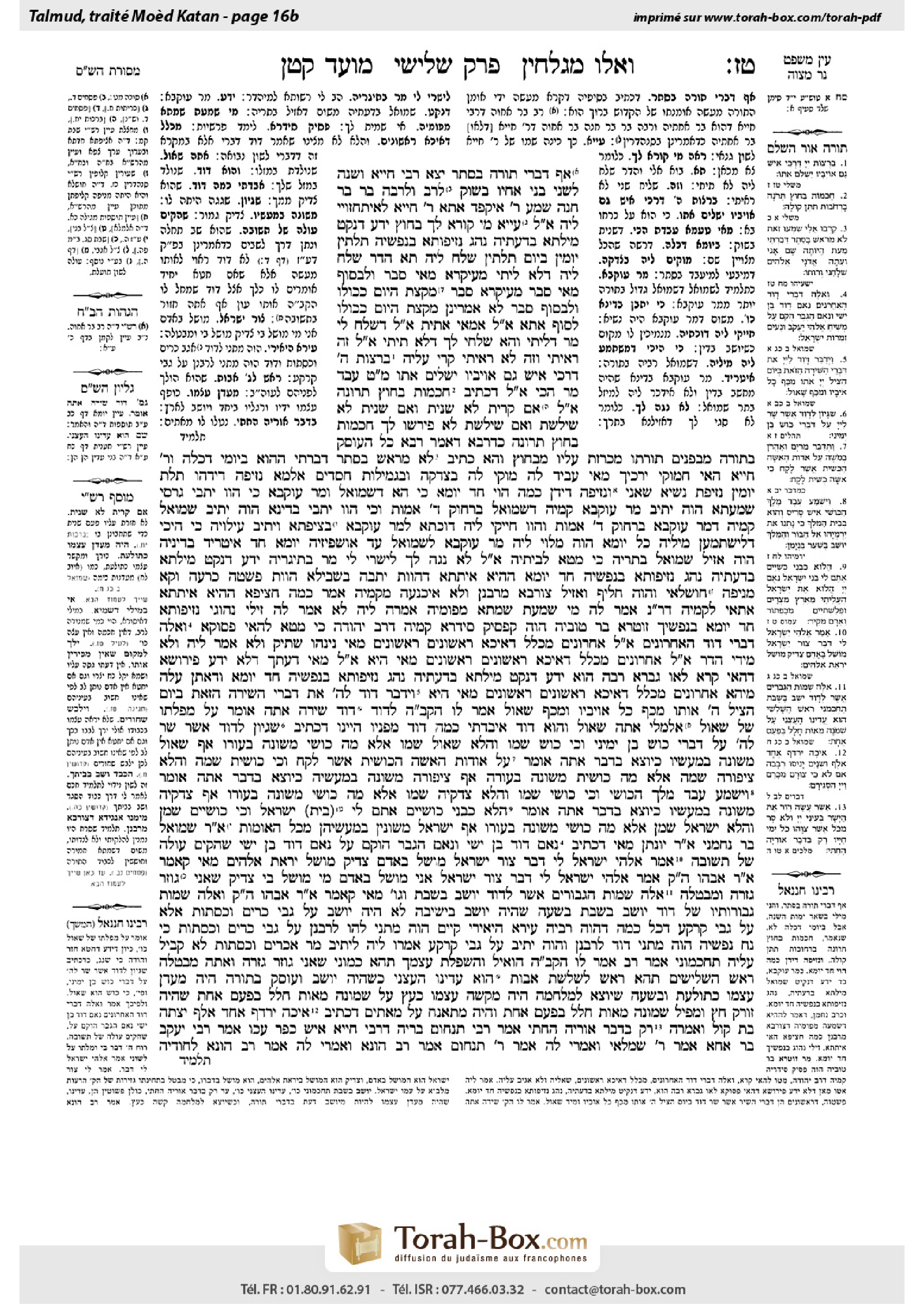
Moed Katan 16b: Talmud study for Daf Yomi
Daf Yomi is the daily study of one Talmud folio. Explore 37 tractates with scans, Hebrew text, Sefaria English and AI-generated French translations where annotated.
Passage selection and English or AI-generated French translation are available where the scan has annotations. Daf Study is independent of Torah-Box and Sefaria.
Browse Moed Katan · מועד קטן · All tractatesMoed Katan 16b text and translations
This page of Moed Katan includes the Aramaic text, an English translation and an AI-generated French translation, alongside the scan above.
מועד קטן י״ו ב · Aramaic and Hebrew text
אַף דִּבְרֵי תוֹרָה בַּסֵּתֶר.
יָצָא רַבִּי חִיָּיא וְשָׁנָה לִשְׁנֵי בְּנֵי אֶחָיו בַּשּׁוּק, לְרַב וּלְרַבָּה בַּר (בַּר) חָנָה. שְׁמַע רַבִּי, אִיקְּפַד. אֲתָא רַבִּי חִיָּיא לְאִיתְחֲזוֹיֵי לֵיהּ, אֲמַר לֵיהּ: עִיָּיא, מִי קוֹרֵא לְךָ בַּחוּץ! יְדַע דִּנְקַט מִילְּתָא בְּדַעְתֵּיהּ, נְהַג נְזִיפוּתָא בְּנַפְשֵׁיהּ תְּלָתִין יוֹמִין.
בְּיוֹם תְּלָתִין שְׁלַח לֵיהּ: תָּא. הֲדַר שְׁלַח לֵיהּ דְּלָא לֵיתֵי.
מֵעִיקָּרָא מַאי סְבַר וּלְבַסּוֹף מַאי סְבַר? מֵעִיקָּרָא סָבַר: מִקְצָת הַיּוֹם כְּכוּלּוֹ. וּלְבַסּוֹף סָבַר: לָא אָמְרִינַן מִקְצָת הַיּוֹם כְּכוּלּוֹ.
לְסוֹף אֲתָא. אֲמַר לֵיהּ: אַמַּאי אֲתֵית? אֲמַר לֵיהּ: דְּשָׁלַח לִי מָר דְּלֵיתֵי. וְהָא שְׁלַחִי לָךְ דְּלָא תֵּיתֵי! אֲמַר לֵיהּ: זֶה רָאִיתִי, וְזֶה לֹא רָאִיתִי. קָרֵי עֲלֵיהּ: ״בִּרְצוֹת ה׳ דַּרְכֵי אִישׁ גַּם אוֹיְבָיו יַשְׁלִים אִתּוֹ״.
מַאי טַעְמָא עֲבַד מָר הָכִי? אֲמַר לֵיהּ, דִּכְתִיב: ״חׇכְמוֹת בַּחוּץ תָּרוֹנָּה״. אֲמַר לֵיהּ: אִם קָרִיתָ — לֹא שָׁנִיתָ, וְאִם שָׁנִיתָ — לֹא שִׁילַּשְׁתָּ, וְאִם שִׁילַּשְׁתָּ — לֹא פֵּירְשׁוּ לְךָ.
״חׇכְמוֹת בַּחוּץ תָּרוֹנָּה״, כִּדְרָבָא. דְּאָמַר רָבָא: כׇּל הָעוֹסֵק בַּתּוֹרָה מִבִּפְנִים, תּוֹרָתוֹ מַכְרֶזֶת עָלָיו מִבַּחוּץ.
וְהָא כְּתִיב: ״לֹא מֵרֹאשׁ בַּסֵּתֶר דִּבַּרְתִּי״! הָהוּא בְּיוֹמֵי דְכַלָּה.
וְרַבִּי חִיָּיא, הַאי ״חַמּוּקֵי יְרֵכַיִךְ״ מַאי עָבֵיד לֵהּ? מוֹקֵי לֵהּ בִּצְדָקָה וּבִגְמִילוּת חֲסָדִים.
אַלְמָא נְזִיפָה דִּידְהוּ תְּלָתִין יוֹמִין! נְזִיפַת נָשִׂיא שָׁאנֵי.
וּנְזִיפָה דִּידַן כַּמָּה הָוֵי? חַד יוֹמָא. כִּי הָא דִּשְׁמוּאֵל וּמָר עוּקְבָא, כִּי הֲווֹ יָתְבִי גָּרְסִי שְׁמַעְתָּא, הֲוָה יָתֵיב מָר עוּקְבָא קַמֵּיהּ דִּשְׁמוּאֵל בְּרָחוֹק אַרְבַּע אַמּוֹת. וְכִי הֲווֹ יָתְבִי בְּדִינָא, הֲוָה יָתֵיב שְׁמוּאֵל קַמֵּיהּ דְּמָר עוּקְבָא בְּרָחוֹק אַרְבַּע אַמּוֹת. וַהֲווֹ חָיְיקִי לֵיהּ דּוּכְתָּא לְמָר עוּקְבָא בְּצִיפְּתָא, וְיָתֵיב עִילָּוֵיהּ כִּי הֵיכִי דְּלִישְׁתַּמְעָן מִילֵּיהּ.
כׇּל יוֹמָא הֲוָה מְלַוִי לֵיהּ מָר עוּקְבָא לִשְׁמוּאֵל עַד אוּשְׁפִּיזֵיהּ. יוֹמָא חַד אִיטְּרִיד בְּדִינֵיהּ הֲוָה אָזֵיל שְׁמוּאֵל בָּתְרֵיהּ. כִּי מְטָא לְבֵיתֵיהּ, אָמַר לֵיהּ: לָא נְגַהּ לָךְ? לִישְׁרֵי לִי מָר בְּתִיגְרֵיהּ! יְדַע דִּנְקַט מִילְּתָא בְּדַעְתֵּיהּ, נְהַג נְזִיפוּתָא בְּנַפְשֵׁיהּ חַד יוֹמָא.
הָהִיא אִיתְּתָא דַּהֲווֹת יָתְבָה בִּשְׁבִילָא, הֲווֹת פָּשְׁטָה כַּרְעַהּ וְקָא מְנִיפָה חוּשְׁלָאֵי, וַהֲוָה חָלֵיף וְאָזֵיל צוּרְבָּא מֵרַבָּנַן וְלָא אִיכַּנְעָה מִקַּמֵּיהּ. אֲמַר: כַּמָּה חַצִּיפָא הָהִיא אִיתְּתָא! אֲתַאי לְקַמֵּיהּ דְּרַב נַחְמָן. אֲמַר לַהּ: מִי שְׁמַעְתְּ שַׁמְתָּא מִפּוּמֵּיהּ? אֲמַרָה לֵיהּ: לָא. אֲמַר לַהּ: זִילִי נְהוּגִי נְזִיפוּתָא חַד יוֹמָא בְּנַפְשִׁיךְ.
זוּטְרָא בַּר טוֹבִיָּה הֲוָה קָפָסֵיק סִידְרָא קַמֵּיהּ דְּרַב יְהוּדָה, כִּי מְטָא לְהַאי פְּסוּקָא ״וְאֵלֶּה דִּבְרֵי דָוִד הָאַחֲרוֹנִים״, אֲמַר לֵיהּ: ״אַחֲרוֹנִים״ — מִכְּלָל דְּאִיכָּא רִאשׁוֹנִים, רִאשׁוֹנִים מַאי נִינְהוּ?
שְׁתֵיק וְלָא אֲמַר לֵיהּ וְלָא מִידֵּי, הֲדַר אֲמַר לֵיהּ: ״אַחֲרוֹנִים״, מִכְּלָל דְּאִיכָּא רִאשׁוֹנִים, רִאשׁוֹנִים מַאי הִיא? אֲמַר לֵיהּ: מַאי דַּעְתָּךְ, דְּלָא יָדַע פֵּירוּשָׁא דְּהַאי קְרָא לָאו גַּבְרָא רַבָּה הוּא? יְדַע דִּנְקַט מִילְּתָא בְּדַעְתֵּיהּ, נְהַג נְזִיפוּתָא בְּנַפְשֵׁיהּ חַד יוֹמָא.
וְדַאֲתָן עֲלַהּ, מִיהָא ״אַחֲרוֹנִים״ — מִכְּלָל דְּאִיכָּא רִאשׁוֹנִים, רִאשׁוֹנִים מַאי הִיא? ״וַיְדַבֵּר דָּוִד לַה׳ אֶת דִּבְרֵי הַשִּׁירָה הַזֹּאת בְּיוֹם הִצִּיל ה׳ אוֹתוֹ מִכַּף כׇּל אוֹיְבָיו וּמִכַּף שָׁאוּל״.
אָמַר לוֹ הַקָּדוֹשׁ בָּרוּךְ הוּא לְדָוִד: דָּוִד, שִׁירָה אַתָּה אוֹמֵר עַל מַפַּלְתּוֹ שֶׁל שָׁאוּל? אִלְמָלֵי אַתָּה שָׁאוּל וְהוּא דָּוִד — אִיבַּדְתִּי כַּמָּה דָּוִד מִפָּנָיו.
הַיְינוּ דִּכְתִיב: ״שִׁגָּיוֹן לְדָוִד אֲשֶׁר שָׁר לַה׳ עַל דִּבְרֵי כוּשׁ בֶּן יְמִינִי״, וְכִי כּוּשׁ שְׁמוֹ? וַהֲלֹא שָׁאוּל שְׁמוֹ! אֶלָּא: מָה כּוּשִׁי מְשׁוּנֶּה בְּעוֹרוֹ — אַף שָׁאוּל מְשׁוּנֶּה בְּמַעֲשָׂיו.
כַּיּוֹצֵא בַּדָּבָר אַתָּה אוֹמֵר: ״עַל אוֹדוֹת הָאִשָּׁה הַכּוּשִׁית אֲשֶׁר לָקָח״, וְכִי כּוּשִׁית שְׁמָהּ? וַהֲלֹא צִיפּוֹרָה שְׁמָהּ! אֶלָּא: מָה כּוּשִׁית מְשׁוּנָּה בְּעוֹרָהּ — אַף צִיפּוֹרָה מְשׁוּנָּה בְּמַעֲשֶׂיהָ. כַּיּוֹצֵא בַּדָּבָר אַתָּה אוֹמֵר: ״וַיִּשְׁמַע עֶבֶד מֶלֶךְ הַכּוּשִׁי״, וְכִי כּוּשִׁי שְׁמוֹ? וַהֲלֹא צִדְקִיָּה שְׁמוֹ! אֶלָּא: מָה כּוּשִׁי מְשׁוּנֶּה בְּעוֹרוֹ — אַף צִדְקִיָּה מְשׁוּנֶּה בְּמַעֲשָׂיו.
כַּיּוֹצֵא בַּדָּבָר אַתָּה אוֹמֵר: ״הֲלֹא כִבְנֵי כוּשִׁיִּים אַתֶּם לִי בֵּית יִשְׂרָאֵל״, וְכִי כּוּשִׁיִּים שְׁמָן? וַהֲלֹא יִשְׂרָאֵל שְׁמָן! אֶלָּא: מָה כּוּשִׁי מְשׁוּנֶּה בְּעוֹרוֹ — אַף יִשְׂרָאֵל מְשׁוּנִּין בְּמַעֲשֵׂיהֶן מִכׇּל הָאוּמּוֹת.
אָמַר רַבִּי שְׁמוּאֵל בַּר נַחְמָנִי אָמַר רַבִּי יוֹנָתָן, מַאי דִּכְתִיב: ״נְאֻם דָּוִד בֶּן יִשַׁי וּנְאֻם הַגֶּבֶר הוּקַם עָל״ — נְאֻם דָּוִד בֶּן יִשַׁי שֶׁהֵקִים עוּלָּהּ שֶׁל תְּשׁוּבָה.
״אָמַר אֱלֹהֵי יִשְׂרָאֵל לִי דִבֶּר צוּר יִשְׂרָאֵל מוֹשֵׁל בָּאָדָם צַדִּיק מוֹשֵׁל יִרְאַת אֱלֹהִים״. מַאי קָאָמַר? אָמַר רַבִּי אֲבָהוּ, הָכִי קָאָמַר: אָמַר אֱלֹהֵי יִשְׂרָאֵל, לִי דִבֶּר צוּר יִשְׂרָאֵל, אֲנִי מוֹשֵׁל בָּאָדָם, מִי מוֹשֵׁל בִּי — צַדִּיק, שֶׁאֲנִי גּוֹזֵר גְּזֵרָה וּמְבַטְּלָהּ.
״אֵלֶּה שְׁמוֹת הַגִּבּוֹרִים אֲשֶׁר לְדָוִד יוֹשֵׁב בַּשֶּׁבֶת וְגוֹ׳״. מַאי קָאָמַר? אָמַר רַבִּי אֲבָהוּ, הָכִי קָאָמַר: וְאֵלֶּה שְׁמוֹת גְּבוּרוֹתָיו שֶׁל דָּוִד.
״יוֹשֵׁב בַּשֶּׁבֶת״ — בְּשָׁעָה שֶׁהָיָה יוֹשֵׁב בִּישִׁיבָה, לֹא הָיָה יוֹשֵׁב עַל גַּבֵּי כָּרִים וּכְסָתוֹת אֶלָּא עַל גַּבֵּי קַרְקַע. דְּכֹל כַּמָּה דַּהֲוָה רַבֵּיהּ עִירָא הַיָּאִירִי קַיָּים, הֲוָה מַתְנֵי לְהוּ לְרַבָּנַן עַל גַּבֵּי כָּרִים וּכְסָתוֹת. כִּי נָח נַפְשֵׁיהּ, הֲוָה מַתְנִי דָּוִד לְרַבָּנַן וַהֲוָה יָתֵיב עַל גַּבֵּי קַרְקַע. אֲמַרוּ לֵיהּ: לִיתֵּיב מָר אַכָּרִים וּכְסָתוֹת! לָא קַבֵּיל עֲלֵיהּ.
״תַּחְכְּמוֹנִי״, אָמַר רַב: אָמַר לוֹ הַקָּדוֹשׁ בָּרוּךְ הוּא, הוֹאִיל וְהִשְׁפַּלְתָּ עַצְמְךָ תְּהֵא כָּמוֹנִי. שֶׁאֲנִי גּוֹזֵר גְּזֵרָה, וְאַתָּה מְבַטְּלָהּ.
״רֹאשׁ הַשָּׁלִישִׁים״ — תְּהֵא רֹאשׁ לִשְׁלֹשֶׁת אָבוֹת. ״הוּא עֲדִינוֹ הָעֶצְנִי״, כְּשֶׁהָיָה יוֹשֵׁב וְעוֹסֵק בַּתּוֹרָה — הָיָה מְעַדֵּן עַצְמוֹ כְּתוֹלַעַת, וּבְשָׁעָה שֶׁיּוֹצֵא לַמִּלְחָמָה — הָיָה מַקְשֶׁה עַצְמוֹ כְּעֵץ.
״עַל שְׁמוֹנֶה מֵאוֹת חָלָל בְּפַעַם אֶחָת״. שֶׁהָיָה זוֹרֵק חֵץ, וּמַפִּיל שְׁמוֹנֶה מֵאוֹת חָלָל בְּפַעַם אֶחָת, וְהָיָה מִתְאַנֵּחַ עַל מָאתַיִם, דִּכְתִיב: ״אֵיכָה יִרְדֹּף אֶחָד אֶלֶף״.
יָצְתָה בַּת קוֹל וְאָמְרָה: ״רַק בִּדְבַר אוּרִיָּה הַחִתִּי״.
אָמַר רַבִּי תַּנְחוּם בְּרֵיהּ דְּרַבִּי חִיָּיא אִישׁ כְּפַר עַכּוֹ, אָמַר רַבִּי יַעֲקֹב בַּר אַחָא אָמַר רַבִּי שִׂמְלַאי. וְאָמְרִי לַהּ, אָמַר רַבִּי תַּנְחוּם אָמַר רַב הוּנָא, וְאָמְרִי לַהּ אָמַר רַב הוּנָא לְחוֹדֵיהּ:
Moed Katan 16b · English translation
so too, the words of Torah, which are “the work of the hands of an artist,” i.e., God, must remain hidden in the study hall.
Despite Rabbi Yehuda HaNasi’s decree, Rabbi Ḥiyya went out and taught his two nephews, Rav and Rabba bar bar Ḥana, in the marketplace. Rabbi Yehuda HaNasi heard what he had done and became angry with him. When Rabbi Ḥiyya came at some later date to visit him, Rabbi Yehuda HaNasi mockingly said to him: Iyya, who is calling you outside? By asking this question Rabbi Yehuda HaNasi was intimating that Rabbi Ḥiyya should leave his house. Rabbi Ḥiyya understood that Rabbi Yehuda HaNasi had taken the matter to heart and was insulted, and so he conducted himself as if he had been admonished, as a self-imposed punishment, for thirty days.
On the thirtieth day, Rabbi Yehuda HaNasi sent him a message, saying: Come and visit me. However, he later reversed his opinion and sent him another message, telling him not to come.
The Gemara asks: At the outset what did he hold, and ultimately what did he hold? Initially, Rabbi Yehuda HaNasi held that the legal status of part of the day is like that of an entire day, and since the thirtieth day already begun, Rabbi Ḥiyya’s time of admonition had ended. But ultimately he held that with regard to this issue we do not say that the legal status of part of the day is like that of an entire day.
In the end Rabbi Ḥiyya came on that same day. Rabbi Yehuda HaNasi asked him: Why have you come? Rabbi Ḥiyya responded: Because you, Master, sent me a message that I should come. He said to him: But I sent you a second message that you should not come. He responded: This messenger that you sent, i.e., the first one, I saw him and I did as he said, but that messenger, i.e., the second one, I did not see. Rabbi Yehuda HaNasi read the verse about Rabbi Ḥiyya: “When a man’s ways please the Lord, He makes even his enemies to be at peace with him” (Proverbs 16:7), as it was clear to him that Rabbi Ḥiyya had merited divine assistance.
§ Concerning the issue with which the entire incident had begun, Rabbi Yehuda HaNasi asked Rabbi Ḥiyya: What is the reason that you, the Master, acted as you did, ignoring my instructions not to teach Torah in the marketplace? Rabbi Ḥiyya said to him: As it is written: “Wisdom cries aloud in the streets” (Proverbs 1:20), which implies that Torah should be publicized in the streets. Rabbi Yehuda HaNasi said to him: If you read this verse once, you certainly did not read it a second time in greater depth; and if you read it a second time, you certainly did not read it a third time; and if you read it a third time, then it was not adequately explained to you, as it is clear that you do not understand it properly.
The words: “Wisdom cries aloud in the streets,” should be understood in accordance with the opinion of Rava. As Rava said: With regard to everyone who occupies himself with Torah study inside the privacy of his home, his Torah knowledge will proclaim his greatness outside, as it will be revealed to the masses and they will see his greatness.
The Gemara asks: But isn’t it written: “From the beginning I have not spoken in secret” (Isaiah 48:16), implying that the Torah should be taught and proclaimed in public? The Gemara answers: That verse is referring to the days of the kalla, the gathering for Torah study held during Elul and Adar, when many people come to listen to Torah discourses. During this time, it is not only permitted but even recommended to teach Torah to the masses. In this way, the verse can be explained in accordance with the opinion of Rabbi Yehuda HaNasi.
The Gemara asks: And what did Rabbi Ḥiyya do with this verse: “Your rounded thighs are like jewels”? How did he understand it? This verse implies that the Torah must be kept hidden in the study hall and not publicized in the marketplace. The Gemara explains: He interprets it not as a reference to Torah, but as referring to acts of charity and loving-kindness, which should certainly be performed in private.
This incident demonstrates that, apparently, admonition of those who live in Eretz Yisrael lasts for thirty days and not for seven days. The Gemara answers that this is not a conclusive proof, since Rabbi Yehuda HaNasi was the Nasi. The admonition of the Nasi of the Sanhedrin is different i.e., more severe, than the admonition of anyone else.
The Gemara asks: And how long is our admonition in Babylonia? The Gemara answers: It is only one day, as in the case involving Shmuel and the Exilarch Mar Ukva. When they would sit and study halakha, Mar Ukva would sit before Shmuel at a distance of four cubits as a sign of respect. Mar Ukva would conduct himself as though Shmuel were his teacher because Shmuel was much greater than him in Torah matters. And when they would sit together in judgment, Shmuel would sit before Mar Ukva at a distance of four cubits because Mar Ukva was the Exilarch and the chief judge. But they would lower a place for Mar Ukva in the matting upon which he sat, and he would sit on it so that he could hear Shmuel’s words of Torah even when they were engaged in judgment.
Every day, Mar Ukva would accompany Shmuel to his lodgings, in the manner that a student would show honor toward his teacher. One day, Mar Ukva was so heavily preoccupied with a case that had been brought before him for judgment that he did not realize that Shmuel was walking behind him to show him respect due to his position as the Exilarch. When Mar Ukva reached his home, Shmuel said to him: Is it not enough for you that I accompanied you until here? Release me, Master, from my obligation, so that I may return home. Mar Ukva understood that Shmuel had taken the matter to heart and was insulted. Therefore, he conducted himself as if he had been admonished, for one day as a self-imposed punishment.
It was related that a certain woman was sitting alongside a path with her leg extended while she was sifting barley. A Torah scholar passed by her on this path, but she did not yield to him and move her leg to make room for him. He said: How rude is that woman! The woman came before Rav Naḥman to ask if this statement should be deemed as excommunication. He said to her: Did you hear the word excommunication explicitly issue from his mouth? She said to him: No. He said to her: If this is the case, then go and observe an admonition for one day, as it appears that the Torah scholar sought only to admonish you.
§ Zutra bar Toviyya was once reading the portion of the Bible before Rav Yehuda. When he reached the verse: “Now these are the last words of David” (II Samuel 23:1), Zutra bar Toviyya said to Rav Yehuda: If it is written that these are the last of David’s words, by inference there are first words as well. If this is the case, what are these first words of David? Prior to this, it mentions only David’s song, but not his words.
Rav Yehuda remained silent and said nothing to him. Zutra bar Toviyya thought that Rav Yehuda did not hear what he had said, so he then said to him a second time: If it is written that these are the last of David’s words, by inference there are first words as well. If this is the case, what are these first words of David? He said to him: What do you think? Do you think that anyone who does not know the meaning of this verse is not a great man? Why are you stressing the fact that I do not know the answer to your question? Zutra bar Toviyya understood that Rav Yehuda had taken the matter to heart and was insulted. Therefore, he conducted himself as if had been admonished for one day as a self-imposed punishment.
The Gemara asks: But now that we have come to discuss this issue, since the verse mentions David’s last words, by inference there are also first words. What then are these first words of David? The Gemara answers: The first words are: “And David spoke to the Lord the words of this song in the day that the Lord delivered him out of the hand of his enemies, and out of the hand of Saul” (II Samuel 22:1), as that song is also referred to as words.
The Gemara elaborates: The Holy One, Blessed be He, said to David: David, do you recite a song over the fall of Saul? Had you been Saul and he were David, then I would have destroyed many Davids before him. Although I decreed that Saul’s kingdom would not continue, as an individual he was far greater and more important than you.
The response to this admonishment is found in the verse, as it is written: “Shiggaion of David, which he sang to the Lord, concerning the words of Cush the Benjaminite” (Psalms 7:1). Is Cush his name? Saul is his name. Rather, this is a designation that indicates: Just as a Cushite, a native of the ancient kingdom of Cush in eastern Africa, is distinguished by his dark skin, so too, Saul was distinguished by his actions, as he was absolutely righteous and performed many good deeds. Therefore, David uses the word shiggaion as an allusion to the error [shegia] that he had made when he sang a song of praise over Saul’s downfall.
The Gemara notes: Similarly, you can explain the verse: “And Miriam and Aaron spoke against Moses due to the Cushite woman whom he had married, for he had taken a Cushite woman” (Numbers 12:1). But is her name Cushite? Zipporah is her name. Rather, just as a Cushite is distinguished by his dark skin, so too, Zipporah was distinguished by her actions. The Gemara continues: Similarly, you can explain the verse: “Now when Ebed-Melech the Cushite heard” (Jeremiah 38:7). Is his name Cushite? Zedekiah is his name. Rather, just as a Cushite is distinguished by his dark skin, so too, Zedekiah was distinguished by his righteous actions.
Similarly, you can explain the verse: “Are you not as much Mine as the children of the Cushites, O children of Israel?” (Amos 9:7). Is their name Cushite? Israel is their name. Rather, just as a Cushite is distinguished by his dark skin, so too, the Jewish people are distinguished by their actions, and they are different from all the other nations.
§ Having mentioned the last words of David, the Gemara continues to explain other expressions in that passage. Rabbi Shmuel bar Naḥmani said in the name of Rabbi Yonatan: What is the meaning of that which is written: “The saying of David, son of Yishai, and the saying of the man who was raised up on high [al ]” (II Samuel 23:1)? It means as follows: The saying of David, son of Yishai, who raised the yoke of [ulla] repentance, as through his actions he taught the power of repentance. The word al, on high, and the word ulla are comprised of the same consonants in Hebrew.
The passage continues: “The God of Israel said, the Rock of Israel spoke to me, He that rules over men must be righteous, ruling in the fear of God” (II Samuel 23:3). The Gemara asks: What is this verse saying? What does it mean? Rabbi Abbahu said: This is what the verse is saying: The God of Israel said, the Rock of Israel spoke to me: Although I rule over man, who rules over Me? It is a righteous person. How is it possible to say that a righteous person rules over God, as it were? As I, God, issue a decree and the righteous person nullifies it.
Similarly, the verse states there: “These are the names of David’s warriors; Josheb-Basshebeth a Tahchemonite, chief of the captains; the same was Adino the Eznite; he raised his spear against eight hundred, whom he slew at one time” (II Samuel 23:8). The Gemara asks: What is this verse saying? Rabbi Abbahu said: This is what the verse is saying: These are the names of the mighty actions of David. These expressions should not be read as names of people but instead as descriptions of David’s good deeds.
Josheb-Basshebeth [yoshev bashevet] indicates that when David would sit [yoshev] in the study hall, he would not sit upon pillows and cushions, as an important person ordinarily would. Rather, he would sit on the ground like one of the students. For as long as David’s teacher, Ira the Jairite, was alive, Ira would teach the Sages while sitting on pillows and cushions. When Ira passed away, David would teach the Sages, and he did this while sitting on the ground. They said to him: Master, you should sit upon pillows and blankets. He did not accept their suggestions, since in his humility he did not wish to appear as the teacher of the Jewish people.
In this verse, David is described as “a Tahchemonite [taḥkemoni].” Rav said: The Holy One, Blessed be He, said to him: Since you have humbled yourself, be you now like Me [tehe kamoni]. How so? As I issue a decree, and you, owing to your righteousness, may nullify it.
David is also described here as “chief of the captains [rosh hashalishim]” because God said to him: You will be the head [rosh] of the three [sheloshet] Patriarchs. “The same was Adino the Eznite”; this alludes to the fact that when David would sit and occupy himself with Torah, he would make himself soft [me’aden] as a worm, and when he would go out to war, he would make himself hard and strong as a tree [etz].
The expression: “Against eight hundred people, which he slew at one time,” means that he would throw an arrow in the air and with it kill eight hundred people at one time. And David would sigh over the two hundred who were missing from fulfillment of the Torah’s promise, as it is written: “How should one man chase a thousand” (Deuteronomy 32:30).
A Divine Voice issued forth and said by way of explanation as to why the promise was not entirely fulfilled: “Because David did that which was right in the eyes of the Lord, and turned not aside from anything that He commanded him all the days of his life, save only the matter of Uriah the Hittite” (I Kings 15:5). Had David not committed this sin, then all of the promises mentioned in the Torah would have been fulfilled in their entirety through him.
The Gemara returns to the halakhot of ostracism and mentions that Rabbi Tanḥum, son of Rabbi Ḥiyya, of the village of Akko, said that Rabbi Ya’akov bar Aḥa said that Rabbi Simlai said, and some say that this tradition was transmitted in the following manner: Rabbi Tanḥum said that Rav Huna said, and others say that Rav Huna himself made this statement without the chain of transmission:
Moed Katan 16b · Traduction française (IA)
De même, les paroles de la Torah, qui sont « l’œuvre des mains d’un artiste », c’est-à-dire de Dieu, doivent rester cachées dans la maison d’étude.
Malgré le décret de Rabbi Yehuda HaNasi, Rabbi Ḥiyya sortit et enseigna à ses deux neveux, Rav et Rabba bar bar Ḥana, sur la place du marché. Rabbi Yehuda HaNasi apprit ce qu’il avait fait et se mit en colère contre lui. Lorsque Rabbi Ḥiyya vint lui rendre visite quelque temps plus tard, Rabbi Yehuda HaNasi lui dit sur un ton moqueur : « Iyya, qui t’appelle dehors ? » Par cette question, Rabbi Yehuda HaNasi insinuait que Rabbi Ḥiyya devait quitter sa maison. Rabbi Ḥiyya comprit que Rabbi Yehuda HaNasi avait pris l’affaire à cœur et s’était senti offensé ; il se comporta donc comme s’il avait été réprimandé et s’imposa cette punition pendant trente jours.
Le trentième jour, Rabbi Yehuda HaNasi lui fit transmettre un message : « Viens me rendre visite. » Mais, par la suite, il revint sur sa décision et lui fit transmettre un autre message, lui disant de ne pas venir.
La Guemara demande : Quelle était son opinion au début, et quelle fut-elle par la suite ? Au début, Rabbi Yehuda HaNasi estimait qu’une partie de la journée avait le statut d’une journée entière ; comme le trentième jour avait déjà commencé, la période de réprimande de Rabbi Ḥiyya était donc terminée. Mais par la suite, il estima que, sur cette question, nous ne disons pas qu’une partie de la journée a le statut d’une journée entière.
Finalement, Rabbi Ḥiyya vint ce même jour. Rabbi Yehuda HaNasi lui demanda : « Pourquoi es-tu venu ? » Rabbi Ḥiyya répondit : « Parce que vous, Maître, m’avez fait transmettre un message me disant de venir. » Il lui dit : « Mais je t’ai fait transmettre un second message te disant de ne pas venir. » Il répondit : « Le messager que vous m’avez envoyé, c’est-à-dire le premier, je l’ai vu et j’ai fait ce qu’il m’a dit ; mais ce messager, c’est-à-dire le second, je ne l’ai pas vu. » Rabbi Yehuda HaNasi lui appliqua le verset : « Quand les voies d’un homme plaisent à l’Éternel, Il met même ses ennemis en paix avec lui » (Proverbes 16:7), car il lui apparut clairement que Rabbi Ḥiyya avait bénéficié de l’aide divine.
§ À propos de la question qui avait donné lieu à tout cet épisode, Rabbi Yehuda HaNasi demanda à Rabbi Ḥiyya : « Pour quelle raison avez-vous agi ainsi, Maître, en ignorant mes instructions de ne pas enseigner la Torah sur la place du marché ? » Rabbi Ḥiyya lui répondit : « Car il est écrit : “La Sagesse proclame à haute voix dans les rues” » (Proverbes 1:20), ce qui laisse entendre que la Torah doit être diffusée dans les rues. Rabbi Yehuda HaNasi lui dit : « Si tu as lu ce verset une fois, tu ne l’as certainement pas relu une seconde fois avec davantage d’attention ; et si tu l’as relu une seconde fois, tu ne l’as certainement pas lu une troisième fois ; et si tu l’as lu une troisième fois, alors on ne te l’a pas expliqué comme il convient, car il est clair que tu ne le comprends pas correctement. »
Les mots « La Sagesse proclame à haute voix dans les rues » doivent être compris conformément à l’opinion de Rava. Car Rava a dit : Quiconque s’adonne à l’étude de la Torah dans l’intimité de sa maison verra son savoir en Torah proclamer sa grandeur à l’extérieur, car il sera révélé aux masses, qui constateront sa grandeur.
La Guemara demande : Mais n’est-il pas écrit : « Dès le commencement, je n’ai pas parlé en secret » (Isaïe 48:16), ce qui implique que la Torah doit être enseignée et proclamée en public ? La Guemara répond : Ce verset se rapporte aux jours de la kalla, le rassemblement consacré à l’étude de la Torah qui se tient pendant les mois d’Eloul et d’Adar, lorsque de nombreuses personnes viennent écouter des discours de Torah. Pendant cette période, il est non seulement permis, mais même recommandé, d’enseigner la Torah aux masses. Ainsi, le verset peut être expliqué conformément à l’opinion de Rabbi Yehuda HaNasi.
La Guemara demande : Et comment Rabbi Ḥiyya comprenait-il ce verset : « Tes hanches arrondies sont comme des joyaux » ? Ce verset laisse entendre que la Torah doit être gardée cachée dans la maison d’étude et non diffusée sur la place du marché. La Guemara explique : Il ne l’interprète pas comme une référence à la Torah, mais comme une référence aux actes de charité et de bonté, qui doivent assurément être accomplis en privé.
Cet épisode semble démontrer que la réprimande des habitants d’Eretz Yisrael dure trente jours et non sept. La Guemara répond que ce n’est pas une preuve concluante, puisque Rabbi Yehuda HaNasi était le Nasi. La réprimande du Nasi du Sanhédrin est différente, c’est-à-dire plus sévère, de celle de toute autre personne.
La Guemara demande : Et combien de temps dure notre réprimande en Babylonie ? La Guemara répond : Un seul jour, comme dans l’épisode impliquant Shmuel et l’exilarque Mar Ukva. Lorsqu’ils s’asseyaient pour étudier la halakha, Mar Ukva s’asseyait devant Shmuel, à une distance de quatre coudées, en signe de respect. Mar Ukva se comportait comme si Shmuel était son maître, car Shmuel le dépassait largement dans les domaines de la Torah. Lorsqu’ils siégeaient ensemble pour juger, Shmuel s’asseyait devant Mar Ukva, à une distance de quatre coudées, parce que Mar Ukva était l’exilarque et le juge en chef. Cependant, on abaissait une partie de la natte sur laquelle Mar Ukva était assis, et il s’y asseyait afin de pouvoir entendre les paroles de Torah de Shmuel même lorsqu’ils rendaient la justice.
Chaque jour, Mar Ukva accompagnait Shmuel jusqu’à son logement, à la manière d’un élève qui témoigne du respect à son maître. Un jour, Mar Ukva était si absorbé par une affaire soumise à son jugement qu’il ne se rendit pas compte que Shmuel marchait derrière lui pour lui témoigner le respect dû à sa fonction d’exilarque. Lorsque Mar Ukva arriva chez lui, Shmuel lui dit : « Ne suffit-il pas que je t’aie accompagné jusqu’ici ? Libère-moi, Maître, de mon obligation, afin que je puisse rentrer chez moi. » Mar Ukva comprit que Shmuel avait pris l’affaire à cœur et s’était senti offensé. Il se comporta donc comme s’il avait été réprimandé et s’imposa cette punition pendant un jour.
On raconte qu’une certaine femme était assise au bord d’un chemin, la jambe tendue, tandis qu’elle tamisait de l’orge. Un érudit en Torah passa par ce chemin, mais elle ne s’écarta pas et ne bougea pas la jambe pour lui faire place. Il dit : « Quelle femme impolie ! » La femme se présenta devant Rav Naḥman pour lui demander si cette déclaration devait être considérée comme une mise au ban. Il lui dit : « L’as-tu entendu prononcer explicitement le mot “mise au ban” ? » Elle lui répondit : « Non. » Il lui dit : « Dans ce cas, va observer une réprimande pendant un jour, car il semble que l’érudit en Torah ait seulement voulu te réprimander. »
§ Zutra bar Toviyya lisait un passage de la Bible devant Rav Yehuda. Lorsqu’il arriva au verset : « Voici les dernières paroles de David » (II Samuel 23:1), Zutra bar Toviyya dit à Rav Yehuda : « S’il est écrit qu’il s’agit des dernières paroles de David, on en déduit qu’il y a aussi des premières paroles. Dans ce cas, quelles sont les premières paroles de David ? Jusque-là, il n’est question que du chant de David, et non de ses paroles. »
Rav Yehuda resta silencieux et ne lui répondit rien. Zutra bar Toviyya pensa que Rav Yehuda n’avait pas entendu ce qu’il avait dit ; il lui répéta donc une seconde fois : « S’il est écrit qu’il s’agit des dernières paroles de David, on en déduit qu’il y a aussi des premières paroles. Dans ce cas, quelles sont les premières paroles de David ? » Rav Yehuda lui dit : « Qu’en penses-tu ? Crois-tu que celui qui ne connaît pas le sens de ce verset n’est pas un grand homme ? Pourquoi insistes-tu sur le fait que je ne connais pas la réponse à ta question ? » Zutra bar Toviyya comprit que Rav Yehuda avait pris l’affaire à cœur et s’était senti offensé. Il se comporta donc comme s’il avait été réprimandé et s’imposa cette punition pendant un jour.
La Guemara demande : Mais puisque nous abordons maintenant cette question, si le verset mentionne les dernières paroles de David, on en déduit qu’il y a aussi des premières paroles. Quelles sont donc ces premières paroles de David ? La Guemara répond : Les premières paroles sont : « David adressa à l’Éternel les paroles de ce chant, le jour où l’Éternel le délivra de la main de tous ses ennemis et de la main de Saül » (II Samuel 22:1), car ce chant est lui aussi désigné comme des paroles.
Le Saint, béni soit-Il, dit à David : « David, récites-tu un chant sur la chute de Saül ? Si tu avais été Saül et lui David, j’aurais détruit bien des David avant lui. Bien que j’aie décrété que le royaume de Saül ne se poursuivrait pas, en tant qu’individu, il était de loin supérieur à toi et plus important que toi. »
La réponse à cette réprimande se trouve dans le verset, comme il est écrit : « Shiggaion de David, qu’il chanta à l’Éternel au sujet des paroles de Koush le Benjaminite » (Psaumes 7:1). Koush est-il son nom ? Son nom est Saül. Ce terme indique plutôt que, de même qu’un Koushite, originaire de l’ancien royaume de Koush, en Afrique orientale, se distingue par sa peau sombre, de même Saül se distinguait par ses actes, car il était parfaitement juste et accomplissait de nombreuses bonnes actions. David emploie donc le mot shiggaion pour faire allusion à l’erreur [shegia] qu’il avait commise en chantant un chant de louange après la chute de Saül.
De même, on peut expliquer le verset : « Miriam et Aaron parlèrent contre Moïse au sujet de la femme koushite qu’il avait épousée, car il avait épousé une femme koushite » (Nombres 12:1). Son nom est-il Koushite ? Son nom est Tsipora. De même qu’un Koushite se distingue par sa peau sombre, Tsipora se distinguait par ses actes. De même, on peut expliquer le verset : « Lorsque Ébed-Mélec le Koushite l’apprit » (Jérémie 38:7). Son nom est-il Koushite ? Son nom est Tsidqiya. De même qu’un Koushite se distingue par sa peau sombre, Tsidqiya se distinguait par ses actes justes.
De même, on peut expliquer le verset : « N’êtes-vous pas pour Moi comme les fils des Koushites, enfants d’Israël ? » (Amos 9:7). Leur nom est-il Koushites ? Leur nom est Israël. De même qu’un Koushite se distingue par sa peau sombre, le peuple juif se distingue par ses actes et diffère de toutes les autres nations.
§ Après avoir mentionné les dernières paroles de David, la Guemara poursuit en expliquant d’autres expressions de ce passage. Rabbi Shmuel bar Naḥmani a dit au nom de Rabbi Yonatan : Que signifie ce qui est écrit : « Parole de David, fils de Yishaï, parole de l’homme élevé en haut [al] » (II Samuel 23:1) ? Cela signifie ceci : parole de David, fils de Yishaï, qui a élevé le joug [ulla] du repentir, car, par ses actes, il a enseigné la puissance du repentir. Les mots al, « en haut », et ulla sont composés des mêmes consonnes en hébreu.
Le passage continue : « Le Dieu d’Israël a dit, le Rocher d’Israël m’a parlé : celui qui gouverne les hommes doit être juste, gouvernant dans la crainte de Dieu » (II Samuel 23:3). La Guemara demande : Que dit ce verset ? Que signifie-t-il ? Rabbi Abbahu a dit : Voici ce que dit le verset : Le Dieu d’Israël a dit, le Rocher d’Israël m’a parlé : bien que je gouverne l’homme, qui gouverne au-dessus de Moi ? Le juste. Comment peut-on dire qu’un juste gouverne Dieu, pour ainsi dire ? C’est parce que Moi, Dieu, prononce un décret et que le juste l’annule.
De même, le verset dit en ce passage : « Voici les noms des guerriers de David : Josheb-Basshebeth, un Tahchemonite, chef des officiers ; le même était Adino l’Eznite ; il brandit sa lance contre huit cents hommes, qu’il tua en une seule fois » (II Samuel 23:8). La Guemara demande : Que dit ce verset ? Rabbi Abbahu a dit : Voici ce que dit le verset : voici les noms des actes puissants de David. Ces expressions ne doivent pas être lues comme des noms de personnes, mais comme des descriptions des bonnes actions de David.
Josheb-Basshebeth [yoshev bashevet] indique que, lorsque David s’asseyait [yoshev] dans la maison d’étude, il ne s’installait pas sur des oreillers et des coussins, comme le ferait ordinairement un personnage important. Il s’asseyait plutôt par terre, comme l’un des élèves. Tant que le maître de David, Ira le Jaïrite, était vivant, Ira enseignait aux Sages assis sur des oreillers et des coussins. Après la mort d’Ira, David enseigna aux Sages, assis par terre. Ils lui dirent : « Maître, vous devriez vous asseoir sur des oreillers et des couvertures. » Il n’accepta pas leur proposition, car, par humilité, il ne voulait pas paraître être le maître du peuple juif.
Dans ce verset, David est décrit comme « un Tahchemonite [taḥkemoni] ». Rav a dit : Le Saint, béni soit-Il, lui dit : « Puisque tu t’es humilié, sois désormais comme Moi [tehe kamoni]. » Comment cela ? Je prononce un décret, et toi, en raison de ta justice, tu peux l’annuler.
David est aussi décrit ici comme « chef des officiers [rosh hashalishim] », car Dieu lui dit : « Tu seras le chef [rosh] des trois [sheloshet] Patriarches. » « Le même était Adino l’Eznite » fait allusion au fait que, lorsque David s’asseyait pour s’adonner à la Torah, il s’adoucissait [me’aden] comme un ver ; et lorsqu’il partait à la guerre, il se rendait dur et fort comme un arbre [etz].
L’expression « contre huit cents hommes, qu’il tua en une seule fois » signifie qu’il lançait une flèche en l’air et tuait ainsi huit cents hommes en une seule fois. David soupirait au sujet des deux cents hommes qui manquaient pour que s’accomplisse la promesse de la Torah, comme il est écrit : « Comment un seul en poursuivrait-il mille ? » (Deutéronome 32:30).
Une Voix céleste se fit entendre et expliqua pourquoi la promesse ne s’était pas entièrement accomplie : « David fit ce qui est droit aux yeux de l’Éternel et ne s’écarta d’aucun de Ses commandements durant toute sa vie, sauf dans l’affaire d’Urie le Hittite » (I Rois 15:5). Si David n’avait pas commis ce péché, toutes les promesses mentionnées dans la Torah se seraient entièrement accomplies par son intermédiaire.
La Guemara revient aux halakhot de la mise au ban et rapporte que Rabbi Tanḥum, fils de Rabbi Ḥiyya, du village d’Akko, a dit que Rabbi Ya’akov bar Aḥa a dit que Rabbi Simlai a dit ; certains transmettent cette tradition sous la forme suivante : Rabbi Tanḥum a dit que Rav Huna a dit ; d’autres disent que Rav Huna a fait cette déclaration lui-même, sans chaîne de transmission :
Traduction française générée par IA à partir de l’édition anglaise de Sefaria. Vérifie toujours un passage avec le texte source.
Text from Sefaria: William Davidson Edition - Vocalized Aramaic (CC BY NC); William Davidson Edition - English (CC BY NC).