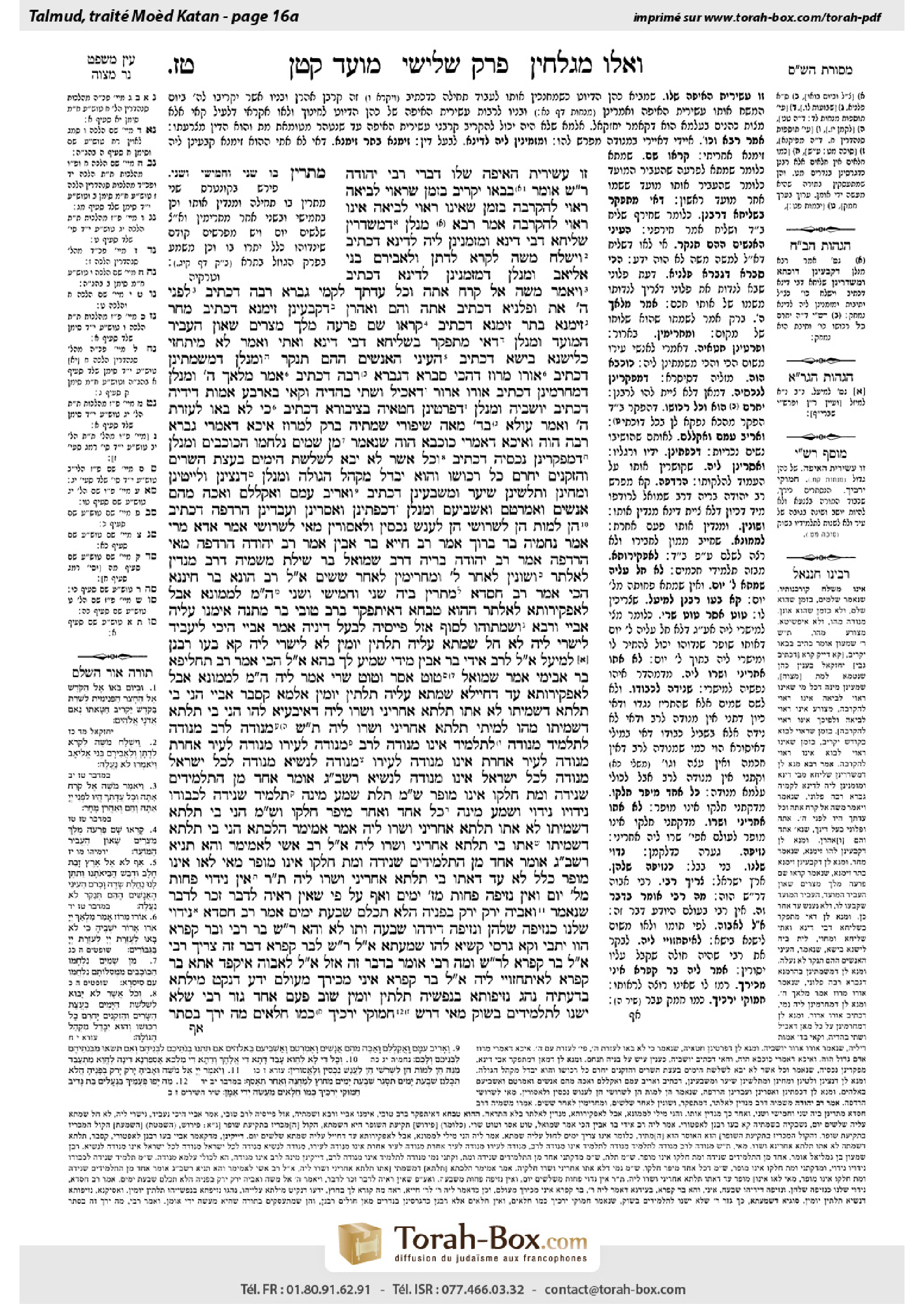
Moed Katan 16a: Talmud study for Daf Yomi
Daf Yomi is the daily study of one Talmud folio. Explore 37 tractates with scans, Hebrew text, Sefaria English and AI-generated French translations where annotated.
Passage selection and English or AI-generated French translation are available where the scan has annotations. Daf Study is independent of Torah-Box and Sefaria.
Browse Moed Katan · מועד קטן · All tractatesMoed Katan 16a text and translations
This page of Moed Katan includes the Aramaic text, an English translation and an AI-generated French translation, alongside the scan above.
מועד קטן י״ו א · Aramaic and Hebrew text
זוֹ עֲשִׂירִית הָאֵיפָה שֶׁלּוֹ, דִּבְרֵי רַבִּי יְהוּדָה.
רַבִּי שִׁמְעוֹן אוֹמֵר: ״בְּבֹאוֹ יַקְרִיב״, בִּזְמַן שֶׁרָאוּי לְבִיאָה — רָאוּי לְהַקְרָבָה, בִּזְמַן שֶׁאֵינוֹ רָאוּי לְבִיאָה — אֵינוֹ רָאוּי לְהַקְרָבָה.
אָמַר רָבָא: מְנָלַן דִּמְשַׁדְּרִין שְׁלִיחָא דְּבֵי דִינָא וּמַזְמְנִינַן לֵיהּ לְדִינָא — דִּכְתִיב: ״וַיִּשְׁלַח מֹשֶׁה לִקְרֹא לְדָתָן וְלַאֲבִירָם בְּנֵי אֱלִיאָב״. וּמְנָלַן דְּמַזְמְנִינַן לְדִינָא — דִּכְתִיב: ״וַיֹּאמֶר מֹשֶׁה אֶל קֹרַח אַתָּה וְכׇל עֲדָתְךָ״.
לְקַמֵּי גַּבְרָא רַבָּה — דִּכְתִיב: ״לִפְנֵי ה׳״. אַתְּ וּפְלָנְיָא — דִּכְתִיב: ״אַתָּה וָהֵם וְאַהֲרֹן״. דְּקָבְעִינַן זִימְנָא — דִּכְתִיב: ״מָחָר״. זִימְנָא בָּתַר זִימְנָא — דִּכְתִיב: ״קָרְאוּ שָׁם פַּרְעֹה מֶלֶךְ מִצְרַיִם שָׁאוֹן הֶעֱבִיר הַמּוֹעֵד״.
וּמְנָלַן דְּאִי מִתְפַּקַּר בִּשְׁלִיחָא דְּבֵי דִינָא, וְאָתֵי וְאָמַר, לָא מִיתְחֲזֵי כְּלִישָּׁנָא בִּישָׁא — דִּכְתִיב: ״הַעֵינֵי הָאֲנָשִׁים הָהֵם תְּנַקֵּר״.
וּמְנָלַן דִּמְשַׁמְּתִינַן — דִּכְתִיב: ״אוֹרוּ מֵרוֹז״. דְּהָכִי סְבָרָא דְּגַבְרָא רַבָּה — דִּכְתִיב: ״אָמַר מַלְאַךְ ה׳״. וּמְנָלַן דְּמַחְרְמִינַן — דִּכְתִיב: ״אוֹרוּ אָרוֹר״.
דְּאָכֵיל וְשָׁתֵי בַּהֲדֵיהּ וְקָאֵי בְּאַרְבַּע אַמּוֹת דִּידֵיהּ — דִּכְתִיב: ״יוֹשְׁבֶיהָ״. וּמְנָלַן דְּפָרְטִינַן חִטְאֵיהּ בְּצִיבּוּרָא — דִּכְתִיב: ״כִּי לֹא בָאוּ לְעֶזְרַת ה׳״.
וְאָמַר עוּלָּא: בְּאַרְבַּע מְאָה שִׁיפּוּרֵי שַׁמְּתֵיהּ בָּרָק לְמֵרוֹז. אִיכָּא דְּאָמְרִי גַּבְרָא רַבָּה הֲוָה, וְאִיכָּא דְּאָמְרִי כּוֹכְבָא הֲוָה, שֶׁנֶּאֱמַר: ״מִן שָׁמַיִם נִלְחָמוּ הַכּוֹכָבִים״.
וּמְנָלַן דְּמַפְקְרִינַן נִכְסֵיהּ — דִּכְתִיב: ״וְכׇל אֲשֶׁר לֹא יָבֹא לִשְׁלֹשֶׁת הַיָּמִים בַּעֲצַת הַשָּׂרִים וְהַזְּקֵנִים יׇחֳרַם כׇּל רְכוּשׁוֹ וְהוּא יִבָּדֵל מִקְּהַל הַגּוֹלָה״.
וּמְנָלַן דְּנָצֵינַן וְלָיְיטִינַן וּמָחֵינַן וְתָלְשִׁינַן שֵׂיעָר וּמַשְׁבְּעִינַן — דִּכְתִיב: ״וָאָרִיב עִמָּם וָאֲקַלְלֵם וָאַכֶּה מֵהֶם אֲנָשִׁים וָאֶמְרְטֵם וָאַשְׁבִּיעֵם״.
וּמְנָלַן דְּכָפְתִינַן וְאָסְרִינַן וְעָבְדִינַן הַרְדָּפָה — דִּכְתִיב: ״הֵן לְמוֹת הֵן לִשְׁרוֹשִׁי הֵן לַעֲנָשׁ נִכְסִין וְלַאֲסוּרִין״. מַאי לִשְׁרוֹשִׁי? אָמַר אַדָּא מָרִי אָמַר נְחֶמְיָה בַּר בָּרוּךְ אָמַר רַב חִיָּיא בַּר אָבִין אָמַר רַב יְהוּדָה: הַרְדָּפָה. מַאי הַרְדָּפָה? אָמַר רַב יְהוּדָה בְּרֵיהּ דְּרַב שְׁמוּאֵל בַּר שִׁילַת מִשְּׁמֵיהּ דְּרַב: מְנַדִּין לְאַלְתַּר, וְשׁוֹנִין לְאַחַר שְׁלֹשִׁים, וּמַחְרִימִין לְאַחַר שִׁשִּׁים.
אֲמַר לֵיהּ רַב הוּנָא בַּר חִינָּנָא, הָכִי אָמַר רַב חִסְדָּא: מַתְרִין בֵּיהּ שֵׁנִי וַחֲמִישִׁי וְשֵׁנִי. הָנֵי מִילֵּי לְמָמוֹנָא, אֲבָל לְאַפְקֵירוּתָא — לְאַלְתַּר.
הָהוּא טַבָּחָא דְּאִיתְפַּקַּר בְּרַב טוֹבִי בַּר מַתְנָה, אִימְּנוֹ עֲלֵיהּ אַבָּיֵי וְרָבָא וְשַׁמְּתוּהוּ, לְסוֹף אֲזַל פַּיְּיסֵיהּ לְבַעַל דִּינֵיהּ. אֲמַר אַבָּיֵי: הֵיכִי לֶיעְבֵּיד? לִישְׁרֵי לֵיהּ — לָא חַל שַׁמְתָּא עֲלֵיהּ תְּלָתִין יוֹמִין. לָא לִישְׁרֵי לֵיהּ — קָא בָּעוּ רַבָּנַן לְמֵיעַל.
אֲמַר לֵיהּ לְרַב אִידִי בַּר אָבִין: מִידֵּי שְׁמִיעַ לָךְ בְּהָא? אֲמַר לֵיהּ: הָכִי אָמַר רַב תַּחְלִיפָא בַּר אֲבִימִי אָמַר שְׁמוּאֵל: טוּט אָסַר וְטוּט שָׁרֵי. אֲמַר לֵיהּ: הָנֵי מִילֵּי לְמָמוֹנָא, אֲבָל לְאַפְקֵירוּתָא — עַד דְּחָיְילָא שַׁמְתָּא עֲלֵיהּ תְּלָתִין יוֹמִין.
אַלְמָא קָסָבַר אַבָּיֵי: הָנֵי בֵּי תְלָתָא דְּשַׁמִּיתוּ — לָא אָתוּ תְּלָתָא אַחֲרִינֵי וְשָׁרוּ לֵיהּ.
דְּאִיבַּעְיָא לְהוּ: הָנֵי בֵּי תְלָתָא דְּשַׁמִּיתוּ, מַהוּ לְמֵיתֵי תְּלָתָא אַחֲרִינֵי וְשָׁרוּ לֵיהּ? תָּא שְׁמַע: מְנוּדֶּה לָרַב — מְנוּדֶּה לַתַּלְמִיד, מְנוּדֶּה לַתַּלְמִיד — אֵינוֹ מְנוּדֶּה לָרַב.
מְנוּדֶּה לְעִירוֹ — מְנוּדֶּה לְעִיר אַחֶרֶת, מְנוּדֶּה לְעִיר אַחֶרֶת — אֵינוֹ מְנוּדֶּה לְעִירוֹ. מְנוּדֶּה לַנָּשִׂיא — מְנוּדֶּה לְכׇל יִשְׂרָאֵל, מְנוּדֶּה לְכׇל יִשְׂרָאֵל — אֵינוֹ מְנוּדֶּה לַנָּשִׂיא. רַבָּן שִׁמְעוֹן בֶּן גַּמְלִיאֵל אוֹמֵר: אֶחָד מִן הַתַּלְמִידִים שֶׁנִּידָּה וָמֵת — חֶלְקוֹ אֵינוֹ מוּפָר.
שְׁמַע מִינַּהּ תְּלָת: שְׁמַע מִינַּהּ תַּלְמִיד שֶׁנִּידָּה לִכְבוֹדוֹ — נִידּוּיוֹ נִידּוּי, וּשְׁמַע מִינַּהּ כׇּל אֶחָד וְאֶחָד מֵיפֵר חֶלְקוֹ, וּשְׁמַע מִינַּהּ הָנֵי בֵּי תְלָתָא דְּשַׁמִּיתוּ, לָא אָתוּ תְּלָתָא אַחֲרִינֵי וְשָׁרוּ לֵיהּ.
אָמַר אַמֵּימָר: הִלְכְתָא, הָנֵי בֵּי תְלָתָא דְּשַׁמִּיתוּ — אָתוּ בֵּי תְּלָתָא אַחֲרִינֵי וְשָׁרוּ לֵיהּ. אֲמַר לֵיהּ רַב אָשֵׁי לְאַמֵּימָר: וְהָא תַּנְיָא, רַבָּן שִׁמְעוֹן בֶּן גַּמְלִיאֵל אוֹמֵר: אֶחָד מִן הַתַּלְמִידִים שֶׁנִּידָּה וָמֵת — חֶלְקוֹ אֵינוֹ מוּפָר. מַאי לָאו, אֵינוֹ מוּפָר כְּלָל! לָא, עַד דְּאָתוּ בֵּי תְּלָתָא אַחֲרִינֵי וְשָׁרוּ לֵיהּ.
תָּנוּ רַבָּנַן: אֵין נִידּוּי פָּחוֹת מִשְּׁלֹשִׁים יוֹם, וְאֵין נְזִיפָה פָּחוֹת מִשִּׁבְעָה יָמִים. וְאַף עַל פִּי שֶׁאֵין רְאָיָה לַדָּבָר, זֵכֶר לַדָּבָר, שֶׁנֶּאֱמַר: ״וְאָבִיהָ יָרֹק יָרַק בְּפָנֶיהָ הֲלֹא תִכָּלֵם שִׁבְעַת יָמִים״.
אָמַר רַב חִסְדָּא: נִידּוּי שֶׁלָּנוּ כִּנְזִיפָה שֶׁלָּהֶן, וּנְזִיפָה דִּידְהוּ שִׁבְעָה וְתוּ לָא. וְהָא רַבִּי שִׁמְעוֹן בַּר רַבִּי וּבַר קַפָּרָא הֲווֹ יָתְבִי וְקָא גָרְסִי, קַשְׁיָא לְהוּ שְׁמַעְתָּא, אֲמַר לֵיהּ רַבִּי שִׁמְעוֹן לְבַר קַפָּרָא: דָּבָר זֶה צָרִיךְ רַבִּי. אֲמַר לֵיהּ בַּר קַפָּרָא לְרַבִּי שִׁמְעוֹן: וּמָה רַבִּי אוֹמֵר בְּדָבָר זֶה?
אֲזַל אֲמַר לֵיהּ לַאֲבוּהּ, אִיקְּפַד. אֲתָא בַּר קַפָּרָא לְאִיתְחֲזוֹיֵי לֵיהּ, אֲמַר לֵיהּ: בַּר קַפָּרָא, אֵינִי מַכִּירְךָ מֵעוֹלָם! יְדַע דִּנְקַט מִילְּתָא בְּדַעְתֵּיהּ, נְהַג נְזִיפוּתָא בְּנַפְשֵׁיהּ תְּלָתִין יוֹמִין.
שׁוּב פַּעַם אֶחָד גָּזַר רַבִּי שֶׁלֹּא יִשְׁנוּ לַתַּלְמִידִים בַּשּׁוּק, מַאי דְּרַשׁ — ״חַמּוּקֵי יְרֵכַיִךְ כְּמוֹ חֲלָאִים״. מָה יָרֵךְ בַּסֵּתֶר,
Moed Katan 16a · English translation
this is the meal-offering of a tenth of an ephah of flour, which every priest would bring on the day he began serving in the Temple. But as long as he is ritually impure, whether because he had come into contact with a corpse or due to leprosy, he may not send his offerings to the Temple; this is the statement of Rabbi Yehuda.
Rabbi Shimon says: The verse states: “And on the day that he goes into the Sanctuary, into the inner court, to minister in the Sanctuary he shall sacrifice his sin offering.” This teaches that when he is fit to enter the Sanctuary, he is fit to sacrifice an offering. But when he is not fit to go into the Sanctuary, i.e., when he is ritually impure, he is not fit to sacrifice an offering. This implies that a leper may not send his offerings to the Temple to be sacrificed on the altar, as he himself is not fit to enter the Temple.
§ Having discussed some of the restrictions applying to a person who was ostracized, the Gemara explains some of the basic principles relating to ostracism: Rava said: From where do we derive that a court agent is sent to summon the defendant to appear before the court before he is ostracized? As it is written: “And Moses sent to call Dathan and Abiram, the sons of Eliab” (Numbers 16:12). And from where do we derive that we summon the defendant, that he himself must appear before the court? As it is written: “And Moses said to Korah: Be you and all your congregation before the Lord, you and they, and Aaron, tomorrow” (Numbers 16:16).
From where is it derived that the defendant must be told that he is being summoned to appear before a great man? As it is written: “And Moses said to Korah: Be you and all your congregation before the Lord” (Numbers 16:16). From where is it derived that the summons must mention the names of both parties: You and so-and-so, the plaintiff? As it is written: “You, and they, and Aaron” (Numbers 16:16). From where is it derived that we set a date for the court proceedings? As it is written: “Tomorrow” (Numbers 16:16). From where is it derived that a second date must be set after the first date, if the defendant did not heed the first summons? As it is written: “They did cry there, Pharaoh, king of Egypt is but a noise; he has passed the time appointed…Surely as Tabor is among the mountains, and as Carmel by the sea, so shall he come” (Jeremiah 46:17). Although a time had been appointed and it had passed, it was not canceled entirely but pushed off to a later date.
And from where do we derive that if the summoned person behaves disrespectfully toward the agent of the court, and the agent comes back and reports his conduct, that this is not considered slander? As it is written: “Will you put out the eyes of these men?” (Numbers 16:14). Dathan and Abiram spoke these words to the messenger that Moses had sent to them, and the messenger reported them back to Moses.
And from where do we derive that we ostracize one who does not obey a court summons? As it is written: “Curse Meroz” (Judges 5:23), who was ostracized for not coming to battle after having been summoned. From where is it derived that the ostracized person must be told that it was the decision of a great man to ostracized him? As it is written: “Curse Meroz, said the messenger of the Lord” (Judges 5:23). And from where do we derive that, if he fails to mend his ways, we excommunicate such a person more harshly, putting him under the most severe form of excommunication? As it is written: “Curse Meroz…curse bitterly its inhabitants” (Judges 5:23), implying that one curse is followed by another, i.e., lesser ostracism is followed by harsh excommunication.
From where is it derived that the curse applies to anyone who eats or drinks with, or stands within, four cubits of the ostracized person? As it is written: “Curse bitterly its inhabitants” (Judges 5:23), in reference to all those sitting together with Meroz. And from where do we derive that we detail his sin in public? As it is written: “Curse bitterly its inhabitants, because they did not come to the help of the Lord” (Judges 5:23).
And Ulla said: Barak ostracized Meroz with the blowing of four hundred shofarot due to his failure to come. As for the identification of Meroz, some say that he was a great man and that he was ostracized because he did not join in the war effort. And others say that the reference is to a star and not a human being, and that it did not aid the Jewish people in their battle, as it is stated: “The stars fought from heaven; in their courses they fought against Sisera,” (Judges 5:20). This star, which did not help the Jewish people, was cursed.
And from where do we derive that the court may declare the property of one who does not obey its orders as ownerless? As it is written: “And that whoever would not come within three days, according to the counsel of the princes and the Elders, all his substance shall be forfeited [yaḥoram] and himself separated from the congregation of the exiles” (Ezra 10:8). “Shall be forfeited” is referring to excommunication.
And from where do we derive that we may contend with such a person, and curse him, and beat him, and pull out his hair, and make him take an oath in order to prevent him from sinning? As it is written: “And I contended with them, and cursed them, and beat some of them, and pulled out their hair, and made them take oath by God” (Nehemiah 13:25).
And from where do we derive that we may shackle his hands and feet, chain him, and apply pressure? As it is written: “Whether it be for death, or for banishment [lishroshi], or for confiscation of goods, or for imprisonment” (Ezra 7:26). The Gemara asks: What is the meaning of the word “lishroshi,” translated here as banishment? Adda Mari said that Neḥemya bar Baruch said that Rav Ḥiyya bar Avin said that Rav Yehuda said: This is pressure. Since this expression is also unclear, the Gemara asks: What is pressure? Rav Yehuda, son of Rav Shmuel bar Sheilat, said in the name of Rav that this term refers to the following series of actions: They ostracize him immediately, and then once again after thirty days, and if he still does not repent, they excommunicate him after sixty days.
Rav Huna bar Ḥinnana said to him: Rav Ḥisda said as follows: Before excommunicating a person, the court warns him three times, on Monday, Thursday, and the following Monday. The Gemara notes: This applies in a case where one ignores a monetary judgment that was issued against him. He is warned three times that he must repay his debt. But in a case where one behaves disrespectfully toward a Torah scholar, he is immediately ostracized.
§ The Gemara relates that a certain butcher behaved disrespectfully toward Rav Tuvi bar Mattana. Abaye and Rava were appointed to the case and ostracized him. In the end the butcher went and appeased his disputant, Rav Tuvi. Abaye said: What should we do in this case? Shall he be released from his decree of ostracism? His decree of ostracism has not yet been in effect for the usual thirty days. On the other hand, shall he not be released from ostracism? But the Sages wish to enter his shop and purchase meat, and they are presently unable to do so. What, then, is the most appropriate course of action?
He said to Rav Idi bar Avin: Have you heard anything with regard to such a case? Rav Idi bar Avin said to Abaye: Rav Taḥlifa bar Avimi said that Shmuel said as follows: A shofar blast at the time of the ostracism makes it binding, and a shofar blast releases it. In other words, the shofar should be sounded now, as it had been sounded when the decree of ostracism was pronounced, and it should be canceled, although thirty days have not passed. Abaye said to him: This applies in a case where one ignores a monetary judgment that was issued against him; but in a case where one behaves disrespectfully, there must be no release until the decree of ostracism has been in effect for thirty days.
The Gemara comments: Apparently, Abaye maintains that if three people ostracized one, three others may not come and release him. This is derived from the fact that Abaye was concerned about releasing the butcher from ostracism and did not delegate the task to someone else.
As a dilemma was raised before the Sages: If three people ostracized someone, what is the halakha with regard to three others coming and releasing him from his decree of ostracism? The Gemara suggests: Come and hear a proof from that which is taught in a baraita: One who was ostracized by the teacher of Torah for having acted disrespectfully toward him is considered ostracized with regard to the student, and the latter must keep his distance from him. However, one who was ostracized by the student is not considered ostracized with regard to the teacher.
One who was ostracized by his own city is considered ostracized with regard to another city. However, one who was ostracized by another city is not considered ostracized with regard to his own city. One who was ostracized by the Nasi of the Sanhedrin is considered ostracized with regard to all the Jewish people; but one who was ostracized by all the Jewish people is not considered ostracized with regard to the Nasi of the Sanhedrin. Rabban Shimon ben Gamliel says: If one of the students sitting as a judge on the court had ostracized someone, and he died before releasing him from the decree of ostracism, his portion of the decree of ostracism is not nullified.
The Gemara says: Learn three halakhot from this baraita. Learn from this that in the case of a student who ostracizes someone due to an insult to his dignity and not because the ostracized person was guilty of some transgression, his decree of ostracism is valid. Were the case one where one was ostracized due to sin, everyone is required to respect the decree of ostracism, even the student’s teacher. And learn from this that each and every one who participated in the decree of ostracism nullifies his own portion of the decree of ostracism, as the baraita speaks of: His portion. And learn from this that if three people ostracized another person, three other people may not come and nullify the decree of ostracism. Were this not the case, it wouldn’t matter if a certain person’s portion was not nullified. His portion could be nullified by someone else.
Ameimar said: The halakha is that if three people ostracize another person, three others may come and nullify the decree of ostracism. Rav Ashi said to Ameimar: But isn’t it taught in a baraita: Rabban Shimon ben Gamliel says: If one of the students had ostracized another person, and he died before releasing him from the decree of ostracism, his portion is not nullified? What, is it not that it is not nullified at all, i.e., it cannot be nullified by another person? The Gemara rejects this argument: No, this means that the decree of ostracism remains in force until three other people come and nullify it.
§ The Sages taught the following baraita: Ostracism does not apply for less than a period of thirty days, and admonition, which is less severe than ostracism, does not apply for less than a period of seven days. And although there is no proof with regard to the matter, i.e., the standard duration of admonition, there is an allusion to the matter, as it is stated: “If her father had but spit in her face, should she not be ashamed for seven days?” (Numbers 12:14). This implies that admonition lasts for seven days.
Rav Ḥisda said: Our decree of ostracism in Babylonia has the power of their admonition in Eretz Yisrael. Since the authorities in Eretz Yisrael are ordained with the title Rabbi, their admonition carries more weight than a decree of ostracism issued in Babylonia. The Gemara asks: Is their admonition in Eretz Yisrael only seven days and no more? But isn’t it related that Rabbi Shimon, son of Rabbi Yehuda HaNasi, and bar Kappara were sitting and studying, and they posed a difficulty with a certain halakha. Rabbi Shimon said to bar Kappara: This issue requires my father, Rabbi Yehuda HaNasi, to explain it. Bar Kappara said to Rabbi Shimon, somewhat mockingly: And what can your father, Rabbi Yehuda HaNasi, say about this issue? What can he add and teach us about it?
Rabbi Shimon went and told his father, Rabbi Yehuda HaNasi, what bar Kappara had said, and Rabbi Yehuda HaNasi became angry with him. When bar Kappara came at some later point to visit, Rabbi Yehuda HaNasi said to him: Bar Kappara, I do not know you at all. Bar Kappara understood that Rabbi Yehuda HaNasi had taken his statement to heart, i.e., was insulted. He subsequently behaved as if he had been admonished, as a self-imposed punishment, for thirty days.
Once again, on another occasion, Rabbi Yehuda HaNasi decreed that students not be taught in the marketplace but only in a study hall. What verse did he expound to serve as the basis for this decree? The verse states: “Your rounded thighs are like jewels, the work of the hands of an artist” (Song of Songs 7:2). Just as a thigh is ordinarily hidden and kept covered with clothes,
Moed Katan 16a · Traduction française (IA)
Il s’agit de l’offrande de farine d’un dixième d’épha que chaque prêtre apportait le jour où il commençait à servir dans le Temple. Mais tant qu’il est rituellement impur, que ce soit parce qu’il a été en contact avec un cadavre ou parce qu’il est atteint de lèpre, il ne peut pas envoyer ses offrandes au Temple. Telle est la déclaration de Rabbi Yehuda.
Rabbi Shimon dit : Le verset énonce : « Le jour où il entrera dans le Sanctuaire, dans la cour intérieure, pour servir dans le Sanctuaire, il offrira son sacrifice expiatoire. » Cela enseigne que lorsqu’il est apte à entrer dans le Sanctuaire, il est apte à offrir un sacrifice. Mais lorsqu’il n’est pas apte à entrer dans le Sanctuaire, c’est-à-dire lorsqu’il est rituellement impur, il n’est pas apte à offrir un sacrifice. Cela implique qu’un lépreux ne peut pas envoyer ses offrandes au Temple pour qu’elles soient offertes sur l’autel, puisqu’il n’est pas lui-même apte à entrer dans le Temple.
§ Après avoir évoqué certaines des restrictions qui s’appliquent à une personne mise au ban, la Guemara expose quelques principes fondamentaux concernant la mise au ban. Rava dit : D’où savons-nous qu’un émissaire du tribunal est envoyé pour convoquer le défendeur à comparaître devant le tribunal avant qu’il soit mis au ban ? Comme il est écrit : « Moïse envoya appeler Dathan et Abiram, fils d’Eliab » (Nombres 16:12). Et d’où savons-nous que le défendeur est convoqué, c’est-à-dire qu’il doit comparaître lui-même devant le tribunal ? Comme il est écrit : « Moïse dit à Korah : Présentez-vous, toi et toute ton assemblée, devant l’Éternel, toi, eux et Aaron, demain » (Nombres 16:16).
D’où apprend-on qu’il faut informer le défendeur qu’il est convoqué à comparaître devant un grand homme ? Comme il est écrit : « Moïse dit à Korah : Présentez-vous, toi et toute ton assemblée, devant l’Éternel » (Nombres 16:16). D’où apprend-on que la convocation doit mentionner les noms des deux parties : toi et untel, le demandeur ? Comme il est écrit : « Toi, eux et Aaron » (Nombres 16:16). D’où apprend-on qu’il faut fixer une date pour l’audience ? Comme il est écrit : « Demain » (Nombres 16:16). D’où apprend-on qu’une deuxième date doit être fixée après la première si le défendeur n’a pas donné suite à la première convocation ? Comme il est écrit : « On criait là : Pharaon, roi d’Égypte, n’est qu’un bruit ; il a laissé passer le moment fixé… Certes, comme le Tabor parmi les montagnes et comme le Carmel près de la mer, il viendra » (Jérémie 46:17). Bien qu’une date ait été fixée et qu’elle soit passée, la convocation n’a pas été entièrement annulée, mais reportée à une date ultérieure.
Et d’où savons-nous que si la personne convoquée manque de respect à l’émissaire du tribunal, et que celui-ci revient rapporter son comportement, cela n’est pas considéré comme de la médisance ? Comme il est écrit : « Veux-tu crever les yeux de ces hommes ? » (Nombres 16:14). Dathan et Abiram adressèrent ces paroles au messager que Moïse leur avait envoyé, et celui-ci les rapporta à Moïse.
Et d’où savons-nous que l’on met au ban celui qui n’obéit pas à une convocation du tribunal ? Comme il est écrit : « Maudissez Meroz » (Juges 5:23), qui fut mis au ban pour ne pas être venu combattre après avoir été convoqué. D’où apprend-on qu’il faut informer la personne mise au ban que la décision a été prise par un grand homme ? Comme il est écrit : « Maudissez Meroz, dit le messager de l’Éternel » (Juges 5:23). Et d’où savons-nous que s’il ne corrige pas sa conduite, on l’excommunie plus sévèrement, en lui imposant la forme d’excommunication la plus rigoureuse ? Comme il est écrit : « Maudissez Meroz… maudissez amèrement ses habitants » (Juges 5:23), ce qui implique qu’une malédiction en suit une autre, c’est-à-dire qu’une mise au ban moins sévère est suivie d’une excommunication rigoureuse.
D’où apprend-on que la malédiction s’applique à quiconque mange ou boit avec la personne mise au ban, ou se tient à moins de quatre coudées d’elle ? Comme il est écrit : « Maudissez amèrement ses habitants » (Juges 5:23), à propos de tous ceux qui étaient assis avec Meroz. Et d’où savons-nous qu’il faut exposer publiquement sa faute ? Comme il est écrit : « Maudissez amèrement ses habitants, car ils ne sont pas venus au secours de l’Éternel » (Juges 5:23).
Et Ulla dit : Barak mit Meroz au ban au son de quatre cents chofarot, parce qu’il n’était pas venu. Quant à l’identification de Meroz, certains disent qu’il s’agissait d’un grand homme, mis au ban parce qu’il n’avait pas participé à l’effort de guerre. D’autres disent que le texte fait référence à une étoile et non à un être humain, et que celle-ci n’a pas aidé le peuple juif dans son combat, comme il est dit : « Les étoiles combattirent du haut des cieux ; de leurs orbites, elles combattirent contre Sisera » (Juges 5:20). Cette étoile, qui n’avait pas aidé le peuple juif, fut maudite.
Et d’où savons-nous que le tribunal peut déclarer sans propriétaire les biens de celui qui n’obéit pas à ses ordres ? Comme il est écrit : « Et quiconque ne viendrait pas dans les trois jours, conformément à la décision des chefs et des anciens, verrait tous ses biens confisqués [yaḥoram] et serait séparé de la communauté des exilés » (Esdras 10:8). « Verrait tous ses biens confisqués » fait référence à l’excommunication.
Et d’où savons-nous que nous pouvons nous opposer à une telle personne, la maudire, la frapper, lui arracher les cheveux et lui faire prêter serment, afin de l’empêcher de pécher ? Comme il est écrit : « Je me suis opposé à eux, je les ai maudits, j’en ai frappé quelques-uns, je leur ai arraché les cheveux et je les ai fait jurer par Dieu » (Néhémie 13:25).
Et d’où savons-nous que nous pouvons lui entraver les mains et les pieds, l’enchaîner et exercer une pression sur lui ? Comme il est écrit : « Qu’il s’agisse de mort, de bannissement [lishroshi], de confiscation des biens ou d’emprisonnement » (Esdras 7:26). La Guemara demande : Que signifie le mot « lishroshi », traduit ici par bannissement ? Adda Mari dit que Neḥemya bar Baruch dit que Rav Ḥiyya bar Avin dit que Rav Yehuda dit : Cela désigne la pression. Comme cette expression est elle aussi obscure, la Guemara demande : Qu’est-ce que cette pression ? Rav Yehuda, fils de Rav Shmuel bar Sheilat, dit au nom de Rav que ce terme désigne la série d’actions suivante : on le met immédiatement au ban, puis de nouveau après trente jours et, s’il ne se repent toujours pas, on l’excommunie après soixante jours.
Rav Huna bar Ḥinnana lui dit : Rav Ḥisda a formulé la règle suivante : Avant d’excommunier une personne, le tribunal l’avertit trois fois, le lundi, le jeudi et le lundi suivant. La Guemara précise : Cela s’applique dans le cas où quelqu’un ne tient pas compte d’un jugement pécuniaire rendu contre lui. On l’avertit trois fois qu’il doit rembourser sa dette. Mais si quelqu’un manque de respect à un sage de Torah, on le met immédiatement au ban.
§ La Guemara rapporte qu’un certain boucher avait manqué de respect à Rav Tuvi bar Mattana. Abaye et Rava furent chargés de l’affaire et le mirent au ban. Finalement, le boucher alla apaiser son adversaire, Rav Tuvi. Abaye dit : Que devons-nous faire dans ce cas ? Faut-il le relever de la mise au ban ? Le délai habituel de trente jours n’est pas encore écoulé. D’un autre côté, faut-il ne pas le relever de la mise au ban ? Mais les sages souhaitent entrer dans sa boutique pour acheter de la viande, et ils ne le peuvent pas actuellement. Quelle est donc la conduite la plus appropriée ?
Il dit à Rav Idi bar Avin : As-tu entendu quelque chose au sujet d’un tel cas ? Rav Idi bar Avin dit à Abaye : Rav Taḥlifa bar Avimi a dit au nom de Shmuel ce qui suit : Un son de chofar au moment de la mise au ban lui donne effet, et un son de chofar y met fin. Autrement dit, il faut sonner du chofar maintenant, comme on l’avait fait lorsque le décret de mise au ban avait été prononcé, et l’annuler, même si trente jours ne se sont pas écoulés. Abaye lui dit : Cela s’applique dans le cas où quelqu’un ne tient pas compte d’un jugement pécuniaire rendu contre lui ; mais si quelqu’un manque de respect, il ne faut pas le relever de la mise au ban avant que le décret ait été en vigueur pendant trente jours.
La Guemara fait remarquer : Apparemment, Abaye estime que si trois personnes ont mis quelqu’un au ban, trois autres ne peuvent pas venir l’en relever. Cela ressort du fait qu’Abaye se souciait de relever le boucher de la mise au ban et n’a pas délégué cette tâche à quelqu’un d’autre.
Une question fut soulevée devant les sages : Si trois personnes ont mis quelqu’un au ban, quelle est la halakha quant à la possibilité que trois autres viennent le relever de cette mise au ban ? La Guemara propose : Voyons ce qui peut être déduit de ce qui est enseigné dans une baraïta : Celui qui a été mis au ban par son maître de Torah pour lui avoir manqué de respect est considéré comme mis au ban aux yeux de l’élève, et celui-ci doit garder ses distances avec lui. Cependant, celui qui a été mis au ban par l’élève n’est pas considéré comme mis au ban aux yeux du maître.
Celui qui a été mis au ban par sa propre ville est considéré comme mis au ban dans une autre ville. Cependant, celui qui a été mis au ban par une autre ville n’est pas considéré comme mis au ban dans sa propre ville. Celui qui a été mis au ban par le Nassi du Sanhédrin est considéré comme mis au ban aux yeux de tout le peuple juif ; mais celui qui a été mis au ban par tout le peuple juif n’est pas considéré comme mis au ban aux yeux du Nassi du Sanhédrin. Rabban Shimon ben Gamliel dit : Si l’un des élèves siégeant comme juge au tribunal a mis quelqu’un au ban et meurt avant de l’en relever, sa part du décret de mise au ban n’est pas annulée.
La Guemara dit : Apprends trois halakhot de cette baraïta. Apprends-en que lorsqu’un élève met quelqu’un au ban parce qu’on a porté atteinte à sa dignité, et non parce que la personne mise au ban a commis une transgression, son décret de mise au ban est valide. Si la personne avait été mise au ban pour une faute, tous seraient tenus de respecter le décret de mise au ban, même le maître de l’élève. Apprends-en également que chacun de ceux qui ont participé au décret de mise au ban annule sa propre part du décret, puisque la baraïta parle de « sa part ». Enfin, apprends-en que si trois personnes ont mis quelqu’un au ban, trois autres ne peuvent pas venir annuler le décret de mise au ban. S’il en était autrement, peu importerait que la part d’une certaine personne n’ait pas été annulée : quelqu’un d’autre pourrait l’annuler.
Ameimar dit : La halakha est que si trois personnes mettent quelqu’un au ban, trois autres peuvent venir annuler le décret de mise au ban. Rav Ashi dit à Ameimar : Mais n’est-il pas enseigné dans une baraïta : Rabban Shimon ben Gamliel dit que si l’un des élèves a mis quelqu’un au ban et meurt avant de l’en relever, sa part n’est pas annulée ? Cela ne signifie-t-il pas qu’elle n’est absolument pas annulée, c’est-à-dire qu’une autre personne ne peut pas l’annuler ? La Guemara rejette cet argument : Non, cela signifie que le décret de mise au ban reste en vigueur jusqu’à ce que trois autres personnes viennent l’annuler.
§ Les sages enseignent dans la baraïta suivante : La mise au ban ne s’applique pas pour une durée inférieure à trente jours, et l’admonestation, qui est moins sévère que la mise au ban, ne s’applique pas pour une durée inférieure à sept jours. Et bien qu’il n’y ait pas de preuve concernant la durée habituelle de l’admonestation, il y en a une allusion, comme il est dit : « Si son père lui avait craché au visage, ne serait-elle pas couverte de honte pendant sept jours ? » (Nombres 12:14). Cela implique que l’admonestation dure sept jours.
Rav Ḥisda dit : Notre mise au ban en Babylonie a la même force que leur admonestation en Eretz Yisrael. Puisque les autorités d’Eretz Yisrael ont reçu l’ordination et portent le titre de Rabbi, leur admonestation a davantage de poids qu’un décret de mise au ban prononcé en Babylonie. La Guemara demande : Leur admonestation en Eretz Yisrael ne dure-t-elle que sept jours, pas davantage ? N’est-il pas rapporté que Rabbi Shimon, fils de Rabbi Yehuda HaNasi, et bar Kappara étaient assis et étudiaient, et qu’ils rencontrèrent une difficulté au sujet d’une certaine halakha ? Rabbi Shimon dit à bar Kappara : Cette question requiert que mon père, Rabbi Yehuda HaNasi, l’explique. Bar Kappara dit à Rabbi Shimon, sur un ton quelque peu moqueur : Et que peut dire ton père, Rabbi Yehuda HaNasi, au sujet de cette question ? Que peut-il y ajouter et nous enseigner à son propos ?
Rabbi Shimon alla rapporter à son père, Rabbi Yehuda HaNasi, ce que bar Kappara avait dit, et Rabbi Yehuda HaNasi se mit en colère contre lui. Lorsque bar Kappara vint lui rendre visite quelque temps plus tard, Rabbi Yehuda HaNasi lui dit : Bar Kappara, je ne te connais pas du tout. Bar Kappara comprit que Rabbi Yehuda HaNasi avait pris ses paroles à cœur, c’est-à-dire qu’il s’était senti offensé. Par la suite, il se comporta comme s’il avait été admonesté, en s’imposant une punition de trente jours.
Une autre fois, Rabbi Yehuda HaNasi décréta que les élèves ne devaient pas recevoir d’enseignement sur la place du marché, mais uniquement dans une maison d’étude. Quel verset interpréta-t-il pour fonder ce décret ? Le verset énonce : « Tes hanches arrondies sont comme des joyaux, œuvre des mains d’un artiste » (Cantique des Cantiques 7:2). De même qu’une hanche est ordinairement cachée et couverte par des vêtements,
Traduction française générée par IA à partir de l’édition anglaise de Sefaria. Vérifie toujours un passage avec le texte source.
Text from Sefaria: William Davidson Edition - Vocalized Aramaic (CC BY NC); William Davidson Edition - English (CC BY NC).