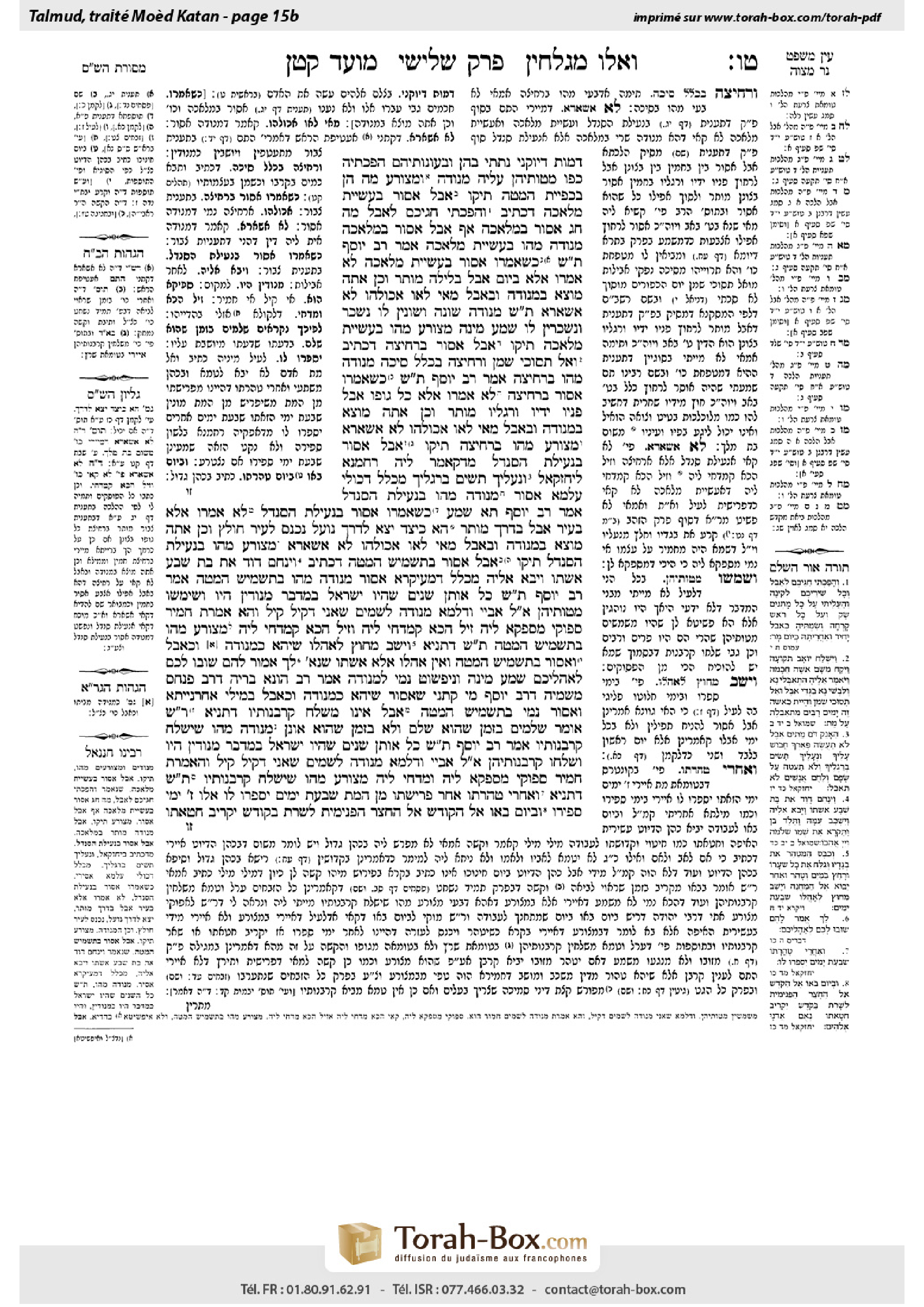
Moed Katan 15b: Talmud study for Daf Yomi
Daf Yomi is the daily study of one Talmud folio. Explore 37 tractates with scans, Hebrew text, Sefaria English and AI-generated French translations where annotated.
Passage selection and English or AI-generated French translation are available where the scan has annotations. Daf Study is independent of Torah-Box and Sefaria.
Browse Moed Katan · מועד קטן · All tractatesMoed Katan 15b text and translations
This page of Moed Katan includes the Aramaic text, an English translation and an AI-generated French translation, alongside the scan above.
מועד קטן י״ה ב · Aramaic and Hebrew text
דְּמוּת דְּיוֹקְנִי נָתַתִּי בָּהֶן, וּבַעֲוֹנוֹתֵיהֶם הֲפַכְתִּיהָ. (כָּפוּ) [יֵהָפְכוּ] מִטּוֹתֵיהֶן עָלֶיהָ. מְנוּדֶּה וּמְצוֹרָע מָה הֵן בִּכְפִיַּית הַמִּטָּה? תֵּיקוּ.
אָבֵל אָסוּר בַּעֲשִׂיַּית מְלָאכָה, דִּכְתִיב: ״וְהָפַכְתִּי חַגֵּיכֶם לְאֵבֶל״. מָה חַג אָסוּר בִּמְלָאכָה — אַף אָבֵל אָסוּר בִּמְלָאכָה.
מְנוּדֶּה מַהוּ בַּעֲשִׂיַּית מְלָאכָה? אָמַר רַב יוֹסֵף, תָּא שְׁמַע: כְּשֶׁאָמְרוּ אָסוּר בַּעֲשִׂיַּית מְלָאכָה, לֹא אָמְרוּ אֶלָּא בַּיּוֹם, אֲבָל בַּלַּיְלָה מוּתָּר. וְכֵן אַתָּה מוֹצֵא בִּמְנוּדֶּה וּבְאָבֵל. מַאי לָאו, אַכּוּלְּהוּ? לָא, אַשְּׁאָרָא.
תָּא שְׁמַע: מְנוּדֶּה שׁוֹנֶה וְשׁוֹנִין לוֹ, נִשְׂכָּר וְנִשְׂכָּרִין לוֹ. שְׁמַע מִינַּהּ. מְצוֹרָע מַהוּ בַּעֲשִׂיַּית מְלָאכָה? תֵּיקוּ.
אָבֵל אָסוּר בִּרְחִיצָה, דִּכְתִיב: ״וְאַל תָּסוּכִי שֶׁמֶן״, וּרְחִיצָה בִּכְלַל סִיכָה.
מְנוּדֶּה מַהוּ בִּרְחִיצָה? אָמַר רַב יוֹסֵף, תָּא שְׁמַע: כְּשֶׁאָמְרוּ אָסוּר בִּרְחִיצָה לֹא אָמְרוּ אֶלָּא כׇּל גּוּפוֹ, אֲבָל פָּנָיו יָדָיו וְרַגְלָיו — מוּתָּר, וְכֵן אַתָּה מוֹצֵא בִּמְנוּדֶּה וּבְאָבֵל. מַאי לָאו אַכּוּלְּהוּ? לָא, אַשְּׁאָרָא. מְצוֹרָע מַהוּ בִּרְחִיצָה? תֵּיקוּ.
אָבֵל אָסוּר בִּנְעִילַת הַסַּנְדָּל, מִדְּקָאָמַר לֵיהּ רַחֲמָנָא לִיחֶזְקֵאל ״וּנְעָלֶיךָ תָּשִׂים בְּרַגְלֶיךָ״, מִכְּלָל דְּכוּלֵּי עָלְמָא אָסוּר.
מְנוּדֶּה מַהוּ בִּנְעִילַת הַסַּנְדָּל? אָמַר רַב יוֹסֵף, תָּא שְׁמַע: כְּשֶׁאָמְרוּ אָסוּר בִּנְעִילַת הַסַּנְדָּל — לֹא אָמְרוּ אֶלָּא בָּעִיר, אֲבָל בַּדֶּרֶךְ — מוּתָּר. הָא כֵּיצַד? יָצָא לַדֶּרֶךְ — נוֹעֵל, נִכְנַס לָעִיר — חוֹלֵץ, וְכֵן אַתָּה מוֹצֵא בִּמְנוּדֶּה וּבְאָבֵל. מַאי לָאו אַכּוּלְּהוּ? לָא, אַשְּׁאָרָא.
מְצוֹרָע מַהוּ בִּנְעִילַת הַסַּנְדָּל? תֵּיקוּ.
אָבֵל אָסוּר בְּתַשְׁמִישׁ הַמִּטָּה, דִּכְתִיב: ״וַיְנַחֵם דָּוִד אֵת בַּת שֶׁבַע אִשְׁתּוֹ וַיָּבֹא אֵלֶיהָ״, מִכְּלָל דְּמֵעִיקָּרָא אָסוּר.
מְנוּדֶּה מַהוּ בְּתַשְׁמִישׁ הַמִּטָּה? אָמַר רַב יוֹסֵף, תָּא שְׁמַע: כׇּל אוֹתָן שָׁנִים שֶׁהָיוּ יִשְׂרָאֵל בַּמִּדְבָּר מְנוּדִּין הָיוּ, וְשִׁימְּשׁוּ מִטּוֹתֵיהֶן. אֲמַר לֵיהּ אַבָּיֵי: וְדִלְמָא מְנוּדֶּה לַשָּׁמַיִם שָׁאנֵי, דְּקִיל.
קִיל?! וְהָא אָמְרַתְּ חֲמִיר! סַפּוֹקֵי מְסַפְּקָא לֵיהּ: זִיל הָכָא קָמְדַחֵי לֵיהּ, וְזִיל הָכָא קָמְדַחֵי לֵיהּ.
מְצוֹרָע מַהוּ בְּתַשְׁמִישׁ הַמִּטָּה? תָּא שְׁמַע, דְּתַנְיָא: ״וְיָשַׁב מִחוּץ לְאׇהֳלוֹ״, שֶׁיְּהֵא כִּמְנוּדֶּה וּכְאָבֵל, וְאָסוּר בְּתַשְׁמִישׁ הַמִּטָּה. וְאֵין ״אׇהֳלוֹ״ אֶלָּא אִשְׁתּוֹ, שֶׁנֶּאֱמַר: ״לֵךְ אֱמוֹר לָהֶם שׁוּבוּ לָכֶם לְאׇהֳלֵיכֶם״. שְׁמַע מִינַּהּ.
וְנִיפְשׁוֹט נָמֵי לִמְנוּדֶּה? אָמַר רַב הוּנָא בְּרֵיהּ דְּרַב פִּנְחָס מִשְּׁמֵיהּ דְּרַב יוֹסֵף: מִי קָתָנֵי שֶׁאָסוּר? שֶׁיְּהֵא כִּמְנוּדֶּה וּכְאָבֵל בְּמִילֵּי אַחְרָנְיָיתָא, וְאָסוּר נָמֵי בְּתַשְׁמִישׁ הַמִּטָּה.
אָבֵל אֵינוֹ מְשַׁלֵּחַ קׇרְבְּנוֹתָיו, דְּתַנְיָא, רַבִּי שִׁמְעוֹן אוֹמֵר: ״שְׁלָמִים״ — בִּזְמַן שֶׁהוּא שָׁלֵם, וְלֹא בִּזְמַן שֶׁהוּא אוֹנֵן.
מְנוּדֶּה מַהוּ שֶׁיְּשַׁלַּח קׇרְבְּנוֹתָיו? אָמַר רַב יוֹסֵף, תָּא שְׁמַע: כׇּל אוֹתָן שָׁנִים שֶׁהָיוּ יִשְׂרָאֵל בַּמִּדְבָּר מְנוּדִּין הָיוּ, וְשִׁלְּחוּ קׇרְבְּנוֹתֵיהֶן. אֲמַר לֵיהּ אַבָּיֵי: וְדִלְמָא מְנוּדֶּה לַשָּׁמַיִם שָׁאנֵי, דְּקִיל?
קִיל?! וְהָאָמְרַתְּ חֲמִיר? סַפּוֹקֵי מְסַפְּקָא לֵיהּ וּמְדַחֵי לֵיהּ.
מְצוֹרָע מַהוּ שֶׁיְּשַׁלַּח קׇרְבְּנוֹתָיו? תָּא שְׁמַע, דְּתַנְיָא: ״וְאַחֲרֵי טׇהֳרָתוֹ״ — אַחַר פְּרִישָׁתוֹ מִן הַמֵּת, ״שִׁבְעַת יָמִים יִסְפְּרוּ לוֹ״ — אֵלּוּ שִׁבְעַת יְמֵי סְפִירוֹ, ״וּבְיוֹם בֹּאוֹ אֶל הַקּוֹדֶשׁ אֶל הֶחָצֵר הַפְּנִימִית לְשָׁרֵת בַּקּוֹדֶשׁ יַקְרִיב חַטָּאתוֹ״ —
Moed Katan 15b · English translation
God stated: I have placed the likeness of My image [deyokan] within humans, as they were created in My image, and owing to their sins I have overturned it, as when this person died the Divine image in him was removed. Therefore, you must also overturn your beds on account of this. The Gemara asks: What is the halakha governing one who was ostracized or a leper, with regard to overturning the bed? The Gemara has no answer, and the question shall stand unresolved.
§ The Gemara proceeds to the next topic: A mourner is prohibited from performing work, as it is written: “And I will turn your Festivals into mourning” (Amos 8:10). The Gemara infers: Just as a Festival is a time when it is prohibited to work, so too, a mourner is prohibited from performing work.
The Gemara asks: What is the halakha concerning one who was ostracized with regard to the performance of work? Rav Yosef said: Come and hear that which is taught in the following baraita: When the Sages said that the performance of work is prohibited on a communal fast due to lack of rain, they meant only that work is prohibited during the day of the fast, but during the night of the fast it is permitted. And you find a similar halakha with regard to a person who was ostracized and with regard to a mourner. What, is it not with regard to all of the prohibitions stated that the baraita says that they apply to one who was ostracized as well, including the prohibition to engage in work? The Gemara rejects this argument: No, this is referring to the rest of the prohibitions, but not to work.
The Gemara offers a different proof: Come and hear that which was taught in the following baraita: One who is ostracized may teach Torah to others, and others may teach him Torah. Similarly, he may be hired for work by others, and others may be hired by him. The Gemara concludes: Learn from here that it is permitted for one who is ostracized to engage in work. The Gemara asks: What is the halakha concerning a leper, with regard to the performance of work? An answer is not found, and the question shall stand unresolved.
§ The Gemara discusses a different prohibition: A mourner is prohibited from bathing, as it is written: “And do not anoint yourself with oil, but be as a woman that had for a long time mourned for the dead” (II Samuel 14:2). And bathing is included in the category of anointing, as both activities have a similar goal, i.e., cleanliness.
The Gemara asks: What is the halakha concerning one who is ostracized with regard to bathing? Rav Yosef said: Come and hear that which was taught in the following baraita: When the Sages said that bathing is prohibited on a communal fast, they meant only that a person may not wash his entire body, but washing his face, his hands, and his feet is permitted. And you find a similar halakha with regard to a person who was ostracized and with regard to a mourner. What, is it not with regard to all the prohibitions stated in the baraita, including the prohibition against bathing, that they apply also to one who is ostracized? The Gemara rejects this argument: No, this is referring to the rest of the prohibitions, but not to bathing. The Gemara asks: What is the halakha concerning a leper with regard to bathing? An answer is not found, and the question shall stand unresolved.
§ The Gemara moves to the next topic: A mourner is prohibited from wearing shoes. Since the Merciful One says to Ezekiel with regard to how his mourning rites should differ from the accepted custom: “And put your shoes upon your feet” (Ezekiel 24:17), which shows by inference that everyone else, i.e., all other mourners, is prohibited from wearing shoes.
The Gemara asks: What is the halakha concerning one who is ostracized with regard to wearing shoes? Rav Yosef said: Come and hear that which is taught in the following baraita: When the Sages said that wearing shoes is prohibited on a communal fast, they meant only that one may not wear shoes when he is walking about in the city, but if he set out to travel on the road, wearing shoes is permitted. How so? When he sets out on the road, he may put on his shoes. But as soon as he enters the city once again, he must take off his shoes and continue barefoot. And you find a similar halakha with regard to a person who was ostracized and with regard to a mourner. What, is it not with regard to all of the prohibitions stated in the baraita, including the prohibition against wearing shoes, that they apply also to one who was ostracized? The Gemara rejects this argument: No, this is referring to the rest of the prohibitions, but not to wearing shoes.
The Gemara asks: What is the halakha concerning a leper with regard to wearing shoes? No answer is found, and the question shall stand unresolved.
§ The Gemara considers another issue: A mourner is prohibited from engaging in sexual relations, as it is written: “And David comforted Bath-Sheba his wife, and went into her, and lay with her” (II Samuel 12:24), after their son had died. This proves by inference that initially, during the period of mourning, sexual relations were forbidden.
The Gemara asks: What is the halakha concerning one who is ostracized with regard to sexual relations? Rav Yosef said: Come and hear that which is taught in a baraita: All those years that the Jewish people were in the wilderness they were ostracized, and yet they engaged in sexual relations, as there were children born to them during that period. It follows that it is permitted for one who is ostracized to engage in sexual relations. Abaye said to him: Perhaps one who is ostracized by Heaven is different, as that is less serious than being ostracized by an earthly court.
The Gemara asks in astonishment: Is it less serious? But didn’t you, Abaye, say elsewhere that a decree of ostracism imposed by Heaven is more serious than one issued by an earthly court? For this reason, Abaye rejected several proofs of Rav Yosef from the previously cited baraita. The Gemara answers: Abaye is uncertain whether a decree of ostracism imposed by Heaven is more or less serious than one imposed by an earthly court. Therefore, when he goes in this direction he rejects the argument, and when he goes in that direction he rejects the argument. Abaye asserts that since the issue is in doubt, no proof can be derived from ostracism issued by Heaven.
The Gemara continues: What is the halakha concerning a leper with regard to sexual relations? Come and hear a proof, as it is taught in a baraita: The verse concerning a leper states: “But he shall remain outside his tent seven days” (Leviticus 14:8), from which it is derived that a leper should be like one who is ostracized and like a mourner, and he is prohibited from engaging in sexual relations. How is this derived? The only meaning of the term “his tent” is his wife, as is stated after the giving of the Torah: “Go say to them, return again to your tents” (Deuteronomy 5:27). This statement rendered it permitted for the men to once again engage in sexual relations with their wives after they had previously been prohibited to do so in anticipation of the giving of the Torah, as expressed in the verse: “Come not near a woman” (Exodus 19:15). The Gemara concludes: Indeed, learn from this that it is prohibited for a leper to engage in sexual relations.
The Gemara asks: If this is the case, then can we also resolve the question raised above with regard to one who is ostracized, by saying that it is prohibited for such a person to engage in sexual relations? Rav Huna, son of Rav Pineḥas, said in the name of Rav Yosef: Is it taught that a leper is prohibited from engaging in sexual relations like one who is ostracized? It states only that he should be treated like one who is ostracized and like a mourner, i.e., he should be like them with regard to other things, and in addition he is prohibited from engaging in sexual relations. Therefore, no proof can be derived from here with regard to one who is ostracized that he, too, is prohibited from engaging in sexual relations.
§ The Gemara continues: A mourner may not send his offerings to the Temple, as it is taught in a baraita: Rabbi Shimon says: A peace-offering [shelamim] is given this name also to teach us that one may sacrifice it only at a time when he is whole [shalem] and his mind is settled, but not at a time when he is an acute mourner, i.e., on the first day of his bereavement, when he is distressed.
The Gemara asks: What is the halakha concerning one who is ostracized with regard to sending his offerings to the Temple? Rav Yosef said: Come and hear a proof from that which is taught in a baraita: All those years that the Jewish people were in the wilderness they were ostracized, and yet they sent their offerings. Abaye said to him: Perhaps one who is ostracized by Heaven is different, as that is less serious than being ostracized by an earthly court.
The Gemara asks in astonishment: Is it less serious? But certainly you, Abaye, said elsewhere that being ostracized by Heaven is more serious than being ostracized by an earthly court. The Gemara offers a resolution: Abaye is uncertain whether being ostracized by Heaven is more or less serious than being ostracized by an earthly court, and therefore he rejects Rav Yosef’s arguments in both directions.
The Gemara asks: What is the halakha with regard to a leper sending his offerings to the Temple? The Gemara answers: Come and hear a proof, as it is taught in a baraita with regard to a priest who became ritually impure: “And after he is purified, they shall count for him seven days” (Ezekiel 44:26). The verse should be understood as follows: “And after he is purified”; after he has separated from his deceased relative. “They shall count for him seven days”; these are the seven days of his counting before he may purify himself. “And on the day that he goes into the Sanctuary, into the inner court, to minister in the Sanctuary, he shall sacrifice his sin-offering, says the Lord God” (Ezekiel 44:27);
Moed Katan 15b · Traduction française (IA)
Dieu a déclaré : « J’ai placé la ressemblance de Mon image [deyokan] dans les êtres humains, car ils ont été créés à Mon image, et, à cause de leurs péchés, Je l’ai renversée. » De même, lorsque cet homme est mort, l’image divine qui était en lui a été retirée. C’est pourquoi vous devez, vous aussi, renverser vos lits à cause de cela. La Guemara demande : Quelle est la halakha concernant celui qui a été mis au ban ou le lépreux, quant au renversement du lit ? La Guemara ne trouve pas de réponse ; la question reste donc sans réponse.
§ La Guemara passe au sujet suivant : Il est interdit à une personne en deuil de travailler, comme il est écrit : « Je changerai vos fêtes en deuil » (Amos 8, 10). La Guemara en déduit que, de même qu’il est interdit de travailler pendant une fête, il est également interdit à une personne en deuil de travailler.
La Guemara demande : Quelle est la halakha concernant celui qui a été mis au ban, quant au travail ? Rav Yossef dit : Viens et entends ce qui est enseigné dans la baraïta suivante : lorsque les Sages ont dit qu’il est interdit de travailler pendant un jeûne communautaire décrété en raison du manque de pluie, ils voulaient dire que le travail est interdit uniquement pendant la journée du jeûne, mais qu’il est permis pendant la nuit. On trouve une halakha semblable concernant celui qui a été mis au ban et la personne en deuil. La baraïta ne vise-t-elle pas toutes les interdictions qu’elle énonce, et ne dit-elle donc pas qu’elles s’appliquent aussi à celui qui a été mis au ban, y compris l’interdiction de travailler ? La Guemara rejette cet argument : Non, il s’agit des autres interdictions, mais pas du travail.
La Guemara apporte une autre preuve : Viens et entends ce qui est enseigné dans la baraïta suivante : celui qui a été mis au ban peut enseigner la Torah à d’autres, et d’autres peuvent lui enseigner la Torah. De même, d’autres peuvent l’engager pour travailler, et il peut en engager d’autres. La Guemara conclut : Apprends-en que celui qui a été mis au ban peut travailler. La Guemara demande : Quelle est la halakha concernant le lépreux, quant au travail ? Aucune réponse n’est trouvée ; la question reste donc sans réponse.
§ La Guemara aborde une autre interdiction : il est interdit à une personne en deuil de se baigner, comme il est écrit : « Ne te parfume pas d’huile, mais sois comme une femme qui porte depuis longtemps le deuil d’un mort » (II Samuel 14, 2). Le bain est inclus dans la catégorie de l’onction, car ces deux activités ont un objectif semblable, à savoir la propreté.
La Guemara demande : Quelle est la halakha concernant celui qui a été mis au ban, quant au bain ? Rav Yossef dit : Viens et entends ce qui est enseigné dans la baraïta suivante : lorsque les Sages ont dit qu’il est interdit de se baigner pendant un jeûne communautaire, ils voulaient dire qu’on ne peut pas se laver tout le corps, mais qu’il est permis de se laver le visage, les mains et les pieds. On trouve une halakha semblable concernant celui qui a été mis au ban et la personne en deuil. La baraïta ne vise-t-elle pas toutes les interdictions qu’elle énonce, y compris l’interdiction de se baigner, et ne dit-elle donc pas qu’elles s’appliquent aussi à celui qui a été mis au ban ? La Guemara rejette cet argument : Non, il s’agit des autres interdictions, mais pas du bain. La Guemara demande : Quelle est la halakha concernant le lépreux, quant au bain ? Aucune réponse n’est trouvée ; la question reste donc sans réponse.
§ La Guemara passe au sujet suivant : il est interdit à une personne en deuil de porter des chaussures. Le Miséricordieux dit à Ézéchiel, au sujet de la manière dont ses rites de deuil doivent différer de la coutume admise : « Mets tes chaussures à tes pieds » (Ézéchiel 24, 17). On en déduit que tous les autres, c’est-à-dire toutes les autres personnes en deuil, ont interdiction de porter des chaussures.
La Guemara demande : Quelle est la halakha concernant celui qui a été mis au ban, quant au port de chaussures ? Rav Yossef dit : Viens et entends ce qui est enseigné dans la baraïta suivante : lorsque les Sages ont dit qu’il est interdit de porter des chaussures pendant un jeûne communautaire, ils voulaient dire qu’on ne peut pas en porter lorsqu’on se déplace en ville, mais que, si l’on part en voyage, il est permis d’en porter. Comment cela ? Lorsqu’il prend la route, il peut mettre ses chaussures. Mais dès qu’il entre de nouveau dans la ville, il doit les enlever et continuer pieds nus. On trouve une halakha semblable concernant celui qui a été mis au ban et la personne en deuil. La baraïta ne vise-t-elle pas toutes les interdictions qu’elle énonce, y compris l’interdiction de porter des chaussures, et ne dit-elle donc pas qu’elles s’appliquent aussi à celui qui a été mis au ban ? La Guemara rejette cet argument : Non, il s’agit des autres interdictions, mais pas du port de chaussures.
La Guemara demande : Quelle est la halakha concernant le lépreux, quant au port de chaussures ? Aucune réponse n’est trouvée ; la question reste donc sans réponse.
§ La Guemara examine une autre question : il est interdit à une personne en deuil d’avoir des relations sexuelles, comme il est écrit : « David consola Bethsabée, sa femme, et alla auprès d’elle et coucha avec elle » (II Samuel 12, 24), après la mort de leur fils. On en déduit qu’auparavant, pendant la période de deuil, les relations sexuelles étaient interdites.
La Guemara demande : Quelle est la halakha concernant celui qui a été mis au ban, quant aux relations sexuelles ? Rav Yossef dit : Viens et entends ce qui est enseigné dans une baraïta : pendant toutes ces années où le peuple juif était dans le désert, il était mis au ban, et pourtant ses membres avaient des relations sexuelles, puisqu’ils eurent des enfants durant cette période. Il s’ensuit qu’il est permis à celui qui a été mis au ban d’avoir des relations sexuelles. Abayé lui dit : Peut-être celui qui est mis au ban par le Ciel est-il différent, car cela est moins grave que d’être mis au ban par un tribunal terrestre.
La Guemara demande avec étonnement : Est-ce moins grave ? Pourtant, Abayé, tu as dit ailleurs qu’un décret de mise au ban prononcé par le Ciel est plus grave qu’un décret prononcé par un tribunal terrestre. C’est pour cette raison qu’Abayé a rejeté plusieurs preuves de Rav Yossef tirées de la baraïta citée précédemment. La Guemara répond : Abayé ne sait pas si un décret de mise au ban prononcé par le Ciel est plus ou moins grave qu’un décret prononcé par un tribunal terrestre. Ainsi, dans un sens, il rejette l’argument, et dans l’autre sens, il le rejette également. Abayé affirme que, puisque la question est incertaine, on ne peut tirer aucune preuve d’une mise au ban prononcée par le Ciel.
La Guemara poursuit : Quelle est la halakha concernant le lépreux, quant aux relations sexuelles ? Viens et entends une preuve, car il est enseigné dans une baraïta : le verset relatif au lépreux dit : « Mais il restera sept jours hors de sa tente » (Lévitique 14, 8). On en déduit que le lépreux doit être considéré comme celui qui a été mis au ban et comme une personne en deuil, et qu’il lui est interdit d’avoir des relations sexuelles. Comment le déduit-on ? Le terme « sa tente » ne peut désigner que son épouse, comme il est dit après le don de la Torah : « Va leur dire : retournez dans vos tentes » (Deutéronome 5, 27). Cette déclaration autorisa les hommes à avoir de nouveau des relations sexuelles avec leurs épouses, après qu’il leur eut auparavant été interdit de le faire en prévision du don de la Torah, comme l’exprime le verset : « N’approchez pas d’une femme » (Exode 19, 15). La Guemara conclut : En effet, apprends-en qu’il est interdit au lépreux d’avoir des relations sexuelles.
La Guemara demande : Si tel est le cas, pouvons-nous aussi résoudre la question soulevée précédemment concernant celui qui a été mis au ban, en disant qu’il lui est interdit d’avoir des relations sexuelles ? Rav Houna, fils de Rav Pin’has, dit au nom de Rav Yossef : Est-il enseigné que le lépreux est empêché d’avoir des relations sexuelles comme celui qui a été mis au ban ? Il est seulement dit qu’il doit être traité comme celui qui a été mis au ban et comme une personne en deuil, c’est-à-dire qu’il doit leur ressembler sur d’autres points, et qu’en outre il lui est interdit d’avoir des relations sexuelles. On ne peut donc en tirer aucune preuve concernant celui qui a été mis au ban, pour établir qu’il lui est lui aussi interdit d’avoir des relations sexuelles.
§ La Guemara poursuit : une personne en deuil ne peut pas envoyer ses offrandes au Temple, comme il est enseigné dans une baraïta : Rabbi Chimon dit : le sacrifice de paix [shelamim] porte également ce nom pour nous enseigner qu’on ne peut l’offrir que lorsqu’on est entier [shalem] et que l’on a l’esprit tranquille, mais pas lorsqu’on est en deuil aigu, c’est-à-dire le premier jour du deuil, lorsque l’on est accablé.
La Guemara demande : Quelle est la halakha concernant celui qui a été mis au ban, quant à l’envoi de ses offrandes au Temple ? Rav Yossef dit : Viens et entends une preuve de ce qui est enseigné dans une baraïta : pendant toutes ces années où le peuple juif était dans le désert, il était mis au ban, et pourtant ses membres envoyaient leurs offrandes. Abayé lui dit : Peut-être celui qui est mis au ban par le Ciel est-il différent, car cela est moins grave que d’être mis au ban par un tribunal terrestre.
La Guemara demande avec étonnement : Est-ce moins grave ? Pourtant, Abayé, tu as certainement dit ailleurs qu’être mis au ban par le Ciel est plus grave qu’être mis au ban par un tribunal terrestre. La Guemara propose une explication : Abayé ne sait pas si être mis au ban par le Ciel est plus ou moins grave qu’être mis au ban par un tribunal terrestre ; il rejette donc les arguments de Rav Yossef dans les deux sens.
La Guemara demande : Quelle est la halakha concernant le lépreux qui envoie ses offrandes au Temple ? La Guemara répond : Viens et entends une preuve, car il est enseigné dans une baraïta au sujet d’un prêtre devenu rituellement impur : « Après qu’il sera purifié, on comptera pour lui sept jours » (Ézéchiel 44, 26). Le verset doit être compris ainsi : « Après qu’il sera purifié », c’est-à-dire après s’être séparé de son proche décédé. « On comptera pour lui sept jours » : il s’agit des sept jours du compte qu’il doit effectuer avant de pouvoir se purifier. « Et le jour où il entrera dans le sanctuaire, dans la cour intérieure, pour officier dans le sanctuaire, il offrira son sacrifice expiatoire, déclare le Seigneur Dieu » (Ézéchiel 44, 27) ;
Traduction française générée par IA à partir de l’édition anglaise de Sefaria. Vérifie toujours un passage avec le texte source.
Text from Sefaria: William Davidson Edition - Vocalized Aramaic (CC BY NC); William Davidson Edition - English (CC BY NC).