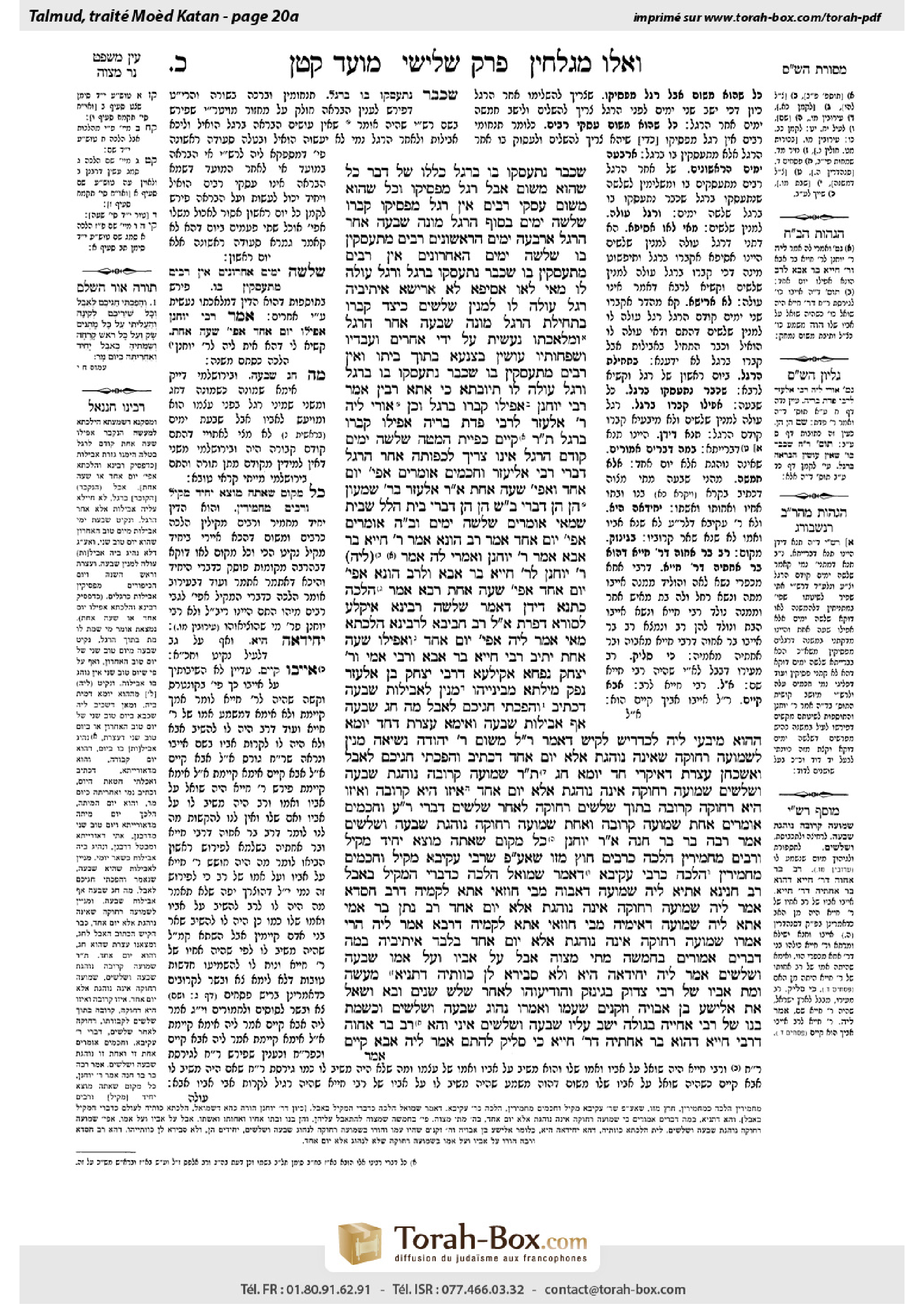
Moed Katan 20a: Talmud study for Daf Yomi
Daf Yomi is the daily study of one Talmud folio. Explore 37 tractates with scans, Hebrew text, Sefaria English and AI-generated French translations where annotated.
Passage selection and English or AI-generated French translation are available where the scan has annotations. Daf Study is independent of Torah-Box and Sefaria.
Browse Moed Katan · מועד קטן · All tractatesMoed Katan 20a text and translations
This page of Moed Katan includes the Aramaic text, an English translation and an AI-generated French translation, alongside the scan above.
מועד קטן כ׳ א · Aramaic and Hebrew text
שֶׁכְּבָר נִתְעַסְּקוּ בּוֹ בָּרֶגֶל. כְּלָלוֹ שֶׁל דָּבָר: כׇּל שֶׁהוּא מִשּׁוּם אֵבֶל — רֶגֶל מַפְסִיקוֹ. וְכׇל שֶׁהוּא מִשּׁוּם עִסְקֵי רַבִּים — אֵין רֶגֶל מַפְסִיקוֹ.
קְבָרוֹ שְׁלֹשָׁה יָמִים בְּסוֹף הָרֶגֶל — מוֹנֶה שִׁבְעָה אַחַר הָרֶגֶל, אַרְבָּעָה יָמִים הָרִאשׁוֹנִים — רַבִּים מִתְעַסְּקִין בּוֹ, שְׁלֹשָׁה יָמִים הָאַחֲרוֹנִים — אֵין רַבִּים מִתְעַסְּקִין בּוֹ, שֶׁכְּבָר נִתְעַסְּקוּ [בּוֹ] בָּרֶגֶל, וְרֶגֶל עוֹלֶה לוֹ.
מַאי לָאו — אַסֵּיפָא! לָא, אַרֵישָׁא.
אֵיתִיבֵיהּ: רֶגֶל עוֹלֶה לוֹ לְמִנְיַן שְׁלֹשִׁים, כֵּיצַד? קְבָרוֹ בִּתְחִילַּת הָרֶגֶל — מוֹנֶה שִׁבְעָה אַחַר הָרֶגֶל, ומְלַאכְתּוֹ נַעֲשֵׂית עַל יְדֵי אֲחֵרִים, וַעֲבָדָיו וְשִׁפְחוֹתָיו עוֹשִׂין בְּצִנְעָא בְּתוֹךְ בֵּיתוֹ, וְאֵין רַבִּים מִתְעַסְּקִין בּוֹ, שֶׁכְּבָר נִתְעַסְּקוּ בּוֹ בָּרֶגֶל, וְרֶגֶל עוֹלֶה לוֹ. תְּיוּבְתָּא.
כִּי אֲתָא רָבִין, אָמַר רַבִּי יוֹחָנָן: אֲפִילּוּ קְבָרוֹ בָּרֶגֶל, וְכֵן אוֹרִי לֵיהּ רַבִּי אֶלְעָזָר לְרַבִּי פְּדָת בְּרֵיהּ: אֲפִילּוּ קְבָרוֹ בָּרֶגֶל.
תָּנוּ רַבָּנַן: קִיֵּים כְּפִיַּית הַמִּטָּה שְׁלֹשָׁה יָמִים קוֹדֶם הָרֶגֶל — אֵינוֹ צָרִיךְ לִכְפּוֹתָהּ אַחַר הָרֶגֶל, דִּבְרֵי רַבִּי אֱלִיעֶזֶר. וַחֲכָמִים אוֹמְרִים: אֲפִילּוּ יוֹם אֶחָד, אֲפִילּוּ שָׁעָה אַחַת.
אָמַר רַבִּי אֶלְעָזָר בְּרַבִּי שִׁמְעוֹן: הֵן הֵן דִּבְרֵי בֵּית שַׁמַּאי, הֵן הֵן דִּבְרֵי בֵּית הִלֵּל. שֶׁבֵּית שַׁמַּאי אוֹמְרִים: שְׁלֹשָׁה יָמִים, וּבֵית הִלֵּל אוֹמְרִים: אֲפִילּוּ יוֹם אֶחָד.
אָמַר רַב הוּנָא אָמַר רַבִּי חִיָּיא בַּר אַבָּא אָמַר רַבִּי יוֹחָנָן, וְאָמְרִי לַהּ: אֲמַר לֵיהּ רַבִּי יוֹחָנָן לְרַבִּי חִיָּיא בַּר אַבָּא וּלְרַב הוּנָא: אֲפִילּוּ יוֹם אֶחָד, אֲפִילּוּ שָׁעָה אַחַת. רָבָא אָמַר: הֲלָכָה כְּתַנָּא דִּידַן דְּאָמַר שְׁלֹשָׁה.
רָבִינָא אִיקְּלַע לְסוּרָא דִפְרָת, אֲמַר לֵיהּ רַב חֲבִיבָא לְרָבִינָא: הִלְכְתָא מַאי? אֲמַר לֵיהּ: אֲפִילּוּ יוֹם אֶחָד, וַאֲפִילּוּ שָׁעָה אַחַת.
יָתֵיב רַבִּי חִיָּיא בַּר אַבָּא וְרַבִּי אַמֵּי וְרַבִּי יִצְחָק נַפָּחָא אַקִּילְעָא דְּרַבִּי יִצְחָק בֶּן אֶלְעָזָר, נְפַק מִילְּתָא מִבֵּינַיְיהוּ: מִנַּיִן לַאֲבֵילוּת שִׁבְעָה — דִּכְתִיב: ״וְהָפַכְתִּי חַגֵּיכֶם לְאֵבֶל״, מָה חַג שִׁבְעָה — אַף אֲבֵילוּת שִׁבְעָה.
וְאֵימָא עֲצֶרֶת, דְּחַד יוֹמָא! הָהוּא מִיבְּעֵי לֵיהּ לְכִדְרֵישׁ לָקִישׁ. דְּאָמַר רֵישׁ לָקִישׁ מִשּׁוּם רַבִּי יְהוּדָה נְשִׂיאָה: מִנַּיִן לִשְׁמוּעָה רְחוֹקָה שֶׁאֵינָהּ נוֹהֶגֶת אֶלָּא יוֹם אֶחָד — דִּכְתִיב: ״וְהָפַכְתִּי חַגֵּיכֶם לְאֵבֶל״, וְאַשְׁכְּחַן עֲצֶרֶת דְּאִיקְּרִי חַד יוֹמָא חַג.
תָּנוּ רַבָּנַן: שְׁמוּעָה קְרוֹבָה — נוֹהֶגֶת שִׁבְעָה וּשְׁלֹשִׁים, שְׁמוּעָה רְחוֹקָה — אֵינָהּ נוֹהֶגֶת אֶלָּא יוֹם אֶחָד. אֵיזוֹ הִיא קְרוֹבָה וְאֵיזוֹ הִיא רְחוֹקָה? קְרוֹבָה בְּתוֹךְ שְׁלֹשִׁים, רְחוֹקָה לְאַחַר שְׁלֹשִׁים, דִּבְרֵי רַבִּי עֲקִיבָא. וַחֲכָמִים אוֹמְרִים: אַחַת שְׁמוּעָה קְרוֹבָה וְאַחַת שְׁמוּעָה רְחוֹקָה — נוֹהֶגֶת שִׁבְעָה וּשְׁלֹשִׁים.
אָמַר רַבָּה בַּר בַּר חָנָה אָמַר רַבִּי יוֹחָנָן: כׇּל מָקוֹם שֶׁאַתָּה מוֹצֵא יָחִיד מֵקֵיל וְרַבִּים מַחְמִירִין — הֲלָכָה כָּרַבִּים. חוּץ מִזּוֹ, שֶׁאַף עַל פִּי שֶׁרַבִּי עֲקִיבָא מֵקֵיל וַחֲכָמִים מַחְמִירִין — הֲלָכָה כְּרַבִּי עֲקִיבָא. דְּאָמַר שְׁמוּאֵל: הֲלָכָה כְּדִבְרֵי הַמֵּקֵיל בְּאֵבֶל.
רַב חֲנִינָא אַתְיָא לֵיהּ שְׁמוּעָה דַאֲבוּהּ מִבֵּי חוֹזָאֵי, אֲתָא לְקַמֵּיהּ דְּרַב חִסְדָּא, אֲמַר לֵיהּ: שְׁמוּעָה רְחוֹקָה אֵינָהּ נוֹהֶגֶת אֶלָּא יוֹם אֶחָד. רַב נָתָן בַּר אַמֵּי אֲתָא לֵיהּ שְׁמוּעָה דְּאִימֵּיהּ מִבֵּי חוֹזָאֵי, אֲתָא לְקַמֵּיהּ דְּרָבָא, אֲמַר לֵיהּ: הֲרֵי אָמְרוּ, שְׁמוּעָה רְחוֹקָה אֵינָהּ נוֹהֶגֶת אֶלָּא יוֹם אֶחָד בִּלְבַד.
אֵיתִיבֵיהּ: בַּמָּה דְּבָרִים אֲמוּרִים — בַּחֲמִשָּׁה מֵתֵי מִצְוָה, אֲבָל עַל אָבִיו וְעַל אִמּוֹ שִׁבְעָה וּשְׁלֹשִׁים!
אֲמַר לֵיהּ: יְחִידָאָה הִיא, וְלָא סְבִירָא לַן כְּווֹתֵיהּ. דְּתַנְיָא: מַעֲשֶׂה וּמֵת אָבִיו שֶׁל רַבִּי צָדוֹק בְּגִינְזַק, וְהוֹדִיעוּהוּ לְאַחַר שָׁלֹשׁ שָׁנִים, וּבָא וְשָׁאַל אֶת אֱלִישָׁע בֶּן אֲבוּיָה וּזְקֵנִים שֶׁעִמּוֹ, וְאָמְרוּ: נְהוֹג שִׁבְעָה וּשְׁלֹשִׁים. וּכְשֶׁמֵּת בְּנוֹ שֶׁל רַבִּי אֲחִיָּיה בַּגּוֹלָה, יָשַׁב עָלָיו שִׁבְעָה וּשְׁלֹשִׁים.
אִינִי? וְהָא רַב, בַּר אֲחוּהּ דְּרַבִּי חִיָּיא דְּהוּא בַּר אֲחָתֵיהּ דְּרַבִּי חִיָּיא, כִּי סְלֵיק לְהָתָם אֲמַר לֵיהּ: אַבָּא קַיָּים?
Moed Katan 20a · English translation
for they already occupied themselves with him when they came to console him during the Festival. The general principle with regard to the matter is as follows: Any activity that is prohibited to the mourner because it is an expression of mourning is interrupted by the Festival and remains prohibited afterward. And anything that involves the public’s occupation with the mourner, e.g., coming to the mourner to offer him comfort and condolence, is not interrupted by the Festival, for people console the mourner during the Festival as well.
If he buries his relative three days before the end of the Festival, the mourner must count seven days of mourning after the Festival because his mourning never began. On the first four days of his mourning, the public must occupy themselves with him and come to console him. On the three last days, however, the public need not occupy themselves with him, as they already occupied themselves with him during the Festival. That is to say, they certainly came to console him during the Festival, although the period of mourning did not actually begin until afterward. And the Festival counts for him toward the thirty-day mourning period.
With regard to the statement of the baraita that the Festival counts toward the thirty-day period of mourning: What, is it not referring to the latter clause of that baraita, which speaks about a case where the burial was performed during the Festival itself? If this is the case, then a refutation of Rava’s opinion is stated explicitly, that the Festival counts toward the thirty-day mourning period, even if the deceased was buried on the Festival itself. Rava rejects this argument: No, it is referring to the first clause, which discusses a case where the burial was performed before the Festival, and since rites of mourning were observed already before the Festival, the Festival is counted toward the thirty-day period of mourning. Therefore, it is not a refutation of Rava’s halakha.
Abaye raised an objection to Rava’s opinion from another baraita, in which it was taught: A pilgrimage Festival counts toward the thirty-day period of mourning. How so? If one buried his dead relative at the beginning of a pilgrimage Festival, he must count seven days of mourning after the Festival, and during this period his work is performed by others. And his menservants and maidservants perform this work in private inside his house, and the public need not occupy themselves with him and come to console him, for they already occupied themselves with him during the Festival. And the Festival counts for him. Here it is explicitly stated that the Festival counts toward the thirty-day period of mourning, even when the deceased was buried during the Festival itself. The Gemara concludes: This is indeed a conclusive refutation of Rava’s opinion.
When Ravin came from Eretz Yisrael to Babylonia, he said that Rabbi Yoḥanan said: Even if one buried his dead relative during the Festival, the Festival counts toward his thirty-day period of mourning. And, similarly, Rabbi Elazar ruled for Rabbi Pedat, his son: Even if one buried his dead relative during the Festival it counts towards his thirty days.
§ The Sages taught the following baraita: If one fulfilled the obligation of overturning the bed for three days before the pilgrimage Festival, he is no longer required to overturn it after the Festival; this is the statement of Rabbi Eliezer. But the Rabbis say: Even if one overturned his bed for only one day, or even for only one hour, he is not required to overturn it after the Festival.
Rabbi Elazar, son of Rabbi Shimon, said: This is the statement of Beit Shammai, and that is the statement of Beit Hillel. In other words, Rabbi Eliezer and the Rabbis disagreed about a matter that was the subject of an earlier dispute between Beit Shammai and Beit Hillel, for Beit Shammai say: Three days, and Beit Hillel say: Even one day.
Rav Huna said that Rabbi Ḥiyya bar Abba said that Rabbi Yoḥanan said, and some say a different version of this line of transmission: Rabbi Yoḥanan said to Rabbi Ḥiyya bar Abba and to Rav Huna: Even one day, even one hour. The Gemara cites Rava, who said: The halakha is in accordance with the opinion of the tanna of our mishna, who said three days. Based on this, we rule that the mourning rites are not canceled after the Festival unless they were observed for at least three days before the Festival.
Ravina happened to come to the city of Sura on the banks of the Euphrates River. Rav Ḥaviva said to Ravina: What is the halakha with regard to this issue? He said to him: Even one day, and even one hour.
§ It was related that Rabbi Ḥiyya bar Abba, Rabbi Ami, and Rabbi Yitzḥak Nappaḥa were once sitting in the pavilion of Rabbi Yitzḥak ben Elazar and were conversing. A matter emerged from among them: From where is it derived that the rites of mourning are observed for seven days? As it is written: “And I will turn your Festivals into mourning” (Amos 8:10). Just as a Festival lasts for seven days, so too mourning lasts for seven days.
The Gemara asks: And say that perhaps mourning is like Shavuot, which is only one day. The Gemara rejects this argument: That derivation, from the one day of Shavuot, is required for what was stated by Reish Lakish, as Reish Lakish said in the name of Rabbi Yehuda Nesia: From where is it derived that mourning in the case of distant tidings, i.e., when one hears that one of his relatives died a long time ago, applies for only one day? As it is written: “And I will turn your Festivals into mourning,” and we find with regard to Shavuot that one day is also called a Festival.
The Sages taught the following baraita: In the case of recent tidings of a relative’s death, mourning applies for seven- and thirty-day periods. In the case of distant tidings, it applies only for one day. What are considered recent tidings and what are considered distant tidings? Recent tidings are news that arrives within thirty days of the person’s death. Distant tidings are news that arrives after thirty days; this is the statement of Rabbi Akiva. And the Rabbis say: Both in the case of recent tidings and in the case of distant tidings, mourning applies for seven- and thirty-day periods.
Rabba bar bar Ḥana said that Rabbi Yoḥanan said: Wherever you find an individual being lenient and the majority being stringent, the halakha is in accordance with the majority, except for this case, for even though Rabbi Akiva is lenient and the Rabbis are stringent, the halakha is in accordance with the opinion of Rabbi Akiva. This is in keeping with the principle stated by Shmuel: The halakha follows the statement of the more lenient authority in matters relating to mourning.
It was related that Rav Ḥanina received distant tidings of his father’s death from Bei Ḥozai. He came before Rav Ḥisda to ask what he should do. Rav Ḥisda said to him: In the case of distant tidings, mourning applies for only one day. It was similarly related that Rav Natan bar Ami received a report about his mother’s death from Bei Ḥozai. He came before Rava, and Rava said to him: They said that in the case of distant tidings, mourning applies for only one day.
Rav Natan raised an objection to Rava’s opinion based on what was taught in a baraita: In what case is this statement that mourning applies for only one day said? In the case of the other five close relatives, over whose death it is a mitzva to mourn, i.e., son, daughter, brother, sister, and spouse. But for one’s father or mother, one is required to mourn for seven and thirty days, even when the report of the parent’s death is received some time after the event.
Rava said to him: This is an individual opinion, and we do not hold in accordance with his opinion, as it is taught in a baraita: There was an incident and the father of Rabbi Tzadok died in the city of Ginzak, and they informed him of his father’s passing only after three years. He came and asked Elisha ben Avuya and the Elders with him what he should do. And Elisha ben Avuya said to him: Observe the rites of mourning for seven and thirty days. And when the son of Rabbi Aḥiyya died in the Diaspora, and Rabbi Aḥiyya was informed about his passing a long time afterward, he sat in mourning for seven and thirty days. Therefore, it is clear that this opinion was held only by a few individual Sages, but it was not generally accepted.
The Gemara asks: Is that so, that this is Rabbi Aḥiyya’s opinion? But Rav was the son of Rabbi Ḥiyya’s brother and also the son of Rabbi Ḥiyya’s sister, for Rav’s father, Aivu, was Rabbi Ḥiyya’s paternal half brother, and Rav’s mother was Rabbi Ḥiyya’s maternal half sister. When Rav went there, Eretz Yisrael, his uncle Rabbi Ḥiyya said to him: Is your father, Aivu, still alive?
Moed Katan 20a · Traduction française (IA)
car on s’était déjà occupé de lui lorsqu’on était venu le consoler pendant la fête. Le principe général en la matière est le suivant : toute activité interdite à l’endeuillé parce qu’elle constitue une expression du deuil est interrompue par la fête et demeure interdite après celle-ci. En revanche, tout ce qui implique que le public s’occupe de l’endeuillé, par exemple venir le réconforter et lui présenter ses condoléances, n’est pas interrompu par la fête, car les gens consolent également l’endeuillé pendant la fête.
S’il enterre son proche trois jours avant la fin de la fête, l’endeuillé doit compter sept jours de deuil après la fête, car son deuil n’a pas encore commencé. Pendant les quatre premiers jours de son deuil, le public doit s’occuper de lui et venir le consoler. En revanche, durant les trois derniers jours, le public n’a pas besoin de s’occuper de lui, puisqu’il l’a déjà fait pendant la fête. Autrement dit, on est certainement venu le consoler pendant la fête, bien que la période de deuil n’ait effectivement commencé qu’après celle-ci. Et la fête compte pour lui dans les trente jours de deuil.
À propos de l’affirmation de la baraïta selon laquelle la fête compte dans les trente jours de deuil : ne se rapporte-t-elle pas à la dernière partie de cette baraïta, qui parle d’un cas où l’enterrement a eu lieu pendant la fête elle-même ? Si tel est le cas, l’opinion de Rava est explicitement réfutée, puisque la fête compte dans les trente jours de deuil même si le défunt a été enterré pendant la fête elle-même. Rava rejette cet argument : Non, cela se rapporte à la première partie, qui traite d’un cas où l’enterrement a eu lieu avant la fête ; comme les rites de deuil ont déjà été observés avant la fête, celle-ci est comptée dans les trente jours de deuil. Il ne s’agit donc pas d’une réfutation de la halakha de Rava.
Abayé souleva une objection contre l’opinion de Rava à partir d’une autre baraïta, où il est enseigné : Une fête de pèlerinage compte dans les trente jours de deuil. Comment cela ? Si quelqu’un a enterré son proche au début d’une fête de pèlerinage, il doit compter sept jours de deuil après la fête et, pendant cette période, d’autres accomplissent son travail. Ses serviteurs et ses servantes effectuent ce travail en privé, dans sa maison, et le public n’a pas besoin de s’occuper de lui ni de venir le consoler, puisqu’il l’a déjà fait pendant la fête. Et la fête compte pour lui. Il est explicitement indiqué ici que la fête compte dans les trente jours de deuil, même si le défunt a été enterré pendant la fête elle-même. La Guemara conclut : Il s’agit bien là d’une réfutation définitive de l’opinion de Rava.
Lorsque Ravin vint d’Eretz Israël en Babylonie, il rapporta que Rabbi Yoḥanan avait dit : Même si quelqu’un a enterré son proche pendant la fête, celle-ci compte dans ses trente jours de deuil. De même, Rabbi Elazar statua pour Rabbi Pedat, son fils : même si quelqu’un a enterré son proche pendant la fête, celle-ci compte dans ses trente jours.
§ Les Sages enseignèrent la baraïta suivante : Si quelqu’un a accompli l’obligation de renverser le lit pendant trois jours avant la fête de pèlerinage, il n’est plus tenu de le renverser après la fête ; telle est l’opinion de Rabbi Eliezer. Mais les Rabbins disent : même s’il a renversé son lit pendant un seul jour, ou même une seule heure, il n’est pas tenu de le renverser après la fête.
Rabbi Elazar, fils de Rabbi Shimon, dit : Ceci est l’opinion de Beit Shammaï, et cela est l’opinion de Beit Hillel. Autrement dit, Rabbi Eliezer et les Rabbins étaient en désaccord sur une question qui avait déjà fait l’objet d’un différend entre Beit Shammaï et Beit Hillel : Beit Shammaï disent trois jours, et Beit Hillel disent même un jour.
Rav Huna dit au nom de Rabbi Ḥiyya bar Abba, qui le dit au nom de Rabbi Yoḥanan ; certains transmettent une autre version de cette chaîne de transmission : Rabbi Yoḥanan dit à Rabbi Ḥiyya bar Abba et à Rav Huna : même un jour, même une heure. La Guemara rapporte l’avis de Rava, qui dit : La halakha est conforme à l’opinion du tanna de notre Michna, qui a dit trois jours. Par conséquent, nous statuons que les rites de deuil ne sont annulés après la fête que s’ils ont été observés pendant au moins trois jours avant celle-ci.
Ravina se trouva à Soura, ville située sur les rives de l’Euphrate. Rav Ḥaviva dit à Ravina : Quelle est la halakha sur cette question ? Il lui répondit : Même un jour, et même une heure.
§ Il fut rapporté que Rabbi Ḥiyya bar Abba, Rabbi Ami et Rabbi Yitzḥak Nappaḥa étaient un jour assis dans le pavillon de Rabbi Yitzḥak ben Elazar et discutaient. Une question surgit parmi eux : D’où apprend-on que les rites de deuil sont observés pendant sept jours ? Comme il est écrit : « Je transformerai vos fêtes en deuil » (Amos 8,10). De même qu’une fête dure sept jours, le deuil dure lui aussi sept jours.
La Guemara demande : Et pourquoi ne pas dire que le deuil est semblable à Chavouot, qui ne dure qu’un jour ? La Guemara rejette cet argument : Cette déduction à partir de l’unique jour de Chavouot est nécessaire pour établir ce qu’a enseigné Reish Lakish, car Reish Lakish a dit au nom de Rabbi Yehuda Nesia : D’où apprend-on que le deuil à la suite d’une annonce tardive, c’est-à-dire lorsqu’on apprend longtemps après qu’un proche est mort, ne s’applique que pendant un jour ? Comme il est écrit : « Je transformerai vos fêtes en deuil », et nous constatons qu’à propos de Chavouot, un seul jour est également appelé une fête.
Les Sages enseignèrent la baraïta suivante : Lorsqu’on apprend la mort d’un proche par une annonce récente, le deuil s’applique pendant les périodes de sept et de trente jours. Lorsqu’on apprend la nouvelle tardivement, il ne s’applique que pendant un jour. Qu’est-ce qui est considéré comme une annonce récente et qu’est-ce qui est considéré comme une annonce tardive ? Une annonce récente est une nouvelle qui parvient dans les trente jours suivant le décès. Une annonce tardive est une nouvelle qui parvient après trente jours ; telle est l’opinion de Rabbi Akiva. Mais les Rabbins disent : qu’il s’agisse d’une annonce récente ou tardive, le deuil s’applique pendant les périodes de sept et de trente jours.
Rabba bar bar Ḥana dit au nom de Rabbi Yoḥanan : Chaque fois que l’on trouve un avis individuel indulgent face à l’avis majoritaire plus rigoureux, la halakha est conforme à l’avis majoritaire, sauf dans le présent cas ; en effet, bien que Rabbi Akiva soit indulgent et les Rabbins rigoureux, la halakha est conforme à l’opinion de Rabbi Akiva. Cela suit le principe énoncé par Shmuel : la halakha suit l’autorité la plus indulgente en matière de deuil.
Il fut rapporté que Rav Ḥanina reçut de Bei Ḥozai une annonce tardive de la mort de son père. Il se présenta devant Rav Ḥisda pour lui demander ce qu’il devait faire. Rav Ḥisda lui dit : Dans le cas d’une annonce tardive, le deuil ne s’applique que pendant un jour. De même, il fut rapporté que Rav Natan bar Ami reçut de Bei Ḥozai une nouvelle concernant la mort de sa mère. Il se présenta devant Rava, et Rava lui dit : Ils ont enseigné que, dans le cas d’une annonce tardive, le deuil ne s’applique que pendant un jour.
Rav Natan souleva une objection contre l’opinion de Rava à partir de ce qui est enseigné dans une baraïta : Dans quel cas a-t-on dit que le deuil ne s’applique que pendant un jour ? Dans le cas des cinq autres proches parents dont la mort entraîne l’obligation de porter le deuil, à savoir le fils, la fille, le frère, la sœur et le conjoint. Mais pour son père ou sa mère, on est tenu de porter le deuil pendant sept et trente jours, même si l’on apprend la mort de son parent quelque temps après les faits.
Rava lui dit : Il s’agit de l’opinion d’un individu, et nous ne statuons pas conformément à son opinion, comme il est enseigné dans une baraïta : Un événement eut lieu : le père de Rabbi Tzadok mourut dans la ville de Ginzak, et ce n’est que trois ans plus tard qu’on l’en informa. Il vint demander à Elisha ben Avuya et aux Sages qui l’accompagnaient ce qu’il devait faire. Elisha ben Avuya lui dit : Observe les rites de deuil pendant sept et trente jours. De même, lorsque le fils de Rabbi Aḥiyya mourut en Diaspora et que Rabbi Aḥiyya en fut informé longtemps après, il observa le deuil pendant sept et trente jours. Il est donc clair que seuls quelques Sages isolés soutenaient cette opinion, mais qu’elle n’était pas généralement acceptée.
La Guemara demande : Est-ce vraiment l’opinion de Rabbi Aḥiyya ? Or Rav était le fils du frère de Rabbi Ḥiyya et aussi le fils de la sœur de Rabbi Ḥiyya, car le père de Rav, Aivu, était le demi-frère paternel de Rabbi Ḥiyya, et la mère de Rav était la demi-sœur maternelle de Rabbi Ḥiyya. Lorsque Rav se rendit là-bas, en Eretz Israël, son oncle Rabbi Ḥiyya lui demanda : Ton père, Aivu, est-il toujours en vie ?
Traduction française générée par IA à partir de l’édition anglaise de Sefaria. Vérifie toujours un passage avec le texte source.
Text from Sefaria: William Davidson Edition - Vocalized Aramaic (CC BY NC); William Davidson Edition - English (CC BY NC).