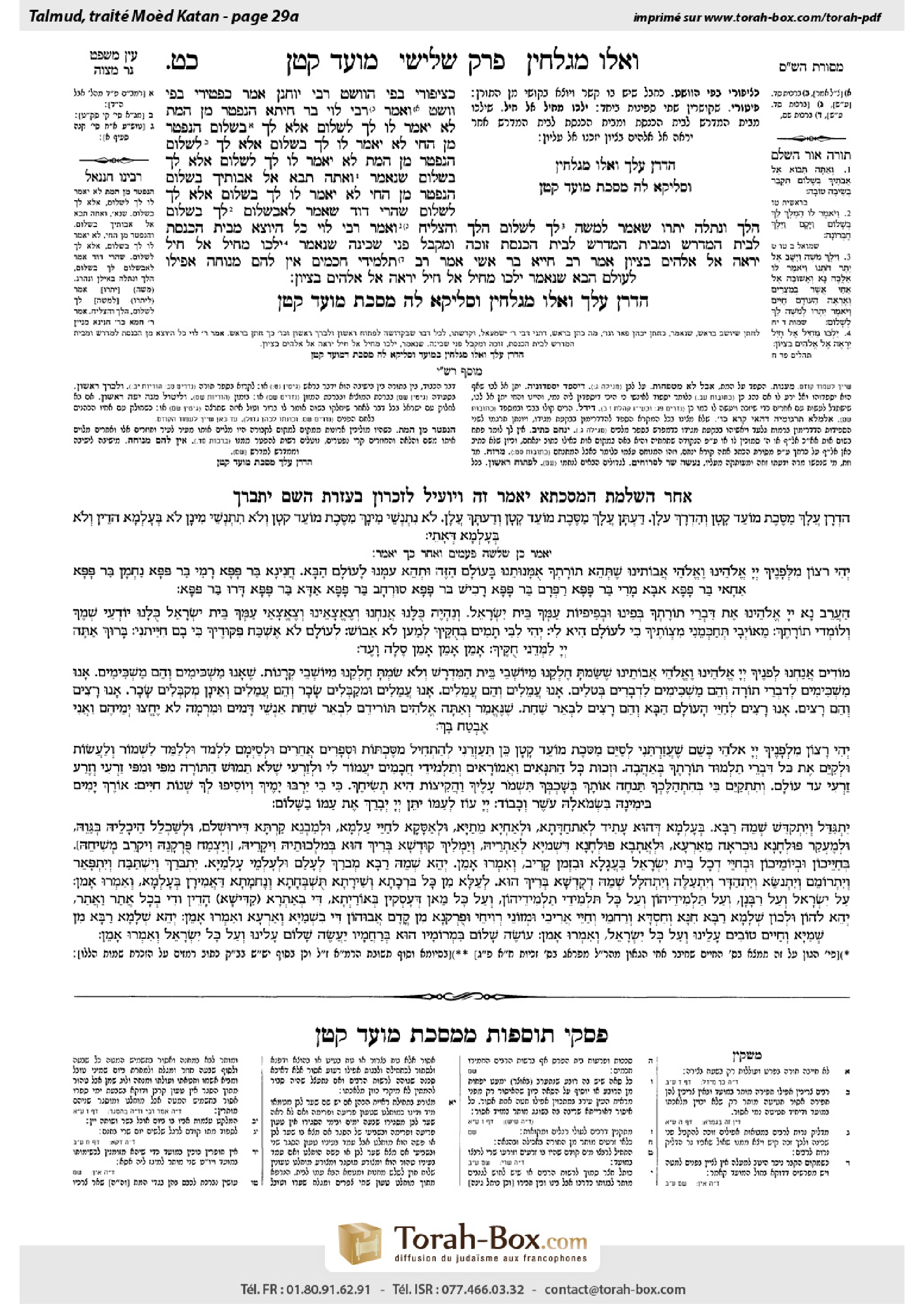
Moed Katan 29a: Talmud study for Daf Yomi
Daf Yomi is the daily study of one Talmud folio. Explore 37 tractates with scans, Hebrew text, Sefaria English and AI-generated French translations where annotated.
Passage selection and English or AI-generated French translation are available where the scan has annotations. Daf Study is independent of Torah-Box and Sefaria.
Browse Moed Katan · מועד קטן · All tractatesMoed Katan 29a text and translations
This page of Moed Katan includes the Aramaic text, an English translation and an AI-generated French translation, alongside the scan above.
מועד קטן כ״ט א · Aramaic and Hebrew text
כְּצִיפּוֹרֵי בְּפִי הַוֶּושֶׁט. רַבִּי יוֹחָנָן אָמַר: כְּפִטּוּרֵי בְּפִי וֶושֶׁט.
וְאָמַר רַבִּי לֵוִי בַּר חַיְתָא: הַנִּפְטָר מִן הַמֵּת, לֹא יֹאמַר לוֹ ״לֵךְ לְשָׁלוֹם״, אֶלָּא ״לֵךְ בְּשָׁלוֹם״. הַנִּפְטָר מִן הַחַי, לֹא יֹאמַר לוֹ ״לֵךְ בְּשָׁלוֹם״, אֶלָּא ״לֵךְ לְשָׁלוֹם״.
הַנִּפְטָר מִן הַמֵּת, לֹא יֹאמַר לוֹ ״לֵךְ לְשָׁלוֹם״, אֶלָּא ״לֵךְ בְּשָׁלוֹם״, שֶׁנֶּאֱמַר: ״וְאַתָּה תָּבֹא אֶל אֲבוֹתֶיךָ בְּשָׁלוֹם״.
הַנִּפְטָר מִן הַחַי, לֹא יֹאמַר לוֹ ״לֵךְ בְּשָׁלוֹם״, אֶלָּא ״לֵךְ לְשָׁלוֹם״, שֶׁהֲרֵי דָּוִד שֶׁאָמַר לְאַבְשָׁלוֹם ״לֵךְ בְּשָׁלוֹם״, הָלַךְ וְנִתְלָה, יִתְרוֹ שֶׁאָמַר לְמֹשֶׁה ״לֵךְ לְשָׁלוֹם״, הָלַךְ וְהִצְלִיחַ.
וְאָמַר רַבִּי לֵוִי: כׇּל הַיּוֹצֵא מִבֵּית הַכְּנֶסֶת לְבֵית הַמִּדְרָשׁ, וּמִבֵּית הַמִּדְרָשׁ לְבֵית הַכְּנֶסֶת, זוֹכֶה וּמְקַבֵּל פְּנֵי שְׁכִינָה, שֶׁנֶּאֱמַר: ״יֵלְכוּ מֵחַיִל אֶל חָיִל יֵרָאֶה אֶל אֱלֹהִים בְּצִיּוֹן״.
אָמַר רַב חִיָּיא בַּר אָשֵׁי אָמַר רַב: תַּלְמִידֵי חֲכָמִים אֵין לָהֶם מְנוּחָה אֲפִילּוּ לָעוֹלָם הַבָּא, שֶׁנֶּאֱמַר: ״יֵלְכוּ מֵחַיִל אֶל חָיִל יֵרָאֶה אֶל אֱלֹהִים בְּצִיּוֹן״.
הֲדַרַן עֲלָךְ וְאֵלּוּ מְגַלְּחִין וּסְלִיקָא לַהּ מַסֶּכֶת מוֹעֵד קָטָן
Moed Katan 29a · English translation
as it is for a knotted rope [tzippori] to pass through an eye [veshet] in a ship’s rigging. Rabbi Yoḥanan said: It is as difficult as it is for a halyard [pitirei] to pass through an eye [veshet].
And Rabbi Levi bar Ḥayyata said: One who departs from the deceased should not say to him: Go to peace, but rather he should say: Go in peace. One who departs from the living should not say to him: Go in peace, but rather he should say: Go to peace.
One who departs from the deceased should not say to him: Go to peace, but rather: Go in peace, as it is stated: “And you shall go to your fathers in peace; you shall be buried in a good old age” (Genesis 15:15).
One who departs from the living should not say to him: Go in peace, but rather: Go to peace, as David said to Absalom: “Go in peace” (II Samuel 15:9), and he subsequently went and was hanged; whereas Jethro said to Moses: “Go to peace” (Exodus 4:18), and he went and was successful.
And Rabbi Levi said: Anyone who leaves from the synagogue and goes to the study hall or goes from the study hall to the synagogue, i.e., he goes from the mitzva of prayer to the mitzva of Torah study or vice versa, merits to receive the Divine Presence, as it is stated: “They go from strength to strength, every one of them appears before God in Zion” (Psalms 84:8).
With regard to the same verse, Rav Ḥiyya bar Ashi said that Rav said: Torah scholars have no rest, even in the World-to-Come, as even there they remain in constant movement and ascent, as it is stated: “They go from strength to strength, every one of them appears before God in Zion.” Even when they are in the World-to-Come, they continue to go from strength to strength, until the final redemption will arrive in the end of days and God will appear in Zion.
Moed Katan 29a · Traduction française (IA)
comme il est difficile de faire passer une corde nouée [tzippori] dans un œillet [veshet] du gréement d’un bateau. Rabbi Yoḥanan dit : C’est aussi difficile que de faire passer une drisse [pitirei] dans un œillet [veshet].
Et Rabbi Levi bar Ḥayyata dit : Celui qui prend congé d’un défunt ne doit pas lui dire : « Va vers la paix », mais plutôt : « Va en paix. » Celui qui prend congé d’un vivant ne doit pas lui dire : « Va en paix », mais plutôt : « Va vers la paix. »
Celui qui prend congé d’un défunt ne doit pas lui dire : « Va vers la paix », mais plutôt : « Va en paix », comme il est dit : « Tu rejoindras tes pères en paix ; tu seras enterré dans une bonne vieillesse » (Genèse 15,15).
Celui qui prend congé d’un vivant ne doit pas lui dire : « Va en paix », mais plutôt : « Va vers la paix », comme David le dit à Absalom : « Va en paix » (II Samuel 15,9), et celui-ci partit ensuite et fut pendu ; tandis que Jéthro dit à Moïse : « Va vers la paix » (Exode 4,18), et celui-ci partit et réussit.
Et Rabbi Levi dit : Quiconque quitte la synagogue pour se rendre à la maison d’étude, ou quitte la maison d’étude pour se rendre à la synagogue — c’est-à-dire qu’il passe de la mitsva de la prière à la mitsva de l’étude de la Torah, ou inversement — mérite de recevoir la Présence divine, comme il est dit : « Ils vont de force en force ; chacun paraît devant Dieu à Sion » (Psaumes 84,8).
À propos du même verset, Rav Ḥiyya bar Ashi rapporte au nom de Rav : Les sages de la Torah ne connaissent pas de repos, même dans le Monde à venir, car même là, ils restent en mouvement constant et continuent de s’élever, comme il est dit : « Ils vont de force en force ; chacun paraît devant Dieu à Sion. » Même dans le Monde à venir, ils continuent d’aller de force en force, jusqu’à ce qu’arrive, à la fin des jours, la rédemption finale et que Dieu apparaisse à Sion.
Traduction française générée par IA à partir de l’édition anglaise de Sefaria. Vérifie toujours un passage avec le texte source.
Text from Sefaria: William Davidson Edition - Vocalized Aramaic (CC BY NC); William Davidson Edition - English (CC BY NC).