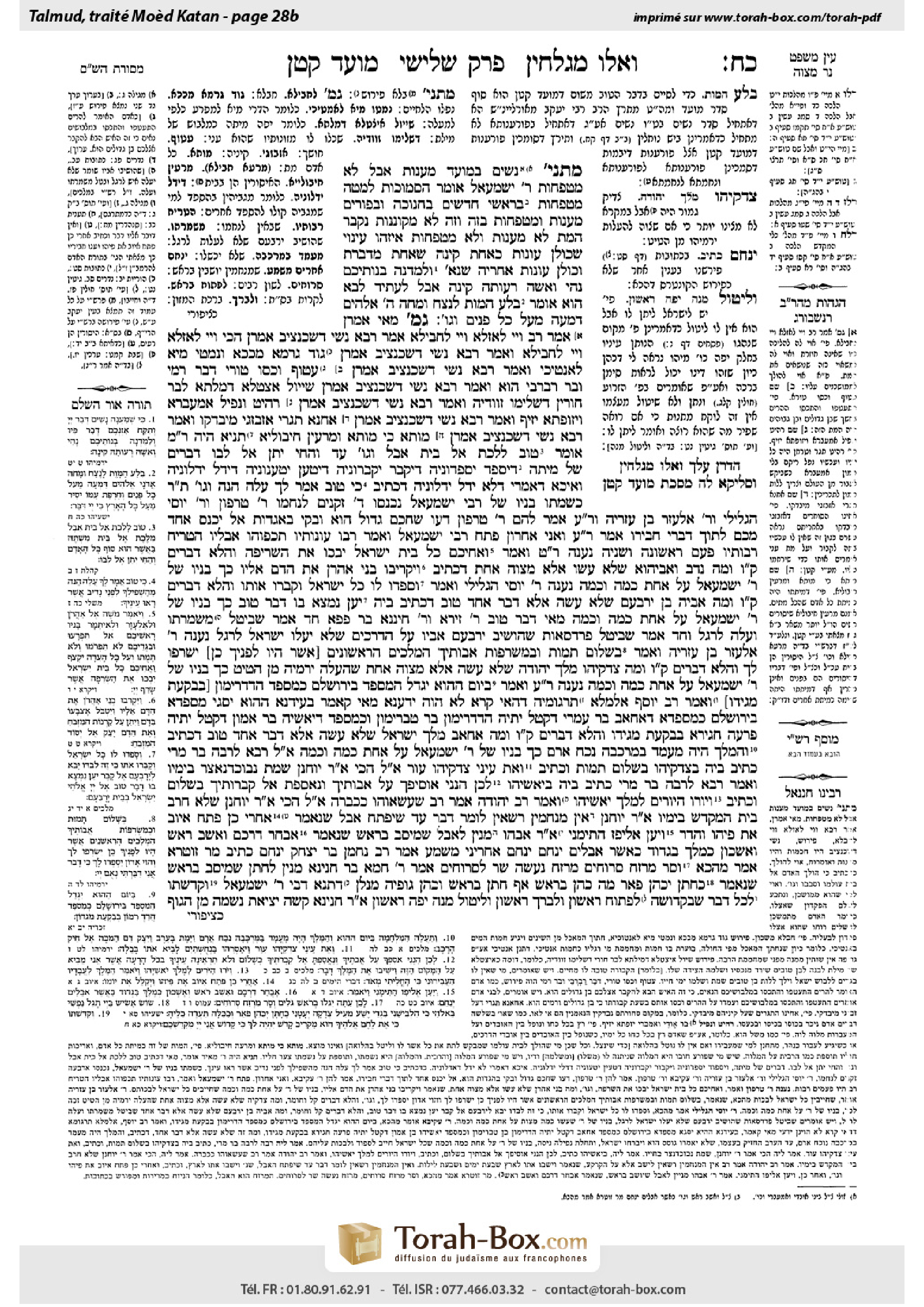
Moed Katan 28b: Talmud study for Daf Yomi
Daf Yomi is the daily study of one Talmud folio. Explore 37 tractates with scans, Hebrew text, Sefaria English and AI-generated French translations where annotated.
Passage selection and English or AI-generated French translation are available where the scan has annotations. Daf Study is independent of Torah-Box and Sefaria.
Browse Moed Katan · מועד קטן · All tractatesMoed Katan 28b text and translations
This page of Moed Katan includes the Aramaic text, an English translation and an AI-generated French translation, alongside the scan above.
מועד קטן כ״ח ב · Aramaic and Hebrew text
מַתְנִי׳ נָשִׁים בַּמּוֹעֵד מְעַנּוֹת, אֲבָל לֹא מְטַפְּחוֹת. רַבִּי יִשְׁמָעֵאל אוֹמֵר: הַסְּמוּכוֹת לַמִּטָּה מְטַפְּחוֹת.
בְּרָאשֵׁי חֳדָשִׁים, בַּחֲנוּכָּה וּבְפוּרִים — מְעַנּוֹת וּמְטַפְּחוֹת, בְּזֶה וָזֶה — לֹא מְקוֹנְנוֹת. נִקְבַּר הַמֵּת — לֹא מְעַנּוֹת וְלֹא מְטַפְּחוֹת.
אֵיזֶהוּ עִינּוּי — שֶׁכּוּלָּן עוֹנוֹת כְּאַחַת, קִינָה — שֶׁאַחַת מְדַבֶּרֶת וְכוּלָּן עוֹנוֹת אַחֲרֶיהָ, שֶׁנֶּאֱמַר: ״וְלַמֵּדְנָה בְנוֹתֵיכֶם נֶהִי וְאִשָּׁה רְעוּתָהּ קִינָה״.
אֲבָל לֶעָתִיד לָבֹא הוּא אוֹמֵר ״בִּלַּע הַמָּוֶת לָנֶצַח וּמָחָה ה׳ אֱלֹהִים דִּמְעָה מֵעַל כׇּל פָּנִים וְגוֹ׳״.
גְּמָ׳ מַאי אֲמַרַן? אָמַר רַב: ״וַיי לְאָזְלָא, וַיי לַחֲבִילָא״.
אָמַר רָבָא, נְשֵׁי דְּשַׁכְנְצִיב אֲמַרַן הָכִי: ״וַיי לָאָזְלָא, וַיי לַחֲבִילָא״. וְאָמַר רָבָא, נְשֵׁי דְשַׁכְנְצִיב אָמְרָן: ״גּוּד גַּרְמָא מִכַּכָּא וְנִמְטֵי מַיָּא לְאַנְטִיכִי״.
וְאָמַר רָבָא, נְשֵׁי דְשַׁכְנְצִיב אָמְרָן: ״עֲטוֹף וְכַסּוֹ טוּרֵי, דְּבַר רָמֵי וּבַר רַבְרְבֵי הוּא״. וְאָמַר רָבָא: נְשֵׁי דְשַׁכְנְצִיב אָמְרָן: ״שְׁייוֹל אִצְטְלָא דְמֵלָתָא לְבַר חוֹרִין, דִּשְׁלִימוּ זְווֹדֵיהּ״.
וְאָמַר רָבָא, נְשֵׁי דְשַׁכְנְצִיב אָמְרָן: ״רָהֵיט וְנָפֵיל אַמַּעְבָּרָא וִיזוּפְתָּא יָזֵיף״. וְאָמַר רָבָא, נְשֵׁי דְשַׁכְנְצִיב אָמְרָן: ״אֲחַנָא תַּגָּרֵי אַזַּבְזָגֵי מִיבַּדְקוּ״. וְאָמַר רָבָא, נְשֵׁי דְשַׁכְנְצִיב אָמְרָן: ״מוֹתָא כִּי מוֹתָא וּמַרְעִין חִיבוּלְיָא״.
תַּנְיָא, הָיָה רַבִּי מֵאִיר אוֹמֵר: ״טוֹב לָלֶכֶת אֶל בֵּית אֵבֶל וְגוֹ׳״ עַד ״וְהַחַי יִתֵּן אֶל לִבּוֹ״ — דְּבָרִים שֶׁל מִיתָה: דְּיִסְפֹּד — יִסְפְּדוּנֵיהּ, דְּיִקְבַּר — יִקְבְּרוּנֵיהּ, דְּיִטְעֹן — יִטְעֲנוּנֵיהּ, דִּידַל — יְדַלּוּנֵיהּ.
וְאִיכָּא דְאָמְרִי: דְּלָא יְדַל — יְדַלּוּנֵיהּ, דִּכְתִיב: ״כִּי טוֹב אֲמׇר לְךָ עֲלֵה הֵנָּה וְגוֹ׳״.
תָּנוּ רַבָּנַן: כְּשֶׁמֵּתוּ בָּנָיו שֶׁל רַבִּי יִשְׁמָעֵאל נִכְנְסוּ אַרְבָּעָה זְקֵנִים לְנַחֲמוֹ, רַבִּי טַרְפוֹן, וְרַבִּי יוֹסֵי הַגְּלִילִי וְרַבִּי אֶלְעָזָר בֶּן עֲזַרְיָה, וְרַבִּי עֲקִיבָא. אֲמַר לָהֶם רַבִּי טַרְפוֹן: דְּעוּ שֶׁחָכָם גָּדוֹל הוּא וּבָקִי בְּאַגָּדוֹת, אַל יִכָּנֵס אֶחָד מִכֶּם לְתוֹךְ דִּבְרֵי חֲבֵירוֹ. אָמַר רַבִּי עֲקִיבָא: וַאֲנִי אַחֲרוֹן.
פָּתַח רַבִּי יִשְׁמָעֵאל וְאָמַר: רַבּוּ עֲוֹנוֹתָיו, תְּכָפוּהוּ אֲבָלָיו, הִטְרִיחַ רַבּוֹתָיו פַּעַם רִאשׁוֹנָה וּשְׁנִיָּה.
נַעֲנָה רַבִּי טַרְפוֹן וְאָמַר: ״וַאֲחֵיכֶם כׇּל בֵּית יִשְׂרָאֵל יִבְכּוּ אֶת הַשְּׂרֵפָה״. וַהֲלֹא דְּבָרִים קַל וָחוֹמֶר: וּמָה נָדָב וַאֲבִיהוּא שֶׁלֹּא עָשׂוּ אֶלָּא מִצְוָה אַחַת, דִּכְתִיב: ״וַיַּקְרִיבוּ בְּנֵי אַהֲרֹן אֶת הַדָּם אֵלָיו״ — כָּךְ, בָּנָיו שֶׁל רַבִּי יִשְׁמָעֵאל — עַל אַחַת כַּמָּה וְכַמָּה.
נַעֲנָה רַבִּי יוֹסֵי הַגְּלִילִי וְאָמַר: ״וְסָפְדוּ לוֹ כׇל יִשְׂרָאֵל וְקָבְרוּ אוֹתוֹ״, וַהֲלֹא דְּבָרִים קַל וָחוֹמֶר: וּמָה אֲבִיָּה בֶּן יָרׇבְעָם שֶׁלֹּא עָשָׂה אֶלָּא דָּבָר אֶחָד טוֹב, דִּכְתִיב בֵּיהּ: ״יַעַן נִמְצָא בוֹ דָּבָר טוֹב״ — כָּךְ, בָּנָיו שֶׁל רַבִּי יִשְׁמָעֵאל — עַל אַחַת כַּמָּה וְכַמָּה.
מַאי דָּבָר טוֹב? רַבִּי זֵירָא וְרַבִּי חִינָּנָא בַּר פָּפָּא, חַד אָמַר: שֶׁבִּיטֵּל מִשְׁמַרְתּוֹ וְעָלָה לָרֶגֶל, וְחַד אָמַר: שֶׁבִּיטֵּל פַּרְדְּסָאוֹת שֶׁהוֹשִׁיב יָרׇבְעָם אָבִיו עַל הַדְּרָכִים שֶׁלֹּא יַעֲלוּ יִשְׂרָאֵל לָרֶגֶל.
נַעֲנָה רַבִּי אֶלְעָזָר בֶּן עֲזַרְיָה וְאָמַר: ״בְּשָׁלוֹם תָּמוּת וּבְמִשְׂרְפוֹת אֲבוֹתֶיךָ הַמְּלָכִים הָרִאשׁוֹנִים [אֲשֶׁר הָיוּ לְפָנֶיךָ כֵּן] יִשְׂרְפוּ לָךְ״, וַהֲלֹא דְּבָרִים קַל וָחוֹמֶר: וּמָה צִדְקִיָּהוּ מֶלֶךְ יְהוּדָה שֶׁלֹּא עָשָׂה אֶלָּא מִצְוָה אַחַת, שֶׁהֶעֱלָה יִרְמְיָה מִן הַטִּיט — כָּךְ, בָּנָיו שֶׁל רַבִּי יִשְׁמָעֵאל — עַל אַחַת כַּמָּה וְכַמָּה.
נַעֲנָה רַבִּי עֲקִיבָא וְאָמַר: ״בַּיּוֹם הַהוּא יִגְדַּל הַמִּסְפֵּד בִּירוּשָׁלִַם כְּמִסְפַּד הֲדַדְרִימּוֹן [בְּבִקְעַת מְגִידּוֹ]״, וְאָמַר רַב יוֹסֵף: אִלְמָלֵא תַּרְגּוּמֵיהּ דְּהַאי קְרָא, לָא הֲוָה יָדַעְנָא מַאי קָאָמַר.
בְּעִידָּנָא הָהוּא יִסְגֵּי מִסְפְּדָא בִּירוּשְׁלֶם כְּמִסְפְּדָא דְּאַחְאָב בַּר עָמְרִי דִּקְטַל יָתֵיהּ הֲדַדְרִימּוֹן בַּר טַבְרִימּוֹן, וּכְמִסְפֵּד דְּיֹאשִׁיָּה בַּר אָמוֹן דִּקְטַל יָתֵיהּ פַּרְעֹה חֲגִירָא בְּבִקְעַת מְגִידּוֹ.
וַהֲלֹא דְּבָרִים קַל וָחוֹמֶר: וּמָה אַחְאָב מֶלֶךְ יִשְׂרָאֵל שֶׁלֹּא עָשָׂה אֶלָּא דָּבָר אֶחָד טוֹב, דִּכְתִיב: ״וְהַמֶּלֶךְ הָיָה מׇעֳמָד בַּמֶּרְכָּבָה נֹכַח אֲרָם״ — כָּךְ, בָּנָיו שֶׁל רַבִּי יִשְׁמָעֵאל — עַל אַחַת כַּמָּה וְכַמָּה.
אֲמַר לֵיהּ רָבָא לְרַבָּה בַּר מָרִי: כְּתִיב בֵּיהּ בְּצִדְקִיָּהוּ ״בְּשָׁלוֹם תָּמוּת״, וּכְתִיב ״וְאֶת עֵינֵי צִדְקִיָּהוּ עִוֵּר״! אֲמַר לֵיהּ, הָכִי אָמַר רַבִּי יוֹחָנָן: שֶׁמֵּת נְבוּכַדְנֶאצַּר בְּיָמָיו.
וְאָמַר רָבָא לְרַבָּה בַּר מָרִי, כְּתִיב בֵּיהּ בְּיֹאשִׁיָּהוּ: ״לָכֵן הִנְנִי אוֹסִיפְךָ עַל אֲבוֹתֶיךָ וְנֶאֱסַפְתָּ אֶל קִבְרוֹתֶיךָ בְּשָׁלוֹם״, וּכְתִיב: ״וַיּוֹרוּ הַיּוֹרִים לַמֶּלֶךְ יֹאשִׁיָּהוּ״, וְאָמַר רַב יְהוּדָה אָמַר רַב: שֶׁעֲשָׂאוּהוּ כִּכְבָרָה!
אֲמַר לֵיהּ, הָכִי אָמַר רַבִּי יוֹחָנָן: שֶׁלֹּא חָרַב בֵּית הַמִּקְדָּשׁ בְּיָמָיו.
אָמַר רַבִּי יוֹחָנָן: אֵין מְנַחֲמִין רַשָּׁאִין לוֹמַר דָּבָר עַד שֶׁיִּפְתַּח אָבֵל, שֶׁנֶּאֱמַר: ״אַחֲרֵי כֵן פָּתַח אִיּוֹב אֶת פִּיהוּ״, וַהֲדַר: ״וַיַּעַן אֱלִיפַז הַתֵּימָנִי״.
אָמַר רַבִּי אֲבָהוּ: מִנַּיִן לָאָבֵל שֶׁמֵּיסֵב בָּרֹאשׁ — שֶׁנֶּאֱמַר: ״אֶבֲחַר דַּרְכָּם וְאֵשֵׁב רֹאשׁ וְאֶשְׁכּוֹן כְּמֶלֶךְ בַּגְּדוּד כַּאֲשֶׁר אֲבֵלִים יְנַחֵם״.
״יְנַחֵם״ — אַחֲרִינֵי מַשְׁמַע! אָמַר רַב נַחְמָן בַּר יִצְחָק: ״יִנָּחֵם״ כְּתִיב.
מָר זוּטְרָא אָמַר מֵהָכָא: ״וְסָר מִרְזַח סְרוּחִים״. ״מִרְזָח״ — נַעֲשֶׂה שַׂר לִסְרוּחִים.
אָמַר רַבִּי חָמָא בַּר חֲנִינָא: מִנַּיִן לְחָתָן שֶׁמֵּיסֵב בָּרֹאשׁ — שֶׁנֶּאֱמַר: ״כְּחָתָן יְכַהֵן פְּאֵר״, מָה כֹּהֵן בָּרֹאשׁ — אַף חָתָן בָּרֹאשׁ.
וְכֹהֵן גּוּפֵיהּ מְנָלַן? דְּתָנָא דְּבֵי רַבִּי יִשְׁמָעֵאל: ״וְקִדַּשְׁתּוֹ״, לְכׇל דָּבָר שֶׁבִּקְדוּשָּׁה: לִפְתּוֹחַ רִאשׁוֹן, וּלְבָרֵךְ רִאשׁוֹן, וְלִיטּוֹל מָנָה יָפָה רִאשׁוֹן.
אָמַר רַבִּי חֲנִינָא: קָשָׁה יְצִיאַת נְשָׁמָה מִן הַגּוּף
Moed Katan 28b · English translation
MISHNA: On the intermediate days of a Festival women may wail in grief over the deceased, but they may not clap [metapeḥot] their hands in mourning. Rabbi Yishmael says: Those who are close to the bier may clap.
On New Moons, Hanukkah and Purim, which are not Festivals by Torah law, the women may both wail and clap their hands in mourning. On both the intermediate days of a Festival and on New Moons, Hanukkah and Purim they may not lament. After the deceased has been buried they may neither wail nor clap.
The mishna explains: What is considered wailing? This is when they all wail together simultaneously. And what is considered a lament? This is when one speaks and they all answer after her with a repeated refrain, as it is stated: “And teach your daughters wailing and everyone her neighbor lamentation” (Jeremiah 9:19).
In order to conclude on a positive note, the mishna says: But with regard to the future, the verse states: “He will destroy death forever; and the Lord, God, will wipe away tears from off all faces and the reproach of His people He will take away from off all the earth” (Isaiah 25:8).
GEMARA: What do the women who wail over the dead say? Rav said: They say: Woe over him who is now departing; woe over him who is now returning the pledge, i.e., his soul, which had been deposited in his hands all the years of his life.
Rava said: The women in the city of Shekhantziv, who were known for their wisdom, would say as follows: Woe over him who is now departing; woe over him who is now returning the pledge. And Rava said: The women of Shekhantziv would say about an elderly person: The bone has been removed from the jaw and the water returns to the kettle.
And Rava said: The women of Shekhantziv would say at a time of bereavement: Wrap and cover the mountains in mourning, as the deceased is the son of the high and distinguished. Rava said: The women of Shekhantziv would say: Lend out a cloak of fine wool to serve as a burial shroud for a free man whose sustenance has been depleted. In other words, a wealthy person who loses his fortune would rather die than live in poverty.
And Rava said: The women of Shekhantziv would say: A person runs and tumbles at the ford and still he borrows. And Rava said: The women of Shekhantziv would say: Our brothers, the merchants, will be examined at their places of business to see if they are honest businessmen. And Rava said: The women of Shekhantziv would say: Death is like death, as everyone must die, and suffering is like interest.
It is taught in a baraita that Rabbi Meir would say with regard to the verse “It is better to go to the house of mourning than to go to the house of feasting, for that is the end of all men; and the living will lay it to his heart” (Ecclesiastes 7:2): What should the living lay to his heart? Matters relating to death. And these matters are as follows: He that eulogizes will be eulogized by others. He that buries others will be buried by others. He that loads many words of praise and tribute into the eulogies that he delivers for others will be similarly treated by others. He that raises his voice in weeping over others will have others raise their voices over him.
And some say: One who does not raise himself with pride, but chooses his place among the lowly, will be raised by others, as it is written: “Do not exalt yourself in the king’s presence, and stand not in the place of great men. For it is better to be told, step up here, than to be degraded in the presence of the great” (Proverbs 25:6–7).
The Sages taught the following baraita: When the sons of Rabbi Yishmael died, four Elders entered to console him: Rabbi Tarfon, Rabbi Yosei HaGelili, Rabbi Elazar ben Azarya, and Rabbi Akiva. Rabbi Tarfon said to them: Know that Rabbi Yishmael is a great Sage and well versed in aggadot. Let none of you interrupt the words of another, but rather each person should say something novel of his own. Rabbi Akiva said: And I shall speak last.
Rabbi Yishmael, the mourner, opened and said about himself: Many are his sins. Due to this, his bereavements came in quick succession and he troubled his teachers once and then a second time to come and console him.
Having been granted permission to speak, Rabbi Tarfon answered and said: With regard to the death of Aaron’s sons it says: “But let your brethren, the whole house of Israel, bewail the burning that the Lord has kindled” (Leviticus 10:6). Are these matters not inferred a fortiori: If, with regard to Nadav and Avihu, who had performed only one mitzva that is explicitly mentioned in the Bible, as it is written: “And the sons of Aaron brought the blood to him” (Leviticus 9:9), this was nevertheless stated about them, then with regard to the sons of Rabbi Yishmael, who were well known for their performance of many mitzvot, all the more so should the entire Jewish people bewail their death.
Rabbi Yosei HaGelili answered and said: With regard to Abijah, son of King Jeroboam, the verse states: “And all Israel shall mourn for him, and bury him” (I Kings 14:13). Are these matters not inferred a fortiori: If, with regard to Abijah, son of Jeroboam, who did only one good thing, as it is written: “Because in him there is found some good thing toward the Lord God of Israel” (I Kings 14:13), i.e., he did only one good thing, and this was his reward, then with regard to the sons of Rabbi Yishmael all the more so should they be rewarded by having the entire Jewish people mourn for them and bury them.
The Gemara asks: What was this one good thing that Abijah did? Rabbi Zeira and Rabbi Ḥinnana bar Pappa disagreed about this issue. One said: He abandoned his guard post. His father, Jeroboam, had assigned him to serve as one of the guards whose mission it was to prevent people from going up to Jerusalem on the pilgrimage Festivals. And he himself went up to Jerusalem for the pilgrimage Festival. And one said: He removed the guards [pardesaot] that his father, Jeroboam, had placed along the roads so that the people of Israel would not go up to Jerusalem for the pilgrimage Festivals.
The baraita continues: Rabbi Elazar ben Azarya answered and said: With regard to King Zedekiah, the verse states: “But you shall die in peace; and with the burnings of your fathers, the former kings that were before you, so shall they make a burning for you” (Jeremiah 34:5). Are these matters not inferred a fortiori: If, with regard to Zedekiah, king of Judea, who had performed only one mitzva that is explicitly mentioned in the Bible, for he had Jeremiah lifted out of the mire (Jeremiah 38:10), this was nevertheless stated about him, then with regard to the sons of Rabbi Yishmael all the more so should they be rewarded by dying in peace.
Rabbi Akiva answered and said: The verse states: “On that day shall there be a great mourning in Jerusalem, like the mourning of Hadadrimmon in the valley of Megiddon” (Zechariah 12:11). The Gemara comments: With regard to this verse, Rav Yosef said: Had it not been for the Aramaic translation of this verse, we would not have known what it is saying, as nowhere in the Bible do we find this incident involving Hadadrimmon.
The Aramaic translation reads as follows: At that time the mourning in Jerusalem will be as great as the mourning over Ahab, son of Omri, who was slain by Hadadrimmon, son of Tabrimmon, and like the mourning over Josiah, son of Amon, who was slain by Pharaoh the lame in the valley of Megiddon.
The baraita continues: Are these matters not inferred a fortiori: If, with regard to Ahab, king of Israel, who did only one good thing that is explicitly mentioned in the Bible, as it is written: “And the king was propped up in his chariot facing Aram” (I Kings 22:35), as he did not want the Jewish people to see that he was mortally wounded and flee, and this, that he was greatly mourned, was nevertheless stated about him, then all the more so will the sons of Rabbi Yishmael be greatly mourned.
The Gemara discusses issues in the aforementioned verses: Rava said to Rabba bar Mari: It is written with regard to Zedekiah: “You shall die in peace,” but elsewhere it is written: “And he put out Zedekiah’s eyes” (Jeremiah 39:7). Rabba bar Mari said to him: Rabbi Yoḥanan said as follows: The first verse: “You shall die in peace,” means that Nebuchadnezzar died in Zedekiah’s lifetime and consequently the latter died in peace, having seen the death of the wicked.
And Rava further said to Rabba bar Mari: It is written with regard to Josiah: “Behold, therefore I will gather you unto your fathers, and you shall be gathered into your grave in peace” (II Kings 22:20), and elsewhere it is written: “And the archers shot at King Josiah; and the king said to his servants, Get me away; for I am grievously wounded” (II Chronicles 35:23). And with regard to this verse Rabbi Yehuda said that Rav said: With their many arrows, they made his body like a sieve.
Rabba bar Mari said to him: Rabbi Yoḥanan said as follows: The words “in peace” stated with regard to King Josiah refer to the fact that the Temple was not destroyed in his lifetime, as the verse itself continues: “And your eyes shall not see all the evil that I will bring upon this place” (II Kings 22:20).
The Gemara returns to examining the halakhot of consolation. Rabbi Yoḥanan said: The consolers are not permitted to speak words of consolation until the mourner opens and speaks first. As it is stated: “And they sat down with him upon the ground for seven days and seven nights, and none spoke a word to him; for they saw that his suffering was very great. After this Job opened his mouth” (Job 2:13–3:1). And afterward: “And Eliphaz the Temanite answered and said” (Job 4:1).
Rabbi Abbahu said: From where is it derived that the mourner reclines at the head [rosh] of the table? As it is stated: “I chose out their way, and sat as chief [rosh], and dwelt as a king in the army, as one that comforts [yenaḥem] the mourners” (Job 29:25). This indicates that the mourner sits at the head of the table, as the chief.
The Gemara raises an objection: But the word yenaḥem means that he comforts others, thereby implying that one who comforts the mourners sits at the head of the table. Rav Naḥman bar Yitzḥak said: The word is written as yinaḥem, meaning: Will be comforted, and therefore can be understood as referring to the mourner.
Mar Zutra said: A proof may be derived from here: The verse “And the revelry [mirzaḥ] of those who stretched themselves out shall pass away [sar]” (Amos 6:7) means that mirzaḥ, he who is bitter [mar] and whose mind is overwrought [zaḥ] due to grief, is made a prince [sar] over those who sit beside him stretched out below him to comfort him.
Rabbi Ḥama bar Ḥanina said: From where is it derived that a groom reclines at the head of the table? As it is stated: “As a bridegroom decks himself [yekhahen] with a garland” (Isaiah 61:10). Just as a priest [kohen] is at the head of the table, so too, a bridegroom is at the head of the table.
The Gemara asks: From where do we derive that the priest himself sits at the head? The Gemara answers: As the school of Rabbi Yishmael taught: With regard to a priest it says: “You shall sanctify him, for he offers the bread of your God” (Leviticus 21:8), meaning that you are to sanctify him with regard to all matters of sanctity: To be first to begin reading the Torah, to be first to recite the Grace after Meals, and to be first to take a portion during a meal.
§ The Gemara returns to its discussion of death: Rabbi Ḥanina said: The soul’s departure from the body is as difficult
Moed Katan 28b · Traduction française (IA)
MICHNA : Pendant les jours intermédiaires d’une fête, les femmes peuvent pousser des cris de lamentation sur le défunt, mais elles ne peuvent pas frapper des mains [metapeḥot] en signe de deuil. Rabbi Yishmael dit : Celles qui se trouvent près du cercueil peuvent frapper des mains.
À la néoménie, à Hanoucca et à Pourim, qui ne sont pas des fêtes selon la loi de la Torah, les femmes peuvent à la fois pousser des cris de lamentation et frapper des mains en signe de deuil. Tant pendant les jours intermédiaires d’une fête qu’à la néoménie, à Hanoucca et à Pourim, elles ne peuvent pas prononcer de complaintes. Après l’inhumation du défunt, elles ne peuvent ni pousser des cris de lamentation ni frapper des mains.
La Michna explique : Qu’est-ce qui est considéré comme des cris de lamentation ? C’est lorsque toutes les femmes poussent simultanément des cris de lamentation. Et qu’est-ce qui est considéré comme une complainte ? C’est lorsqu’une femme parle et que toutes les autres lui répondent par un refrain répété, comme il est dit : « Enseignez à vos filles les lamentations, et chacune à sa voisine les complaintes » (Jérémie 9:19).
Afin de conclure sur une note positive, la Michna dit : Mais, pour l’avenir, le verset déclare : « Il détruira la mort pour toujours ; le Seigneur Dieu essuiera les larmes de tous les visages, et il ôtera de toute la terre l’opprobre de son peuple » (Isaïe 25:8).
GUEMARA : Que disent les femmes qui poussent des cris de lamentation sur les morts ? Rav dit : Elles disent : « Malheur à celui qui s’en va maintenant ; malheur à celui qui rend maintenant le dépôt », c’est-à-dire son âme, qui avait été déposée entre ses mains durant toutes les années de sa vie.
Rava dit : Les femmes de la ville de Shekhantziv, réputées pour leur sagesse, disaient ceci : « Malheur à celui qui s’en va maintenant ; malheur à celui qui rend maintenant le dépôt. » Et Rava dit : Au sujet d’une personne âgée, les femmes de Shekhantziv disaient : « L’os a été ôté de la mâchoire, et l’eau retourne dans la marmite. »
Et Rava dit : Au moment d’un deuil, les femmes de Shekhantziv disaient : « Enveloppez et couvrez les montagnes de deuil, car le défunt est le fils d’un homme éminent et distingué. » Rava dit : Les femmes de Shekhantziv disaient : « Prêtez un manteau de laine fine pour servir de linceul à un homme libre dont les moyens de subsistance sont épuisés. » Autrement dit, une personne riche qui perd sa fortune préférerait mourir plutôt que vivre dans la pauvreté.
Et Rava dit : Les femmes de Shekhantziv disaient : « Un homme court et tombe au gué, et pourtant il emprunte encore. » Et Rava dit : Les femmes de Shekhantziv disaient : « Nos frères, les marchands, seront examinés dans leurs commerces afin de vérifier s’ils sont honnêtes. » Et Rava dit : Les femmes de Shekhantziv disaient : « La mort est comme la mort, puisque tout le monde doit mourir, et la souffrance est comme l’intérêt. »
Il est enseigné dans une baraïta que Rabbi Meïr disait au sujet du verset : « Mieux vaut aller dans une maison de deuil que dans une maison de festin, car c’est la fin de tout homme, et le vivant le prendra à cœur » (Ecclésiaste 7:2) : Que doit prendre à cœur le vivant ? Les choses qui concernent la mort. Et voici ces choses : Celui qui fait l’éloge funèbre d’autrui recevra lui-même un éloge funèbre. Celui qui enterre autrui sera lui-même enterré par d’autres. Celui qui accumule de nombreuses paroles de louange et d’hommage dans les éloges funèbres qu’il prononce pour autrui recevra le même traitement de la part des autres. Celui qui élève la voix pour pleurer autrui aura d’autres personnes qui élèveront la voix pour le pleurer.
Et certains disent : Celui qui ne s’élève pas avec orgueil, mais choisit sa place parmi les humbles, sera élevé par les autres, comme il est écrit : « Ne prends pas une position élevée en présence du roi, et ne te tiens pas à la place des grands. Car il vaut mieux qu’on te dise : “Monte ici”, plutôt que d’être rabaissé en présence des grands » (Proverbes 25:6-7).
Les Sages enseignèrent la baraïta suivante : Lorsque les fils de Rabbi Yishmael moururent, quatre anciens vinrent le consoler : Rabbi Tarfon, Rabbi Yosei HaGelili, Rabbi Elazar ben Azarya et Rabbi Akiva. Rabbi Tarfon leur dit : Sachez que Rabbi Yishmael est un grand sage et qu’il connaît bien les aggadot. Qu’aucun de vous n’interrompe les paroles d’un autre ; que chacun dise plutôt une idée nouvelle qui lui soit propre. Rabbi Akiva dit : Et moi, je parlerai en dernier.
Rabbi Yishmael, l’endeuillé, prit la parole et dit à son propre sujet : « Ses péchés sont nombreux. » C’est pourquoi ses deuils se succédèrent rapidement, et il donna deux fois la peine à ses maîtres de venir le consoler.
Ayant reçu la permission de parler, Rabbi Tarfon répondit et dit : Au sujet de la mort des fils d’Aaron, il est dit : « Mais que vos frères, toute la maison d’Israël, pleurent l’incendie que le Seigneur a allumé » (Lévitique 10:6). N’en déduit-on pas a fortiori ceci : si, à propos de Nadav et Avihou, qui n’avaient accompli qu’une seule mitsva explicitement mentionnée dans la Bible, comme il est écrit : « Les fils d’Aaron lui apportèrent le sang » (Lévitique 9:9), cette déclaration a néanmoins été faite à leur sujet, alors à plus forte raison tout le peuple juif devrait-il pleurer la mort des fils de Rabbi Yishmael, connus pour avoir accompli de nombreuses mitsvot.
Rabbi Yosei HaGelili répondit et dit : Au sujet d’Abiya, fils du roi Jéroboam, le verset déclare : « Tout Israël le pleurera et l’enterrera » (I Rois 14:13). N’en déduit-on pas a fortiori ceci : si, à propos d’Abiya, fils de Jéroboam, qui n’avait accompli qu’une seule bonne action, comme il est écrit : « Car on a trouvé en lui quelque chose de bon envers le Seigneur, Dieu d’Israël » (I Rois 14:13), c’est-à-dire qu’il n’avait fait qu’une seule bonne action, et que telle fut sa récompense, alors à plus forte raison les fils de Rabbi Yishmael devraient-ils être récompensés en étant pleurés et enterrés par tout le peuple juif.
La Guemara demande : Quelle était cette unique bonne action qu’Abiya avait accomplie ? Rabbi Zeira et Rabbi Ḥinnana bar Pappa étaient en désaccord à ce sujet. L’un dit : Il abandonna son poste de garde. Son père, Jéroboam, l’avait affecté au service des gardes chargés d’empêcher les gens de monter à Jérusalem pour les fêtes de pèlerinage. Or, lui-même monta à Jérusalem pour la fête de pèlerinage. Et l’autre dit : Il renvoya les gardes [pardesaot] que son père, Jéroboam, avait placés le long des routes afin que le peuple d’Israël ne monte pas à Jérusalem pour les fêtes de pèlerinage.
La baraïta poursuit : Rabbi Elazar ben Azarya répondit et dit : Au sujet du roi Sédécias, le verset déclare : « Tu mourras en paix, et l’on fera pour toi des brûlures funèbres comme pour tes pères, les anciens rois qui t’ont précédé » (Jérémie 34:5). N’en déduit-on pas a fortiori ceci : si, à propos de Sédécias, roi de Judée, qui n’avait accompli qu’une seule mitsva explicitement mentionnée dans la Bible — car il avait fait sortir Jérémie de la boue (Jérémie 38:10) —, cette déclaration a néanmoins été faite à son sujet, alors à plus forte raison les fils de Rabbi Yishmael devraient-ils être récompensés en mourant en paix.
Rabbi Akiva répondit et dit : Le verset déclare : « En ce jour-là, il y aura à Jérusalem un grand deuil, comme le deuil de Hadadrimmon dans la vallée de Meguiddo » (Zacharie 12:11). La Guemara commente : Au sujet de ce verset, Rav Yosef dit : Sans la traduction araméenne de ce verset, nous n’aurions pas su ce qu’il signifie, car nulle part dans la Bible nous ne trouvons cet épisode concernant Hadadrimmon.
La traduction araméenne dit ceci : À cette époque, le deuil à Jérusalem sera aussi grand que le deuil pour Achab, fils d’Omri, tué par Hadadrimmon, fils de Tabrimmon, et comme le deuil pour Josias, fils d’Amon, tué par le Pharaon boiteux dans la vallée de Meguiddo.
La baraïta poursuit : N’en déduit-on pas a fortiori ceci : si, à propos d’Achab, roi d’Israël, qui n’avait accompli qu’une seule bonne action explicitement mentionnée dans la Bible, comme il est écrit : « Le roi était maintenu debout dans son char, face à Aram » (I Rois 22:35), car il ne voulait pas que le peuple juif voie qu’il était mortellement blessé et s’enfuie, et que cette déclaration — selon laquelle il fut pleuré dans un grand deuil — a néanmoins été faite à son sujet, alors à plus forte raison les fils de Rabbi Yishmael seront-ils pleurés dans un grand deuil.
La Guemara examine les difficultés soulevées par les versets mentionnés précédemment : Rava dit à Rabba bar Mari : Il est écrit au sujet de Sédécias : « Tu mourras en paix », mais ailleurs il est écrit : « Il creva les yeux de Sédécias » (Jérémie 39:7). Rabba bar Mari lui répondit : Rabbi Yoḥanan a dit ceci : Le premier verset, « Tu mourras en paix », signifie que Nabuchodonosor mourut du vivant de Sédécias ; celui-ci mourut donc en paix, après avoir vu la mort du méchant.
Rava dit encore à Rabba bar Mari : Il est écrit au sujet de Josias : « Voici, je te recueillerai auprès de tes pères, et tu seras recueilli dans ta tombe en paix » (II Rois 22:20), mais ailleurs il est écrit : « Les archers tirèrent sur le roi Josias, et le roi dit à ses serviteurs : Emmenez-moi, car je suis grièvement blessé » (II Chroniques 35:23). Et à propos de ce verset, Rabbi Yehouda dit au nom de Rav : Avec leurs nombreuses flèches, ils firent de son corps un tamis.
Rabba bar Mari lui répondit : Rabbi Yoḥanan a dit ceci : Les mots « en paix », prononcés au sujet du roi Josias, font référence au fait que le Temple ne fut pas détruit de son vivant, comme le verset lui-même poursuit : « Tes yeux ne verront pas tout le mal que je ferai venir sur ce lieu » (II Rois 22:20).
La Guemara revient à l’examen des halakhot relatives à la consolation. Rabbi Yoḥanan dit : Ceux qui viennent consoler ne sont pas autorisés à prononcer des paroles de consolation tant que l’endeuillé n’a pas pris la parole en premier. Comme il est dit : « Ils s’assirent à terre avec lui pendant sept jours et sept nuits, et personne ne lui adressa la parole, car ils virent que sa souffrance était très grande. Après cela, Job ouvrit la bouche » (Job 2:13–3:1). Puis : « Élifaz de Téman prit la parole et dit » (Job 4:1).
Rabbi Abbahou dit : D’où apprend-on que l’endeuillé est assis en tête [rosh] de la table ? Comme il est dit : « Je choisissais leur chemin, je m’asseyais en chef [rosh], et je demeurais comme un roi parmi son armée, comme celui qui console [yenaḥem] les endeuillés » (Job 29:25). Cela indique que l’endeuillé s’assoit en tête de la table, en qualité de chef.
La Guemara soulève une objection : Mais le mot yenaḥem signifie qu’il console les autres, ce qui implique que c’est celui qui console les endeuillés qui s’assoit en tête de la table. Rav Naḥman bar Yitzḥak dit : Le mot est écrit yinaḥem, c’est-à-dire « sera consolé » ; il peut donc être compris comme désignant l’endeuillé.
Mar Zutra dit : On peut en tirer une preuve d’ici : Le verset « La réjouissance [mirzaḥ] de ceux qui sont étendus prendra fin [sar] » (Amos 6:7) signifie que mirzaḥ — celui qui est amer [mar] et dont l’esprit est accablé [zaḥ] par le chagrin — est fait prince [sar] de ceux qui sont assis à ses côtés, étendus plus bas que lui pour le consoler.
Rabbi Ḥama bar Ḥanina dit : D’où apprend-on que le marié est assis en tête de la table ? Comme il est dit : « Comme un époux se pare [yekhahen] d’une couronne » (Isaïe 61:10). De même qu’un prêtre [kohen] est en tête de la table, de même un marié est en tête de la table.
La Guemara demande : D’où apprend-on que le prêtre lui-même s’assoit en tête ? La Guemara répond : Comme l’école de Rabbi Yishmael l’a enseigné : Au sujet du prêtre, il est dit : « Tu le sanctifieras, car il offre le pain de ton Dieu » (Lévitique 21:8), ce qui signifie que tu dois le distinguer dans toutes les questions de sainteté : il doit être le premier à commencer la lecture de la Torah, le premier à réciter la bénédiction après le repas et le premier à prendre une portion au cours d’un repas.
§ La Guemara revient à sa discussion sur la mort : Rabbi Ḥanina dit : Le départ de l’âme du corps est aussi difficile
Traduction française générée par IA à partir de l’édition anglaise de Sefaria. Vérifie toujours un passage avec le texte source.
Text from Sefaria: William Davidson Edition - Vocalized Aramaic (CC BY NC); William Davidson Edition - English (CC BY NC).