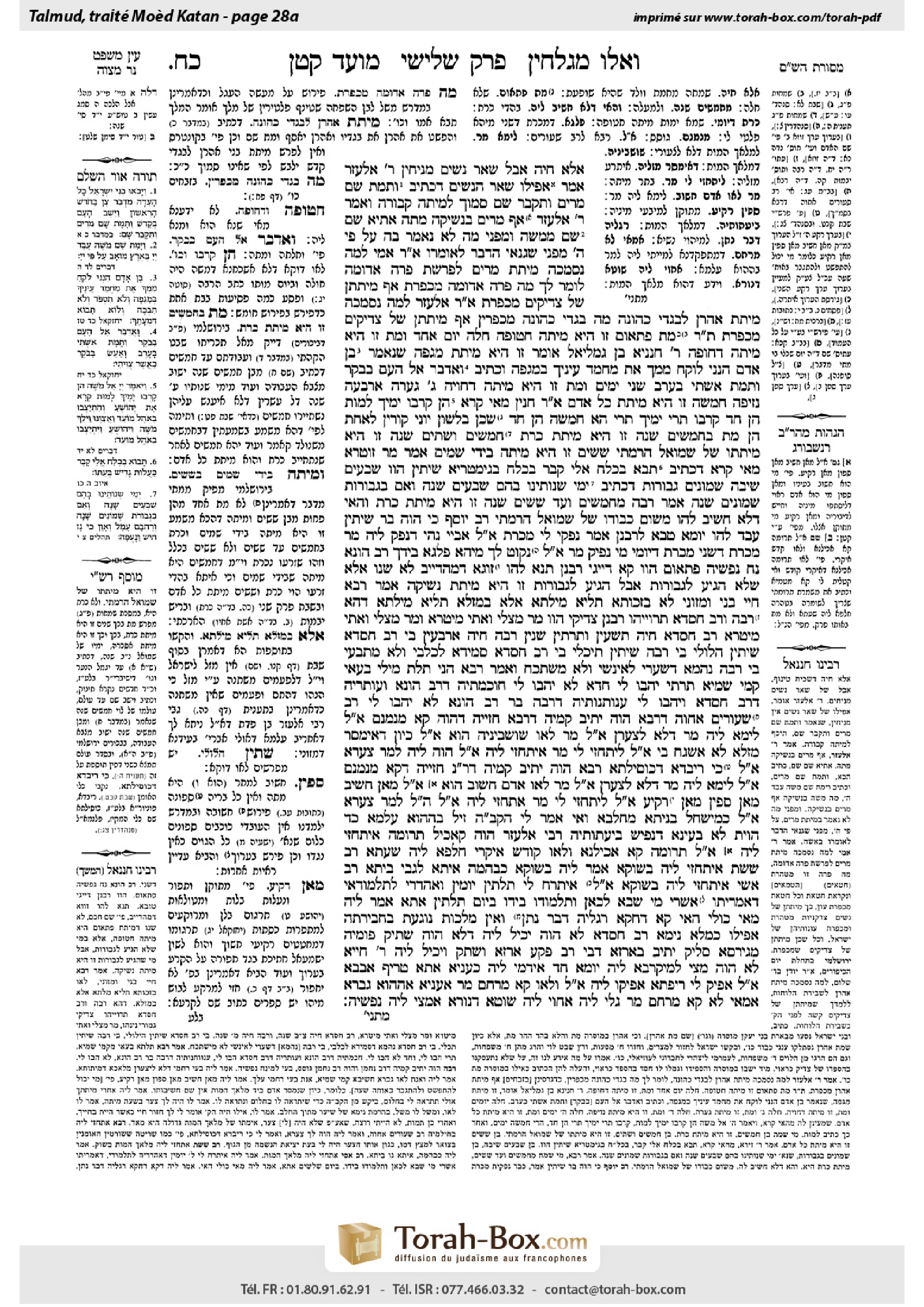
Moed Katan 28a: Talmud study for Daf Yomi
Daf Yomi is the daily study of one Talmud folio. Explore 37 tractates with scans, Hebrew text, Sefaria English and AI-generated French translations where annotated.
Passage selection and English or AI-generated French translation are available where the scan has annotations. Daf Study is independent of Torah-Box and Sefaria.
Browse Moed Katan · מועד קטן · All tractatesMoed Katan 28a text and translations
This page of Moed Katan includes the Aramaic text, an English translation and an AI-generated French translation, alongside the scan above.
מועד קטן כ״ח א · Aramaic and Hebrew text
אֶלָּא חָיָה. אֲבָל שְׁאָר נָשִׁים — מַנִּיחִין.
רַבִּי אֶלְעָזָר אָמַר: אֲפִילּוּ שְׁאָר הַנָּשִׁים, דִּכְתִיב: ״וַתָּמׇת שָׁם מִרְיָם וַתִּקָּבֵר שָׁם״ — סָמוּךְ לַמִּיתָה קְבוּרָה.
וְאָמַר רַבִּי אֶלְעָזָר: אַף מִרְיָם בִּנְשִׁיקָה מֵתָה. אָתְיָא ״שָׁם״ ״שָׁם״ מִמֹּשֶׁה. וּמִפְּנֵי מָה לֹא נֶאֱמַר בָּהּ ״עַל פִּי ה׳״ — מִפְּנֵי שֶׁגְּנַאי הַדָּבָר לְאוֹמְרוֹ.
אָמַר רַבִּי אַמֵּי: לָמָּה נִסְמְכָה מִיתַת מִרְיָם לְפָרָשַׁת פָּרָה אֲדוּמָּה? לוֹמַר לָךְ: מָה פָּרָה אֲדוּמָּה מְכַפֶּרֶת — אַף מִיתָתָן שֶׁל צַדִּיקִים מְכַפֶּרֶת. אָמַר רַבִּי אֶלְעָזָר: לָמָּה נִסְמְכָה מִיתַת אַהֲרֹן לְבִגְדֵי כְהוּנָּה? מָה בִּגְדֵי כְהוּנָּה מְכַפְּרִין — אַף מִיתָתָן שֶׁל צַדִּיקִים מְכַפֶּרֶת.
תָּנוּ רַבָּנַן: מֵת פִּתְאוֹם — זוֹ הִיא מִיתָה חֲטוּפָה, חָלָה יוֹם אֶחָד וָמֵת — זוֹ הִיא מִיתָה דְּחוּפָה. רַבִּי חֲנַנְיָא בֶּן גַּמְלִיאֵל אוֹמֵר: זוֹ הִיא מִיתַת מַגֵּפָה, שֶׁנֶּאֱמַר: ״בֶּן אָדָם הִנְנִי לוֹקֵחַ מִמְּךָ אֶת מַחְמַד עֵינֶיךָ בְּמַגֵּפָה״, וּכְתִיב: ״וָאֲדַבֵּר אֶל הָעָם בַּבֹּקֶר וַתָּמׇת אִשְׁתִּי בָּעָרֶב״.
שְׁנֵי יָמִים וָמֵת — זוֹ הִיא מִיתָה דְּחוּיָה. שְׁלֹשָׁה — גְּעָרָה. אַרְבָּעָה — נְזִיפָה. חֲמִשָּׁה — זוֹ הִיא מִיתַת כׇּל אָדָם.
אָמַר רַבִּי חָנִין, מַאי קְרָא: ״הֵן קָרְבוּ יָמֶיךָ לָמוּת״. ״הֵן״ — חַד, ״קָרְבוּ״ — תְּרֵי, ״יָמֶיךָ״ — תְּרֵי, הָא חֲמִשָּׁה. ״הֵן״ חַד, שֶׁכֵּן בְּלָשׁוֹן יְוָנִי קוֹרִין לְאַחַת ״הֵן״.
מֵת בַּחֲמִשִּׁים שָׁנָה — זוֹ הִיא מִיתַת כָּרֵת. חֲמִשִּׁים וּשְׁתַּיִם שָׁנָה — זוֹ הִיא מִיתָתוֹ שֶׁל שְׁמוּאֵל הָרָמָתִי. שִׁשִּׁים — זוֹ הִיא מִיתָה בִּידֵי שָׁמַיִם.
אָמַר מָר זוּטְרָא: מַאי קְרָא — דִּכְתִיב: ״תָּבֹא בְּכֶלַח אֱלֵי קֶבֶר״, ״בְּכֶלַח״ בְּגִימַטְרִיָּא שִׁיתִּין הָווּ.
שִׁבְעִים — שֵׂיבָה. שְׁמוֹנִים — גְּבוּרוֹת, דִּכְתִיב: ״יְמֵי שְׁנוֹתֵינוּ בָהֶם שִׁבְעִים שָׁנָה וְאִם בִּגְבוּרוֹת שְׁמוֹנִים שָׁנָה״. אָמַר רַבָּה: מֵחֲמִשִּׁים וְעַד שִׁשִּׁים שָׁנָה — זוֹ הִיא מִיתַת כָּרֵת. וְהַאי דְּלָא חָשֵׁיב לְהוּ — מִשּׁוּם כְּבוֹדוֹ שֶׁל שְׁמוּאֵל הָרָמָתִי.
רַב יוֹסֵף כִּי הֲוָה בַּר שִׁיתִּין, עֲבַד לְהוּ יוֹמָא טָבָא לְרַבָּנַן, אָמַר: נְפַקִי לִי מִכָּרֵת. אָמַר לֵיהּ אַבָּיֵי: נְהִי דִּנְפַק לֵיהּ מָר מִכָּרֵת דִּשְׁנֵי, מִכָּרֵת דְּיוֹמֵי מִי נָפֵיק מָר? אֲמַר לֵיהּ: נְקוֹט לָךְ מִיהָא פַּלְגָא בִּידָךְ.
רַב הוּנָא נָח נַפְשֵׁיהּ פִּתְאוֹם, הֲווֹ קָא דָּיְיגִי רַבָּנַן, תְּנָא לְהוּ זוּגָא דְּמֵהַדְיָיב: לֹא שָׁנוּ אֶלָּא שֶׁלֹּא הִגִּיעַ לִגְבוּרוֹת, אֲבָל הִגִּיעַ לִגְבוּרוֹת — זוֹ הִיא מִיתַת נְשִׁיקָה.
אָמַר רָבָא: חַיֵּי, בְּנֵי וּמְזוֹנֵי, לָא בִּזְכוּתָא תַּלְיָא מִילְּתָא, אֶלָּא בְּמַזָּלָא תַּלְיָא מִילְּתָא. דְּהָא רַבָּה וְרַב חִסְדָּא תַּרְוַיְיהוּ רַבָּנַן צַדִּיקֵי הֲווֹ, מָר מְצַלֵּי וְאָתֵי מִיטְרָא וּמָר מְצַלֵּי וְאָתֵי מִיטְרָא,
רַב חִסְדָּא חֲיָה תִּשְׁעִין וְתַרְתֵּין שְׁנִין, רַבָּה חֲיָה אַרְבְּעִין. בֵּי רַב חִסְדָּא שִׁיתִּין הִלּוּלֵי, בֵּי רַבָּה שִׁיתִּין תִּיכְלֵי.
בֵּי רַב חִסְדָּא סְמִידָא לְכַלְבֵי וְלָא מִתְבְּעֵי, בֵּי רַבָּה נַהֲמָא דִשְׂעָרֵי לְאִינָשֵׁי וְלָא מִשְׁתְּכַח.
וְאָמַר רָבָא: הָנֵי תְּלָת מִילֵּי בְּעַאי קַמֵּי שְׁמַיָּא, תַּרְתֵּי יְהַבוּ לִי, חֲדָא לָא יְהַבוּ לִי: חוּכְמְתֵיהּ דְּרַב הוּנָא, וְעוּתְרֵיהּ דְּרַב חִסְדָּא, וִיהַבוּ לִי. עִנְוְתָנוּתֵיהּ דְּרַבָּה בַּר רַב הוּנָא, לָא יְהַבוּ לִי.
רַב שְׂעוֹרִים אֲחוּהּ דְּרָבָא הֲוָה יָתֵיב קַמֵּיהּ דְּרָבָא, חַזְיֵיהּ דַּהֲוָה קָא מְנַמְנֵם. אֲמַר לֵיהּ: לֵימָא לֵיהּ מָר דְּלָא לְצַעֲרַן. אֲמַר לֵיהּ: מָר לָאו שׁוֹשְׁבִינֵיהּ הוּא? אֲמַר לֵיהּ: כֵּיוָן דְּאִימְּסַר מַזָּלָא, לָא אַשְׁגַּח בִּי. אֲמַר לֵיהּ: לִיתְחֲזֵי לִי מָר. אִיתְחֲזִי לֵיהּ. אֲמַר לֵיהּ: הֲוָה לֵיהּ לְמָר צַעֲרָא? אֲמַר לֵיהּ: כִּי רִיבְדָּא דְכוּסִילְתָּא.
רָבָא הֲוָה יָתֵיב קַמֵּיהּ דְּרַב נַחְמָן, חַזְיֵיהּ דְּקָא מְנַמְנֵם. אֲמַר לֵיהּ: לֵימָא לֵיהּ מָר דְּלָא לְצַעֲרַן. אֲמַר לֵיהּ: מָר לָאו אָדָם חָשׁוּב הוּא? אֲמַר לֵיהּ: מַאן חֲשִׁיב, מַאן סְפִין, מַאן רְקִיעַ!
אֲמַר לֵיהּ: לִיתְחֲזֵי לִי מָר. אִתְחֲזִי לֵיהּ. אֲמַר לֵיהּ: הֲוָה לֵיהּ לְמָר צַעֲרָא? אֲמַר לֵיהּ: כְּמִישְׁחַל בִּנִיתָא מֵחֲלָבָא, וְאִי אָמַר לִי הַקָּדוֹשׁ בָּרוּךְ הוּא זִיל בְּהָהוּא עָלְמָא כִּד הֲוֵית — לָא בָּעֵינָא, דִּנְפִישׁ בִּיעֲתוּתֵיהּ.
רַבִּי אֶלְעָזָר הֲוָה קָאָכֵיל תְּרוּמָה. אִיתְחֲזִי לֵיהּ, אֲמַר לֵיהּ: תְּרוּמָה קָא אָכֵילְנָא, וְלָאו קוֹדֶשׁ אִיקְּרִי? חֲלַפָא לֵיהּ שַׁעְתָּא.
רַב שֵׁשֶׁת אִיתְחֲזִי לֵיהּ בְּשׁוּקָא, אֲמַר לֵיהּ: בְּשׁוּקָא כִּבְהֵמָה? אִיתַא לְגַבֵּי בֵּיתָא.
רַב אָשֵׁי אִיתְחֲזִי לֵיהּ (בְּשׁוּקָא), אֲמַר לֵיהּ: אִיתְּרַח לִי תְּלָתִין יוֹמִין, וְאַהְדְּרֵי[הּ] לְתַלְמוּדַאי, דְּאָמְרִיתוּ: אַשְׁרֵי מִי שֶׁבָּא לְכָאן וְתַלְמוּדוֹ בְּיָדוֹ. בְּיוֹם תְּלָתִין אֲתָא. אֲמַר לֵיהּ: מַאי כּוּלֵּי הַאי? קָא דָחֲקָא רַגְלֵיהּ דְּבַר נָתָן, וְאֵין מַלְכוּת נוֹגַעַת בַּחֲבֶירְתָּהּ אֲפִילּוּ כִּמְלֹא נִימָא.
רַב חִסְדָּא, לָא הֲוָה יָכֵיל לֵיהּ, דְּלָא הֲוָה שָׁתֵיק פּוּמֵּיהּ מִגִּירְסָא, סְלֵיק יְתֵיב בְּאַרְזָא דְּבֵי רַב. פְּקַע אַרְזָא וּשְׁתַק, וִיכֵיל לֵיהּ.
רַבִּי חִיָּיא לָא הֲוָה מָצֵי לְמִיקְרַבא לֵיהּ, יוֹמָא חַד אִידְּמִי לֵיהּ כְּעַנְיָא, אֲתָא טָרֵיף אַבָּבָא, אֲמַר לֵיהּ: אַפֵּיק לִי רִיפְתָּא, אַפִּיקוּ לֵיהּ. אֲמַר לֵיהּ: וְלָאו קָא מְרַחֵם מָר אַעַנְיָא? אַהָהוּא גַּבְרָא אַמַּאי לָא קָא מְרַחֵם מָר? גַּלִּי לֵיהּ, אַחְוִי לֵיהּ שׁוֹטָא דְנוּרָא, אַמְצִי לֵיהּ נַפְשֵׁיהּ.
Moed Katan 28a · English translation
with regard to a woman who died in childbirth, and therefore continues to bleed. But the biers of other women may be set down in the street.
Rabbi Elazar said: Even the biers of other women must not be set down in the street, as it is written: “And Miriam died there and was buried there” (Numbers 20:1), which teaches that the site of her burial was close to the place of her death. Therefore, it is preferable to bury a woman as close as possible to the place where she died.
With regard to that same verse Rabbi Elazar said further: Miriam also died by the divine kiss, just like her brother Moses. What is the source for this? This is derived through a verbal analogy between the word “there” stated with regard to Miriam and the word “there” mentioned with regard to Moses. With regard to Moses it says: “So Moses the servant of the Lord died there in the land of Moab by the mouth of the Lord” (Deuteronomy 34:5). For what reason was it not explicitly stated with regard to her, as it is stated with regard to Moses, that she died “by the mouth of the Lord”? It is because it would be unseemly to say such a thing, that a woman died by way of a divine kiss, and therefore it is not said explicitly.
Rabbi Ami said: Why was the Torah portion that describes the death of Miriam juxtaposed to the portion dealing with the red heifer? To tell you: Just as the red heifer atones for sin, so too, the death of the righteous atones for sin. Rabbi Elazar said: Why was the Torah portion that describes the death of Aaron juxtaposed to the portion discussing the priestly garments? This teaches that just as the priestly garments atone for sin, so too, the death of the righteous atones for sin.
§ The Sages taught the following baraita: If one dies suddenly without having been sick, this is death through snatching. If he became sick for a day and died, this is an expedited death. Rabbi Ḥananya ben Gamliel says: This is death at a stroke, as it is stated: “Son of man, behold, I am about to take away from you the delight of your eyes at a stroke” (Ezekiel 24:16). And when this prophecy is fulfilled it is written: “So I spoke to the people in the morning and at evening my wife died” (Ezekiel 24:18).
If he was sick for two days and died, this is a quickened death. If he was sick for three days and died, this is a death of rebuke. If he died after being sick for four days, this is a death of reprimand. If one died after a sickness lasting five days, this is the ordinary death of all people.
Rabbi Ḥanin said: What is the verse from which this is derived? It is stated: “Behold, your days approach that you must die” (Deuteronomy 31:14). This verse is expounded in the following manner: “Behold [hen]” indicates one; “approach [karvu],” a plural term, indicates two; “your days [yamekha],” also a plural term, indicates another two; and therefore in total this is five. How does the word hen indicate one? Because in the Greek language they call the number one hen.
The Gemara discusses the significance of death at different ages: If one dies when he is fifty years old, this is death through karet, the divine punishment of excision, meted out for the most serious transgressions. If he dies when he is fifty-two years old, this is the death of Samuel from Ramah. If he dies at the age of sixty, this is death at the hand of Heaven.
Mar Zutra said: What is the verse from which this is derived? As it is written: “You shall come to your grave in a ripe age [bekhelaḥ]” (Job 5:26). The word “ripe age” [bekhelaḥ] has the numerical value of sixty, and it is alluded to there that dying at this age involves a divine punishment.
One who dies at the age of seventy has reached old age. One who dies at the age of eighty dies in strength, as it is written: “The days of our years are seventy, or if by reason of strength, eighty years” (Psalms 90:10). Rabba said: Not only is death at the age of fifty a sign of karet, but even death from fifty to sixty years of age is death by karet. And the reason that all of these years were not counted in connection with karet is due to the honor of Samuel from Ramah, who died at the age of fifty-two.
The Gemara relates that when Rav Yosef turned sixty he made a holiday for the Sages. Explaining the cause for his celebration, he said: I have passed the age of karet. Abaye said to him: Master, even though you have passed the karet of years, have you, Master, escaped the karet of days? As previously mentioned, sudden death is also considered to be a form of karet. He said to him: Grasp at least half in your hand, for I have at least escaped one type of karet.
It was related that Rav Huna died suddenly, and the Sages were concerned that this was a bad sign. The Sage Zuga from Hadayeiv taught them the following: They taught these principles only when the deceased had not reached the age of strength, i.e., eighty. But if he had reached the age of strength and then died suddenly, this is death by way of a divine kiss.
Rava said: Length of life, children, and sustenance do not depend on one’s merit, but rather they depend upon fate. As, Rabba and Rav Ḥisda were both pious Sages; one Sage would pray during a drought and rain would fall, and the other Sage would pray and rain would fall.
And nevertheless, their lives were very different. Rav Ḥisda lived for ninety-two years, whereas Rabba lived for only forty years. The house of Rav Ḥisda celebrated sixty wedding feasts, whereas the house of Rabba experienced sixty calamities. In other words, many fortuitous events took place in the house of Rav Ḥisda and the opposite occurred in the house of Rabba.
In the house of Rav Ḥisda there was bread from the finest flour [semida] even for the dogs, and it was not asked after, as there was so much food. In the house of Rabba, on the other hand, there was coarse barley bread even for people, and it was not found in sufficient quantities. This shows that the length of life, children, and sustenance all depend not upon one’s merit, but upon fate.
Apropos Rav Ḥisda’s great wealth, the Gemara reports that Rava said: These three things I requested from Heaven, two of which were given to me, and one was not given to me: I requested the wisdom of Rav Huna and the wealth of Rav Ḥisda and they were given to me. I also requested the humility of Rabba bar Rav Huna, but it was not given to me.
The Gemara continues its discussion of the deaths of the righteous. Rav Seorim, Rava’s brother, sat before Rava, and he saw that Rava was dozing, i.e., about to die. Rava said to his brother: Master, tell him, the Angel of Death, not to torment me. Knowing that Rava was not afraid of the Angel of Death, Rav Seorim said to him: Master, are you not a friend of the Angel of Death? Rava said to him: Since my fate has been handed over to him, and it has been decreed that I shall die, the Angel of Death no longer pays heed to me. Rav Seorim said to Rava: Master, appear to me in a dream after your death. And Rava appeared to him. Rav Seorim said to Rava: Master, did you have pain in death? He said to him: Like the prick of the knife when letting blood.
It was similarly related that Rava sat before Rav Naḥman, and he saw that Rav Naḥman was dozing, i.e., slipping into death. Rav Naḥman said to Rava: Master, tell the Angel of Death not to torment me. Rava said to him: Master, are you not an important person who is respected in Heaven? Rav Naḥman said to him: In the supernal world who is important? Who is honorable? Who is complete?
Rava said to Rav Naḥman: Master, appear to me in a dream after your death. And he appeared to him. Rava said to him: Master, did you have pain in death? Rav Naḥman said to him: Like the removal of hair from milk, which is a most gentle process. But nevertheless, were the Holy One, Blessed be He, to say to me: Go back to that world, the physical world, as you were, I would not want to go, for the fear of the Angel of Death is great. And I would not want to go through such a terrifying experience a second time.
The Gemara relates that Rabbi Elazar was once eating teruma, when the Angel of Death appeared to him. He said to the Angel of Death: I am eating teruma; is it not called sacred? It would be inappropriate for me to die now and thereby defile this sacred teruma. The Angel of Death accepted his argument and left him. The moment passed, and he lived for some time afterward.
It was similarly related that the Angel of Death once appeared to Rav Sheshet in the marketplace. Rav Sheshet said to the Angel of Death: Shall I die in the market like an animal? Come to my house and kill me there like a human being.
So too, the Angel of Death appeared to Rav Ashi in the marketplace. Rav Ashi said to the Angel of Death: Give me thirty days so that I may review my studies, for you say above: Fortunate is he who comes here to Heaven with his learning in his hand. On the thirtieth day the Angel of Death came to take him. Rav Ashi said to the Angel of Death: What is all of this? Why are you in such a hurry to take me? Why can you not postpone my death? He said to him: The foot of Rav Huna bar Natan is pushing you, as he is ready to succeed you as the leader of the generation, and one sovereignty does not overlap with its counterpart, even by one hairbreadth. Therefore, you cannot live any longer.
The Angel of Death was unable to take Rav Ḥisda because his mouth was never silent from study. So the Angel of Death went and sat on the cedar column that supported the roof of the study hall of the Sages. The cedar cracked and Rav Ḥisda was silent for a moment, as he was startled by the sound. At that point the Angel of Death was able to take him.
The Angel of Death could not come near Rabbi Ḥiyya, owing to his righteousness. One day the Angel of Death appeared to him as a poor person. He came and knocked on the door. He said to Rabbi Ḥiyya: Bring out bread for me, and he took out bread for him. The Angel of Death then said to Rabbi Ḥiyya: Master, do you not have mercy on a poor person? Why, then, do you not have mercy upon that man, i.e., upon me, and give me what I want? The Angel of Death then revealed his identity to him, and showed him a fiery rod in order to confirm that he was the Angel of Death. At this point Rav Ḥiyya surrendered himself to him.
Moed Katan 28a · Traduction française (IA)
dans le cas d’une femme morte en couches et qui, par conséquent, continue à saigner. Mais les civières funéraires des autres femmes peuvent être déposées dans la rue.
Rabbi Elazar dit : Même les civières funéraires des autres femmes ne doivent pas être déposées dans la rue, comme il est écrit : « Miriam mourut là et y fut enterrée » (Nombres 20:1). Cela enseigne que le lieu de son enterrement était proche du lieu de sa mort. Il est donc préférable d’enterrer une femme aussi près que possible de l’endroit où elle est morte.
À propos de ce même verset, Rabbi Elazar dit encore : Miriam aussi mourut par le baiser divin, tout comme son frère Moïse. Quelle en est la source ? Cela se déduit par analogie verbale entre le mot « là », employé au sujet de Miriam, et le mot « là », employé au sujet de Moïse. À propos de Moïse, il est dit : « Moïse, serviteur de l’Éternel, mourut là, au pays de Moav, par la bouche de l’Éternel » (Deutéronome 34:5). Pourquoi n’est-il pas explicitement dit à son sujet, comme il l’est à propos de Moïse, qu’elle mourut « par la bouche de l’Éternel » ? Parce qu’il aurait été inconvenant de dire une telle chose, à savoir qu’une femme mourut par un baiser divin ; c’est pourquoi cela n’est pas dit explicitement.
Rabbi Ami dit : Pourquoi le passage de la Torah qui décrit la mort de Miriam est-il juxtaposé à celui qui traite de la vache rousse ? Pour t’enseigner que, de même que la vache rousse expie la faute, la mort des justes expie elle aussi la faute. Rabbi Elazar dit : Pourquoi le passage de la Torah qui décrit la mort d’Aaron est-il juxtaposé à celui qui traite des vêtements sacerdotaux ? Cela enseigne que, de même que les vêtements sacerdotaux expient la faute, la mort des justes expie elle aussi la faute.
§ Les Sages ont enseigné dans une baraïta : Si quelqu’un meurt soudainement, sans avoir été malade, c’est une mort par arrachement. S’il tombe malade pendant un jour puis meurt, c’est une mort précipitée. Rabbi Ḥananya ben Gamliel dit : C’est une mort d’un coup, comme il est dit : « Fils de l’homme, voici que je vais t’enlever d’un coup ce qui fait les délices de tes yeux » (Ézéchiel 24:16). Et lorsque cette prophétie s’accomplit, il est écrit : « Je parlai au peuple le matin, et le soir ma femme mourut » (Ézéchiel 24:18).
S’il fut malade pendant deux jours puis mourut, c’est une mort hâtée. S’il fut malade pendant trois jours puis mourut, c’est une mort de réprimande. S’il mourut après avoir été malade pendant quatre jours, c’est une mort de reproche. Si quelqu’un mourut après une maladie de cinq jours, c’est la mort ordinaire de tous les hommes.
Rabbi Ḥanin dit : Quel verset permet de le déduire ? Il est dit : « Voici, tes jours approchent, et tu dois mourir » (Deutéronome 31:14). Ce verset est interprété de la manière suivante : « Voici » [hen] indique un ; « approchent » [karvu], terme au pluriel, indique deux ; « tes jours » [yamekha], également au pluriel, indique encore deux ; au total, cela fait donc cinq. Comment le mot hen indique-t-il un ? Parce qu’en grec, on appelle le nombre un hen.
La Guemara examine la signification de la mort à différents âges : si quelqu’un meurt à cinquante ans, c’est une mort par karet, la peine divine d’excision infligée pour les transgressions les plus graves. S’il meurt à cinquante-deux ans, c’est la mort de Samuel de Rama. S’il meurt à soixante ans, c’est une mort par la main du Ciel.
Mar Zutra dit : Quel verset permet de le déduire ? Comme il est écrit : « Tu iras à ta tombe en pleine maturité [bekhelaḥ] » (Job 5:26). Le mot « maturité » [bekhelaḥ] a une valeur numérique de soixante ; il est donc suggéré ici que mourir à cet âge implique une punition divine.
Celui qui meurt à soixante-dix ans a atteint la vieillesse. Celui qui meurt à quatre-vingts ans meurt dans sa vigueur, comme il est écrit : « La durée de nos jours est de soixante-dix ans, et si, grâce à la vigueur, de quatre-vingts ans » (Psaumes 90:10). Rabba dit : Non seulement mourir à cinquante ans est un signe de karet, mais mourir entre cinquante et soixante ans est également une mort par karet. Si toutes ces années n’ont pas été comptées en rapport avec le karet, c’est par égard pour Samuel de Rama, qui mourut à cinquante-deux ans.
La Guemara rapporte que lorsque Rav Yosef eut soixante ans, il organisa une fête pour les Sages. Expliquant la raison de cette célébration, il dit : J’ai dépassé l’âge du karet. Abaye lui dit : Maître, même si vous avez dépassé le karet des années, avez-vous, Maître, échappé au karet des jours ? Comme cela a été mentionné précédemment, la mort soudaine est elle aussi considérée comme une forme de karet. Il lui répondit : Saisis au moins la moitié ; j’ai au moins échappé à une sorte de karet.
Il fut rapporté que Rav Huna mourut soudainement, et les Sages craignirent que ce fût un mauvais signe. Le sage Zuga de Hadayeiv leur enseigna ce qui suit : Ces principes n’ont été enseignés que lorsque le défunt n’avait pas atteint l’âge de la vigueur, c’est-à-dire quatre-vingts ans. Mais s’il avait atteint l’âge de la vigueur puis était mort soudainement, c’est une mort par le baiser divin.
Rava dit : La longévité, les enfants et la subsistance ne dépendent pas du mérite d’une personne, mais du destin. En effet, Rabba et Rav Ḥisda étaient tous deux des Sages pieux ; l’un priait pendant une sécheresse et la pluie tombait, et l’autre priait et la pluie tombait.
Et pourtant, leurs vies furent très différentes. Rav Ḥisda vécut quatre-vingt-douze ans, tandis que Rabba ne vécut que quarante ans. La maison de Rav Ḥisda célébra soixante fêtes de mariage, tandis que la maison de Rabba connut soixante calamités. Autrement dit, de nombreux événements heureux se produisirent dans la maison de Rav Ḥisda, tandis que l’inverse se produisit dans celle de Rabba.
Dans la maison de Rav Ḥisda, il y avait même du pain de la meilleure farine [semida] pour les chiens, et l’on ne s’enquérait pas de ce qu’il en restait, tant la nourriture abondait. Dans la maison de Rabba, en revanche, il y avait même pour les gens du pain d’orge grossière, et il n’y en avait pas en quantité suffisante. Cela montre que la longévité, les enfants et la subsistance ne dépendent pas du mérite d’une personne, mais du destin.
À propos de la grande richesse de Rav Ḥisda, la Guemara rapporte que Rava dit : J’ai demandé trois choses au Ciel ; deux m’ont été accordées, et une ne m’a pas été accordée : j’ai demandé la sagesse de Rav Huna et la richesse de Rav Ḥisda, et elles m’ont été accordées. J’ai aussi demandé l’humilité de Rabba bar Rav Huna, mais elle ne m’a pas été accordée.
La Guemara poursuit sa discussion sur la mort des justes. Rav Seorim, le frère de Rava, était assis devant Rava et vit que celui-ci somnolait, c’est-à-dire qu’il était sur le point de mourir. Rava dit à son frère : Maître, dis à l’Ange de la Mort de ne pas me tourmenter. Sachant que Rava n’avait pas peur de l’Ange de la Mort, Rav Seorim lui dit : Maître, n’êtes-vous pas l’ami de l’Ange de la Mort ? Rava lui répondit : Puisque mon sort lui a été confié et qu’il a été décrété que je mourrais, l’Ange de la Mort ne tient plus compte de moi. Rav Seorim dit à Rava : Maître, apparaissez-moi en rêve après votre mort. Et Rava lui apparut. Rav Seorim dit à Rava : Maître, avez-vous souffert en mourant ? Il lui répondit : Comme la piqûre d’une lancette lors d’une saignée.
Il fut rapporté de même que Rava était assis devant Rav Naḥman et vit que Rav Naḥman somnolait, c’est-à-dire qu’il glissait vers la mort. Rav Naḥman dit à Rava : Maître, dis à l’Ange de la Mort de ne pas me tourmenter. Rava lui dit : Maître, n’êtes-vous pas un personnage important, respecté au Ciel ? Rav Naḥman lui répondit : Dans le monde supérieur, qui est important ? Qui est honoré ? Qui est irréprochable ?
Rava dit à Rav Naḥman : Maître, apparaissez-moi en rêve après votre mort. Et il lui apparut. Rava lui dit : Maître, avez-vous souffert en mourant ? Rav Naḥman lui répondit : Comme lorsqu’on retire les poils du lait, ce qui est un procédé très doux. Pourtant, si le Saint, béni soit-Il, me disait : « Retourne dans ce monde, le monde physique, tel que tu étais », je ne voudrais pas y retourner, car la crainte de l’Ange de la Mort est grande. Je ne voudrais pas vivre une seconde fois une expérience aussi terrifiante.
La Guemara rapporte que Rabbi Elazar mangeait un jour de la terouma lorsque l’Ange de la Mort lui apparut. Il lui dit : Je mange de la terouma ; n’est-elle pas appelée chose sainte ? Il serait inconvenant que je meure maintenant et que je souille ainsi cette terouma sainte. L’Ange de la Mort accepta son argument et le quitta. Le moment passa, et il vécut encore quelque temps.
Il fut rapporté de même que l’Ange de la Mort apparut un jour à Rav Sheshet sur la place du marché. Rav Sheshet lui dit : Dois-je mourir sur le marché comme un animal ? Viens chez moi et tue-moi là comme un être humain.
De même, l’Ange de la Mort apparut à Rav Ashi sur la place du marché. Rav Ashi lui dit : Accorde-moi trente jours pour que je puisse réviser mes études, car tu dis plus haut : « Heureux celui qui vient ici, au Ciel, avec son étude en main. » Le trentième jour, l’Ange de la Mort vint le prendre. Rav Ashi lui dit : Qu’est-ce que tout cela ? Pourquoi es-tu si pressé de me prendre ? Pourquoi ne peux-tu pas retarder ma mort ? Il lui répondit : Le pied de Rav Huna bar Natan te presse, car il est prêt à te succéder comme chef de la génération, et un règne ne chevauche pas un autre, pas même de l’épaisseur d’un cheveu. Tu ne peux donc pas vivre plus longtemps.
L’Ange de la Mort ne parvenait pas à prendre Rav Ḥisda, car sa bouche ne cessait jamais d’étudier. L’Ange de la Mort alla donc s’asseoir sur la colonne de cèdre qui soutenait le toit de la maison d’étude des Sages. Le cèdre se fendit et Rav Ḥisda se tut un instant, effrayé par le bruit. L’Ange de la Mort put alors le prendre.
L’Ange de la Mort ne pouvait s’approcher de Rabbi Ḥiyya, en raison de sa piété. Un jour, l’Ange de la Mort lui apparut sous les traits d’un pauvre. Il vint frapper à la porte. Il dit à Rabbi Ḥiyya : Donne-moi du pain, et Rabbi Ḥiyya lui en donna. L’Ange de la Mort dit alors à Rabbi Ḥiyya : Maître, n’avez-vous pas pitié d’un pauvre ? Pourquoi donc n’avez-vous pas pitié de cet homme, c’est-à-dire de moi, et ne me donnez-vous pas ce que je veux ? L’Ange de la Mort lui révéla alors son identité et lui montra un bâton de feu pour confirmer qu’il était bien l’Ange de la Mort. Rabbi Ḥiyya se livra alors à lui.
Traduction française générée par IA à partir de l’édition anglaise de Sefaria. Vérifie toujours un passage avec le texte source.
Text from Sefaria: William Davidson Edition - Vocalized Aramaic (CC BY NC); William Davidson Edition - English (CC BY NC).