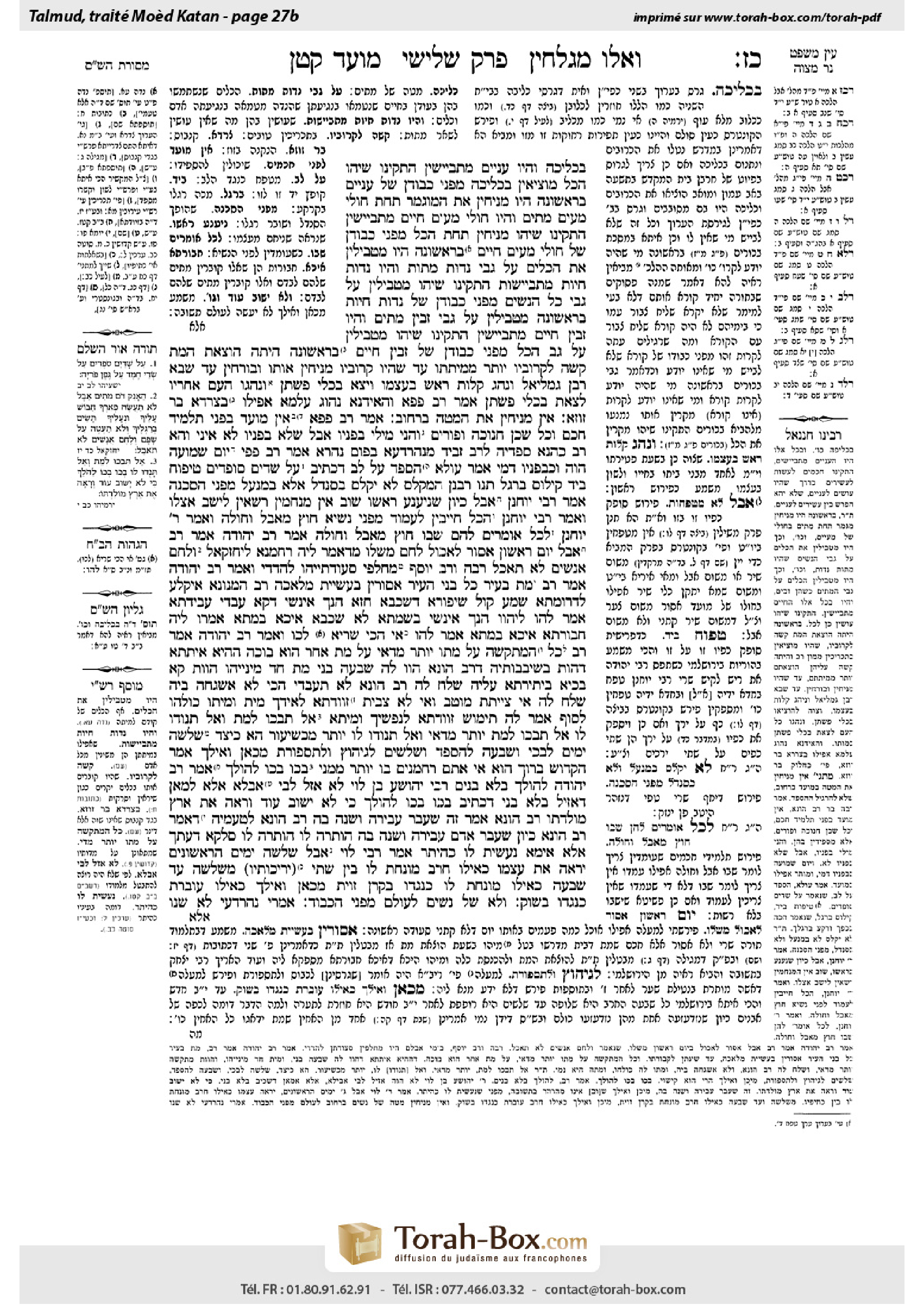
Moed Katan 27b: Talmud study for Daf Yomi
Daf Yomi is the daily study of one Talmud folio. Explore 37 tractates with scans, Hebrew text, Sefaria English and AI-generated French translations where annotated.
Passage selection and English or AI-generated French translation are available where the scan has annotations. Daf Study is independent of Torah-Box and Sefaria.
Browse Moed Katan · מועד קטן · All tractatesMoed Katan 27b text and translations
This page of Moed Katan includes the Aramaic text, an English translation and an AI-generated French translation, alongside the scan above.
מועד קטן כ״ז ב · Aramaic and Hebrew text
בִּכְלִיכָה, וְהָיוּ עֲנִיִּים מִתְבַּיְּישִׁין. הִתְקִינוּ שֶׁיְּהוּ הַכֹּל מוֹצִיאִין בִּכְלִיכָה, מִפְּנֵי כְּבוֹדָן שֶׁל עֲנִיִּים.
בָּרִאשׁוֹנָה הָיוּ מַנִּיחִין אֶת הַמּוּגְמָר תַּחַת חוֹלֵי מֵעַיִם מֵתִים, וְהָיוּ חוֹלֵי מֵעַיִם חַיִּים מִתְבַּיְּישִׁין. הִתְקִינוּ שֶׁיְּהוּ מַנִּיחִין תַּחַת הַכֹּל, מִפְּנֵי כְּבוֹדָן שֶׁל חוֹלֵי מֵעַיִם חַיִּים.
בָּרִאשׁוֹנָה הָיוּ מַטְבִּילִין אֶת הַכֵּלִים עַל גַּבֵּי נִדּוֹת מֵתוֹת, וְהָיוּ נִדּוֹת חַיּוֹת מִתְבַּיְּישׁוֹת. הִתְקִינוּ שֶׁיְּהוּ מַטְבִּילִין עַל גַּבֵּי כׇּל הַנָּשִׁים, מִפְּנֵי כְּבוֹדָן שֶׁל נִדּוֹת חַיּוֹת. בָּרִאשׁוֹנָה מַטְבִּילִין עַל גַּבֵּי זָבִין מֵתִים, וְהָיוּ זָבִין חַיִּים מִתְבַּיְּישִׁין. הִתְקִינוּ שֶׁיְּהוּ מַטְבִּילִין עַל גַּב הַכֹּל, מִפְּנֵי כְּבוֹדָן שֶׁל זָבִין חַיִּים.
בָּרִאשׁוֹנָה הָיְתָה הוֹצָאַת הַמֵּת קָשָׁה לִקְרוֹבָיו יוֹתֵר מִמִּיתָתוֹ, עַד שֶׁהָיוּ קְרוֹבָיו מַנִּיחִין אוֹתוֹ וּבוֹרְחִין. עַד שֶׁבָּא רַבָּן גַּמְלִיאֵל וְנָהַג קַלּוּת רֹאשׁ בְּעַצְמוֹ, וְיָצָא בִּכְלֵי פִשְׁתָּן, וְנָהֲגוּ הָעָם אַחֲרָיו לָצֵאת בִּכְלֵי פִשְׁתָּן. אָמַר רַב פָּפָּא: וְהָאִידָּנָא נְהוּג עָלְמָא אֲפִילּוּ בְּצַרְדָּא בַּר זוּזָא.
אֵין מַנִּיחִין אֶת הַמִּטָּה בָּרְחוֹב. אָמַר רַב פָּפָּא: אֵין מוֹעֵד בִּפְנֵי תַּלְמִיד חָכָם, וְכׇל שֶׁכֵּן חֲנוּכָּה וּפוּרִים.
וְהָנֵי מִילֵּי בְּפָנָיו, אֲבָל שֶׁלֹּא בְּפָנָיו — לָא. אִינִי?! וְהָא רַב כָּהֲנָא סַפְדֵיהּ לְרַב זְבִיד מִנְּהַרְדְּעָא בְּפוּם נַהֲרָא! אָמַר רַב פַּפֵּי: יוֹם שְׁמוּעָה הֲוָה, וְכִבְפָנָיו דָּמֵי.
אָמַר עוּלָּא: הֶסְפֵּד עַל לֵב, דִּכְתִיב: ״עַל שָׁדַיִם סוֹפְדִים״. טִיפּוּחַ בַּיָּד. קִילּוּס בָּרֶגֶל.
תָּנוּ רַבָּנַן: הַמְקַלֵּס — לֹא יְקַלֵּס בְּסַנְדָּל, אֶלָּא בְּמִנְעָל, מִפְּנֵי הַסַּכָּנָה.
אָמַר רַבִּי יוֹחָנָן: אָבֵל, כֵּיוָן שֶׁנִּיעְנַע רֹאשׁוֹ — שׁוּב אֵין מְנַחֲמִין רַשָּׁאִין לֵישֵׁב אֶצְלוֹ.
וְאָמַר רַבִּי יוֹחָנָן: הַכֹּל חַיָּיבִין לַעֲמוֹד מִפְּנֵי נָשִׂיא, חוּץ מֵאָבֵל וְחוֹלֶה. וְאָמַר רַבִּי יוֹחָנָן: לַכֹּל אוֹמְרִים לָהֶם ״שֵׁבוּ״, חוּץ מֵאָבֵל וְחוֹלֶה.
אָמַר רַב יְהוּדָה אָמַר רַב: אָבֵל, יוֹם רִאשׁוֹן אָסוּר לֶאֱכוֹל לֶחֶם מִשֶּׁלּוֹ, מִדַּאֲמַר לֵיהּ רַחֲמָנָא לִיחֶזְקֵאל: ״וְלֶחֶם אֲנָשִׁים לֹא תֹאכֵל״. רַבָּה וְרַב יוֹסֵף מְחַלְּפִי סְעוֹדָתַיְיהוּ לַהֲדָדֵי.
וְאָמַר רַב יְהוּדָה אָמַר רַב: מֵת בְּעִיר — כׇּל בְּנֵי הָעִיר אֲסוּרִין בַּעֲשִׂיַּית מְלָאכָה.
רַב הַמְנוּנָא אִיקְּלַע לְדֵרוּ מָתָא, שְׁמַע קוֹל שִׁיפּוּרָא דְשָׁכְבָא. חֲזָא הָנָךְ אִינָשֵׁי דְּקָא עָבְדִי עֲבִידְתָּא, אֲמַר לְהוּ: לֶיהְווֹ הָנָךְ אִינָשֵׁי בְּשַׁמְתָּא. לָא שָׁכְבָא אִיכָּא בְּמָתָא?! אֲמַרוּ לֵיהּ: חֲבוּרָתָא אִיכָּא בְּמָתָא. אֲמַר לְהוּ: אִי הָכִי, שַׁרְיָא לְכוּ.
וְאָמַר רַב יְהוּדָה אָמַר רַב: כׇּל הַמִּתְקַשֶּׁה עַל מֵתוֹ יוֹתֵר מִדַּאי, עַל מֵת אַחֵר הוּא בּוֹכֶה. הָהִיא אִיתְּתָא דַּהֲוָת בְּשִׁיבָבוּתֵיהּ דְּרַב הוּנָא, הֲווֹ לַהּ שִׁבְעָה בְּנֵי, מִית חַד מִינַּיְיהוּ, הֲווֹת קָא בָּכְיָא בִּיתִירֻתָא עֲלֵיהּ. שְׁלַח לַהּ רַב הוּנָא: לָא תַּעַבְדִי הָכִי! לָא אַשְׁגְּחָה בֵּיהּ. שְׁלַח לַהּ: אִי צָיְיתַתְּ — מוּטָב, וְאִי לָא — צְבִית זְוַודְתָּא לְאִידַּךְ מִית, וּמִיתוּ כּוּלְּהוּ. לְסוֹף אֲמַר לַהּ: תִּימוּשׁ זְוַודְתָּא לְנַפְשִׁיךְ, וּמִיתָא.
״אַל תִּבְכּוּ לְמֵת וְאַל תָּנוּדוּ לוֹ״. ״אַל תׇּבְכּוּ לְמֵת״ — יוֹתֵר מִדַּאי, ״וְאַל תָּנוּדוּ לוֹ״ — יוֹתֵר מִכְּשִׁיעוּר. הָא כֵּיצַד? שְׁלֹשָׁה יָמִים לְבֶכִי, וְשִׁבְעָה לְהֶסְפֵּד, וּשְׁלֹשִׁים לְגִיהוּץ וּלְתִסְפּוֹרֶת. מִכָּאן וְאֵילָךְ — אָמַר הַקָּדוֹשׁ בָּרוּךְ הוּא: אִי אַתֶּם רַחְמָנִים בּוֹ יוֹתֵר מִמֶּנִּי.
״בְּכוּ בָכוֹ לַהוֹלֵךְ״, אָמַר רַב יְהוּדָה: לַהוֹלֵךְ בְּלֹא בָּנִים. רַבִּי יְהוֹשֻׁעַ בֶּן לֵוִי לָא אֲזַל לְבֵי אִבְלָא אֶלָּא לְמַאן דְּאָזֵיל בְּלָא בְּנֵי, דִּכְתִיב: ״בְּכוּ בָכוֹ לַהוֹלֵךְ כִּי לֹא יָשׁוּב עוֹד וְרָאָה אֶת אֶרֶץ מוֹלַדְתּוֹ״. רַב הוּנָא אָמַר: זֶה שֶׁעָבַר עֲבֵירָה וְשָׁנָה בָּהּ.
רַב הוּנָא לְטַעְמֵיהּ, דְּאָמַר רַב הוּנָא: כֵּיוָן שֶׁעָבַר אָדָם עֲבֵירָה וְשָׁנָה בָּהּ — הוּתְּרָה לוֹ. הוּתְּרָה לוֹ סָלְקָא דַּעְתָּךְ?! אֶלָּא אֵימָא: נַעֲשֵׂית לוֹ כְּהֶיתֵּר.
אָמַר רַבִּי לֵוִי: אָבֵל, שְׁלֹשָׁה יָמִים הָרִאשׁוֹנִים יִרְאֶה אֶת עַצְמוֹ כְּאִילּוּ חֶרֶב מוּנַּחַת לוֹ בֵּין שְׁתֵּי יַרְיכוֹתָיו. מִשְּׁלֹשָׁה עַד שִׁבְעָה — כְּאִילּוּ מוּנַּחַת לוֹ כְּנֶגְדּוֹ בְּקֶרֶן זָוִית, מִכָּאן וְאֵילָךְ — כְּאִילּוּ עוֹבֶרֶת כְּנֶגְדּוֹ בַּשּׁוּק.
וְלֹא שֶׁל נָשִׁים לְעוֹלָם מִפְּנֵי הַכָּבוֹד. אָמְרִי נְהַרְדָּעֵי: לֹא שָׁנוּ
Moed Katan 27b · English translation
on a plain bier made from poles that were strapped together, and the poor were embarrassed. The Sages instituted that everyone should be taken out for burial on a plain bier, due to the honor of the poor.
Similarly, at first they would place incense under the beds of those who died with an intestinal disease, because the body emitted an especially unpleasant odor. And those who were alive with an intestinal disease were embarrassed when they understood that they, too, would be treated in this manner after their death, and that everyone would know the cause of their death. The Sages instituted that incense should be placed under everyone, due to the honor of those with an intestinal disease who were still living.
Moreover, at first they would ritually immerse all the utensils that had been used by women who died while menstruating, which had thereby contracted ritual impurity. And due to this, the living menstruating women were embarrassed. The Sages instituted that the utensils that had been used by all dying women must be immersed, due to the honor of living menstruating women. And, at first they would ritually immerse all the utensils that had been used by zavin, men suffering from gonorrhea, who died, as the utensils had thereby contracted ritual impurity. And due to this the living zavin felt embarrassed. The Sages instituted that the utensils that had been used by all men must be immersed, due to the honor of the living zavin.
Likewise, at first taking the dead out for burial was more difficult for the relatives than the actual death, because it was customary to bury the dead in expensive shrouds, which the poor could not afford. The problem grew to the point that relatives would sometimes abandon the corpse and run away. This lasted until Rabban Gamliel came and acted with frivolity, meaning that he waived his dignity, by leaving instructions that he be taken out for burial in linen garments. And the people adopted this practice after him and had themselves taken out for burial in linen garments. Rav Pappa said: And nowadays, everyone follows the practice of taking out the dead for burial even in plain hemp garments [tzerada] that cost only a dinar.
It is taught in the mishna: The bier of the deceased is not set down in the street during the intermediate days of a Festival, so as not to encourage eulogies. Rav Pappa said: There are no restrictions on eulogizing on the intermediate days of a Festival in the presence of a deceased Torah scholar, and therefore he may be eulogized in the ordinary manner during the Festival week. And all the more so a Torah scholar may be eulogized on the days of Hanukkah and Purim, which have less sanctity than the intermediate days of a Festival.
The Gemara comments: But this allowance to eulogize a Torah scholar during the intermediate days of a Festival applies only when the eulogy is in the presence of the deceased, before the bier. However, giving a eulogy that is not in his presence is not permitted. The Gemara asks: Is that so? But didn’t Rav Kahana eulogize Rav Zevid from Neharde’a in his city Pum Nahara during the intermediate days of a Festival? Rav Pappa said: It was the day on which Rav Kahana received the news of Rav Zevid’s death, and a eulogy in such a situation is considered as if it is in his presence.
The Gemara continues its discussion of the halakhot of mourning: Ulla said: Although hesped usually refers to a eulogy, strictly speaking, hesped is referring to striking oneself on the heart, as it is written: “Striking [sofedim] the breasts” (Isaiah 32:12). The term tipuaḥ is referring to striking with one hand against the other hand, i.e., clapping. The term killus is referring to stomping with one’s foot on the ground.
The Sages taught a baraita: One who stomps his foot on the ground as a sign of mourning should not stomp with a sandal, but rather he should do so wearing a shoe, due to the danger of being hurt. Because a sandal is easily torn, it is possible that something sharp on the ground will puncture his foot, or that he will suffer some other injury.
Rabbi Yoḥanan said: Once a mourner nods his head to show that his grief has slightly diminished, the consolers may no longer sit next to him, as with his action the mourner shows that he no longer desires their presence.
Rabbi Yoḥanan further said: All are obligated to stand in the presence of the Nasi, except for a mourner and one who is sick. Rabbi Yoḥanan said: To all who stand before a great person one says: Be seated, and only then may they sit down, except for a mourner and one who is sick. If they stood up they do not need permission to sit down, but rather they may do so if they wish.
Rav Yehuda said in the name of Rav: A mourner on the first day of his mourning is prohibited from eating of his own bread. From where is this derived? From what the Merciful One says to Ezekiel when the latter is in mourning: “Nor eat the bread of men” (Ezekiel 24:17), which indicates that other mourners must eat bread made by others. It was related that when Rabba and Rav Yosef were in mourning they would exchange their meals with each other.
And Rav Yehuda said in the name of Rav: When a person dies in a city, all of the residents of that city are prohibited from performing work until he has been buried.
The Gemara relates that when Rav Hamnuna once happened to come to a place called Darumata he heard the sound of a shofar announcing that a person had died in the town. When he saw some people doing work he said to them: Let these people be under an excommunication. Is there not a dead person in town? They said to him: There are separate groups in the town, each one responsible for its own dead. Knowing that the deceased was not from our group, we continued our work. He said to them: If so, it is permitted to you, and he revoked his excommunication.
And Rav Yehuda said further in the name of Rav: Anyone who grieves excessively over his dead and does not allow himself to be consoled will in the end weep for another person. The Gemara relates that a certain woman who lived in the neighborhood of Rav Huna had seven sons. One of them died and she wept for him excessively. Rav Huna sent a message to her: Do not do this. But she took no heed of him. He then sent another message to her: If you listen to me, it is well, but if not, prepare shrouds for another death. But she would not listen and they all died. In the end, when she continued with her excessive mourning, he said to her: Since you are acting in this way, prepare shrouds for yourself, and soon thereafter she died.
The Sages taught in a baraita with regard to the verse that states: “Weep not for the dead, neither bemoan him” (Jeremiah 22:10): “Weep not for the dead” is referring to excessive mourning; “neither bemoan him” more than the appropriate measure of time. How so? What is the appropriate measure? Three days for weeping, and seven for eulogizing, and thirty for the prohibition against ironing clothing and for the prohibition against cutting hair. From this point forward the Holy One, Blessed be He, says: Do not be more merciful with the deceased than I am. If the Torah commands one to mourn for a certain period of time, then that suffices.
It is stated in the continuation of the verse: “Weep sore for him that goes away.” Rav Yehuda said: This is referring to one who leaves the world without children to survive him, since mourning for him is much more intense. It was related that Rabbi Yehoshua ben Levi would go to a house of mourning only for one who passed away without children, as it is written: “Weep sore for him that goes away; for he shall return [yashuv] no more, nor see his native land” (Jeremiah 22:10). Rav Huna disagreed with the interpretation of the verse and said: “Him that goes” is one who committed a transgression and then repeated it, i.e., one who sins constantly and does not repent [yashav], and therefore loses his portion in the World-to-Come, his “native land.”
The Gemara notes that Rav Huna conforms to his standard line of reasoning, as Rav Huna said: Once a person commits a transgression and repeats it, it becomes permitted to him. The Gemara questions the wording used here: Does it enter your mind that it is actually permitted? How could it possibly be permitted for him to sin? Rather, say instead: It becomes as though it were permitted, for after doing it twice he no longer relates to his action as the violation of a serious prohibition.
Rabbi Levi said: A mourner during the first three days of his mourning should see himself as though a sword were lying between his two thighs, meaning that he too may be facing imminent death. During this period he should live in dread. From the third to the seventh days he should conduct himself as if the sword were lying opposite him in the corner, but still threatening him. From this point forward it is as if the sword was moving before him in the marketplace, and the fear is not as great.
§ The mishna teaches: And the biers of women are never set down, due to their honor. The Sages of Neharde’a say: They only taught this
Moed Katan 27b · Traduction française (IA)
sur un simple brancard fait de perches attachées ensemble, ce qui faisait honte aux pauvres. Les Sages instituèrent que tout le monde soit porté à sa sépulture sur un simple brancard, par égard pour les pauvres.
De même, au début, on plaçait de l’encens sous les lits de ceux qui mouraient d’une maladie intestinale, car leur corps dégageait une odeur particulièrement désagréable. Les personnes encore en vie atteintes d’une maladie intestinale éprouvaient de la honte lorsqu’elles comprenaient qu’on ferait de même pour elles après leur mort et que tout le monde connaîtrait la cause de leur décès. Les Sages instituèrent que l’on place de l’encens sous tout le monde, par égard pour les personnes atteintes d’une maladie intestinale encore en vie.
En outre, au début, on immergeait rituellement tous les ustensiles utilisés par les femmes mortes pendant leurs menstruations, car ils étaient ainsi devenus rituellement impurs. De ce fait, les femmes menstruées encore en vie éprouvaient de la honte. Les Sages instituèrent que les ustensiles utilisés par toutes les femmes mortes soient immergés, par égard pour les femmes menstruées encore en vie. De même, au début, on immergeait rituellement tous les ustensiles utilisés par les zavin — des hommes souffrant de gonorrhée — qui étaient morts, car ces ustensiles étaient ainsi devenus rituellement impurs. De ce fait, les zavin encore en vie éprouvaient de la honte. Les Sages instituèrent que les ustensiles utilisés par tous les hommes soient immergés, par égard pour les zavin encore en vie.
De même, au début, emmener les morts à leur sépulture était plus pénible pour leurs proches que la mort elle-même, car il était d’usage d’ensevelir les morts dans des linceuls coûteux, que les pauvres ne pouvaient se permettre. Le problème prit une telle ampleur qu’il arrivait parfois aux proches d’abandonner le corps et de s’enfuir. Cela dura jusqu’à ce que Rabban Gamliel agisse avec désinvolture, c’est-à-dire renonce à sa dignité, en laissant pour instruction qu’on l’emmène à sa sépulture vêtu de vêtements de lin. Après lui, le peuple adopta cette pratique et se fit emmener à sa sépulture vêtu de vêtements de lin. Rav Pappa dit : De nos jours, tout le monde suit la pratique consistant à emmener les morts à leur sépulture même dans de simples vêtements de chanvre [tzerada], qui ne coûtent qu’un dinar.
La Michna enseigne : on ne dépose pas le brancard du défunt dans la rue pendant les jours intermédiaires d’une fête, afin de ne pas inciter aux éloges funèbres. Rav Pappa dit : Il n’y a aucune restriction concernant les éloges funèbres pendant les jours intermédiaires d’une fête en présence d’un érudit de la Torah décédé ; on peut donc faire son éloge funèbre de la manière habituelle pendant la semaine de fête. À plus forte raison, on peut faire l’éloge funèbre d’un érudit de la Torah pendant les jours de Hanoucca et de Pourim, dont la sainteté est moindre que celle des jours intermédiaires d’une fête.
La Guemara fait remarquer : cette autorisation de faire l’éloge funèbre d’un érudit de la Torah pendant les jours intermédiaires d’une fête ne s’applique que si l’éloge est prononcé en présence du défunt, devant le brancard. En revanche, il est interdit de faire son éloge funèbre en son absence. La Guemara demande : En est-il ainsi ? Rav Kahana n’a-t-il pas fait l’éloge funèbre de Rav Zevid de Neharde’a dans sa ville, Poum Nahara, pendant les jours intermédiaires d’une fête ? Rav Pappa dit : C’était le jour où Rav Kahana avait appris la mort de Rav Zevid ; dans une telle situation, l’éloge funèbre est considéré comme ayant lieu en sa présence.
La Guemara poursuit son examen des halakhot du deuil : Oulla dit : bien que hesped désigne habituellement un éloge funèbre, à proprement parler, hesped désigne le fait de se frapper la poitrine, comme il est écrit : « Se frappant [sofedim] la poitrine » (Isaïe 32:12). Le terme tipuaḥ désigne le fait de frapper une main contre l’autre, c’est-à-dire d’applaudir. Le terme killus désigne le fait de frapper le sol du pied.
Les Sages enseignèrent dans une baraïta : celui qui frappe le sol du pied en signe de deuil ne doit pas le faire en sandales, mais plutôt chaussé de chaussures, en raison du risque de se blesser. Comme une sandale se déchire facilement, un objet pointu au sol pourrait lui transpercer le pied, ou il pourrait subir une autre blessure.
Rabbi Yoḥanan dit : dès qu’un endeuillé incline la tête pour montrer que sa peine s’est quelque peu apaisée, les consolateurs ne doivent plus s’asseoir à ses côtés, car, par ce geste, l’endeuillé montre qu’il ne souhaite plus leur présence.
Rabbi Yoḥanan dit aussi : tous sont tenus de se lever en présence du Nassi, à l’exception d’un endeuillé et d’un malade. Rabbi Yoḥanan dit encore : à tous ceux qui se lèvent devant un grand personnage, on dit : « Asseyez-vous », et ce n’est qu’ensuite qu’ils peuvent s’asseoir, à l’exception d’un endeuillé et d’un malade. S’ils se sont levés, ils n’ont pas besoin d’autorisation pour se rasseoir ; ils peuvent le faire s’ils le souhaitent.
Rav Yehouda dit au nom de Rav : le premier jour de son deuil, il est interdit à l’endeuillé de manger de son propre pain. D’où cela se déduit-il ? De ce que le Miséricordieux dit à Ézéchiel alors que celui-ci est en deuil : « Ne mange pas le pain des hommes » (Ézéchiel 24:17), ce qui indique que les autres endeuillés doivent manger du pain préparé par autrui. On rapporte que, lorsque Rabba et Rav Yosef étaient en deuil, ils échangeaient leurs repas.
Rav Yehouda dit au nom de Rav : lorsqu’une personne meurt dans une ville, tous les habitants de cette ville ont l’interdiction de travailler jusqu’à ce qu’elle ait été ensevelie.
La Guemara rapporte que Rav Hamnouna, étant arrivé un jour dans un endroit appelé Darumata, entendit le son d’un chofar annonçant qu’une personne était morte dans la ville. Voyant des gens travailler, il leur dit : « Que ces gens soient frappés d’excommunication ! N’y a-t-il pas un mort dans la ville ? » Ils lui répondirent : « Il y a dans la ville des groupes distincts, chacun chargé de ses propres morts. Sachant que le défunt n’appartenait pas à notre groupe, nous avons poursuivi notre travail. » Il leur dit : « Dans ce cas, cela vous est permis », et il leva l’excommunication.
Rav Yehouda dit encore au nom de Rav : quiconque se lamente excessivement sur son mort et refuse de se laisser consoler finira par pleurer la mort d’une autre personne. La Guemara rapporte qu’une certaine femme qui habitait dans le voisinage de Rav Houna avait sept fils. L’un d’eux mourut et elle pleura sa mort excessivement. Rav Houna lui fit transmettre ce message : « Ne fais pas cela. » Mais elle ne tint pas compte de ses paroles. Il lui fit alors transmettre un autre message : « Si tu m’écoutes, tant mieux ; sinon, prépare des linceuls pour un autre décès. » Mais elle refusa de l’écouter et tous ses fils moururent. Finalement, comme elle continuait à se lamenter excessivement, il lui dit : « Puisque tu agis ainsi, prépare des linceuls pour toi-même », et peu après, elle mourut.
Les Sages enseignèrent dans une baraïta au sujet du verset : « Ne pleurez pas le mort, ne le plaignez pas » (Jérémie 22:10) : « Ne pleurez pas le mort » désigne un deuil excessif ; « ne le plaignez pas » signifie ne pas le pleurer au-delà de la durée appropriée. Quelle est cette durée appropriée ? Trois jours pour les pleurs, sept jours pour les éloges funèbres et trente jours pendant lesquels il est interdit de repasser les vêtements et de se couper les cheveux. À partir de là, le Saint, béni soit-Il, dit : « Ne soyez pas plus miséricordieux envers le défunt que moi. » Si la Torah commande de se lamenter pendant une certaine période, cela suffit.
La suite du verset dit : « Pleurez amèrement celui qui s’en va. » Rav Yehouda dit : cela désigne celui qui quitte le monde sans laisser d’enfants après lui, car le deuil à son sujet est beaucoup plus intense. On rapporte que Rabbi Yehoshua ben Levi ne se rendait dans une maison de deuil que pour une personne morte sans enfants, comme il est écrit : « Pleurez amèrement celui qui s’en va, car il ne reviendra [yashuv] plus et ne verra plus son pays natal » (Jérémie 22:10). Rav Houna n’était pas d’accord avec cette interprétation du verset et dit : « Celui qui s’en va » désigne celui qui a commis une transgression puis l’a répétée, c’est-à-dire celui qui pèche constamment sans se repentir [yashav], et qui perd ainsi sa part dans le monde à venir, son « pays natal ».
La Guemara note que Rav Houna est fidèle à son raisonnement habituel, car Rav Houna dit : dès qu’une personne commet une transgression et la répète, celle-ci devient permise à ses yeux. La Guemara conteste la formulation employée ici : Peut-on penser qu’elle lui soit réellement permise ? Comment pourrait-il lui être permis de pécher ? Il faut plutôt dire : elle lui devient comme permise, car après l’avoir commise deux fois, il ne considère plus son acte comme la transgression d’une grave interdiction.
Rabbi Levi dit : pendant les trois premiers jours de son deuil, l’endeuillé doit se voir comme si une épée était posée entre ses deux cuisses, ce qui signifie que lui aussi pourrait être menacé d’une mort imminente. Pendant cette période, il doit vivre dans la crainte. Du troisième au septième jour, il doit se comporter comme si l’épée était posée en face de lui, dans un coin, tout en continuant à le menacer. À partir de là, c’est comme si l’épée avançait devant lui sur la place du marché, et la crainte est moins grande.
§ La Michna enseigne : on ne dépose jamais les brancards des femmes, par égard pour elles. Les Sages de Neharde’a disent : ils n’ont enseigné cela que
Traduction française générée par IA à partir de l’édition anglaise de Sefaria. Vérifie toujours un passage avec le texte source.
Text from Sefaria: William Davidson Edition - Vocalized Aramaic (CC BY NC); William Davidson Edition - English (CC BY NC).