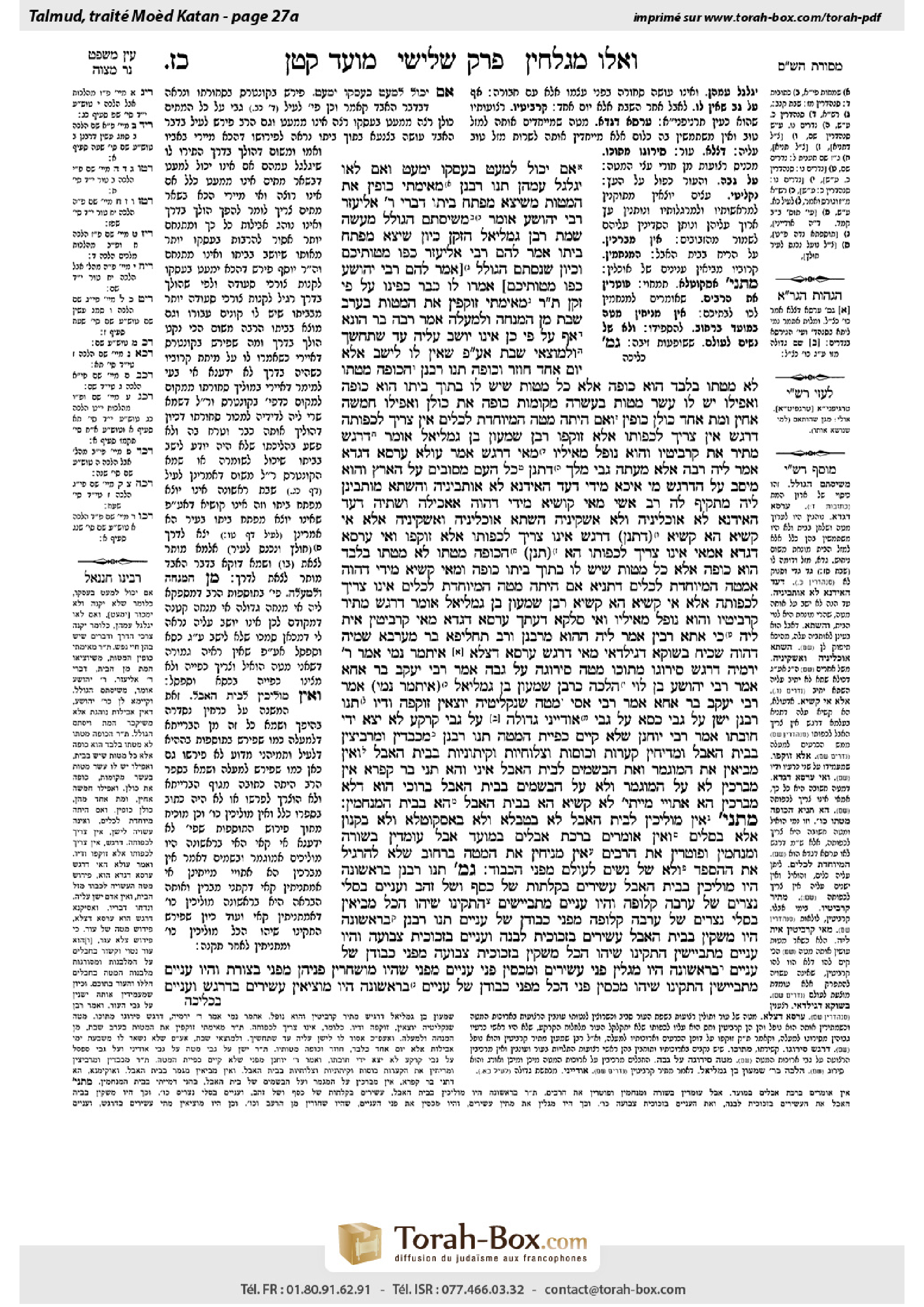
Moed Katan 27a: Talmud study for Daf Yomi
Daf Yomi is the daily study of one Talmud folio. Explore 37 tractates with scans, Hebrew text, Sefaria English and AI-generated French translations where annotated.
Passage selection and English or AI-generated French translation are available where the scan has annotations. Daf Study is independent of Torah-Box and Sefaria.
Browse Moed Katan · מועד קטן · All tractatesMoed Katan 27a text and translations
This page of Moed Katan includes the Aramaic text, an English translation and an AI-generated French translation, alongside the scan above.
מועד קטן כ״ז א · Aramaic and Hebrew text
אִם יָכוֹל לְמַעֵט בְּעִסְקוֹ — יְמַעֵט, וְאִם לָאו — יְגַלְגֵּל עִמָּהֶן.
תָּנוּ רַבָּנַן: מֵאֵימָתַי כּוֹפִין אֶת הַמִּטּוֹת — מִשֶּׁיֵּצֵא מִפֶּתַח בֵּיתוֹ, דִּבְרֵי רַבִּי אֱלִיעֶזֶר. רַבִּי יְהוֹשֻׁעַ אוֹמֵר: מִשֶּׁיִּסָּתֵם הַגּוֹלֵל.
מַעֲשֶׂה שֶׁמֵּת רַבָּן גַּמְלִיאֵל הַזָּקֵן, כֵּיוָן שֶׁיָּצָא מִפֶּתַח בֵּיתוֹ אָמַר לָהֶם רַבִּי אֱלִיעֶזֶר: כְּפוּ מִטּוֹתֵיכֶם. וְכֵיוָן שֶׁנִּסְתַּם הַגּוֹלֵל, אָמַר לָהֶם רַבִּי יְהוֹשֻׁעַ: כְּפוּ מִטּוֹתֵיכֶם. אָמְרוּ לוֹ: כְּבָר כָּפִינוּ עַל פִּי זָקֵן.
תָּנוּ רַבָּנַן: מֵאֵימָתַי זוֹקְפִין אֶת הַמִּטּוֹת בְּעֶרֶב שַׁבָּת — מִן הַמִּנְחָה וּלְמַעְלָה. אָמַר רַבָּה בַּר הוּנָא: אַף עַל פִּי כֵן אֵינוֹ יוֹשֵׁב עָלֶיהָ עַד שֶׁתֶּחְשַׁךְ. וּלְמוֹצָאֵי שַׁבָּת, אַף עַל פִּי שֶׁאֵין לוֹ לֵישֵׁב אֶלָּא יוֹם אֶחָד — חוֹזֵר וְכוֹפֶה.
תָּנוּ רַבָּנַן: הַכּוֹפֶה מִטָּתוֹ, לֹא מִטָּתוֹ בִּלְבַד הוּא כּוֹפֶה, אֶלָּא כׇּל מִטּוֹת שֶׁיֵּשׁ לוֹ בְּתוֹךְ בֵּיתוֹ הוּא כּוֹפֶה. וַאֲפִילּוּ יֵשׁ לוֹ עֶשֶׂר מִטּוֹת בַּעֲשָׂרָה מְקוֹמוֹת — כּוֹפֶה אֶת כּוּלָּן. וַאֲפִילּוּ חֲמִשָּׁה אַחִין וּמֵת אֶחָד — כּוּלָּן כּוֹפִין.
וְאִם הָיְתָה מִטָּה הַמְיוּחֶדֶת לְכֵלִים — אֵין צָרִיךְ לִכְפּוֹתָהּ. דַּרְגֵּשׁ — אֵין צָרִיךְ לִכְפּוֹתוֹ, אֶלָּא זוֹקְפוֹ. רַבָּן שִׁמְעוֹן בֶּן גַּמְלִיאֵל אוֹמֵר: דַּרְגֵּשׁ מַתִּיר אֶת קַרְבִּיטָיו וְהוּא נוֹפֵל מֵאֵילָיו.
מַאי דַּרְגֵּשׁ? אָמַר עוּלָּא: עַרְסָא דְגַדָּא.
אֲמַר לֵיהּ רַבָּה: אֶלָּא מֵעַתָּה גַּבֵּי מֶלֶךְ, דִּתְנַן: כׇּל הָעָם מְסוּבִּים עַל הָאָרֶץ, וְהוּא מֵיסֵב עַל הַדַּרְגֵּשׁ. מִי אִיכָּא מִידֵּי דְּעַד הָאִידָּנָא לָא אוֹתְבִינֵּיהּ, וְהַשְׁתָּא מוֹתְבִינַן לֵיהּ?
מַתְקֵיף לַהּ רַב אָשֵׁי: מַאי קוּשְׁיָא? מִידֵּי דְּהָוֵה אַאֲכִילָה וּשְׁתִיָּה, דְּעַד הָאִידָּנָא לָא אוֹכְלִינֵּיהּ וְלָא אַשְׁקִינֵּיהּ, הַשְׁתָּא אוֹכְלִינֵּיהּ וְאַשְׁקִינֵּיהּ!
אֶלָּא, אִי קַשְׁיָא — הָא קַשְׁיָא, דִּתְנַן: דַּרְגֵּשׁ אֵינוֹ צָרִיךְ לִכְפּוֹתוֹ אֶלָּא זוֹקְפוֹ. וְאִי עַרְסָא דְגַדָּא, אַמַּאי אֵינוֹ צָרִיךְ לִכְפּוֹתוֹ? הָא תְּנַן: הַכּוֹפֶה מִטָּתוֹ, לֹא מִטָּתוֹ בִּלְבַד הוּא כּוֹפֶה, אֶלָּא כׇּל מִטּוֹת שֶׁיֵּשׁ לוֹ בְּתוֹךְ בֵּיתוֹ כּוֹפֶה!
וּמַאי קַשְׁיָא? מִידֵּי דְּהָוֵה אַמִּטָּה הַמְיוּחֶדֶת לְכֵלִים. דְּתַנְיָא: אִם הָיְתָה מִטָּה הַמְיוּחֶדֶת לְכֵלִים — אֵינוֹ צָרִיךְ לִכְפּוֹתָהּ.
אֶלָּא, אִי קַשְׁיָא הָא קַשְׁיָא: רַבָּן שִׁמְעוֹן בֶּן גַּמְלִיאֵל אוֹמֵר: דַּרְגֵּשׁ, מַתִּיר קַרְבִּיטָיו וְהוּא נוֹפֵל מֵאֵילָיו. וְאִי סָלְקָא דַעְתָּךְ עַרְסָא דְגַדָּא, מַאי קַרְבִּיטִין אִית לֵיהּ?
כִּי אֲתָא רָבִין אֲמַר לֵיהּ הָהוּא מֵרַבָּנַן, וְרַב תַּחְלִיפָא בַּר מַעְרְבָא שְׁמֵיהּ, דַּהֲוָה שְׁכִיחַ בְּשׁוּקָא דְגִילְדָּאֵי: מַאי דַּרְגֵּשׁ — עַרְסָא דְצַלָּא.
אִיתְּמַר נָמֵי, אָמַר רַבִּי יִרְמְיָה: דַּרְגֵּשׁ — סֵירוּגוֹ מִתּוֹכוֹ, מִטָּה — סֵירוּגָהּ עַל גַּבָּהּ.
אָמַר רַבִּי יַעֲקֹב בַּר אַחָא אָמַר רַבִּי יְהוֹשֻׁעַ בֶּן לֵוִי: הֲלָכָה כְּרַבָּן שִׁמְעוֹן בֶּן גַּמְלִיאֵל. אִיתְּמַר נָמֵי, אָמַר רַבִּי יַעֲקֹב בַּר אַחָא אָמַר רַבִּי אַסִּי: מִטָּה שֶׁנַּקְלִיטֶיהָ יוֹצְאִין — זוֹקְפָהּ וְדַיּוֹ.
תָּנוּ רַבָּנַן: יָשֵׁן עַל גַּבֵּי כִּסֵּא, עַל גַּבֵּי אוּדְיָינִי גְּדוֹלָה, עַל גַּבֵּי קַרְקַע — לֹא יָצָא יְדֵי חוֹבָתוֹ. אָמַר רַבִּי יוֹחָנָן: שֶׁלֹּא קִיֵּים כְּפִיַּית הַמִּטָּה.
תָּנוּ רַבָּנַן: מְכַבְּדִין וּמַרְבִּיצִין בְּבֵית הָאֵבֶל, וּמְדִיחִין קְעָרוֹת וְכוֹסוֹת וּצְלוֹחִיּוֹת וְקִיתוֹנִיּוֹת בְּבֵית הָאֵבֶל. וְאֵין מְבִיאִין אֶת הַמּוּגְמָר וְאֶת הַבְּשָׂמִים לְבֵית הָאֵבֶל.
אִינִי? וְהָא תָּנֵי בַּר קַפָּרָא: אֵין מְבָרְכִין לֹא עַל הַמּוּגְמָר וְלֹא עַל הַבְּשָׂמִים בְּבֵית הָאֵבֶל. בָּרוֹכֵי הוּא דְּלָא מְבָרְכִין, הָא אֵתוֹיֵי — מַיְיתִינַן!
לָא קַשְׁיָא: הָא — בְּבֵית הָאֵבֶל, הָא — בְּבֵית הַמְנַחֲמִין.
מַתְנִי׳ אֵין מוֹלִיכִין לְבֵית הָאֵבֶל, לֹא בְּטַבְלָא, וְלֹא בְּאִסְקוּטְלָא, וְלֹא בְּקָנוֹן, אֶלָּא בְּסַלִּים. וְאֵין אוֹמְרִים בִּרְכַּת אֲבֵלִים בַּמּוֹעֵד, אֲבָל עוֹמְדִין בְּשׁוּרָה וּמְנַחֲמִין, וּפוֹטְרִין אֶת הָרַבִּים.
אֵין מַנִּיחִין אֶת הַמִּטָּה בָּרְחוֹב, שֶׁלֹּא לְהַרְגִּיל אֶת הַהֶסְפֵּד. וְלֹא שֶׁל נָשִׁים לְעוֹלָם, מִפְּנֵי הַכָּבוֹד.
גְּמָ׳ תָּנוּ רַבָּנַן: בָּרִאשׁוֹנָה הָיוּ מוֹלִיכִין בְּבֵית הָאֵבֶל, עֲשִׁירִים — בִּקְלָתוֹת שֶׁל כֶּסֶף וְשֶׁל זָהָב, וַעֲנִיִּים — בְּסַלֵּי נְצָרִים שֶׁל עֲרָבָה קְלוּפָה, וְהָיוּ עֲנִיִּים מִתְבַּיְּישִׁים. הִתְקִינוּ שֶׁיְּהוּ הַכֹּל מְבִיאִין בְּסַלֵּי נְצָרִים שֶׁל עֲרָבָה קְלוּפָה, מִפְּנֵי כְּבוֹדָן שֶׁל עֲנִיִּים.
תָּנוּ רַבָּנַן: בָּרִאשׁוֹנָה הָיוּ מַשְׁקִין בְּבֵית הָאֵבֶל, עֲשִׁירִים — בִּזְכוּכִית לְבָנָה, וַעֲנִיִּים — בִּזְכוּכִית צְבוּעָה, וְהָיוּ עֲנִיִּים מִתְבַּיְּישִׁין. הִתְקִינוּ שֶׁיְּהוּ הַכֹּל מַשְׁקִין בִּזְכוּכִית צְבוּעָה, מִפְּנֵי כְּבוֹדָן שֶׁל עֲנִיִּים.
בָּרִאשׁוֹנָה הָיוּ מְגַלִּין פְּנֵי עֲשִׁירִים וּמְכַסִּין פְּנֵי עֲנִיִּים, מִפְּנֵי שֶׁהָיוּ מוּשְׁחָרִין פְּנֵיהֶן מִפְּנֵי בַצּוֹרֶת, וְהָיוּ עֲנִיִּים מִתְבַּיְּישִׁין. הִתְקִינוּ שֶׁיְּהוּ מְכַסִּין פְּנֵי הַכֹּל, מִפְּנֵי כְּבוֹדָן שֶׁל עֲנִיִּים.
בָּרִאשׁוֹנָה הָיוּ מוֹצִיאִין עֲשִׁירִים בְּדַרְגֵּשׁ, וַעֲנִיִּים
Moed Katan 27a · English translation
if he can reduce his business, he should reduce it; and if not, he may carry on with them, i.e., his business partners. He may act in partnership with the members of the group with which he is traveling, but he may not engage in business independently.
§ The Sages taught the following baraita: From when do the mourners overturn their beds? From when the corpse is taken out of the opening of his house; this is the statement of Rabbi Eliezer. Rabbi Yehoshua says: From when the tomb is sealed with the grave cover.
There was an incident in which the Nasi Rabban Gamliel the Elder died, and once his body left the opening of his house, Rabbi Eliezer said to the members of the household: Overturn your beds. And once the tomb was sealed with the grave cover, Rabbi Yehoshua said to them: Overturn your beds. They then said to him: We already overturned them in accordance with the Elder, i.e., Rabbi Eliezer.
The Sages taught in a baraita: From when do the mourners stand their beds upright on Friday; as the rites of mourning are not observed on Shabbat, and the beds must be returned to their ordinary position beforehand? From minḥa time onward. Rabba bar Huna said: Even so, one may not sit down on his upright bed immediately. Rather, he must wait until it becomes dark to do so. And at the conclusion of Shabbat, even if he has only one more day to sit in mourning, i.e., his period of mourning concludes on Sunday, he must once again overturn his bed.
The Sages taught in a baraita: With regard to one who is in mourning and must overturn his bed, he overturns not only his own bed, but rather he overturns all the beds he has in his house. And even if he has ten beds in ten different places, he overturns them all. And even if there are five brothers and one of them died, all of them overturn their beds wherever they live.
If, however, it is a bed designated for the storage of garments and not for sleeping, he is not required to overturn it. It is also not necessary to overturn a dargash, but rather he stands it upright. Rabban Shimon ben Gamliel says: With regard to a dargash, one loosens its loops [karbitav], which hold up the pillows, and it falls on its own.
The Gemara asks: What is the meaning of the word dargash? Ulla said: It is a good-luck [gada] bed, as it was common to have ornamental beds for good luck, which were not used for sleeping.
Rabba said to him: However, if that is so, then the following statement with regard to a king is difficult, as we learned in a mishna (Sanhedrin 20a): When the mourner’s meal is served to the king and his family, all the people recline on the ground, and he, the king, due to his honor, reclines on a dargash. Is there anything upon which we would not have seated him until now, when he was not a mourner, but now, specifically during the mourning period, we seat him on it?
Rav Ashi strongly objects to this: What is the difficulty raised by Rabba? One can answer: The halakha is just as it is in the case of eating and drinking, that until now, before one became a mourner, we did not feed him or give him drink, but now that he is a mourner we feed him and give him drink during the first meal after the burial.
Rather, if it is difficult, this is difficult, as we learned in a baraita: It is not necessary to overturn a dargash, but rather he stands it upright. But if it is a good-luck bed, why is it not necessary to overturn it? Didn’t we learn: One who is in mourning and must overturn his bed overturns not only his own bed, but rather he overturns all the beds in his house, including this good luck bed?
The Gemara rejects this: And what is difficult in this? One can answer: The halakha is just as it is in the case of a bed designated for the storage of garments, as it is taught in a baraita: If it is a bed designated for the storage of garments, and not for sleeping, one is not required to overturn it. So too, one is not required to overturn a dargash, as it is a bed that is not used for sleeping.
Rather if it is difficult, this is the difficulty: It was taught in a baraita: Rabban Shimon ben Gamliel says: With regard to a dargash, one loosens the loops that hold up the pillows, and it falls on its own. And if it enters your mind to say that a dargash is a good-luck bed, it is like other beds, so what loops does it have?
When Ravin came from Eretz Yisrael to Babylonia, one of the Sages, whose name was Rav Taḥalifa from the West, and who was frequently found in the market of leather workers, said to him: What is a dargash? It is a leather bed.
It was also stated that Rabbi Yirmeya said: A dargash has its interlacing from the inside, i.e., attached to loops that go through holes that are made in the bed frame itself; whereas a bed has its interlacing from the outside, i.e., the strapping itself is looped around the wood of the frame, and therefore it cannot be loosened.
Rabbi Ya’akov bar Aḥa said in the name of Rabbi Yehoshua ben Levi: The halakha is in accordance with the opinion of Rabban Shimon ben Gamliel with regard to a dargash. It was also stated that Rabbi Ya’akov bar Aḥa said in the name of Rabbi Asi: A bed whose posts [naklitin] extend, meaning that they are very long so that the bed will remain high off the ground even if it is overturned, may be stood upright and that is sufficient. That is to say, one is not required to overturn such a bed.
The Sages taught the following baraita: If the mourner sleeps on a chair, or on a large overturned mortar, or on the ground, he does not fulfill his obligation, even though he is uncomfortable while sleeping. Rabbi Yoḥanan said: This is because he did not fulfill the mitzva of overturning the bed.
The Sages taught another baraita: One may sweep and sprinkle water on a dirt floor in the house of a mourner, and one may wash bowls, cups, jugs, and pitchers in the house of a mourner. But one may not bring incense or fragrant spices into the house of a mourner.
The Gemara asks: Is that so? But doesn’t bar Kappara teach the following baraita: One may not recite a blessing either over incense or over fragrant spices in the house of a mourner? From this one may infer that one may not recite a blessing over these incense or spices, but one may bring them into the house of the mourner. This appears to contradict the previous baraita.
The Gemara explains: It is not difficult. Here, the baraita is referring to the house of a mourner, into which spices should not be taken; there, the baraita that states that one may not recite a blessing over them, is referring to the house of the consolers, his relatives, into which spices may be brought.
MISHNA: One does not bring the first meal after the burial to the house of mourning on a small tray [tavla], in a bowl [iskutla], or in a narrow-mouthed basket [kanon], but rather in ordinary baskets. And the mourners’ blessing is not recited on the intermediate days of a Festival, but the consolers may stand in a row when the mourners leave the cemetery and console them. And the mourners dismiss the many consolers, by telling them that they may return home after they have fulfilled the mitzva of consoling the mourners.
The bier of the deceased is not set down in the street during the intermediate days of a Festival so as not to encourage eulogies. On an ordinary weekday, people would gather in the street around the bier to eulogize the deceased, but this should be avoided during the intermediate days of the Festival. And the biers of women are never set down, even if it is not the intermediate days of a Festival, due to their honor. Blood might drip from their bodies, and it would cause them dishonor if their blood stained the street.
GEMARA: The Sages taught the following baraita: At first, the meal after the burial would be brought to the house of the mourner in various ways. The wealthy would bring the meal in baskets of silver and gold, and the poor would bring it in baskets of peeled willow branches. And the poor were embarrassed, as everyone would see that they were poor. The Sages instituted that everyone should bring the meal in baskets of peeled willow branches, due to the honor of the poor.
The Sages taught a similar baraita: At first, they would serve wine in the house of the mourner during the first meal after the burial; the wealthy would do so in cups made from white glass, and the poor would serve this wine in cups of colored glass. And the poor were embarrassed, as everyone would see that they were poor. The Sages instituted that all should serve drinks in the house of the mourner in colored glass cups, due to the honor of the poor.
Furthermore, at first they would uncover the faces of the wealthy who passed away and cover the faces of the poor, because their faces were blackened by famine. And the poor were embarrassed because they were buried in a different manner. The Sages instituted that everyone’s face should be covered, due to the honor of the poor.
Additionally, at first the wealthy would take the deceased out for burial on a dargash, and the poor would take the deceased out
Moed Katan 27a · Traduction française (IA)
S’il peut réduire ses activités commerciales, qu’il le fasse ; sinon, il peut poursuivre ses affaires avec eux, c’est-à-dire ses associés. Il peut faire des affaires en partenariat avec les membres du groupe avec lequel il voyage, mais il ne peut pas en faire de manière indépendante.
§ Les Sages ont enseigné dans une baraïta : À partir de quand les endeuillés retournent-ils leurs lits ? Dès que le corps est sorti par l’ouverture de la maison ; telle est l’opinion de Rabbi Eliezer. Rabbi Yehoshua dit : Dès que la tombe est scellée par la dalle funéraire.
Il arriva que le nassi, Rabban Gamliel l’Ancien, mourut. Dès que son corps fut sorti par l’ouverture de sa maison, Rabbi Eliezer dit aux membres de sa maisonnée : « Retournez vos lits. » Puis, dès que la tombe fut scellée par la dalle funéraire, Rabbi Yehoshua leur dit : « Retournez vos lits. » Ils lui répondirent alors : « Nous les avons déjà retournés, conformément à l’avis de l’Ancien », c’est-à-dire Rabbi Eliezer.
Les Sages ont enseigné dans une baraïta : À partir de quand les endeuillés remettent-ils leurs lits à l’endroit le vendredi, puisque les rites de deuil ne sont pas observés pendant Chabbat et que les lits doivent avoir retrouvé leur position habituelle auparavant ? À partir de l’heure de min’ha. Rabba bar Huna dit : Malgré cela, on ne peut pas s’asseoir immédiatement sur son lit remis à l’endroit. Il faut attendre la tombée de la nuit pour le faire. À la fin de Chabbat, même s’il ne lui reste qu’un jour de deuil, c’est-à-dire si sa période de deuil prend fin le dimanche, il doit de nouveau retourner son lit.
Les Sages ont enseigné dans une baraïta : L’endeuillé qui doit retourner son lit ne retourne pas seulement le sien, mais tous les lits qu’il a chez lui. Même s’il a dix lits en dix endroits différents, il les retourne tous. Et même s’il y a cinq frères et que l’un d’eux est mort, tous retournent leurs lits, où qu’ils vivent.
Toutefois, s’il s’agit d’un lit destiné à ranger des vêtements et non à dormir, il n’est pas nécessaire de le retourner. Il n’est pas non plus nécessaire de retourner un dargash ; il suffit de le redresser. Rabban Shimon ben Gamliel dit : Pour un dargash, on desserre ses boucles [karbitav], qui soutiennent les coussins, et il tombe de lui-même.
La Guemara demande : Que signifie le mot dargash ? Oulla dit : C’est un lit porte-bonheur [gada], car il était courant d’avoir des lits ornementaux censés porter bonheur et qui n’étaient pas utilisés pour dormir.
Rabba lui dit : Cependant, si c’est le cas, la déclaration suivante au sujet d’un roi pose difficulté, car nous avons appris dans une Michna (Sanhédrin 20a) : Lorsque le repas de deuil est servi au roi et à sa famille, tous s’allongent à même le sol, tandis que le roi, en raison de son honneur, s’allonge sur un dargash. Y a-t-il quelque chose sur lequel nous ne l’aurions pas fait asseoir jusqu’à présent, lorsqu’il n’était pas en deuil, mais sur lequel nous le faisons asseoir maintenant, précisément pendant sa période de deuil ?
Rav Ashi s’oppose vivement à cette objection : Quelle difficulté Rabba soulève-t-il ? On peut répondre que la halakha est la même que dans le cas de la nourriture et de la boisson : jusqu’à présent, avant qu’il ne soit en deuil, nous ne le nourrissions pas et ne lui donnions pas à boire ; mais maintenant qu’il est en deuil, nous le nourrissons et lui donnons à boire lors du premier repas après l’inhumation.
Mais s’il y a une difficulté, c’est plutôt la suivante, car nous avons appris dans une baraïta : Il n’est pas nécessaire de retourner un dargash ; il suffit de le redresser. Mais si c’est un lit porte-bonheur, pourquoi n’est-il pas nécessaire de le retourner ? N’avons-nous pas appris que l’endeuillé qui doit retourner son lit ne retourne pas seulement le sien, mais tous les lits de sa maison, y compris ce lit porte-bonheur ?
La Guemara rejette cette objection : En quoi est-ce une difficulté ? On peut répondre que la halakha est la même que pour un lit destiné à ranger des vêtements, comme il est enseigné dans une baraïta : S’il s’agit d’un lit destiné à ranger des vêtements et non à dormir, il n’est pas nécessaire de le retourner. De même, il n’est pas nécessaire de retourner un dargash, puisqu’il s’agit d’un lit qui n’est pas utilisé pour dormir.
Mais s’il y a une difficulté, la voici : il est enseigné dans une baraïta que Rabban Shimon ben Gamliel dit : Pour un dargash, on desserre les boucles qui soutiennent les coussins, et il tombe de lui-même. Or, si tu envisages qu’un dargash soit un lit porte-bonheur, il est comme les autres lits ; alors, quelles boucles possède-t-il ?
Lorsque Ravin vint d’Eretz Israël en Babylonie, l’un des Sages, Rav Taḥalifa de l’Ouest, qui se trouvait souvent au marché des tanneurs, lui dit : « Qu’est-ce qu’un dargash ? C’est un lit en cuir. »
Il a aussi été dit que Rabbi Yirmeya a déclaré : Sur un dargash, le laçage se trouve à l’intérieur, c’est-à-dire qu’il est fixé à des boucles qui passent dans des trous pratiqués dans le cadre même du lit ; tandis que, sur un lit, le laçage se trouve à l’extérieur, c’est-à-dire que les sangles sont enroulées autour du bois du cadre et ne peuvent donc pas être desserrées.
Rabbi Ya’akov bar Aḥa a dit au nom de Rabbi Yehoshua ben Levi : La halakha suit l’opinion de Rabban Shimon ben Gamliel concernant un dargash. Il a aussi été dit que Rabbi Ya’akov bar Aḥa a dit au nom de Rabbi Asi : Un lit dont les montants [naklitin] sont très longs, de sorte qu’il reste haut au-dessus du sol même lorsqu’on le retourne, peut être redressé, et cela suffit. Autrement dit, il n’est pas nécessaire de retourner un tel lit.
Les Sages ont enseigné la baraïta suivante : Si l’endeuillé dort sur une chaise, sur un grand mortier retourné ou à même le sol, il ne s’acquitte pas de son obligation, même si son sommeil est inconfortable. Rabbi Yoḥanan dit : C’est parce qu’il ne s’est pas acquitté de la mitsva de retourner le lit.
Les Sages ont enseigné une autre baraïta : On peut balayer et asperger d’eau le sol en terre battue de la maison d’un endeuillé, et on peut y laver des bols, des coupes, des cruches et des jarres. Mais on ne peut pas apporter d’encens ni d’épices parfumées dans la maison d’un endeuillé.
La Guemara demande : Est-ce bien le cas ? Bar Kappara n’enseigne-t-il pas la baraïta suivante : On ne peut réciter de bénédiction ni sur l’encens ni sur les épices parfumées dans la maison d’un endeuillé ? On peut en déduire qu’il est interdit de réciter une bénédiction sur cet encens ou ces épices, mais qu’on peut les apporter dans la maison de l’endeuillé. Cela semble contredire la baraïta précédente.
La Guemara explique : Il n’y a pas de difficulté. Ici, la baraïta parle de la maison de l’endeuillé, où il ne faut pas apporter d’épices ; là, la baraïta qui dit qu’on ne peut pas réciter de bénédiction sur elles parle de la maison de ceux qui viennent présenter leurs condoléances, ses proches, où l’on peut apporter des épices.
MICHNA : On n’apporte pas le premier repas après l’inhumation à la maison de deuil sur un petit plateau [tavla], dans un bol [iskutla] ou dans un panier à ouverture étroite [kanon], mais plutôt dans des paniers ordinaires. On ne récite pas la bénédiction des endeuillés pendant les jours intermédiaires d’une fête, mais ceux qui viennent présenter leurs condoléances peuvent se tenir en rang lorsque les endeuillés quittent le cimetière et les consoler. Les endeuillés congédient la foule des consolateurs en leur disant qu’ils peuvent rentrer chez eux après avoir accompli la mitsva de consoler les endeuillés.
On ne dépose pas la bière dans la rue pendant les jours intermédiaires d’une fête, afin de ne pas encourager les éloges funèbres. Un jour de semaine ordinaire, les gens se rassemblent dans la rue autour de la bière pour prononcer des éloges funèbres, mais il faut éviter cela pendant les jours intermédiaires de la fête. On ne dépose jamais les bières des femmes, même en dehors des jours intermédiaires d’une fête, par égard pour leur dignité. Du sang pourrait s’écouler de leur corps et les déshonorer si leur sang tachait la rue.
GUEMARA : Les Sages ont enseigné la baraïta suivante : Au début, le repas après l’inhumation était apporté à la maison de l’endeuillé de différentes manières. Les riches apportaient le repas dans des paniers d’argent et d’or, tandis que les pauvres l’apportaient dans des paniers faits de branches de saule écorcées. Les pauvres étaient embarrassés, car tout le monde voyait qu’ils étaient pauvres. Les Sages instituèrent que tous apportent le repas dans des paniers faits de branches de saule écorcées, par égard pour les pauvres.
Les Sages ont enseigné une baraïta semblable : Au début, on servait du vin dans la maison de l’endeuillé pendant le premier repas après l’inhumation ; les riches le servaient dans des coupes en verre blanc, tandis que les pauvres le servaient dans des coupes en verre coloré. Les pauvres étaient embarrassés, car tout le monde voyait qu’ils étaient pauvres. Les Sages instituèrent que tous servent les boissons dans la maison de l’endeuillé dans des coupes en verre coloré, par égard pour les pauvres.
De plus, au début, on découvrait le visage des riches qui étaient morts et on couvrait celui des pauvres, car leur visage était noirci par la famine. Les pauvres étaient embarrassés, car on les enterrait d’une manière différente. Les Sages instituèrent que le visage de tous soit couvert, par égard pour les pauvres.
De plus, au début, les riches faisaient transporter le défunt pour l’inhumation sur un dargash, tandis que les pauvres faisaient transporter le défunt
Traduction française générée par IA à partir de l’édition anglaise de Sefaria. Vérifie toujours un passage avec le texte source.
Text from Sefaria: William Davidson Edition - Vocalized Aramaic (CC BY NC); William Davidson Edition - English (CC BY NC).