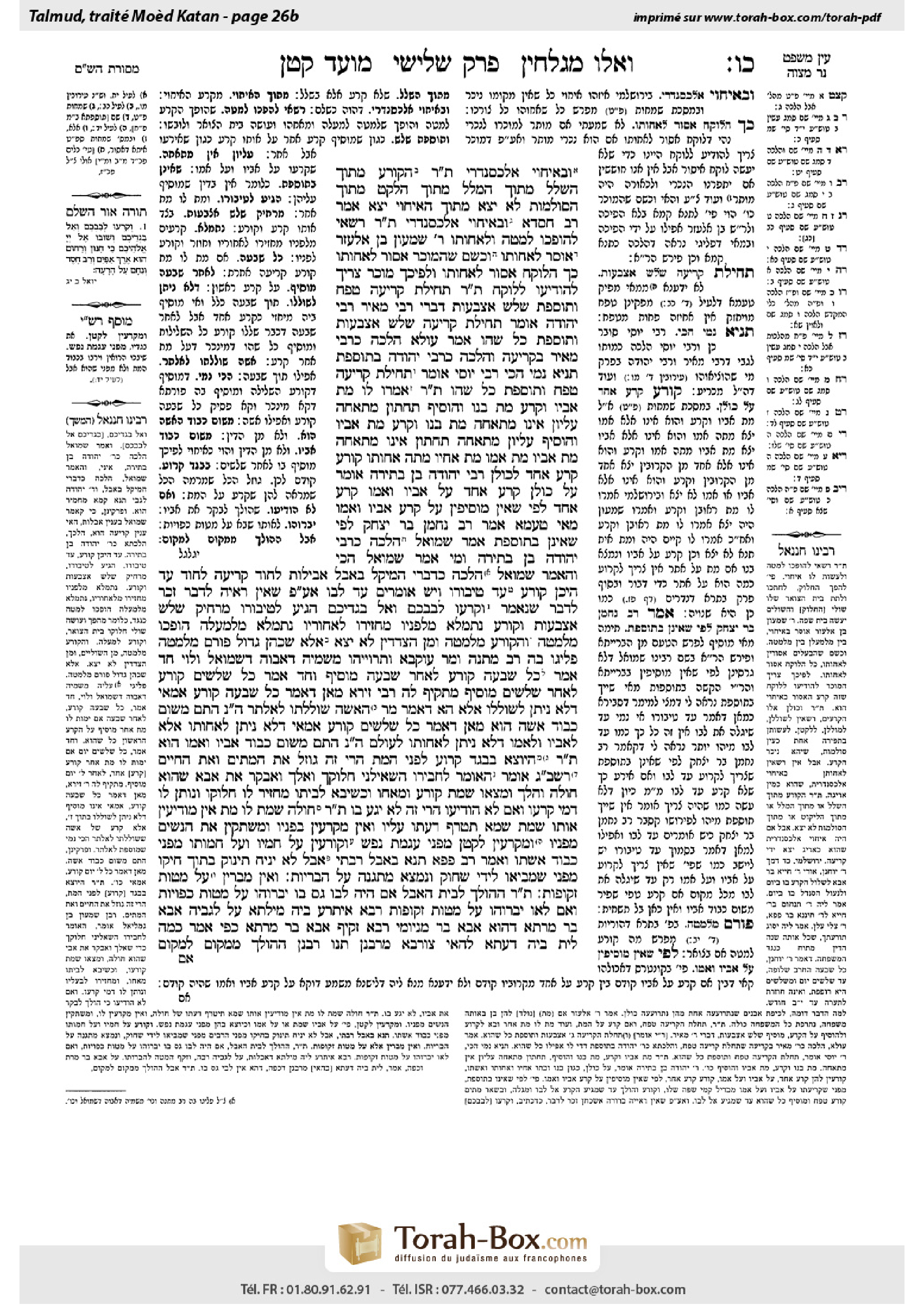
Moed Katan 26b: Talmud study for Daf Yomi
Daf Yomi is the daily study of one Talmud folio. Explore 37 tractates with scans, Hebrew text, Sefaria English and AI-generated French translations where annotated.
Passage selection and English or AI-generated French translation are available where the scan has annotations. Daf Study is independent of Torah-Box and Sefaria.
Browse Moed Katan · מועד קטן · All tractatesMoed Katan 26b text and translations
This page of Moed Katan includes the Aramaic text, an English translation and an AI-generated French translation, alongside the scan above.
מועד קטן כ״ו ב · Aramaic and Hebrew text
וּבְאִיחוּי אֲלֶכְּסַנְדְּרִי.
תָּנוּ רַבָּנַן: הַקּוֹרֵעַ מִתּוֹךְ הַשְּׁלָל מִתּוֹךְ הַמְּלָל מִתּוֹךְ הַלֶּקֶט, מִתּוֹךְ הַסּוּלָּמוֹת — לֹא יָצָא. מִתּוֹךְ הָאִיחוּי — יָצָא. אָמַר רַב חִסְדָּא: וּבְאִיחוּי אֲלֶכְּסַנְדְּרִי.
תָּנוּ רַבָּנַן: רַשַּׁאי לְהוֹפְכוֹ לְמַטָּה וּלְאַחוֹתוֹ. רַבִּי שִׁמְעוֹן בֶּן אֶלְעָזָר אוֹסֵר לְאַחוֹתוֹ, וּכְשֵׁם שֶׁהַמּוֹכֵר אָסוּר לְאַחוֹתוֹ — כָּךְ הַלּוֹקֵחַ אָסוּר לְאַחוֹתוֹ. וּלְפִיכָךְ מוֹכֵר צָרִיךְ לְהוֹדִיעוֹ לַלּוֹקֵחַ.
תָּנוּ רַבָּנַן: תְּחִילַּת קְרִיעָה — טֶפַח, וְתוֹסֶפֶת — שָׁלֹשׁ אֶצְבָּעוֹת, דִּבְרֵי רַבִּי מֵאִיר. רַבִּי יְהוּדָה אוֹמֵר: תְּחִילַּת קְרִיעָה — שָׁלֹשׁ אֶצְבָּעוֹת, וְתוֹסֶפֶת — כׇּל שֶׁהוּ.
אָמַר עוּלָּא: הֲלָכָה כְּרַבִּי מֵאִיר בִּקְרִיעָה, וַהֲלָכָה כְּרַבִּי יְהוּדָה בְּתוֹסֶפֶת. תַּנְיָא נָמֵי הָכִי, רַבִּי יוֹסֵי אוֹמֵר: תְּחִילַּת קְרִיעָה — טֶפַח, וְתוֹסֶפֶת — כׇּל שֶׁהוּ.
תָּנוּ רַבָּנַן: אָמְרוּ לוֹ מֵת אָבִיו וְקָרַע, מֵת בְּנוֹ וְהוֹסִיף, תַּחְתּוֹן — מִתְאַחֶה, עֶלְיוֹן — אֵינוֹ מִתְאַחֶה.
מֵת בְּנוֹ וְקָרַע, מֵת אָבִיו וְהוֹסִיף, עֶלְיוֹן — מִתְאַחֶה, תַּחְתּוֹן — אֵינוֹ מִתְאַחֶה.
מֵת אָבִיו, מֵת אִמּוֹ, מֵת אָחִיו, מֵתָה אֲחוֹתוֹ — קוֹרֵעַ קֶרַע אֶחָד לְכוּלָּן. רַבִּי יְהוּדָה בֶּן בְּתִירָה אוֹמֵר: עַל כּוּלָּן קֶרַע אֶחָד, עַל אָבִיו וְאִמּוֹ קֶרַע אֶחָד, לְפִי שֶׁאֵין מוֹסִיפִין עַל קֶרַע אָבִיו וְאִמּוֹ.
מַאי טַעְמָא? אָמַר רַב נַחְמָן בַּר יִצְחָק: לְפִי שֶׁאֵינָן בְּתוֹסֶפֶת.
אָמַר שְׁמוּאֵל: הֲלָכָה כְּרַבִּי יְהוּדָה בֶּן בְּתִירָה. וּמִי אָמַר שְׁמוּאֵל הָכִי? וְהָאָמַר שְׁמוּאֵל: הֲלָכָה כְּדִבְרֵי הַמֵּיקֵל בְּאֵבֶל! אֲבֵילוּת לְחוּד, קְרִיעָה לְחוּד.
עַד הֵיכָן קוֹרֵעַ — עַד טִיבּוּרוֹ, וְיֵשׁ אוֹמְרִים: עַד לִבּוֹ. אַף עַל פִּי שֶׁאֵין רְאָיָה לְדָבָר, זֵכֶר לַדָּבָר, שֶׁנֶּאֱמַר: ״וְקִרְעוּ לְבַבְכֶם וְאַל בִּגְדֵיכֶם״.
הִגִּיעַ לְטִיבּוּרוֹ — מַרְחִיק שָׁלֹשׁ אֶצְבָּעוֹת וְקוֹרֵעַ. נִתְמַלֵּא מִלְּפָנָיו — מַחְזִירוֹ לַאֲחוֹרָיו. נִתְמַלֵּא מִלְּמַעְלָה — הוֹפְכוֹ מִלְּמַטָּה. וְהַקּוֹרֵעַ מִלְּמַטָּה וּמִן הַצְּדָדִין — לֹא יָצָא. אֶלָּא שֶׁכֹּהֵן גָּדוֹל פּוֹרֵם מִלְּמַטָּה.
פְּלִיגוּ בַּהּ רַב מַתְנָה וּמָר עוּקְבָא, וְתַרְוַיְיהוּ מִשְּׁמֵיהּ דַּאֲבוּהּ דִּשְׁמוּאֵל וְלֵוִי. חַד אָמַר: כֹּל שִׁבְעָה קוֹרֵעַ, לְאַחַר שִׁבְעָה — מוֹסִיף. וְחַד אָמַר: כׇּל שְׁלֹשִׁים קוֹרֵעַ, לְאַחַר שְׁלֹשִׁים — מוֹסִיף.
מַתְקֵיף לַהּ רַבִּי זֵירָא: מַאן דְּאָמַר כׇּל שִׁבְעָה קוֹרֵעַ, אַמַּאי — דְּלֹא נִיתַּן לְשׁוֹלְלוֹ, אֶלָּא הָא דְּאָמַר מָר: הָאִשָּׁה שׁוֹלַלְתּוֹ לְאַלְתַּר, הָכָא נָמֵי?!
הָתָם מִשּׁוּם כְּבוֹד אִשָּׁה הוּא.
מַאן דְּאָמַר כׇּל שְׁלֹשִׁים קוֹרֵעַ, אַמַּאי — דְּלֹא נִיתַּן לְאַחוֹתוֹ. אֶלָּא לְאָבִיו וּלְאִמּוֹ, דְּלֹא נִיתַּן לְאַחוֹתוֹ לְעוֹלָם, הָכִי נָמֵי?!
הָתָם מִשּׁוּם כְּבוֹד אָבִיו וְאִמּוֹ הוּא.
תָּנוּ רַבָּנַן: הַיּוֹצֵא בְּבֶגֶד קָרוּעַ לִפְנֵי הַמֵּת — הֲרֵי זֶה גּוֹזֵל אֶת הַמֵּתִים וְאֶת הַחַיִּים.
רַבָּן שִׁמְעוֹן בֶּן גַּמְלִיאֵל אוֹמֵר, הָאוֹמֵר לַחֲבֵירוֹ: הַשְׁאִילֵנִי חֲלוּקְךָ וְאֵלֵךְ וַאֲבַקֵּר אֶת אַבָּא שֶׁהוּא חוֹלֶה, וְהָלַךְ וּמְצָאוֹ שֶׁמֵּת — קוֹרֵעַ וּמְאַחוֹ, וּכְשֶׁיָּבֹא לְבֵיתוֹ מַחֲזִיר לוֹ חֲלוּקוֹ, וְנוֹתֵן לוֹ דְּמֵי קִרְעוֹ. וְאִם לֹא הוֹדִיעוֹ — הֲרֵי זֶה לֹא יִגַּע בּוֹ.
תָּנוּ רַבָּנַן: חוֹלֶה שֶׁמֵּת לוֹ מֵת — אֵין מוֹדִיעִין אוֹתוֹ שֶׁמֵּת, שֶׁמָּא תִּטָּרֵף דַּעְתּוֹ עָלָיו. וְאֵין מְקָרְעִין בְּפָנָיו, וּמְשַׁתְּקִין אֶת הַנָּשִׁים מִפָּנָיו.
וּמְקָרְעִין לַקָּטָן מִפְּנֵי עׇגְמַת נֶפֶשׁ. וְקוֹרְעִין עַל חָמִיו וְעַל חֲמוֹתוֹ, מִפְּנֵי כְּבוֹד אִשְׁתּוֹ.
וְאָמַר רַב פָּפָּא, תָּנָא בְּאֵבֶל רַבָּתִי: אָבֵל לֹא יַנִּיחַ תִּינוֹק בְּתוֹךְ חֵיקוֹ, מִפְּנֵי שֶׁמְּבִיאוֹ לִידֵי שְׂחוֹק, וְנִמְצָא מִתְגַּנֶּה עַל הַבְּרִיּוֹת.
וְאֵין מַבְרִין עַל מִטּוֹת זְקוּפוֹת. תָּנוּ רַבָּנַן: הַהוֹלֵךְ לְבֵית הָאֵבֶל, אִם הָיָה לִבּוֹ גַּס בּוֹ — יַבְרוּהוּ עַל מִטּוֹת כְּפוּיוֹת. וְאִם לָאו — יַבְרוּהוּ עַל מִטּוֹת זְקוּפוֹת.
רָבָא אִיתְּרַע בֵּיהּ מִילְּתָא, עַל לְגַבֵּיהּ אַבָּא בַּר מָרְתָא, דְּהוּא אַבָּא בַּר מִנְיוֹמֵי. רָבָא זָקֵיף, אַבָּא בַּר מָרְתָא כָּפֵי. אֲמַר: כַּמָּה לֵית בֵּיהּ דַּעְתָּא לְהַאי צוּרְבָּא מֵרַבָּנַן.
תָּנוּ רַבָּנַן: הַהוֹלֵךְ מִמָּקוֹם לְמָקוֹם
Moed Katan 26b · English translation
And the reference here is to the Alexandrian method of mending, a type of sewing performed in Alexandria, which is considered to be of exceptional quality and after which the tear is no longer visible.
The Sages taught the following baraita: One who rends his garment in a place that had been loosely tacked together, or from the hem of the garment, or on the gathering, or on the ladder-like stiches has not fulfilled his obligation to rend it. But if he rends it in a place that had been carefully mended, he has fulfilled his obligation, because such a garment is regarded as whole. Rav Ḥisda said: And here, too, the reference is to the Alexandrian method of mending and not to ordinary sewing.
The Sages taught another baraita: One is permitted to turn a garment that was rent on the upper edge upside down and then mend it in a precise fashion. Rabbi Shimon ben Elazar prohibits careful mending in this case as well. And if one wishes to sell a garment that he had previously rent in mourning, just as the seller, who had rent the garment, is prohibited from carefully mending the garment, so too the buyer, who purchases it from him, is prohibited from mending it. The seller must therefore inform the buyer that the rent was made on account of mourning and may not be mended.
The Sages taught a baraita: The initial rending is a handbreadth in length, and the extension, if one is obligated to rend his garment for other deceased relatives and he wishes to use the same rent for this purpose, is three fingerbreadths; this is the statement of Rabbi Meir. Rabbi Yehuda says: The initial rending is three fingerbreadths in length, and its extension is any amount, with no minimum measure.
Ulla said: The halakha is in accordance with the opinion of Rabbi Meir that the initial rending is one handbreadth in length, and the halakha is in accordance with the opinion of Rabbi Yehuda that an extension can be any length. The Gemara comments: That is also taught in a baraita: Rabbi Yosei says: The initial rending is one handbreadth, and the size of the extension is any minimal amount. By tradition, the halakha is in accordance with the opinion of Rabbi Yosei when he disagrees with any one of his colleagues.
The Sages taught the following baraita: If they first said to a person that his father died, and he rent his garment, and afterward they told him that his son died, and he added to the same rent, in such a case the lower portion of the rent that had been made for his son may be mended. This is because, after completing the period of mourning, one is permitted to mend a rent made for relatives other than one’s parents. However, the upper portion of the rent may not be mended, as a tear made for one’s father may never be carefully sewn back together.
If, on the other hand, they said to him first that his son died, and he rent his garment, and afterward they told him that his father died, and he added to the same rent, then in that case the upper portion of the rent, which had been made for his son, may be mended, but the lower portion of the rent, which had been made for his father, may not be mended.
If they said to him all at one time that his father died, his mother died, his brother died, and his sister died, then he may make one rent for all of them. Rabbi Yehuda ben Beteira says: For all of his other relatives he makes one rent, and for his father and mother he makes another rent, as one must not add to a rent made for his father and mother.
The Gemara asks: What is the reason for Rabbi Yehuda ben Beteira’s opinion that one may not add to the rent torn for a mother or father? Rav Naḥman bar Yitzḥak said: Because they cannot be added; one has only one father and one mother and cannot add others.
Shmuel said: The halakha is in accordance with the opinion of Rabbi Yehuda ben Beteira. The Gemara asks: And did Shmuel actually say this? But didn’t Shmuel say the principle is that the halakha is in accordance with the statement of the lenient Sage with regard to mourning; yet here he rules in accordance with the more stringent opinion. The Gemara answers: The halakhot of mourning are discrete and the halakhot of rending are discrete, and it is only with regard to the halakhot of mourning that Shmuel rules consistently in accordance with the lenient opinion.
It was taught in a baraita: Until where may he rend his garment, if he continues to rend the same garment for additional relatives? He may continue rending until the point where the garment covers his navel. Some say: Until the point where the garment covers his heart. Although there is no absolute proof for the matter that one may rend the garment until this point, there is an allusion to this matter, as it is stated: “And rend your hearts, and not your garments” (Joel 2:13), thereby intimating that one may extend the rent in his garment only until he reaches the point where the garment covers his heart.
If he tore his garment until he reached the point where it covers his navel, he should not continue rending in the same place. Instead, he should move away a space of three fingerbreadths from the first rent and make a new rent. If the garment became full of rents in the front, he should turn the garment front to back and make a rent on the other side. If it became full of rents above, he should turn it top to bottom and make a rent on what used to be the bottom. But one who rends his garment at the bottom or at the sides has not fulfilled his obligation, as rending may be done only at the top of the garment. The High Priest, however, who is prohibited from rending his garments in mourning, may tear his garment at the bottom to mark his mourning in a symbolic manner.
Rav Mattana and Mar Ukva disagreed about the following issue, and both of them stated their respective opinions in the name of Shmuel’s father and Levi. One said: During all seven days of mourning, if the mourner hears that another relative of his passed away, he makes a new rent; after seven days of mourning he merely adds to the first one. And one said: During all of the first thirty days he makes a new rent; after thirty days he merely adds to the first one.
Rabbi Zeira strongly objects to this: According to the one who said that during all seven days of mourning he makes a new rent, why is it not enough to add to the first one? It is because he may not tack it until the end of the seven-day period of mourning, and therefore if he adds to the rent it will look like a continuation of the previous tear. But then, with regard to that which the Master said in the baraita: After a woman rends her garment, she may tack the tear immediately, would you say that here also she may add to the first rent for a new bereavement during the seven-day period of mourning?
The Gemara answers: There the woman is permitted to tack the rent due to the woman’s honor, as it would be dishonorable for her to be seen wearing torn garments. However, halakhically the rent is considered as if it still exists, and therefore she must make a new rent for a new bereavement and not merely add to the previous one.
Rabbi Zeira asked further: According to the one who said that all thirty days of mourning one must make a new rent rather than add to the existing tear, why does he say this? It is because during the thirty days one is not given permission to properly mend the garment, and so it still appears to be torn. But then, in a case of a rent made for one’s father or mother, for which he is not given permission to ever properly mend it, would you say that he should so too be forever barred from adding to the rent for a new bereavement and is instead obligated to make a new rent?
The Gemara answers: There he may not properly mend the rent due to the honor due to his father and mother. Essentially, however, the tear is considered as if it had been sewn up after the thirty-day period, and therefore the son may extend it in the case of a new bereavement.
The Sages taught the following baraita: One who goes out before the deceased in a rent garment that he had previously torn over another bereavement, thereby giving the appearance of having rent his garment for him, steals from the dead, as he did not rend a garment for him. And he similarly steals from the living, who see him and think that he made the tear in honor of the deceased, when in reality he is deceiving them.
Rabban Shimon ben Gamliel says: In the case of one who says to his fellow: Lend me your cloak and I will go and visit my father because he is sick, and he goes and finds that his father has died, he rends the cloak and may then mend it in the proper manner. And when he returns home, he returns the cloak to his fellow and pays him the value of the rent, i.e., the depreciation in the value of the cloak that resulted from the tear. The assumption is that the lender considered the possibility that the sick father might die, and lent the garment anyway, understanding that he might have to tear it. But if one did not inform his fellow that he was going to visit his sick father, he must not touch it, as he was not granted permission to tear the garment belonging to someone else.
The Sages taught the following baraita: When a relative of a sick person dies, those around him do not inform him that this relative died, lest he lose control of his mind due to his emotional state and his grief exacerbate his physical health. And other people may not rend their garments in his presence, so that he will not know that one of his relatives passed away. And we silence the women who weep in his presence, so that he will not know that his relative is no longer alive.
And the relatives rend the garment of a minor child when there is mourning in his family in order to arouse grief. Although a minor is not required to rend his garments, this will add to the grief of those who see that even the garments of children are rent. And one rends his garment for his father-in-law or mother-in-law, although he is not required to mourn for them, due to the honor of his wife, to show her that he joins in her mourning.
And Rav Pappa said: A Sage taught in Evel Rabbati: A mourner should not place a young child in his lap because the child will bring him to laughter, and he will be disgraced in the eyes of other people because he laughed while in mourning.
§ The mishna taught: And the consolers provide the first meal after the burial only while the mourner sits on an upright bed and not on one that is overturned. The Sages taught in a baraita: With regard to one who goes to the house of the mourner, if he is confident in his friendship with him because they are close friends, they provide him with the meal of comfort while both he and the mourner sit on overturned beds. And if he is not confident in his friendship with him, both he and the mourner should be fed on upright beds.
The Gemara relates that something unpleasant happened to Rava, i.e., one of his close relatives died, and Abba bar Marta, who was also known as Abba bar Minyomi, entered to visit him. Rava stood the bed upright, treating him like any other person who came to comfort him. Abba bar Marta overturned the bed because he saw himself as being on very familiar terms with Rava. Rava said: How lacking in sense is this Torah scholar. Rava had shown from the outset that he did not consider Abba bar Marta to be a close friend, yet the latter ignored this message and viewed himself as being exceptionally close to Rava.
The Sages taught a baraita: If one who was going from place to place learned of the death of a close relative, so that he must now observe the rites of mourning,
Moed Katan 26b · Traduction française (IA)
La référence porte ici sur la méthode alexandrine de réparation, une technique de couture pratiquée à Alexandrie, réputée d’une qualité exceptionnelle, qui rend la déchirure invisible.
Les Sages ont enseigné dans une baraïta : Celui qui déchire son vêtement à un endroit où il avait été faufilé à grands points, à l’ourlet, sur un froncement ou le long des coutures en échelle n’a pas accompli son obligation de le déchirer. Mais s’il le déchire à un endroit qui avait été soigneusement réparé, il a accompli son obligation, car un tel vêtement est considéré comme intact. Rav Ḥisda dit : Ici aussi, il s’agit de la méthode alexandrine de réparation, et non d’une couture ordinaire.
Les Sages ont enseigné une autre baraïta : Il est permis de retourner de haut en bas un vêtement déchiré sur le bord supérieur, puis de le réparer soigneusement. Rabbi Shimon ben Elazar interdit également une réparation soignée dans ce cas. Si quelqu’un souhaite vendre un vêtement qu’il avait auparavant déchiré en signe de deuil, le vendeur, qui a déchiré le vêtement, n’a pas le droit de le réparer soigneusement, et l’acheteur qui le lui achète n’a pas non plus le droit de le réparer. Le vendeur doit donc informer l’acheteur que la déchirure a été faite en signe de deuil et ne peut pas être réparée.
Les Sages ont enseigné dans une baraïta : La déchirure initiale mesure un téfaḥ, et son prolongement — si l’on est tenu de déchirer son vêtement pour d’autres proches décédés et que l’on souhaite utiliser la même déchirure à cette fin — mesure trois largeurs de doigt ; telle est l’opinion de Rabbi Meïr. Rabbi Yehouda dit : La déchirure initiale mesure trois largeurs de doigt, et son prolongement peut être de n’importe quelle longueur, sans mesure minimale.
Oula dit : La halakha suit l’opinion de Rabbi Meïr, selon laquelle la déchirure initiale mesure un téfaḥ, et celle de Rabbi Yehouda, selon laquelle le prolongement peut être de n’importe quelle longueur. La Guemara fait remarquer que cela est également enseigné dans une baraïta : Rabbi Yossi dit que la déchirure initiale mesure un téfaḥ et que son prolongement peut être de la moindre mesure. La tradition veut que la halakha suive l’opinion de Rabbi Yossi lorsqu’il est en désaccord avec l’un de ses collègues.
Les Sages ont enseigné dans la baraïta suivante : Si l’on annonce d’abord à quelqu’un que son père est mort, qu’il déchire son vêtement, puis qu’on lui annonce que son fils est mort et qu’il prolonge la même déchirure, la partie inférieure de la déchirure, faite pour son fils, peut être réparée. En effet, une fois la période de deuil achevée, on est autorisé à réparer une déchirure faite pour des proches autres que ses parents. Toutefois, la partie supérieure de la déchirure ne peut pas être réparée, car une déchirure faite pour son père ne peut jamais être recousue soigneusement.
En revanche, si l’on lui annonce d’abord que son fils est mort, qu’il déchire son vêtement, puis qu’on lui annonce que son père est mort et qu’il prolonge la même déchirure, la partie supérieure de la déchirure, faite pour son fils, peut être réparée, mais la partie inférieure, faite pour son père, ne peut pas l’être.
Si l’on annonce en même temps à quelqu’un que son père, sa mère, son frère et sa sœur sont morts, il peut faire une seule déchirure pour tous. Rabbi Yehouda ben Beteira dit : Il fait une déchirure pour tous ses autres proches et une autre pour son père et sa mère, car on ne doit pas prolonger une déchirure faite pour son père et sa mère.
La Guemara demande : Quelle est la raison de l’opinion de Rabbi Yehouda ben Beteira, selon laquelle on ne peut pas prolonger la déchirure faite pour son père ou sa mère ? Rav Naḥman bar Yitzḥak dit : Parce qu’on ne peut pas les ajouter ; on n’a qu’un seul père et une seule mère, auxquels on ne peut en ajouter d’autres.
Shmuel dit : La halakha suit l’opinion de Rabbi Yehouda ben Beteira. La Guemara demande : Shmuel a-t-il vraiment dit cela ? N’a-t-il pas énoncé le principe selon lequel, en matière de deuil, la halakha suit l’avis du Sage le plus indulgent ? Or, ici, il tranche selon l’opinion la plus rigoureuse. La Guemara répond : Les halakhot du deuil constituent une catégorie distincte et les halakhot de la déchirure en constituent une autre ; Shmuel tranche systématiquement selon l’opinion indulgente uniquement en ce qui concerne les halakhot du deuil.
Il a été enseigné dans une baraïta : Jusqu’où peut-on déchirer son vêtement si l’on continue à déchirer le même vêtement pour d’autres proches ? On peut continuer jusqu’au point où le vêtement couvre le nombril. Certains disent : jusqu’au point où le vêtement couvre le cœur. Bien qu’il n’y ait pas de preuve absolue que l’on puisse déchirer le vêtement jusqu’à ce point, il y en a une allusion, comme il est dit : « Déchirez vos cœurs et non vos vêtements » (Joël 2,13), ce qui suggère que l’on peut prolonger la déchirure de son vêtement seulement jusqu’au point où celui-ci couvre le cœur.
S’il a déchiré son vêtement jusqu’au point où il couvre le nombril, il ne doit pas continuer à déchirer au même endroit. Il doit plutôt s’écarter de trois largeurs de doigt de la première déchirure et en faire une nouvelle. Si le devant du vêtement est couvert de déchirures, il doit le retourner de l’avant vers l’arrière et faire une déchirure de l’autre côté. Si le haut du vêtement est couvert de déchirures, il doit le retourner de haut en bas et déchirer ce qui était auparavant le bas. Mais celui qui déchire son vêtement en bas ou sur les côtés n’a pas accompli son obligation, car on ne peut déchirer que le haut du vêtement. Toutefois, le Grand Prêtre, à qui il est interdit de déchirer ses vêtements en signe de deuil, peut déchirer son vêtement en bas pour marquer symboliquement son deuil.
Rav Mattana et Mar Ukva étaient en désaccord sur la question suivante, et chacun d’eux énonça son opinion au nom du père de Shmuel et de Levi. L’un dit : Pendant les sept jours de deuil, si l’endeuillé apprend qu’un autre de ses proches est décédé, il fait une nouvelle déchirure ; après les sept jours de deuil, il ne fait que prolonger la première. L’autre dit : Pendant les trente premiers jours, il fait une nouvelle déchirure ; après trente jours, il ne fait que prolonger la première.
Rabbi Zeira soulève une forte objection : Selon celui qui dit qu’il fait une nouvelle déchirure pendant les sept jours de deuil, pourquoi ne suffit-il pas de prolonger la première ? C’est parce qu’il ne peut la faufiler qu’à la fin de la période de deuil de sept jours ; par conséquent, s’il prolonge la déchirure, cela donnera l’impression qu’elle se poursuit depuis la déchirure précédente. Mais alors, à propos de ce que le Maître a dit dans la baraïta — après qu’une femme a déchiré son vêtement, elle peut immédiatement faufiler la déchirure — dirait-on qu’ici aussi elle peut prolonger la première déchirure pour un nouveau deuil survenant pendant les sept jours de deuil ?
La Guemara répond : Dans ce cas, la femme est autorisée à faufiler la déchirure par égard pour sa dignité, car il serait indigne qu’on la voie porter des vêtements déchirés. Toutefois, selon la halakha, la déchirure est considérée comme toujours présente ; elle doit donc faire une nouvelle déchirure pour un nouveau deuil, et non simplement prolonger la précédente.
Rabbi Zeira demande encore : Selon celui qui dit que, pendant les trente jours de deuil, il faut faire une nouvelle déchirure plutôt que de prolonger celle qui existe déjà, pourquoi en est-il ainsi ? C’est parce que, pendant les trente jours, on n’est pas autorisé à réparer soigneusement le vêtement, de sorte qu’il semble toujours déchiré. Mais alors, dans le cas d’une déchirure faite pour son père ou sa mère, qu’on n’est jamais autorisé à réparer soigneusement, dirait-on qu’il lui est également interdit pour toujours de la prolonger en cas de nouveau deuil et qu’il est plutôt tenu de faire une nouvelle déchirure ?
La Guemara répond : Dans ce cas, il ne peut pas réparer soigneusement la déchirure par égard pour l’honneur dû à son père et à sa mère. En réalité, toutefois, la déchirure est considérée comme recousue après la période de trente jours ; le fils peut donc la prolonger lors d’un nouveau deuil.
Les Sages ont enseigné dans la baraïta suivante : Celui qui accompagne le défunt en portant un vêtement déchiré qu’il avait auparavant déchiré pour un autre deuil, donnant ainsi l’impression d’avoir déchiré son vêtement pour ce défunt, vole les morts, car il n’a pas déchiré de vêtement pour lui. Il vole également les vivants, qui le voient et pensent qu’il a fait la déchirure en l’honneur du défunt, alors qu’en réalité il les trompe.
Rabban Shimon ben Gamliel dit : Si quelqu’un dit à son compagnon : « Prête-moi ton manteau ; je vais rendre visite à mon père, car il est malade », puis qu’en arrivant il découvre que son père est mort, il déchire le manteau et peut ensuite le réparer comme il convient. À son retour, il rend le manteau à son compagnon et lui paie la valeur de la déchirure, c’est-à-dire la dépréciation du manteau causée par celle-ci. On suppose que le prêteur avait envisagé que le père malade puisse mourir et qu’il a tout de même prêté le vêtement, comprenant que l’emprunteur pourrait devoir le déchirer. Mais si quelqu’un n’a pas informé son compagnon qu’il allait rendre visite à son père malade, il ne doit pas toucher au vêtement, car il n’a pas reçu l’autorisation de déchirer le vêtement d’autrui.
Les Sages ont enseigné dans une baraïta : Lorsqu’un proche d’un malade meurt, ceux qui l’entourent ne le lui annoncent pas, de peur qu’en raison de son état émotionnel il ne perde la raison et que son chagrin n’aggrave son état physique. Les autres ne doivent pas non plus déchirer leurs vêtements en sa présence, afin qu’il ne sache pas qu’un de ses proches est décédé. On fait taire les femmes qui pleurent en sa présence, afin qu’il ne sache pas que son proche n’est plus en vie.
Les proches déchirent le vêtement d’un enfant mineur lorsqu’il y a un deuil dans sa famille, afin d’éveiller le chagrin. Bien qu’un mineur ne soit pas tenu de déchirer ses vêtements, cela intensifiera le chagrin de ceux qui voient que même les vêtements des enfants sont déchirés. On déchire aussi son vêtement pour son beau-père ou sa belle-mère, bien qu’on ne soit pas tenu de porter leur deuil, par égard pour sa femme, afin de lui montrer qu’on partage son deuil.
Rav Pappa dit : Un Sage a enseigné dans Evel Rabbati : Un endeuillé ne doit pas prendre un jeune enfant sur ses genoux, car l’enfant le fera rire et il sera déshonoré aux yeux des autres parce qu’il aura ri pendant son deuil.
§ La Michna a enseigné : Les consolateurs servent le premier repas après l’enterrement uniquement lorsque l’endeuillé est assis sur un lit droit, et non sur un lit renversé. Les Sages ont enseigné dans une baraïta : Celui qui se rend chez un endeuillé, s’il est sûr de leur amitié parce qu’ils sont des amis proches, on lui sert le repas de consolation tandis que lui et l’endeuillé sont assis sur des lits renversés. S’il n’est pas sûr de leur amitié, on sert le repas à tous deux alors qu’ils sont assis sur des lits droits.
La Guemara rapporte qu’un événement douloureux survint à Rava, c’est-à-dire qu’un de ses proches mourut, et qu’Abba bar Marta, également connu sous le nom d’Abba bar Minyomi, entra pour lui rendre visite. Rava remit le lit à l’endroit, le traitant comme toute autre personne venue le consoler. Abba bar Marta renversa le lit, car il se considérait comme très proche de Rava. Rava dit : « Comme ce Sage manque de discernement ! » Rava avait montré d’emblée qu’il ne considérait pas Abba bar Marta comme un ami proche ; pourtant, celui-ci ignora ce signe et se croyait particulièrement proche de Rava.
Les Sages ont enseigné dans une baraïta : Si quelqu’un qui se rend d’un endroit à un autre apprend le décès d’un proche parent, de sorte qu’il doit désormais observer les rites du deuil,
Traduction française générée par IA à partir de l’édition anglaise de Sefaria. Vérifie toujours un passage avec le texte source.
Text from Sefaria: William Davidson Edition - Vocalized Aramaic (CC BY NC); William Davidson Edition - English (CC BY NC).