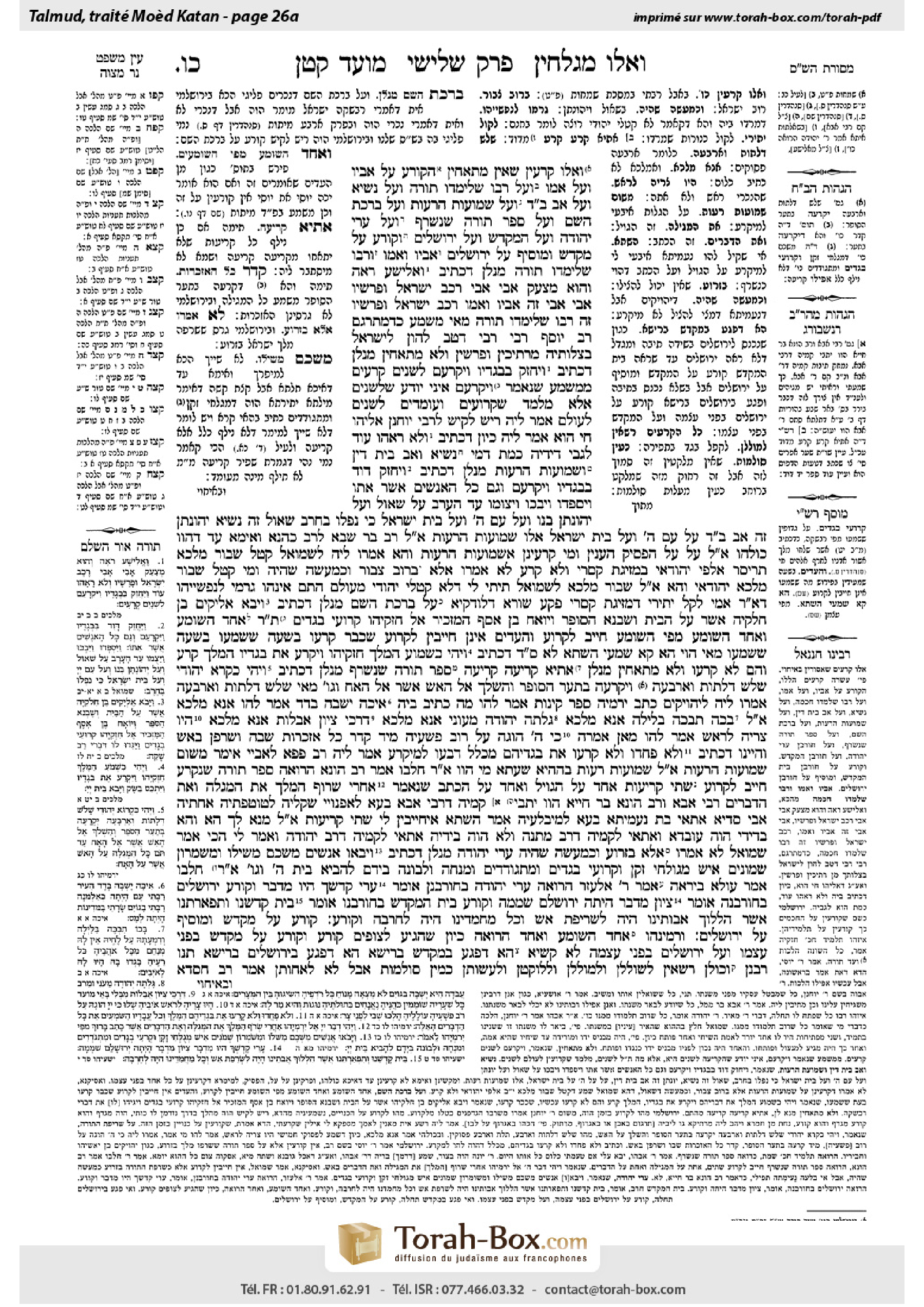
Moed Katan 26a: Talmud study for Daf Yomi
Daf Yomi is the daily study of one Talmud folio. Explore 37 tractates with scans, Hebrew text, Sefaria English and AI-generated French translations where annotated.
Passage selection and English or AI-generated French translation are available where the scan has annotations. Daf Study is independent of Torah-Box and Sefaria.
Browse Moed Katan · מועד קטן · All tractatesMoed Katan 26a text and translations
This page of Moed Katan includes the Aramaic text, an English translation and an AI-generated French translation, alongside the scan above.
מועד קטן כ״ו א · Aramaic and Hebrew text
וְאֵלּוּ קְרָעִין שֶׁאֵין מִתְאַחִין: הַקּוֹרֵעַ עַל אָבִיו וְעַל אִמּוֹ, וְעַל רַבּוֹ שֶׁלִּימְּדוֹ תּוֹרָה, וְעַל נָשִׂיא וְעַל אָב בֵּית דִּין, וְעַל שְׁמוּעוֹת הָרָעוֹת, וְעַל בִּרְכַּת הַשֵּׁם, וְעַל סֵפֶר תּוֹרָה שֶׁנִּשְׂרַף, וְעַל עָרֵי יְהוּדָה וְעַל הַמִּקְדָּשׁ וְעַל יְרוּשָׁלַיִם. וְקוֹרֵעַ עַל מִקְדָּשׁ, וּמוֹסִיף עַל יְרוּשָׁלַיִם.
אָבִיו וְאִמּוֹ וְרַבּוֹ שֶׁלִּימְּדוֹ תּוֹרָה מְנָלַן — דִּכְתִיב: ״וֶאֱלִישָׁע רֹאֶה וְהוּא מְצַעֵק אָבִי אָבִי רֶכֶב יִשְׂרָאֵל וּפָרָשָׁיו״. ״אָבִי אָבִי״ — זֶה אָבִיו וְאִמּוֹ, ״רֶכֶב יִשְׂרָאֵל וּפָרָשָׁיו״ — זֶה רַבּוֹ שֶׁלִּימְּדוֹ תּוֹרָה.
מַאי מַשְׁמַע? כְּדִמְתַרְגֵּם רַב יוֹסֵף: רַבִּי רַבִּי דְּטָב לְהוֹן לְיִשְׂרָאֵל בִּצְלוֹתֵיהּ מֵרְתִיכִּין וּפָרָשִׁין.
וְלֹא מִתְאַחִין מְנָלַן — דִּכְתִיב: ״וַיַּחֲזֵק בִּבְגָדָיו וַיִּקְרָעֵם לִשְׁנַיִם קְרָעִים״, מִמַּשְׁמַע שֶׁנֶּאֱמַר ״וַיִּקְרָעֵם״ אֵינִי יוֹדֵעַ שֶׁלִּשְׁנַיִם? אֶלָּא מְלַמֵּד שֶׁקְּרוּעִים וְעוֹמְדִים לִשְׁנַיִם לְעוֹלָם.
אֲמַר לֵיהּ רֵישׁ לָקִישׁ לְרַבִּי יוֹחָנָן: אֵלִיָּהוּ חַי הוּא? אֲמַר לֵיהּ, כֵּיוָן דִּכְתִיב: ״וְלֹא רָאָהוּ עוֹד״, לְגַבֵּי דִידֵיהּ כְּמֵת דָּמֵי.
נָשִׂיא וְאַב בֵּית דִּין וּשְׁמוּעוֹת הָרָעוֹת מְנָלַן — דִּכְתִיב: ״וַיַּחֲזֵק דָּוִד בִּבְגָדָיו וַיִּקְרָעֵם וְגַם כׇּל הָאֲנָשִׁים אֲשֶׁר אִתּוֹ. וַיִּסְפְּדוּ וַיִּבְכּוּ וַיָּצוּמוּ עַד הָעָרֶב עַל שָׁאוּל וְעַל יְהוֹנָתָן בְּנוֹ וְעַל עַם ה׳ וְעַל בֵּית יִשְׂרָאֵל כִּי נָפְלוּ בֶּחָרֶב״.
״שָׁאוּל״ — זֶה נָשִׂיא, ״יְהוֹנָתָן״ — זֶה אַב בֵּית דִּין, ״עַל עַם ה׳ וְעַל בֵּית יִשְׂרָאֵל״ — אֵלּוּ שְׁמוּעוֹת הָרָעוֹת.
אֲמַר לֵיהּ רַב בַּר שַׁבָּא לְרַב כָּהֲנָא: וְאֵימָא עַד דְּהָווּ כּוּלְּהוּ! אָמַר לֵיהּ: ״עַל״ ״עַל״ הִפְסִיק הָעִנְיָן.
וּמִי קָרְעִינַן אַשְּׁמוּעוֹת הָרָעוֹת? וְהָא אֲמַרוּ לֵיהּ לִשְׁמוּאֵל: קְטַל שַׁבּוּר מַלְכָּא תְּרֵיסַר אַלְפֵי יְהוּדָאֵי בִּמְזִיגַת קֵסָרִי, וְלָא קְרַע! לֹא אָמְרוּ אֶלָּא בְּרוֹב צִבּוּר וּכְמַעֲשֶׂה שֶׁהָיָה.
וּמִי קְטַל שַׁבּוּר מַלְכָּא יְהוּדָאֵי? וְהָא אֲמַר לֵיהּ שַׁבּוּר מַלְכָּא לִשְׁמוּאֵל: תֵּיתֵי לִי דְּלָא קְטַלִי יְהוּדִי מֵעוֹלָם! הָתָם אִינְהוּ גָּרְמִי לְנַפְשַׁיְיהוּ, דְּאָמַר רַבִּי אַמֵּי: לְקָל יְתֵירֵי דִּמְזִיגַת קֵסָרִי, פְּקַע שׁוּרָא דְלוּדְקִיָּא.
עַל בִּרְכַּת הַשֵּׁם מְנָלַן? דִּכְתִיב: ״וַיָּבֹא אֶלְיָקִים בֶּן חִלְקִיָּה אֲשֶׁר עַל הַבַּיִת וְשֶׁבְנָא הַסּוֹפֵר וְיוֹאָח בֶּן אָסָף הַמַּזְכִּיר אֶל חִזְקִיָּהוּ קְרוּעֵי בְגָדִים״.
תָּנוּ רַבָּנַן: אֶחָד הַשּׁוֹמֵעַ וְאֶחָד הַשּׁוֹמֵעַ מִפִּי הַשּׁוֹמֵעַ — חַיָּיב לִקְרוֹעַ. וְהָעֵדִים אֵינָן חַיָּיבִין לִקְרוֹעַ, שֶׁכְּבָר קָרְעוּ בְּשָׁעָה שֶׁשָּׁמְעוּ.
בְּשָׁעָה שֶׁשָּׁמְעוּ מַאי הָוֵי? הָא קָא שָׁמְעִי הַשְׁתָּא! לָא סָלְקָא דַּעְתָּךְ, דִּכְתִיב: ״וַיְהִי כִּשְׁמוֹעַ הַמֶּלֶךְ חִזְקִיָּהוּ וַיִּקְרַע אֶת בְּגָדָיו״, הַמֶּלֶךְ קָרַע וְהֵם לֹא קָרְעוּ.
וְלֹא מִתְאַחִין מְנָלַן — אָתְיָא ״קְרִיעָה״ ״קְרִיעָה״.
סֵפֶר תּוֹרָה שֶׁנִּשְׂרַף מְנָלַן? דִּכְתִיב: ״וַיְהִי כִּקְרֹא יְהוּדִי שָׁלֹשׁ דְּלָתוֹת וְאַרְבָּעָה וְיִקְרָעֶהָ בְּתַעַר הַסּוֹפֵר וְהַשְׁלֵךְ אֶל הָאֵשׁ אֲשֶׁר אֶל הָאָח וְגוֹ׳״. מַאי שָׁלֹשׁ דְּלָתוֹת וְאַרְבָּעָה?
אֲמַרוּ לֵיהּ לִיהוֹיָקִים: כָּתַב יִרְמְיָה סֵפֶר קִינוֹת. אֲמַר לְהוּ: מָה כְּתִיב בֵּיהּ? ״אֵיכָה יָשְׁבָה בָּדָד״. אֲמַר לְהוּ: אֲנָא מַלְכָּא. אֲמַר לֵיהּ: ״בָּכֹה תִבְכֶּה בַּלַּיְלָה״. אֲנָא מַלְכָּא. ״גָּלְתָה יְהוּדָה מֵעוֹנִי״. אֲנָא מַלְכָּא. ״דַּרְכֵי צִיּוֹן אֲבֵלוֹת״. אֲנָא מַלְכָּא.
״הָיוּ צָרֶיהָ לְרֹאשׁ״. אֲמַר לְהוּ: מַאן אַמְרַהּ? ״כִּי ה׳ הוֹגָהּ עַל רוֹב פְּשָׁעֶיהָ״. מִיָּד קָדַר כׇּל אַזְכָּרוֹת שֶׁבָּהּ, וּשְׂרָפָן בָּאֵשׁ. וְהַיְינוּ דִּכְתִיב: ״וְלֹא פָחֲדוּ וְלֹא קָרְעוּ אֶת בִּגְדֵיהֶם״, מִכְּלַל דִּבְעוֹ לְמִיקְרַע.
אֲמַר לֵיהּ רַב פָּפָּא לְאַבָּיֵי: אֵימַר מִשּׁוּם שְׁמוּעוֹת הָרָעוֹת. אֲמַר לֵיהּ: שְׁמוּעוֹת רָעוֹת בְּהָהִיא שַׁעְתָּא מִי הֲווֹ?!
אָמַר רַבִּי חֶלְבּוֹ אָמַר רַב הוּנָא: הָרוֹאֶה סֵפֶר תּוֹרָה שֶׁנִּקְרַע — חַיָּיב לִקְרוֹעַ שְׁתֵּי קְרִיעוֹת: אֶחָד עַל הַגְּוִיל וְאֶחָד עַל הַכְּתָב, שֶׁנֶּאֱמַר: ״אַחֲרֵי שְׂרוֹף הַמֶּלֶךְ אֶת הַמְּגִלָּה וְאֶת הַדְּבָרִים״.
רַבִּי אַבָּא וְרַב הוּנָא בַּר חִיָּיא הָווּ יָתְבִי קַמֵּיהּ דְּרַבִּי אַבָּא. בְּעָא לְאִפַּנּוֹיֵי, שַׁקְלֵיהּ לְטוֹטֶפְתֵּיהּ אַחֲתֵיהּ אַבֵּי סַדְיָא. אֲתַאי בַּת נַעָמִיתָא בְּעַא לְמִיבְלְעֵיהּ.
אֲמַר: הַשְׁתָּא כִּי חַיְּיבַן לִי שְׁתֵּי קְרִיעוֹת. אֲמַר לֵיהּ: מְנָא לָךְ הָא? וְהָא בְּדִידִי הֲוָה עוֹבָדָא, וַאֲתַאי לְקַמֵּיהּ דְּרַב מַתְנָה וְלָא הֲוָה בִּידֵיהּ. אֲתַאי לְקַמֵּיהּ דְּרַב יְהוּדָה, וַאֲמַר לִי, הָכִי אָמַר שְׁמוּאֵל: לֹא אָמְרוּ אֶלָּא בִּזְרוֹעַ, וּכְמַעֲשֶׂה שֶׁהָיָה.
עָרֵי יְהוּדָה מְנָלַן — דִּכְתִיב: ״וַיָּבֹאוּ אֲנָשִׁים מִשְּׁכֶם מִשִּׁילוֹ וּמִשֹּׁמְרוֹן שְׁמוֹנִים אִישׁ מְגוּלְּחֵי זָקָן וּקְרוּעֵי בְגָדִים וּמִתְגּוֹדְדִים וּמִנְחָה וּלְבוֹנָה בְּיָדָם לְהָבִיא בֵּית ה׳ וְגוֹ׳״.
אָמַר רַבִּי חֶלְבּוֹ אָמַר עוּלָּא בִּירָאָה אָמַר רַבִּי אֶלְעָזָר: הָרוֹאֶה עָרֵי יְהוּדָה בְּחוּרְבָּנָן, אוֹמֵר: ״עָרֵי קׇדְשְׁךָ הָיוּ מִדְבָּר״, וְקוֹרֵעַ. יְרוּשָׁלַיִם בְּחוּרְבָּנָהּ, אוֹמֵר: ״צִיּוֹן מִדְבָּר הָיָתָה יְרוּשָׁלִַם שְׁמָמָה״, וְקוֹרֵעַ. בֵּית הַמִּקְדָּשׁ בְּחוּרְבָּנוֹ, אוֹמֵר: ״בֵּית קׇדְשֵׁנוּ וְתִפְאַרְתֵּנוּ אֲשֶׁר הִלְלוּךָ אֲבוֹתֵינוּ הָיָה לִשְׂרֵיפַת אֵשׁ וְכׇל מַחֲמַדֵּינוּ הָיָה לְחׇרְבָּה״, וְקוֹרֵעַ.
קוֹרֵעַ עַל מִקְדָּשׁ, וּמוֹסִיף עַל יְרוּשָׁלַיִם. וּרְמִינְהוּ: אֶחָד הַשּׁוֹמֵעַ וְאֶחָד הָרוֹאֶה, כֵּיוָן שֶׁהִגִּיעַ לְצוֹפִים — קוֹרֵעַ, וְקוֹרֵעַ עַל מִקְדָּשׁ בִּפְנֵי עַצְמוֹ וְעַל יְרוּשָׁלַיִם בִּפְנֵי עַצְמָהּ!
לָא קַשְׁיָא: הָא דְּפָגַע בַּמִּקְדָּשׁ בְּרֵישָׁא. הָא דְּפָגַע בִּירוּשָׁלַיִם בְּרֵישָׁא.
תָּנוּ רַבָּנַן: וְכוּלָּן רַשָּׁאִין לְשׁוֹלְלָן וּלְמוֹלְלָן וּלְלוֹקְטָן וְלַעֲשׂוֹתָן כְּמִין סוּלָּמוֹת, אֲבָל לֹא לְאַחוֹתָן.
אָמַר רַב חִסְדָּא:
Moed Katan 26a · English translation
And these are the rents of mourning that may never be properly mended: One who rends his garments for the death his father, or for his mother, or for his teacher who taught him Torah, or for the Nasi, or for the president of the court; or upon hearing evil tidings; or hearing God’s name being blessed, which is a euphemism for hearing God’s name being cursed; or when a Torah scroll has been burned; or upon seeing the cities of Judea that were destroyed or the destroyed Temple or Jerusalem in ruins. This is the way one conducts himself when approaching Jerusalem when it lies in ruin: He first rends his garments for the Temple and then extends the rent for Jerusalem.
The Gemara elaborates upon the halakhot mentioned in this baraita: From where do we derive that one must rend his clothing for his father, his mother, and his teacher who taught him Torah? As it is written with regard to the prophet Elijah, when he ascended to Heaven in a tempest: “And Elisha saw it, and he cried, My father, my father, the chariots of Israel and their horsemen” (II Kings 2:12). The Gemara interprets this verse as follows: “My father, my father”; this comes to teach that one must rend his garments for the death of his father or mother. “The chariots of Israel and their horsemen”; this comes to include also one’s teacher who taught him Torah.
The Gemara asks: From where may it be inferred that this is referring to one’s teacher? The Gemara explains: As the verse was translated by Rav Yosef: My teacher, my teacher, who was better for the protection of the Jewish people with his prayers than an army with chariots and horsemen.
And from where do we derive that these rents are never to be properly mended? As it is written: “And he took hold of his own clothes, and rent them in two pieces” (II Kings 2:12). From the fact that it is stated: “And he rent them,” do I not know that he rent them in two pieces? Rather, when the verse adds that they were torn into two pieces, it teaches that they must remain torn in two pieces forever. Accordingly, this rent must never be properly mended.
Reish Lakish said to Rabbi Yoḥanan: But isn’t Elijah still alive? Why, then, did Elisha rend his garments for him? He said to him: Since it is written: “And he saw him no more” (II Kings 2:12), Elijah was considered dead from Elisha’s perspective, and so Elisha rent his clothing for him.
§ From where do we derive that one must rend his clothing for the death of the Nasi or the president of the court and upon hearing evil tidings? As it is written, when David heard about the defeat of Israel and the death of Saul and his sons: “Then David took hold of his clothes, and rent them; and likewise all the men that were with him: And they mourned, and wept, and fasted until evening, for Saul and for Jonathan his son, and for the people of the Lord, and for the house of Israel; because they were fallen by the sword” (II Samuel 1:11–12).
The Gemara explains how the aforementioned halakhot are derived from the verse: “Saul”; this is a reference to the Nasi, as Saul was king of Israel. “Jonathan”; this is a reference to the president of the court. “For the people of the Lord, and for the house of the Israel”; these are a reference to evil tidings.
Rav bar Shaba said to Rav Kahana: But perhaps you can say that one need not rend his clothing until all these calamities occur together, and that rending clothing is performed only over a tragedy of this magnitude. He said to him: The repetition of the word “for”: “For Saul,” “for Jonathan,” and “for the people of the Lord” divides the matter and teaches that each individual misfortune is sufficient cause to rend one’s garments.
The Gemara asks: But do we actually rend our clothing upon hearing evil tidings? But didn’t they say to Shmuel: King Shapur killed twelve thousand Jews in Mezigat Caesarea, and Shmuel did not rend his clothing?The Gemara answers: They said that one must rend his clothing upon hearing evil tidings only in a case where the calamity involved the majority of the community of Israel and resembles the incident that occurred when Saul was killed and the entire nation of Israel suffered defeat.
The Gemara tangentially asks: Did King Shapur really kill Jews? But didn’t King Shapur say to Shmuel: I have a blessing coming to me, for I have never killed a Jew? The Gemara answers: King Shapur never instigated the killing of Jews; there, however, they brought it upon themselves, as Rabbi Ami said in an exaggerated manner: Due to the noise of the harp strings of Mezigat Caesarea, the walls of Laodicea were breached, for the residents of the city celebrated when they rebelled against King Shapur. Because they rebelled against him and threatened his rule, he was forced to kill them.
§ The Gemara continues its analysis of the baraita: From where do we derive that one must rend his garments upon hearing God’s name being blessed, i.e., cursed? As it is written with regard to the blasphemous words said by Rab-shakeh: “Then came Eliakim, son of Hilkiya, who was over the household, and Shebna the scribe, and Joah, son of Asaph, the recorder, to Hezekiah with their clothes rent” (II Kings 18:37).
The Sages taught a baraita with regard to this issue: Both one who actually hears the curse and one who hears from the mouth of the one who heard the curse are obligated to rend their garments. But the witnesses who testify against the person who uttered the blasphemy are not obligated to rend their clothing when they testify as to what they heard because they already rent their clothing when they heard the curse the first time.
The Gemara asks: What difference does it make that they rent their garments when they heard the curse the first time? Didn’t they hear it again now? The Gemara rejects this argument: This will not enter your mind, as it is written: “And it came to pass, when King Hezekiah heard it, that he rent his clothes” (II Kings 19:1). This indicates that the king rent his garments, but those who reported the blasphemy to him did not rend theirs, as they had already rent their garments the first time.
And from where do we derive that these rents may not be properly mended? This is derived by way of a verbal analogy between the verb rending used here with regard to Hezekiah and the verb rending used in the case of Elijah and Elisha.
§ From where do we derive that one must rend his garments when a Torah scroll has been burned? As it is written: “And it came to pass, that when Jehudi had read three or four leaves, he would cut it with a penknife, and cast it into the fire that was in the brazier” (Jeremiah 36:23). With regard to the verse itself the Gemara asks: What is meant by “three or four leaves,” and why did he cut the book only at that point?
The Gemara explains: They said to Jehoiakim: Jeremiah has written a book of Lamentations over the future downfall and destruction of Jerusalem. He said to them: What is written in it? They read him the first verse: “How does the city sit solitary” (Lamentations 1:1). He said to them: I am king, and this does not apply to me. They read him the second verse: “She weeps sore in the night” (Lamentations 1:2). He said to them: I am king, and this does not apply to me. They read him the third verse: “Judah is gone into exile due to affliction” (Lamentations 1:3). He said to them: I am king. They read to him: “The ways of Zion do mourn” (Lamentations 1:4). He said to them: I am king. These are the four leaves, or verses, that he read first.
They read him an additional verse: “Her adversaries have become the chief” (Lamentations 1:5), i.e., the reigning king will be removed from power. Once he heard this, he said to them: Who said this? They said to him: This is the continuation of the verse: “For the Lord has afflicted her for the multitude of her transgressions” (Lamentations 1:5). Immediately, he cut out all the names of God from the book and burned them in fire. This is as it is written: “Yet they were not afraid, nor rent their garments, neither the king, nor any of his servants that heard all these words” (Jeremiah 36:24). By inference, this shows that they were required to rend their clothing when they saw this.
Rav Pappa said to Abaye: Perhaps you can say that they should have rent their garments due to the evil tidings contained in the scroll and not because of the destruction of the book? Abaye said to him: Were they evil tidings at that time? This was a prophecy and not an account of current events.
Rabbi Ḥelbo said that Rav Huna said: One who sees a Torah scroll that was torn is obligated to make two rents, one for the parchment that was damaged and one for the writing, as it is stated: “Then the word of the Lord came to Jeremiah, after the king had burned the scroll and the words” (Jeremiah 36:27). This implies that a separate rent must be made for each of them, both the parchment and the writing.
It was related that Rabbi Abba and Rav Huna bar Ḥiyya were sitting before Rabbi Abba. Rabbi Abba needed to relieve himself. He removed his phylacteries from his head and placed them on the cushion on which he was sitting. An ostrich came and wanted to swallow the phylacteries.
He said: Now, had it succeeded to swallow it, I would have been obligated to make two rents. He said to him: From where do you derive this? There was an incident in which I was involved and I came before Rav Mattana asking what to do, but he did not have an answer readily available. I then came before Rav Yehuda, and he said to me: Shmuel said as follows: They said that one is obligated to rend his clothing only when a Torah scroll or some other sacred book is torn by force, and it resembles the incident that occurred with Jehoiakim.
§ From where do we derive that one must rend his garments upon seeing the cities of Judea in ruin? As it is written: “There came certain men from Shechem, from Shiloh, and from Samaria, eighty people, their beards shaven, and their clothes rent, and having cut themselves, with offerings and incense in their hand, to bring to the house of the Lord” (Jeremiah 41:5). This indicates that they rent their garments upon seeing the destruction.
Rabbi Ḥelbo said that Ulla Bira’a said that Rabbi Elazar said: One who sees the cities of Judea in their desolation says: “Your sacred cities are become a wilderness” (Isaiah 64:9), and then rends his garments. One who sees Jerusalem in its desolation says: “Zion is a wilderness, Jerusalem a desolation” (Isaiah 64:9), and then rends his garments. One who sees the Temple in its desolation says: “Our sacred and our beautiful house, where our fathers praised You, is burned with fire; and all our pleasant things are laid waste” (Isaiah 64:10), and then rends his garments.
It was taught in the baraita: He first rends his garments for the Temple and then extends the rent for Jerusalem. And they raise a contradiction from another baraita that states: Both one who hears that Jerusalem is in ruin and one who sees the destruction, once he reaches Mount Scopus [Tzofim], rends his garments. And he rends his garments for the Temple separately and for Jerusalem separately.
The Gemara answers: This is not difficult. This baraita, which states that instead of making a separate rent for Jerusalem one may extend the first rent that he had made for the Temple, is referring to the case where one reached the Temple first, before seeing the rest of Jerusalem, and saw it in ruin. That baraita, which states that one must make separate rents for Jerusalem and for the Temple, is referring to the case where one reached Jerusalem first, and only afterward the Temple.
§ The Sages taught the following baraita: And all of these rents, one may tack them together with loose stitches, and hem them, and gather them, and fix them with imprecise ladder-like stitches. But one may not mend them with precise stitches.
Rav Ḥisda said:
Moed Katan 26a · Traduction française (IA)
Et voici les déchirures de deuil qui ne peuvent jamais être réparées convenablement : celles que l’on fait à la mort de son père, de sa mère ou de son maître qui lui a enseigné la Torah, du nassi ou du président du tribunal ; en apprenant une mauvaise nouvelle ; en entendant le Nom de Dieu « béni », euphémisme pour dire qu’il a été maudit ; lorsqu’un rouleau de la Torah a été brûlé ; ou en voyant les villes de Judée détruites, le Temple détruit ou Jérusalem en ruines. Voici comment on se conduit en approchant de Jérusalem lorsqu’elle est en ruines : on déchire d’abord ses vêtements pour le Temple, puis on prolonge la déchirure pour Jérusalem.
La Guemara développe les halakhot mentionnées dans cette baraïta : d’où savons-nous qu’il faut déchirer ses vêtements à la mort de son père, de sa mère et de son maître qui lui a enseigné la Torah ? Car il est écrit au sujet du prophète Élie, lorsqu’il monta au ciel dans une tempête : « Élisée le vit et s’écria : “Mon père, mon père ! Chars d’Israël et ses cavaliers !” » (II Rois 2,12). La Guemara interprète ce verset ainsi : « Mon père, mon père » vient enseigner qu’il faut déchirer ses vêtements à la mort de son père ou de sa mère. « Chars d’Israël et ses cavaliers » vient inclure également son maître qui lui a enseigné la Torah.
La Guemara demande : Comment peut-on déduire qu’il s’agit de son maître ? La Guemara explique : car Rav Yossef a traduit le verset ainsi : « Mon maître, mon maître, dont les prières protégeaient mieux le peuple juif qu’une armée de chars et de cavaliers. »
Et d’où savons-nous que ces déchirures ne doivent jamais être réparées convenablement ? Car il est écrit : « Il saisit ses vêtements et les déchira en deux morceaux » (II Rois 2,12). Puisqu’il est dit : « Il les déchira », ne savons-nous pas déjà qu’il les déchira en deux morceaux ? Au contraire, le fait que le verset précise qu’ils furent déchirés en deux morceaux enseigne qu’ils doivent rester ainsi déchirés à jamais. Par conséquent, cette déchirure ne doit jamais être réparée convenablement.
Rech Lakich dit à Rabbi Yoḥanan : Mais Élie n’est-il pas encore vivant ? Pourquoi Élisée a-t-il donc déchiré ses vêtements pour lui ? Il lui répondit : Puisqu’il est écrit : « Il ne le vit plus » (II Rois 2,12), Élie était considéré comme mort du point de vue d’Élisée ; celui-ci déchira donc ses vêtements pour lui.
§ D’où savons-nous qu’il faut déchirer ses vêtements à la mort du nassi ou du président du tribunal, et en apprenant une mauvaise nouvelle ? Car il est écrit, lorsque David apprit la défaite d’Israël et la mort de Saül et de ses fils : « Alors David saisit ses vêtements et les déchira ; tous les hommes qui étaient avec lui firent de même. Ils se lamentèrent, pleurèrent et jeûnèrent jusqu’au soir, à cause de Saül, de Jonathan son fils, du peuple de l’Éternel et de la maison d’Israël, parce qu’ils étaient tombés par l’épée » (II Samuel 1,11-12).
La Guemara explique comment les halakhot mentionnées sont déduites du verset : « Saül » fait référence au nassi, puisque Saül était roi d’Israël. « Jonathan » fait référence au président du tribunal. « À cause du peuple de l’Éternel et de la maison d’Israël » fait référence aux mauvaises nouvelles.
Rav bar Chava dit à Rav Kahana : Mais peut-être peut-on dire qu’il n’est pas nécessaire de déchirer ses vêtements tant que toutes ces calamités ne se sont pas produites ensemble, et que cette déchirure n’est prescrite que pour une tragédie d’une telle ampleur. Il lui répondit : La répétition du mot « à cause de » — « à cause de Saül », « à cause de Jonathan » et « à cause du peuple de l’Éternel » — distingue les cas et enseigne que chacun de ces malheurs suffit à lui seul pour devoir déchirer ses vêtements.
La Guemara demande : Déchire-t-on réellement ses vêtements en apprenant une mauvaise nouvelle ? Ne dit-on pas qu’on annonça à Chmouel que le roi Chapour avait tué douze mille Juifs à Mezigat Caesarea, et que Chmouel ne déchira pas ses vêtements ? La Guemara répond : Ils ont dit qu’il faut déchirer ses vêtements en apprenant une mauvaise nouvelle uniquement lorsque la calamité touche la majorité de la communauté d’Israël et ressemble à l’événement où Saül fut tué et où toute la nation d’Israël essuya une défaite.
La Guemara pose incidemment la question : Le roi Chapour a-t-il vraiment tué des Juifs ? Le roi Chapour n’a-t-il pas dit à Chmouel : « Une bénédiction m’est due, car je n’ai jamais tué de Juif » ? La Guemara répond : Le roi Chapour n’a jamais ordonné de tuer des Juifs ; dans ce cas, toutefois, ils avaient provoqué leur propre sort, car Rabbi Ami dit de façon exagérée : le bruit des cordes de la harpe de Mezigat Caesarea fit tomber les murailles de Laodicée, car les habitants de la ville célébrèrent leur révolte contre le roi Chapour. Parce qu’ils s’étaient révoltés contre lui et menaçaient son pouvoir, il fut contraint de les tuer.
§ La Guemara poursuit l’analyse de la baraïta : d’où savons-nous qu’il faut déchirer ses vêtements en entendant le Nom de Dieu « béni », c’est-à-dire maudit ? Car il est écrit au sujet des paroles blasphématoires prononcées par Rabchaké : « Éliaqim, fils de Hilqiya, qui était préposé à la maison, Chévna le secrétaire et Yoah, fils d’Asaph, le rédacteur, vinrent auprès d’Ézéchias, les vêtements déchirés » (II Rois 18,37).
Les Sages ont enseigné une baraïta à ce sujet : celui qui entend directement la malédiction et celui qui l’entend de la bouche de celui qui l’a entendue sont tous deux tenus de déchirer leurs vêtements. Mais les témoins qui déposent contre celui qui a proféré le blasphème ne sont pas tenus de déchirer leurs vêtements lorsqu’ils témoignent de ce qu’ils ont entendu, puisqu’ils ont déjà déchiré leurs vêtements la première fois qu’ils ont entendu la malédiction.
La Guemara demande : Quelle différence cela fait-il qu’ils aient déchiré leurs vêtements la première fois qu’ils ont entendu la malédiction ? Ne l’ont-ils pas entendue de nouveau maintenant ? La Guemara rejette cet argument : cela ne saurait te venir à l’esprit, car il est écrit : « Et il arriva, lorsque le roi Ézéchias l’entendit, qu’il déchira ses vêtements » (II Rois 19,1). Cela indique que le roi déchira ses vêtements, mais pas ceux qui lui rapportèrent le blasphème, car ils avaient déjà déchiré les leurs la première fois.
Et d’où savons-nous que ces déchirures ne peuvent pas être réparées convenablement ? On le déduit par une analogie verbale entre le verbe « déchirer », employé ici au sujet d’Ézéchias, et le verbe « déchirer » employé dans le cas d’Élie et d’Élisée.
§ D’où savons-nous qu’il faut déchirer ses vêtements lorsqu’un rouleau de la Torah a été brûlé ? Car il est écrit : « Et il arrivait que, lorsque Yehoudi avait lu trois ou quatre colonnes, il le coupait avec un canif et le jetait dans le feu qui était dans le brasero » (Jérémie 36,23). À propos du verset lui-même, la Guemara demande : Que signifie « trois ou quatre colonnes », et pourquoi ne coupa-t-il le livre qu’à ce moment-là ?
La Guemara explique : On dit à Yehoyaqim : « Jérémie a écrit un livre de Lamentations au sujet de la chute et de la destruction futures de Jérusalem. » Il leur demanda : « Qu’y est-il écrit ? » Ils lui lurent le premier verset : « Hélas ! Elle est assise solitaire, la ville » (Lamentations 1,1). Il leur dit : « Je suis roi, cela ne me concerne pas. » Ils lui lurent le deuxième verset : « Elle pleure amèrement dans la nuit » (Lamentations 1,2). Il leur dit : « Je suis roi, cela ne me concerne pas. » Ils lui lurent le troisième verset : « Juda est parti en exil sous le poids de l’affliction » (Lamentations 1,3). Il leur dit : « Je suis roi. » Ils lui lurent : « Les chemins de Sion sont en deuil » (Lamentations 1,4). Il leur dit : « Je suis roi. » Voilà les quatre colonnes, ou versets, qu’il lut d’abord.
Ils lui lurent un verset supplémentaire : « Ses adversaires sont devenus les chefs » (Lamentations 1,5), c’est-à-dire que le roi régnant sera destitué. Dès qu’il entendit cela, il leur demanda : « Qui a dit cela ? » Ils lui répondirent : « C’est la suite du verset : “Car l’Éternel l’a affligée à cause de la multitude de ses transgressions” » (Lamentations 1,5). Aussitôt, il découpa du livre tous les noms de Dieu et les brûla. C’est ce qui est écrit : « Pourtant, ils n’eurent pas peur et ne déchirèrent pas leurs vêtements, ni le roi ni aucun de ses serviteurs qui entendirent toutes ces paroles » (Jérémie 36,24). On en déduit qu’ils étaient tenus de déchirer leurs vêtements lorsqu’ils virent cela.
Rav Pappa dit à Abayé : Peut-être peut-on dire qu’ils auraient dû déchirer leurs vêtements à cause des mauvaises nouvelles contenues dans le rouleau, et non parce que le livre avait été détruit ? Abayé lui dit : Était-ce alors de mauvaises nouvelles ? C’était une prophétie, et non le récit d’événements présents.
Rabbi Ḥelbo dit au nom de Rav Houna : Celui qui voit un rouleau de la Torah déchiré est tenu de faire deux déchirures : l’une pour le parchemin endommagé et l’autre pour l’écriture, comme il est dit : « Alors la parole de l’Éternel fut adressée à Jérémie, après que le roi eut brûlé le rouleau et les paroles » (Jérémie 36,27). Cela implique qu’il faut faire une déchirure distincte pour chacun des deux, le parchemin et l’écriture.
Il fut rapporté que Rabbi Abba et Rav Houna bar Ḥiyya étaient assis devant Rabbi Abba. Rabbi Abba eut besoin de se soulager. Il retira les téfilines de sa tête et les posa sur le coussin sur lequel il était assis. Une autruche arriva et voulut avaler les téfilines.
Il dit : « Si elle avait réussi à les avaler, j’aurais été tenu de faire deux déchirures. » Il lui dit : « D’où déduis-tu cela ? Il m’est arrivé une fois une histoire à laquelle j’étais mêlé ; je suis allé trouver Rav Mattana pour lui demander quoi faire, mais il n’avait pas de réponse à me donner sur-le-champ. Je suis alors allé trouver Rav Yehouda, qui m’a dit : Chmouel a enseigné ainsi : On a dit qu’on n’est tenu de déchirer ses vêtements que lorsqu’un rouleau de la Torah ou un autre livre sacré est déchiré violemment, dans un cas semblable à l’événement survenu avec Yehoyaqim. »
§ D’où savons-nous qu’il faut déchirer ses vêtements en voyant les villes de Judée en ruines ? Car il est écrit : « Des hommes vinrent de Sichem, de Silo et de Samarie, au nombre de quatre-vingts, la barbe rasée et les vêtements déchirés, s’étant fait des incisions, avec des offrandes et de l’encens à la main, pour les apporter à la maison de l’Éternel » (Jérémie 41,5). Cela indique qu’ils déchirèrent leurs vêtements en voyant la destruction.
Rabbi Ḥelbo dit au nom d’Oulla Bira’a, qui dit au nom de Rabbi Elazar : Celui qui voit les villes de Judée dans leur désolation récite : « Tes villes saintes sont devenues un désert » (Isaïe 64,9), puis déchire ses vêtements. Celui qui voit Jérusalem dans sa désolation récite : « Sion est un désert, Jérusalem une désolation » (Isaïe 64,9), puis déchire ses vêtements. Celui qui voit le Temple dans sa désolation récite : « Notre maison sainte et magnifique, où nos pères te louaient, a été consumée par le feu, et tout ce qui faisait nos délices est en ruines » (Isaïe 64,10), puis déchire ses vêtements.
Il a été enseigné dans une baraïta : on déchire d’abord ses vêtements pour le Temple, puis on prolonge la déchirure pour Jérusalem. On oppose à cela une autre baraïta, qui enseigne : celui qui apprend que Jérusalem est en ruines comme celui qui voit sa destruction, dès qu’il atteint le mont Scopus [Tzofim], déchire ses vêtements. Il fait une déchirure pour le Temple et une autre pour Jérusalem.
La Guemara répond : il n’y a pas de contradiction. La baraïta qui dit qu’au lieu de faire une déchirure distincte pour Jérusalem, on peut prolonger celle faite d’abord pour le Temple, traite du cas où l’on a atteint le Temple en premier, avant de voir le reste de Jérusalem, et où on l’a vu en ruines. L’autre baraïta, qui dit qu’il faut faire des déchirures distinctes pour Jérusalem et pour le Temple, traite du cas où l’on a atteint Jérusalem en premier, et le Temple seulement ensuite.
§ Les Sages ont enseigné la baraïta suivante : toutes ces déchirures, on peut les rapprocher par des points lâches, les ourler, les froncer et les fixer avec des points imprécis en forme d’échelle. Mais on ne peut pas les réparer par des points réguliers.
Rav Ḥisda dit :
Traduction française générée par IA à partir de l’édition anglaise de Sefaria. Vérifie toujours un passage avec le texte source.
Text from Sefaria: William Davidson Edition - Vocalized Aramaic (CC BY NC); William Davidson Edition - English (CC BY NC).