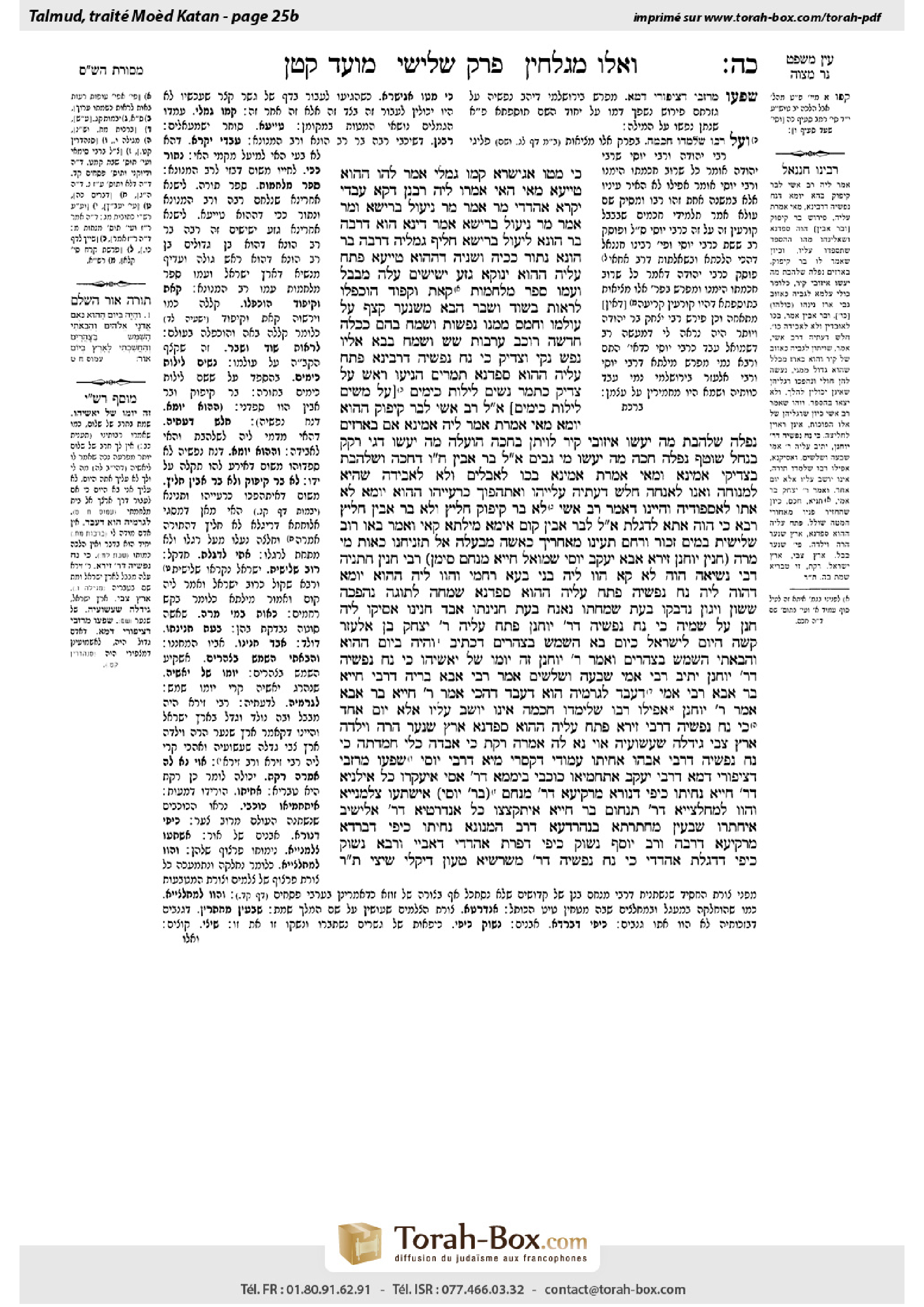
Moed Katan 25b: Talmud study for Daf Yomi
Daf Yomi is the daily study of one Talmud folio. Explore 37 tractates with scans, Hebrew text, Sefaria English and AI-generated French translations where annotated.
Passage selection and English or AI-generated French translation are available where the scan has annotations. Daf Study is independent of Torah-Box and Sefaria.
Browse Moed Katan · מועד קטן · All tractatesMoed Katan 25b text and translations
This page of Moed Katan includes the Aramaic text, an English translation and an AI-generated French translation, alongside the scan above.
מועד קטן כ״ה ב · Aramaic and Hebrew text
כִּי מְטוֹ אַגִּישְׁרָא, קָמוּ גַּמְלֵי. אֲמַר לְהוּ הַהוּא טַיָּיעָא: מַאי הַאי? אֲמַרוּ לֵיהּ: רַבָּנַן דְּקָא עָבְדִי יְקָרָא אַהֲדָדֵי. מָר אָמַר: מָר נֵיעוּל בְּרֵישָׁא, וּמָר אָמַר: מָר נֵיעוּל בְּרֵישָׁא. אֲמַר: דִּינָא הוּא דְּרַבָּה בַּר הוּנָא לֵיעוּל בְּרֵישָׁא. חֲלֵיף גַּמְלֵיהּ דְּרַבָּה בַּר הוּנָא, נְתוּר כַּכֵּיהּ וְשִׁנֵּיהּ דְּהָהוּא טַיָּיעָא.
פְּתַח עֲלֵיהּ הַהוּא יָנוֹקָא: גֶּזַע יְשִׁישִׁים עָלָה מִבָּבֶל, וְעִמּוֹ סֵפֶר מִלְחָמוֹת, קָאַת וְקִפּוֹד הוּכְפְּלוּ, לִרְאוֹת בְּשׁוֹד וָשֶׁבֶר הַבָּא מִשִּׁנְעָר. קָצַף עַל עוֹלָמוֹ וְחָמַס מִמֶּנּוּ נְפָשׁוֹת, וְשָׂמַח בָּהֶם כְּכַלָּה חֲדָשָׁה. רוֹכֵב עֲרָבוֹת שָׂשׂ וְשָׂמַח, בְּבֹא אֵלָיו נֶפֶשׁ נָקִי וְצַדִּיק.
כִּי נָח נַפְשֵׁיהּ דְּרָבִינָא, פְּתַח עֲלֵיהּ הַהוּא סַפְדָנָא: תְּמָרִים הָנִיעוּ רֹאשׁ עַל צַדִּיק כַּתָּמָר, נָשִׂים לֵילוֹת כְּיָמִים עַל מֵשִׂים לֵילוֹת כְּיָמִים.
אֲמַר לֵיהּ רַב אָשֵׁי לְבַר קִיפּוֹק: הָהוּא יוֹמָא מַאי אָמְרַתְּ? אֲמַר לֵיהּ, אָמֵינָא: אִם בַּאֲרָזִים נָפְלָה שַׁלְהֶבֶת, מָה יַעֲשׂוּ אֵיזוֹבֵי קִיר. לִוְיָתָן בְּחַכָּה הוֹעֲלָה, מָה יַעֲשׂוּ דְּגֵי רְקָק. בְּנַחַל שׁוֹטֵף נָפְלָה חַכָּה, מָה יַעֲשׂוּ מֵי גֵבִים.
אֲמַר לֵיהּ בַּר אָבִין: חַס וְשָׁלוֹם דְּחַכָּה וְשַׁלְהֶבֶת בְּצַדִּיקֵי אָמֵינָא. וּמַאי אָמְרַתְּ? אָמֵינָא: בְּכוּ לָאֲבֵלִים וְלֹא לָאֲבֵידָה, שֶׁהִיא לִמְנוּחָה וְאָנוּ לַאֲנָחָה.
חֲלַשׁ דַּעְתֵּיהּ עֲלַיְיהוּ, וְאִתְהֲפוּךְ כַּרְעַיְיהוּ. הַהוּא יוֹמָא לָא אֲתוֹ לְאַסְפּוֹדֵיהּ. וְהַיְינוּ דְּאָמַר רַב אָשֵׁי: לָא בַּר קִיפּוֹק חָלֵיץ, וְלָא בַּר אָבִין חָלֵיץ.
רָבָא, כִּי הֲוָה אֲתָא לְדִגְלַת, אֲמַר לֵיהּ לְבַר אָבִין: קוּם אֵימָא מִילְּתָא. קָאֵי וְאָמַר: בָּאוּ רוֹב שְׁלִישִׁית בְּמַיִם, זְכוֹר וְרַחֵם. תָּעִינוּ מֵאַחֲרֶיךָ כְּאִשָּׁה מִבַּעְלָהּ, אַל תַּזְנִיחֵנוּ כְּאוֹת מֵי מָרָה.
(חָנִין, יוֹחָנָן, זֵירָא, אַבָּא, יַעֲקֹב, יוֹסֵי, שְׁמוּאֵל, חִיָּיא, מְנַחֵם סִימָן).
רַבִּי חָנִין, חַתְנֵיהּ דְּבֵי נְשִׂיאָה הֲוָה. לָא (קָא) הֲווֹ לֵיהּ בְּנֵי, בְּעָא רַחֲמֵי וַהֲווֹ לֵיהּ. הָהוּא יוֹמָא דַּהֲוָה לֵיהּ, נָח נַפְשֵׁיהּ, פְּתַח עֲלֵיהּ הַהוּא סַפְדָנָא: שִׂמְחָה לְתוּגָה נֶהְפָּכָה, שָׂשׂוֹן וְיָגוֹן נִדְבָּקוּ, בְּעֵת שִׂמְחָתוֹ נֶאֱנַח, בְּעֵת חֲנִינָתוֹ אָבַד חֲנִינוֹ. אַסִּיקוּ לֵיהּ חָנִן עַל שְׁמֵיהּ.
כִּי נָח נַפְשֵׁיהּ דְּרַבִּי יוֹחָנָן, פְּתַח עֲלֵיהּ רַבִּי יִצְחָק בֶּן אֶלְעָזָר: קָשֶׁה הַיּוֹם לְיִשְׂרָאֵל כְּיוֹם בֹּא הַשֶּׁמֶשׁ בַּצׇּהֳרַיִם, דִּכְתִיב: ״וְהָיָה בַּיּוֹם הַהוּא וְהֵבֵאתִי הַשֶּׁמֶשׁ בַּצׇּהֳרַיִם״. וְאָמַר רַבִּי יוֹחָנָן: זֶה יוֹמוֹ שֶׁל יֹאשִׁיָּהוּ.
כִּי נָח נַפְשֵׁיהּ דְּרַבִּי יוֹחָנָן, יָתֵיב רַבִּי אַמֵּי שִׁבְעָה וּשְׁלֹשִׁים. אָמַר רַבִּי אַבָּא בְּרֵיהּ דְּרַבִּי חִיָּיא בַּר אַבָּא: רַבִּי אַמֵּי דַּעֲבַד — לְגַרְמֵיהּ הוּא דַּעֲבַד, דְּהָכִי אָמַר רַבִּי חִיָּיא בַּר אַבָּא אָמַר רַבִּי יוֹחָנָן: אֲפִילּוּ רַבּוֹ שֶׁלִּימְּדוֹ חׇכְמָה — אֵינוֹ יוֹשֵׁב עָלָיו אֶלָּא יוֹם אֶחָד.
כִּי נָח נַפְשֵׁיהּ דְּרַבִּי זֵירָא, פְּתַח עֲלֵיהּ הַהוּא סַפְדָנָא: אֶרֶץ שִׁנְעָר הָרָה וְיָלְדָה, אֶרֶץ צְבִי גִּידְּלָה שַׁעֲשׁוּעֶיהָ. אוֹי נָא לָהּ אָמְרָה רַקַּת, כִּי אִבְּדָה כְּלִי חֶמְדָּתָהּ.
כִּי נָח נַפְשֵׁיהּ דְּרַבִּי אֲבָהוּ, אַחִיתוּ עַמּוּדֵי דְקֵסָרִי מַיָּא. דְּרַבִּי יוֹסֵי, שְׁפַעוּ מַרְזְבֵי דְצִיפּוֹרִי דְּמָא. דְּרַבִּי יַעֲקֹב, אִתְחֲמִיאוּ כּוֹכְבֵי בִּימָמָא. דְּרַבִּי אַסִּי, אִיעֲקַרוּ כׇּל אִילָנַיָּא. דְּרַבִּי חִיָּיא, נְחִיתוּ כֵּיפֵי דְנוּרָא מֵרְקִיעָא. דְּרַבִּי מְנַחֵם בְּרַבִּי יוֹסֵי, אִישְׁתַּעוֹ צַלְמָנַיָּיא וַהֲווֹ (לְמַחְלְצַיָּיא).
דְּרַבִּי תַּנְחוּם בַּר חִיָּיא, אִיתְקַצַּצוּ כֹּל אַנְדְּרָטַיָּא. דְּרַבִּי אֶלְיָשִׁיב, אִיחֲתַרוּ שִׁבְעִין מַחְתַּרְתָּא בִּנְהַרְדְּעָא. דְּרַב הַמְנוּנָא, נְחִיתוּ כֵּיפֵי דְבַרְדָּא מֵרְקִיעָא. דְּרַבָּה וְרַב יוֹסֵף, נְשׁוּק כֵּיפֵי דִפְרָת אַהֲדָדֵי. דְּאַבָּיֵי וְרָבָא, נְשׁוּק כֵּיפֵי דְּדִגְלַת אַהֲדָדֵי. כִּי נָח נַפְשֵׁיהּ דְּרַבִּי מְשַׁרְשְׁיָא, טְעוּן דִּיקְלֵי שִׁיצֵי.
תָּנוּ רַבָּנַן:
Moed Katan 25b · English translation
When they reached a bridge that could be crossed only in single file, the camels carrying the two Sages stood in their places and would not cross the bridge. A certain Arab [Tayya’a] who witnessed what was happening said to them: What is this phenomenon that the camels have stopped moving? They said to him: The deceased Sages are showing honor to each other. It is as if one Sage is saying: The Master should go and cross the bridge first, while at the same time the other Sage is saying: The Master should go and cross first. The Arab said: By law Rabba bar Huna should go first, since he is the son of a great man, and the camel carrying Rabba bar Huna then passed first. Shortly thereafter, the molars and other teeth of that Arab fell out due to the disrespect he showed Rav Hamnuna.
When they reached Tiberias a certain child opened his eulogy saying as follows: The shoot of an ancient line, i.e., Rabba bar Rav Huna, who was the descendant of great people, has ascended from Babylonia, and with him is the book of wars, i.e., Rav Hamnuna, who was great in Torah, which is referred to as the book of the Wars of the Lord (Numbers 21:14). The curses of the pelican and the bittern, which are symbols of the destruction of the Temple (Isaiah 34:11), have been doubled, to see the ruin and brokenness that has come from Shinar, i.e., Babylonia. The Lord became angry with His world and seized souls from it, and He rejoices over them when they come to Him like a new bride. God who rides upon the clouds is joyous and happy when an innocent and righteous soul comes to Him.
§ The Gemara continues recounting other famous eulogies. When Ravina passed away, a certain eulogizer opened his eulogy for him with the following words: Date-palms, hang your heads in sadness over the righteous man who may be likened to a date-palm. Let us make, our nights like days in weeping, over a man who made his nights like days studying the Torah.
The Gemara relates that prior to Ravina’s death, Rav Ashi said to bar Kippok, who was a famous eulogizer: On that day when Ravina will die, what will you say? He said to him: I shall begin my eulogy and say as follows: If the cedars went up in flame, what shall the hyssop of the wall do? If the leviathan was lifted by a hook, what shall the tiny fish of the marsh do? If dryness overtook a flowing river, what can the water of the puddles do?
Bar Avin, who was also a eulogizer, said to him: God forbid that the words hook and flame should be said with regard to the righteous, as these are not expressions of honor. Rav Ashi asked him: And what will you say? He said to him: I shall say: Cry for the mourners and not for that which was lost, as that which was lost, i.e., the soul of Ravina, has gone to its eternal rest, while we, the mourners, are left with our sighs.
Rav Ashi was offended by them, as their words of praise for Ravina might have been understood as a show of disrespect to Rav Ashi, since they likened Ravina to a cedar and the other Sages, Rav Ashi included, to hyssops of the wall. Due to Rav Ashi’s anger, their feet turned inward and became crooked. On that day when Ravina actually died, neither of them came to eulogize him. This is what Rav Ashi said using a metaphor to describe this incident: Neither bar Kippok can perform ḥalitza, nor can bar Avin perform ḥalitza, because their feet are crooked and so their shoes cannot be removed from their feet in the proper manner.
When Rava once came to the Tigris River, and he was concerned that he might be swept away by the water, he said to bar Avin: Rise and say a prayer on our behalf. He rose and said: Most of the third, a poetic reference to the Jewish people (Isaiah 19:24), has come in the water, implying that Rava was equal in importance to the majority of the Jewish people. Remember then and have mercy on us. Although we have strayed from you like an unfaithful woman strays from her husband, do not forsake and punish us like the sign of the bitter water, with which a woman suspected of adultery is tested. That is to say, do not punish us with water.
Apropos eulogies for righteous men, the Gemara presents the names: Ḥanin, Yoḥanan, Zeira, Abba, Ya’akov, Yosei, Shmuel, Ḥiyya, and Menaḥem; this is a mnemonic device for the stories that follow.
It was related that Rabbi Ḥanin was a son-in-law in the house of the Nasi. At first he did not have any children, but he prayed that God have mercy on him, and then had a child. On the same day that a son was born to him, he himself passed away. A certain eulogizer opened his eulogy for him with the following words: Happiness has been turned into sorrow; joy and suffering have become joined together. At the moment of his happiness he sighed his dying breath. At the moment he was graced with a son, his own grace was lost. And they named the child Ḥanan after his father.
When Rabbi Yoḥanan passed away, Rabbi Yitzḥak ben Elazar opened his eulogy for him as follows: Today is as difficult for the Jewish people as the day that the sun set at noon, as it is written: “And it shall come to pass on that day, says the Lord God, that I will cause the sun to go down at noon, and I will darken the earth in the clear day. And I will turn your feasts into mourning, and all your songs into lamentation; and I will bring up sackcloth upon all loins, and baldness upon every head; and I will make it as the mourning for an only son, and its end like a bitter day” (Amos 8:9–10). And Rabbi Yoḥanan said: This was the day on which King Josiah was killed (see II Chronicles 35:20–24). This demonstrates that the most righteous person of the generation is described as the sun.
It was further related that when Rabbi Yoḥanan passed away, Rabbi Ami sat in mourning for him for seven days and for thirty days as though he had lost a close relative. Rabbi Abba, son of Rabbi Ḥiyya bar Abba, said: What Rabbi Ami did, he did on his own, but this practice does not reflect the halakha. For Rabbi Ḥiyya bar Abba said that Rabbi Yoḥanan said as follows: Even for the death of his teacher who taught him wisdom, one sits in mourning over him for only one day and no more.
The Gemara tells of another incident about a eulogy: When Rabbi Zeira died, a certain eulogizer opened his eulogy for him saying: The land of Shinar conceived and gave birth to him, as he was originally Babylonian, but the land of beauty, i.e., Eretz Yisrael, raised the darling of Babylonia, as he later moved to Eretz Yisrael and grew up there. Woe to her, said Rakkath, a poetic name for Tiberias, for her dearest vessel has been lost.
The Gemara continues to discuss the death of the righteous: When Rabbi Abbahu passed away, the pillars of Caesarea, his city, ran with water as if they were shedding tears over him. When Rabbi Yosei passed away, the gutters of Tzippori, his city, flowed with blood. When Rabbi Ya’akov passed away, the stars were visible during the day. When Rabbi Asi passed away, all the trees were uprooted in a storm. When Rabbi Ḥiyya passed away, fiery stones fell from the sky. When Rabbi Menaḥem, son of Rabbi Yosei, passed away, the faces of the statues became smooth as if they had been smoothed with a plasterer’s trowel [meḥlatzaya].
When Rabbi Tanḥum bar Ḥiyya passed away, every statue [andartaya] of the king was mutilated. When Rabbi Elyashiv passed away, seventy tunnels of thieves were dug in Neharde’a, because as long as he was alive there were no thieves in the town due to his merit. When Rav Hamnuna passed away, hail stones fell from the sky. When Rabba and Rav Yosef passed away, the tops of the bridges of the Euphrates collapsed and touched each other. When Abaye and Rava passed away, the tops of the bridges of the Tigris collapsed and touched each other. When Rabbi Mesharshiyya passed away, the palm trees became laden with thorns [shitzei].
§ The Gemara returns to the subject of tearing garments in mourning: The Sages taught the following baraita:
Moed Katan 25b · Traduction française (IA)
Lorsqu’ils arrivèrent à un pont que l’on ne pouvait franchir qu’en file indienne, les chameaux qui portaient les deux Sages s’arrêtèrent et refusèrent de traverser. Un certain Arabe [Tayya’a], témoin de la scène, leur demanda : « Quel est ce phénomène ? Pourquoi les chameaux ont-ils cessé d’avancer ? » Ils lui répondirent : « Les Sages défunts se témoignent mutuellement du respect. C’est comme si l’un disait : “Que le Maître passe le pont le premier”, tandis que l’autre dit en même temps : “Que le Maître passe le premier.” » L’Arabe dit : « Selon la règle, c’est Rabba bar Huna qui doit passer le premier, puisqu’il est le fils d’un grand homme. » Le chameau qui portait Rabba bar Huna passa alors le premier. Peu après, les molaires et les autres dents de cet Arabe tombèrent, en raison du manque de respect dont il avait fait preuve envers Rav Hamnuna.
Lorsqu’ils arrivèrent à Tibériade, un certain enfant entama son éloge funèbre en ces termes : « Le rejeton d’une ancienne lignée, c’est-à-dire Rabba bar Rav Huna, descendant de grands personnages, est monté de Babylonie ; avec lui se trouve le livre des guerres, c’est-à-dire Rav Hamnuna, grand dans l’étude de la Torah, appelée le Livre des guerres de l’Éternel (Nombres 21,14). Les malédictions du pélican et du butor, symboles de la destruction du Temple (Isaïe 34,11), se sont multipliées, afin que l’on voie les ruines et la désolation venues de Shinar, c’est-à-dire de Babylonie. Le Seigneur s’est irrité contre Son monde et lui a pris des âmes ; Il se réjouit de les voir venir à Lui comme une nouvelle mariée. Le Dieu qui chevauche les nuées est dans l’allégresse et la joie lorsqu’une âme innocente et juste vient à Lui. »
§ La Guemara poursuit le récit d’autres éloges funèbres célèbres. Lorsque Ravina mourut, un certain orateur entama son éloge en ces termes : « Palmiers, inclinez vos têtes dans la tristesse pour le juste que l’on peut comparer à un palmier. Faisons de nos nuits des jours, en pleurant un homme qui faisait de ses nuits des jours en étudiant la Torah. »
La Guemara rapporte qu’avant la mort de Ravina, Rav Ashi dit à bar Kippok, un orateur célèbre : « Le jour où Ravina mourra, que diras-tu ? » Il lui répondit : « Je commencerai mon éloge funèbre ainsi : “Si les cèdres ont pris feu, que fera l’hysope du mur ? Si le Léviathan a été soulevé par un hameçon, que feront les minuscules poissons des marais ? Si la sécheresse s’est abattue sur un fleuve en crue, que peuvent les eaux des flaques ?” »
Bar Avin, qui était lui aussi un orateur funèbre, lui dit : « À Dieu ne plaise que l’on emploie, à propos des justes, les mots “hameçon” et “feu”, car ce ne sont pas des expressions honorifiques. » Rav Ashi lui demanda : « Et que diras-tu ? » Il lui répondit : « Je dirai : “Pleurez les endeuillés, et non ce qui a été perdu ; car ce qui a été perdu, c’est-à-dire l’âme de Ravina, a rejoint son repos éternel, tandis que nous, les endeuillés, restons avec nos soupirs.” »
Rav Ashi fut offensé par leurs paroles, car leurs éloges de Ravina pouvaient être compris comme un manque de respect envers lui : ils comparaient Ravina à un cèdre et les autres Sages, Rav Ashi compris, à des hysope du mur. Sous l’effet de la colère de Rav Ashi, leurs pieds se retournèrent vers l’intérieur et se déformèrent. Le jour où Ravina mourut effectivement, aucun des deux ne vint faire son éloge funèbre. Rav Ashi décrivit cet épisode par une métaphore : « Ni bar Kippok ni bar Avin ne peuvent accomplir la ḥalitsa, car leurs pieds sont déformés et leurs chaussures ne peuvent donc pas être retirées comme il convient. »
Un jour, lorsque Rava arriva au Tigre et craignit d’être emporté par les eaux, il dit à bar Avin : « Lève-toi et prie pour nous. » Celui-ci se leva et dit : « La majeure partie du tiers, allusion poétique au peuple juif (Isaïe 19,24), est dans l’eau », laissant entendre que Rava avait autant d’importance que la majorité du peuple juif. « Souviens-toi alors de nous et prends-nous en pitié. Bien que nous nous soyons éloignés de Toi comme une femme infidèle s’éloigne de son mari, ne nous abandonne pas et ne nous punis pas comme par le signe des eaux amères, par lesquelles on éprouve une femme soupçonnée d’adultère. » Autrement dit : « Ne nous punis pas par l’eau. »
À propos des éloges funèbres pour les justes, la Guemara présente les noms suivants : Ḥanin, Yoḥanan, Zeira, Abba, Ya’akov, Yosei, Shmuel, Ḥiyya et Menaḥem ; ils constituent un aide-mémoire pour les récits qui suivent.
On rapporte que Rabbi Ḥanin était le gendre de la maison du Nassi. Au début, il n’avait pas d’enfants, mais il pria Dieu de prendre pitié de lui, et il eut alors un enfant. Le jour même où un fils lui naquit, il mourut lui-même. Un certain orateur entama son éloge funèbre en ces termes : « Le bonheur s’est changé en chagrin ; la joie et la souffrance se sont mêlées. Au comble de son bonheur, il a poussé son dernier soupir. Au moment où il était gratifié d’un fils, sa propre grâce s’est éteinte. » On donna à l’enfant le nom de Ḥanan, d’après son père.
Lorsque Rabbi Yoḥanan mourut, Rabbi Yitzḥak ben Elazar entama ainsi son éloge funèbre : « Aujourd’hui est pour le peuple juif aussi éprouvant que le jour où le soleil s’est couché à midi, comme il est écrit : “En ce jour-là, dit le Seigneur Dieu, je ferai coucher le soleil à midi et j’obscurcirai la terre en plein jour. Je changerai vos fêtes en deuil et tous vos chants en lamentation ; je couvrirai de sacs toutes les hanches et je rendrai chauve toute tête ; je ferai cela comme le deuil d’un fils unique, et sa fin sera comme un jour amer” (Amos 8,9-10). » Et Rabbi Yoḥanan dit : « C’est le jour où le roi Josias fut tué » (voir II Chroniques 35,20-24). Cela montre que la personne la plus juste de la génération est comparée au soleil.
On rapporte encore que, lorsque Rabbi Yoḥanan mourut, Rabbi Ami porta le deuil pendant sept jours, puis pendant trente jours, comme s’il avait perdu un proche parent. Rabbi Abba, fils de Rabbi Ḥiyya bar Abba, dit : « Rabbi Ami a agi ainsi de sa propre initiative, mais cette pratique ne correspond pas à la halakha. Car Rabbi Ḥiyya bar Abba rapporte que Rabbi Yoḥanan a dit : Même à la mort de son maître qui lui a enseigné la sagesse, on ne porte le deuil qu’un seul jour, pas davantage. »
La Guemara rapporte un autre épisode concernant un éloge funèbre : lorsque Rabbi Zeira mourut, un certain orateur entama son éloge en disant : « Le pays de Shinar l’a conçu et mis au monde, car il était à l’origine Babylonien ; mais le pays de beauté, c’est-à-dire Eretz Israël, a élevé le bien-aimé de la Babylonie, car il s’y est installé plus tard et y a grandi. “Malheur à elle !” dit Rakkath, nom poétique de Tibériade, “car son vase le plus précieux a été perdu.” »
La Guemara poursuit son récit de la mort des justes : lorsque Rabbi Abbahu mourut, les piliers de Césarée, sa ville, ruisselèrent d’eau comme s’ils pleuraient sur lui. Lorsque Rabbi Yosei mourut, les gouttières de Tsippori, sa ville, se mirent à couler de sang. Lorsque Rabbi Ya’akov mourut, les étoiles furent visibles en plein jour. Lorsque Rabbi Asi mourut, tous les arbres furent déracinés par une tempête. Lorsque Rabbi Ḥiyya mourut, des pierres de feu tombèrent du ciel. Lorsque Rabbi Menaḥem, fils de Rabbi Yosei, mourut, les visages des statues devinrent lisses, comme s’ils avaient été aplanis à la truelle d’un plâtrier [meḥlatzaya].
Lorsque Rabbi Tanḥum bar Ḥiyya mourut, toutes les statues [andartaya] du roi furent mutilées. Lorsque Rabbi Elyashiv mourut, soixante-dix tunnels de voleurs furent creusés à Neharde’a, car tant qu’il était en vie, il n’y avait pas de voleurs dans la ville, grâce à son mérite. Lorsque Rav Hamnuna mourut, des grêlons tombèrent du ciel. Lorsque Rabba et Rav Yosef moururent, les sommets des ponts de l’Euphrate s’effondrèrent et se touchèrent. Lorsque Abaye et Rava moururent, les sommets des ponts du Tigre s’effondrèrent et se touchèrent. Lorsque Rabbi Mesharshiyya mourut, les palmiers se couvrirent d’épines [shitzei].
§ La Guemara revient au sujet de la déchirure des vêtements en période de deuil : les Sages ont enseigné la baraïta suivante :
Traduction française générée par IA à partir de l’édition anglaise de Sefaria. Vérifie toujours un passage avec le texte source.
Text from Sefaria: William Davidson Edition - Vocalized Aramaic (CC BY NC); William Davidson Edition - English (CC BY NC).