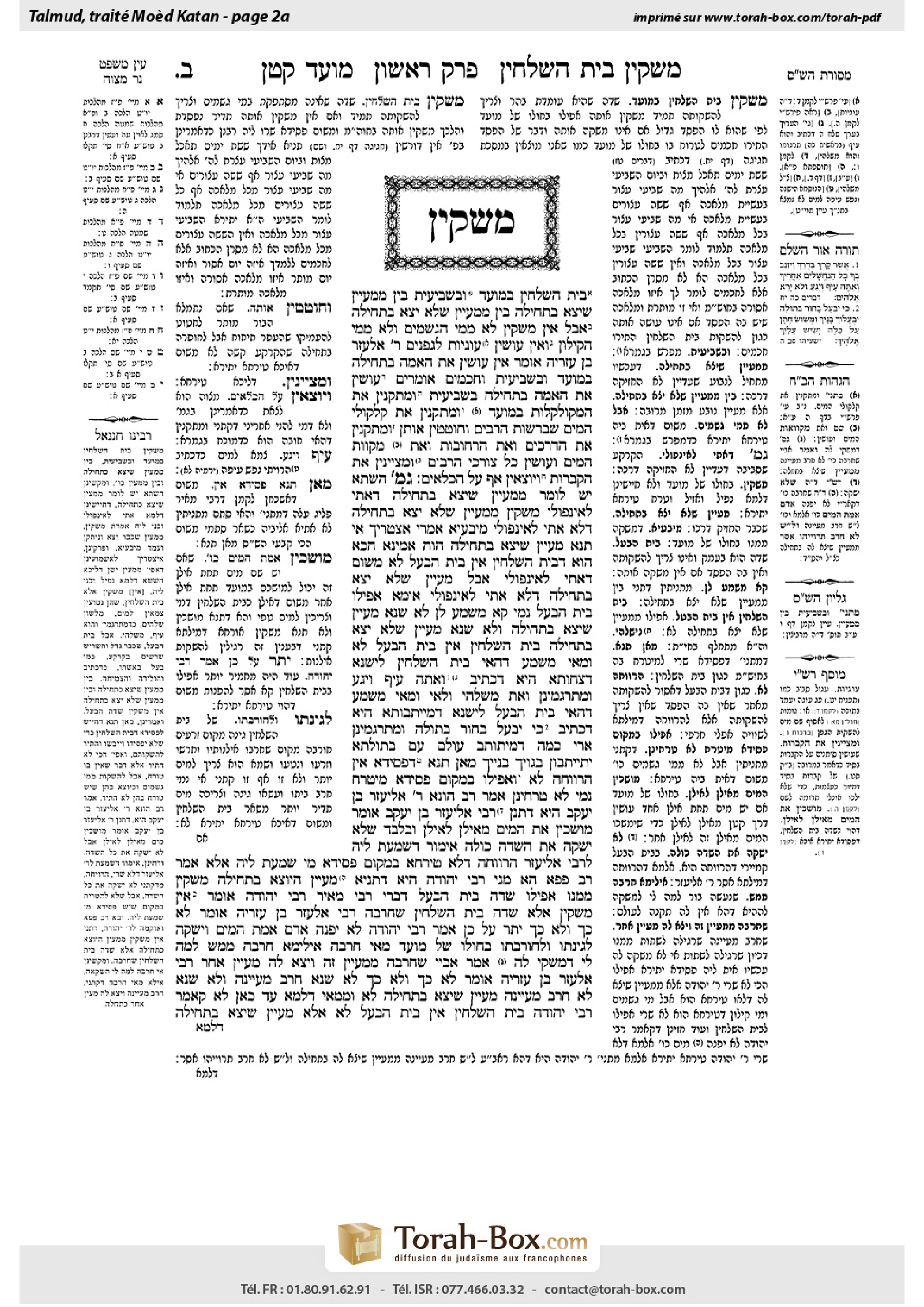
Moed Katan 2a: Talmud study for Daf Yomi
Daf Yomi is the daily study of one Talmud folio. Explore 37 tractates with scans, Hebrew text, Sefaria English and AI-generated French translations where annotated.
Passage selection and English or AI-generated French translation are available where the scan has annotations. Daf Study is independent of Torah-Box and Sefaria.
Browse Moed Katan · מועד קטן · All tractatesMoed Katan 2a text and translations
This page of Moed Katan includes the Aramaic text, an English translation and an AI-generated French translation, alongside the scan above.
מועד קטן ב׳ א · Aramaic and Hebrew text
מַשְׁקִין בֵּית הַשְּׁלָחִין בַּמּוֹעֵד וּבַשְּׁבִיעִית, בֵּין מִמַּעְיָין שֶׁיָּצָא בַּתְּחִילָּה, בֵּין מִמַּעְיָין שֶׁלֹּא יָצָא בַּתְּחִילָּה. אֲבָל אֵין מַשְׁקִין לֹא מִמֵּי הַגְּשָׁמִים, וְלֹא מִמֵּי הַקִּילוֹן.
וְאֵין עוֹשִׂין עוּגִיּוֹת לַגְּפָנִים. רַבִּי אֶלְעָזָר בֶּן עֲזַרְיָה אוֹמֵר: אֵין עוֹשִׂין אֶת הָאַמָּה בַּתְּחִילָּה בַּמּוֹעֵד וּבִשְׁבִיעִית, וַחֲכָמִים אוֹמְרִים: עוֹשִׂין אֶת הָאַמָּה בַּתְּחִילָּה בַּשְּׁבִיעִית, וּמְתַקְּנִין אֶת הַמְקוּלְקָלוֹת בַּמּוֹעֵד.
וּמְתַקְּנִין אֶת קִלְקוּלֵי הַמַּיִם שֶׁבִּרְשׁוּת הָרַבִּים, וְחוֹטְטִין אוֹתָן, וּמְתַקְּנִין אֶת הַדְּרָכִים וְאֶת הָרְחוֹבוֹת וְאֶת מִקְווֹת הַמַּיִם, וְעוֹשִׂין כׇּל צוֹרְכֵי הָרַבִּים, וּמְצַיְּינִין אֶת הַקְּבָרוֹת, וְיוֹצְאִין אַף עַל הַכִּלְאַיִם.
גְּמָ׳ הַשְׁתָּא יֵשׁ לוֹמַר מִמַּעְיָין שֶׁיָּצָא בַּתְּחִילָּה, דְּאָתֵי לְאִינְּפוֹלֵי — מַשְׁקִין, מִמַּעְיָין שֶׁלֹּא יָצָא בַּתְּחִילָּה, דְּלָא אָתֵי לְאִינְּפוֹלֵי — מִיבַּעְיָא?
אָמְרִי, אִצְטְרִיךְ: אִי תַּנָּא מַעְיָין שֶׁיָּצָא בַּתְּחִילָּה, הֲוָה אָמֵינָא: הָכָא הוּא דְּבֵית הַשְּׁלָחִין — אִין, בֵּית הַבַּעַל — לָא, מִשּׁוּם דְּאָתֵי לְאִינְּפוֹלֵי. אֲבָל מַעְיָין שֶׁלֹּא יָצָא בַּתְּחִילָּה, דְּלָא אָתֵי לְאִינְּפוֹלֵי — אֵימָא אֲפִילּוּ בֵּית הַבַּעַל נָמֵי,
קָא מַשְׁמַע לַן: לָא שְׁנָא מַעְיָין שֶׁיָּצָא בַּתְּחִילָּה, וְלָא שְׁנָא מַעְיָין שֶׁלֹּא יָצָא בַּתְּחִילָּה, בֵּית הַשְּׁלָחִין — אִין, בֵּית הַבַּעַל — לָא.
וּמַאי מַשְׁמַע דְּהַאי ״בֵּית הַשְּׁלָחִין״ לִישָּׁנָא דְּצָחוּתָא הִיא — דִּכְתִיב: ״וְאַתָּה עָיֵף וְיָגֵעַ״, וּמְתַרְגְּמִינַן: וְאַתְּ מְשַׁלְהֵי וּלְאֵי.
וּמַאי מַשְׁמַע דְּהַאי ״בֵּית הַבַּעַל״ לִישָּׁנָא דִּמְיַיתְּבוּתָא הִיא — דִּכְתִיב: ״כִּי יִבְעַל בָּחוּר בְּתוּלָה״, וּמְתַרְגְּמִינַן: אֲרֵי כַּמָּה דְּמִיתּוֹתַב עוּלֵם עִם בְּתוּלְתָּא יִתְיַיתְּבוּן בְּגַוִּיךְ בְּנַיִיךְ.
מַאן תַּנָּא דִּפְסֵידָא — אִין, הַרְוָוחָה — לָא, וַאֲפִילּוּ בִּמְקוֹם פְּסֵידָא — מִיטְרָח נָמֵי לָא טָרְחִינַן?
אָמַר רַב הוּנָא: רַבִּי אֱלִיעֶזֶר בֶּן יַעֲקֹב הִיא. דִּתְנַן, רַבִּי אֱלִיעֶזֶר בֶּן יַעֲקֹב אוֹמֵר: מוֹשְׁכִין אֶת הַמַּיִם מֵאִילָן לְאִילָן, וּבִלְבַד שֶׁלֹּא יַשְׁקֶה אֶת הַשָּׂדֶה כּוּלָּהּ.
אֵימוֹר דְּשָׁמְעַתְּ לֵיהּ לְרַבִּי אֱלִיעֶזֶר הַרְוָוחָה דְּלָא, טִירְחָא בִּמְקוֹם פְּסֵידָא מִי שָׁמְעַתְּ לֵיהּ?
אֶלָּא אָמַר רַב פָּפָּא: הָא מַנִּי — רַבִּי יְהוּדָה הִיא, דְּתַנְיָא: מַעְיָין הַיּוֹצֵא בַּתְּחִילָּה — מַשְׁקִין מִמֶּנּוּ אֲפִילּוּ שְׂדֵה בֵּית הַבַּעַל, דִּבְרֵי רַבִּי מֵאִיר. רַבִּי יְהוּדָה אוֹמֵר: אֵין מַשְׁקִין אֶלָּא שְׂדֵה בֵּית הַשְּׁלָחִין שֶׁחָרְבָה. רַבִּי אֶלְעָזָר בֶּן עֲזַרְיָה אוֹמֵר: לֹא כָּךְ וְלֹא כָּךְ. יָתֵר עַל כֵּן אָמַר רַבִּי יְהוּדָה: לֹא יַפְנֶה אָדָם אַמַּת הַמַּיִם וְיַשְׁקֶה לְגִינָּתוֹ וּלְחוּרְבָּתוֹ בְּחוּלּוֹ שֶׁל מוֹעֵד.
מַאי ״חָרְבָה״? אִילֵּימָא חָרְבָה מַמָּשׁ, לְמָה לִי דְּמַשְׁקֵי לַהּ? אָמַר אַבָּיֵי: שֶׁחָרְבָה מִמַּעְיָין זֶה וְיָצָא לָהּ מַעְיָין אַחֵר.
רַבִּי אֶלְעָזָר בֶּן עֲזַרְיָה אוֹמֵר לֹא כָּךְ וְלֹא כָּךְ, לָא שְׁנָא חָרַב מַעְיָינָהּ וְלָא שְׁנָא לֹא חָרַב מַעְיָינָהּ — מַעְיָין שֶׁיָּצָא בַּתְּחִילָּה לָא.
וּמִמַּאי? דִּלְמָא עַד כָּאן לָא קָאָמַר רַבִּי יְהוּדָה: בֵּית הַשְּׁלָחִין — אִין, בֵּית הַבַּעַל — לָא, אֶלָּא מַעְיָין שֶׁיָּצָא בַּתְּחִילָּה
Moed Katan 2a · English translation
MISHNA: One may irrigate a field that requires irrigation on the intermediate days of a Festival as well as during the Sabbatical Year, both from a newly emerged spring that began to flow only during the Festival, and from a spring that did not just emerge and that has been flowing for some time. However, one may not irrigate a field with rainwater collected in a cistern, a procedure that requires excessive exertion, or with water drawn with a shadoof [kilon], a lever used to raise water with a bucket from deep down in a well.
And one may not construct circular ditches around the bases of grapevines on the intermediate days of a Festival. Rabbi Elazar ben Azarya says: One may not construct a new water channel during the intermediate days of a Festival or during the Sabbatical Year. And the Rabbis say: One may construct a new water channel during the Sabbatical Year and one may repair damaged water channels during the intermediate days of a Festival.
In addition to performing labor on one’s own property in order to avoid financial loss, it is also permitted to perform labor on the intermediate days of a Festival for the public welfare: One may repair damaged water cisterns that are in the public domain, and clean them out by removing the dirt and sediment that accumulated there; one may repair roads, streets, and ritual baths; and one may tend to all other public needs. So too, one may mark graves to inform the public of their ritual impurity, and inspectors may even go out to uproot the shoots of prohibited diverse kinds [kilayim] that grew in the fields during the rainy season.
GEMARA: The Gemara begins by questioning the wording of the mishna: Now that it has been said that on the intermediate days of a Festival one may irrigate a field from a newly emerged spring, whose walls have not yet stabilized and are likely to collapse, necessitating laborious repairs, is it necessary to mention that one may irrigate a field from a spring that did not just emerge, whose walls have already stabilized and are therefore not likely to collapse?
The Gemara answers: They say that it was necessary to mention the second case as well. For had the tanna taught us the halakha with regard to only a newly emerged spring, I would have said that here, in the case of a field that requires irrigation, yes, one is permitted to irrigate from such a spring, but in the case of a field that ordinarily suffices with rainwater, no, one is not permitted to do so, because it is likely to collapse. But with regard to a spring that did not just emerge, that is not likely to collapse, I might say that one may provide supplementary irrigation even in the case of a field that ordinarily suffices with rainwater.
Therefore, the tanna teaches us that a newly emerged spring is no different from a spring that did not just emerge. In the case of a field that requires irrigation, yes, one may irrigate on the intermediate days of a Festival, while in the case of a field that ordinarily suffices with rainwater, no, one may not do so, even from an established spring.
The Gemara raises a question with regard to a linguistic issue: And from where may it be inferred that this term, beit hashelaḥin, a field that requires irrigation, is a term denoting thirst, implying that supplementary watering is necessary? The Gemara answers: As it is written: “And you were faint and weary” (Deuteronomy 25:18). The term faint is referring to the thirst of the Israelites in the desert. And, in the standard Aramaic translation, we translate the verse as: And you were thirsty [meshalhei] and weary. The letters ḥet and heh are sometimes interchanged, and therefore the term beit hashelaḥin connotes a thirsty field.
And from where may it be inferred that this term, beit haba’al, a field that suffices with rainwater, is a term denoting settlement, i.e., an established field that does not require extensive upkeep? As it is written: “For as a young man takes to himself [yiv’al] a virgin, so shall your sons take you to themselves” (Isaiah 62:5). And it is translated in the Aramaic translation: As a young man settles down with a virgin, so shall your sons become settled within you. Similarly, beit haba’al is referring to a settled field that suffices with rainwater.
The Gemara begins to clarify the underlying principle of the mishna, asking: Who is the anonymous tanna of the mishna who maintains that labor performed to prevent a considerable loss, such as watering a field that requires irrigation, yes, it is permitted on the intermediate days of a Festival; but labor performed to increase one’s profit, such as watering a field that ordinarily suffices with rainwater, no, it is not permitted? Furthermore, even in a case involving loss, one may not excessively exert oneself, as the tanna of the mishna renders prohibited all cases of watering fields with collected rainwater or with water drawn with a shadoof, even in a field that requires irrigation.
Rav Huna said: It is Rabbi Eliezer ben Ya’akov, as we learned in a mishna: Rabbi Eliezer ben Ya’akov says: In a field filled with trees, one may draw water via channels from tree to tree, provided that in doing so he does not water the entire field. As this field ordinarily suffices with rainwater, it is prohibited to water the entire field. Therefore, it is evident that Rabbi Eliezer ben Ya’akov renders prohibited work performed to increase profit on the intermediate days of a Festival.
The Gemara challenges this comparison: Say that you heard that Rabbi Eliezer ben Ya’akov holds that labor performed only to increase profit is not permitted. But did you hear him prohibit excessive exertion in a case of considerable loss? This aspect of the mishna finds no expression in the words of Rabbi Eliezer ben Ya’akov.
Rather, Rav Pappa said: In accordance with whose opinion is this mishna? It is in accordance with the opinion of Rabbi Yehuda, as it is taught in a baraita: From a newly emerged spring one may irrigate even a field that ordinarily suffices with rainwater; this is the statement of Rabbi Meir. Rabbi Yehuda says: One may irrigate only a field requiring irrigation that dried up and needs water. Rabbi Elazar ben Azarya says: Neither the one nor the other. Furthermore, Rabbi Yehuda said: Owing to the exertion involved, one may not divert a water channel from its regular path in order to water his garden or his ruin, which is now being used for planting, during the intermediate days of a Festival.
The Gemara first clarifies the case of the baraita: What does Rabbi Yehuda mean when he speaks of a field that is dried up? If we say that the field is literally dried up and the plants are already parched, why do I need to water it? Abaye said: It means that the one spring from which the field had been irrigated until now dried up, but in the meantime another spring emerged. If the field is not irrigated from this spring, it will be ruined.
The Gemara explains the next clause of the baraita, which states: Rabbi Elazar ben Azarya says: Neither the one nor the other. By this he means that it is no different whether the original spring dried up or did not dry up. The guiding principle is: From a newly emerged spring one may not irrigate even a field that requires irrigation. In any event, Rabbi Yehuda seems to maintain an opinion that is like that of the mishna, i.e., that only a field that requires irrigation may be watered, but not a field that suffices with rainwater. And even in the case of a field that requires irrigation, excessive exertion is prohibited.
The Gemara challenges this understanding: And from where do you conclude that the mishna reflects the opinion of Rabbi Yehuda? Perhaps Rabbi Yehuda stated that a field that requires irrigation, yes, one may irrigate it on the intermediate days of a Festival, and a field that suffices with rainwater, no, one may not do so, only with regard to a newly emerged spring,
Moed Katan 2a · Traduction française (IA)
MICHNA : On peut irriguer un champ qui nécessite une irrigation pendant les jours intermédiaires d’une fête ainsi que pendant l’année sabbatique, aussi bien à partir d’une source nouvellement apparue, qui a commencé à couler seulement pendant la fête, qu’à partir d’une source qui n’est pas nouvelle et coule depuis quelque temps. Toutefois, on ne peut irriguer un champ avec l’eau de pluie recueillie dans une citerne, opération qui exige un effort excessif, ni avec de l’eau puisée à l’aide d’un balancier [kilon], levier servant à remonter un seau d’eau depuis le fond d’un puits.
On ne peut pas non plus creuser de rigoles circulaires autour du pied des vignes pendant les jours intermédiaires d’une fête. Rabbi Elazar ben Azarya dit : On ne peut pas creuser un nouveau canal d’irrigation pendant les jours intermédiaires d’une fête ni pendant l’année sabbatique. Et les Rabbins disent : On peut creuser un nouveau canal d’irrigation pendant l’année sabbatique, et réparer les canaux d’irrigation endommagés pendant les jours intermédiaires d’une fête.
Outre les travaux effectués sur sa propre propriété afin d’éviter une perte financière, il est également permis d’effectuer des travaux d’intérêt public pendant les jours intermédiaires d’une fête : on peut réparer les citernes endommagées qui se trouvent dans le domaine public et les nettoyer en en retirant la terre et les sédiments qui s’y sont accumulés ; on peut réparer les routes, les rues et les bains rituels ; et l’on peut s’occuper de tous les autres besoins de la collectivité. De même, on peut marquer les tombes pour avertir le public de leur impureté rituelle, et des inspecteurs peuvent même se rendre sur place pour arracher les pousses d’espèces interdites [kilayim] qui ont poussé dans les champs pendant la saison des pluies.
GUEMARA : La Guemara commence par s’interroger sur la formulation de la Michna : Puisqu’il a été dit que, pendant les jours intermédiaires d’une fête, on peut irriguer un champ à partir d’une source nouvellement apparue, dont les parois ne sont pas encore stabilisées et risquent de s’effondrer, ce qui nécessiterait des réparations laborieuses, est-il nécessaire de préciser que l’on peut irriguer un champ à partir d’une source qui n’est pas nouvelle, dont les parois sont déjà stabilisées et ne risquent donc pas de s’effondrer ?
La Guemara répond : On dit qu’il était également nécessaire de mentionner le second cas. En effet, si le tanna nous avait enseigné la halakha uniquement à propos d’une source nouvellement apparue, j’aurais dit qu’ici, dans le cas d’un champ qui nécessite une irrigation, oui, il est permis de l’irriguer à partir d’une telle source, mais que, dans le cas d’un champ qui se satisfait habituellement de l’eau de pluie, non, cela n’est pas permis, car la source risque de s’effondrer. Mais à propos d’une source qui n’est pas nouvelle et qui ne risque pas de s’effondrer, j’aurais pu dire qu’il est permis d’apporter un supplément d’irrigation même à un champ qui se satisfait habituellement de l’eau de pluie.
Le tanna nous enseigne donc qu’une source nouvellement apparue ne diffère pas d’une source qui n’est pas nouvelle. Dans le cas d’un champ qui nécessite une irrigation, oui, on peut l’irriguer pendant les jours intermédiaires d’une fête ; tandis que, dans le cas d’un champ qui se satisfait habituellement de l’eau de pluie, non, on ne peut pas le faire, même à partir d’une source déjà établie.
La Guemara pose une question d’ordre linguistique : D’où peut-on déduire que l’expression beit hashelaḥin, « champ qui nécessite une irrigation », désigne un champ assoiffé, ce qui implique qu’un arrosage supplémentaire est nécessaire ? La Guemara répond : Comme il est écrit : « Tu étais épuisé et las » (Deutéronome 25,18). Le terme « épuisé » fait référence à la soif des Israélites dans le désert. Et, dans la traduction araméenne usuelle, le verset est rendu ainsi : « Tu étais assoiffé [meshalhei] et las. » Les lettres ḥet et heh s’interchangent parfois ; l’expression beit hashelaḥin désigne donc un champ assoiffé.
Et d’où peut-on déduire que l’expression beit haba’al, « champ qui se satisfait de l’eau de pluie », désigne un lieu établi, c’est-à-dire un champ bien installé qui ne nécessite pas un entretien important ? Comme il est écrit : « De même qu’un jeune homme prend pour épouse [yiv’al] une vierge, ainsi tes fils te prendront pour épouse » (Isaïe 62,5). Dans la traduction araméenne, le verset est rendu ainsi : « De même qu’un jeune homme s’établit auprès d’une vierge, ainsi tes fils s’établiront en toi. » De même, beit haba’al désigne un champ bien établi qui se satisfait de l’eau de pluie.
La Guemara commence à éclaircir le principe sous-jacent à la Michna en demandant : Quel est le tanna anonyme de la Michna, qui considère que les travaux effectués pour éviter une perte importante, comme irriguer un champ qui nécessite une irrigation, oui, sont permis pendant les jours intermédiaires d’une fête, mais que les travaux effectués pour accroître ses bénéfices, comme irriguer un champ qui se satisfait habituellement de l’eau de pluie, non, ne sont pas permis ? En outre, même en cas de perte, on ne peut pas fournir un effort excessif, puisque le tanna de la Michna interdit d’irriguer un champ avec de l’eau de pluie recueillie ou avec de l’eau puisée à l’aide d’un balancier, même s’il nécessite une irrigation.
Rav Houna dit : C’est Rabbi Eliezer ben Yaakov, comme nous l’avons appris dans une Michna : Rabbi Eliezer ben Yaakov dit : Dans un champ planté d’arbres, on peut faire passer l’eau par des rigoles d’un arbre à l’autre, à condition de ne pas irriguer ainsi tout le champ. Comme ce champ se satisfait habituellement de l’eau de pluie, il est interdit de l’irriguer en entier. Il est donc évident que Rabbi Eliezer ben Yaakov interdit les travaux effectués pour accroître les bénéfices pendant les jours intermédiaires d’une fête.
La Guemara conteste cette comparaison : Tu as entendu que Rabbi Eliezer ben Yaakov considère que les travaux effectués uniquement pour accroître les bénéfices ne sont pas permis. Mais l’as-tu entendu interdire un effort excessif en cas de perte importante ? Cet aspect de la Michna ne trouve aucun écho dans les propos de Rabbi Eliezer ben Yaakov.
Rav Pappa dit plutôt : Selon l’opinion de qui cette Michna est-elle conforme ? Elle est conforme à l’opinion de Rabbi Yehouda, comme l’enseigne une baraïta : À partir d’une source nouvellement apparue, on peut irriguer même un champ qui se satisfait habituellement de l’eau de pluie ; telle est la déclaration de Rabbi Meïr. Rabbi Yehouda dit : On ne peut irriguer qu’un champ qui nécessite une irrigation, s’est desséché et a besoin d’eau. Rabbi Elazar ben Azarya dit : Ni l’un ni l’autre. En outre, Rabbi Yehouda dit : En raison de l’effort que cela implique, on ne peut pas détourner un canal d’irrigation de son cours habituel pour irriguer son jardin ou sa ruine, désormais utilisée pour des plantations, pendant les jours intermédiaires d’une fête.
La Guemara précise d’abord le cas de la baraïta : Que veut dire Rabbi Yehouda lorsqu’il parle d’un champ desséché ? Si l’on dit que le champ est littéralement desséché et que les plantes sont déjà flétries, pourquoi aurait-on besoin de l’irriguer ? Abayé dit : Cela signifie que la source à partir de laquelle le champ était irrigué jusqu’alors s’est tarie, mais qu’entre-temps une autre source est apparue. Si le champ n’est pas irrigué à partir de cette source, il sera ruiné.
La Guemara explique la clause suivante de la baraïta, qui dit : Rabbi Elazar ben Azarya dit : Ni l’un ni l’autre. Il veut dire que cela ne fait aucune différence que la source initiale se soit tarie ou non. Le principe directeur est le suivant : on ne peut irriguer à partir d’une source nouvellement apparue même un champ qui nécessite une irrigation. Quoi qu’il en soit, Rabbi Yehouda semble soutenir une opinion semblable à celle de la Michna, à savoir que seul un champ qui nécessite une irrigation peut être arrosé, mais pas un champ qui se satisfait de l’eau de pluie. Et même dans le cas d’un champ qui nécessite une irrigation, un effort excessif est interdit.
La Guemara conteste cette compréhension : Et d’où conclus-tu que la Michna reflète l’opinion de Rabbi Yehouda ? Peut-être Rabbi Yehouda a-t-il dit qu’un champ qui nécessite une irrigation, oui, on peut l’irriguer pendant les jours intermédiaires d’une fête, tandis qu’un champ qui se satisfait de l’eau de pluie, non, on ne peut pas l’irriguer, uniquement à propos d’une source nouvellement apparue,
Traduction française générée par IA à partir de l’édition anglaise de Sefaria. Vérifie toujours un passage avec le texte source.
Text from Sefaria: William Davidson Edition - Vocalized Aramaic (CC BY NC); William Davidson Edition - English (CC BY NC).