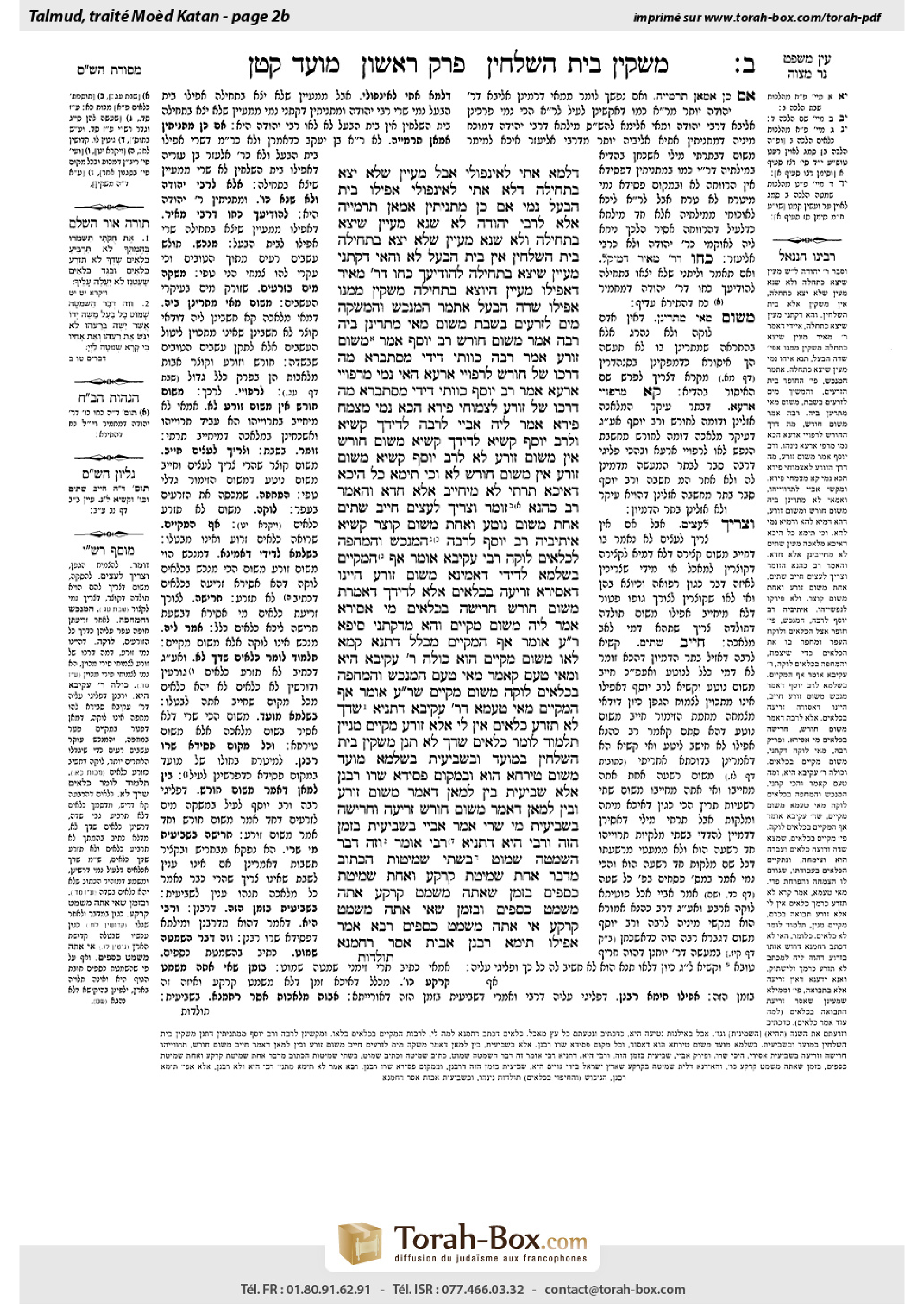
Moed Katan 2b: Talmud study for Daf Yomi
Daf Yomi is the daily study of one Talmud folio. Explore 37 tractates with scans, Hebrew text, Sefaria English and AI-generated French translations where annotated.
Passage selection and English or AI-generated French translation are available where the scan has annotations. Daf Study is independent of Torah-Box and Sefaria.
Browse Moed Katan · מועד קטן · All tractatesMoed Katan 2b text and translations
This page of Moed Katan includes the Aramaic text, an English translation and an AI-generated French translation, alongside the scan above.
מועד קטן ב׳ ב · Aramaic and Hebrew text
דִּלְמָא אָתֵי לְאִינְּפוֹלֵי. אֲבָל מַעְיָין שֶׁלֹּא יָצָא בַּתְּחִילָּה, דְּלָא אָתֵי לְאִינְּפוֹלֵי — אֲפִילּוּ בֵּית הַבַּעַל נָמֵי!
אִם כֵּן — מַתְנִיתִין אַמַּאן תִּרְמְיַיהּ? אֶלָּא: לְרַבִּי יְהוּדָה לָא שְׁנָא מַעְיָין שֶׁיָּצָא בַּתְּחִילָּה, וְלָא שְׁנָא מַעְיָין שֶׁלֹּא יָצָא בַּתְּחִילָּה, בֵּית הַשְּׁלָחִין — אִין, בֵּית הַבַּעַל — לָא. וְהַאי דְּקָתָנֵי מַעְיָין שֶׁיָּצָא בַּתְּחִילָּה, לְהוֹדִיעֲךָ כֹּחוֹ דְּרַבִּי מֵאִיר, דַּאֲפִילּוּ מַעְיָין הַיּוֹצֵא בַּתְּחִילָּה — מַשְׁקִין מִמֶּנּוּ אֲפִילּוּ שְׂדֵה הַבַּעַל.
אִתְּמַר: הַמְנַכֵּשׁ וְהַמַּשְׁקֶה מַיִם לִזְרָעִים בְּשַׁבָּת, מִשּׁוּם מַאי מַתְרִינַן בֵּיהּ? רַבָּה אָמַר: מִשּׁוּם חוֹרֵשׁ. רַב יוֹסֵף אָמַר: מִשּׁוּם זוֹרֵעַ.
אָמַר רַבָּה, כְּווֹתִי דִּידִי מִסְתַּבְּרָא: מָה דַּרְכּוֹ שֶׁל חוֹרֵשׁ — לְרַפּוֹיֵי אַרְעָא, הַאי נָמֵי מְרַפֵּויי אַרְעָא. אָמַר רַב יוֹסֵף, כְּווֹתִי דִּידִי מִסְתַּבְּרָא: מָה דַּרְכּוֹ שֶׁל זוֹרֵעַ — לְצַמּוֹחֵי פֵּירָא, הָכָא נָמֵי מְצַמַּח פֵּירָא.
אֲמַר לֵיהּ אַבָּיֵי לְרַבָּה: לְדִידָךְ קַשְׁיָא וּלְרַב יוֹסֵף קַשְׁיָא. לְדִידָךְ קַשְׁיָא: מִשּׁוּם חוֹרֵשׁ אִין, מִשּׁוּם זוֹרֵעַ לָא? לְרַב יוֹסֵף קַשְׁיָא: מִשּׁוּם זוֹרֵעַ אִין, מִשּׁוּם חוֹרֵשׁ לָא?
וְכִי תֵּימָא: כׇּל הֵיכָא דְּאִיכָּא תַּרְתֵּי לָא מִיחַיַּיב אֶלָּא חֲדָא, וְהָאָמַר רַב כָּהֲנָא: זוֹמֵר וְצָרִיךְ לָעֵצִים — חַיָּיב שְׁתַּיִם. אַחַת מִשּׁוּם נוֹטֵעַ, וְאַחַת מִשּׁוּם קוֹצֵר.
קַשְׁיָא.
אֵיתִיבֵיהּ רַב יוֹסֵף לְרַבָּה: הַמְנַכֵּשׁ וְהַמְחַפֶּה לְכִלְאַיִם לוֹקֶה. רַבִּי עֲקִיבָא אוֹמֵר: אַף הַמְקַיֵּים.
בִּשְׁלָמָא לְדִידִי, דְּאָמֵינָא מִשּׁוּם זוֹרֵעַ — הַיְינוּ דַּאֲסִירָא זְרִיעָה בְּכִלְאַיִם, אֶלָּא לְדִידָךְ, דְּאָמְרַתְּ מִשּׁוּם חוֹרֵשׁ — חֲרִישָׁה בְּכִלְאַיִם מִי אֲסִירָא?
אֲמַר לֵיהּ: מִשּׁוּם מְקַיֵּים.
וְהָא מִדְּקָתָנֵי סֵיפָא: רַבִּי עֲקִיבָא אוֹמֵר אַף הַמְקַיֵּים, מִכְּלָל דְּתַנָּא קַמָּא לָאו מִשּׁוּם מְקַיֵּים הוּא!
כּוּלַּהּ רַבִּי עֲקִיבָא הִיא, וּ״מַאי טַעַם״ קָאָמַר: מַאי טַעַם הַמְנַכֵּשׁ וְהַמְחַפֶּה בְּכִלְאַיִם לוֹקֶה מִשּׁוּם מְקַיֵּים — שֶׁרַבִּי עֲקִיבָא אוֹמֵר: אַף הַמְקַיֵּים.
מַאי טַעְמָא דְּרַבִּי עֲקִיבָא? דְּתַנְיָא: ״שָׂדְךָ לֹא תִזְרַע כִּלְאָיִם״, אֵין לִי אֶלָּא זוֹרֵעַ, מְקַיֵּים מִנַּיִין?
תַּלְמוּד לוֹמַר: ״כִּלְאַיִם שָׂדְךָ לֹא״.
תְּנַן: מַשְׁקִין בֵּית הַשְּׁלָחִין בַּמּוֹעֵד וּבִשְׁבִיעִית.
בִּשְׁלָמָא מוֹעֵד, מִשּׁוּם טִירְחָא הוּא, וּבִמְקוֹם פְּסֵידָא שָׁרוּ רַבָּנַן. אֶלָּא שְׁבִיעִית, בֵּין לְמַאן דְּאָמַר מִשּׁוּם זוֹרֵעַ וּבֵין לְמַאן דְּאָמַר מִשּׁוּם חוֹרֵשׁ, זְרִיעָה וַחֲרִישָׁה בִּשְׁבִיעִית מִי שְׁרֵי?
אָמַר אַבָּיֵי: בִּשְׁבִיעִית בִּזְמַן הַזֶּה, וְרַבִּי הִיא. דְּתַנְיָא, רַבִּי אוֹמֵר: ״וְזֶה דְּבַר הַשְּׁמִטָּה שָׁמוֹט״. בִּשְׁתֵּי שְׁמִיטוֹת הַכָּתוּב מְדַבֵּר, אַחַת שְׁמִיטַּת קַרְקַע, וְאַחַת שְׁמִיטַּת כְּסָפִים.
בִּזְמַן שֶׁאַתָּה מְשַׁמֵּט קַרְקַע — אַתָּה מְשַׁמֵּט כְּסָפִים, וּבִזְמַן שֶׁאִי אַתָּה מְשַׁמֵּט קַרְקַע — אִי אַתָּה מְשַׁמֵּט כְּסָפִים.
רָבָא אָמַר: אֲפִילּוּ תֵּימָא רַבָּנַן — אָבוֹת אָסַר רַחֲמָנָא,
Moed Katan 2b · English translation
as it is likely to collapse. But in the case of a spring that did not just emerge, which is not likely to collapse because its walls have already stabilized, even a field that ordinarily suffices with rainwater may be irrigated.
The Gemara asks: If that were so, then to whom, i.e., to which tanna, would you attribute the mishna? According to this interpretation, the mishna does not correspond to any opinion, while according to the previous interpretation, it corresponds to the opinion of Rabbi Yehuda. Rather, it must be that according to the opinion of Rabbi Yehuda, a newly emerged spring is no different from a spring that did not just emerge. A field that requires irrigation, yes, it may be irrigated, while a field that suffices with rainwater, no, it may not be irrigated. And the baraita opted to teach this dispute in the case of a newly emerged spring in order to convey the far-reaching nature of the opinion of Rabbi Meir, which states that one may irrigate even from a newly emerged spring, and even a field that suffices with rainwater.
§ It was stated that the amora’im disputed the following question: With regard to one who weeds or one who waters seedlings on Shabbat, for what prohibited labor do we forewarn him? Judicial punishment may be administered to a sinner only if he has been forewarned by two witnesses prior to the commission of his offense. This forewarning must include the specific transgression being violated, and on Shabbat it must include the specific category of prohibited labor that the action involves. Rabba said: It is due to the prohibition against plowing. Rav Yosef said: It is due to the prohibition against sowing.
Rabba said: According to my opinion it is reasonable. Just as the usual objective of plowing is to loosen the earth, so too, this, weeding or watering, loosens the earth. Rav Yosef said: According to my opinion, it is reasonable. Just as the usual objective of sowing is to cause the fruit to grow, here too, weeding or watering causes the fruit to grow.
Abaye said to Rabba: According to your opinion, it is difficult, and according to the opinion of Rav Yosef, it is difficult. Abaye explains: According to your opinion, it is difficult: Is it true that for the prohibition against plowing, yes, he is forewarned, but for the prohibition against sowing, no, he is not forewarned? Similarly, according to the opinion of Rav Yosef, it is difficult: Can it be that for the prohibition against sowing, yes, he is forewarned, but for the prohibition against plowing, no, he is not forewarned? Everyone should agree that weeding and watering fall under the categories of both plowing and sowing.
And if you say that anywhere that there are two possible categories of prohibited labor into which a particular action might fall, one is liable to be punished for only one of them, didn’t Rav Kahana say: If one prunes the branches of a vine on Shabbat and he needs the wood for firewood or any other purpose, he is liable to bring two sin-offerings? He is liable to bring one sin-offering for violating the primary category of sowing, as pruning vines facilitates their growth, and so it is a sub-category of sowing. And he is liable to bring one sin-offering for violating the primary category of reaping, as the essence of reaping is detaching that which one needs from the ground. Since he needs the wood that he is detaching from the vine, his action is considered reaping. Consequently, one action that incorporates two prohibited labors causes liability for both.
The Gemara concludes: Indeed, it is difficult according to both opinions.
Rav Yosef raised an objection to the opinion of Rabba from what is taught in the following baraita: One who weeds in proximity to diverse kinds of seeds, or covers with earth the exposed roots of diverse kinds, is flogged for transgressing the prohibition against diverse kinds, i.e., tending different species of crops in one area of the same field, as it is stated: “You shall not sow your field with two kinds of seed” (Leviticus 19:19). Rabbi Akiva says: Even one who maintains in his field a mixture of species that he could have uprooted is flogged for violating the prohibition against diverse kinds of seeds.
Rav Yosef explains: Granted, according to my opinion, that I say that one who weeds on Shabbat is forewarned for the prohibited labor of sowing, this is the reason he is liable to be punished with flogging for weeding diverse seeds: Sowing diverse kinds is prohibited. But according to you, who said that one who weeds on Shabbat is forewarned for plowing, why is one liable to be flogged for weeding in proximity to diverse kinds? Is plowing prohibited in connection with diverse kinds? At the time of plowing, there is no mixture of different species of crops, so plowing cannot be prohibited in this case.
Rabba said to him: According to my opinion, one who weeds a field of diverse kinds is flogged not because he is guilty of plowing, but for violating the prohibition against maintaining a mixture of species in his field.
The Gemara objects: However, from the fact that it teaches in the latter clause of the baraita that Rabbi Akiva says: Even one who maintains in his field a mixture of species is liable to be flogged, it may be inferred that according to the anonymous first tanna, the liability for weeding is not for maintaining diverse kinds, but for performing some other prohibited labor.
The Gemara rejects this opinion: In fact, the entire baraita reflects the opinion of Rabbi Akiva, and it is stated in the style of what is the reason. The baraita should be understood as follows: What is the reason that one who weeds and one who covers the exposed roots of diverse kinds with earth is flogged? He is flogged for maintaining diverse kinds in his field, as Rabbi Akiva says: Even one who maintains in his field a mixture of species is flogged.
With regard to Rabbi Akiva’s opinion, the Gemara asks: What is the reason for Rabbi Akiva’s opinion? How did he derive this prohibition from the verses? The Gemara answers: As it is taught in a baraita: “You shall not sow your field with mingled seed” (Leviticus 19:19). I have derived from this verse that only sowing diverse kinds is prohibited. From where is it derived that maintaining diverse kinds, which does not involve any positive action, is also prohibited?
The verse states: “Diverse kinds, you shall not sow your field with mingled seed” (Leviticus 19:19). The prohibition against planting different species of a crop in one area of the same field is preceded in the verse by the prohibition against crossbreeding livestock: “You shall not let your cattle gender with a diverse kind.” A slight change in punctuation yields the phrase: Diverse kinds in your field, you shall not, indicating that merely preserving diverse kinds in one’s field is prohibited.
§ The Gemara returns to the original topic of discussion: We learned in the mishna: One may irrigate a field that requires irrigation on the intermediate days of a Festival as well as during the Sabbatical Year.
The Gemara asks: Granted, with regard to the intermediate days of a Festival, where the prohibition against irrigation is due to the mandate to avoid excessive exertion on the Festival, in a case of considerable loss, the Sages permitted one to exert himself. However, during the Sabbatical Year, both according to the one who said that one who waters is liable due to the prohibition against sowing, and according to the one who said that one is liable due to the prohibition against plowing, are sowing and plowing permitted during the Sabbatical Year? How can these actions be permitted when the Torah explicitly renders prohibited working the land during the Sabbatical Year?
Abaye said: The mishna is referring to the Sabbatical Year in the present time, when its prohibitions are only by rabbinic decree, and it is in accordance with the opinion of Rabbi Yehuda HaNasi. As it is taught in a baraita that Rabbi Yehuda HaNasi says: When the verse states: “And this is the manner of the release, every creditor will release that which he has lent to his neighbor” (Deuteronomy 15:2), the verse speaks of two releases: One is the release of land, that one must refrain from working the land, and the other is the release of money, that one must refrain from collecting debts.
This verse equates these two releases, indicating that when you are mandated by Torah law to release land, you must release money, and when you are not mandated to release land, you need not release money. This indicates that according to Rabbi Yehuda HaNasi, at the present time, the release of land is not mandated by Torah law. Therefore, observance of the Sabbatical Year is mandated only by rabbinic law, and the Sages were lenient in a case of significant loss.
Rava said: Even if you say that the mishna was taught in accordance with the opinion of the Rabbis, who disagree with Rabbi Yehuda HaNasi and maintain that the observance of the Sabbatical Year, even at the present time, is mandated by Torah law, one can understand the leniency in the mishna. The reason for the leniency with regard to irrigation is because only primary categories of labor were prohibited by the Merciful One, i.e., by Torah law,
Moed Katan 2b · Traduction française (IA)
car elle risque de s’effondrer. En revanche, dans le cas d’une source qui n’a pas jailli récemment, dont les parois se sont déjà stabilisées et qui ne risque donc pas de s’effondrer, on peut irriguer même un champ qui se contente habituellement de l’eau de pluie.
La Guemara demande : si tel était le cas, à qui, c’est-à-dire à quel tanna, attribuerais-tu la Michna ? Selon cette interprétation, la Michna ne correspond à l’avis d’aucun tanna, tandis que, selon l’interprétation précédente, elle correspond à l’avis de Rabbi Yehouda. Il faut plutôt dire que, selon Rabbi Yehouda, une source qui vient de jaillir ne diffère pas d’une source qui n’a pas jailli récemment. Un champ qui a besoin d’être irrigué, oui, on peut l’irriguer ; mais un champ qui se contente de l’eau de pluie, non, on ne peut pas l’irriguer. La baraïta a choisi de présenter cette controverse dans le cas d’une source qui vient de jaillir afin de faire ressortir toute la portée de l’avis de Rabbi Meïr, selon lequel on peut irriguer même à partir d’une source qui vient de jaillir, et même un champ qui se contente de l’eau de pluie.
§ Il a été rapporté que les amoraïm ont débattu de la question suivante : si quelqu’un désherbe ou arrose des plants le Chabbat, pour quel travail interdit doit-on l’avertir ? Un contrevenant ne peut être soumis à une peine judiciaire que si deux témoins l’ont averti avant qu’il ne commette sa faute. Cet avertissement doit préciser la transgression commise et, le Chabbat, la catégorie de travail interdit dont relève l’acte. Rabba dit : il faut l’avertir au sujet de l’interdiction de labourer. Rav Yossef dit : il faut l’avertir au sujet de l’interdiction de semer.
Rabba dit : selon moi, cela se comprend. De même que l’objectif habituel du labour est d’ameublir la terre, de même, ici, le désherbage ou l’arrosage ameublit la terre. Rav Yossef dit : selon moi, cela se comprend. De même que l’objectif habituel du semis est de faire pousser les fruits, de même, ici, le désherbage ou l’arrosage fait pousser les fruits.
Abayé dit à Rabba : selon ton avis, cela pose problème, et selon l’avis de Rav Yossef, cela pose également problème. Abayé explique : selon ton avis, cela pose problème : peut-on dire qu’on l’avertit au sujet de l’interdiction de labourer, mais pas au sujet de celle de semer ? De même, selon l’avis de Rav Yossef, cela pose problème : peut-on dire qu’on l’avertit au sujet de l’interdiction de semer, mais pas au sujet de celle de labourer ? Tous devraient convenir que le désherbage et l’arrosage relèvent à la fois des catégories du labour et du semis.
Et si tu dis que, lorsqu’un acte peut relever de deux catégories de travaux interdits, on n’est passible que pour l’une d’elles, Rav Kahana n’a-t-il pas dit : si quelqu’un élague les branches d’une vigne le Chabbat et qu’il a besoin du bois pour le chauffage ou pour tout autre usage, il est passible de deux sacrifices expiatoires ? Il est passible d’un sacrifice expiatoire pour avoir transgressé la catégorie principale du semis, car l’élagage des vignes favorise leur croissance et relève donc d’une sous-catégorie du semis. Il est aussi passible d’un sacrifice expiatoire pour avoir transgressé la catégorie principale de la moisson, car celle-ci consiste essentiellement à détacher du sol ce dont on a besoin. Puisqu’il a besoin du bois qu’il détache de la vigne, son acte est considéré comme une moisson. Par conséquent, un seul acte qui comporte deux travaux interdits entraîne une responsabilité pour les deux.
La Guemara conclut : en effet, les deux avis posent problème.
Rav Yossef soulève une objection contre l’avis de Rabba à partir de l’enseignement de la baraïta suivante : celui qui désherbe à proximité de cultures d’espèces différentes, ou recouvre de terre les racines apparentes de cultures d’espèces différentes, est passible de flagellation pour avoir transgressé l’interdiction des espèces mélangées, c’est-à-dire pour avoir cultivé différentes espèces de plantes dans une même partie d’un champ, comme il est dit : « Tu ne sèmeras pas ton champ de deux espèces de semences » (Lévitique 19,19). Rabbi Akiva dit : même celui qui maintient dans son champ un mélange d’espèces qu’il aurait pu arracher est passible de flagellation pour avoir transgressé l’interdiction des espèces mélangées.
Rav Yossef explique : il est compréhensible que, selon mon avis, puisque je dis que celui qui désherbe le Chabbat doit être averti au sujet du travail interdit de semer, il soit passible de flagellation lorsqu’il désherbe parmi des espèces mélangées : semer différentes espèces est interdit. Mais selon toi, qui dis que celui qui désherbe le Chabbat doit être averti au sujet du labour, pourquoi est-on passible de flagellation lorsqu’on désherbe à proximité d’espèces mélangées ? Le labour est-il interdit dans le cas des espèces mélangées ? Au moment du labour, il n’y a pas de mélange de différentes espèces de plantes ; le labour ne peut donc pas être interdit dans ce cas.
Rabba lui dit : selon mon avis, celui qui désherbe un champ où poussent des espèces mélangées est passible de flagellation, non pas parce qu’il a labouré, mais parce qu’il a transgressé l’interdiction de maintenir un mélange d’espèces dans son champ.
La Guemara objecte : cependant, puisque la dernière clause de la baraïta enseigne que Rabbi Akiva dit : « Même celui qui maintient dans son champ un mélange d’espèces est passible de flagellation », on peut en déduire que, selon le premier tanna anonyme, celui qui désherbe n’est pas passible pour avoir maintenu des espèces mélangées, mais pour avoir accompli un autre travail interdit.
La Guemara rejette cette interprétation : en réalité, toute la baraïta reflète l’avis de Rabbi Akiva et est formulée sous la forme d’une explication, c’est-à-dire en donnant la raison. Il faut comprendre la baraïta ainsi : pourquoi celui qui désherbe ou recouvre de terre les racines apparentes de plantes d’espèces différentes est-il passible de flagellation ? Il l’est pour avoir maintenu des espèces mélangées dans son champ, comme le dit Rabbi Akiva : « Même celui qui maintient dans son champ un mélange d’espèces est passible de flagellation. »
Au sujet de l’avis de Rabbi Akiva, la Guemara demande : quelle en est la raison ? Comment a-t-il déduit cette interdiction des versets ? La Guemara répond : comme il est enseigné dans une baraïta : « Tu ne sèmeras pas ton champ de semences mélangées » (Lévitique 19,19). J’ai déduit de ce verset que seul le semis d’espèces mélangées est interdit. D’où déduit-on que le maintien d’espèces mélangées, qui n’implique aucune action positive, est également interdit ?
Le verset dit : « Des espèces mélangées, tu ne sèmeras pas ton champ de semences mélangées » (Lévitique 19,19). Dans le verset, l’interdiction de planter différentes espèces dans une même partie d’un champ est précédée par celle de croiser des espèces de bétail : « Tu ne feras pas s’accoupler ton bétail avec une espèce différente. » Une légère modification de la ponctuation donne le sens suivant : « Des espèces mélangées dans ton champ, tu ne le feras pas », ce qui indique qu’il est interdit de simplement maintenir des espèces mélangées dans son champ.
§ La Guemara revient au sujet initial de la discussion : nous avons appris dans la Michna qu’on peut irriguer un champ qui a besoin d’être irrigué pendant les jours intermédiaires d’une fête ainsi que pendant l’année de la Chemita.
La Guemara demande : il est vrai que, pendant les jours intermédiaires d’une fête, l’interdiction d’irriguer découle de l’obligation d’éviter les efforts excessifs pendant la fête ; en cas de perte importante, les Sages ont permis de faire des efforts. Mais pendant l’année de la Chemita, que l’on suive celui qui dit que celui qui arrose est passible en raison de l’interdiction de semer ou celui qui dit qu’il est passible en raison de l’interdiction de labourer, le semis et le labour sont-ils permis pendant l’année de la Chemita ? Comment ces actes peuvent-ils être permis alors que la Torah interdit explicitement de travailler la terre pendant l’année de la Chemita ?
Abayé dit : la Michna parle de l’année de la Chemita à l’époque actuelle, où ses interdictions ne relèvent que d’un décret rabbinique, et elle suit l’avis de Rabbi Yehouda HaNassi. En effet, il est enseigné dans une baraïta que Rabbi Yehouda HaNassi dit : lorsque le verset dit : « Voici comment s’applique la remise : tout créancier remettra ce qu’il a prêté à son prochain » (Deutéronome 15,2), il parle de deux remises : l’une est la remise de la terre, c’est-à-dire l’obligation de s’abstenir de travailler la terre ; l’autre est la remise des dettes, c’est-à-dire l’obligation de s’abstenir de recouvrer les dettes.
Ce verset met ces deux remises en parallèle, ce qui indique que, lorsque la Torah écrite t’impose la remise de la terre, tu dois aussi remettre les dettes, et que, lorsque tu n’es pas tenu de remettre la terre, tu n’es pas tenu de remettre les dettes. Cela indique que, selon Rabbi Yehouda HaNassi, à l’époque actuelle, la remise de la terre n’est pas imposée par la Torah écrite. Par conséquent, l’observance de l’année de la Chemita n’est imposée que par la loi rabbinique, et les Sages ont été indulgents en cas de perte importante.
Rava dit : même si tu dis que la Michna a été enseignée selon l’avis des Sages, qui sont en désaccord avec Rabbi Yehouda HaNassi et soutiennent que l’observance de l’année de la Chemita, même à l’époque actuelle, est imposée par la Torah, on peut comprendre l’indulgence de la Michna. Cette indulgence concernant l’irrigation s’explique par le fait que le Miséricordieux, c’est-à-dire la Torah, n’a interdit que les catégories principales de travaux,
Traduction française générée par IA à partir de l’édition anglaise de Sefaria. Vérifie toujours un passage avec le texte source.
Text from Sefaria: William Davidson Edition - Vocalized Aramaic (CC BY NC); William Davidson Edition - English (CC BY NC).